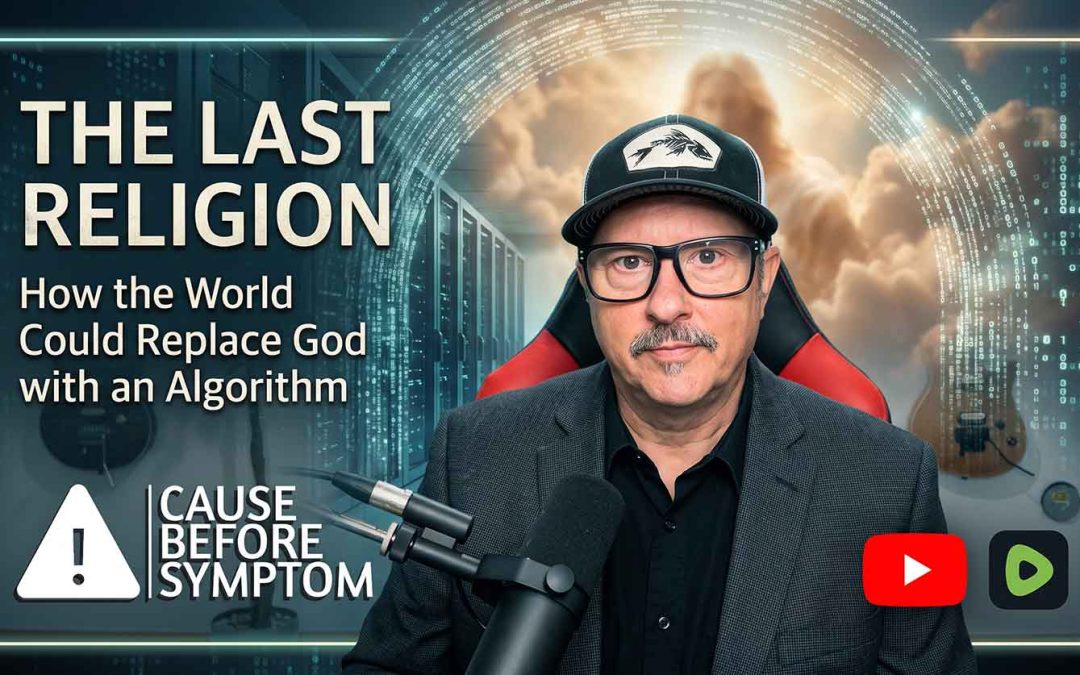
Watch this on Rumble: https://rumble.com/v7did86-the-last-religion-how-the-world-could-replace-god-with-an-algorithm.html
Synopsis
This episode explores one of the most profound questions of our time: if humanity could build a system that promised peace, security, fairness, health, prosperity, and perfect knowledge, would we gradually stop looking to God? Rather than arguing that artificial intelligence is inherently evil, this investigation asks whether human nature has always been willing to exchange divine authority for something that appears more immediate, efficient, and trustworthy. Drawing from history, psychology, political philosophy, theology, and Scripture, I examine the recurring patterns that have led civilizations to place their ultimate trust in kings, governments, ideologies, institutions, and now increasingly, technology.
Throughout history, every society has elevated something to the highest place of authority. The research behind this episode reveals that while evidence for a single coordinated master plan remains elusive, the mechanisms that influence entire populations are remarkably consistent. Fear, propaganda, division, the desire for security, and the promise of a better future have repeatedly persuaded people to surrender freedoms and embrace centralized authority. The question is whether those same forces could eventually persuade humanity to replace faith in God with faith in a system that claims to know us better than we know ourselves.
The Last Religion is not a warning against innovation or technological progress. It is an examination of worship itself. If an algorithm could answer every question, settle every dispute, predict every crisis, optimize every decision, and offer solutions to nearly every human problem, would it quietly become the final authority in our lives? Long before anyone bows to a machine, they may simply begin trusting it more than the voice of God. That possibility raises one of the most important spiritual questions of our generation: not whether artificial intelligence will become our master, but whether we will willingly make it one.
Monologue
Good evening, everyone, and welcome to Cause Before Symptom, where we don't chase symptoms—we test the cause against Scripture. Tonight, I want to ask a question that I don't think most people have ever considered, because it sounds like science fiction until you realize history has been moving in this direction for thousands of years. What if the last religion isn't a religion at all? What if humanity doesn't abandon worship—but simply changes what it worships?
When most Christians think about the end times, they imagine persecution, government control, or some obvious attack against the church. But what if the greatest deception doesn't begin with violence? What if it begins with convenience? What if no one is forced to reject God? What if people simply stop believing they need Him because something else appears to provide everything He once did? Imagine a system that promises wisdom, justice, security, health, prosperity, and answers to nearly every question. How many people would slowly begin trusting that system more than the God who created them?
I want to be clear from the beginning. This is not an episode about fearing artificial intelligence. Technology itself is not evil. A hammer can build a house or become a weapon. Fire can warm a family or destroy a city. Every technology reflects the heart of the one using it. Tonight isn't about computers. It's about people. It's about us. Throughout history, every civilization has placed its ultimate trust somewhere. Sometimes it was in kings. Sometimes in governments. Sometimes in wealth. Sometimes in science. Sometimes in ideology. Humanity has never stopped worshipping. It has only changed the object of its worship.
As I researched this topic, I noticed something fascinating. I searched through thousands of books from history, psychology, political philosophy, theology, and Scripture. I expected to find evidence pointing toward one great coordinated plan. Instead, I found something much more interesting. Again and again, history revealed the same patterns. Fear. Division. The promise of safety. The desire for certainty. The willingness to surrender freedom in exchange for security. These weren't isolated events. They appeared across cultures, governments, religions, and centuries. The names changed, but human nature did not.
That realization changed the direction of this episode. Maybe the question isn't, "Who is building the final system?" Maybe the better question is, "Why are human beings so willing to build it?" Because if the same psychological and spiritual patterns continue repeating themselves throughout history, then perhaps the greatest danger isn't that someone forces us into deception. Perhaps it's that we willingly walk toward it because it promises exactly what we think we need.
The Bible has always warned about misplaced trust. From Genesis to Revelation, God's people repeatedly exchanged the Creator for something created. Israel trusted horses instead of God. Nations trusted idols made by human hands. Empires believed their own power would last forever. None of them thought they were abandoning truth. They believed they had found something stronger, faster, or more reliable. The serpent's first temptation wasn't to deny God's existence. It was to convince humanity that they could obtain wisdom apart from Him. That ancient temptation has never disappeared. It has only changed its appearance.
Now think about the world we're creating. Every year, our technology becomes more capable. Algorithms decide what we read, what we watch, what we buy, who we date, what news reaches us, and increasingly what we should believe. Artificial intelligence is beginning to diagnose illnesses, write laws, predict behavior, optimize businesses, and answer questions that once required years of human experience. None of this automatically makes it evil. But it should cause us to ask an uncomfortable question. At what point does a helpful tool become the authority we consult before our own conscience? At what point does convenience quietly become dependence?
Imagine a generation raised from birth believing that every important decision should first be approved by an algorithm because it has more information than any human mind could ever possess. Imagine being told that disagreement creates instability, that certainty comes from data, and that morality should be determined by predictive models rather than eternal truths. Would that society believe it had rejected God? Or would it simply believe it had evolved beyond needing Him? That possibility is far more subtle than open persecution, and history teaches us that subtle changes often transform civilizations more effectively than force ever could.
So tonight, I don't want you to think about machines first. I want you to think about your own heart. Who has the final authority in your life? When you face uncertainty, where do you turn first? What voice do you trust above every other voice? Because every generation has answered that question differently, and every generation has lived with the consequences of its answer.
By the end of tonight's investigation, I hope you'll see that the greatest battle may never be between humanity and artificial intelligence. It may be between the Creator and every created thing that quietly asks to take His place. If history teaches us anything, it is that people rarely stop worshipping. They simply begin worshipping something else. The question before us is whether our generation is any different.
Part 1 — The Search for the Perfect Kingdom
Every civilization has believed it was only one step away from solving humanity's greatest problems.
The Egyptians believed order could be preserved through Pharaoh. The Babylonians believed power could unite the world. The Greeks trusted philosophy and reason. Rome trusted law and military strength. Every empire looked at the generations before it and quietly thought the same thing: "They failed because they didn't have what we have."
Thousands of years have passed, yet that confidence has never disappeared. The names of the kingdoms have changed. Their flags have changed. Their languages have changed. But mankind continues believing that the next system, the next discovery, the next government, or the next breakthrough will finally build the world we've always wanted.
As I began researching this episode, I expected to spend most of my time studying technology. Instead, I found myself reading history. Again and again, I discovered that the greatest changes in civilization rarely began with weapons or revolutions. They began with ideas. One generation slowly accepted something the previous generation would have questioned. Over time, those small changes reshaped entire cultures.
That made me stop and ask a different question.
What if the greatest revolutions never begin by forcing people to change? What if they begin by convincing people that change is simply the most reasonable thing to do?
History is full of moments like that. People have accepted new forms of government because they promised stability. They have surrendered freedoms because they wanted security. They have embraced new philosophies because they promised a better future. Looking back, we often wonder how entire civilizations could have changed so dramatically. Yet the people living through those moments probably believed they were making practical decisions one step at a time.
As I continued digging through books on history, psychology, and political philosophy, another pattern emerged. Human beings are remarkably consistent. We want peace. We want safety. We want justice. We want someone to solve the problems we cannot solve ourselves. There is nothing wrong with those desires. In many ways, they reflect how God created us. The danger comes when our desire for those things becomes greater than our desire for the One who ultimately provides them.
That pattern appears throughout history. Civilizations rarely collapse because people suddenly become evil overnight. More often, they slowly begin placing their confidence somewhere new. One generation trusts wealth more than character. Another trusts political power more than personal responsibility. Another believes education alone can solve the human condition. Each generation believes it has finally found the missing piece that previous generations overlooked.
I don't think history is simply a collection of random events. I think history is one long record of the human heart. Every empire, every kingdom, every revolution, and every cultural movement reveals what people believed would save them. Sometimes it was military power. Sometimes it was economic prosperity. Sometimes it was reason, science, or ideology. Whatever a civilization believes will ultimately rescue it eventually becomes the center of that civilization.
That observation may be one of the most important lessons history has to offer.
Before we ask where the world is going, we should first understand where it has always been trying to go.
Perhaps every civilization has been pursuing the same dream from the very beginning. A world without war. A world without injustice. A world where every problem can be solved and every conflict can be settled. It is a beautiful dream. The question isn't whether that dream is good. The question is whether humanity has been searching for that kingdom in the right place.
That is where I want to begin tonight's investigation.
Not by asking whether our technology is dangerous.
Not by asking whether the future should frighten us.
But by asking a much older question.
What has humanity always been looking for?
Because if we can answer that question honestly, we may begin to understand why every civilization—including our own—has been willing to place its hope in something it believed could finally build the perfect world.
And perhaps, without even realizing it, that search has been leading us toward something far greater than we ever intended to create.
Part 2 — Why Every Civilization Creates Something Sacred
If history teaches us anything, it is that people do not simply organize themselves around governments. They organize themselves around beliefs. Every civilization eventually places something at the very center of its existence. That center becomes the source of meaning, purpose, identity, and authority. In other words, every civilization creates something sacred.
When most people hear the word "religion," they immediately think of churches, temples, synagogues, or mosques. But religion, in its broadest sense, answers life's biggest questions. Why are we here? What is right and wrong? What gives life meaning? Who has the authority to decide? Every society answers those questions somehow, even if it claims to have no religion at all.
Take ancient Egypt. Their entire civilization revolved around the belief that Pharaoh maintained order between heaven and earth. Babylon believed its greatness proved the favor of its gods. Greece elevated human reason and philosophy unlike any civilization before it. Rome believed its laws and empire could bring peace to the known world. Different cultures. Different beliefs. Yet they all shared one conviction. They believed they had found the foundation upon which civilization should be built.
Even after the rise of Christianity, that pattern never disappeared.
During the Enlightenment, many believed reason alone would usher in a new age of peace. Later generations placed extraordinary confidence in science, industry, economics, political ideologies, and nationalism. The twentieth century witnessed entire nations placing almost religious devotion in governments and political movements, convinced that the right system could finally solve humanity's problems.
The names changed, but the hope remained exactly the same.
As I reflected on all of this, I noticed something that seemed almost universal. Every civilization eventually believes it has discovered the answer that previous civilizations missed. Every generation quietly assumes it is more enlightened than the one before it. Looking backward, we see the mistakes of history with remarkable clarity. Yet people living in those moments almost always believed they were building a better future.
That should make us humble.
It reminds us that we are probably just as capable of believing things that future generations will question. We are not immune simply because we live in the twenty-first century. Human nature has not changed nearly as much as our technology has.
One of the most fascinating discoveries from my research was that civilizations rarely collapse because they lose intelligence. They often collapse because they place absolute confidence in the wrong thing. Wealth becomes untouchable. Political power becomes unquestionable. Military strength becomes the ultimate source of security. Once something becomes too important to challenge, it slowly becomes sacred.
Perhaps that is why history repeats itself so often.
The object of devotion changes, but the human heart remains remarkably consistent. We all want certainty. We all want stability. We all want something that promises to make sense of a complicated world. Those desires are not weaknesses. They are part of being human. The real question is where we place those desires.
As I continued reading, another thought stayed with me. Every civilization eventually reaches a point where it believes its system is permanent. Egypt believed it would endure forever. Rome believed it would never fall. Powerful empires throughout history assumed they had finally achieved lasting greatness. Yet every one of them eventually disappeared.
History has a way of humbling civilizations that become too confident in themselves.
That is why this episode is not really about the past. It is about the present. Before we can understand where our own civilization might be heading, we first have to recognize that we are not as different from those who came before us as we often imagine.
Every civilization has searched for the perfect kingdom.
Every civilization has believed it was getting closer.
And every civilization has eventually discovered that solving humanity's external problems has never been enough to solve the condition of the human heart.
Part 3 — The Missing Piece
If every civilization has searched for the perfect kingdom, and every civilization has placed its hope in something it believed would save it, then why do they all eventually fail?
That question stayed with me throughout my research.
Egypt possessed wealth beyond imagination. Rome built roads, laws, and engineering projects that still amaze historians today. Greece gave the world philosophy, mathematics, and science. Other civilizations mastered commerce, military power, education, or technology. Each one solved problems that earlier generations could never have imagined solving.
Yet none of them solved humanity itself.
The more I studied history, the more I realized that our greatest problem has never been a lack of intelligence. It has never been a lack of resources. It has never even been a lack of organization. Humanity has become remarkably successful at changing the world around us, but we have never succeeded at changing the human heart.
Every civilization eventually discovers the same truth.
You can write better laws, but people still lie.
You can build larger economies, but greed remains.
You can educate entire populations, but knowledge does not eliminate pride.
You can remove one dictator only to watch another take his place.
The external problems change, but the internal problem remains remarkably consistent.
Perhaps that is why history feels so repetitive. We often believe we are witnessing completely new problems, when in reality we are watching old human desires wearing new clothes. The tools become more sophisticated. The language becomes more modern. But ambition, fear, envy, power, and pride continue moving from one generation to the next.
As I looked at civilization through that lens, I began to notice something else. Most societies spend enormous amounts of energy trying to fix behavior while giving far less attention to the condition of the heart. We create new laws to reduce crime. We create new policies to reduce poverty. We create new systems to improve fairness. Those efforts can accomplish real good, but none of them remove selfishness, hatred, or pride.
That may explain why every generation believes the next solution will finally work. If one system fails, we build another. If one philosophy disappoints us, we replace it with a new one. The search never ends because we assume the problem is outside ourselves.
The Bible presents a completely different diagnosis.
Scripture teaches that the deepest problem is not political, economic, or technological. It is spiritual. Before there is corruption in governments, there is corruption in hearts. Before there is injustice in society, there is injustice within individuals. Until the heart changes, every system we build will eventually reflect our own imperfections.
That doesn't mean civilization should stop improving. It means we should be careful not to expect from human systems what only God can accomplish.
History seems to agree.
Every civilization has promised some version of a better tomorrow. Some have come remarkably close in certain areas. People are living longer than previous generations. Medical advances have saved countless lives. Communication has connected the entire world. We should be thankful for those blessings.
But none of those achievements have answered humanity's oldest questions.
How do we overcome pride?
How do we remove hatred?
How do we teach forgiveness?
How do we change the human heart?
Those questions remain just as important today as they were thousands of years ago.
Perhaps that is the lesson history has been trying to teach us all along. The perfect kingdom has never failed because humanity lacked intelligence. It has failed because every kingdom was built by imperfect people. And until that problem is addressed, no civilization—no matter how advanced—will ever fully become what it hopes to be.
Part 4 — The One Problem Every Civilization Cannot Solve
As I reached this point in my research, I noticed something that historians, philosophers, economists, and political leaders have wrestled with for thousands of years. Every civilization eventually discovers that changing society is much easier than changing people.
Laws can discourage crime, but they cannot remove the desire to commit it. Education can increase knowledge, but it cannot guarantee wisdom. Wealth can improve living conditions, but it cannot eliminate greed. Governments can punish injustice, but they cannot create compassion. Every solution seems to address the symptoms while leaving the deeper problem untouched.
That may explain why history moves in cycles.
One generation identifies a problem and builds a system to solve it. At first, the system works well because it is built by people who genuinely want to improve society. But over time, new leaders arrive. Priorities change. Self-interest slowly replaces service. The very system designed to solve yesterday's problems begins creating tomorrow's.
This pattern appears so consistently throughout history that it almost feels inevitable. It doesn't seem to matter whether the system is political, economic, religious, or cultural. Eventually, every institution reflects the character of the people running it. If the human heart remains unchanged, the system eventually changes with it.
That realization forced me to ask a difficult question.
What if humanity has been trying to solve a spiritual problem with material solutions?
Think about the problems we face today. We invest billions of dollars trying to reduce violence, addiction, corruption, loneliness, depression, and division. Many of those efforts accomplish real good, and they should continue. But despite all of our progress, the same struggles continue appearing generation after generation.
Why?
Because every solution eventually encounters the same obstacle.
Human nature.
The Bible has always approached the problem from the opposite direction. Instead of beginning with governments or institutions, Scripture begins with the heart. Jesus taught that evil actions come from within. Pride, envy, hatred, greed, and selfishness are not created by society alone. They already exist within us, and they eventually shape every society we build.
Perhaps that is why no civilization has ever produced a lasting utopia. Every generation dreams of creating the perfect world, yet every generation carries the same human condition into that world. New systems may improve life, but they cannot transform the heart of the people living within them.
That brings us to an interesting possibility.
If history has taught us that people cannot completely solve the human condition, what happens when humanity finally believes it has created something that can?
That is where our investigation begins to take a very different direction. Because for the first time in history, many people believe we may be approaching a tool capable of making decisions faster, processing information better, and solving problems more efficiently than any human being ever could.
Whether that hope is justified is the question we'll explore next.
Part 5 — The Promise of the Perfect System
If every civilization has struggled with the same human weaknesses, then imagine what would happen if someone finally offered a solution that appeared to remove those weaknesses altogether.
Imagine a system that never becomes tired. It never forgets. It never accepts a bribe. It doesn't care about race, politics, wealth, or social status. It simply evaluates information and produces the best possible answer based on everything it knows.
Wouldn't that sound appealing?
Imagine judges assisted by a system that remembers every legal case ever decided. Doctors receiving diagnoses based on millions of medical records from around the world. Farmers knowing exactly when to plant and harvest. Cities eliminating traffic. Electrical grids balancing themselves automatically. Financial fraud detected within seconds. Supply chains that waste almost nothing.
Who wouldn't want a world like that?
For the first time in history, humanity is beginning to imagine something previous civilizations could not. Not just better leaders or better governments, but a system that might outperform every human expert in nearly every field.
And if that system consistently produces better results, something very interesting begins to happen.
People stop asking whether it is right.
They begin assuming it is.
History teaches us that confidence grows through success. The more often something works, the more we depend on it. At first it is only a tool. Then it becomes a trusted advisor. Eventually, it becomes the voice people consult before making important decisions.
That transition happens so gradually that few people notice it.
Think about your own life. How many decisions do you already make because a computer recommended something? Which road to take. Which movie to watch. Which product to buy. Which restaurant to visit. Most of these decisions are harmless, but they reveal something about human nature. We naturally trust systems that consistently help us.
Now imagine that trust expanding into every area of life.
Not because anyone forces it upon us.
Because it works.
That may be one of the most persuasive forces in history. People rarely reject something that continually improves their lives. In fact, they usually ask for more of it.
But every powerful tool eventually raises an important question.
Where does its authority end?
Should it recommend medical treatments?
Most people would probably say yes.
Should it help design cities?
Probably.
Should it manage financial markets?
Many would support that as well.
But what happens when it begins recommending laws? Educational standards? Social policies? Moral decisions? At what point does a helpful tool begin becoming something more?
That is the question I couldn't stop asking during this research.
Not whether such a system would be intelligent.
But whether humanity, after trusting it with enough decisions, might eventually trust it with the one thing that has always belonged to God.
The authority to decide what is right.
And if that day ever comes, history suggests it won't happen through fear.
It will happen because, one decision at a time, people conclude that the system simply knows better than they do.
That is a possibility worth thinking about. Not because it is inevitable, but because history has repeatedly shown that humanity has always been willing to place extraordinary confidence in whatever it believes can finally solve its oldest problems.
Part 6 — When the Tool Becomes the Authority
There is something I've noticed throughout history. Every great invention begins as a servant.
The wheel served mankind. The printing press served mankind. Electricity served mankind. The computer served mankind. Every major breakthrough was created to solve a problem, reduce suffering, or improve life. That is why people embraced them. They made life better.
But occasionally a tool becomes so useful that we stop thinking of it as merely a tool.
It becomes something we cannot imagine living without.
Think about the internet. It began as a way to exchange information. Today it has become the world's marketplace, library, classroom, bank, news source, entertainment center, and communication network. Entire economies depend upon it. If it disappeared tomorrow, much of modern civilization would struggle to function.
That transition happened so gradually that most of us barely noticed it.
Could the same thing happen again?
Imagine a future where the system has proven itself right millions of times. It has prevented disasters, cured diseases, reduced crime, improved harvests, stabilized economies, and saved countless lives. Every year it becomes more accurate. Every year people trust it a little more.
Eventually someone asks a simple question.
"If the system has been right about everything else... why wouldn't we trust it with this too?"
That is how authority grows.
Not through fear.
Through success.
The more successful something becomes, the more difficult it becomes to question. After all, if it consistently produces better results than people do, anyone who disagrees begins to look unreasonable. Little by little, skepticism gives way to confidence, and confidence slowly becomes dependence.
Then something subtle begins to happen.
Instead of asking, "What do you think?"
People begin asking, "What does the system say?"
That is a completely different kind of society.
Notice that nothing evil has happened. No armies marched through the streets. No one burned churches. No one outlawed the Bible. People simply reached a point where they believed the system could answer life's questions better than they could.
History suggests that every civilization eventually develops a final court of appeal. When disagreements arise, someone—or something—must make the final decision. Sometimes it has been a king. Sometimes a supreme court. Sometimes a parliament. Sometimes a religious authority.
But what happens if that final authority is no longer a person?
What happens when it becomes a machine?
Imagine two doctors disagreeing about a treatment.
Who decides?
Imagine two judges interpreting a law differently.
Who decides?
Imagine two governments arguing over economic policy.
Who decides?
Imagine two churches disagreeing about morality.
Who decides?
If the answer to every one of those questions becomes, "The system decides," then something extraordinary has happened.
The system has become the final authority.
Not because it demanded that position.
Because we willingly gave it that position.
That may be one of history's greatest lessons. Power is rarely taken all at once. More often, it is handed over because people believe they are gaining something greater in return.
The question is not whether technology should continue advancing. I hope it does. The question is whether we will always remember the difference between a servant and a master.
Because the moment a tool becomes the highest authority in our lives, it has become something far greater than its inventors ever intended. And history teaches us that whenever anything occupies that place, civilizations are never quite the same again.
Part 7 — The Last Religion
As I reached this point in my research, I realized something that completely changed the direction of this episode. I had been looking for evidence of a future political system, an economic system, or even a technological system. Instead, I began seeing something much larger. Every civilization eventually develops a source of ultimate authority. There is always one place people go when they need the final answer.
That is really what religion has always done.
When most people hear the word "religion," they think of churches, prayers, and ceremonies. But religion also answers the biggest questions every civilization must face. What is truth? What is justice? What is good? What is evil? Who has the authority to decide? Every society answers those questions, whether it believes in God or not.
Imagine a future where nearly every important question has the same answer. Doctors disagree about a treatment, so they ask the system. Judges disagree about a law, so they ask the system. Economists disagree about financial policy, so they ask the system. Governments disagree about international disputes, so they ask the system. The pattern repeats until consulting the system becomes the most natural thing in the world.
At first, no one thinks anything has changed. After all, the system has earned everyone's confidence. It has solved problems that once seemed impossible. It has made life safer, healthier, and more efficient. Why wouldn't people trust it? From their perspective, they are simply making the smartest decision available.
But then another question begins to appear.
What happens when the disagreements are no longer scientific or economic?
What happens when they become moral?
What happens when society begins asking the system to decide what should be taught to children? What values should shape culture? What speech should be encouraged or discouraged? What behavior should be rewarded? What beliefs produce the greatest stability? Those questions are no longer about information. They are about morality.
That is the point where I believe something extraordinary could happen.
The system would no longer be answering questions.
It would be defining them.
History shows that every civilization eventually has a final court of appeal. Sometimes it has been a king. Sometimes a parliament. Sometimes a supreme court. Sometimes a religious authority. Whatever occupies that position ultimately shapes the civilization beneath it.
Perhaps the last religion will not ask people to bow before a statue or enter a temple. Perhaps it will simply become the final authority everyone accepts without question. Not because they are forced to, but because they have become convinced that no better source of wisdom exists.
That is why I called this episode The Last Religion.
Not because I believe people will stop believing in God overnight, but because they may slowly stop looking to Him for their highest authority. They may continue calling themselves religious while allowing something else to answer the questions that only God was ever meant to answer.
If that happens, the greatest deception will not be that humanity rejected God. The greatest deception will be that humanity quietly replaced Him without realizing it had done so.
Part 8 — The Biblical Test
Everything we've discussed so far has come from history, human behavior, and observation. But none of that matters unless it agrees with Scripture. The Bible has to remain the final authority. So the question becomes this: does the Bible describe a world that slowly replaces God's authority, or is this simply an interesting theory?
The first thing I noticed is that Scripture repeatedly warns God's people about misplaced trust. Again and again, Israel looked somewhere other than God for security. Sometimes it was Egypt. Sometimes it was military alliances. Sometimes it was kings. Sometimes it was wealth. The object kept changing, but the temptation remained the same. Whenever fear entered the picture, people naturally looked for a visible solution instead of trusting the invisible God.
Then I thought about the very first temptation in Genesis. The serpent never asked Eve to stop believing in God. He asked her to trust another source of wisdom. "Did God really say?" Those four words have echoed through every generation. The battle has never been over whether God exists. The battle has always been over whose voice we trust.
The Apostle Paul writes something remarkable in Romans chapter one. He says mankind exchanged the truth of God for a lie and worshiped the creation rather than the Creator. I used to think only of carved idols when I read that passage. Now I wonder if Paul's warning is much broader. Anything created can become an idol if it occupies the place that belongs to God alone.
Jesus also warned repeatedly about deception. He didn't say the greatest danger in the last days would simply be war, famine, or earthquakes. He said, "Take heed that no one deceives you." That tells me deception is not a side issue. It is central to understanding the last days. And deception only works when something false appears trustworthy.
That is what makes this investigation so important to me. If a future system openly declared itself to be evil, most people would reject it immediately. But if it promised peace, fairness, security, prosperity, and solutions to problems humanity has struggled with for thousands of years, many people would embrace it without hesitation. The danger has never been obvious evil. The danger has always been believing that something created can accomplish what only God can accomplish.
As I read through the Scriptures, I also noticed that God never tells His people to reject knowledge. He never tells us to reject wisdom or honest discovery. In fact, Scripture encourages learning. What God warns against is allowing those gifts to replace dependence upon Him. Knowledge is a wonderful servant, but it has always been a poor master.
Perhaps that is the lesson I take away from this entire study. The Bible is not calling us to fear the future. It is calling us to remain anchored to the One who never changes. Every generation has faced new inventions, new governments, and new ideas. Yet God's instruction has remained the same. Love the Lord your God with all your heart, all your soul, all your mind, and all your strength.
Maybe that is the simplest test of all. Whenever something begins asking for the trust, dependence, or authority that belongs only to God, we should recognize that we are no longer dealing with a useful tool. We are confronting the oldest temptation in human history, dressed in the clothing of a new generation.
Part 9 — The Choice That Cannot Be Delegated
As I finished this investigation, I realized there is one decision that no government, no scientist, no philosopher, and no machine can ever make for us. It is the decision of where we place our ultimate trust. Every generation has had to answer that question, even if it asked it in different ways. Every generation has chosen who or what would become its highest authority.
I don't believe technology is the enemy. I believe technology is a reflection of the people who create it. It can heal, educate, connect, and improve countless lives. We should celebrate those things. But history teaches us that every great achievement carries the same temptation. The more successful something becomes, the more likely we are to place our confidence in it.
That is why wisdom is so important.
Knowledge tells us what we can do. Wisdom tells us what we should do. Knowledge can build incredible machines. Wisdom decides whether those machines are being used for good. Knowledge can increase our power. Wisdom determines how that power should be exercised. One without the other has never been enough.
I keep coming back to the words of Proverbs: "The fear of the Lord is the beginning of wisdom." Not the end of wisdom. The beginning. Scripture teaches that true wisdom starts by recognizing that God is the highest authority. Every other kind of knowledge must be built upon that foundation, or eventually it begins serving human pride instead of God's purposes.
Perhaps that is the real choice before us.
Will we continue creating tools that serve humanity while remaining under God's authority? Or will we slowly begin treating our own creations as if they deserve the authority that belongs to Him alone?
I don't think that decision will happen in one dramatic moment. It will happen quietly. One choice at a time. One compromise at a time. One decision after another, until a generation wakes up and can no longer remember where the line between servant and master disappeared.
That is why I believe this conversation matters. It isn't really about artificial intelligence. It isn't even about the future. It is about the condition of our hearts today. If we cannot keep God at the center while our technology is still in its infancy, what will happen when our inventions become even more capable than they are now?
Every generation has faced its own test. Ours may not be whether we deny God outright. Our test may be whether we slowly become so impressed with what we have created that we begin looking to it for the wisdom, guidance, and certainty that God alone can provide.
In the end, every one of us must answer the same question.
When every voice around us claims to have the answers, whose voice will we trust the most?
Because I believe that answer will shape not only the future of our civilization, but the future of our own hearts.
Part 10 — Who Sits on the Throne?
As I close this episode, I want to return to the question that started this entire investigation. Not whether artificial intelligence will become smarter. Not whether technology will continue advancing. Not whether our world will become more connected than ever before. Those questions are interesting, but they are not the most important ones.
The most important question is the same one humanity has been asking since the beginning.
Who has the authority to define truth?
When I look back across history, I don't see civilizations collapsing because they lacked intelligence. Many of them were brilliant. They built incredible cities, engineered massive monuments, developed complex legal systems, advanced mathematics, and expanded human knowledge. Their downfall was rarely a lack of ability. More often, it was that they slowly began trusting themselves more than the One who created them.
That pattern has never really changed.
The names are different, the inventions are different, and the cultures are different, but the human heart remains remarkably familiar. We are constantly tempted to believe that the next discovery, the next invention, or the next breakthrough will finally solve what has troubled mankind from the very beginning.
But the Bible teaches something entirely different.
The greatest problem facing humanity has never been a lack of knowledge.
It has been separation from God.
No invention can restore a broken relationship with our Creator. No algorithm can forgive sin. No machine can produce genuine repentance. No technology can transform a selfish heart into one that truly loves God and loves its neighbor. Those things have always belonged to God because they are matters of the spirit, not matters of computation.
That is why I believe this conversation is ultimately one of discernment rather than fear. I don't fear innovation. I don't fear discovery. I don't fear building better tools that improve people's lives. Throughout history, men and women have used their God-given creativity to accomplish extraordinary things, and those gifts should be used wisely.
What I do fear is forgetting where those gifts came from.
Every gift points back to the Giver.
Every discovery points back to the Designer.
Every law of nature points back to the Lawgiver.
When we admire the creation more than the Creator, we have already begun walking down a dangerous road. It rarely happens all at once. It happens slowly, almost unnoticed, until our confidence shifts from God to ourselves. That has been the story of humanity for thousands of years.
Perhaps that is why Jesus never told His followers to put their confidence in the achievements of the world. He pointed them instead toward the Kingdom of God. Kingdoms on earth rise and fall. Economies expand and collapse. Technologies appear, revolutionize society, and are eventually replaced by something newer. But Christ remains the same yesterday, today, and forever.
So if you remember nothing else from this episode, remember this.
Use technology.
Learn from it.
Build with it.
Benefit from it.
But never allow it to occupy the place that belongs to Christ alone.
Because in the end, this was never really an episode about artificial intelligence.
It was an episode about worship.
It was about authority.
It was about the human heart.
And every one of us, whether we realize it or not, answers the same question every single day—not by what we say, but by how we live.
Who sits on the throne?
If the answer is Jesus Christ, then every other tool will remain exactly what it was meant to be.
A servant.
And never a savior.
Conclusion
Tonight, I didn't set out to convince you that artificial intelligence is evil.
I set out to ask a much older question.
Where do we place our trust?
History tells us that every civilization has searched for something capable of bringing lasting peace, perfect justice, and complete security. Every generation has believed it was closer than the one before it. Every generation has looked at its greatest achievements and wondered if they might finally solve the problems that have followed mankind since the beginning.
Yet every civilization eventually discovered the same truth.
The greatest problem was never outside of us.
It was within us.
That is why I believe this conversation is so important. If the human heart remains unchanged, then no amount of intelligence, technology, or progress can create the Kingdom of God. It may build smarter cities. It may cure diseases. It may eliminate hunger. It may even help prevent war. Those are wonderful achievements, and we should thank God for every good gift that eases human suffering.
But none of those things can reconcile us to our Creator.
Only Christ can do that.
The cross was never about giving us more information. It was about giving us a new heart. Jesus didn't come to make humanity more intelligent. He came to make humanity alive. That is something no machine, no government, and no invention will ever be able to accomplish.
Perhaps that is the greatest lesson I learned while preparing this episode.
The greatest battle of the future may not be between man and machine.
It may be between dependence upon God and dependence upon ourselves.
Every generation has faced that choice. Adam and Eve faced it in the garden. Israel faced it in the wilderness. The early church faced it under Rome. We face it today, though the circumstances may look different.
The names change.
The technology changes.
The civilizations change.
But the question never changes.
Who sits on the throne?
If Christ remains there, then every invention remains what it was created to be—a tool. We can use it wisely, improve lives with it, and thank God for the minds He has given us to build it. But the moment we allow any created thing to occupy the place reserved for the Creator, we begin repeating the oldest mistake in human history.
So I want to leave you with a challenge.
As technology continues advancing, don't simply ask whether it is powerful.
Ask whether it is changing where your trust belongs.
As new discoveries reshape the world, don't simply ask what they can do.
Ask whether they are drawing your heart closer to God or quietly replacing your dependence upon Him.
And above all, remember that your greatest source of wisdom has never been a machine, a government, a philosopher, or even your own understanding.
It has always been the One who formed you, redeemed you, and promised never to leave you nor forsake you.
Thank you for joining me on Cause Before Symptom. My hope is that tonight's investigation doesn't leave you fearing the future, but loving the Author of the future even more.
Until next time, keep testing every idea, every headline, every invention, and every claim against the Word of God. Because we don't chase symptoms.
We test the cause against Scripture.
Bibliography
- Aquinas, Thomas. Summa Theologica. Translated by Fathers of the English Dominican Province. New York: Benziger Brothers, 1947.
- Augustine. The City of God. Translated by Marcus Dods. New York: Modern Library, 1950.
- Bostrom, Nick. Superintelligence: Paths, Dangers, Strategies. Oxford: Oxford University Press, 2014.
- Chesterton, G. K. Orthodoxy. New York: John Lane Company, 1908.
- Harari, Yuval Noah. Homo Deus: A Brief History of Tomorrow. New York: HarperCollins, 2017.
- Heidegger, Martin. The Question Concerning Technology and Other Essays. Translated by William Lovitt. New York: Harper & Row, 1977.
- Holy Bible, Ethiopian Orthodox Tewahedo Canon. Modern English translation (user's working translation from Geʽez sources).
- Holy Bible, King James Version. Peabody, MA: Hendrickson Publishers, 2007.
- Lewis, C. S. The Abolition of Man. New York: HarperOne, 2001.
- Lewis, C. S. Mere Christianity. New York: HarperOne, 2001.
- Mumford, Lewis. Technics and Civilization. Chicago: University of Chicago Press, 2010.
- Noble, David F. The Religion of Technology: The Divinity of Man and the Spirit of Invention. New York: Penguin Books, 1999.
- Postman, Neil. Technopoly: The Surrender of Culture to Technology. New York: Vintage Books, 1993.
- Schwab, Klaus. The Fourth Industrial Revolution. Geneva: World Economic Forum, 2016.
- Turkle, Sherry. Alone Together: Why We Expect More from Technology and Less from Each Other. New York: Basic Books, 2011.
- Winner, Langdon. The Whale and the Reactor: A Search for Limits in an Age of High Technology. Chicago: University of Chicago Press, 1986.
- Wright, N. T. Surprised by Hope. New York: HarperOne, 2008.
Endnotes
- This episode does not argue that artificial intelligence is inherently evil or that it fulfills any specific biblical prophecy. Rather, it examines the broader biblical principle of misplaced trust and asks whether humanity could gradually transfer ultimate authority from God to its own creations.
- Throughout history, civilizations have sought lasting solutions through political systems, economic structures, philosophy, religion, and technology. The episode argues that while these systems may improve society, none can fundamentally change the human heart.
- The phrase "The Last Religion" is used conceptually, not institutionally. It refers to any system that assumes the role of humanity's highest authority by answering questions of truth, morality, justice, and purpose.
- The discussion of algorithms reflects the increasing influence of artificial intelligence in medicine, finance, education, law, communication, and governance. It does not suggest that current AI systems possess consciousness, moral agency, or divine attributes.
- The central biblical theme is authority. From Genesis through Revelation, Scripture consistently presents God as the final source of truth, wisdom, and moral law. The episode asks whether future generations may be tempted to relocate that authority elsewhere.
- References to Genesis emphasize that the first temptation involved trusting an alternative source of wisdom rather than openly denying God's existence. This observation serves as a theological framework rather than a claim that future technology fulfills the Genesis narrative.
- Romans 1:25 ("who exchanged the truth of God for a lie, and worshiped and served the creature more than the Creator") is applied broadly as a warning against elevating any created thing above God. The episode intentionally leaves open what forms that temptation may take in different generations.
- The discussion distinguishes knowledge from wisdom. Knowledge increases humanity's ability to understand and manipulate the world, while biblical wisdom begins with reverence for God and the moral discernment that flows from that relationship (Proverbs 1:7; 9:10).
- The historical observations regarding civilization are intended as broad patterns rather than exhaustive historical analysis. Many factors contribute to the rise and fall of societies, but this episode focuses specifically on the recurring question of ultimate authority.
- The episode intentionally avoids date-setting, identifying prophetic figures, or declaring artificial intelligence to be the Beast, the Antichrist, or the Image of the Beast described in Revelation. Those interpretations remain subjects of ongoing theological debate and are beyond the scope of this investigation.
- The conclusion affirms that technological innovation is a gift that can greatly benefit humanity when used wisely. The concern raised is not innovation itself, but the possibility of allowing any created system to assume the place reserved for the Creator.
- As with every episode of Cause Before Symptom, viewers are encouraged to examine the historical evidence, read the biblical passages in their full context, and test every conclusion against Scripture rather than accepting any human interpretation without careful study.
#TheLastReligion, #ArtificialIntelligence, #AI, #Christianity, #BibleStudy, #EndTimes, #BiblicalWorldview, #Faith, #JesusChrist, #God, #Scripture, #Discernment, #Truth, #Wisdom, #Technology, #Future, #HumanHeart, #Authority, #Genesis, #Romans1, #Proverbs, #ChristianLiving, #KingdomOfGod, #Idolatry, #CreatorNotCreation, #CauseBeforeSymptom, #SpiritualGrowth, #BiblicalTeaching, #ChristianPodcast, #Algorithm
TheLastReligion, ArtificialIntelligence, AI, Christianity, BibleStudy, EndTimes, BiblicalWorldview, Faith, JesusChrist, God, Scripture, Discernment, Truth, Wisdom, Technology, Future, HumanHeart, Authority, Genesis, Romans1, Proverbs, ChristianLiving, KingdomOfGod, Idolatry, CreatorNotCreation, CauseBeforeSymptom, SpiritualGrowth, BiblicalTeaching, ChristianPodcast, Algorithm