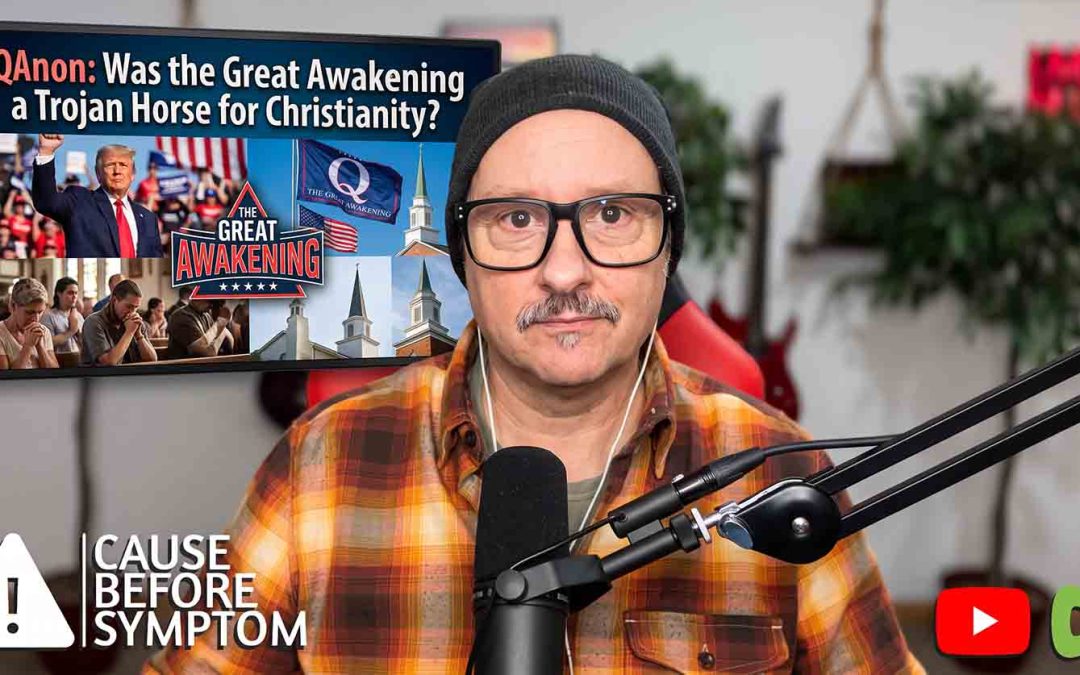
Watch this on Rumble: https://rumble.com/v7i2nj4-qanon-was-the-great-awakening-a-trojan-horse-for-christianity.html
Opening — The Promise That Never Came
For years, Americans were told that something extraordinary was happening behind the scenes. An anonymous figure known only as Q claimed to possess information about a secret struggle taking place inside the United States government. Corruption would be exposed. Powerful criminals would be arrested. The American people would witness a Great Awakening. And Donald Trump was supposedly at the center of a plan to restore the nation.
Millions of Americans encountered these claims, and some Christians embraced them as something more than politics. They saw the possibility of divine intervention. They believed their country might finally return to the principles they had spent their lives defending. And when events failed to unfold as expected, they were reminded of three simple ideas: trust the plan, disinformation is necessary, and future proves past.
But what if those very ideas were the mechanism of deception?
Tonight, we're going to examine the original Q drops, not merely what people said about them. We have an archive containing thousands of messages, and within those messages we find recurring patterns involving secrecy, military intelligence, religious language, political promises, and explanations for events that never materialized.
We are going to ask whether QAnon functioned like a psychological operation. Not because we have already established who created it, but because the methods themselves deserve investigation. What happens when people are taught that the absence of evidence might actually be evidence of a secret plan? What happens when every failure can be explained away as intentional disinformation? And what happens when Christians begin trusting an anonymous political authority more readily than they question its claims?
But our investigation cannot stop with QAnon.
While Americans were waiting for political restoration, the world continued changing. Christianity's political influence faced new challenges. The relationship between the United States and Israel became increasingly controversial. Gaza brought extraordinary suffering and international condemnation. Russia's war in Ukraine continued. Iran, China, Europe, and the Middle East pursued competing interests that could reshape the balance of world power.
Were these simply separate historical developments, or could some of them be connected through political decisions and strategic interests that deserve closer examination?
And here is where our investigation becomes particularly important.
In Revelation chapter 20, Scripture describes Satan being released for a little season and going out to deceive the nations, gathering Gog and Magog for battle. I have long considered the possibility that we are living in that period. But believing something may be happening does not relieve us of the responsibility to test it. Scripture does not give us permission to turn suspicion into proof.
So tonight, we will investigate whether the promise of American restoration became a political Trojan horse. Did Christians place their confidence in a movement that offered secret knowledge instead of verifiable results? Who benefited from that confidence? Did political leaders knowingly exploit it? And is there documented evidence connecting this movement to the changing international relationships surrounding Israel?
We will not assume that Muslims, Christians, Jews, or entire nations share one hidden agenda. We will examine organizations, leaders, decisions, and evidence.
Because the question is not simply whether Q was telling the truth.
The deeper question is whether Christians were so busy waiting for someone to save their country that they stopped examining what was happening to it.
And if deception is central to Satan's Little Season, perhaps the first thing we should investigate is not the enemy we have been told to fear, but the promises we have been taught to trust.
Investigation 1 — Who Was Q, and Why Did People Believe?
Play Video
On October 28, 2017, an anonymous individual began posting messages on an internet discussion board called 4chan. The author claimed to possess information about secret government operations and suggested that powerful political figures were about to be exposed. Eventually, this anonymous figure became known as Q, a reference to Q-level security clearance within the Department of Energy. But possessing a letter associated with classified information is not evidence that the person using it actually holds that clearance.
That distinction is important because Q never publicly established a verifiable identity. Nevertheless, thousands of messages followed, eventually moving from 4chan to 8chan and later 8kun. The posts became known as Q drops, and an expanding community began examining them for clues about what was supposedly happening behind the scenes.
Our archive contains numbered messages extending through December 2020. Some are lengthy explanations. Others contain photographs, links, questions, military terminology, or cryptic statements. Many suggest that readers possess access to information deliberately concealed from the public.
But why would people believe an anonymous stranger?
Consider the political environment of 2017. Americans had witnessed years of controversy involving intelligence agencies, Hillary Clinton's emails, Russian election interference, and investigations surrounding Donald Trump. Trust in government and journalism was already deeply divided. Q entered that environment offering something many people desperately wanted: an explanation that made the confusion appear purposeful.
Instead of presenting political conflict as disorder, Q presented it as a secret operation. Instead of accepting that powerful institutions might escape accountability, followers were promised that justice was approaching. Instead of acknowledging uncertainty, the messages suggested that someone already knew how everything would end.
And there was another important feature. Q rarely required readers to accept a complete explanation immediately. Many posts asked questions. Who controlled an institution? Why had someone resigned? What did a particular photograph mean? Readers were encouraged to investigate and connect the pieces themselves.
This created a powerful psychological effect. When people discover what appears to be a hidden connection through their own efforts, they may become more confident in that conclusion than if someone simply tells them what to believe.
But discovering a connection does not necessarily establish its meaning.
The Q community also developed its own language. Followers called themselves Anons. Research discussions became known as bread. Repeated phrases created a sense of belonging, while the Great Awakening promised that participants were helping reveal truths the wider population could not yet understand.
For Christians, religious language added another dimension. References to God, prayer, good overcoming evil, and national restoration could make the movement feel compatible with their faith. Yet Q's claimed authority came from supposed intelligence access, not demonstrated biblical understanding.
Here we encounter the first possible Trojan horse mechanism.
An anonymous source entered a divided political environment, claimed privileged knowledge, encouraged people to investigate, and gradually became an authority whose own claims were difficult to verify.
Was that deliberately engineered psychological manipulation? The messages alone cannot establish the operator's identity or intentions. But they demonstrate how anonymous political messaging could acquire extraordinary influence.
And that leaves us with a question Christians should recognize immediately.
If Scripture tells us to test every claim, why would we grant an unidentified political messenger an exemption simply because the promised outcome was something we wanted to believe?
Investigation 2 — The Anatomy of a Psychological Operation
Before we can determine whether QAnon was a psychological operation, we must understand what that term actually means. Psychological operations, commonly called PSYOP, involve the deliberate use of information to influence how people think, feel, and behave. Military organizations have employed these methods for decades, particularly during conflicts where controlling perceptions can be as important as controlling territory.
But psychological influence is not limited to governments or military intelligence. Political campaigns, advertising companies, religious movements, and online communities can employ similar techniques. Finding those techniques in Q's messages would not automatically prove government involvement. It would, however, give us a reason to examine how the messages influenced their audience.
One of the first techniques involves creating an information advantage. Q repeatedly suggested that ordinary Americans were witnessing only the surface of events while hidden operators understood the entire situation. Military terminology, references to classified information, and cryptic instructions reinforced the impression that readers were receiving privileged intelligence.
The second technique involves emotional reinforcement. Q's messages frequently promised that justice was approaching, corruption would be exposed, and patriots would prevail. These assurances offered hope to people frustrated with political institutions. Hope itself is not manipulation. But when hope becomes dependent upon promises that cannot be independently verified, it can create vulnerability.
The third technique involves uncertainty. Q often presented questions rather than complete explanations. Followers were encouraged to research photographs, names, dates, and relationships. This made participation feel like an investigation. Yet the person asking the questions could influence which evidence received attention without accepting responsibility for the conclusions followers reached.
The fourth technique involves repetition. Expressions such as "Trust the plan," "Future proves past," and "Nothing can stop what is coming" appeared throughout the movement's messaging. Repetition makes ideas familiar, and familiarity can gradually be mistaken for credibility. A statement repeated thousands of times does not become true merely because an audience remembers it.
The fifth technique involves explaining away failure. Q explicitly introduced the idea that disinformation was necessary. Think about what that means. If an anonymous source admits that misleading information may be intentional, how can followers reliably distinguish a genuine intelligence disclosure from a false prediction? The source has created a possible explanation for being wrong before accountability arrives.
Now consider our earlier research into the Tavistock Institute and the history of psychological influence. Tavistock has conducted research involving human behavior, organizations, and social systems. But similarities between Q's methods and psychological research do not establish that Tavistock designed or directed QAnon. That would require documents, communications, financial records, or credible testimony connecting the institution to the operation.
What we can establish is that Q's messaging contained several recognizable influence mechanisms.
And here is the troubling possibility.
A movement does not need to convince people to abandon their beliefs openly. It can attach itself to beliefs they already hold, promise to defend those beliefs, and gradually redirect their attention toward an authority they cannot examine.
For Christians who believed America needed spiritual and political restoration, Q offered an appealing narrative: powerful patriots were secretly fighting evil, and victory was already underway.
But who verified that promise?
Second Corinthians 11:14 warns that Satan can disguise himself as an angel of light. That passage does not identify QAnon as satanic. It reminds believers that an appealing appearance is not sufficient evidence of truth.
The question is whether Q was providing intelligence or manufacturing confidence.
And until we identify who controlled the messages, we cannot establish whose interests that confidence was intended to serve.
# Investigation 3 — Disinformation Is Necessary: The Perfect Escape Clause
Imagine following someone who claims to possess secret government intelligence. This person tells you that powerful criminals are about to be arrested, corruption will be exposed, and your country is approaching a historic restoration. You believe these promises because the source supposedly knows things ordinary Americans cannot know. But when the promised events fail to happen, the source offers an explanation: disinformation is necessary.
That phrase appears in the original Q drops, and it deserves careful examination. In legitimate intelligence operations, deception can be used to mislead adversaries. But Q was communicating publicly with ordinary citizens who were encouraged to trust the messages. If some information was deliberately misleading, how were those citizens supposed to determine which statements were reliable?
This is where the psychological mechanism becomes important.
Q also repeatedly used the expression "Future proves past." The suggestion was that events occurring later would confirm the meaning of earlier messages. At first, this sounds reasonable. Predictions can certainly be tested against subsequent events. But genuine testing requires specific claims, clear deadlines, and an honest accounting of failures.
Q's messages frequently lacked those safeguards.
A vague reference to an approaching political event could later be connected to numerous developments. A photograph, resignation, arrest, or government announcement might be interpreted as confirmation. Meanwhile, predictions that failed could be explained as deliberate misdirection, postponed operations, or evidence that something greater was happening secretly.
Notice what this does to accountability.
If an event occurs, the source receives credit. If it does not occur, the source may still receive credit for supposedly protecting an operation. Either outcome can reinforce the original belief.
Now consider the promises surrounding the exposure of political corruption. Q repeatedly suggested that powerful figures would face consequences and that patriots were conducting operations behind the scenes. Followers anticipated dramatic revelations and a transformation of American government.
Yet many of the extraordinary outcomes anticipated by the movement did not materialize as followers expected. The promised sweeping restoration was not demonstrated by the events that followed the 2020 election.
And still, the explanations continued.
The archive we examined contains another revealing example. After Q stopped posting in December 2020, the website preserving the messages encouraged readers to interpret the silence as a possible indication of secret military operations. That statement came from the archive's operators, not necessarily Q. Nevertheless, it demonstrates how the surrounding community could transform an absence of information into renewed confidence.
This is sometimes called self-sealing reasoning. A belief becomes protected against contrary evidence because every contradiction receives an explanation that preserves the original claim.
But there is a deeper danger for Christians.
Deuteronomy 18:22 warns against treating an unfulfilled prophetic claim as though it carried divine authority. Q did not consistently present itself as a biblical prophet, so we should not pretend the passage directly identifies the movement. Nevertheless, the principle of examining extraordinary claims remains relevant.
When someone repeatedly promises future events, we should compare those promises with what actually happens.
We should not excuse failed claims merely because we admire the person supposedly benefiting from them.
And here is the question that brings us closer to our Trojan horse investigation.
If people can be persuaded to interpret every political disappointment as evidence that a hidden victory is approaching, how long might they continue waiting before demanding accountability?
We still cannot establish who designed Q's messaging or whether its failures were intentional.
But we can identify the mechanism.
A promise created expectation. An explanation protected the promise. And the audience was left waiting for the next revelation.
# Investigation 4 — When Political Loyalty Becomes Religious Faith
There is a difference between believing that God can work through political leaders and believing that a political leader has been appointed to carry out a secret divine plan. That distinction matters because Christianity teaches faith in God, not unquestioning confidence in human authority. Yet during the rise of QAnon, those two ideas sometimes became difficult to separate.
The original Q messages frequently employed religious language. References to God, prayer, the struggle between good and evil, and the Great Awakening appeared alongside claims about military intelligence and government operations. The result was a political narrative that could feel like a spiritual mission.
For Christians who believed their country was losing its moral foundation, the message was appealing. Corruption would be exposed. Evil would be defeated. America would be restored. And Donald Trump was portrayed as a central figure in that struggle.
But notice something important. Q did not establish these promises through Scripture. The claimed authority came from supposed access to classified information. Religious language gave the political narrative spiritual meaning, but it did not make the anonymous source accountable to biblical teaching.
This is where our investigation must become uncomfortable.
When Christians heard that patriots were secretly in control, did they examine that claim as carefully as they would examine a preacher claiming to speak for God? When predictions failed, did they demand accountability? Or did the promise of national restoration become so attractive that questioning the messenger felt like questioning God's purposes?
We cannot assume every Christian who encountered QAnon surrendered personal discernment. Many rejected the movement, and others followed it without treating its claims as religious truth. But the overlap between Christian identity and QAnon belief deserves attention because it reveals how political expectations can become attached to spiritual convictions.
First John 4:1 instructs believers not to believe every spirit, but to test them. First Thessalonians 5:21 tells us to examine everything and hold fast to what is good. Neither passage tells Christians to accept a political message simply because it promises victory over evil.
And Jeremiah 17:5 warns against making human strength the foundation of our confidence.
Consider what happens when these principles are reversed.
Instead of testing the political message against Scripture and observable reality, a person begins interpreting Scripture through the political message. Instead of asking whether a leader's actions are righteous, the person assumes the leader must be righteous because the promised outcome is righteous.
That is a dangerous reversal of authority.
It also creates an opportunity for exploitation. A political movement that successfully presents itself as the defender of Christianity can receive extraordinary loyalty even when its promises remain unfulfilled. Supporters may begin treating criticism as betrayal rather than an opportunity to examine the evidence.
But benefiting from religious loyalty does not automatically prove that a political leader created the movement. We must distinguish deliberate coordination from opportunistic advantage.
Jesus warned in Matthew 24:24 that deception could be powerful enough to threaten even the elect, if that were possible. His warning calls for vigilance, not fear.
So we must ask whether Christians were being encouraged to practice discernment or being persuaded that discernment was unnecessary because someone else already knew the plan.
If QAnon became a Trojan horse, perhaps its greatest achievement was not changing what Christians believed about God.
Perhaps it was changing whom they trusted to explain what God was doing.
And that leads us directly to Donald Trump, the man Q's followers were repeatedly encouraged to see as central to the promised restoration.
# Investigation 5 — Trump: The Deliverer or the Beneficiary?
Donald Trump occupied a unique position within the QAnon movement. He was not simply another president whose policies were being debated. In Q's narrative, Trump became the central figure in a hidden struggle against corruption. Military intelligence, secret investigations, and powerful patriots were supposedly working behind the scenes to help him defeat an entrenched political establishment.
But there is an important distinction between what Q claimed Trump was doing and what Trump actually did. One was an anonymous narrative. The other can be examined through public statements, government records, appointments, legislation, and political decisions.
So let us begin with what we know.
Q first appeared in October 2017, after Trump had become president. The messages repeatedly portrayed his administration as participating in an extraordinary operation. Followers interpreted speeches, photographs, gestures, and social media posts as possible confirmations that Trump knew about Q and supported the movement.
But interpreting a gesture as a secret signal is not the same as establishing communication between two parties.
Trump publicly acknowledged QAnon in August 2020, saying he understood that its followers liked him and loved their country. He also said he did not know much about the movement. His statements gave supporters reason to feel recognized, but they did not establish that he created Q or controlled its messages.
Now consider the political benefit.
Q presented Trump as someone fighting enemies ordinary Americans could not see. That narrative could encourage supporters to excuse setbacks, distrust criticism, and remain loyal through political controversy. If something appeared to go wrong, followers could believe it was part of a larger strategy.
That is an extraordinary advantage for any political leader.
But benefiting from a movement does not prove responsibility for creating it. Trump could have benefited from QAnon without knowing who operated Q. Supporters, influencers, and political organizations could also have promoted the narrative for their own reasons.
We must also examine the other side. QAnon generated public controversy, spread false accusations, and became associated with some participants in the January 6 attack on the Capitol. These developments could damage the credibility of the political causes its followers claimed to defend.
That means the benefits were neither universal nor necessarily permanent.
Now return to the Christian question.
During Trump's presidency, many Christians supported his judicial appointments, abortion policies, and defense of religious liberty. Those were identifiable political decisions that could be examined independently. But Q encouraged expectations extending far beyond ordinary policy disagreements.
The promised restoration involved secret operations, extraordinary arrests, and the defeat of supposedly hidden enemies.
Those expectations require their own evidence.
Romans 13 recognizes governing authority, but it does not declare political leaders incapable of wrongdoing. Acts 17:11 praises people who examined what they were taught. Christians should apply that same discipline to political claims, regardless of which party benefits.
Here is where the Trojan horse hypothesis becomes worth investigating.
If Christians believed Trump was carrying out a secret mission, they might judge his decisions according to an imagined future victory rather than their immediate consequences.
But did that happen broadly enough to change political behavior? And did anyone deliberately encourage it?
Those questions require more than Q's messages. They require evidence about campaigns, financial relationships, communications, and the actions of followers.
For now, we can establish that Q built an extraordinary political mythology around Trump, and that Trump-aligned politics benefited from some of the loyalty it inspired.
What remains unproven is whether Trump directed the operation.
And our next investigation asks what happened while people waited for its promises to come true.
# Investigation 6 — The Trojan Horse: What Happened While Everyone Waited?
A Trojan horse does not have to look like an enemy. In the ancient story, the danger came disguised as a gift. The people accepted something they believed represented victory, never realizing that the danger was already inside. That is the possibility we must examine with QAnon. What if the promise of restoration became a distraction from the political changes taking place in plain sight?
Between 2017 and 2021, Q repeatedly encouraged followers to believe that extraordinary operations were underway. Powerful criminals would face justice. Corrupt institutions would be exposed. Patriots were supposedly in control. But while followers searched for hidden meanings, the ordinary machinery of government continued operating.
Congress passed legislation. Federal agencies issued regulations. Corporations expanded their influence. Government borrowing increased. Political appointments reshaped institutions. International alliances evolved. None of these developments required secret messages to understand. They were happening publicly, and their consequences could be examined.
The important question is whether Q's followers spent more energy interpreting promises than evaluating those consequences.
We should be careful here. QAnon did not simply tell everyone to remain passive. Its messages also encouraged research, voting, political participation, and sharing information. Some followers became more politically active, not less. The potential deception was therefore more complicated than persuading people to do nothing.
It may have involved persuading them to act while accepting an unverified explanation of what their actions were accomplishing.
Consider the difference. A citizen can vote for a president because of identifiable policies and then hold that president accountable. But someone who believes the president is secretly conducting an extraordinary rescue operation may interpret disappointing decisions as necessary sacrifices within a hidden strategy.
That changes the relationship between citizens and government.
Accountability becomes difficult when supporters believe the real explanation is classified.
Now consider who benefited. Political influencers attracted audiences by interpreting Q drops. Online platforms received attention and traffic. Some commentators built businesses around the movement. Trump gained supporters who believed his political struggle involved something far greater than ordinary elections.
These benefits are observable in the movement's history, although the size and financial value of individual benefits require separate documentation.
But we cannot jump from beneficiaries to masterminds. The person who profits from an event is not necessarily the person who arranged it.
There were also costs. False accusations damaged innocent people. Families experienced division. Some followers became absorbed in predictions that repeatedly failed. The movement contributed to distrust of institutions and, among some participants, acceptance of increasingly extreme political explanations.
And after the 2020 election, the promised restoration did not arrive.
Trump left office in January 2021. The anticipated sweeping arrests and military intervention did not occur as followers expected. Yet some continued believing that the operation remained underway.
That persistence reveals something important about the mechanism.
Once a person has invested years of hope, reputation, and religious conviction in a promised outcome, abandoning the promise can become harder than explaining away its failure.
Proverbs 14:15 warns that the simple believe every word, while the prudent consider their steps. That principle applies equally to political promises and religious claims.
So was QAnon deliberately designed as a Trojan horse? We have not established that.
But we can identify the danger it presented: people could become so committed to an unseen plan that they stopped demanding visible accountability.
And while Americans debated secret victories, the world outside their expectations continued changing.
The next question is whether those changes included a measurable shift in religious and political power.
# Investigation 7 — The Changing West: Christianity, Islam, and Political Power
While Americans were debating QAnon, another conversation was developing across the Western world. Christianity's relationship with government was changing, religious identification was declining in some countries, and Muslim communities were becoming increasingly visible in public life. For Christians already concerned about their country's future, these developments raised an uncomfortable question: Was political authority gradually moving away from the Christian institutions that had historically influenced Western society?
Before answering, we must distinguish three things: religious belief, population change, and political power. They are not interchangeable.
In Britain, census figures show that fewer than half of residents in England and Wales identified as Christian in 2021, while the proportion identifying as Muslim increased. But the largest shift was toward people reporting no religion. That distinction matters. Declining Christian identification does not automatically mean that Islam is replacing Christianity as the governing authority.
In America, Christianity has also experienced a long-term decline in religious identification, although Christians remain a substantial majority of the population. Muslim Americans constitute a much smaller community. Their political participation, like that of other religious groups, occurs within a constitutional system that protects freedom of religion.
But we should not confuse ordinary Muslims with Islamist political organizations.
Islam is a religion practiced by people with widely differing beliefs and political opinions. Islamism refers to movements seeking to organize political authority around particular interpretations of Islam. Some participate peacefully in elections. Others reject democratic principles, and violent extremist organizations pursue entirely different methods.
These distinctions are essential if we intend to identify actual threats rather than manufacture enemies.
Now consider the Trojan horse hypothesis.
If QAnon encouraged Christians to concentrate on an anticipated political rescue, did that attention prevent them from recognizing changes in local government, education, immigration policy, religious freedom, and international relationships?
Possibly, for some individuals. But establishing a broad political effect requires evidence connecting QAnon participation to measurable changes in civic engagement and political decisions.
We cannot simply observe two developments occurring simultaneously and declare that one caused the other.
There is another possibility worth examining. Christianity's declining political influence may have begun long before QAnon appeared. Secularization, generational differences, institutional scandals, and changing social values have contributed to that decline across decades.
QAnon may have exploited existing anxiety about these developments rather than caused them.
And who benefits when Christians interpret every political change as an organized religious attack?
Political organizations can gain support by promising protection. Media personalities can attract audiences by emphasizing threats. Religious leaders can gain influence by presenting themselves as defenders against an approaching enemy.
Those incentives deserve investigation regardless of which religion or political party is involved.
Jesus instructed His followers in Matthew 5:44 to love their enemies. That command does not prevent Christians from examining political movements or opposing unjust laws. It prevents us from treating entire populations as enemies merely because they belong to another faith.
The deeper question is whether Christians have allowed political fear to replace careful judgment.
If a government restricts religious freedom, we should examine the law. If an organization advocates coercive religious rule, we should examine its program, funding, and actions. But if someone claims that an entire religion is secretly taking over a nation, we should demand evidence.
That is the standard we applied to Q, and it must remain our standard here.
Because a genuine Trojan horse would succeed most effectively if Christians stopped distinguishing real political threats from the fears others wanted them to believe.
And that brings us to Israel, where religious conviction, political loyalty, and international power have become increasingly difficult to separate.
# Investigation 8 — Gaza, Israel, and the Crisis of Christian Zionism
For generations, many American Christians have viewed Israel through two different lenses. One is biblical, rooted in God's promises to Abraham and the history of the Jewish people. The other is political, involving the modern State of Israel, its government, military, borders, and relationships with foreign powers. The problem begins when these two lenses become so closely connected that questioning a government's actions is treated as questioning God Himself.
That distinction becomes especially important when examining Gaza.
Following the Hamas attacks of October 7, 2023, Israel launched a devastating military campaign in Gaza. The resulting destruction, civilian deaths, displacement, and humanitarian suffering intensified international criticism of Israeli government policy. Hamas's attacks and hostage-taking were crimes against civilians. But those crimes do not eliminate Israel's obligations toward Palestinian civilians.
For Christians, this presents a moral question that cannot be answered simply by choosing a political side.
If we believe every human being is created in God's image, then Palestinian children and Israeli children possess equal human dignity. If Scripture commands justice and mercy, those obligations cannot disappear whenever a government claims to be defending a biblical homeland.
Yet Christian Zionism has often connected support for modern Israel with interpretations of biblical prophecy. Some Christians believe Israel's restoration as a nation fulfills divine promises. Others interpret those promises differently, emphasizing Christ, the Church, or a future restoration that cannot be equated with every decision of the modern Israeli government.
These disagreements existed long before QAnon.
But Q's political mythology raises another question. If Christians were encouraged to view Trump as an instrument of divine restoration, did that also influence how they interpreted his relationship with Israel?
During Trump's first administration, the United States recognized Jerusalem as Israel's capital, moved its embassy there, and helped broker the Abraham Accords. Those agreements normalized relations between Israel and several Arab governments, emphasizing diplomacy, security, and economic cooperation.
Their existence demonstrates something important. Governments with different religious traditions can cooperate when their strategic interests align.
But normalization agreements do not automatically resolve Palestinian demands for self-determination, territorial disputes, or the religious significance of Jerusalem.
And the war in Gaza exposed how fragile regional cooperation could become.
Now consider the Third Temple movement. Some Jewish religious organizations advocate rebuilding a temple in Jerusalem. Certain Christians interpret that possibility through biblical prophecy. But these movements do not represent all Jews, all Israelis, or all Christians.
We must not turn the beliefs of particular organizations into an imagined unified agenda.
Here is where our investigation returns to the possibility of deception.
If Christians become convinced that supporting a political leader or government is necessary to fulfill prophecy, they may stop evaluating that government's conduct by the moral standards Scripture itself establishes.
Micah 6:8 calls God's people to act justly, love mercy, and walk humbly with Him. It does not provide an exemption for governments claiming religious significance.
But the opposite mistake is equally dangerous. Criticizing Israeli government policy does not justify hostility toward Jewish people, denial of their history, or attacks against civilians.
So has Christian Zionism become politically vulnerable? Yes, in the sense that its public credibility can suffer when religious support appears unconditional despite documented suffering and injustice.
But did QAnon deliberately create that vulnerability? We have not established such a connection.
What we can investigate is whether political loyalty, religious expectation, and foreign policy became so intertwined that Christians struggled to separate them.
And if that happened, the consequences extend beyond America.
Because Israel's future is being shaped not only by biblical interpretations, but by governments pursuing security, territory, economic advantage, and regional influence.
That brings us to Russia, Iran, China, and the changing balance of international power.
# Investigation 9 — Russia, Iran, Europe, and the Rearrangement of World Power
When we examine the changing world order, one mistake can distort our entire investigation: assuming that every government opposing American influence must be working toward the same objective. Russia, Iran, China, and the European Union have different histories, interests, and ambitions. Sometimes those interests overlap. Sometimes they collide. And sometimes governments cooperate with countries they fundamentally distrust.
To understand what is happening around Israel, we must follow the decisions, the money, the military relationships, and the strategic advantages rather than assuming that every conflict is part of a single hidden plan.
Begin with Russia and Ukraine.
Russia's invasion of Ukraine in 2022 transformed European security. Western governments supplied Ukraine with weapons, financial assistance, intelligence, and diplomatic support. Russia strengthened relationships with governments willing to resist Western sanctions and American influence.
But Ukraine is not simply a battlefield between two armies. It is also a struggle involving territory, military positioning, energy infrastructure, trade routes, and Europe's future security arrangements.
Our earlier investigations raised the possibility that Ukraine holds special importance within Jewish history and modern Israeli strategic interests. Jewish communities lived throughout Ukrainian territory for centuries, and many Israelis have family connections to the region. But historical settlement and cultural connections do not establish that Israel controls Ukraine or that the war was designed to serve Israeli objectives.
That claim would require evidence of actual decision-making authority.
Now consider Iran.
Iran's government has supported armed organizations opposing Israel, including Hezbollah and Hamas. Its relationship with Russia has also expanded through military and economic cooperation. These connections create genuine security concerns for Israel and Western governments.
But Iran's objectives are not identical to Russia's. Tehran seeks regional influence, regime security, and leverage against its adversaries. Moscow seeks strategic advantage against NATO and Western economic pressure. Cooperation does not mean that either government has surrendered its independent interests.
China presents another dimension.
China depends heavily on international trade, energy imports, shipping routes, and stable commercial relationships. It maintains economic relationships with Iran, Arab governments, and Israel. A major regional war threatening energy supplies could damage Chinese interests even if Beijing benefits diplomatically from declining American influence.
This is why economic incentives matter.
A country can oppose American dominance without wanting the destruction of the international trading system from which it profits.
Europe faces its own contradictions. European governments have supported Ukraine while confronting energy costs, defense spending, migration disputes, and domestic political divisions. They have also differed over how strongly to criticize Israeli military operations in Gaza.
These disagreements reveal competing national priorities rather than a single European intention.
Now return to QAnon.
While followers anticipated a secret American restoration, these international relationships continued evolving. But we cannot establish that Q caused those changes or was created to conceal them.
The more useful question is whether extraordinary political promises distracted some Americans from examining ordinary geopolitical decisions.
Who authorized military assistance? Who received contracts? Who gained access to markets? Which governments acquired leverage, and which populations carried the costs?
Those questions can be investigated through budgets, treaties, trade records, and documented agreements.
And they are far more revealing than assigning every country a predetermined role in prophecy.
The danger is not merely that people might misunderstand Russia, Iran, China, or Israel.
It is that they might mistake a complicated struggle over power and resources for a single coordinated operation without establishing the connections.
Scripture tells us that nations can be deceived. But identifying deception requires examining what governments actually do, not simply what we fear they intend.
# Investigation 10 — Satan's Little Season: Is This the Deception of the Nations?
We have reached the most difficult question of our investigation. Could QAnon, the changing political landscape of America, the weakening of Christian influence, and the growing conflicts surrounding Israel be connected to the deception described in Revelation chapter 20? I have considered the possibility that we are living in Satan's Little Season. But if we intend to examine that possibility faithfully, we must begin with what Scripture actually says.
Revelation 20 describes Satan being bound for a thousand years so that he could no longer deceive the nations during that period. Afterward, he is released for a little season. He goes out to deceive the nations in the four corners of the earth, identified as Gog and Magog, gathering them for battle. They surround the camp of the saints and the beloved city before fire from heaven destroys them.
Notice that deception comes before the gathering.
That sequence matters because the passage does not describe Satan merely conquering nations through military force. It describes him deceiving them. Something causes the nations to participate in a confrontation against God's people.
But what is that deception?
Revelation does not identify QAnon, Donald Trump, Russia, Iran, China, or the modern United States. Nor does it explain the precise political methods Satan uses. Assigning those identities requires interpretation beyond the explicit wording of the passage.
Ezekiel chapters 38 and 39 also describe Gog and a gathering of nations against Israel. Christians disagree about how Ezekiel's prophecy relates to Revelation. Some understand these passages as describing future military events involving geographical Israel. Others understand Revelation's language as portraying a final worldwide assault against God's people.
We cannot resolve that disagreement by simply pointing to today's headlines.
Now consider the possibility we have investigated tonight.
What if deception does not begin by convincing Christians to reject God? What if it begins by convincing them to trust a political promise that appears to defend God?
QAnon offered extraordinary assurances about secret knowledge, hidden enemies, and approaching restoration. Some Christians interpreted those assurances through their religious convictions. Yet the original messages did not establish that their anonymous author possessed divine authority or reliable intelligence.
Could such a movement contribute to spiritual confusion? Certainly. Could it represent one example of the kind of deception Christians are warned to resist? That is a reasonable theological question.
But claiming QAnon was deliberately created by Satan's agents to prepare Gog and Magog would go beyond the evidence we possess.
There is another danger we must recognize.
If we decide beforehand that Russia is Gog, Iran is Magog, or modern Israel must be the beloved city, we may begin forcing every international development into that interpretation. Then we risk repeating the very mistake we identified in QAnon: interpreting uncertain events as confirmation of a predetermined conclusion.
Jesus warned in Matthew 24:4, "Take heed that no man deceive you."
He did not instruct His followers to identify every political actor in advance. He instructed them to remain watchful.
So perhaps our investigation has uncovered something more immediate than a prophetic timetable.
The danger of deception exists whether or not we are living in Satan's Little Season.
Christians can surrender discernment to political leaders. Governments can manipulate religious expectations. Nations can pursue power while claiming moral authority.
And believers can mistake confidence for faith.
Our responsibility is not to predict every movement of the nations.
It is to test what we are told, examine what actually happens, and refuse to give any earthly authority the trust that belongs to God.
# Conclusion — What If the Deception Was the Promise of Rescue?
Tonight, we began with an anonymous figure who promised Americans that something extraordinary was happening behind the scenes. Powerful people would be exposed. Corruption would be defeated. Patriots were supposedly in control. And a Great Awakening would restore the nation. For many who followed QAnon, these were not simply political predictions. They became reasons to believe that everything happening around them was part of a hidden plan.
But after examining the original messages, we discovered something troubling. Q's authority depended upon claims that ordinary people could not independently verify. Failed expectations could be explained as necessary disinformation. Silence could be interpreted as evidence of secret operations. And future events could be used to reinterpret earlier statements until almost anything appeared to confirm the original promise.
That is not a reliable method of discovering truth.
We also examined the possibility that QAnon functioned as a psychological operation. Its messages contained recognizable methods of influence, including repetition, secrecy, emotional reinforcement, and the promise of privileged knowledge. But recognizing those methods does not establish who created the movement or whether a government agency directed it.
We must not replace one unproven secret plan with another.
Donald Trump benefited from a political narrative portraying him as the central figure in an extraordinary struggle against corruption. Yet we did not establish that he controlled Q. We found reasons to investigate political exploitation, not sufficient evidence to declare a coordinated operation.
And while followers anticipated restoration, the world continued changing.
Christianity's political influence faced challenges. Governments pursued economic and military advantages. Russia's war in Ukraine reshaped European security. Iran and other regional powers challenged Israel. Gaza exposed terrible human suffering and deepened international divisions. China pursued its commercial and strategic interests.
But simultaneous events are not necessarily coordinated events. We cannot establish that QAnon caused these developments or that they were deliberately arranged to prepare the nations for war against Israel.
Then we returned to Revelation chapter 20.
Scripture describes Satan deceiving the nations and gathering Gog and Magog against the camp of the saints and the beloved city. I believe we must take that warning seriously. But taking Scripture seriously also means refusing to insert names, dates, and political organizations that the passage itself does not identify.
Perhaps we are living in Satan's Little Season. Perhaps we are witnessing developments that will eventually become clearer. But uncertainty does not give us permission to announce conclusions God has not established.
And here is what concerns me most.
Christians can become so determined to recognize the Antichrist, identify Gog and Magog, or expose a secret political operation that they overlook the deception taking place within their own expectations.
We can become convinced that someone is coming to rescue our nation. We can excuse wrongdoing because we believe a greater victory is approaching. We can stop asking questions because someone tells us that questioning the plan means helping the enemy.
And without realizing it, we can place our confidence in human authority while claiming we are defending our faith.
That is why this investigation matters.
We do not need to identify Q's author to recognize the danger of unquestioned political loyalty. We do not need to solve every geopolitical mystery to demand accountability. And we do not need a prophetic timetable to obey Christ.
First Thessalonians 5:21 tells us to prove all things and hold fast to what is good.
So examine the promises. Examine the actions. Examine the consequences. And when the evidence contradicts what we believed, have the courage to correct ourselves.
Because our hope was never supposed to rest in Q, Trump, a military operation, or the restoration of an earthly government.
Our hope rests in Jesus Christ.
And He never asked us to trust the plan of an anonymous man.
Bibliography
- Anonymous. Q Drops: Archived Posts, October 2017–December 2020. User-provided PDF archive, snapshot dated January 10, 2021.
- Barkun, Michael. A Culture of Conspiracy: Apocalyptic Visions in Contemporary America. 2nd ed. Berkeley: University of California Press, 2013.
- Berger, J. M. Extremism. Cambridge, MA: MIT Press, 2018.
- Bergen, Peter. The Rise and Fall of Osama bin Laden. New York: Simon & Schuster, 2021.
- Brotherton, Rob. Suspicious Minds: Why We Believe Conspiracy Theories. New York: Bloomsbury Sigma, 2015.
- Cohn, Norman. The Pursuit of the Millennium: Revolutionary Millenarians and Mystical Anarchists of the Middle Ages. Revised and expanded ed. New York: Oxford University Press, 1970.
- Douglas, Karen M., Robbie M. Sutton, and Aleksandra Cichocka. “The Psychology of Conspiracy Theories.” Current Directions in Psychological Science 26, no. 6 (2017): 538–542.
- Festinger, Leon, Henry W. Riecken, and Stanley Schachter. When Prophecy Fails. Minneapolis: University of Minnesota Press, 1956.
- Hofstadter, Richard. The Paranoid Style in American Politics and Other Essays. New York: Alfred A. Knopf, 1965.
- LaFrance, Adrienne. “The Prophecies of Q.” The Atlantic, June 2020.
- Lifton, Robert Jay. Thought Reform and the Psychology of Totalism: A Study of “Brainwashing” in China. New York: W. W. Norton, 1961.
- Melley, Timothy. Empire of Conspiracy: The Culture of Paranoia in Postwar America. Ithaca, NY: Cornell University Press, 2000.
- Pew Research Center. Religious Landscape Study. Washington, DC: Pew Research Center.
- Public Religion Research Institute. American Values Survey. Washington, DC: PRRI, 2024.
- Rogers, Richard. “Deplatforming: Following Extreme Internet Celebrities to Telegram and Alternative Social Media.” European Journal of Communication 35, no. 3 (2020): 213–229.
- Sunstein, Cass R., and Adrian Vermeule. “Conspiracy Theories: Causes and Cures.” Journal of Political Philosophy 17, no. 2 (2009): 202–227.
- United Kingdom Office for National Statistics. “Religion, England and Wales: Census 2021.” November 29, 2022.
- United States Department of Defense. Joint Publication 3-13.2: Military Information Support Operations. Washington, DC: Joint Chiefs of Staff, 2011.
- United States Department of State. The Abraham Accords Declaration. September 15, 2020.
- United States House of Representatives. Final Report of the Select Committee to Investigate the January 6th Attack on the United States Capitol. Washington, DC: U.S. Government Publishing Office, 2022.
- United Nations Office for the Coordination of Humanitarian Affairs. Humanitarian Situation Reports: Occupied Palestinian Territory. Various dates.
- Zuboff, Shoshana. The Age of Surveillance Capitalism: The Fight for a Human Future at the New Frontier of Power. New York: PublicAffairs, 2019.
- The Holy Bible. King James Version. 1611. Especially Deuteronomy 18; Jeremiah 17; Ezekiel 38–39; Proverbs 14; Micah 6; Matthew 5 and 24; Acts 17; Romans 13; 2 Corinthians 11; 1 Thessalonians 5; 1 John 4; and Revelation 20.
Endnotes
- The original QAnon messages began appearing on 4chan on October 28, 2017. The anonymous author later became known as Q, referencing the Q clearance designation used by the United States Department of Energy. No publicly authenticated evidence establishes that the original author possessed such clearance.
- The Q archive examined for this investigation contains numbered messages extending through December 8, 2020. The archive's January 10, 2021 snapshot includes commentary from its operators. Statements added by archive administrators must be distinguished from Q's original messages.
- QAnon developed around claims of secret intelligence, impending arrests, political corruption, and a hidden operation involving Donald Trump. These claims were presented as assertions by Q and should not be confused with independently established government operations.
- United States military doctrine recognizes Military Information Support Operations as activities intended to influence the perceptions and behavior of selected audiences. Similarities between QAnon's communication methods and psychological influence techniques do not establish that QAnon was operated by the military or an intelligence agency.
- The Tavistock Institute has conducted research involving human behavior, organizations, and social systems. No authenticated documentary connection between Tavistock and the creation or direction of QAnon was established in this investigation.
- The expressions “Trust the plan,” “Future proves past,” and “Disinformation is necessary” became associated with QAnon. Their significance lies in how followers could interpret uncertain or contradictory information while preserving confidence in the movement.
- The concept of self-sealing reasoning describes a belief system in which contradictory evidence is reinterpreted to protect the original belief. Leon Festinger, Henry Riecken, and Stanley Schachter examined related processes in When Prophecy Fails (1956).
- Research by Karen Douglas, Robbie Sutton, and Aleksandra Cichocka examines psychological motivations associated with conspiracy beliefs, including the desire for understanding, security, and social belonging. These findings describe possible mechanisms rather than proving the motives of every QAnon follower.
- QAnon employed religious language involving God, prayer, spiritual conflict, and the Great Awakening. The presence of religious language does not establish divine authority, nor does it mean every Christian who encountered QAnon accepted its claims.
- First John 4:1 instructs believers to test spiritual claims. First Thessalonians 5:21 calls for examination and discernment. These passages provide biblical principles for evaluating claims but do not specifically identify QAnon or any modern political movement.
- Donald Trump publicly discussed QAnon during an August 19, 2020, White House press briefing. He acknowledged that its followers supported him while stating that he knew little about the movement. His statements do not establish that he created or directed Q.
- Political benefit and operational responsibility are separate questions. Evidence that a political leader gained support from QAnon does not independently demonstrate that the leader organized, financed, or controlled the movement.
- The anticipated sweeping arrests, military intervention, and extraordinary political restoration promoted within QAnon communities did not occur as many followers expected following the 2020 presidential election. Trump left office on January 20, 2021.
- The House January 6 committee documented the attack on the United States Capitol and the broader effort to overturn the 2020 election. Participation by individuals associated with QAnon does not establish that all QAnon followers supported violence or participated in the attack.
- The 2021 census of England and Wales recorded a decline in Christian religious identification and an increase in both Muslim identification and identification with no religion. The largest of these shifts does not establish a transfer of governmental control from Christianity to Islam.
- Islam, Islamism, and violent Islamist extremism are distinct categories. Investigating political organizations requires examining their stated objectives, leadership, funding, and conduct rather than attributing a single political agenda to all Muslims.
- The October 7, 2023, Hamas-led attacks involved the killing and abduction of civilians. Israel's subsequent military operations in Gaza produced extensive civilian suffering, destruction, and displacement. Both the attacks and the conduct of military operations require examination under applicable international humanitarian law.
- Christian Zionism encompasses differing theological interpretations of biblical promises concerning Israel. Support for the modern State of Israel should not be assumed to represent every Christian interpretation of Scripture or unconditional approval of Israeli government policy.
- The Abraham Accords, signed in September 2020, established or advanced normalization between Israel and participating Arab governments. The agreements involved diplomatic, security, and economic interests; they did not resolve the Israeli-Palestinian conflict.
- Religious movements advocating construction of a Third Temple exist, but their objectives do not represent the beliefs or political intentions of all Jewish people, Israeli citizens, or the Israeli government.
- Russia's full-scale invasion of Ukraine began on February 24, 2022. The conflict involves territorial control, national sovereignty, European security, military assistance, economic sanctions, and competing geopolitical interests.
- Ukraine has a substantial Jewish historical heritage, including centuries of Jewish settlement and important religious and cultural institutions. This history does not establish that the modern Ukrainian state is controlled by Israel or that the war was initiated for Israeli strategic purposes.
- Russia and Iran have developed military, diplomatic, and economic cooperation. Their overlapping opposition to certain Western policies does not mean their national interests are identical or that every action is centrally coordinated.
- China maintains significant economic relationships across the Middle East, including with Iran, Arab governments, and Israel. Its interests in energy security, trade, and shipping must be considered when evaluating claims about its geopolitical objectives.
- Revelation 20:7–10 describes Satan's release, the deception of the nations, the gathering of Gog and Magog, and the confrontation involving the camp of the saints and the beloved city. The passage does not explicitly identify contemporary governments or political organizations.
- Ezekiel 38–39 describes Gog and a gathering against Israel. Christian interpretations differ regarding the relationship between Ezekiel's prophecy and Revelation 20, including whether the passages describe the same event or employ related prophetic imagery.
- The identification of the beloved city in Revelation 20 is disputed among interpreters. Some understand it as geographical Jerusalem, while others understand it as representing God's people. The show does not establish one interpretation as conclusively demonstrated.
- The hypothesis that QAnon was deliberately created to distract Christians while geopolitical alliances changed remains unproven. Establishing such coordination would require credible evidence connecting the movement's operators, objectives, communications, and relevant political actors.
- The fact that several political developments occurred during the same period does not establish a common cause. Claims of coordinated deception must be evaluated through documented relationships, decisions, financial transactions, and independently verifiable evidence.
- The central conclusion of this investigation is that QAnon displayed mechanisms capable of encouraging extraordinary trust in unverifiable political claims. Whether those mechanisms were deliberately designed as part of a larger intelligence or geopolitical operation remains unresolved. The biblical responsibility to test claims does not depend upon resolving that question.
#QAnon, #QAnonInvestigation, #GreatAwakening, #PsychologicalOperations, #PoliticalDeception, #ChristianDiscernment, #TrustThePlan, #DonaldTrump, #SatanLittleSeason, #GogAndMagog, #BibleProphecy, #Revelation20, #Christianity, #Israel, #Geopolitics, #QuestionEverything, #TestAllThings, #CauseBeforeSymptom, #pukanacua, #puka, #pukanacuaformvp, #nfl, #nflfootball
QAnon, QAnonInvestigation, GreatAwakening, PsychologicalOperations, PoliticalDeception, ChristianDiscernment, TrustThePlan, DonaldTrump, SatanLittleSeason, GogAndMagog, BibleProphecy, Revelation20, Christianity, Israel, Geopolitics, QuestionEverything, TestAllThings, CauseBeforeSymptom, pukanacua, puka, pukanacuaformvp, nfl, nflfootball