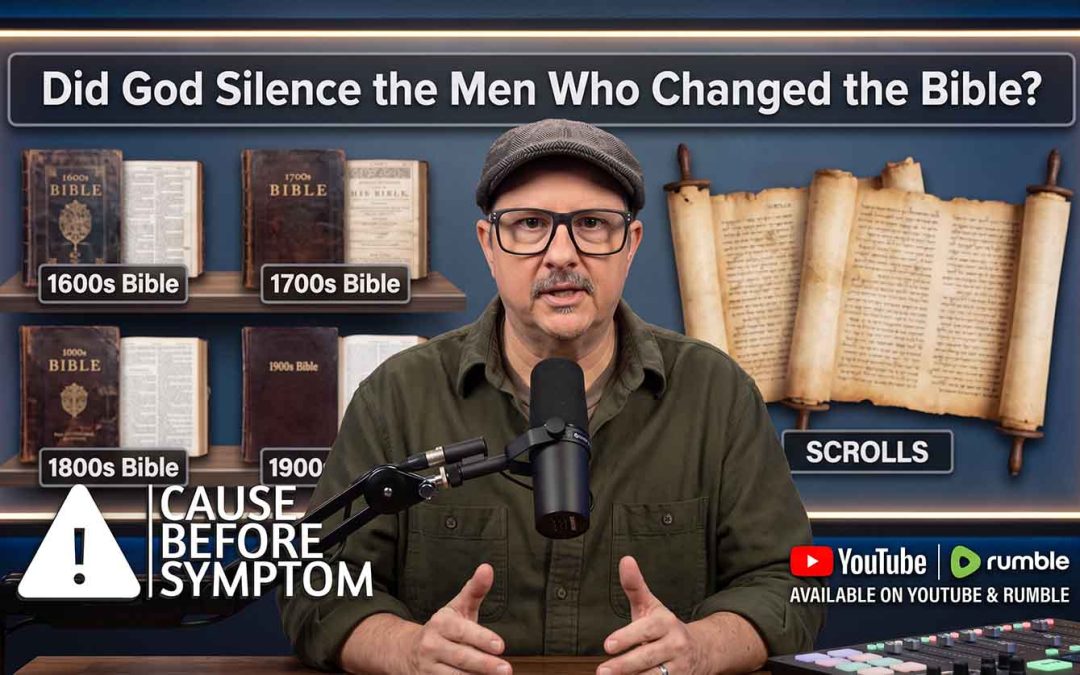
Watch this on Rumble: https://rumble.com/v7gncus-did-god-silence-the-men-who-changed-the-bible.html
Gail Riplinger, the Lost Voices, and the Ethiopian Scriptures
Opening — What If the Men Who Changed Scripture Lost Their Voices?
Welcome to Cause Before Symptom, where we don't chase symptoms—we test the cause against Scripture.
Tonight, I want to investigate something that has troubled Christians for decades. What if some of the men responsible for revising or translating the Bible eventually lost their ability to speak? What if their voices weakened, their speech failed, or their ability to communicate was suddenly taken away? And what if those events occurred after their work had influenced the Scriptures that millions of Christians read today?
In 1993, Gail Riplinger published *New Age Bible Versions*, a controversial investigation into modern Bible translations and the manuscripts behind them. She challenged changes to biblical wording and warned that Christians might not understand what had been altered. But one allegation stood out. Riplinger claimed that five men associated with Bible revision and translation had permanently lost their ability to speak.
Was this an extraordinary coincidence? Were these unrelated medical conditions? Or was something more significant happening?
I respect Gail Riplinger's willingness to investigate difficult questions. Some of the textual differences she identified are genuine. But respecting her work does not mean accepting every conclusion without examining the evidence. If her claims are correct, they should withstand investigation. If something is mistaken, the truth deserves to be told.
During our research, we examined the lives of these men. We found documented strokes, paralysis, serious voice impairment, and accounts of interrupted communication. But we also discovered that some continued speaking publicly after the periods in which they were supposedly silenced. The historical evidence was more complicated than the original allegation suggested.
Then our investigation took an unexpected turn.
When I compared disputed passages against the 1611 King James Bible and our Ethiopian English restoration, I discovered that some questions about biblical preservation applied to our own work.
Acts 8:37 records the Ethiopian official confessing that Jesus Christ is the Son of God. The King James Bible includes it. Many critical editions omit it. Our Ethiopian restoration preserves it in brackets. Yet the historical Ethiopic evidence raises questions about whether the verse appeared in the earliest recoverable text.
Then there is 1 John 5:7–8, containing the famous declaration about the Father, the Word, and the Holy Spirit. Our restoration includes the longer wording found in the King James Bible, but its early Geʽez manuscript support has not been established.
That presents a responsibility I cannot ignore. If I am willing to question Westcott, Hort, and other biblical scholars, I must be willing to examine my own translation work with the same scrutiny. Otherwise, I am defending a position rather than investigating truth.
Scripture warns against adding to God's words or taking away from them. But it also warns against judging another person's suffering as evidence of personal sin. In John chapter nine, Jesus rejected His disciples' assumption that a man's blindness must have resulted from someone's wrongdoing.
So tonight, I am not asking you to condemn Gail Riplinger or the men whose illnesses she documented. I am asking you to examine the evidence.
Who were these men? What happened to their voices? What did they actually change? And what can the Ethiopian biblical tradition tell us about the preservation of Scripture?
Because tonight's investigation is not ultimately about five men who may have lost their voices. It is about whether I am willing to hear the truth, even when that truth challenges something I already believe.
Let's begin with Gail Riplinger.
Investigation 1 — Who Is Gail Riplinger, and What Did She Discover?
Before investigating the men who reportedly lost their voices, I want to understand the woman who brought this allegation to the attention of the Christian world. Her name is Gail Riplinger, and in 1993 she published a book called *New Age Bible Versions*. Her argument was that changes appearing in modern Bible translations were not simply improvements in language. She believed some of those changes affected the identity of Jesus Christ, the authority of Scripture, and the way Christians understood essential biblical teachings.
Riplinger challenged the assumption that newer automatically means better. She examined differences between the King James Bible and modern translations, focusing on passages where words, phrases, or entire verses appeared differently. She questioned the Greek manuscripts used by modern translators and the influence of nineteenth-century biblical scholars. Her central concern was preservation. Had Christians received a more accurate Bible, or had something important been lost along the way?
To understand her argument, I need to explain something that is often overlooked. Translating Scripture and determining the underlying biblical text are not the same task. A translator takes Hebrew, Aramaic, or Greek and expresses its meaning in another language. A textual critic examines surviving manuscripts to determine which readings most likely represent the earliest recoverable text. A paraphraser takes an existing translation or biblical text and expresses its meaning more freely. These activities can influence what readers encounter, but they involve different responsibilities.
This distinction matters because Riplinger's investigation included people whose work was not identical. Some edited Greek texts. Others participated in English revisions. Still others produced modern translations or paraphrases. If I am going to examine what happened to these individuals, I must first establish what each person actually did.
Riplinger also raised questions about the manuscripts associated with Westcott and Hort, two scholars whose 1881 Greek New Testament influenced later biblical scholarship. She argued that departures from the traditional Greek text had consequences beyond vocabulary. In her view, certain changes weakened important biblical statements concerning Christ and Christian doctrine.
But here is where the investigation becomes complicated. A difference between two Bible versions does not automatically establish that someone deliberately removed Scripture. Sometimes manuscripts disagree because scribes copied different readings centuries before modern translators existed. Sometimes a later manuscript preserves an ancient reading. Sometimes an older manuscript preserves wording that later copies expanded. The historical evidence must determine which explanation is most persuasive.
And that brings me to the most unusual part of Riplinger's work. In a chapter titled *Silenced Scribes Summon Psychology*, she connected several men involved in biblical scholarship and translation with serious speech difficulties. She believed these events deserved spiritual attention, raising the possibility that their suffering was connected to their treatment of God's Word.
I understand why that allegation would capture the attention of Christians. Scripture contains serious warnings about mishandling God's words. But those warnings do not give me permission to declare that another person's illness was divine punishment. That conclusion requires more than an extraordinary coincidence.
So I am beginning with two separate questions. Was Riplinger correct that significant textual differences exist? Yes, those differences can be documented. Was she correct about the men who reportedly lost their voices and the meaning of their suffering? That requires a separate investigation.
And that is where the evidence takes us next: to the five men themselves.
Investigation 2 — The Five Men Who Reportedly Lost Their Voices
Now I want to introduce the five men at the center of Gail Riplinger's extraordinary allegation. These were not five men working together in the same room, nor were they all responsible for producing the same Bible. They lived in different periods, performed different kinds of biblical work, and experienced different physical difficulties. Yet Riplinger connected their stories through one disturbing question: Why did so many men associated with changing Scripture reportedly lose their ability to speak?
The first was Philip Schaff, a nineteenth-century church historian, theologian, and biblical scholar. Schaff participated in the American Bible Revision Committee, which contributed to the English Revised Version published in the 1880s. He was an influential figure in biblical scholarship, and his later life was marked by strokes that seriously affected his speech. Riplinger considered his condition significant because of his involvement in revising the biblical text. But Schaff's participation in revision must be distinguished from personally determining every reading that appeared in the finished Bible.
The second man was Samuel Prideaux Tregelles, an English biblical scholar who devoted much of his life to examining Greek New Testament manuscripts. His objective was to reconstruct the biblical text using manuscript evidence rather than simply reproduce the traditional printed Greek editions. Tregelles suffered severe attacks of paralysis, and historical accounts describe difficulties with his speech. His case deserves attention because his physical suffering is documented. But the question remains whether those difficulties amounted to permanent loss of speech and whether they had any demonstrable connection to his scholarly work.
The third was Brooke Foss Westcott, whose name frequently appears alongside Fenton John Anthony Hort. Together, they published a critical Greek New Testament in 1881 that became influential in subsequent biblical scholarship. Riplinger cited descriptions of Westcott's weak or nearly inaudible voice. Yet biographical accounts also describe him reading aloud and preaching publicly in later years. That creates an important distinction between having difficulty speaking and permanently losing the ability to speak.
The fourth was J. B. Phillips, an Anglican minister who produced a modern English translation of the New Testament. Phillips wanted ordinary readers to understand Scripture without struggling through unfamiliar language. His work was different from that of Westcott and Hort because he was translating the biblical message into contemporary English rather than independently reconstructing the entire Greek manuscript tradition. Riplinger quoted an autobiographical account describing a period when Phillips experienced serious difficulties speaking, writing, and communicating. That account is significant, although its original context and the duration of his impairment still require careful verification.
The fifth was Kenneth N. Taylor, the man behind *The Living Bible*. Taylor produced an English paraphrase intended to make Scripture understandable to his children and other readers. His case is particularly striking because contemporary reporting confirms that he experienced serious voice impairment. But Taylor was not editing ancient Greek manuscripts in the same manner as Tregelles or Westcott. He was paraphrasing Scripture into accessible English, which makes his inclusion in the same category worth examining.
These five stories share a theme, but they are not identical. Some involved strokes or paralysis. Others involved voice weakness or broader communication difficulties. Their biblical work also differed considerably.
That does not mean Riplinger's observations should be dismissed. It means that before drawing a spiritual conclusion, I need to establish exactly what happened to each man.
And that brings us to the next investigation: what the historical records actually reveal about their voices.
Investigation 3 — What Really Happened to Their Voices?
Now we arrive at the evidence behind Gail Riplinger's most unsettling allegation. Five men associated with biblical translation or revision reportedly experienced serious difficulties speaking. But when I began examining their individual histories, I discovered that the phrase “lost their voices” did not describe the same medical event in every case. Some suffered strokes, others experienced paralysis, and some struggled with vocal weakness or broader difficulties communicating.
Kenneth Taylor presents one of the clearest documented cases. Taylor produced *The Living Bible*, a paraphrase intended to make Scripture easier to understand. In July 1972, TIME magazine reported that Taylor had experienced a serious loss of voice and was speaking in a hoarse whisper. The report also discussed a proposed psychological explanation, but that explanation was not proof of what caused his condition. His voice impairment was real. Whether it had anything to do with his biblical work is an entirely different question.
Philip Schaff also experienced a serious physical decline. During the final years of his life, he suffered strokes that affected his ability to speak. Schaff had participated in the American Bible Revision Committee, and Riplinger connected his later illness with that work. But strokes have recognized medical causes, and the historical record does not establish that Schaff's biblical scholarship caused his condition. His suffering is documented; its proposed spiritual explanation is not.
Samuel Prideaux Tregelles suffered attacks of paralysis while pursuing his scholarly work on the Greek New Testament. Historical descriptions indicate that his speech became seriously impaired, with one account describing him as scarcely able to speak audibly. This makes his case more substantial than a mere rumor. Nevertheless, the evidence we examined does not establish precisely how long his speech difficulties lasted or whether he became permanently incapable of speaking.
Brooke Foss Westcott presents a different picture. Riplinger cited descriptions of his weak or nearly inaudible speaking voice. Yet accounts from his later life describe him reading aloud and delivering sermons. That matters because a weak voice is not the same thing as permanent muteness. Westcott may genuinely have struggled with speaking at particular times, but the available evidence does not support the stronger claim that he permanently lost his ability to speak.
Then there is J. B. Phillips, whose modern English New Testament became widely known. Riplinger reproduced an account attributed to Phillips's autobiography describing a sudden interruption in his ability to speak, write, and communicate. According to that account, rest did not immediately resolve the problem, and he cancelled speaking engagements. The testimony deserves examination, but the original autobiographical pages were not independently verified during our research. We therefore cannot confidently establish the complete medical circumstances or duration of his condition.
What emerges is not a fabricated collection of names. Several of these men experienced genuine suffering, and some experienced serious speech impairment. That is historically significant. But their conditions differed, and the evidence does not establish that all five permanently became speechless.
Scripture requires caution here. In John chapter nine, the disciples encountered a man born blind and immediately asked whose sin had caused his condition. Jesus rejected their assumption. His answer reminds me that physical suffering cannot automatically be treated as evidence of personal wrongdoing.
I can acknowledge that these events are unusual without claiming to know why God permitted them. The historical evidence tells me what happened. It does not authorize me to announce divine punishment.
But one question remains. Did these afflictions occur immediately after the men changed Scripture, or has the chronology been misunderstood?
That is what we investigate next.
Investigation 4 — Did Their Afflictions Follow Their Work on Scripture?
Now we need to examine something that could change how we understand Gail Riplinger's allegation. It is one thing to establish that five men associated with Bible revision experienced difficulties speaking. It is another to establish that those difficulties occurred because they changed Scripture. If I am going to investigate that possibility, I need to examine the chronology. What came first? Their biblical work, or their physical suffering? And how much time passed between the two?
Let's begin with Philip Schaff. Schaff participated in the American Bible Revision Committee during the nineteenth century. The English Revised Version appeared between 1881 and 1885. Schaff suffered serious strokes in the early 1890s, years after that revision work. The sequence is clear: his biblical work preceded his speech impairment. But the passage of time does not establish causation. Millions of people experience strokes without ever participating in Bible translation.
Samuel Prideaux Tregelles presents a different chronology. He spent decades examining Greek manuscripts and publishing his critical edition of the New Testament. He suffered a serious attack of paralysis in 1861, followed by another in 1870. His physical difficulties therefore occurred while his scholarly work was still underway, not simply after he had completed everything. That distinction matters because the popular allegation can leave the impression that these men finished changing Scripture and were immediately silenced. Tregelles's history does not fit that simple sequence.
Brooke Foss Westcott began collaborating with Fenton John Anthony Hort on Greek New Testament research in the 1850s. Their edition was published in 1881. Yet reports of Westcott's weak speaking voice appeared during the decades before publication. Later biographical accounts describe him continuing to read aloud and preach. If the allegation is that he permanently lost his voice after publishing a corrupted Greek text, the chronology does not support it. His reported vocal weakness preceded the publication, and his public speaking continued afterward.
J. B. Phillips began translating portions of the New Testament during the Second World War. His work developed into a widely read modern English translation, with the complete New Testament appearing in 1958. Riplinger quotes Phillips describing a serious communication crisis in 1961. Here, the reported impairment followed a major publication. But that sequence alone cannot establish why the condition developed. His autobiography's original account still needs to be checked before making more precise medical claims.
Kenneth Taylor began preparing his English paraphrase during the 1950s, and *The Living Bible* appeared as a complete volume in 1971. Contemporary reporting in 1972 documented his serious voice difficulties, although the onset was associated with the period in which he was preparing the work. His case establishes an overlap between biblical paraphrasing and voice impairment, but it does not demonstrate that one caused the other.
Now look at what these timelines reveal. The events did not follow one consistent pattern. Some conditions developed during ongoing work. Others appeared years afterward. In Westcott's case, the reported vocal difficulties began before the publication most closely associated with his name.
This does not make the suffering imaginary. It means the chronology cannot carry the weight of the accusation by itself.
Scripture warns that teachers will receive stricter judgment, as James chapter three reminds us. But that warning does not give me authority to identify a particular illness as God's punishment.
If these men truly changed the biblical text, that question must be answered by examining their work. Their illnesses cannot substitute for manuscript evidence.
And that brings us to Westcott and Hort, the two names most closely associated with the controversy over modern Bible versions.
Investigation 5 — What Did Westcott and Hort Actually Change?
Now we come to two of the most controversial names in the history of modern Bible scholarship: Brooke Foss Westcott and Fenton John Anthony Hort. Gail Riplinger considered their work central to the changes appearing in modern Bible versions. But before I decide whether these men corrupted Scripture, I need to understand exactly what they produced and why their work became so influential.
In 1881, Westcott and Hort published *The New Testament in the Original Greek*. They were not translating the Bible into English. They were attempting to determine which Greek readings most closely represented the earliest recoverable New Testament text. Their work challenged the traditional Greek text underlying much of the King James Bible.
That traditional text is commonly called the Textus Receptus, meaning the Received Text. It developed through printed Greek editions beginning in the sixteenth century, drawing largely upon manuscripts available to European scholars. Westcott and Hort believed that some earlier surviving manuscripts preserved readings that were older than those found in the traditional printed editions.
Their approach gave particular importance to manuscripts associated with the Alexandrian textual tradition, including Codex Vaticanus and Codex Sinaiticus. These manuscripts differ from the Textus Receptus in numerous places. Sometimes the differences involve individual words. Sometimes they involve entire sentences or passages.
Consider Acts 8:37, where the Ethiopian official confesses his belief that Jesus Christ is the Son of God. That verse appears in the King James Bible but is absent from the main text of Westcott and Hort's Greek edition. Then there is 1 John 5:7, where the King James Bible contains the famous declaration about the Father, the Word, and the Holy Spirit. The longer wording is not present in their critical Greek text.
These are real textual differences. Riplinger did not invent them.
But another distinction is essential. Westcott and Hort did not personally remove those words from ancient manuscripts. They selected among readings already preserved in different manuscript witnesses. Their argument was that some familiar passages entered the manuscript tradition later than the original writings.
Whether their conclusions were correct must be examined passage by passage. An earlier manuscript is not automatically right merely because it is older. But a reading is not automatically original merely because it appears in the King James Bible.
One example reveals why precision matters. The longer ending of Mark, verses 9 through 20, is often described as having been deleted by Westcott and Hort. In reality, they printed the passage within double brackets, signaling serious doubts about its originality. That is different from pretending the passage never existed.
Their methods were influential, but they were not beyond criticism. Scholars have questioned their theories about manuscript families, their preference for particular witnesses, and aspects of their reconstruction of textual history. Modern textual criticism has developed considerably since 1881 and does not simply reproduce every conclusion Westcott and Hort reached.
There is another issue I cannot ignore. The King James Bible itself emerged from a history of manuscript comparison, editorial decisions, and earlier English translations. Its translators were not working from the original handwritten documents of the apostles. They, too, depended upon the manuscript evidence available to them.
So the question is not whether human beings made decisions about the biblical text. They did, on both sides of this controversy. The question is whether those decisions faithfully preserved what the apostles originally wrote.
And that cannot be settled by examining someone's illness, reputation, or theological associations.
It must be settled by examining the evidence.
Our next investigation begins with one of the most compelling examples: the Ethiopian official's confession in Acts chapter eight. Was his declaration of faith removed from Scripture, or does the manuscript history reveal something more complicated?
Investigation 6 — The Ethiopian Eunuch: Was His Confession Removed?
Now we arrive at a passage that brings this investigation directly into the Ethiopian biblical tradition. In Acts chapter eight, Philip encounters an Ethiopian official traveling home from Jerusalem. The man is reading the prophet Isaiah but does not understand whom the prophet is describing. Philip approaches him, explains the Scripture, and preaches Jesus Christ.
As they travel, they come upon water. The Ethiopian asks a question that every Christian should recognize: “See, here is water; what doth hinder me to be baptized?” In the King James Bible, Philip answers that baptism is permitted if the man believes with all his heart. The Ethiopian then makes an extraordinary confession: “I believe that Jesus Christ is the Son of God.”
That confession appears in Acts 8:37. But in many modern Bible translations, the verse is absent from the main text or placed in a footnote. Gail Riplinger regarded such differences as evidence that important Christian doctrine was being removed from Scripture. And I understand why this particular passage would trouble believers. The verse explicitly connects faith in Jesus Christ with baptism.
But was it deliberately removed?
When I examined the manuscript evidence, I found something important. Acts 8:37 is absent from several early Greek witnesses, including major manuscripts used by modern textual critics. That is why critical editions generally do not include it in the main text. However, the confession is not a modern invention. Irenaeus, writing in the second century, referred to the Ethiopian's confession that Jesus Christ is the Son of God. This establishes that the tradition was known very early in Christian history.
That creates a genuine historical question. If the confession was known in the second century, why is it missing from some of our earliest surviving Greek manuscripts? Was it omitted during copying, or was it an early explanatory addition that eventually entered the biblical text? Both possibilities must be investigated through the surviving evidence. The age of the confession alone does not prove that Luke originally wrote it.
Now consider something especially relevant to our Ethiopian Bible restoration. Our modern English reconstruction includes Acts 8:37 in brackets. Initially, that might appear to support the King James reading against modern critical editions. But the modern restoration is not itself an ancient Geʽez manuscript. Historical studies of the Ethiopic textual tradition indicate that the verse was absent from important Ethiopic witnesses.
That distinction is essential. I cannot claim that the ancient Ethiopian Bible confirms the verse simply because our English restoration includes it. To establish that, I would need to examine identifiable Geʽez manuscripts, their dates, and their actual wording.
There is also something remarkable about the passage even without verse 37. The Ethiopian official is reading Isaiah. Philip explains Jesus to him. The man requests baptism, and Philip baptizes him. The surrounding narrative still presents the Ethiopian as someone who receives the gospel and responds in faith.
So removing the verse from the main text does not remove the identity of Jesus Christ from the book of Acts. Yet that does not make the textual question unimportant. Every word of Scripture deserves careful examination.
What I have discovered is that Riplinger identified a genuine difference, and the Ethiopian's confession has ancient historical support. But whether that confession belonged to Luke's original text remains disputed.
And if this passage challenges our assumptions about biblical preservation, the next one raises an even more difficult question: what happened to the three heavenly witnesses in First John?
Investigation 7 — The Three Heavenly Witnesses: What Happened to 1 John 5:7–8?
Now we come to one of the most controversial passages in the entire New Testament. It concerns the Father, the Word, and the Holy Spirit, and it raises a question that goes directly to the heart of Gail Riplinger's investigation. Did modern Bible scholars remove an explicit testimony about the Trinity, or did the King James Bible preserve wording that entered the manuscript tradition later?
In the King James Bible, First John chapter five, verses seven and eight, declares: “For there are three that bear record in heaven, the Father, the Word, and the Holy Ghost: and these three are one.” The passage continues by identifying three witnesses on earth: the Spirit, the water, and the blood.
That is an extraordinary statement. It explicitly identifies three heavenly witnesses and declares their unity. Yet when I examine modern critical Greek editions, most of that heavenly declaration is absent. The shorter reading speaks of the Spirit, the water, and the blood, without the extended statement about the Father, the Word, and the Holy Spirit.
This difference is commonly called the *Comma Johanneum*. Riplinger regarded its absence as another example of modern Bible versions weakening the testimony of Scripture. But the manuscript history presents a serious challenge to that conclusion.
The longer reading is missing from the early Greek manuscript tradition. It became prominent in Latin Christianity, where it appeared in portions of the Latin textual tradition and was eventually incorporated into printed Greek editions. Erasmus initially omitted the longer wording from his Greek New Testament because the Greek evidence available to him did not support it. He later included it in his third edition in 1522, following the emergence of a Greek manuscript containing the passage.
Through subsequent printed editions, the longer reading became part of the Greek textual tradition used by the King James translators.
Now consider what that means. The King James translators did not invent the passage. They inherited it from the printed Greek text available to them. But the fact that a passage appeared in a sixteenth-century Greek edition does not automatically establish that John wrote it in the first century.
And this is where our Ethiopian investigation becomes particularly important.
Our modern Ethiopian English restoration contains the longer heavenly-witness wording. On the surface, that appears to agree with the King James Bible. But I cannot treat our restoration as independent proof that ancient Ethiopian manuscripts contained those words. Historical descriptions of the Ethiopic tradition indicate that the longer reading was not part of its early textual witness.
To establish otherwise, I would need dated Geʽez manuscripts containing the actual passage. Without those manuscripts, claiming that Ethiopia independently preserved the longer wording would go beyond the evidence.
Does that mean the doctrine of the Trinity disappears without this verse? No. Christians have historically drawn upon numerous biblical passages when explaining the relationship between the Father, Son, and Holy Spirit. Matthew 28:19, for example, names all three in the baptismal command. The doctrine does not depend exclusively upon the disputed wording in First John.
But neither should I dismiss the importance of the passage. If those words were original, their omission would be serious. If they were added later, presenting them as John's original words would raise a different concern.
The responsibility is the same in either direction: preserve what Scripture actually says.
And now I must confront the question that has been building throughout this investigation. If our Ethiopian restoration sometimes agrees with the King James Bible while the ancient Ethiopic evidence points elsewhere, what exactly does the Ethiopian biblical tradition reveal?
That is where we turn next.
Investigation 8 — What Does the Ethiopian Bible Actually Reveal?
Now we arrive at a question that is especially important to me because of the work I have undertaken with the Ethiopian Orthodox Tewahedo Scriptures. For centuries, Ethiopia preserved a Christian biblical tradition that developed outside many of the institutional and political struggles of Western Christianity. Its broader canon contains writings unfamiliar to many Protestant readers. But does that mean the Ethiopian Bible can settle the controversy between the King James Bible and modern translations?
To answer that, I must first explain something. There is no single surviving manuscript containing every book of the Ethiopian canon exactly as Christians read it today. The Ethiopian tradition developed through centuries of copying, translation, preservation, and religious practice. Its biblical books survive in different manuscripts, from different periods, sometimes with differences in wording and arrangement.
The language at the center of this history is Geʽez, the classical literary and liturgical language of Ethiopian Christianity. Many biblical texts were translated into Geʽez from Greek sources, although their histories are not identical. Later Amharic translations and modern English compilations represent additional stages in that transmission.
That matters because an English book labeled *Ethiopian Bible* is not automatically a direct translation of an ancient Geʽez manuscript. Some modern compilations combine existing English translations, traditional Ethiopian writings, and editorial reconstruction. Their contents may be valuable, but their authority must be evaluated according to their actual sources.
This is where I have to examine my own work.
Our modern English Ethiopian restoration includes passages that agree with the King James Bible, including the Ethiopian official's confession in Acts 8:37 and the longer heavenly-witness statement in First John chapter five. But agreement between two modern English texts does not establish that an ancient Ethiopian manuscript contained those readings.
In fact, historical textual research raises questions about both passages in the Ethiopic tradition. If I claim that Ethiopia preserved words missing from modern Bibles, I must identify the Geʽez manuscripts that support that claim. I cannot simply point to our English restoration and declare the matter settled.
There is another passage that illustrates the problem from the opposite direction.
In Revelation 22:19, the King James Bible warns about losing one's part in the “book of life.” Many modern translations instead read “tree of life.” Our Ethiopian English restoration also uses “tree of life.” The Greek manuscript evidence strongly favors that reading, while the King James wording reflects the complicated history of Erasmus's printed Greek text.
So the Ethiopian restoration does not consistently support the King James Bible against modern critical editions. Sometimes it agrees with one, sometimes with the other. That alone should warn me against treating the Ethiopian tradition as a convenient witness for whichever reading I already prefer.
And consider the broader Ethiopian canon. Books such as First Enoch and Jubilees preserve important ancient religious traditions. Their presence tells us something remarkable about Ethiopian Christianity's history. But a broader canon does not automatically establish which Greek reading of First John is original. Those are separate historical questions.
What, then, does the Ethiopian Bible actually reveal?
It reveals that the history of Scripture is larger than the Western debate between the King James Bible and modern translations. It preserves ancient Christian traditions deserving serious investigation. And it reminds me that biblical preservation must be studied through actual manuscripts, not merely through claims about them.
If I demand evidence from Westcott and Hort, I must demand the same evidence from my own restoration.
Because the goal is not to prove that my preferred Bible is always right. The goal is to discover, as faithfully as possible, what God has given us.
And that leads to a question more serious than manuscript history alone: Can God judge someone for mishandling His Word?
Investigation 9 — Can God Judge Someone for Mishandling His Word?
Now we arrive at the spiritual question behind Gail Riplinger's entire allegation. Can God judge someone for mishandling Scripture? Can a person entrusted with teaching, translating, or preserving God's Word be held accountable for what they do with it? And if that person later suffers a serious illness, should Christians interpret that suffering as evidence of divine judgment?
The first question is not difficult to answer. Scripture repeatedly warns that God's Word must be handled with reverence. In Deuteronomy chapter four, Moses commands Israel not to add to God's commandments or take away from them. Proverbs chapter thirty warns against adding to His words. Revelation chapter twenty-two contains a solemn warning against adding to or taking away from the words of that prophecy.
These passages establish a principle that I take seriously. God's Word does not belong to me. I am not free to rewrite it according to my preferences, remove something because it makes me uncomfortable, or insert something because it supports a doctrine I already believe.
James chapter three adds another warning. Teachers will receive stricter judgment. That should concern anyone who stands before an audience claiming to explain Scripture, including me. The responsibility is not limited to scholars working with ancient manuscripts. It applies to pastors, translators, teachers, and everyone who presents biblical interpretation as truth.
But now comes the difficult distinction. Scripture establishes that God judges wrongdoing. It does not establish that every physical affliction is evidence of a particular sin.
In John chapter nine, Jesus encounters a man who was born blind. His disciples ask whether the man's condition resulted from his own sin or his parents' sin. Jesus rejects both explanations. The disciples believed they could identify a spiritual cause by examining a physical condition. Jesus showed them that their conclusion was wrong.
Then consider Job. His friends repeatedly attempted to explain his suffering as evidence of wrongdoing. They were convinced that severe affliction must reveal something about the sufferer's relationship with God. Yet the book ultimately exposes the danger of speaking confidently about divine purposes without actually knowing them.
There are also biblical examples of unmistakable divine judgment. In Acts chapter twelve, Herod accepts praise that belongs to God and is struck down. In Acts chapter five, Ananias and Sapphira die after lying about their offering. But in those accounts, Scripture itself identifies the offense and presents the judgment. I do not have that kind of revelation concerning Philip Schaff, Samuel Tregelles, Brooke Westcott, J. B. Phillips, or Kenneth Taylor.
That distinction matters enormously.
If I claim that God took a man's voice because he changed the Bible, I am making two accusations. First, that the man mishandled Scripture. Second, that God personally punished him through illness. The first allegation requires textual and historical evidence. The second requires knowledge of God's purpose that the medical record cannot provide.
I cannot establish divine judgment simply by placing two events next to each other.
And I must apply that same standard to my own work. If I introduce wording into an Ethiopian restoration without sufficient manuscript support, I cannot excuse the decision because my intentions were sincere. I must correct the text when the evidence requires correction.
Reverence for Scripture is not demonstrated by defending every inherited reading. It is demonstrated by pursuing faithfulness to the original testimony, even when doing so challenges my assumptions.
So yes, God can judge those who mishandle His Word. Scripture leaves no doubt about human accountability.
But whether God judged these particular men by affecting their voices is something I cannot honestly claim to know.
And that leaves one final investigation. After examining the men, their illnesses, the manuscripts, and the Ethiopian tradition, what did Gail Riplinger get right, and what remains unproven?
Investigation 10 — What Did Gail Riplinger Get Right, and What Remains Unproven?
We have reached the final investigation, and now I must answer the question that started this entire journey. Was Gail Riplinger right? Did she uncover something important about modern Bible translations, or did she connect historical events in ways the evidence cannot support?
I want to begin by giving Riplinger credit where it is deserved. She challenged Christians to examine the Bibles they were reading instead of assuming that every translation contained exactly the same words. That was a legitimate concern. Differences between the King James Bible and modern translations are real. Entire verses appear in one edition and not another. Some passages contain substantially different wording.
Riplinger was also correct that Westcott and Hort influenced the development of modern biblical scholarship. Their 1881 Greek New Testament challenged the traditional printed Greek text underlying the King James Bible. Their editorial decisions affected subsequent discussions about which readings should appear in modern translations.
And Riplinger identified real suffering among men associated with biblical translation and scholarship. Kenneth Taylor experienced serious voice impairment. Philip Schaff suffered strokes that affected his speech. Samuel Tregelles experienced paralysis. J. B. Phillips described a period of serious communication difficulties. Brooke Westcott was sometimes described as having a weak or nearly inaudible voice.
Those accounts deserve examination, not ridicule.
But here is where the evidence begins to separate from Riplinger's interpretation.
We could not establish that all five men permanently lost their ability to speak. Their conditions were different, their medical histories were different, and their difficulties did not follow one consistent timeline. Westcott continued speaking publicly. Tregelles experienced paralysis while his scholarly work was ongoing. Schaff's strokes occurred years after major revision work.
Most importantly, we found no historical evidence establishing that God caused these afflictions as punishment for changing Scripture.
That does not mean divine judgment is impossible. It means I cannot claim to know God's purpose where Scripture has not revealed it.
Then there is the manuscript evidence. Riplinger identified genuine textual differences, but identifying a difference is not the same as proving deliberate corruption. Acts 8:37 contains an ancient confession of Jesus Christ, yet its presence in Luke's original text remains disputed. The longer heavenly-witness passage in First John has a complicated history, with little early Greek manuscript support.
And our Ethiopian investigation revealed something I did not expect. The modern English restoration we have been examining sometimes agrees with the King James Bible, but that agreement does not establish what ancient Geʽez manuscripts actually contained. If I demand manuscript evidence from modern translators, I must demand it from my own restoration.
That may be the most important discovery of this entire investigation.
I began by examining whether other men had mishandled God's Word. I ended by recognizing that my own work must remain open to correction.
Riplinger's concern about biblical preservation deserves to be taken seriously. Her historical observations deserve verification. But her proposed connection between textual changes and divine punishment remains unproven.
I also cannot accept the opposite extreme: the idea that every modern editorial decision must be correct simply because scholars made it. Scholarship is not infallible. Neither is tradition. Both must answer to evidence.
So where does that leave me?
It leaves me with a greater responsibility to distinguish the original biblical text from later additions, genuine omissions from legitimate textual questions, and historical facts from spiritual interpretations.
It leaves me unwilling to condemn suffering men without evidence, but equally unwilling to dismiss legitimate questions about Scripture.
And above all, it leaves me convinced that defending God's Word requires something more difficult than defending a preferred translation.
It requires a willingness to be corrected.
Because truth does not become weaker when I investigate it. My understanding becomes stronger when I allow the evidence to challenge me.
And that brings us to our conclusion: God's Word does not fear investigation.
Conclusion — God's Word Does Not Fear Investigation
Tonight, I began with an extraordinary allegation. Five men associated with changing, revising, or translating the Bible reportedly lost their ability to speak. Gail Riplinger brought their stories together and raised a disturbing possibility: Could God have silenced men who mishandled His Word?
After examining their histories, I found something more complicated than the allegation suggested. Several experienced genuine suffering. Some suffered strokes, paralysis, or serious speech difficulties. But the evidence did not establish that all five permanently lost their voices, nor did it establish that God punished them for their biblical work.
And that distinction matters. I believe God judges wrongdoing. Scripture teaches that plainly. But I also believe I must be careful about claiming to know why another person suffers. Job's friends were convinced they understood the cause of his affliction. They were wrong. In John chapter nine, Jesus rejected the assumption that a man's blindness must have resulted from someone's sin.
I do not want to repeat that mistake.
But something else happened during this investigation that I believe is even more important.
When I examined the passages Gail Riplinger questioned, I discovered that the textual differences were real. Acts 8:37, First John 5:7–8, and other disputed passages reveal genuine disagreements within the manuscript tradition. These questions cannot be dismissed simply because someone finds them uncomfortable.
Yet when I compared those passages with our Ethiopian English restoration, I encountered a problem of my own. Some readings we preserved agreed with the King James Bible, but that did not necessarily mean they were supported by ancient Geʽez manuscripts.
And suddenly, the investigation was no longer just about Gail Riplinger, Westcott, Hort, or five men who suffered physical afflictions.
It was about me.
If I am going to stand before you and question the work of biblical scholars, then I must be willing to question my own work. If I discover that something in our Ethiopian restoration lacks sufficient manuscript support, I have a responsibility to investigate it and correct it where necessary.
I cannot demand honesty from others while granting myself an exemption.
There is something deeply comforting about that realization. God's truth does not depend upon my ability to defend every conclusion I have ever reached. Scripture does not become less sacred because I acknowledge uncertainty about a disputed verse. And Jesus Christ does not become less real because I discover that a familiar passage has a complicated manuscript history.
The Lord never commanded me to protect my pride. He commanded me to seek truth, walk humbly, and love Him with all my heart.
I respect Gail Riplinger for asking questions that many Christians were unwilling to ask. But respect does not require agreement with every answer. The same principle applies to the King James translators, modern textual critics, Ethiopian scholars, and my own restoration work.
None of us stands above examination.
What I take away from tonight is not fear that God might silence me for making an honest mistake. It is a greater reverence for the responsibility of handling His Word faithfully.
I would rather discover that I was mistaken and correct my work than spend the rest of my life defending something simply because I once believed it.
Because the objective was never to prove that I was right.
The objective was to discover what is true.
And perhaps that is the lesson God wanted me to find in an investigation that began with five men who reportedly lost their voices.
Sometimes the most important thing I can do is stop defending my own understanding long enough to listen.
This has been Cause Before Symptom, where we don't chase symptoms—we test the cause against Scripture.
Bibliography
*Chicago Manual of Style, 17th Edition*
Aland, Kurt, and Barbara Aland. *The Text of the New Testament: An Introduction to the Critical Editions and to the Theory and Practice of Modern Textual Criticism*. 2nd ed. Translated by Erroll F. Rhodes. Grand Rapids, MI: William B. Eerdmans, 1989.
Ehrman, Bart D. *Misquoting Jesus: The Story Behind Who Changed the Bible and Why*. New York: HarperSanFrancisco, 2005.
Erasmus, Desiderius. *Novum Instrumentum Omne*. Basel: Johann Froben, 1516.
Hort, Fenton John Anthony. *Introduction to the New Testament in the Original Greek: With Notes on Selected Readings*. London: Macmillan, 1882.
Irenaeus. *Against Heresies*. Book 3, chapter 12, section 8. In *The Ante-Nicene Fathers*, vol. 1, edited by Alexander Roberts and James Donaldson. Buffalo, NY: Christian Literature Publishing, 1885.
Metzger, Bruce M. *A Textual Commentary on the Greek New Testament*. 2nd ed. Stuttgart: Deutsche Bibelgesellschaft, 1994.
Niccum, Curt. *The Bible in Ethiopia: The Book of Acts*. Ethiopic Manuscripts, Texts, and Studies 19. Eugene, OR: Pickwick Publications, 2014.
Phillips, J. B. *The Price of Success*. London: Hodder and Stoughton, 1984.
Riplinger, Gail A. *New Age Bible Versions*. Munroe Falls, OH: A.V. Publications, 1993.
Schaff, Philip. *The Revision of the English Version of the New Testament*. New York: Harper & Brothers, 1873.
Scrivener, Frederick Henry Ambrose. *A Plain Introduction to the Criticism of the New Testament*. 4th ed. Edited by Edward Miller. 2 vols. London: George Bell & Sons, 1894.
Taylor, Kenneth N. *The Living Bible*. Wheaton, IL: Tyndale House Publishers, 1971.
Tregelles, Samuel Prideaux. *An Account of the Printed Text of the Greek New Testament*. London: Samuel Bagster and Sons, 1854.
Westcott, Arthur. *Life and Letters of Brooke Foss Westcott, D.D., D.C.L., Sometime Bishop of Durham*. 2 vols. London: Macmillan, 1903.
Westcott, Brooke Foss, and Fenton John Anthony Hort. *The New Testament in the Original Greek*. 2 vols. Cambridge and London: Macmillan, 1881.
*The Holy Bible: King James Version, 1611, with Apocrypha*. London: Robert Barker, 1611.
*The Holy Bible: New Revised Standard Version*. Nashville: Thomas Nelson, 1989.
*The Holy Bible: Ethiopian Orthodox Tewahedo Scriptural Tradition*. Geʽez manuscript tradition and modern English restoration materials consulted for textual comparison. Manuscript dates, provenance, and individual readings require independent verification.
*TIME*. “Religion: The Bible in Living Language.” July 24, 1972.
Endnotes
*Chicago Manual of Style, 17th Edition*
1. Gail A. Riplinger, *New Age Bible Versions* (Munroe Falls, OH: A.V. Publications, 1993), chap. “Silenced Scribes Summon Psychology.” Riplinger connects speech difficulties experienced by several men associated with Bible translation and textual criticism to concerns about their treatment of Scripture. Her proposed spiritual explanation should be distinguished from the historical evidence documenting their illnesses.
2. Kurt Aland and Barbara Aland, *The Text of the New Testament: An Introduction to the Critical Editions and to the Theory and Practice of Modern Textual Criticism*, 2nd ed., trans. Erroll F. Rhodes (Grand Rapids, MI: William B. Eerdmans, 1989). This work explains the distinction between manuscript transmission, textual criticism, and the preparation of critical editions of the Greek New Testament.
3. Philip Schaff, *The Revision of the English Version of the New Testament* (New York: Harper & Brothers, 1873). Schaff participated in the American Bible revision movement. His subsequent strokes and speech impairment occurred years after the principal revision work discussed in this investigation.
4. Samuel Prideaux Tregelles, *An Account of the Printed Text of the Greek New Testament* (London: Samuel Bagster and Sons, 1854). Tregelles advocated examination of manuscript evidence when establishing the Greek New Testament text. His later paralysis and speech difficulties require separate biographical documentation; his textual scholarship alone does not establish the medical circumstances.
5. Arthur Westcott, *Life and Letters of Brooke Foss Westcott, D.D., D.C.L., Sometime Bishop of Durham*, 2 vols. (London: Macmillan, 1903). Westcott's biography provides evidence of his continuing public religious responsibilities and speaking activities, complicating claims that he permanently lost his ability to speak.
6. Brooke Foss Westcott and Fenton John Anthony Hort, *The New Testament in the Original Greek*, 2 vols. (Cambridge and London: Macmillan, 1881). Their critical Greek text differed from the Textus Receptus at numerous points. Their treatment of disputed passages must be evaluated individually rather than characterized uniformly as deletion.
7. Fenton John Anthony Hort, *Introduction to the New Testament in the Original Greek: With Notes on Selected Readings* (London: Macmillan, 1882). Hort explains the principles behind the critical text, including manuscript relationships, textual history, and the evaluation of competing readings.
8. J. B. Phillips, *The Price of Success* (London: Hodder and Stoughton, 1984). Riplinger attributes an account of serious communication difficulties to Phillips's autobiography. The precise wording, context, and duration of the episode require verification against the original pages before stronger conclusions are drawn.
9. Kenneth N. Taylor, *The Living Bible* (Wheaton, IL: Tyndale House Publishers, 1971). Taylor's work was an English paraphrase, not an independently reconstructed critical edition of the Greek New Testament. This distinction is important when comparing his work with that of Tregelles, Westcott, and Hort.
10. “Religion: The Bible in Living Language,” *TIME*, July 24, 1972. Contemporary reporting described Taylor's significant voice impairment and his difficulty speaking. The report supports the existence of the condition but does not establish divine punishment as its cause.
11. Irenaeus, *Against Heresies*, 3.12.8, in *The Ante-Nicene Fathers*, vol. 1, ed. Alexander Roberts and James Donaldson (Buffalo, NY: Christian Literature Publishing, 1885). Irenaeus refers to the Ethiopian official's confession of faith, providing early evidence for the tradition associated with Acts 8:37. This does not by itself establish that the confession appeared in Luke's original text.
12. Bruce M. Metzger, *A Textual Commentary on the Greek New Testament*, 2nd ed. (Stuttgart: Deutsche Bibelgesellschaft, 1994), discussion of Acts 8:37. Metzger reviews the manuscript evidence surrounding the Ethiopian official's confession and the reasons critical editions generally exclude the verse from their main text.
13. Curt Niccum, *The Bible in Ethiopia: The Book of Acts*, Ethiopic Manuscripts, Texts, and Studies 19 (Eugene, OR: Pickwick Publications, 2014). Niccum's study is especially relevant to the textual history of Acts in the Ethiopic tradition. A modern English restoration cannot independently establish an ancient Geʽez reading without identification and examination of the underlying manuscripts.
14. Metzger, *Textual Commentary*, discussion of 1 John 5:7–8. The extended heavenly-witness passage, commonly called the *Comma Johanneum*, has very limited support in the early Greek manuscript tradition and a more substantial history in Latin textual transmission.
15. Desiderius Erasmus, *Novum Instrumentum Omne* (Basel: Johann Froben, 1516). Erasmus's early printed Greek New Testament omitted the longer heavenly-witness reading. Its inclusion in his 1522 third edition became significant for the subsequent printed Greek tradition underlying the King James Bible.
16. Frederick Henry Ambrose Scrivener, *A Plain Introduction to the Criticism of the New Testament*, 4th ed., ed. Edward Miller, 2 vols. (London: George Bell & Sons, 1894). Scrivener discusses manuscript variants and the development of the printed Greek text, including questions relevant to the Textus Receptus.
17. Westcott and Hort, *The New Testament in the Original Greek*, Mark 16:9–20. The longer ending of Mark was printed within double brackets, indicating serious textual reservations. Describing the passage as simply deleted does not accurately represent their editorial treatment.
18. Metzger, *Textual Commentary*, discussion of Revelation 22:19. The distinction between “book of life” in the King James tradition and “tree of life” in the critical Greek tradition illustrates how the history of printed Greek editions can affect familiar English wording.
19. Niccum, *The Bible in Ethiopia: The Book of Acts*. Ethiopian biblical manuscript history must be distinguished from modern English compilations marketed as Ethiopian Bibles. Establishing a particular ancient reading requires manuscript identification, dating, and comparison rather than reliance on the title of a modern compilation.
20. *The Holy Bible: King James Version, 1611, with Apocrypha* (London: Robert Barker, 1611), Acts 8:37; 1 John 5:7–8; Revelation 22:19. These passages provide the traditional English readings compared with modern critical editions and the Ethiopian English restoration.
21. *The Holy Bible: New Revised Standard Version* (Nashville: Thomas Nelson, 1989), Acts 8:37; 1 John 5:7–8; Revelation 22:19. The translation illustrates how modern editions distinguish certain traditional readings from those supported by their underlying critical Greek texts.
22. Deuteronomy 4:2; Proverbs 30:5–6; Revelation 22:18–19. These passages contain warnings concerning the treatment of divine revelation. Their literary contexts differ, and they should not be presented as though each specifically addresses modern Bible translation or textual criticism.
23. James 3:1. The warning that teachers will receive stricter judgment establishes the seriousness of communicating religious instruction. It does not identify the illnesses of particular historical scholars as acts of divine punishment.
24. John 9:1–3. Jesus rejects His disciples' assumption that a man's blindness must have resulted from his own sin or that of his parents. The passage provides an important biblical safeguard against treating physical suffering as automatic evidence of personal wrongdoing.
25. Job 4–5; 8; 11; 42:7–9. Job's friends repeatedly interpret his suffering through assumptions about divine retribution. God's eventual rebuke demonstrates the danger of confidently assigning spiritual causes to suffering without sufficient knowledge.
26. Acts 5:1–11; 12:20–23. These passages describe particular instances of divine judgment within the biblical narrative. Unlike modern historical allegations, the biblical accounts explicitly identify the wrongdoing and its relationship to the judgment.
27. Matthew 28:19; John 1:1–14; 2 Corinthians 13:14. These passages remain relevant to Christian discussions of the Father, Son, and Holy Spirit independently of the disputed longer wording in 1 John 5:7–8.
28. Riplinger, *New Age Bible Versions*; Aland and Aland, *Text of the New Testament*; Niccum, *Bible in Ethiopia*. Taken together, these works represent different approaches to biblical preservation, textual history, and manuscript evidence. Their conclusions should not be treated as interchangeable or equally established on every disputed reading.
29. The modern English Ethiopian restoration examined in this investigation is a working reconstruction rather than an independently authenticated ancient Geʽez manuscript. Its readings in Acts 8:37, 1 John 5:7–8, and Revelation 22:19 require verification against identifiable Ethiopic witnesses before being cited as evidence of ancient Ethiopian textual preservation.
30. The central historical conclusion of this investigation is limited: several men associated with biblical scholarship or translation experienced documented or reported speech difficulties, but the evidence reviewed does not establish permanent muteness in all five cases or demonstrate that their afflictions were divine punishment. The theological possibility of divine judgment must not be confused with historical proof that it occurred in these particular cases.
#GailRiplinger, #NewAgeBibleVersions, #KingJamesBible, #KJV1611, #EthiopianBible, #EthiopianOrthodox, #GeEzBible, #BibleTranslations, #BibleManuscripts, #BiblicalPreservation, #WestcottAndHort, #TextusReceptus, #BiblicalTextualCriticism, #Acts837, #FirstJohn57, #ThreeHeavenlyWitnesses, #BibleHistory, #Scripture, #BiblicalTruth, #DivineJudgment, #Christianity, #JesusChrist, #CauseBeforeSymptom, #JamesCarner
GailRiplinger, NewAgeBibleVersions, KingJamesBible, KJV1611, EthiopianBible, EthiopianOrthodox, GeEzBible, BibleTranslations, BibleManuscripts, BiblicalPreservation, WestcottAndHort, TextusReceptus, BiblicalTextualCriticism, Acts837, FirstJohn57, ThreeHeavenlyWitnesses, BibleHistory, Scripture, BiblicalTruth, DivineJudgment, Christianity, JesusChrist, CauseBeforeSymptom, JamesCarner