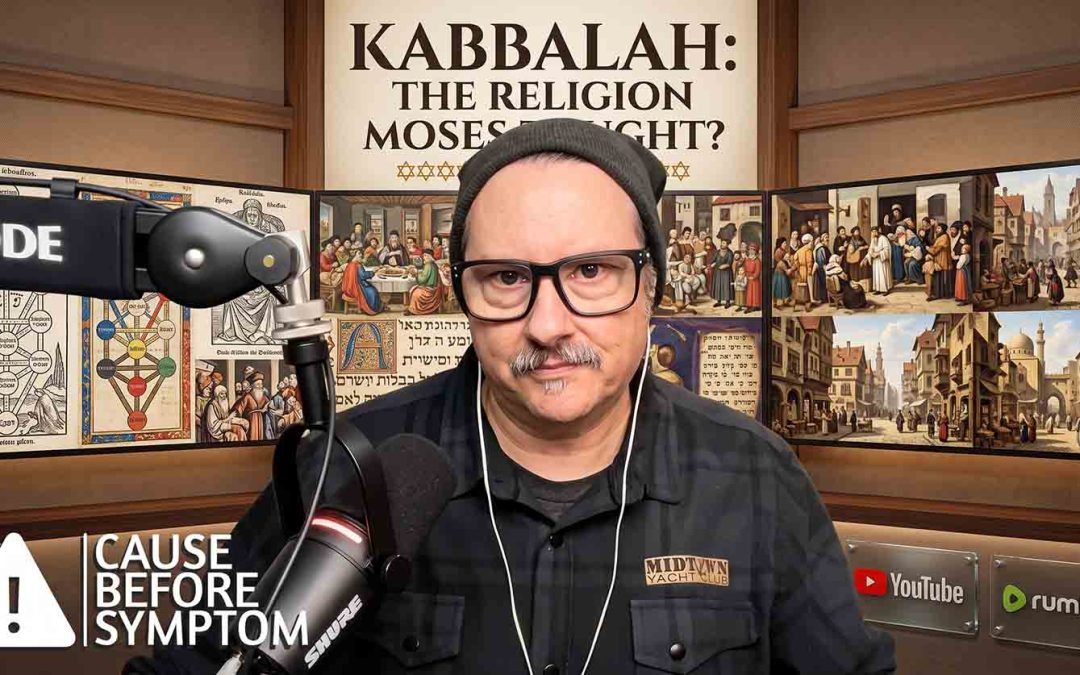
Watch this on Rumble: https://rumble.com/v7iifrk-kabbalah-the-religion-moses-never-taught.html
Opening — When Did God's Word Become a Hidden Mystery?
Good evening, brothers and sisters, and welcome to Cause Before Symptom. Tonight, we are going to examine a religious tradition that has influenced Jewish theology, Christian scholars, Western occultism, and modern spirituality. It is called Kabbalah. Some people regard it as an ancient body of divine wisdom handed down through generations. Others understand it as a mystical interpretation of the Hebrew Scriptures. Still others associate it with secret knowledge, sacred names, numerical symbolism, and supernatural powers. But tonight, we are going to ask a question that comes before all those interpretations. Was Kabbalah actually the religion Moses taught, or did it develop centuries after the Torah was written?
This is not our first examination of Kabbalah. Previously, we asked whether its teachings agreed with Scripture. Tonight, we are going further. We want to establish where its ideas came from, when they appeared in the surviving historical record, who promoted them, why people believed them, and how they eventually influenced religious traditions far beyond Judaism. We are going to follow the evidence from ancient Israel through Babylon and Persia, into early Jewish mystical literature, medieval Europe, Renaissance Christianity, and the modern world. Along the way, we will examine the writings that gave Kabbalah its authority and the historical questions those writings raise.
Before we begin, I want to establish something important. Judaism and Kabbalah are not interchangeable terms. Judaism is a religious tradition with a long and complicated history, and Kabbalah is one mystical current within that history. Many Jewish people have never studied Kabbalah, and Jewish scholars themselves have disagreed about its teachings and authority. We are not investigating an entire people, and we are not suggesting that Jewish communities secretly control other religions or political movements. We are investigating a specific religious tradition and the claims made about its origins.
The Torah describes a covenant between God and Israel. It contains commandments concerning worship, justice, holiness, family life, sacrifice, and obedience. It warns against idolatry, divination, sorcery, and the religious practices of surrounding nations. Yet centuries later, Kabbalistic writings developed elaborate explanations of divine emanations, spiritual realms, the hidden meanings of Hebrew letters, and relationships within divine reality. Some practitioners understood these teachings as ancient revelations that had been transmitted through generations. But the question before us is whether the surviving historical evidence supports that claim.
And there is something else we must consider. Human beings have always wanted to understand mysteries. Why does God allow suffering? What happens after death? What exists beyond the visible world? How can a finite human being understand an infinite Creator? These are serious questions, and religious traditions have developed many different answers. Kabbalah offers one set of answers. But the fact that a teaching addresses a profound question does not establish that it originated with Moses, and the fact that a book claims ancient authority does not prove its traditional authorship.
Our purpose tonight is not to mock religious belief. It is to distinguish history from tradition, interpretation from revelation, and evidence from assumption. We will also apply the same standard to ourselves. Christians have inherited centuries of theological interpretation, and we should be willing to examine our own traditions as carefully as we examine anyone else's. If we are going to claim that something comes from God, we should be prepared to explain why we believe that claim.
So tonight, I want you to listen for three things. First, what does the Torah actually teach? Second, when do the distinctive teachings of Kabbalah become visible in the historical record? And third, what happened when those teachings spread into other religious and cultural movements? By the time we finish, we should be able to distinguish the religion described in the Torah from the mystical system that developed many centuries later. That distinction is the foundation of our investigation, and it begins with Moses.
Investigation 1 — The Religion Moses Actually Taught
Before we can examine whether Kabbalah belongs to the original Hebrew religion, we must establish what that religion looked like according to the Torah. The first five books of Scripture describe creation, the patriarchs, Israel's deliverance from Egypt, the covenant at Sinai, the establishment of priestly worship, and the responsibilities of God's people. Their central concerns include faithfulness to God, justice among neighbors, holiness in daily life, and obedience to the commandments. They contain profound spiritual ideas, but they do not present the developed mystical system that later became associated with Kabbalah.
In Exodus 20, God commands Israel to have no other gods before Him. The commandments address idolatry, the Sabbath, family obligations, murder, adultery, theft, false testimony, and covetousness. Leviticus expands upon sacrifice, priestly responsibilities, purity, and moral conduct. Deuteronomy repeatedly instructs Israel to remember God's commandments and avoid the religious practices of surrounding nations. Deuteronomy 6:4 declares that the Lord is one. This statement became foundational to Jewish religious identity, and it gives us an important starting point for examining later claims about the nature of God.
Now compare that framework with the developed teachings of medieval Kabbalah. The Torah does not present the ten sefirot as the later Kabbalists understood them. It does not explain God's inner life through the elaborate system found in the Zohar, and it does not provide the familiar Kabbalistic Tree of Life as a diagram of divine emanations. Genesis contains the tree of life in the Garden of Eden, but that does not establish that Moses intended the later mystical diagram. The same words can appear in different religious interpretations without proving that the interpretations are historically identical.
We must also examine the Torah's warnings concerning supernatural practices. Deuteronomy 18:10–12 prohibits divination, sorcery, enchantment, and consultation with the dead. Leviticus 19:31 warns against seeking guidance from familiar spirits. These passages establish boundaries around Israel's religious conduct. Yet Scripture also contains priestly blessings, prophetic revelation, sacred names, and extraordinary events performed through God's authority. Therefore, we cannot automatically classify every ritual or supernatural account as sorcery. We must examine what the practice involves, what authority it claims, and whether it seeks God's will or attempts to manipulate supernatural powers.
This distinction becomes especially important when we reach practical Kabbalah. Some later traditions used divine names, letters, and ritual formulas in ways that their practitioners believed could produce extraordinary effects. Other Kabbalists rejected or discouraged such practices and concentrated instead on prayer, contemplation, and interpretation. We cannot treat these different approaches as though they were identical. But we can ask whether particular practices agree with the boundaries established in the Torah, and whether their supposed authority can be traced to the foundational text.
Another important issue is the Jewish understanding of transmitted religious teaching. Rabbinic Judaism recognizes an Oral Torah, understood as teachings and interpretations transmitted alongside the written Torah. Kabbalists have sometimes understood their own tradition as part of an ancient inheritance. But the Oral Torah and medieval Kabbalah are not simply two names for the same thing. The historical existence of interpretive traditions does not establish that every later mystical doctrine was taught by Moses.
And here is our first major finding. The religion described in the Torah centers upon covenant, worship, holiness, justice, and obedience to God. Medieval Kabbalah represents a later mystical interpretation of that inheritance. It is connected to the Hebrew Scriptures, but its developed system cannot be demonstrated as the original religion Moses taught. That conclusion does not require us to condemn anyone who studies Kabbalah. It requires us to recognize the difference between a foundational religious text and interpretations that developed many centuries afterward. Now we must ask what happened during those intervening centuries.
Investigation 2 — Babylon, Persia, and the Changing Religious World
In 586 BCE, the Babylonian Empire destroyed Jerusalem and the First Temple. Many Judeans were deported, and the destruction profoundly changed their religious and political circumstances. The temple had stood at the center of national worship, and its loss raised painful questions about God's covenant, Israel's disobedience, divine judgment, and the possibility of restoration. The prophets interpreted these events through the relationship between God and His people. Exile was therefore more than a military defeat. It became a defining experience in the development of Jewish religious memory and identity.
Then, in 539 BCE, Cyrus the Great conquered Babylon. The Judean exiles came under Persian imperial rule, and Cyrus subsequently permitted the restoration of the Jerusalem temple. The return and rebuilding unfolded over time, but Persian rule created a new political environment for Jewish communities. This is where an important historical question enters our investigation. Did contact with ancient Iranian religion influence the development of Jewish ideas concerning angels, resurrection, judgment, and the struggle between good and evil?
Zoroastrianism is an ancient Iranian religious tradition associated with Zarathustra, also called Zoroaster. Its teachings emphasize truth, righteousness, moral responsibility, and devotion to Ahura Mazda. Later Zoroastrian literature contains developed teachings concerning spiritual conflict, judgment, resurrection, and the ultimate defeat of evil. Scholars have long investigated possible relationships between these ideas and developments in Jewish religious thought during and after the Persian period. The question deserves serious examination because Jewish literature from the Second Temple era contains increasingly elaborate discussions of heavenly beings, cosmic conflict, resurrection, and final judgment.
But we must be careful with the evidence. The Hebrew Bible already contains angels, divine judgment, and prophetic expectations before Persian rule. Furthermore, much surviving Zoroastrian literature was written down or compiled long after the Achaemenid Empire. We cannot simply take a later Persian text and assume that every teaching it contains was already established in the sixth century before Christ. Nor can we assume that two religions sharing an idea proves that one borrowed it from the other. Similar teachings may arise through contact, shared inheritance, independent development, or combinations of these processes.
Gershom Scholem's Origins of the Kabbalah discusses earlier scholarly attempts to connect Kabbalah with ancient Persian religion. One nineteenth-century scholar, Adolphe Franck, argued for substantial Persian connections. But a historical theory is not the same thing as a demonstrated chain of transmission. Recognizable medieval Kabbalah appeared more than a thousand years after the Persian conquest of Babylon. That enormous interval prevents us from claiming that Zoroastrianism simply became Kabbalah. The evidence supports a much more complicated history involving Jewish religious interpretation, mystical literature, philosophical exchange, and changing political circumstances.
Greek influence must also enter the discussion. Following Alexander's conquests, Greek language and philosophy spread throughout the eastern Mediterranean. Jewish thinkers encountered questions about God's transcendence, the nature of reality, the relationship between spirit and matter, and the possibility of knowledge beyond ordinary human experience. Some of these questions later became important in Kabbalistic thought. But we must distinguish the presence of similar philosophical questions from proof that a particular medieval doctrine came directly from a particular ancient school.
The larger lesson is that religious traditions develop within history. Communities encounter new cultures, political systems, philosophical arguments, and spiritual practices. Some ideas are rejected, others are debated, and still others are reinterpreted through existing beliefs. This does not mean Jewish religion disappeared during Persian rule. The rebuilding of the temple and continued importance of the Torah demonstrate substantial continuity alongside change. What we can investigate is whether particular ideas entered Jewish thought through cultural contact and were later incorporated into mystical interpretations. To understand that development, we must now examine the Jewish writings that appeared before medieval Kabbalah.
Investigation 3 — Enoch, Metatron, and the Rise of Heavenly Mysteries
Our next investigation begins with a man mentioned briefly in Genesis. His name was Enoch. Genesis 5:24 tells us that Enoch walked with God and that God took him. The passage is remarkably short. It does not describe an elaborate journey through multiple heavens, explain the organization of angelic hierarchies, or provide detailed accounts of hidden heavenly knowledge. Yet later writings attributed to Enoch expanded this brief biblical statement into extensive revelations. That development gives us an important example of how religious interpretation can grow beyond the information contained in an earlier text.
First Enoch contains visions, angelic narratives, heavenly journeys, and teachings about judgment. Portions of the Enochic literary tradition are preserved among the Dead Sea Scrolls, establishing that substantial Enoch writings existed long before medieval Kabbalah. Second Enoch, preserved primarily through Slavonic manuscript traditions, describes additional heavenly journeys, although its date and transmission history remain disputed. Third Enoch, also known as the Hebrew Book of Enoch, belongs to a later mystical literary environment and develops the extraordinary association between Enoch and Metatron, an exalted heavenly figure.
Consider the transformation taking place across these writings. In Genesis, Enoch is a human being who walks with God. In later mystical literature, he becomes associated with heavenly transformation, angelic authority, and extraordinary knowledge of the divine realm. How did that happen? Ancient religious interpreters frequently expanded brief biblical narratives to answer questions that the original text left unanswered. What happened to Enoch? Where was he taken? What did he see? What could his experience reveal about heaven? These questions helped produce a much larger body of literature.
Peter Schäfer's The Origins of Jewish Mysticism examines the development of Jewish mystical ideas, including biblical visions and later traditions concerning encounters with the divine. Andrei Orlov's The Enoch-Metatron Tradition investigates the relationship between Enochic literature and later traditions concerning Metatron. Their research helps us understand that Jewish mysticism existed before medieval Kabbalah, but that earlier mystical traditions should not automatically be identified with the complete Kabbalistic system. This distinction matters because a later religious movement may inherit ancient ideas while developing new explanations of their meaning.
Another major development was Merkavah mysticism, named for the divine chariot or throne imagery associated with Ezekiel's vision. Ezekiel 1 describes living creatures, wheels, and the appearance of divine glory. Later Jewish mystical writings developed elaborate accounts of heavenly palaces, angelic guardians, and extraordinary encounters with the divine realm. Some texts describe ritual preparation, sacred names, and specialized knowledge associated with heavenly ascent. These writings show that Jewish religious thinkers were exploring heavenly mysteries centuries before the Zohar appeared.
We must also examine the authority claimed by ancient religious writings. Many texts were attributed to famous figures from earlier generations, a practice scholars discuss under the term pseudepigraphy. Such attribution could give a writing the appearance of ancient authority, but it does not automatically establish that the named figure actually wrote it. Nor should we assume that every ancient author intended deliberate deception. Literary conventions and claims of visionary revelation differed from modern expectations concerning authorship. The historian's responsibility is to examine manuscripts, language, quotations, and references in other writings to determine when a text becomes visible.
And here is our third finding. Ancient Jewish mystical traditions existed long before recognizable medieval Kabbalah. They provide important background for its development, but they do not establish that the complete medieval system existed in Moses' day. The existence of ancient roots does not prove that every later branch was present from the beginning. This is particularly important when we examine writings attributed to biblical figures, because religious authority and historical authorship are different questions. We now have enough background to enter the period when recognizable Kabbalah actually appears in the surviving historical record.
Investigation 4 — The Birth of Kabbalah in Medieval Europe
We have now reached the twelfth and thirteenth centuries, the period when recognizable Kabbalah emerges in the surviving historical record. Gershom Scholem's Origins of the Kabbalah provides one of the major scholarly examinations of this development. Scholem investigates the mystical communities of southern France and Spain, the Book of Illumination, early Kabbalistic teachers, and the development of the sefirot. His research establishes an important distinction between older Jewish mystical traditions and the particular system that became known as medieval Kabbalah.
One important earlier work is Sefer Yetzirah, commonly translated as the Book of Formation or Book of Creation. This text describes creation through thirty-two paths of wisdom, including ten sefirot and twenty-two Hebrew letters. But we must understand something essential. The ten sefirot in Sefer Yetzirah are not presented in precisely the same developed theological form found in later Kabbalah. Their meaning and interpretation changed through centuries of commentary. The date of Sefer Yetzirah remains debated, and scholars generally locate its formation in late antiquity or the early medieval period rather than accepting traditional attributions to Abraham as historically established.
Then we encounter Sefer ha-Bahir, the Book of Illumination. This text became visible in southern France during the late twelfth century and contains mystical interpretations of Scripture that helped shape the emerging Kabbalistic understanding of divine reality. Its importance lies partly in the way it presents religious symbols and relationships that later Kabbalists developed more extensively. The emerging teachers were not simply asking what God commanded Israel to do. They were also asking how creation, revelation, divine attributes, and spiritual reality were connected through hidden structures.
Isaac the Blind became an influential figure in this development. His teachings helped shape early Kabbalistic thought in Provence, and other teachers continued these developments in Spain. The movement did not arise in isolation from Jewish religious life. Its participants studied Scripture, inherited rabbinic traditions, and interpreted familiar religious practices through mystical ideas. Many believed they were preserving or recovering ancient wisdom rather than inventing something new. That conviction helps explain why Kabbalah could develop authority among religious students who already regarded the Torah as sacred.
But historical scholarship asks a different question from religious tradition. Can we demonstrate that a particular teaching existed in the period to which it is attributed? For some Kabbalistic ideas, earlier parallels exist. For others, the earliest surviving evidence appears in medieval writings. The familiar Tree of Life diagram provides a useful example. Genesis contains the tree of life in Eden, but that does not establish that the biblical tree was originally understood as a diagram of ten interconnected divine emanations. That interpretation belongs to a later mystical framework.
There is another historical detail worth considering. Medieval Kabbalah emerged in Jewish communities living within Christian Europe. Its teachers were surrounded by philosophical debates, religious disagreements, and competing explanations of divine reality. Scholem and later scholars have investigated possible relationships with Neoplatonic and other intellectual traditions. But we should not assume that the presence of a philosophical influence means the resulting religious system was simply copied from another religion. Kabbalistic teachers interpreted inherited ideas through their own understanding of Jewish Scripture and tradition.
Our fourth finding is therefore clear. Recognizable Kabbalah emerged through identifiable medieval Jewish teachers, texts, and religious communities. It drew upon older traditions, but its developed system cannot be demonstrated as an unchanged body of teaching transmitted from Moses. This conclusion does not deny the sincerity of those who believe Kabbalah preserves ancient wisdom. It distinguishes what religious tradition claims from what surviving documents establish. And the importance of that distinction becomes even greater when we examine the book that eventually became central to classical Kabbalah.
Investigation 5 — The Zohar: Who Wrote the Book of Splendor?
If there is one collection of writings that transformed the history of Kabbalah, it is the Zohar. The word means splendor or radiance. The Zohar is a substantial body of mystical literature, largely written in Aramaic, containing elaborate interpretations of Scripture, discussions of divine reality, and narratives involving ancient rabbis. Its central literary figure is Rabbi Shimon bar Yochai, traditionally associated with the second century after Christ. According to traditional accounts, Rabbi Shimon and his companions possessed extraordinary knowledge of the Torah's hidden meanings.
But the Zohar became publicly known in thirteenth-century Spain, particularly through the activities of Moses de León. That creates a historical problem. Approximately eleven centuries separate Rabbi Shimon's lifetime from the medieval circulation of the text. Where was the Zohar during those centuries? Scholars have examined its language, literary structure, theological ideas, historical references, and relationship to other medieval writings. Many associate Moses de León with substantial portions of its composition, while others emphasize evidence that the Zoharic corpus developed through multiple writers or a literary circle.
Traditional Kabbalists understand the Zohar differently. They regard it as preserving teachings associated with Rabbi Shimon and ancient mystical revelation. These are different explanations of its authority, and we should present them accurately. The historical question is not whether the Zohar eventually became important. Its influence is well established. The question is whether its traditional second-century attribution can be demonstrated through surviving evidence. Modern historical scholarship has extensively challenged that attribution, while religious tradition continues to preserve it.
Arthur Green's A Guide to the Zohar helps explain why the text became so influential. The Zohar presents the Torah as containing layers of divine meaning beneath the ordinary narrative. A biblical story about Abraham, Isaac, Jacob, or creation can become a symbolic account of relationships within divine reality. Imagine someone who has studied Scripture for years and then encounters an interpretation suggesting that familiar passages reveal the hidden structure of the spiritual world. Every word may suddenly appear to contain additional significance, and every biblical character may represent something beyond the ordinary narrative.
This approach offers readers a powerful sense that Scripture contains more than its immediately visible meaning. But it also raises questions about authority. Who determines which hidden interpretation is correct? How can an ordinary reader distinguish a legitimate interpretation from an imaginative explanation? If a teacher claims that a biblical passage contains a secret meaning unavailable through ordinary reading, what evidence establishes that claim? These questions matter because religious authority can gradually shift from the text itself toward those who claim specialized knowledge of its hidden meaning.
We should also recognize that the Zohar did not immediately become authoritative for every Jewish community. Its influence developed over time, and Jewish scholars disagreed about its authorship and teachings. Some accepted its mystical authority, while others questioned it. This disagreement is important because Jewish religious thought has never been completely uniform. The Zohar eventually became central to classical Kabbalah and influenced prayer, biblical interpretation, religious symbolism, and later movements, but its religious importance does not eliminate the historical questions surrounding its composition.
And here is our fifth finding. A book can become deeply meaningful to generations of believers without its traditional authorship claim being historically demonstrated. The Zohar's influence is historically established, but its claimed second-century origin remains a matter of religious tradition that modern scholarship has challenged. This distinction is not an insult to those who study the text. It is the same distinction we should apply whenever a religious writing claims ancient authority. Now we must ask why people accepted these teachings and what they believed Kabbalah offered them.
Investigation 6 — Why People Believe Kabbalah
We have examined the historical development of Kabbalah, but we still need to understand the people who embraced it. Why would someone who already possessed the Torah, participated in religious worship, and believed in the God of Israel turn toward Kabbalah? The answer cannot be reduced to a desire for magic, power, or forbidden knowledge. For many traditional Kabbalists, Kabbalah is a way of understanding God more deeply, interpreting Scripture, strengthening prayer, and explaining humanity's relationship with the divine. To understand its appeal, we must examine what its followers actually believe.
One important concept is Ein Sof, often translated as the Infinite or Without End. In Kabbalistic theology, this term refers to divine reality beyond ordinary human comprehension and description. Another central concept is the ten sefirot, which in developed Kabbalistic thought describe aspects or manifestations of divine life and activity. Different schools explain their relationships in different ways, but Kabbalists generally do not understand them as ten independent gods. Their theological intention is to explain divine unity while describing differentiated manifestations of divine activity.
This does not eliminate the theological questions raised by the system. Critics have asked whether the language of multiple divine emanations is compatible with the strict unity of God. Kabbalists have responded that the sefirot are not separate deities but expressions of the one divine reality. The disagreement is serious, and it deserves accurate representation. Calling Kabbalah the worship of ten gods would misrepresent its traditional teachings, but dismissing every concern about its theological language would also prevent meaningful examination.
Now consider the spiritual appeal of this system. Someone struggling to understand how an infinite God interacts with a finite world may find the language of divine emanation meaningful. Someone experiencing suffering may seek an explanation of how human actions relate to spiritual disorder and restoration. Someone praying may believe that prayer participates in a much larger relationship between humanity and God. Kabbalah offers interpretations addressing these concerns, and those interpretations can make ordinary religious responsibilities appear connected to the structure of the universe itself.
Later Lurianic Kabbalah developed particularly influential teachings about divine contraction, the breaking of vessels, and restoration. These ideas became ways of understanding creation, evil, suffering, and the spiritual significance of human conduct. We should not project every later Lurianic doctrine backward into the earliest Kabbalistic writings, because the tradition developed over time. But these teachings help explain why Kabbalah remained meaningful. Prayer, commandments, repentance, and moral conduct could be understood as participating in a cosmic process, giving everyday religious life profound spiritual significance.
Community also matters. People rarely adopt religious ideas through intellectual arguments alone. They learn from parents, teachers, respected authorities, and religious communities. A teaching transmitted through generations can become part of a person's understanding of faith and identity. Mystical experiences also matter, because some people describe profound moments of spiritual awareness that they interpret through the religious framework they already know. But experience and historical proof are not identical. A person may sincerely experience something powerful without that experience establishing the authorship of an ancient text.
As Christians, we should examine our own traditions with the same seriousness. Christianity also contains centuries of theological interpretation, denominational development, and religious writings beyond the biblical text. If we demand historical evidence from Kabbalists, we should be prepared to examine our own claims of tradition and authority. That is not a concession to another religion. It is a commitment to consistent standards. So why do people believe Kabbalah? Many regard it as part of their religious inheritance, a profound interpretation of Scripture, and a way of drawing closer to God. Others approach modern Kabbalah through spirituality, symbolism, or personal transformation. Understanding those motivations is necessary before we can fairly evaluate the tradition.
Investigation 7 — Magic, Spells, Amulets, and the Names of God
Now we reach one of the most difficult subjects in tonight's investigation. The Torah prohibits sorcery and divination, yet historical Jewish literature contains magical formulas, amulets, invocations, and instructions intended to influence events through supernatural means. How did these practices develop, and what relationship do they have to Kabbalah? Our research collection includes Gideon Bohak's Ancient Jewish Magic and Yuval Harari's Jewish Magic before the Rise of Kabbalah. These works examine magical traditions that existed before recognizable medieval Kabbalah, which means we cannot simply claim that Kabbalah invented Jewish magic.
Bohak examines evidence from ancient Jewish communities, including written magical texts, amulets, and material practices. Harari investigates the cultural and religious environments in which magical traditions developed before medieval Kabbalah. Their work demonstrates that religious communities maintained complicated relationships with practices intended to provide healing, protection, knowledge, or control over uncertain circumstances. But the existence of such practices does not mean every Jewish religious authority accepted them, and it does not mean that every person who studied Jewish mysticism practiced magic.
Consider the difference between prayer and a magical formula. A prayer may ask God for protection, healing, or guidance while acknowledging God's authority. A magical formula may be understood as producing a particular result through the correct use of words, names, objects, or rituals. Even this distinction can become complicated because historical practitioners did not always separate prayer and magic according to modern definitions. That is why we must examine specific texts and practices rather than assume that every unusual religious expression belongs in the same category.
One important text is Sefer ha-Razim, the Book of Mysteries. This work contains angelic hierarchies and ritual instructions, and its narrative associates secret knowledge with the angel Raziel and the biblical figure Noah. Scholars generally place its composition in late antiquity, although the dating and transmission of its materials remain subjects of research. Another important work is The Sword of Moses, which contains magical names and ritual instructions associated with particular desired results. These texts claim ancient authority, but the surviving evidence points toward much later literary histories.
These examples are significant because they show how magical traditions sometimes attached themselves to the names of biblical figures. But the appearance of Moses' name in a magical text does not establish that Moses actually authored it. Nor does the use of Hebrew letters or divine names prove that a practice was commanded in the Torah. Historical authority must be examined through evidence, and theological authority must be examined through the religious standards being claimed.
We must also distinguish practical Kabbalah from speculative or contemplative Kabbalah. Some Kabbalistic traditions involved divine names, amulets, and practices intended to produce extraordinary effects. Other Kabbalists concentrated on prayer, contemplation, scriptural interpretation, and theological symbolism. Many Jewish authorities also warned against dangerous or improper magical practices. It would therefore be inaccurate to describe all Kabbalists as magicians, just as it would be inaccurate to deny that magical practices intersected with some Kabbalistic traditions.
Now return to Deuteronomy 18. The Torah prohibits divination, sorcery, and consulting the dead. That gives us a legitimate theological question. When a later religious practice involves an attempt to control supernatural powers through ritual formulas, does it cross the boundaries established by the Torah? We must examine each practice rather than assume the answer from its label. A sacred name appearing in a prayer is not automatically a spell, and a numerical interpretation of Scripture is not automatically sorcery. But a ritual designed to compel supernatural results raises questions that cannot be dismissed merely because it uses biblical language.
And here is our seventh finding. Ancient Jewish magical literature is historically documented, and medieval Kabbalistic mystical teachings are also documented. Their relationship must be demonstrated through specific texts and practices rather than treated as automatic identity. The Torah provides a standard against which religious practices can be examined, but accurate examination requires understanding what the practitioners actually did and believed. This brings us to the next stage of our investigation, because Kabbalistic ideas eventually moved beyond Jewish religious communities and entered Christian intellectual life.
Investigation 8 — How Kabbalah Entered Christianity and Western Occultism
One of the most surprising chapters in the history of Kabbalah concerns its influence beyond Judaism. During the Renaissance, certain Christian intellectuals became interested in Jewish mystical writings and began interpreting them through Christian theology. Among them was Giovanni Pico della Mirandola, an Italian philosopher who lived during the fifteenth century. Pico believed that Kabbalistic teachings could be interpreted in ways that supported Christian doctrines. Other Christian thinkers, including Johannes Reuchlin, developed similar interests, helping establish what became known as Christian Kabbalah.
But we must understand something important. Christian Kabbalah was not simply traditional Jewish Kabbalah practiced by Christians. Christian interpreters frequently reinterpreted Jewish mystical concepts through their own theological commitments. Some attempted to connect Kabbalistic symbolism with the Trinity, the identity of Jesus, and Christian understandings of revelation. These interpretations were not necessarily accepted by Jewish Kabbalists. That distinction matters because religious ideas can change significantly when they cross cultural and theological boundaries.
Consider what happens when a symbol enters a new religious environment. A concept that carries one meaning in a Jewish mystical text may acquire another meaning when interpreted by a Christian philosopher. The Christian thinker may believe he has discovered confirmation of his own faith, while the Jewish scholar may believe the interpretation misunderstands the original teaching. Both may use similar language, but they are not necessarily teaching the same doctrine. This is why historical context matters whenever we investigate the influence of one religion upon another.
Later, Kabbalistic symbols entered additional European esoteric movements. Hermetic Qabalah developed through combinations of Kabbalistic ideas with other philosophical, magical, and symbolic traditions. Organizations such as the Hermetic Order of the Golden Dawn incorporated interpretations of the Tree of Life into ceremonial systems. Writers associated with Western esotericism subsequently popularized additional adaptations. By this stage, we are dealing with systems substantially different from classical Jewish Kabbalah, even when they use similar symbols and terminology.
This is one reason different spellings sometimes appear. Kabbalah is commonly used for Jewish mystical traditions, Cabala sometimes identifies Christian adaptations, and Qabalah often appears in Western Hermetic contexts. These distinctions are not perfectly consistent, but they can help identify different historical traditions. They also remind us that a religious idea can change as it moves between communities. The meaning of a symbol must be established within the tradition that uses it rather than assumed from its appearance elsewhere.
Now consider what this means for Christianity. The historical evidence establishes that Kabbalistic writings influenced certain Renaissance Christian thinkers and later esoteric movements. But Christianity did not originate from medieval Kabbalah. Christian mysticism has its own extensive history, including traditions that predate recognizable medieval Kabbalah. Likewise, modern occult systems cannot simply be projected backward onto the Jewish scholars who developed classical Kabbalistic theology. We must distinguish direct borrowing, reinterpretation, shared symbolism, and independent development.
For Christians, this raises a legitimate theological question. If a religious teaching or symbol comes from another tradition, should its adoption be examined through Scripture and theological reasoning? Certainly, but that examination must begin with an accurate understanding of the teaching itself. We cannot evaluate a doctrine fairly if we misunderstand its original meaning or confuse it with a later adaptation. And we should not assume that every Christian thinker who studied Kabbalah accepted the same ideas or pursued the same purposes.
Our eighth finding is that Kabbalah crossed religious boundaries through identifiable intellectual and cultural movements. Its influence is historically documented, but that influence does not establish that Judaism, Christianity, and Western occultism are secretly identical or controlled by one religious authority. The actual story is one of transmission, reinterpretation, disagreement, and change. And that leads us to a modern question, because religious ideas do not remain confined to books. Sometimes they influence how people understand society, national identity, and political restoration.
Investigation 9 — Kabbalah, Zionism, and the Politics of Redemption
Now we must examine a subject that can easily become confused if we fail to distinguish religion from politics. What relationship exists between Kabbalah and Zionism? The first distinction is chronological. Recognizable Kabbalah emerged in medieval Europe, while modern political Zionism developed in the nineteenth century. These movements arose in different historical circumstances and pursued different immediate purposes. Political Zionism developed amid European nationalism, antisemitism, debates over Jewish identity, and efforts to establish a Jewish national homeland. Theodor Herzl published Der Judenstaat in 1896, and his political program was not founded upon Kabbalistic magic.
But that does not mean Kabbalah had no relationship to later religious understandings of Jewish national restoration. Jewish religious traditions had expressed hopes for return, restoration, and redemption long before modern political Zionism appeared. Kabbalistic thinkers interpreted exile and redemption through their own mystical frameworks. These interpretations became part of the religious world inherited by later Jewish thinkers, some of whom connected national restoration with spiritual redemption.
In the sixteenth century, Isaac Luria became an influential figure in the development of Kabbalah in Safed. His teachings, transmitted largely through students such as Hayyim Vital, emphasized spiritual restoration and the significance of human religious action. These ideas influenced later Jewish religious thought, but we must distinguish Lurianic teachings about spiritual repair from the political program of nineteenth-century Zionism. They are not the same thing, and the existence of similar language concerning restoration does not establish that one movement directly created the other.
A more specific relationship appears in certain forms of religious Zionism. Rabbi Abraham Isaac Kook, who lived from 1865 to 1935, drew upon Jewish mystical ideas in developing his understanding of holiness, national restoration, and redemption. His writings demonstrate that Kabbalistic concepts could influence particular religious interpretations of Jewish national life. That is a documented intellectual relationship, and it deserves examination. But it does not establish that all Zionists are Kabbalists, that secular Zionism originated from mystical theology, or that Jewish people collectively participate in a single religious or political program.
We should examine political movements through their actual institutions, leaders, writings, funding, and decisions. Religious symbolism alone cannot establish political control. If we discover that a political thinker used Kabbalistic language, we can investigate what that language meant and how it influenced his thinking. But we cannot assume that every person who shares his political goals also shares his mystical beliefs. Nor can we attribute the actions of a government to an entire religion without evidence.
There is another important distinction concerning the historical questions we raised earlier. Zoroastrianism, Kabbalah, and Zionism did not simply transform into one another. Ancient Iranian religion, medieval Jewish mysticism, and modern Jewish nationalism have different origins. Historical connections and influences may exist without making those movements identical. A serious investigation must establish each proposed connection through identifiable documents and people rather than treating similarities as proof of a hidden chain.
This standard should apply to Christian political movements, Islamic political movements, and every other religiously influenced organization. Religious ideas can shape national identity, and theological interpretations can influence political beliefs. But influence must be demonstrated rather than assumed. We should also recognize that people within the same religious tradition may disagree profoundly about political questions. Religious identity does not establish political agreement.
Our ninth finding is therefore a distinction rather than a sweeping accusation. Kabbalistic ideas influenced certain religious understandings of Jewish restoration, including the thought of Abraham Isaac Kook. But the historical record does not establish Kabbalah as the origin of modern political Zionism. That conclusion allows us to investigate real relationships without inventing a single explanation for movements that developed under very different circumstances. And it brings us to our final question: What does Kabbalah mean for the world today?
Investigation 10 — What Kabbalah Means for the World Today
We have followed Kabbalah from its medieval development through its influence upon religious thinkers and spiritual movements. Now we must ask what it means for the modern world. The first answer is that Kabbalah remains part of Jewish religious life. Some Jewish communities study Kabbalistic writings as important interpretations of Scripture, prayer, creation, and divine reality. Others place less emphasis upon Kabbalah or approach its teachings critically. Judaism is not a single uniform interpretation of every religious question, and we should not assume that every Jewish person accepts the same mystical teachings.
The second answer concerns Christianity. Christian Kabbalah influenced particular Renaissance intellectuals and later esoteric thinkers, but most Christian denominations do not teach the classical Kabbalistic system as a foundation of their faith. The third answer concerns Western esotericism, where Kabbalistic symbols, especially the Tree of Life, became influential in certain occult and ceremonial traditions. Some modern spiritual movements use these symbols in ways that differ substantially from their historical Jewish meanings. The fourth answer concerns popular spirituality, where audiences may encounter Kabbalah through books, classes, public figures, or simplified teachings about personal transformation.
That creates an important challenge. When someone says they believe in Kabbalah, what exactly do they mean? Are they studying the Zohar? Are they following a traditional Jewish teacher? Are they practicing a modern spiritual system? Are they using symbols borrowed from Western occultism? These activities are not interchangeable, and we cannot understand their significance without identifying the particular tradition involved. This is why historical research matters. Without understanding origins and development, we may misunderstand both believers and critics.
We may also accept claims of ancient authority without examining the documents that support them. A religious text may be attributed to Moses, Abraham, Enoch, or another biblical figure, but that attribution does not establish authorship. We must ask when the text becomes visible in surviving manuscripts, whether earlier writers mention it, and whether its language and ideas fit the period in which it supposedly originated. These are ordinary historical questions, and they should not become controversial merely because the subject is religious.
There is also a broader lesson concerning spiritual authority. Human beings naturally want answers to mysteries. We want to understand what lies beyond death, why suffering exists, and how God relates to creation. That curiosity has produced extraordinary religious literature across many cultures. But curiosity does not automatically establish revelation. A complicated teaching is not necessarily more truthful than a simple one, and a mysterious symbol is not necessarily evidence of hidden divine authority. A religious teacher's confidence does not establish that his interpretation came directly from God.
For Christians, the responsibility is to examine teachings carefully. First Thessalonians 5:21 instructs believers to prove all things and hold fast to what is good. That principle requires investigation rather than automatic acceptance or rejection. We should examine what a religious text actually teaches, when it appeared, how its interpretation developed, and whether its claims agree with Scripture. But we must apply that responsibility to ourselves as well. It is easy to criticize another religion's traditions while accepting our own assumptions without examination, and that is not discernment.
Our final finding is that Kabbalah has influenced multiple religious and cultural traditions, but its influence must be established through specific historical evidence. It is not necessary to imagine a hidden organization controlling the world in order to recognize that religious ideas can shape human thought across centuries. The more important question is whether people understand the teachings they have inherited and the authority those teachings claim. That is where our investigation leads us, because the difference between God's revelation and human interpretation remains one of the most important questions in religious life.
Conclusion — The Difference Between God's Revelation and Man's Interpretation
Brothers and sisters, tonight we have traveled through centuries of religious history. We began with the Torah, where the covenant between God and Israel is expressed through commandments, worship, holiness, justice, and obedience. We examined the Babylonian exile, Persian rule, and the possibility that contact with surrounding cultures contributed to later developments in Jewish religious thought. We studied Enoch, Metatron, heavenly visions, and the early mystical traditions that existed long before medieval Kabbalah. Then we reached southern France and Spain, where recognizable Kabbalah emerged through identifiable teachers and writings during the twelfth and thirteenth centuries.
We examined Sefer Yetzirah, the Bahir, and the Zohar. We discovered that the Zohar's traditional attribution to an ancient rabbi differs from the conclusions reached by much modern historical scholarship. We also examined why people believed these teachings. Many Kabbalists regarded their tradition as a profound interpretation of Scripture and a way of understanding their relationship with God. Their motivations cannot fairly be reduced to deception, magic, or the pursuit of power. We investigated Jewish magical traditions that existed before medieval Kabbalah and distinguished those practices from its contemplative and theological dimensions.
We followed Kabbalistic ideas into Renaissance Christianity, Western esotericism, and modern spirituality. We also examined documented connections between Kabbalistic interpretations of redemption and certain religious Zionist thinkers without confusing those connections with the origins of modern political Zionism. Along the way, we encountered an important historical lesson. Religious ideas can move between communities, acquire new meanings, and influence later generations without proving that every movement using similar symbols belongs to the same tradition.
So what have we established? The developed mystical system known as medieval Kabbalah cannot be demonstrated as the original religion taught by Moses. That is the historical foundation of tonight's investigation. But we have also established that Kabbalah did not emerge from nothing. It drew upon Hebrew Scripture, older Jewish mystical traditions, religious interpretation, and centuries of intellectual development. Therefore, we cannot say that every Kabbalistic idea was invented in medieval Europe, that every mystical interpretation contradicts the Torah, or that every Kabbalist practices magic.
What we can say is that the historical evidence distinguishes the religion described in the Torah from the developed mystical system that emerged many centuries later. For Christians, that raises a question of authority. If a teaching claims to reveal something about God that is not explicitly presented in Scripture, what responsibility do we have to examine it? Deuteronomy 29:29 tells us that the secret things belong to the Lord, while the things revealed belong to His people so that they may obey His law. That passage does not prohibit every attempt to understand Scripture more deeply, but it reminds us that human curiosity does not create divine authority.
We should not assume that something came from God merely because it is ancient, complicated, mysterious, or associated with a respected teacher. Neither should we condemn people simply because they belong to a tradition we do not share. Our responsibility is to examine the teaching itself. The earliest religion of Israel was not identical to every form of Judaism that developed afterward, just as the earliest Christian communities were not identical in every practice to the Christian institutions that developed over subsequent centuries. Religious history involves continuity, interpretation, disagreement, and change.
Tonight's investigation is not a judgment against Jewish people. It is an examination of a historical and theological claim. Kabbalah is a historically developed Jewish mystical tradition. Its followers may understand it as preserving ancient revelation, but its complete medieval system cannot be established from the Torah itself. Whether someone regards that development as legitimate depends partly upon the religious authority they recognize. For me, as a Christian, Scripture remains the standard against which theological claims must be examined, but that standard also requires humility.
We must be willing to correct ourselves when the evidence challenges our assumptions. We must distinguish what we know from what we suspect, and we must never allow the desire for a dramatic conclusion to become more important than the truth. Our purpose is not to win an argument. Our purpose is to understand the cause before we judge the symptom. Study the Scriptures, study history, listen carefully, and test the claims. Understanding God is not a competition to possess the most mysterious knowledge. It is a responsibility to seek truth with faith, humility, and discernment.
Good night, brothers and sisters, and may the Lord bless you and keep you.
Bibliography
Bohak, Gideon. Ancient Jewish Magic: A History. Cambridge: Cambridge University Press, 2008.
Green, Arthur. A Guide to the Zohar. Stanford, CA: Stanford University Press, 2004.
Harari, Yuval. Jewish Magic before the Rise of Kabbalah. Detroit: Wayne State University Press, 2017.
Idel, Moshe. Kabbalah: New Perspectives. New Haven, CT: Yale University Press, 1988.
Kaplan, Aryeh, trans. Sefer Yetzirah: The Book of Creation. York Beach, ME: Samuel Weiser, 1990.
Orlov, Andrei A. The Enoch-Metatron Tradition. Tübingen: Mohr Siebeck, 2005.
Schäfer, Peter. The Origins of Jewish Mysticism. Princeton, NJ: Princeton University Press, 2009.
Scholem, Gershom. Origins of the Kabbalah. Edited by R. J. Zwi Werblowsky. Translated by Allan Arkush. Princeton, NJ: Princeton University Press, 1987.
Scholem, Gershom. Major Trends in Jewish Mysticism. New York: Schocken Books, 1941.
The Holy Bible. King James Version. 1611.
The Zohar: Pritzker Edition. Translated and annotated by Daniel C. Matt, Nathan Wolski, and Joel Hecker. Stanford, CA: Stanford University Press, 2004–2017.
Vital, Hayyim. Etz Chaim. Various editions.
Endnotes
1. Exodus 20 and Deuteronomy 6 establish foundational covenantal teachings, while Deuteronomy 18 addresses prohibited divinatory practices.
2. Scholem's Origins of the Kabbalah examines the Bahir, early Provençal Kabbalists, Isaac the Blind, and the emergence of medieval Kabbalistic doctrines.
3. Schäfer's The Origins of Jewish Mysticism examines biblical, apocalyptic, and early mystical traditions preceding medieval Kabbalah.
4. Orlov's The Enoch-Metatron Tradition examines the development of Enochic and Metatron traditions in Jewish mystical literature.
5. The dating and authorship of Sefer Yetzirah remain disputed. Its early use of the term sefirot should not automatically be equated with later Kabbalistic theology.
6. Sefer ha-Bahir became visible in southern France during the late twelfth century and contributed significantly to the development of medieval Kabbalah.
7. Green's A Guide to the Zohar examines the Zohar's historical setting, authorship debates, mystical theology, and subsequent religious influence.
8. The Zohar's traditional attribution to Rabbi Shimon bar Yochai differs from the conclusions of much modern historical scholarship concerning its medieval composition.
9. Bohak and Harari document Jewish magical traditions that existed before medieval Kabbalah, including amulets, ritual formulas, and writings claiming ancient authority.
10. The relationship between ancient Iranian religion and later Jewish religious thought remains debated. Similarities alone do not establish direct borrowing.
11. Renaissance Christian Kabbalah involved the reinterpretation of Jewish mystical concepts through Christian theological frameworks.
12. Certain religious Zionist thinkers, including Abraham Isaac Kook, drew upon Jewish mystical ideas. This does not establish Kabbalah as the origin of modern political Zionism.
13. Deuteronomy 29:29 and 1 Thessalonians 5:21 provide biblical points of reflection concerning revelation, knowledge, and the examination of religious teachings.
#Kabbalah, #Torah, #Moses, #JewishMysticism, #Zohar, #BibleStudy, #ReligiousHistory, #AncientIsrael, #SpiritualDiscernment, #CauseBeforeSymptom, #ChristianResearch, #Scripture, #HistoryOfReligion, #FaithAndTruth, #BiblicalInvestigation
Kabbalah, Torah, Moses, JewishMysticism, Zohar, BibleStudy, ReligiousHistory, AncientIsrael, SpiritualDiscernment, CauseBeforeSymptom, ChristianResearch, Scripture, HistoryOfReligion, FaithAndTruth, BiblicalInvestigation