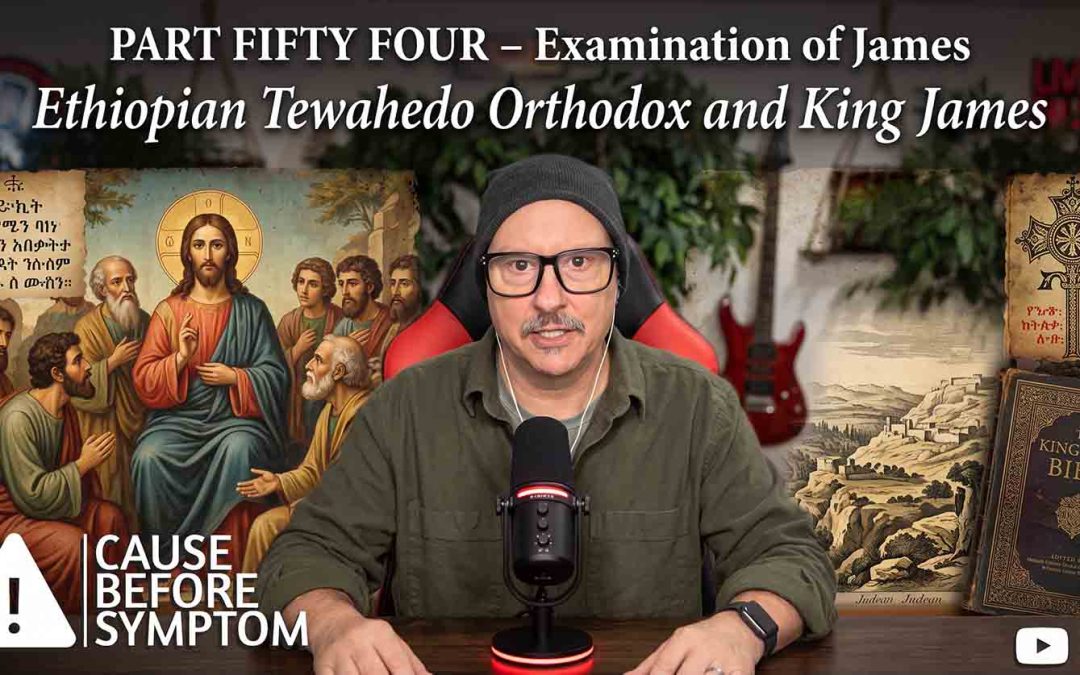
Watch this on Rumble: https://rumble.com/v7i69da-part-fifty-four-examination-of-james-ethiopian-tewahedo-orthodox-and-king-j.html
Opening – Is Faith Something We Believe or Something We Live?
Welcome to Cause Before Symptom, where we don't chase symptoms—we test the cause against Scripture.
Tonight, we continue our examination of the Ethiopian Tewahedo Orthodox Bible alongside the 1611 King James Bible. We have traveled through the Old Testament, examined the Gospels, and followed the writings of the apostles. Now, in Part Fifty Four, we arrive at the letter of James, a book that asks some of the most uncomfortable questions a Christian can face.
What does it mean to have faith? Is faith something we say we possess, or is it something that becomes visible in how we live? And when James tells us that faith without works is dead, is he placing another burden upon believers, or is he explaining what happens when faith is alive?
These are questions worth examining because Christians have struggled with them for centuries. Some have understood James as emphasizing obedience, while others have worried that his language makes salvation sound like something we must earn. But before accepting either interpretation, we need to hear what James actually wrote and determine whether the two biblical renderings lead us toward the same understanding.
Throughout this series, we have followed a simple method. We place the Ethiopian English translation beside the King James Bible. We examine the words, identify where they agree, and investigate where they differ. We do not assume that different wording means different Scripture. Sometimes the difference is simply the way a translator expresses the same thought. Other times, a particular word can influence how an entire passage is understood.
And when we find no meaningful difference, we will say so.
James is especially important because his letter deals with everyday life. He speaks about suffering, temptation, wealth, poverty, anger, the words we speak, the judgments we make, and the way we treat our neighbors. He challenges people who speak about faith while overlooking those who need compassion.
But there is another question I want us to carry throughout tonight's examination. What kind of God does James reveal?
Is God standing over humanity waiting for someone to fail? Is He demanding that we prove ourselves worthy through religious performance? Or is James describing a Father who gives wisdom generously, extends mercy, and calls His children to live according to the faith they have received?
We cannot answer those questions by selecting only the verses that support what we already believe. We must read the surrounding passages and allow both translations to speak before drawing conclusions.
There are also places where the wording deserves special attention. In chapter three, the translations describe the One we bless with our mouths somewhat differently. In chapter four, the language concerning the spirit and jealousy raises questions about interpretation. And in chapter five, James speaks about prayer, healing, confession, forgiveness, and saving a soul from death.
We will examine these passages carefully without claiming that every difference changes doctrine.
My purpose tonight is not to tell you which Bible to defend. It is to help us understand what has been preserved, what the words actually communicate, and whether our own assumptions have sometimes made Scripture more complicated than it needs to be.
Because salvation is not a prize awarded to the person who understands the most Scripture. Our hope rests in Jesus Christ.
And perhaps James will help us recognize something simple: faith is not a competition in religious knowledge. It is a relationship with God that changes how we love one another.
Let's begin our examination.
Investigation 1 – James 1:1–12: Does God Test Our Faith or Our Endurance?
James begins his letter by addressing people who have been scattered. They are not living in perfect circumstances. They are facing uncertainty, hardship, and the challenges of remaining faithful when life becomes difficult. Before offering them encouragement, James asks them to consider their suffering from a different perspective.
James 1:2–3.
Ethiopian Tewahedo Orthodox:
“My brothers, count it all joy when you fall into various trials, knowing that the testing of your faith produces patience.”
King James:
“My brethren, count it all joy when ye fall into divers temptations; Knowing this, that the trying of your faith worketh patience.”
Here we encounter our first difference. The Ethiopian English translation says “various trials,” while the King James says “divers temptations.”
To someone reading the King James today, temptation may suggest being enticed toward sin. But in the English of 1611, temptation could also mean a trial or test. The Greek word used here can describe testing, and the surrounding passage concerns the endurance produced through difficulty.
Therefore, the two translations are not presenting different teachings. The Ethiopian wording makes the intended meaning easier for a modern reader to recognize.
But notice something else. Neither translation says that God enjoys watching His children suffer. Both describe what faith can produce when it is tested. The emphasis is not on suffering as a punishment but on patience developing through adversity.
James continues in verse four.
Ethiopian Tewahedo Orthodox:
“But let patience have its perfect work, that you may be perfect and complete, lacking nothing.”
King James:
“But let patience have her perfect work, that ye may be perfect and entire, wanting nothing.”
Again, the meaning remains substantially the same. The Ethiopian uses “complete,” while the King James uses “entire.” Both describe maturity rather than a claim that human beings become incapable of making mistakes.
Now consider what James says when believers do not understand what they are experiencing.
James 1:5.
Ethiopian Tewahedo Orthodox:
“If any of you lacks wisdom, let him ask of God, who gives to all generously and without reproach, and it will be given to him.”
King James:
“If any of you lack wisdom, let him ask of God, that giveth to all men liberally, and upbraideth not; and it shall be given him.”
The Ethiopian says God gives without reproach. The King James says He “upbraideth not.” That older expression means God does not scold or rebuke someone merely for asking.
This matters because James does not describe a Father who humiliates His children for lacking understanding. He encourages them to ask.
Verses six through eight then warn against doubting and double-mindedness. Both translations preserve that warning. James is calling for trust rather than divided allegiance, although the passage does not explain every experience of uncertainty a believer might face.
Finally, James 1:12 promises the crown of life to those who endure and love the Lord. Both translations preserve that promise.
What have we discovered?
The first twelve verses reveal no substantial disagreement between our two English witnesses. Their vocabulary differs, but the teaching remains consistent.
James does not tell suffering believers to earn God's love. He encourages endurance, wisdom, and faithfulness.
And perhaps that is the first lesson we should carry forward. When life becomes difficult, we do not have to pretend that suffering is pleasant. We can ask God for wisdom while learning to remain faithful through what we do not yet understand.
Investigation 2 – James 1:13–27: Does God Tempt Us, or Do Our Own Desires Lead Us Away?
In our first investigation, James explained that trials can produce patience. But now he makes an important distinction. Being tested by difficult circumstances is not the same as being tempted toward evil. And if we misunderstand that difference, we may begin blaming God for something James says comes from within ourselves.
James 1:13.
Ethiopian Tewahedo Orthodox:
“Let no one say when he is tempted, ‘I am tempted by God,’ for God cannot be tempted by evil, nor does He Himself tempt anyone.”
King James:
“Let no man say when he is tempted, I am tempted of God: for God cannot be tempted with evil, neither tempteth he any man:”
The wording is remarkably close. Both translations reject the idea that God entices people toward evil. This matters because James has just discussed the testing of faith. Without reading the surrounding verses, someone might confuse the two teachings.
Now listen to verse fourteen.
Ethiopian Tewahedo Orthodox:
“But each one is tempted when he is drawn away by his own desire and enticed.”
King James:
“But every man is tempted, when he is drawn away of his own lust, and enticed.”
Here the Ethiopian uses “desire,” while the King James uses “lust.” Today, lust usually suggests sexual desire, but the older English word could describe a much broader appetite or craving.
James is describing the process through which human desire becomes temptation. Neither translation identifies God as the source.
Verse fifteen continues that progression. Desire conceives, sin develops, and sin brings forth death. Both witnesses preserve the same sequence.
But James does not leave us with human weakness. In verse seventeen, he reminds us where goodness originates.
Ethiopian Tewahedo Orthodox:
“Every good gift and every perfect gift is from above, coming down from the Father of lights, with whom there is no variation or shadow of turning.”
King James:
“Every good gift and every perfect gift is from above, and cometh down from the Father of lights, with whom is no variableness, neither shadow of turning.”
Again, the difference is largely English expression. Both describe God as the source of goodness, without the shifting character James associates with human temptation.
Then James turns from what we desire to how we behave.
In verses nineteen and twenty, both translations instruct believers to listen carefully, speak slowly, and restrain anger. Human anger, James tells us, does not produce God's righteousness.
But listen to verse twenty-two.
Ethiopian Tewahedo Orthodox:
“But be doers of the word, and not hearers only, deceiving yourselves.”
King James:
“But be ye doers of the word, and not hearers only, deceiving your own selves.”
There is no meaningful disagreement here. Both warn that hearing Scripture without responding to it can become self-deception.
James then compares such a person to someone looking into a mirror and immediately forgetting what he saw. The problem is not a lack of information. It is failing to respond to what has been revealed.
Finally, verse twenty-seven identifies pure religion with caring for orphans and widows in their affliction and remaining unspotted by the world.
Both translations preserve that responsibility.
So what have we discovered?
James does not blame God for our temptation, and he does not measure genuine religion merely by what someone claims to believe. He directs our attention toward our desires, our words, and our treatment of vulnerable people.
The two English witnesses agree on these central teachings.
And perhaps the question we should ask ourselves is not how much Scripture we have heard, but whether we are allowing what we hear to change how we treat one another.
Investigation 3 – James 2:1–13: Does God Measure People by Their Position in the World?
James now moves from personal faith to something we can observe in our churches, communities, and everyday relationships. He asks whether we can claim to follow Jesus Christ while treating people differently because of their wealth or position in society.
James 2:1.
Ethiopian Tewahedo Orthodox:
“My brothers, do not hold the faith of our glorious Lord Jesus Christ with respect of persons.”
King James:
“My brethren, have not the faith of our Lord Jesus Christ, the Lord of glory, with respect of persons.”
Notice the difference. The Ethiopian rendering calls Jesus “our glorious Lord Jesus Christ,” while the King James says “our Lord Jesus Christ, the Lord of glory.” The expressions differ, but both associate glory with Christ and forbid favoritism.
James then describes two people entering an assembly. One wears fine clothing and a gold ring. The other is poor and poorly dressed. The wealthy visitor receives a comfortable place, while the poor visitor is told to stand or sit beneath someone's footstool.
Both translations preserve this illustration. James is not condemning someone for owning fine clothing. He is confronting the decision to honor one person while humiliating another.
In verse four, James asks whether those making such distinctions have become judges with evil thoughts. The problem is not recognizing that people have different circumstances. The problem is allowing those circumstances to determine their worth.
Now consider James 2:5.
Ethiopian Tewahedo Orthodox:
“Listen, my beloved brothers: has not God chosen the poor of this world to be rich in faith and heirs of the kingdom which He has promised to those who love Him?”
King James:
“Hearken, my beloved brethren, Hath not God chosen the poor of this world rich in faith, and heirs of the kingdom which he hath promised to them that love him?”
The wording is remarkably close. Neither translation teaches that poverty automatically makes someone righteous. Both direct our attention toward faith and love for God rather than material possessions.
James then reminds his readers that wealthy and powerful people can also become oppressors. He speaks about those who drag others before judgment seats. This is a warning about the misuse of power, not a declaration that every wealthy person is wicked.
But listen to James 2:8.
Ethiopian Tewahedo Orthodox:
“If you really fulfill the royal law according to the Scripture, ‘You shall love your neighbor as yourself,’ you do well.”
King James:
“If ye fulfil the royal law according to the scripture, Thou shalt love thy neighbour as thyself, ye do well:”
Both witnesses preserve the same command. Love for our neighbor is not measured by how important that neighbor appears to the world.
Then James 2:9 warns that showing favoritism is sin. The Ethiopian uses the modern word “partiality,” while the King James continues with “respect to persons.” These are different English expressions for the same wrongdoing.
Finally, James 2:13.
Ethiopian Tewahedo Orthodox:
“For judgment is without mercy to the one who has shown no mercy; mercy triumphs over judgment.”
King James:
“For he shall have judgment without mercy, that hath shewed no mercy; and mercy rejoiceth against judgment.”
Here we find a difference worth hearing. The Ethiopian says mercy “triumphs,” while the King James says mercy “rejoiceth against” judgment. The underlying Greek expression can convey mercy boasting over judgment. The translations express that image differently without establishing opposing teachings.
What have we discovered?
Across these thirteen verses, both witnesses condemn favoritism, affirm love for one's neighbor, and warn against withholding mercy.
James is asking us to examine something more important than our religious appearance. When someone enters our lives with nothing to offer us, do we treat that person with the same dignity we would offer someone wealthy and influential?
Because the faith we profess must never become an excuse to withhold the mercy we ourselves hope to receive.
Investigation 4 – James 2:14–26: Can Faith Without Works Save Anyone?
We now arrive at one of the most debated passages in the New Testament. For centuries, Christians have wrestled with the relationship between faith and works. Some believe James is teaching that salvation requires human effort. Others believe he is describing what genuine faith produces. But rather than begin with either conclusion, we need to examine what the two biblical renderings actually say.
James 2:14.
Ethiopian Tewahedo Orthodox:
“What does it profit, my brothers, if someone says he has faith but does not have works? Can faith save him?”
King James:
“What doth it profit, my brethren, though a man say he hath faith, and have not works? can faith save him?”
The wording is remarkably close. But notice something important. James does not begin by describing someone who possesses genuine faith. He describes someone who says he has faith. That distinction matters because the question concerns whether a claim of faith, unsupported by action, is sufficient.
James immediately provides an example. A brother or sister lacks clothing and daily food. Someone offers kind words, wishing them warmth and nourishment, but provides nothing they actually need.
Both translations preserve this illustration. James is not discussing an abstract theological argument. He is describing a person who encounters suffering and responds with words instead of compassion.
Now consider James 2:17.
Ethiopian Tewahedo Orthodox:
“Thus also faith by itself, if it does not have works, is dead.”
King James:
“Even so faith, if it hath not works, is dead, being alone.”
The Ethiopian says “by itself,” while the King James says “being alone.” Both express the same condition. James is describing faith separated from action.
But we must be careful. James has not said that charitable deeds purchase salvation. He has said that faith without works is dead. Whether that distinction resolves the larger theological question requires us to continue reading.
In verse nineteen, James reminds his readers that even demons believe there is one God and tremble. His point is uncomfortable. Knowing something about God is not necessarily the same as trusting and following Him.
Then James turns to Abraham.
James 2:22.
Ethiopian Tewahedo Orthodox:
“Do you see that faith was working together with his works, and by works faith was made perfect?”
King James:
“Seest thou how faith wrought with his works, and by works was faith made perfect?”
Both witnesses describe faith and works operating together. The Ethiopian makes that relationship easier to hear in modern English, while the King James preserves the older expression “wrought with.”
Now we reach James 2:24.
Ethiopian Tewahedo Orthodox:
“You see then that a man is justified by works, and not by faith only.”
King James:
“Ye see then how that by works a man is justified, and not by faith only.”
There is no meaningful disagreement. Both say that a person is justified by works and not by faith alone.
We must not soften those words merely because they create theological discomfort. But neither should we ignore the preceding example, where Abraham's faith was active alongside his obedience.
James then introduces Rahab, whose actions demonstrated her response to what she believed.
Finally, verse twenty-six compares faith without works to a body without the spirit. Both translations preserve that image.
What have we discovered?
The Ethiopian and King James renderings agree on the central teaching. James rejects a profession of faith that remains disconnected from action.
The larger question is how this teaching relates to Paul's explanation of justification by faith. That requires careful comparison with Romans and Galatians, rather than assuming the apostles contradict one another.
For now, James leaves us with a question worth considering. If we say we trust God, but that trust never influences how we treat others, what exactly are we calling faith?
Investigation 5 – James 3:1–12: Can the Same Mouth Bless God and Curse His Children?
James now turns our attention toward something every human being possesses, something capable of bringing comfort or causing tremendous harm. Our words. And before discussing the tongue itself, James begins with a warning directed toward those who teach others.
James 3:1.
Ethiopian Tewahedo Orthodox:
“My brothers, let not many of you become teachers, knowing that we shall receive a stricter judgment.”
King James:
“My brethren, be not many masters, knowing that we shall receive the greater condemnation.”
Here we encounter an important difference in English expression. The Ethiopian says “teachers,” while the King James says “masters.” The Greek word refers to teachers, not necessarily people who exercise ownership or control over others.
But there is another distinction. The Ethiopian says “stricter judgment,” while the King James says “greater condemnation.”
To modern ears, condemnation can sound like an automatic declaration of guilt. Judgment, however, describes an evaluation that may result in accountability. The Greek word used here refers to judgment, although the warning clearly carries serious consequences.
James is not saying that everyone who teaches will automatically be condemned. He is warning that those who instruct others bear greater responsibility for what they say.
This matters because religious teachers influence how people understand God. Their words can encourage faith, but they can also introduce confusion, fear, and unnecessary burdens.
James continues by comparing the tongue to a small bit placed in a horse's mouth and a small rudder controlling a large ship. Both translations preserve these illustrations. Something physically small can direct something much larger.
Then James 3:6 describes the tongue as a fire capable of defiling the entire body. The warning is severe because words can spread harm far beyond the person who speaks them.
But the passage becomes especially important when James reaches verse nine.
Ethiopian Tewahedo Orthodox:
“With it we bless our Lord and Father, and with it we curse men, who have been made in the likeness of God.”
King James:
“Therewith bless we God, even the Father; and therewith curse we men, which are made after the similitude of God.”
Notice the difference. The Ethiopian English rendering says “our Lord and Father,” while the King James says “God, even the Father.”
This is more than a difference between old and modern English. Greek manuscripts preserve different readings at this point, including forms referring to the Lord and to God. The distinction deserves recognition, although both readings identify the One being blessed as Father.
Neither translation changes James's central argument. We cannot reasonably claim to honor God while deliberately dishonoring human beings made in His likeness.
James then asks whether a spring can produce both fresh and bitter water from the same opening. He asks whether a fig tree can produce olives or a grapevine produce figs.
Both witnesses preserve these examples. James is describing the contradiction between the identity we profess and the conduct we demonstrate.
But notice what James does not say. He does not claim that a believer who speaks wrongly has permanently lost God's mercy. He exposes a contradiction that requires correction.
And perhaps this is where the passage becomes personal.
We can study Scripture for years, memorize passages, and explain complicated doctrines. Yet if our words humiliate people, spread accusations, or encourage hatred, James asks us to examine what our speech reveals.
The Ethiopian and King James renderings agree on that warning.
Our words matter because the people hearing them matter. And if we truly believe that human beings were made in God's likeness, then how we speak about them must reflect that belief.
Investigation 6 – James 3:13–18: Does Wisdom Produce Peace or Give Us Power Over Others?
In our previous investigation, James warned that the tongue can bless God while harming people made in His likeness. Now he takes us deeper. He asks where our words and behavior originate. Are they coming from wisdom, or are they coming from jealousy, ambition, and the desire to be recognized as important?
James 3:13.
Ethiopian Tewahedo Orthodox:
“Who is wise and understanding among you? Let him show by good conduct that his works are done in the meekness of wisdom.”
King James:
“Who is a wise man and endued with knowledge among you? let him shew out of a good conversation his works with meekness of wisdom.”
Here the Ethiopian rendering says “good conduct,” while the King James says “good conversation.” Today, conversation usually means speaking with someone. But in older English, it could describe a person's entire manner of life.
Both translations are therefore addressing behavior, not merely speech. James is asking people who claim wisdom to demonstrate it through the way they live.
But notice the final expression. Both preserve the connection between wisdom and meekness. James does not describe wisdom as the ability to defeat others in an argument. He associates it with humility.
Now consider James 3:14.
Ethiopian Tewahedo Orthodox:
“But if you have bitter envy and self-seeking in your hearts, do not boast and lie against the truth.”
King James:
“But if ye have bitter envying and strife in your hearts, glory not, and lie not against the truth.”
The Ethiopian uses “self-seeking,” while the King James uses “strife.” These expressions emphasize different aspects of the problem. Self-seeking points toward selfish ambition, while strife suggests conflict and rivalry.
The Greek word in this passage can describe selfish ambition or contentious rivalry. Neither English rendering captures every possible shade of meaning.
That matters because James is exposing something that can hide behind religious certainty. A person may speak confidently about truth while being motivated by personal advantage.
James 3:15.
Ethiopian Tewahedo Orthodox:
“This wisdom does not descend from above, but is earthly, sensual, demonic.”
King James:
“This wisdom descendeth not from above, but is earthly, sensual, devilish.”
The Ethiopian says “demonic,” while the King James says “devilish.” Both describe wisdom that does not originate with God. Neither translation teaches that every disagreement between Christians is caused by demons.
James identifies the problem through its results. Where envy and selfish ambition dominate, disorder and evil practices follow.
Then comes the contrast.
James 3:17.
Ethiopian Tewahedo Orthodox:
“But the wisdom that is from above is first pure, then peaceable, gentle, willing to yield, full of mercy and good fruits, without partiality and without hypocrisy.”
King James:
“But the wisdom that is from above is first pure, then peaceable, gentle, and easy to be intreated, full of mercy and good fruits, without partiality, and without hypocrisy.”
The Ethiopian says “willing to yield.” The King James says “easy to be intreated.” Both describe someone open to reason and persuasion rather than stubbornly defending personal pride.
But this does not mean abandoning truth simply to avoid disagreement. James places purity before peace. His description joins moral integrity with humility, mercy, and a willingness to listen.
Finally, verse eighteen connects righteousness with peacemaking. Both translations preserve that relationship.
What have we discovered?
The two witnesses agree that wisdom is recognized through its fruit. James does not measure wisdom by education, status, or the ability to silence an opponent.
He asks whether our conduct produces mercy, humility, and peace.
And perhaps that gives us a valuable test for our own examination of Scripture. If our pursuit of truth makes us increasingly arrogant, hostile, and unwilling to listen, James challenges us to ask whether we are displaying the wisdom we claim to possess.
Investigation 7 – James 4:1–10: Is God Jealous, or Is the Human Spirit Envious?
James has just explained the difference between wisdom that comes from God and wisdom driven by selfish ambition. Now he asks a question that brings the entire discussion into our own hearts. Where do our conflicts actually begin? Are they caused by the people around us, or are they sometimes the result of desires we have allowed to control us?
James 4:1.
King James:
“From whence come wars and fightings among you? come they not hence, even of your lusts that war in your members?”
The Ethiopian English rendering likewise connects conflict with desires struggling within us. The King James uses the older word “lusts,” which can refer to cravings and appetites beyond sexual desire.
James is not claiming that every war or disagreement has one simple cause. He is addressing the quarrels among his readers and asking them to examine their own motives before blaming others.
In verses two and three, James describes people who desire what they cannot obtain. They fight, struggle, and even pray for things they intend to consume upon their own pleasures.
The King James calls these “lusts,” while the Ethiopian English rendering expresses the idea in terms of desires and pleasures. The central warning remains the same. Even prayer can become self-serving when we seek only to satisfy ourselves.
Then James speaks about friendship with the world and hostility toward God. His concern is not ordinary friendship with people outside the faith. It is allegiance to values that contradict what God asks of us.
But now we arrive at one of the most difficult verses in the entire letter.
James 4:5.
Ethiopian English rendering:
“The Spirit that dwells in us yearns jealously.”
King James:
“Do ye think that the scripture saith in vain, The spirit that dwelleth in us lusteth to envy?”
Notice the difference. The Ethiopian rendering capitalizes “Spirit” and uses “yearns jealously.” The King James uses a lowercase “spirit” and says “lusteth to envy.”
This is not simply a matter of modernizing old English. The underlying Greek sentence is difficult, and interpreters disagree about whose spirit is being described and how the language of jealousy should be understood.
One interpretation understands the verse as describing God's jealous concern for those who belong to Him. Another understands it as describing the human spirit's tendency toward envy.
The capitalization in the Ethiopian English rendering supports one interpretation, but capitalization in an English translation does not, by itself, settle what the ancient Greek means.
And we should not pretend that it does.
The surrounding passage speaks repeatedly about human desires, conflict, pride, and divided loyalty. Those themes are important evidence, but the verse remains disputed.
Now listen to James 4:6.
King James:
“But he giveth more grace. Wherefore he saith, God resisteth the proud, but giveth grace unto the humble.”
The Ethiopian English rendering preserves the same promise of grace to the humble.
Whatever interpretation we adopt for verse five, verse six gives us something unmistakable. God gives grace. James does not leave his readers trapped beneath their failures.
He calls them to resist the devil, draw near to God, cleanse their hands, purify their hearts, and humble themselves before the Lord.
Both translations preserve those instructions and the promise that God will lift up those who humble themselves.
What have we discovered?
James 4:5 presents a genuine interpretive difficulty. We cannot honestly declare that the two English renderings prove one explanation beyond dispute.
But the larger passage is clear. James confronts selfish desire and pride while inviting his readers to return to God.
And perhaps that is the lesson we should carry forward. When Scripture presents a difficult question, humility means acknowledging what we do not know while remaining faithful to what the passage clearly teaches.
Investigation 8 – James 4:11–17: Who Has the Right to Judge Another Person?
James has just warned his readers about pride, selfish desires, and the importance of humility before God. Now he turns toward something that can quietly destroy relationships, especially among people who believe they are defending what is right. He begins talking about how we judge one another.
James 4:11.
Ethiopian Tewahedo Orthodox:
“Do not speak evil of one another, brothers. He who speaks evil of a brother and judges his brother, speaks evil of the law and judges the law.”
King James:
“Speak not evil one of another, brethren. He that speaketh evil of his brother, and judgeth his brother, speaketh evil of the law, and judgeth the law.”
The two English renderings are remarkably close. Both warn against speaking evil of another person and placing ourselves in judgment over them.
But we must understand what James is saying. He is not forbidding every form of moral discernment. Scripture repeatedly calls believers to recognize wrongdoing, correct harmful behavior, and distinguish truth from deception.
James is confronting something different. He is warning against treating another person as though we possess God's authority to pronounce their final worth or standing.
Remember what we examined in chapter two. James commanded believers to love their neighbors as themselves. Now he explains what happens when we abandon that command and begin speaking against those same neighbors.
James 4:12.
Ethiopian Tewahedo Orthodox:
“There is one Lawgiver and Judge, who is able to save and to destroy. Who are you to judge another?”
King James:
“There is one lawgiver, who is able to save and to destroy: who art thou that judgest another?”
Here we encounter a difference worth examining. The Ethiopian English rendering explicitly says “Lawgiver and Judge,” while the King James says “lawgiver.”
The Greek textual tradition includes a variation concerning the explicit mention of a judge. But the surrounding passage already concerns judgment, and both translations identify God as the One possessing ultimate authority over salvation and destruction.
Neither version gives human beings permission to replace God's judgment with their own.
Then James changes the subject in a way that may initially seem surprising.
James 4:13.
Ethiopian Tewahedo Orthodox:
“Come now, you who say, ‘Today or tomorrow we will go to such and such a city, spend a year there, buy and sell, and make a profit.’”
King James:
“Go to now, ye that say, To day or to morrow we will go into such a city, and continue there a year, and buy and sell, and get gain:”
Both describe people confidently planning their business affairs. James does not condemn commerce, planning, or earning money. His concern is the assumption that tomorrow belongs to us.
In verse fourteen, James reminds his readers that human life is like a vapor appearing briefly before vanishing.
Then comes verse fifteen.
Ethiopian Tewahedo Orthodox:
“Instead you ought to say, ‘If the Lord wills, we shall live and do this or that.’”
King James:
“For that ye ought to say, If the Lord will, we shall live, and do this, or that.”
The message is the same. Human beings may make plans, but they do not control the future.
Notice how these teachings connect. Earlier, James warned against assuming authority over another person's judgment. Now he warns against assuming authority over tomorrow.
Both mistakes begin with human pride.
Finally, James 4:17.
Ethiopian Tewahedo Orthodox:
“Therefore, to him who knows to do good and does not do it, to him it is sin.”
King James:
“Therefore to him that knoweth to do good, and doeth it not, to him it is sin.”
There is no meaningful disagreement.
James reminds us that wrongdoing is not limited to harmful actions. Knowing that something good should be done and deliberately refusing to do it also carries moral responsibility.
What have we discovered?
Both witnesses warn against arrogance in judgment, confidence in our own control, and the refusal to do what we know is right.
James is not asking us to abandon discernment or stop making plans. He is asking us to remember our limitations.
We can recognize wrongdoing without pretending to know another person's heart. We can prepare for tomorrow without pretending tomorrow is guaranteed.
And perhaps humility begins when we stop trying to occupy God's position and start accepting the responsibilities He has already placed before us.
Investigation 9 – James 5:1–12: Is God's Judgment Directed at Wealth or at Injustice?
James now delivers one of the strongest warnings in his entire letter. He speaks directly to wealthy people, describing misery, corruption, unpaid wages, and the suffering of those who have been mistreated. But before deciding that James is condemning wealth itself, we need to examine what he actually says.
James 5:1.
Ethiopian Tewahedo Orthodox:
“Come now, you rich, weep and howl for your miseries that are coming upon you!”
King James:
“Go to now, ye rich men, weep and howl for your miseries that shall come upon you.”
The wording is nearly identical. Both translations announce coming misery. But neither verse, standing alone, explains why these wealthy people are being warned. For that answer, we must continue reading.
In verses two and three, James describes riches becoming corrupted, garments eaten by moths, and gold and silver becoming corroded. These images describe wealth that cannot provide lasting security.
Then James identifies something far more serious.
James 5:4.
Ethiopian Tewahedo Orthodox:
“Indeed the wages of the laborers who mowed your fields, which you kept back by fraud, cry out; and the cries of the reapers have reached the ears of the Lord of hosts.”
King James:
“Behold, the hire of the labourers who have reaped down your fields, which is of you kept back by fraud, crieth: and the cries of them which have reaped are entered into the ears of the Lord of sabaoth.”
Here we encounter an important difference in English wording. The Ethiopian says “Lord of hosts,” while the King James says “Lord of sabaoth.”
Sabaoth is a transliteration of a Hebrew expression referring to hosts or armies. Both translations preserve the same divine title. The King James retains its traditional form, while the Ethiopian English rendering communicates its meaning.
But the larger message deserves our attention. James identifies workers whose wages have been withheld through fraud. Their suffering has not escaped God's notice.
This is not merely a warning about possessing money. It is a warning about acquiring or protecting wealth through injustice.
James continues in verse five.
Ethiopian Tewahedo Orthodox:
“You have lived on the earth in pleasure and luxury; you have fattened your hearts as in a day of slaughter.”
King James:
“Ye have lived in pleasure on the earth, and been wanton; ye have nourished your hearts, as in a day of slaughter.”
The Ethiopian says “luxury,” while the King James uses “wanton,” an older word that can describe indulgent and unrestrained living.
Both describe people enjoying abundance while ignoring the consequences of their conduct.
Then verse six speaks about condemning and killing the just person who does not resist. James's accusation has moved beyond greed into serious oppression.
But something changes in verse seven. James turns toward those who are suffering and tells them to be patient until the coming of the Lord.
He compares their waiting to a farmer who patiently awaits the precious fruit of the earth. Both translations preserve this illustration.
James is not telling the oppressed that injustice is acceptable. He is encouraging endurance while reminding them that their suffering is not forgotten.
In verses nine through twelve, he warns against grumbling, recalls the patience of the prophets, and points toward Job.
James 5:11 describes the Lord as compassionate and merciful. The King James says the Lord is “very pitiful, and of tender mercy.” Here “pitiful” carries its older meaning of being full of pity or compassion.
What have we discovered?
Both English witnesses condemn fraudulent withholding of wages, oppressive conduct, and selfish indulgence. Neither establishes that every wealthy person is condemned simply for possessing wealth.
James directs his strongest warning toward people whose prosperity is accompanied by injustice.
And perhaps the question for us is not whether someone has more money than we do. It is whether that wealth was obtained and maintained through fairness, honesty, and respect for others.
Because according to James, the cries of those who suffer injustice do not disappear simply because the powerful refuse to listen.
Investigation 10 – James 5:13–20: Who Heals, Who Forgives, and Who Saves a Soul From Death?
We have reached the final investigation in the letter of James. Throughout this examination, James has challenged how we understand faith, how we treat our neighbors, and how we respond to suffering. Now he closes with something deeply personal. He speaks about prayer, sickness, confession, forgiveness, and helping someone who has wandered from the truth.
James 5:13.
Ethiopian Tewahedo Orthodox:
“Is anyone among you suffering? Let him pray. Is anyone cheerful? Let him sing psalms.”
King James:
“Is any among you afflicted? let him pray. Is any merry? let him sing psalms.”
The Ethiopian uses “suffering” and “cheerful,” while the King James uses “afflicted” and “merry.” The meaning remains consistent. James encourages believers to turn toward God in both difficult and joyful circumstances.
Then James addresses sickness.
James 5:14.
Ethiopian Tewahedo Orthodox:
“Is anyone among you sick? Let him call for the elders of the church, and let them pray over him, anointing him with oil in the name of the Lord.”
King James:
“Is any sick among you? let him call for the elders of the church; and let them pray over him, anointing him with oil in the name of the Lord:”
There is no meaningful disagreement. Both describe the sick person calling upon church elders for prayer and anointing.
But notice what James does not say. He does not instruct believers to purchase healing, seek a particular religious celebrity, or prove their worthiness before receiving prayer.
Now consider verse fifteen.
Ethiopian Tewahedo Orthodox:
“And the prayer of faith will save the sick, and the Lord will raise him up. And if he has committed sins, he will be forgiven.”
King James:
“And the prayer of faith shall save the sick, and the Lord shall raise him up; and if he have committed sins, they shall be forgiven him.”
Both translations identify the Lord as the One who raises the sick person. Both also connect the passage with forgiveness.
The Greek word translated “save” can carry meanings involving rescue, preservation, and healing. Its meaning must be understood within the surrounding passage.
We should also be careful not to turn James's encouragement into an accusation against people who remain ill. The passage does not establish that every sickness results from personal sin or that every unanswered prayer proves insufficient faith.
Then James 5:16.
Ethiopian Tewahedo Orthodox:
“Confess your trespasses to one another, and pray for one another, that you may be healed.”
King James:
“Confess your faults one to another, and pray one for another, that ye may be healed.”
Here the Ethiopian says “trespasses,” while the King James says “faults.” The underlying Greek textual tradition contains variation in this expression, and the words can influence how broadly confession is understood.
But both witnesses preserve the central instruction: believers should pray for one another rather than conceal every struggle behind an appearance of perfection.
James then recalls Elijah, whom the King James calls Elias. These are different forms of the same prophet's name. Both accounts describe his prayers concerning rain.
Finally, James 5:19–20 addresses someone who wanders from the truth and another person who helps bring that individual back.
Both translations describe turning a sinner from error, saving a soul from death, and covering a multitude of sins.
But James does not say that the person offering correction becomes the source of salvation. The passage describes the importance of helping someone return from a destructive path.
What have we discovered?
The two English witnesses agree on prayer, care for the sick, confession, forgiveness, and restoring those who wander.
James closes without presenting faith as a competition for religious authority. Instead, he describes a community whose members care for one another.
And perhaps that is a fitting place to end our investigations. The faith James describes is not merely something we defend with our mouths. It becomes visible when we pray for the suffering, show mercy to the struggling, and help one another find the way home.
Conclusion – James: What Remains When We Let the Words Speak?
Tonight, we have completed our examination of the letter of James, placing the Ethiopian Tewahedo Orthodox English rendering alongside the King James Bible. We have examined all five chapters, looking for differences that might change how we understand faith, salvation, obedience, judgment, forgiveness, and the character of God.
And what have we discovered?
First, the two English renderings agree far more often than they disagree. We encountered differences in vocabulary, older expressions, and the way certain passages are translated. But we did not discover two different messages about what James expects from those who follow Jesus Christ.
James begins with suffering and endurance. He reminds believers that difficult circumstances can strengthen patience, while also making clear that God does not tempt people toward evil. Both translations preserve that distinction. God is described as the giver of good gifts, not the author of wickedness.
Then James confronts something that should make every Christian uncomfortable. He warns against hearing Scripture without allowing it to influence our behavior. He condemns favoritism, especially when wealthy people receive honor while poor people are treated as though they have less value.
Both witnesses preserve that warning.
But perhaps the greatest challenge comes in chapter two, where James declares that faith without works is dead. Neither translation removes those words. Neither softens the statement that a person is justified by works and not by faith only.
We must allow those words to stand.
At the same time, James describes faith working together with action. He gives us Abraham and Rahab as examples. His concern is not simply what people claim to believe, but whether their trust becomes visible through what they do.
This does not settle every theological debate about salvation. Those questions require us to examine James alongside the other apostolic writings. But it does prevent us from pretending that James considered a profession of faith sufficient regardless of how someone lived.
Then we examined the tongue.
James reminds us that the same mouth can bless God and curse human beings made in His likeness. The Ethiopian rendering speaks of blessing our Lord and Father, while the King James speaks of blessing God, even the Father. This difference deserves textual examination, but neither reading excuses cruelty toward our neighbors.
We also encountered a difficult passage in James chapter four concerning the spirit and jealousy. Here we found genuine uncertainty about interpretation. Rather than force an answer, we acknowledged what the wording does and does not establish.
And that matters.
If our purpose is to discover truth, then admitting uncertainty is not a failure. It is part of examining Scripture faithfully.
James then warns against judging others arrogantly, assuming control over tomorrow, and withholding what we know is right. He condemns those who become wealthy through injustice, especially those who refuse to pay workers what they have earned.
Finally, he calls believers to pray for the sick, confess their faults, forgive, and help those who have wandered from the truth.
Look at what connects these teachings.
James continually moves our attention away from religious appearances and toward the way we live with one another.
But I want to leave you with something important.
We must not turn this letter into another burden that convinces struggling believers they can never do enough to please God. James also speaks about wisdom generously given, grace offered to the humble, and a Lord who is compassionate and merciful.
The question is not whether we can achieve perfection through our own efforts. The question is whether the faith we profess is changing how we live.
And perhaps that is what remains when we let the words speak.
Faith is not a competition in knowledge. Mercy is not weakness. Humility is not ignorance. And loving our neighbor is not separate from following Jesus Christ.
Until next time, keep examining, keep questioning, and never be afraid to correct what you thought you understood.
God bless you, and thank you for joining me on Cause Before Symptom.
Bibliography
- The Ethiopian Bible. Geʽez to English edition supplied for this examination. Modern English compilation, publication details unverified.
- The Holy Bible, King James Version, with Apocrypha. 1611. Digital transcription supplied for this examination.
- Aland, Kurt, Barbara Aland, Johannes Karavidopoulos, Carlo M. Martini, and Bruce M. Metzger, eds. The Greek New Testament. 5th revised edition. Stuttgart: Deutsche Bibelgesellschaft, 2014.
- Bauckham, Richard. James: Wisdom of James, Disciple of Jesus the Sage. London: Routledge, 1999.
- Blomberg, Craig L., and Mariam J. Kamell. James. Zondervan Exegetical Commentary on the New Testament. Grand Rapids: Zondervan, 2008.
- Davids, Peter H. The Epistle of James: A Commentary on the Greek Text. New International Greek Testament Commentary. Grand Rapids: Eerdmans, 1982.
- Dibelius, Martin. James: A Commentary on the Epistle of James. Revised by Heinrich Greeven. Translated by Michael A. Williams. Philadelphia: Fortress Press, 1976.
- Ehrman, Bart D. The Orthodox Corruption of Scripture: The Effect of Early Christological Controversies on the Text of the New Testament. 2nd edition. New York: Oxford University Press, 2011.
- Johnson, Luke Timothy. The Letter of James: A New Translation with Introduction and Commentary. Anchor Bible 37A. New York: Doubleday, 1995.
- Laws, Sophie. A Commentary on the Epistle of James. Harper's New Testament Commentaries. San Francisco: Harper & Row, 1980.
- McCartney, Dan G. James. Baker Exegetical Commentary on the New Testament. Grand Rapids: Baker Academic, 2009.
- Metzger, Bruce M. A Textual Commentary on the Greek New Testament. 2nd edition. Stuttgart: Deutsche Bibelgesellschaft, 1994.
- Moo, Douglas J. The Letter of James. Pillar New Testament Commentary. Grand Rapids: Eerdmans, 2000.
- Nestle, Eberhard, Erwin Nestle, Barbara Aland, and Kurt Aland, eds. Novum Testamentum Graece. 28th revised edition. Stuttgart: Deutsche Bibelgesellschaft, 2012.
- Ullendorff, Edward. Ethiopia and the Bible. London: Oxford University Press, 1968.
- Wall, Robert W. Community of the Wise: The Letter of James. New Testament in Context. Valley Forge, PA: Trinity Press International, 1997.
Endnotes
- The examination of James compares the modern English rendering contained in the supplied Ethiopian Bible compilation with the supplied King James Bible transcription. These are the two English witnesses used throughout Part Fifty Four. Differences between them should not automatically be treated as differences between ancient Geʽez and Greek manuscripts. Establishing an ancient textual variant requires examination of the underlying manuscripts and their transmission histories.
- James 1:2–4 distinguishes the testing of faith from the temptation toward evil discussed in James 1:13–15. The King James expression “divers temptations” reflects older English usage in which temptation could describe a trial or test. The modern expression “various trials” makes that meaning clearer. Both readings connect the testing of faith with the development of patience and endurance.
- James 1:5 describes God as giving wisdom liberally and without reproach. The King James phrase “upbraideth not” means that God does not rebuke someone merely for asking. This is important when examining the character of God because the passage presents divine generosity rather than humiliation as the response to a sincere request for wisdom.
- James 1:14 uses language concerning desire and temptation. The King James word “lust” had a broader meaning in earlier English than its common modern association with sexual desire. The passage describes human desires becoming occasions for temptation. It does not establish that every desire is sinful.
- James 1:22–27 connects hearing Scripture with responding through action. The reference to caring for orphans and widows identifies practical compassion as an expression of genuine religion. The passage should not be reduced to outward religious performance, because James also emphasizes restraint of the tongue and personal integrity.
- James 2:1–13 addresses favoritism toward wealthy people and humiliation of the poor. The expression “respect of persons” refers to partiality or preferential treatment. James does not condemn every person who possesses wealth. He condemns the practice of assigning greater human worth or honor according to social and economic position.
- James 2:8 identifies the command to love one's neighbor as oneself as the royal law. James 2:13 then connects judgment with mercy. The King James expression “mercy rejoiceth against judgment” and the modern expression “mercy triumphs over judgment” communicate closely related meanings. The Greek wording carries the image of mercy boasting or prevailing over judgment.
- James 2:14–26 must be examined in its complete argument. James begins by questioning the value of someone saying that he possesses faith while providing no corresponding action. His examples of neglected physical needs, Abraham, and Rahab connect genuine faith with conduct. The passage should not be interpreted solely from verse twenty-four without considering those examples.
- James 2:24 explicitly states in both English witnesses that a person is justified by works and not by faith only. This wording should not be omitted or softened. Its relationship to Paul's teaching in Romans 3–4 and Galatians 2–3 requires careful comparison of context, the meaning of justification, and the different arguments being addressed. The examination of James alone does not settle every question in that larger theological discussion.
- James 3:1 warns that teachers face greater judgment. The King James word “masters” reflects an older translation of the Greek term for teachers. The Greek word translated “judgment” does not by itself establish that every teacher will be condemned. The warning concerns heightened responsibility and accountability.
- James 3:9 contains a textual variation of particular importance to this examination. Greek witnesses differ between wording referring to the Lord and wording referring to God in the expression concerning blessing the Father. The Ethiopian English rendering used in the show says “our Lord and Father,” while the King James says “God, even the Father.” The difference is not adequately explained as modernization of English alone. A definitive claim about the ancient Ethiopian reading would require direct examination of the Geʽez textual evidence.
- James 3:13 uses the King James expression “good conversation.” In seventeenth-century English, conversation could describe a person's conduct or manner of life rather than spoken communication alone. Both English renderings therefore connect wisdom with observable behavior and meekness.
- James 3:14–18 distinguishes wisdom associated with envy and selfish ambition from wisdom characterized by purity, peace, gentleness, mercy, and sincerity. The King James expression “easy to be intreated” describes a willingness to listen or respond to persuasion. This does not require abandoning moral conviction simply to avoid disagreement.
- James 4:1–3 connects quarrels with conflicting desires and warns against asking for things merely to satisfy selfish pleasures. The passage addresses the motives behind conflict and prayer. It should not be generalized into a claim that every disagreement, unanswered prayer, or human conflict has the same cause.
- James 4:5 is among the most difficult passages in the letter to translate and interpret. The underlying Greek permits competing explanations concerning the spirit, desire, and jealousy. Some interpretations understand the passage as referring to God's jealous concern, while others understand it as describing the human spirit's inclination toward envy. English capitalization of “Spirit” is an editorial decision and cannot independently establish the intended referent. The passage should remain an acknowledged interpretive question rather than a settled doctrinal difference between the two English witnesses.
- James 4:6 quotes the teaching that God resists the proud but gives grace to the humble. The surrounding verses call for repentance, submission to God, and drawing near to Him. The promise of grace is essential to the passage and prevents its warnings from being interpreted as though human beings must restore themselves without divine help.
- James 4:11–12 distinguishes wrongful judgment of one's neighbor from legitimate moral discernment. The Greek textual tradition contains variation concerning the explicit reference to a judge alongside the lawgiver. Both English witnesses nevertheless affirm God's ultimate authority. The passage does not eliminate the responsibility to recognize wrongdoing or protect others from harm.
- James 4:13–17 warns against boasting about plans as though the future were guaranteed. The instruction to acknowledge the Lord's will does not prohibit business, planning, or responsible preparation. Verse seventeen also identifies the failure to perform known good actions as morally significant.
- James 5:1–6 contains specific accusations involving fraudulent withholding of wages, luxury, oppression, and condemnation of the righteous. These details are necessary when evaluating whether James condemns wealth itself or the unjust conduct of particular wealthy people. The passage strongly condemns economic injustice without establishing that every wealthy person is guilty of the offenses described.
- James 5:4 uses the divine title rendered “Lord of hosts” in modern English and “Lord of sabaoth” in the King James. Sabaoth represents the Hebrew term for hosts or armies. The expressions refer to the same title and do not establish different identities or characters of God.
- James 5:11 describes the Lord's compassion and mercy. The King James expression “very pitiful” reflects an older meaning associated with pity and compassion. It should not be confused with the modern use of “pitiful” to describe someone as weak or contemptible.
- James 5:14–15 instructs sick believers to call upon church elders for prayer and anointing with oil. The passage attributes the raising of the sick person to the Lord. Its wording should not be used to guarantee that every illness will immediately disappear or to accuse those who remain ill of lacking faith.
- James 5:16 concerns confession and prayer among believers. The King James uses “faults,” while the Ethiopian English rendering supplied for the examination uses “trespasses.” Greek textual witnesses differ in this expression. The broader instruction concerning mutual confession and prayer remains present, but the precise textual variation deserves separate manuscript examination before conclusions are drawn about its historical origin.
- James 5:17–18 refers to Elijah, called Elias in the King James. These are different forms of the same prophet's name and do not identify separate individuals. The example emphasizes prayer through the experience of a human being subject to ordinary human limitations.
- James 5:19–20 closes the letter by describing the restoration of someone who has wandered from the truth. The language concerning saving a soul from death and covering a multitude of sins should be read within that setting. The person who helps restore another is not thereby identified as an independent source of salvation.
- Across the five chapters of James, the two supplied English witnesses preserve the same broad sequence of teaching concerning endurance, temptation, practical faith, impartiality, speech, wisdom, humility, economic justice, prayer, and restoration. Their differences include ordinary translation choices as well as passages requiring closer textual examination. This conclusion applies to the English texts compared and should not be represented as a completed critical collation of the Ethiopian Geʽez manuscript tradition.
- The purpose of this examination is to distinguish what the texts actually say from what readers may assume they say. Where wording agrees, agreement should be acknowledged. Where a difference affects interpretation, it should be investigated. Where the available evidence does not establish a definitive answer, uncertainty should be preserved rather than replaced with an unsupported conclusion.
#CauseBeforeSymptom, #BookOfJames, #EthiopianBible, #KingJamesBible, #EthiopianOrthodox, #Tewahedo, #BibleComparison, #ScriptureStudy, #FaithAndWorks, #FaithWithoutWorks, #ChristianFaith, #BiblicalTruth, #BibleStudy, #JesusChrist, #GodsMercy, #FaithAndObedience, #ChristianDiscernment, #BiblicalWisdom, #PrayerAndHealing, #LoveYourNeighbor, #Christianity, #JamesChapter2, #BiblicalExamination, #TruthInScripture, #JamesCarner
CauseBeforeSymptom, BookOfJames, EthiopianBible, KingJamesBible, EthiopianOrthodox, Tewahedo, BibleComparison, ScriptureStudy, FaithAndWorks, FaithWithoutWorks, ChristianFaith, BiblicalTruth, BibleStudy, JesusChrist, GodsMercy, FaithAndObedience, ChristianDiscernment, BiblicalWisdom, PrayerAndHealing, LoveYourNeighbor, Christianity, JamesChapter2, BiblicalExamination, TruthInScripture, JamesCarner