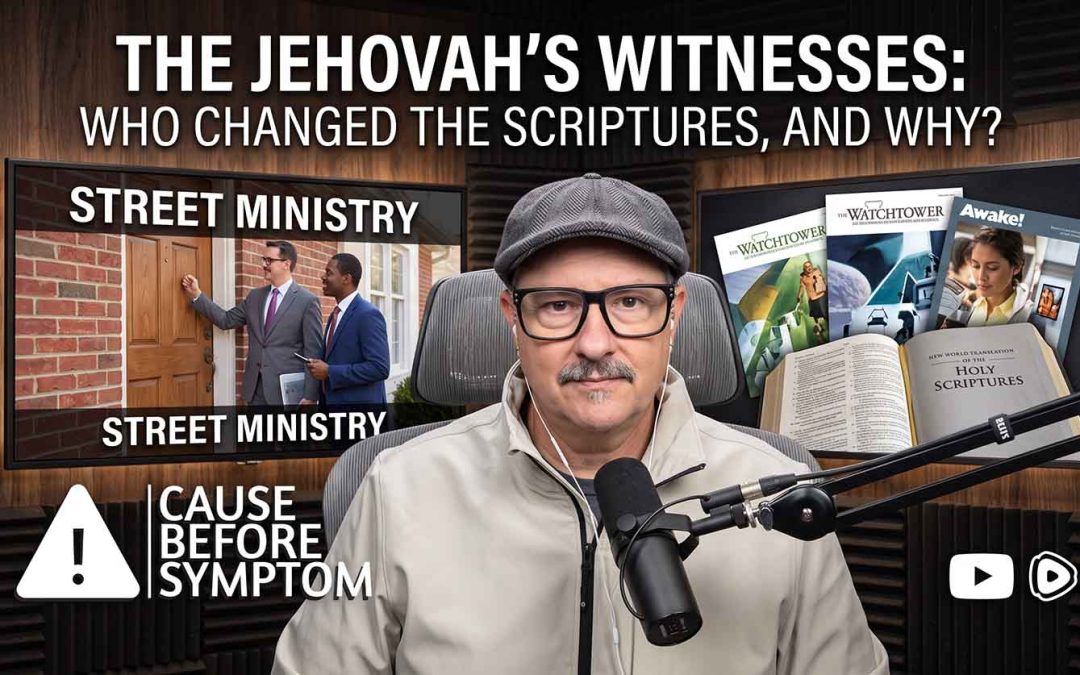
Watch this on Rumble: https://rumble.com/v7gqhly-the-jehovahs-witnesses-who-changed-the-scriptures-and-why.html
Opening — When One Word Changes Everything
Welcome to Cause Before Symptom, where we don’t chase symptoms—we test the cause against Scripture.
Tonight, I want to ask a question that reaches into the very foundation of Christianity. What happens when a religious organization teaches millions of people about Jesus Christ, but the Bible it places in their hands contains wording that differs from the Scriptures Christians have read for centuries? What happens when one word changes the meaning of a passage, and that passage becomes the foundation for an entire doctrine? And perhaps most importantly, who made those decisions, and why?
Tonight, I am investigating the Jehovah’s Witnesses.
Most people recognize them as the individuals who knock on doors, distribute religious literature, and speak about Jehovah, the coming Kingdom, and everlasting life on a paradise earth. Many are sincere, dedicated people who genuinely believe they are serving God. My investigation is not an attack on those individuals. It is an examination of the organization that teaches them, the history behind its doctrines, and the Bible translation upon which many of those teachings depend.
Consider the opening chapter of John's Gospel. The King James Bible declares that the Word was God. The New World Translation, published by the Watch Tower Society, says the Word was a god. One small English letter introduces an enormous theological distinction. Is Jesus truly God, or is he a lesser divine being? That question reaches directly into the identity of the Savior.
Then consider Colossians, where Paul describes the creation of all things through Christ. The New World Translation says all other things were created through him. That additional word matters because Jehovah's Witnesses teach that Jesus himself was created before everything else. The organization acknowledges that the literal Greek expression means all things, but argues that its expanded wording communicates the intended meaning. Is that a defensible translation decision, or has an interpretation been inserted into the biblical text?
And then there is Thomas, standing before the resurrected Jesus and declaring, “My Lord and my God.” Even the New World Translation preserves those words. How does an organization that rejects the full deity of Christ explain a disciple addressing Jesus in this manner?
These are not questions I intend to answer through accusations, assumptions, or religious tradition. I want to examine the evidence.
We will travel back to the nineteenth century, when Charles Taze Russell began developing the movement that eventually became the Jehovah’s Witnesses. We will investigate Joseph Rutherford, the Watch Tower Society, the anonymous New World Bible Translation Committee, and the development of teachings concerning Jesus, Michael the archangel, the Holy Spirit, salvation, and the year 1914.
But our investigation will not stop with organizational history. We will place the 1611 King James Bible beside the New World Translation and our Ethiopian Bible compilation. Where possible, we will examine the underlying Greek and Hebrew, and distinguish readings verified from ancient manuscripts from those preserved only in modern English translations. We will ask what the original text says, what translators chose to write, and whether the evidence supports their explanations.
There is something important I want everyone listening to understand. A translation difference does not automatically prove deception. Some differences arise from genuine grammatical questions. Others reflect theological interpretation. And some involve words supplied by translators that are not explicitly present in the original language. Our responsibility is to distinguish those categories rather than pretend they are all the same.
Jesus warned about false prophets, but Scripture also commands us to test what we hear. That responsibility applies to every religious institution, including the traditions we personally accept.
So tonight, I am not asking you to hate Jehovah’s Witnesses. I am asking you to love the truth enough to investigate what you have been told.
Because if Jesus Christ is the foundation of Christianity, then understanding who he is cannot be treated as a minor disagreement.
And if a single word can influence how millions understand the identity of Jesus, then that word deserves to be examined.
Tonight, we begin with the movement's origins, because before we can understand why a Bible was translated a particular way, we must understand the beliefs of the people who translated it.
And as always, we will follow the evidence back to the cause.
Investigation 1 — Who Founded the Jehovah’s Witnesses?
To understand the Jehovah’s Witnesses, we must begin long before the first New World Translation was published. We must return to the nineteenth century, when a young American named Charles Taze Russell began questioning the teachings of established Christianity. What emerged from those questions would eventually become a worldwide religious movement with its own understanding of Jesus Christ, salvation, prophecy, and biblical authority.
Russell was born in 1852 in Allegheny, Pennsylvania, now part of Pittsburgh. Raised in a Presbyterian family, he became troubled by traditional teachings concerning eternal punishment and predestination. As a young man, he encountered Adventist interpretations of biblical prophecy, particularly those associated with expectations about Christ’s return. These influences helped shape the Bible study movement he began organizing during the 1870s.
Russell did not initially establish an organization called Jehovah’s Witnesses. His followers became known as Bible Students. In 1879, he began publishing Zion’s Watch Tower and Herald of Christ’s Presence. In 1884, the Watch Tower Tract Society was incorporated in Pennsylvania, providing an institutional foundation for distributing religious literature.
But here is where our investigation becomes important. Russell believed that established churches had departed from original Christianity. He rejected the Trinity, questioned traditional teachings about the immortal soul and eternal torment, and developed a prophetic framework centered on Christ’s invisible presence and the approaching establishment of God's Kingdom.
These beliefs did not originate from a newly discovered biblical manuscript. They developed through Russell’s interpretation of Scripture, influenced by religious movements already examining prophecy and challenging established doctrines. That distinction matters because the later New World Translation would reflect several theological positions that existed within the movement decades before the translation committee began its work.
Russell also promoted prophetic chronology. He taught that Christ’s invisible presence had begun in 1874 and that the Gentile Times would end in 1914. His expectations surrounding these dates became central to the movement’s identity, even though later Jehovah’s Witness teaching would revise important parts of that chronology.
When Russell died in 1916, a major leadership struggle followed. Joseph Franklin Rutherford became president of the Watch Tower Society in 1917. Under Rutherford, the movement became increasingly centralized, with stronger organizational direction and greater emphasis on public preaching. Not all Bible Students accepted these changes, and some groups separated from the Society.
In 1931, Rutherford’s followers adopted the name Jehovah’s Witnesses, drawing from Isaiah 43:10. This marked a clearer distinction between the organization and the independent Bible Student groups that continued outside its authority.
Now consider what we have established. The movement began with a man challenging existing religious interpretations. It developed into a publishing organization, experienced internal struggles, and eventually established a distinct religious identity. Its teachings concerning Christ and prophecy were already taking shape before its own Bible translation existed.
That does not automatically make those teachings false. Every Christian tradition must answer for how it interprets Scripture. But it gives us an essential historical question: when the New World Translation appeared decades later, did its translators approach the biblical text independently, or did established organizational doctrines influence their decisions?
We cannot answer that question merely by examining Russell’s intentions. We must examine the organization that inherited his movement, the authority it claimed, and the translation choices it eventually made.
Because before we can determine who changed the wording of Scripture, we must understand who held the authority to decide what Scripture was supposed to mean.
Investigation 2 — Who Controls What Jehovah’s Witnesses Believe?
When Charles Taze Russell began organizing Bible study groups in the nineteenth century, he presented his work as an effort to recover biblical truth from centuries of religious tradition. But the movement that emerged after his death would develop something far more structured: a centralized organization claiming responsibility for directing the spiritual instruction of millions of believers. And this raises a question that every Christian should consider. When a religious organization tells its members what Scripture means, who has the authority to decide whether that interpretation is correct?
Today, Jehovah’s Witnesses are directed by a Governing Body operating from their world headquarters in Warwick, New York. This group oversees religious teaching, organizational policies, publications, and the worldwide preaching work. Congregations are led by elders, while organizational direction flows through appointed representatives and branch offices. Individual Witnesses are encouraged to study the Bible, but their understanding is expected to remain consistent with the teachings issued by the organization.
The theological foundation for this authority comes largely from Matthew 24:45–47, where Jesus asks who is the faithful and wise servant appointed to provide food for the household at the proper time. Jehovah’s Witnesses interpret this servant, whom their translation calls the faithful and discreet slave, as the small group of anointed Christians serving on their Governing Body. They teach that Jesus uses this group to provide spiritual instruction to his followers.
But notice what happens when we examine the passage itself. Jesus describes a servant entrusted with responsibility and warns that the servant must remain faithful. The text does not explicitly identify a twentieth- or twenty-first-century governing institution, nor does it name the Watch Tower Society. That organizational identification is an interpretation applied to the passage.
Now compare this with Acts 17:11. The Bereans were commended because they examined the Scriptures daily to determine whether the teachings they received were true. They did not reject instruction, but neither did they accept it without examination. Even the preaching of Paul was tested against Scripture.
Jesus also warned his disciples against seeking religious titles and authority over one another. In Matthew 23:8–10, he reminded them that they had one Teacher and one Father in heaven. The question is not whether Christians may have teachers or elders. The New Testament clearly recognizes both. The question is whether human leadership can become the final authority over the interpretation of God's Word.
The Watch Tower organization has changed important teachings throughout its history. Its understanding of the generation mentioned in Matthew 24:34 has been revised. Its interpretation of the faithful and discreet slave has changed. Its prophetic explanations and certain organizational practices have also developed. Jehovah’s Witnesses describe such revisions as progressive clarification of biblical truth, often appealing to Proverbs 4:18 and its image of increasing light.
But Proverbs 4:18 describes the path of the righteous growing brighter. Whether that verse promises successive corrections to an institution's doctrines is itself a matter requiring interpretation. When a teaching once presented as biblical truth is later replaced, the question becomes whether the earlier interpretation was genuinely established by Scripture.
This is especially important because Jehovah’s Witnesses distinguish between personal Bible study and promoting interpretations contrary to established organizational teaching. Persistent public disagreement with core doctrines can result in disciplinary action, including removal from the congregation.
I want to be careful here. Organizational structure does not automatically establish spiritual corruption. Churches throughout history have developed leadership, councils, confessions, and disciplinary procedures. The issue is whether those structures remain accountable to Scripture.
And that brings us to the next investigation. If an organization claims authority to explain biblical truth, what happens when that same organization produces its own translation of the Bible?
Because now we must examine not only who interprets the words, but who decided which English words would appear on the page.
Investigation 3 — Who Produced the New World Translation?
Now we arrive at one of the most important questions in tonight’s investigation. Who actually translated the Bible used by Jehovah’s Witnesses? We have established that their movement existed for decades before their own translation appeared. We have also established that their teachings concerning Jesus Christ, the Trinity, and the nature of God were already well developed. So when the Watch Tower Society decided to produce a new Bible translation, did its translators approach the ancient manuscripts independently, or did they interpret those manuscripts through doctrines the organization had already accepted?
In 1947, a group known as the New World Bible Translation Committee began its work. In 1950, the Watch Tower Society released the New World Translation of the Christian Greek Scriptures, covering what Christians commonly call the New Testament. The Hebrew Scriptures followed in separate volumes, and the complete Bible appeared in 1961. Further revisions followed, including a major revision in 2013.
What makes this history unusual is that the translation committee chose to remain anonymous. The Watch Tower Society explained that the translators wanted attention directed toward God rather than themselves. That explanation deserves to be represented fairly. Anonymity does not automatically invalidate a translation. However, it makes independent evaluation of the original translators’ individual qualifications and responsibilities more difficult.
Historical accounts have identified several individuals associated with the committee, including Nathan H. Knorr, then president of the Watch Tower Society, and Frederick W. Franz, a prominent organizational leader. Franz is frequently described as having played a significant role in the translation project. But because the committee did not publish a complete, individually attributed record of its work, we cannot responsibly claim that a particular member personally translated or altered a specific verse.
Now consider John 1:1. The traditional King James rendering declares that the Word was God. The New World Translation says the Word was a god. The underlying Greek does not contain an English indefinite article. Yet Greek grammar does not operate exactly like English grammar, so the absence of that article alone cannot settle the translation. We must examine the grammatical construction, the surrounding context, and how the Gospel of John describes the Word throughout its opening chapter.
Then consider Colossians 1:16. The Greek speaks of all things being created through Christ. The New World Translation renders the expression as all other things. This is particularly revealing because the Watch Tower Society’s own explanatory material acknowledges that the literal Greek wording is all things. The organization argues that adding other communicates the intended meaning because it understands Jesus to be the first creation of God.
That distinction is critical. The additional word is not explicitly present in the Greek expression. It reflects an interpretation of how the passage should be understood. Earlier editions indicated the supplied word with brackets, while the 2013 revision retained the word without those brackets. The doctrinal interpretation remained, but the presentation changed.
Does that prove deliberate dishonesty? Not by itself. Translators sometimes supply words to communicate what they believe a sentence implies. But when the supplied word directly supports an established religious doctrine, readers deserve to know that the wording involves interpretation rather than an explicit word in the original text.
The New World Translation also renders John 8:58 differently from the King James Bible and translates the angelic response to Jesus in Hebrews 1:6 as obeisance rather than worship. Each passage presents a separate linguistic question. We cannot simply assume that every difference has the same explanation.
Here is what the historical evidence allows us to conclude. The Watch Tower Society commissioned, published, and revised the New World Translation. Its translation committee made choices that sometimes align closely with doctrines the organization already taught. The organization has publicly explained several of those choices, making them available for examination.
But responsibility for a translation is not the same as proof of malicious intent. To establish whether a rendering is justified, we must return to the biblical text itself.
And that brings us to the question at the center of Christianity. When John wrote about the Word who was with God in the beginning, did he identify Jesus as God, or as a lesser divine being? Because the answer affects everything that follows.
Investigation 4 — Was Jesus God, or Was Jesus a God?
We have reached the question that may be more important than anything else in tonight’s investigation. Who is Jesus Christ? Not who does a denomination say He is, not what a religious institution requires its members to believe, but what do the Scriptures actually reveal about Him? Because if Jesus is merely a created being, then Christianity means something fundamentally different from what Christians have historically understood. And if Jesus shares the divine identity of God, then any translation that diminishes that identity deserves careful examination.
Let us begin with John 1:1. The King James Bible declares, “In the beginning was the Word, and the Word was with God, and the Word was God.” Our Ethiopian English compilation preserves the same essential declaration. But the New World Translation concludes the verse differently: “and the Word was a god.” That single English letter introduces an enormous theological distinction.
The Greek reads, in part, kai theos ēn ho logos. Literally, the construction places God before the verb and the Word after it. Jehovah’s Witnesses argue that the absence of the definite article before theos supports their rendering. But Greek does not possess an indefinite article corresponding directly to the English word a. The absence of the article does not automatically mean that John intended to describe the Word as one god among others.
Greek grammar allows a predicate noun without the article to emphasize nature or quality. Many scholars understand John’s statement as identifying the Word as divine while maintaining the distinction between the Word and the Father. This is why the traditional rendering does not mean that Jesus and the Father are the same person. It means that the Word shares the divine nature while existing in relationship with God.
Now continue reading. John 1:3 declares that all things came into existence through the Word. John 1:14 identifies that Word as the one who became flesh and dwelt among humanity. If everything that came into existence did so through the Word, where does the Word Himself belong? Is He among the things created, or does John distinguish Him from the created order?
Then examine John 10:30, where Jesus declares, “I and my Father are one.” Jehovah’s Witnesses interpret this as unity of purpose rather than identity of nature. That interpretation must be examined in context, because Jesus also distinguishes Himself from the Father. The verse alone does not establish the entire doctrine of the Trinity, but neither should its significance be dismissed without considering the reaction of His opponents and the surrounding argument.
Now we arrive at John 20:28. Thomas stands before the resurrected Jesus and declares, “My Lord and my God.” Remarkably, the New World Translation preserves this declaration. The Greek identifies Jesus as the one Thomas addresses. Jesus does not rebuke Thomas for these words. Instead, He responds concerning Thomas’s belief.
Jehovah’s Witnesses explain that Thomas could recognize Jesus as divine without identifying Him as Almighty God. But the question remains whether John intended his readers to understand Thomas’s confession as the culmination of the Gospel’s opening declaration.
We must also examine John 1:18, where ancient Greek manuscripts preserve textual differences, including readings commonly translated as the only-begotten Son and the only-begotten God. This is a genuine textual question, not simply a disagreement invented by modern religious organizations.
And here is what I want everyone listening to understand. The historical doctrine of Christ’s deity was not created by inserting an English article into John’s Gospel. It developed from the early Christian effort to understand the full biblical witness concerning Jesus, the Father, and the Holy Spirit.
Our Ethiopian English compilation agrees with the traditional reading of John 1:1, although its claimed relationship to ancient Geʽez manuscripts still requires independent verification. Agreement between two modern English texts does not automatically establish two independent ancient witnesses.
So what have we discovered? The New World Translation makes a consequential interpretive choice in John 1:1, while preserving Thomas’s direct address to Jesus as God in John 20:28. Those passages must be examined together.
And the investigation becomes even more revealing when we turn to Colossians, where the question is no longer whether an English article belongs in a sentence, but why an additional word appears repeatedly in a passage describing the creation of everything.
Investigation 5 — Why Was the Word “Other” Added to Colossians?
We have already examined John 1:1, where the New World Translation describes the Word as a god rather than God. But now we arrive at a passage where the disagreement is even easier to identify. In Colossians chapter one, the Apostle Paul describes the relationship between Jesus Christ and everything that exists. And when we compare the translations, we discover that the New World Translation repeatedly includes a word that is not explicitly present in the underlying Greek expression. That word is other.
Colossians 1:16 in the King James Bible declares, “For by him were all things created, that are in heaven, and that are in earth, visible and invisible.” Our Ethiopian English compilation preserves the same essential meaning. But the New World Translation says that by means of Jesus, all other things were created. The distinction is enormous because Jehovah’s Witnesses teach that Jesus was God's first creation and that everything else was subsequently created through Him.
The Greek expression is ta panta, meaning all things. The word other is not explicitly present in that expression. Yet the New World Translation includes it in Colossians 1:16 and again in the surrounding discussion of Christ's relationship to creation. Earlier editions marked the supplied word with brackets. In the 2013 revision, those brackets were removed, leaving other as part of the ordinary English sentence.
Here is something especially important. The Watch Tower Society does not deny that the literal Greek wording is all things. Its own explanatory material acknowledges that fact. Instead, the organization argues that the context requires readers to understand all other things because Jesus is described in verse fifteen as the firstborn of all creation. In other words, the translation follows an interpretation of what firstborn means.
But does firstborn necessarily mean the first being created? In Scripture, the term can describe birth order, but it can also signify rank, inheritance, and supremacy. Psalm 89:27 describes God's promise to make David His firstborn, the highest of the kings of the earth. David was not literally the first king ever born. The title communicates a position of preeminence.
Now return to Colossians. Paul identifies Jesus as the image of the invisible God and the firstborn of all creation. He then explains that all things in heaven and earth, visible and invisible, including thrones, dominions, principalities, and powers, were created through Him and for Him. Paul continues by declaring that Christ is before all things and that in Him all things hold together.
That sequence matters. Paul does not simply give Jesus an honorary title. He connects Christ's position to the origin, purpose, and continuing existence of creation itself. The question is whether Paul places Jesus within the category of created things or presents Him as the one through whom that entire category came into existence.
Jehovah’s Witnesses answer that Jesus is the first created Son, through whom Jehovah created everything else. Traditional Nicene Christianity understands firstborn as expressing Christ's supremacy over creation, not His origin as a creature. Both interpretations appeal to the context, but the actual Greek wording remains all things.
We should also be fair about translation practices. Supplying an implied word is not automatically dishonest. Languages frequently require translators to express relationships that are understood rather than explicitly stated. The problem arises when a supplied word resolves a major theological dispute in favor of the translator's existing doctrine. Readers deserve to know where the original wording ends and interpretation begins.
And this brings us to the central discovery. We can identify the publisher responsible for the New World Translation, the editions in which this wording appeared, and the organization's own explanation for choosing it. We do not need to invent secret motives or accuse an unidentified translator of deliberately corrupting Scripture.
What we can say is that a doctrinal interpretation influenced how Colossians was expressed in English. And that influence affects whether readers understand Jesus as the Creator of all things or as the first creature through whom other things were made.
Now we must follow that question into Hebrews, where the Son is distinguished from the angels and addressed in language that raises an even more challenging question for Jehovah’s Witness theology.
If Jesus created the angels, why does the organization identify Him as Michael the archangel?
Investigation 6 — Is Jesus the Archangel Michael?
We have established that Jehovah’s Witnesses teach that Jesus Christ was God's first creation and that everything else was created through Him. But there is another teaching that deserves close examination. According to the Watch Tower Society, Jesus Christ and Michael the archangel are the same person. Michael was His name in heaven before He came to earth, and the organization identifies the resurrected Jesus with Michael once again. But does Scripture actually make that identification, or does it emerge from connecting passages that never explicitly say Jesus is Michael?
Let us begin with Daniel 10:13, where Michael is described as one of the chief princes. In Daniel 12:1, Michael is called the great prince who stands for God's people. Jude 9 identifies Michael as the archangel and describes his dispute with the devil concerning the body of Moses. Revelation 12:7 portrays Michael and his angels fighting against the dragon and his angels. These passages establish that Michael holds an important position in the heavenly realm. But none explicitly identifies him as Jesus Christ.
Jehovah’s Witnesses also appeal to 1 Thessalonians 4:16, where Paul describes the Lord descending from heaven with a commanding call, with an archangel's voice, and with God's trumpet. Their argument is that Christ's association with an archangel's voice supports His identity as Michael. But does arriving with an archangel's voice necessarily mean that the Lord Himself is an archangel? The passage does not directly answer that question.
Now consider Hebrews chapter one. The writer begins by declaring that God has spoken through His Son, whom He appointed heir of all things and through whom He made the ages. The Son is described as the radiance of God's glory and the exact representation of His being. Then the writer asks a remarkable question in Hebrews 1:5: “For unto which of the angels said he at any time, Thou art my Son?”
That question establishes a distinction between the Son and the angels. The writer continues by describing angels as ministering spirits, while presenting the Son as uniquely exalted. Jehovah’s Witnesses respond that Michael is no ordinary angel, but the chief angel. Yet Hebrews does not introduce an exception identifying the Son as a special member of the angelic order.
Hebrews 1:6 introduces another translation difference. The King James Bible says that all God's angels should worship the Son. The New World Translation says they should do obeisance to Him. The underlying Greek verb, proskyneō, can describe worship or an act of reverence and submission. Its meaning must be determined by context. We cannot claim that every occurrence necessarily means divine worship, but neither can we dismiss the significance of angels being commanded to honor the Son.
Then comes Hebrews 1:8. The King James rendering addresses the Son with the words, “Thy throne, O God, is for ever and ever.” The New World Translation instead reads, “God is your throne forever and ever.” Both renderings arise from a disputed grammatical construction in the Greek, drawn from Psalm 45. The difference is important because the traditional reading directly addresses the Son as God, while the alternative emphasizes God as the foundation of His kingship.
But the chapter does not end there. Hebrews 1:10–12 applies language concerning the founding of the earth and heavens to the Son. This language comes from Psalm 102, where the original context addresses the Lord as the enduring Creator. The author of Hebrews uses it within a sustained contrast between the Son and the angels. That makes the entire chapter essential to understanding Christ's identity.
Here is what our investigation establishes. The identification of Jesus as Michael is a theological inference constructed from several passages. It is not an explicit biblical declaration. Hebrews presents substantial evidence that the Son occupies a unique position distinct from the angels, although Jehovah’s Witnesses interpret that uniqueness as consistent with His identity as the supreme archangel.
The question is not whether Michael exists or whether he serves God. Scripture identifies him as a powerful heavenly figure. The question is whether Scripture authorizes us to identify Michael with Jesus Christ.
And if that identification is not explicitly established, we must be cautious about building our understanding of the Savior upon it.
Because the next question is equally important. If the Son is understood as a created being, what happens to the Holy Spirit? And why does the Watch Tower Society reject the doctrine of the Trinity?
Investigation 7 — What Happened to the Holy Spirit and the Trinity?
We have examined the Jehovah’s Witness teaching that Jesus Christ is God's first creation and that He is identified with Michael the archangel. But now we arrive at another fundamental disagreement between the Watch Tower Society and historic Christianity. Jehovah’s Witnesses reject the Trinity, and they do not believe the Holy Spirit is a divine person. Instead, they describe the Holy Spirit as God's active force, the power through which Jehovah accomplishes His purposes. But what does Scripture actually reveal about the Holy Spirit, and how did Christians come to understand the relationship between the Father, the Son, and the Spirit?
First, we need to understand what the Trinity teaches. Historic Trinitarian Christianity does not claim that the Father, Son, and Holy Spirit are three separate gods. Nor does it claim that Jesus is the Father. The doctrine teaches that there is one God who eternally exists as three distinct persons, sharing one divine nature. Jehovah’s Witnesses reject this understanding because they believe Jehovah alone is Almighty God, Jesus is His created Son, and the Holy Spirit is His impersonal power.
Let us begin with Genesis 1:2, where the Spirit of God moves over the waters during creation. The Hebrew word ruach can mean spirit, wind, or breath, depending upon its context. Jehovah’s Witnesses understand this passage as describing God's power operating in creation. But Genesis alone does not settle whether the Spirit should be understood as personal or impersonal. We must examine how Scripture speaks about the Spirit elsewhere.
In John 14:16–17, Jesus promises His disciples another Comforter, whom He identifies as the Spirit of truth. In John 16:13, Jesus says that when the Spirit of truth comes, He will guide the disciples into all truth, speak what He hears, and declare what is to come. Jehovah’s Witnesses argue that such expressions can personify an impersonal force, just as Scripture sometimes personifies wisdom or sin. That is a legitimate literary possibility to examine. But the repeated descriptions of the Spirit teaching, speaking, guiding, and bearing witness create a substantial question about whether personification adequately explains every passage.
Now examine Acts 5:3–4. Peter confronts Ananias for lying to the Holy Spirit, and then declares that he has not lied merely to human beings but to God. Traditional Christianity understands this passage as evidence of the Spirit's divine identity. Jehovah’s Witnesses interpret the offense as lying to God through His operative power. The disagreement is not about whether the Spirit comes from God, but whether Scripture presents the Spirit as someone rather than something.
Consider also Acts 13:2, where the Holy Spirit says to set apart Barnabas and Saul for the work to which He has called them. Paul later writes in Ephesians 4:30 that believers must not grieve the Holy Spirit. These passages deserve examination because calling, speaking, and being grieved are ordinarily associated with personal agency.
Then we come to Matthew 28:19. Jesus commands His disciples to baptize in the name of the Father, the Son, and the Holy Spirit. The passage does not present a fully developed theological definition of the Trinity. Nevertheless, it places all three together within the central command of Christian baptism. Second Corinthians 13:14 likewise brings together the grace of Jesus Christ, the love of God, and the fellowship of the Holy Spirit.
Historically, Christians debated how these biblical statements should be understood. The Council of Nicaea in 325 addressed the relationship between the Father and the Son, while the Council of Constantinople in 381 affirmed the divinity of the Holy Spirit. These councils did not create the biblical passages. They formulated doctrinal language in response to disputes about their meaning.
Here is the distinction we must preserve. The word Trinity does not appear in Scripture, but the absence of a later theological term does not automatically disprove the doctrine it describes. Equally, citing a council does not establish that its interpretation is correct. The teaching must be tested against the biblical evidence.
And this returns us to our central investigation. If an organization begins with the conviction that only the Father is Almighty God, that conviction will influence how it understands passages concerning Jesus and the Holy Spirit.
The question is whether that conviction arises from the complete testimony of Scripture or determines how difficult passages are interpreted.
Because when we change our understanding of who God is, we also change our understanding of salvation, resurrection, and the eternal destiny promised to those who follow Jesus Christ.
Investigation 8 — Who Is Saved, Who Goes to Heaven, and What Happens After Death?
We have examined how Jehovah’s Witnesses understand Jesus Christ and the Holy Spirit. But now we must ask what those teachings mean for the people who follow them. What happens when a person dies? Who will enter heaven? Who will inherit everlasting life on earth? And does Scripture teach that faithful Christians are divided into two groups with different eternal destinies? These questions reach beyond religious terminology because they concern the promises Jesus made to those who believe in Him.
Jehovah’s Witnesses teach that 144,000 Christians are selected to reign with Christ in heaven, while a much larger group of faithful people may receive everlasting life on a restored paradise earth. They identify the 144,000 with the group described in Revelation chapters seven and fourteen. They also connect the great crowd of Revelation 7:9 with those who hope to survive the coming judgment and live under God's Kingdom.
But let us examine the language carefully. Revelation 7:4 describes 144,000 sealed from the tribes of Israel. The passage then names twelve tribes, assigning twelve thousand to each. Beginning in verse nine, John sees a great multitude that no one can number, drawn from every nation, tribe, people, and language. They stand before the throne and before the Lamb.
Jehovah’s Witnesses understand these descriptions as referring to two distinct groups with different destinies. Other Christian interpreters understand them differently, including the possibility that John hears the numbered people of God and then sees the same redeemed community represented as an innumerable multitude. The text does not explicitly state that one group consists of all heavenly Christians while the other consists exclusively of faithful people who will never enter heaven.
Now consider John 14:2–3. Jesus tells His disciples that His Father's house has many dwelling places and promises to prepare a place for them. Jehovah’s Witnesses apply this heavenly promise specifically to the anointed group. But does Jesus establish that numerical restriction in the passage itself? That is the question we must investigate rather than assume.
The same distinction appears in the organization's understanding of the new covenant. Jehovah’s Witnesses teach that the 144,000 are participants in the new covenant and will reign with Christ, while the other sheep of John 10:16 benefit from Christ's sacrifice and Kingdom rule. Yet Jesus describes those other sheep as becoming one flock under one shepherd. Whether that passage identifies a separate earthly class or anticipates the inclusion of believers beyond Israel remains disputed.
Now we must examine salvation itself. Ephesians 2:8–10 declares that salvation comes by grace through faith, not as the result of human works, while also teaching that believers are created in Christ Jesus for good works. Jehovah’s Witnesses likewise teach that salvation is possible only through Jesus' ransom sacrifice and God's undeserved kindness. They also emphasize obedience, faithful endurance, and participation in the congregation's ministry. The question is how these responsibilities relate to the gift of salvation, not whether Christian obedience matters.
What about death? Jehovah’s Witnesses reject the doctrine that human beings possess an inherently immortal soul. They understand death as a state of unconsciousness and teach that the dead await resurrection. They appeal to passages such as Ecclesiastes 9:5 and Ezekiel 18:4. Traditional Christian interpretations often appeal to Luke 23:43, Philippians 1:23, and other passages describing communion with Christ beyond death. These texts require careful examination of context, language, and the distinction between the intermediate state and final resurrection.
Jehovah’s Witnesses also reject eternal conscious torment, teaching that the ultimately wicked face permanent destruction rather than everlasting suffering. Christians have debated the meaning of judgment, destruction, and eternal punishment for centuries. We should not pretend that every Christian tradition agrees on these questions.
Finally, Revelation 21 describes a new heaven and a new earth, with God's dwelling among humanity and death abolished. Whatever distinctions interpreters draw between heaven and earth, the passage centers the final hope on God's presence with His redeemed people.
Here is the question I want everyone listening to consider. When Jesus promises eternal life to those who believe in Him, does Scripture require us to divide faithful believers into two permanently separate classes? Or have later interpretations imposed a structure upon promises that should be examined together?
Because the authority to define salvation and eternal destiny is no small matter. And that brings us to another foundational Jehovah’s Witness teaching: the claim that Christ began ruling invisibly in heaven in 1914, a date upon which much of the movement's understanding of the last days depends.
Investigation 9 — Why Does Everything Lead Back to 1914?
We have examined the Jehovah’s Witness teachings concerning Jesus Christ, salvation, and the resurrection. But now we arrive at a date that helps explain the entire movement's understanding of biblical prophecy. That date is 1914. Jehovah’s Witnesses teach that Jesus Christ began ruling as heavenly King in that year and that the world subsequently entered the last days. But where does Scripture identify 1914, and how did a religious movement founded in the nineteenth century arrive at such a specific conclusion?
To understand this, we must return to Charles Taze Russell and the prophetic chronology circulating among Bible Students during the 1870s. Russell and his associates believed that biblical prophecy could be used to calculate important periods in God's plan. Russell taught that Christ's invisible presence had begun in 1874 and that the Gentile Times would end in 1914. The modern organization no longer teaches that Christ's presence began in 1874. Instead, it places the beginning of His invisible presence and heavenly kingship in 1914.
That distinction is important. The year 1914 did not originate as an explanation invented after the First World War. It was already prominent in the movement's prophetic expectations. But the meaning assigned to the date changed as events unfolded and earlier expectations were reconsidered.
The modern calculation begins with Daniel chapter four, where King Nebuchadnezzar dreams of an enormous tree that is cut down and restrained for seven times. Daniel interprets the dream as a warning concerning Nebuchadnezzar's humiliation and eventual restoration. Jehovah’s Witnesses believe this account also contains a larger prophetic pattern concerning God's kingship and the period during which human governments exercise authority without a Davidic king ruling in Jerusalem.
The organization connects those seven times with the Gentile Times mentioned in Luke 21:24. It interprets the seven times as 2,520 years, beginning with Jerusalem's destruction in 607 BCE and ending in 1914 CE. The calculation depends on connecting Daniel's account with other prophetic time expressions and applying a day-for-a-year principle.
But here is the historical difficulty. The destruction of Jerusalem by Babylon is generally dated by historians to 587 or 586 BCE, not 607 BCE. This conclusion rests upon Babylonian chronological records, astronomical evidence, and the established sequence of kings. Jehovah’s Witnesses defend their alternative date through their interpretation of biblical chronology, particularly the seventy years associated with Jeremiah.
That creates two separate questions. First, does Daniel chapter four authorize the application of Nebuchadnezzar's seven times to a period of 2,520 years? Second, does the historical evidence support the starting date required for the calculation? Both questions must be answered before 1914 can be treated as a biblically established date.
Now examine Luke 21:24. Jesus declares that Jerusalem will be trampled by the nations until the times of the nations are fulfilled. The passage does not explicitly identify a period of 2,520 years, nor does it state that Christ's invisible heavenly enthronement will occur in 1914. Those conclusions emerge from the organization's combination of several passages.
Jehovah’s Witnesses also point to the First World War and the turmoil that followed as evidence that the last days began in 1914. They connect wars, food shortages, earthquakes, and other conditions with Jesus' prophecy in Matthew chapter twenty-four. But Jesus also warned His followers against being misled by alarming events and claims concerning the timing of His return.
Here is what our investigation establishes. The year 1914 occupies a central place in Jehovah’s Witness theology, but its significance depends upon a chain of interpretations rather than a direct biblical statement naming that year. Its calculation also depends upon a historical date that differs from the prevailing scholarly chronology.
This does not mean that Christians should ignore biblical prophecy or dismiss the promise of Christ's return. It means that precise prophetic calculations must withstand the same scrutiny we apply to translation decisions.
And now we arrive at our final investigation. We have examined the movement's origins, its authority, its doctrines, and its prophetic chronology. But who was responsible for the words appearing in its Bible, what exactly changed, and what can the evidence actually prove?
Because the question is no longer simply what Jehovah’s Witnesses believe. It is whether the Scriptures themselves establish those beliefs.
Investigation 10 — Who Changed the Scriptures, and What Does the Evidence Prove?
We have followed the Jehovah’s Witnesses from their nineteenth-century origins through their teachings concerning Jesus Christ, the Holy Spirit, salvation, and biblical prophecy. But now we return to the question that began tonight’s investigation. Who changed the Scriptures, and why? After examining these passages, we can identify the organization responsible for the New World Translation, document several consequential translation decisions, and examine the explanations given for them. But we must also distinguish what the evidence proves from what we might suspect.
The New World Translation was produced by the New World Bible Translation Committee and published by the Watch Tower Bible and Tract Society. Its Christian Greek Scriptures appeared in 1950, followed by the complete Bible in 1961 and subsequent revisions, including the major revision of 2013. The original committee remained anonymous, although historical accounts identify Nathan H. Knorr and Frederick W. Franz among those associated with its work. We can establish organizational responsibility, but we cannot reliably assign every disputed verse to a particular individual.
Now return to John 1:1. The King James Bible declares that the Word was God. Our Ethiopian English compilation agrees with that traditional rendering. The New World Translation says the Word was a god. The Greek construction allows us to examine the nature of the Word and His relationship to the Father, but it does not contain an English indefinite article. The question is whether the translation communicates John's intended meaning or reflects the organization's existing understanding of Jesus as subordinate to Jehovah.
Then consider Colossians 1:16. Here the evidence becomes especially revealing. The Greek expression ta panta means all things. The New World Translation renders it all other things. The Watch Tower Society acknowledges the literal wording but argues that other expresses the intended meaning because Jesus is understood to be the first created being. Earlier editions marked the supplied word with brackets; the 2013 revision removed those brackets.
We therefore know that the word other was supplied by the translators. We know the organization responsible for publishing that decision. And we know its stated theological explanation. What we cannot establish from that evidence alone is that the translators knowingly intended to deceive readers.
John 8:58 presents another disagreement. The King James Bible records Jesus declaring, “Before Abraham was, I am.” The New World Translation renders His statement, “Before Abraham came into existence, I have been.” The Greek uses the expression ego eimi, meaning I am. The debate concerns how that present-tense expression functions in context and whether John's wording intentionally evokes Old Testament declarations concerning God's identity.
Now examine John 20:28, where Thomas addresses the resurrected Jesus as “My Lord and my God.” The New World Translation preserves this declaration. That matters because not every passage concerning Christ's deity was translated differently. Sometimes the disagreement concerns the interpretation of words that all the translations retain.
Hebrews chapter one provides another test. The King James Bible describes angels worshiping the Son, while the New World Translation describes them doing obeisance. The Greek verb can express worship or reverential homage, depending on context. Hebrews 1:8 also presents a grammatical disagreement between “Your throne, O God” and “God is your throne.” These are interpretive decisions that must be evaluated through grammar, context, and the chapter's sustained distinction between the Son and the angels.
And what about our Ethiopian Bible? Its English readings frequently agree with traditional Christian translations. But agreement alone does not prove that the compilation independently preserves ancient Geʽez readings. To establish that, we would need identifiable manuscripts, their dates, and verified comparisons with the original language. We must not claim more historical certainty than the evidence permits.
There is another distinction worth remembering. The Watch Tower Society did not alter the surviving ancient Greek manuscripts by publishing an English translation. The documented differences concern how the organization rendered and interpreted those texts. That does not make the differences insignificant. A supplied word or disputed grammatical choice can profoundly influence how readers understand Jesus Christ.
So who changed the wording? The New World Bible Translation Committee, under the publishing responsibility of the Watch Tower Society, made the translation decisions we have examined. Why? The organization's own explanations show that its understanding of biblical doctrine influenced at least some of those decisions.
But our final judgment must rest upon Scripture, not speculation about hidden motives.
Because the greatest question is not whether we can identify the people who published a translation. It is whether that translation faithfully communicates what the biblical authors wrote.
And when the subject is the identity of Jesus Christ, that question deserves nothing less than our most careful examination.
Conclusion — What Happens When Scripture Is Tested Against Scripture?
Tonight, we began with a question that seemed simple enough. Who changed the Scriptures, and why? But as we followed the evidence, we discovered that the answer requires us to examine something much larger than a Bible translation. We had to investigate the history of a religious movement, the development of its doctrines, the authority of its leadership, and the decisions made by the people responsible for placing the words of Scripture into English. And at the center of everything stood one question that no Christian can afford to ignore. Who is Jesus Christ?
We discovered that the Jehovah’s Witnesses did not begin as an ancient Christian denomination preserving a separate apostolic manuscript tradition. Their movement emerged during the nineteenth century through the Bible studies and prophetic interpretations of Charles Taze Russell. Under Joseph Rutherford, that movement developed into an increasingly centralized religious organization. Its teachings concerning the Trinity, the nature of Christ, death, resurrection, and biblical prophecy were established long before the New World Translation appeared in 1950.
That history matters because it raises a legitimate question about the relationship between doctrine and translation. When an organization already believes that Jesus is God's first creation, how does that belief influence the way it translates passages describing His relationship to everything that exists?
We examined John 1:1, where the traditional declaration that the Word was God becomes the statement that the Word was a god. We examined Colossians, where the expression all things becomes all other things. We examined John 8:58, where the words of Jesus are rendered differently, and Hebrews chapter one, where the language concerning the Son, the angels, worship, and divine authority becomes a matter of interpretation.
But we also discovered something important. The New World Translation preserves Thomas's declaration to the resurrected Jesus: “My Lord and my God.” That means our investigation cannot be reduced to the accusation that every reference to Christ's deity was simply removed. The evidence is more complicated, and the truth deserves that complexity.
We identified the New World Bible Translation Committee and the Watch Tower Society as responsible for the English translation decisions we examined. We found published explanations for some of those decisions, including the addition of the word other in Colossians. What we did not establish was that every disputed rendering resulted from a deliberate attempt to deceive. There is a difference between demonstrating that theology influenced a translation and proving that an individual knowingly falsified Scripture.
And that distinction matters because Christians are called to bear truthful witness, even when examining teachings with which they strongly disagree.
Our comparison with the King James Bible and the Ethiopian English compilation revealed substantial agreement on passages concerning Christ's identity. Yet we must continue distinguishing a modern Ethiopian compilation from independently verified ancient Geʽez manuscripts. If we claim to be testing everything, then our own sources must withstand the same scrutiny we apply to the Watch Tower Society.
But perhaps the most important lesson tonight has nothing to do with the name of a translation committee.
It concerns the responsibility of every believer.
The Bereans were commended because they searched the Scriptures to determine whether the things they heard were true. They did not surrender that responsibility to religious reputation, institutional authority, or personal loyalty. They examined the Word of God.
And that is what I want everyone listening to take away from tonight's investigation.
If a Jehovah’s Witness comes to your door, remember that you are speaking with another human being who may sincerely believe that sharing those teachings is an act of love. You do not need to insult that person, ridicule their faith, or treat them as an enemy. You can open the Scriptures together. You can ask questions. You can examine the original wording. And you can demonstrate the love of Christ without compromising your convictions.
The same responsibility applies to every pastor, teacher, denomination, and ministry, including this one. No religious institution should be exempt from examination simply because it claims to speak for God.
Jesus declared in John 14:6 that He is the way, the truth, and the life. He did not tell His disciples that truth would be established by the popularity of an organization or the authority of a publishing society.
So tonight, I leave you with the question that began our investigation. If the identity of Jesus Christ can be understood differently because of a single translated word, shouldn't we care enough to examine that word?
And if we discover that a teaching rests upon an interpretation rather than an explicit statement of Scripture, shouldn't we have the humility to recognize the difference?
Our responsibility is not to win an argument against Jehovah’s Witnesses. It is to seek the truth, protect the integrity of Scripture, and love our neighbors while doing so.
Because the goal of Christianity is not merely to be right about Jesus.
It is to know Him, follow Him, and become more like Him.
And that is why we must never allow our loyalty to an organization, a tradition, or even our own interpretation to become greater than our loyalty to the truth.
This has been Cause Before Symptom, where we don't chase symptoms—we test the cause against Scripture.
Good night, and God bless.
Bibliography
- The Jehovah’s Witnesses: Who Changed the Scriptures, and Why?
- The Holy Bible, 1611 King James Version, with the Apocrypha. London: Robert Barker, 1611.
- The Ethiopian Bible. English compilation supplied for this investigation, dated 2025. Translation provenance and relationship to original Geʽez manuscripts not independently verified.
- New World Translation of the Christian Greek Scriptures. Brooklyn, NY: Watch Tower Bible and Tract Society, 1950.
- New World Translation of the Holy Scriptures. Brooklyn, NY: Watch Tower Bible and Tract Society, 1961.
- New World Translation of the Holy Scriptures—With References. Brooklyn, NY: Watchtower Bible and Tract Society, 1984.
- New World Translation of the Holy Scriptures. Revised edition. Wallkill, NY: Watchtower Bible and Tract Society of New York, 2013.
- Nestle, Eberhard, Erwin Nestle, Barbara Aland, and Kurt Aland, eds. Novum Testamentum Graece. 28th rev. ed. Stuttgart: Deutsche Bibelgesellschaft, 2012.
- Rahlfs, Alfred, and Robert Hanhart, eds. Septuaginta. Rev. ed. Stuttgart: Deutsche Bibelgesellschaft, 2006.
- Russell, Charles Taze. The Divine Plan of the Ages. Millennial Dawn, vol. 1. Allegheny, PA: Watch Tower Bible and Tract Society, 1886.
- Russell, Charles Taze. The Time Is at Hand. Millennial Dawn, vol. 2. Allegheny, PA: Watch Tower Bible and Tract Society, 1889.
- Russell, Charles Taze. Thy Kingdom Come. Millennial Dawn, vol. 3. Allegheny, PA: Watch Tower Bible and Tract Society, 1891.
- Watch Tower Bible and Tract Society. Jehovah’s Witnesses—Proclaimers of God’s Kingdom. Brooklyn, NY: Watchtower Bible and Tract Society of New York, 1993.
- Watch Tower Bible and Tract Society. Reasoning from the Scriptures. Brooklyn, NY: Watchtower Bible and Tract Society of New York, 1985.
- Watch Tower Bible and Tract Society. What Does the Bible Really Teach? Brooklyn, NY: Watchtower Bible and Tract Society of New York, 2005.
- Watch Tower Bible and Tract Society. Insight on the Scriptures. 2 vols. Brooklyn, NY: Watchtower Bible and Tract Society of New York, 1988.
- Watch Tower Bible and Tract Society. God’s Kingdom Rules! Brooklyn, NY: Watchtower Bible and Tract Society of New York, 2014.
- Jehovah’s Witnesses. “Who Is Michael the Archangel?” JW.ORG. https://www.jw.org/.
- Jehovah’s Witnesses. “Is Jesus Almighty God?” JW.ORG. https://www.jw.org/.
- Jehovah’s Witnesses. New World Translation of the Holy Scriptures: Study Bible. JW.ORG. https://www.jw.org/en/library/bible/study-bible/.
- Penton, M. James. Apocalypse Delayed: The Story of Jehovah’s Witnesses. 3rd ed. Toronto: University of Toronto Press, 2015.
- Chryssides, George D. Jehovah’s Witnesses: Continuity and Change. Farnham, UK: Ashgate, 2016.
- Chryssides, George D. Jehovah’s Witnesses: A New Introduction. London: Bloomsbury Academic, 2022.
- Wills, Tony. A People for His Name: A History of Jehovah’s Witnesses and an Evaluation. 2nd ed. Morrisville, NC: Lulu, 2007.
- Franz, Raymond. Crisis of Conscience. 4th ed. Atlanta: Commentary Press, 2004.
- Wallace, Daniel B. Greek Grammar Beyond the Basics: An Exegetical Syntax of the New Testament. Grand Rapids, MI: Zondervan, 1996.
- Metzger, Bruce M. The Text of the New Testament: Its Transmission, Corruption, and Restoration. 4th ed. Revised by Bart D. Ehrman. New York: Oxford University Press, 2005.
- Bauckham, Richard. Jesus and the God of Israel: God Crucified and Other Studies on the New Testament’s Christology of Divine Identity. Grand Rapids, MI: Eerdmans, 2008.
- Hurtado, Larry W. Lord Jesus Christ: Devotion to Jesus in Earliest Christianity. Grand Rapids, MI: Eerdmans, 2003.
- Beale, G. K. The Book of Revelation: A Commentary on the Greek Text. Grand Rapids, MI: Eerdmans, 1999.
- Bruce, F. F. The Epistle to the Hebrews. Revised edition. Grand Rapids, MI: Eerdmans, 1990.
- Dunn, James D. G. The Epistles to the Colossians and to Philemon: A Commentary on the Greek Text. Grand Rapids, MI: Eerdmans, 1996.
- Finegan, Jack. Handbook of Biblical Chronology: Principles of Time Reckoning in the Ancient World and Problems of Chronology in the Bible. Rev. ed. Peabody, MA: Hendrickson, 1998.
- Parker, Richard A., and Waldo H. Dubberstein. Babylonian Chronology, 626 B.C.–A.D. 75. Providence, RI: Brown University Press, 1956.
- Kelly, J. N. D. Early Christian Doctrines. 5th rev. ed. London: A & C Black, 1977.
- Ayres, Lewis. Nicaea and Its Legacy: An Approach to Fourth-Century Trinitarian Theology. Oxford: Oxford University Press, 2004.
Endnotes
- The Jehovah’s Witnesses: Who Changed the Scriptures, and Why?
- Charles Taze Russell began organizing Bible study groups during the 1870s in the Pittsburgh area. His teachings developed within a broader nineteenth-century environment of Adventist prophetic interpretation and dissatisfaction with established Christian doctrines. For the movement's early history, see M. James Penton, Apocalypse Delayed: The Story of Jehovah’s Witnesses, 3rd ed. (Toronto: University of Toronto Press, 2015), and George D. Chryssides, Jehovah’s Witnesses: Continuity and Change (Farnham, UK: Ashgate, 2016).
- The Watch Tower Tract Society was incorporated in Pennsylvania in 1884. Following Russell's death in 1916, Joseph Franklin Rutherford became president in 1917. His administration brought significant organizational changes, including increased centralization and the adoption of the name Jehovah’s Witnesses in 1931. See Watch Tower Bible and Tract Society, Jehovah’s Witnesses—Proclaimers of God’s Kingdom (Brooklyn, NY: Watchtower Bible and Tract Society of New York, 1993).
- Jehovah’s Witnesses identify their Governing Body with the faithful and discreet slave described in Matthew 24:45–47. This identification is an organizational interpretation rather than an explicit identification contained in the biblical passage. The relationship between the Governing Body, congregational elders, and doctrinal authority is examined in Chryssides, Jehovah’s Witnesses: Continuity and Change, and Penton, Apocalypse Delayed.
- The New World Translation of the Christian Greek Scriptures appeared in 1950, followed by the complete New World Translation in 1961. The original translation committee requested anonymity. Historical accounts associate Nathan H. Knorr and Frederick W. Franz with the project, although the committee did not publish a complete verse-by-verse attribution of translation responsibility. See Watch Tower Bible and Tract Society, Jehovah’s Witnesses—Proclaimers of God’s Kingdom, and Penton, Apocalypse Delayed.
- John 1:1 contains the Greek expression kai theos ēn ho logos. The absence of the definite article before theos does not automatically require the English translation “a god.” The grammatical construction must be evaluated in context, particularly John 1:1–3 and John 1:14. For the grammatical discussion, see Daniel B. Wallace, Greek Grammar Beyond the Basics: An Exegetical Syntax of the New Testament (Grand Rapids, MI: Zondervan, 1996). For the wider question of early Christian understanding of Jesus' divine identity, see Richard Bauckham, Jesus and the God of Israel (Grand Rapids, MI: Eerdmans, 2008).
- John 20:28 records Thomas addressing the resurrected Jesus as “My Lord and my God.” The New World Translation preserves this declaration. The theological disagreement concerns the significance of Thomas's confession rather than the removal of the word God from the verse. The passage should be read alongside John 1:1, John 1:18, and John 20:30–31. See Bauckham, Jesus and the God of Israel, and Larry W. Hurtado, Lord Jesus Christ: Devotion to Jesus in Earliest Christianity (Grand Rapids, MI: Eerdmans, 2003).
- The Greek expression ta panta in Colossians 1:16 refers to “all things.” The New World Translation renders the expression as “all other things,” reflecting the Jehovah’s Witness understanding that Jesus was created before everything else. Earlier editions marked the supplied word with brackets, while the 2013 revision retained the word without those brackets. The Watch Tower Society explains its reasoning in the study material accompanying its translation. See New World Translation of the Holy Scriptures—With References (1984), New World Translation of the Holy Scriptures (2013), and James D. G. Dunn, The Epistles to the Colossians and to Philemon (Grand Rapids, MI: Eerdmans, 1996).
- Colossians 1:15 describes Christ as the firstborn of all creation. The Greek term prōtotokos may express birth order or preeminence, depending upon context. Psalm 89:27 provides an example of firstborn language associated with royal supremacy. The interpretation of Colossians 1:15 must therefore consider the surrounding statements concerning creation, Christ's priority, and His authority. See Dunn, The Epistles to the Colossians and to Philemon.
- John 8:58 contains the Greek expression egō eimi, traditionally translated “I am.” The New World Translation renders the statement “I have been,” emphasizing Jesus' existence before Abraham. The relationship between this passage and the divine language of Exodus 3 requires attention to the Greek Septuagint, the Hebrew text, and the immediate context of John's Gospel. The wording of Exodus 3:14 in the Septuagint is not identical to John 8:58.
- Jehovah’s Witnesses identify Jesus Christ with Michael the archangel by connecting Daniel 10:13, Daniel 12:1, Jude 9, 1 Thessalonians 4:16, and Revelation 12:7. None of these passages explicitly states that Jesus is Michael. Hebrews 1:1–14 provides an important counterpoint through its distinction between the Son and the angels. See Jehovah’s Witnesses, “Who Is Michael the Archangel?” JW.ORG, and F. F. Bruce, The Epistle to the Hebrews, rev. ed. (Grand Rapids, MI: Eerdmans, 1990).
- Hebrews 1:6 uses a form of the Greek verb proskyneō, which can describe worship or reverential homage depending upon context. The King James Bible uses “worship,” while the New World Translation uses “do obeisance.” The interpretation must account for the larger argument of Hebrews chapter one, including the Son's relationship to the angels and His unique exaltation. See Bruce, The Epistle to the Hebrews, and Wallace, Greek Grammar Beyond the Basics.
- Hebrews 1:8 quotes Psalm 45 and contains a grammatical construction translated traditionally as “Your throne, O God.” The New World Translation renders the expression “God is your throne.” The disagreement concerns the grammatical relationship between God and throne within the quotation. Hebrews 1:9–12 and the chapter's broader argument are essential to evaluating the competing interpretations. See Bruce, The Epistle to the Hebrews.
- Jehovah’s Witnesses understand the Holy Spirit as God's active force rather than a distinct divine person. Traditional Trinitarian Christianity interprets passages such as John 14:16–17, John 16:13, Acts 5:3–4, and Matthew 28:19 as part of the biblical foundation for the Spirit's personal and divine identity. The historical formulation of Trinitarian doctrine developed through centuries of theological debate. See J. N. D. Kelly, Early Christian Doctrines, 5th rev. ed. (London: A & C Black, 1977), and Lewis Ayres, Nicaea and Its Legacy (Oxford: Oxford University Press, 2004).
- Jehovah’s Witnesses interpret the 144,000 of Revelation 7 and 14 as a limited group called to heavenly life and the great crowd as a distinct group with an earthly hope. Other Christian interpreters understand these passages differently, including interpretations that identify the numbered group and the innumerable multitude as two descriptions of God's redeemed people. See G. K. Beale, The Book of Revelation: A Commentary on the Greek Text (Grand Rapids, MI: Eerdmans, 1999).
- Jehovah’s Witnesses teach salvation through Christ's ransom sacrifice, reject the inherent immortality of the soul, and understand death as unconsciousness until resurrection. Their teachings should be compared with Ephesians 2:8–10, Ecclesiastes 9:5, Luke 23:43, Philippians 1:23, and Revelation 21. These passages are interpreted differently across Christian traditions. See Watch Tower Bible and Tract Society, What Does the Bible Really Teach? (Brooklyn, NY: Watchtower Bible and Tract Society of New York, 2005).
- Charles Taze Russell promoted 1914 as the conclusion of the Gentile Times, while also teaching that Christ's invisible presence began in 1874. Later Jehovah’s Witness teaching assigned the beginning of Christ's invisible presence and heavenly kingship to 1914. The calculation of 2,520 years depends upon a particular interpretation of Daniel 4, Luke 21:24, and the chronology of Jerusalem's destruction. See Russell, The Time Is at Hand (Allegheny, PA: Watch Tower Bible and Tract Society, 1889), and Penton, Apocalypse Delayed.
- Jehovah’s Witnesses date Jerusalem's destruction by Babylon to 607 BCE, while the prevailing historical chronology places the event in 587 or 586 BCE. The historical dating is supported by Babylonian king lists, chronological records, and astronomical evidence. See Richard A. Parker and Waldo H. Dubberstein, Babylonian Chronology, 626 B.C.–A.D. 75(Providence, RI: Brown University Press, 1956), and Jack Finegan, Handbook of Biblical Chronology, rev. ed. (Peabody, MA: Hendrickson, 1998).
- The Ethiopian English compilation used in this investigation contains readings that agree with traditional English translations in several passages concerning the identity of Jesus Christ. However, the compilation's relationship to identifiable ancient Geʽez manuscripts has not been independently established. Its agreement with the King James Bible should not be presented as independent ancient manuscript confirmation until its translation history, textual sources, and provenance have been verified.
- The Watch Tower Bible and Tract Society is responsible for publishing the New World Translation and its subsequent revisions. The New World Bible Translation Committee made the original translation decisions, but the available evidence does not establish which individual translator was responsible for each disputed passage. Documented interpretive additions and alternative grammatical renderings can be evaluated without assuming that every difference constitutes intentional falsification. See the 1950, 1961, 1984, and 2013 editions of the New World Translation, together with the Society's published translation explanations.
- Acts 17:11 commends the Bereans for examining Scripture to evaluate the message they received. First John 4:1 instructs believers to test spiritual claims, while John 14:6 identifies Jesus Christ with truth itself. These passages provide the biblical foundation for investigating religious teachings without hostility toward the individuals who hold them. The central principle of this investigation is that claims about Scripture should be evaluated through Scripture, historical evidence, and responsible interpretation rather than institutional authority alone.
#JehovahsWitnesses, #WatchtowerSociety, #NewWorldTranslation, #WhoChangedTheBible, #BibleTranslation, #BiblicalTruth, #Scripture, #JesusChrist, #WhoIsJesus, #DivinityOfChrist, #Trinity, #HolySpirit, #MichaelTheArchangel, #CharlesTazeRussell, #JosephRutherford, #GoverningBody, #KingJamesBible, #EthiopianBible, #OriginalGreek, #John1, #Colossians1, #Hebrews1, #BibleStudy, #ChristianHistory, #Christianity, #BiblicalInvestigation, #FalseTeaching, #ReligiousAuthority, #BibleProphecy, #1914Prophecy, #144000, #Salvation, #Faith, #Truth, #ChristianApologetics, #CauseBeforeSymptom, #JamesCarner
JehovahsWitnesses, WatchtowerSociety, NewWorldTranslation, WhoChangedTheBible, BibleTranslation, BiblicalTruth, Scripture, JesusChrist, WhoIsJesus, DivinityOfChrist, Trinity, HolySpirit, MichaelTheArchangel, CharlesTazeRussell, JosephRutherford, GoverningBody, KingJamesBible, EthiopianBible, OriginalGreek, John1, Colossians1, Hebrews1, BibleStudy, ChristianHistory, Christianity, BiblicalInvestigation, FalseTeaching, ReligiousAuthority, BibleProphecy, 1914Prophecy, 144000, Salvation, Faith, Truth, ChristianApologetics, CauseBeforeSymptom, JamesCarner