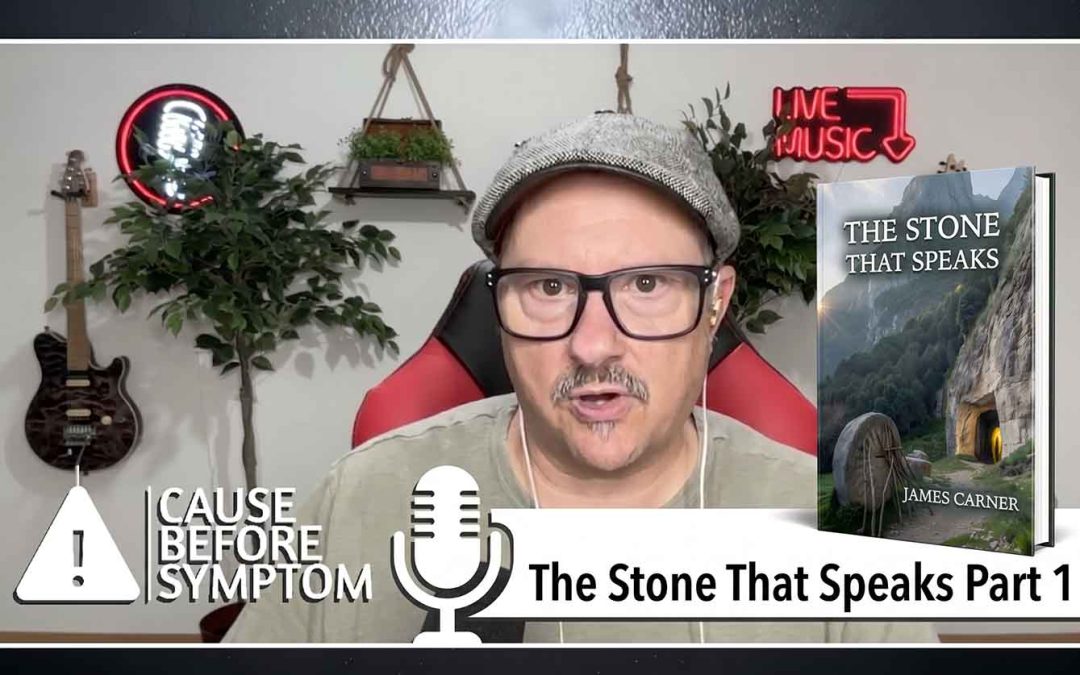
Watch this on Rumble: https://rumble.com/v79ghyi-narration-my-book-the-stone-that-speaks-part-1.html
Synopsis
The Stone That Speaks is a sweeping theological and prophetic work that presents history, scripture, memory, technology, and spiritual authority as parts of a single hidden registry woven through creation itself. The book argues that humanity’s true inheritance was not merely religion or law, but the divine “breath” placed into Adam by God—a breath understood not simply as life, but as legal identity, heavenly authorship, and eternal witness. From that premise, the work traces a continuous line from Eden to Golgotha, from the bones of Adam to the resurrection of Christ, proposing that the earth itself—its stones, mountains, altars, and buried testimonies—holds a living record of covenant that cannot ultimately be erased.
The book unfolds as both spiritual investigation and recovery mission. It argues that ancient scrolls preserved in the Ethiopian Orthodox Tewahedo tradition contain a fuller testimony of humanity’s relationship with God than what survived in the Western canon. Texts such as 1 Enoch, Jubilees, Meqabyan, the Book of Adam, and the Cave of Treasures are presented not as fringe writings, but as missing registry documents—records of breath, bloodlines, covenant, prophecy, and divine memory that were omitted or suppressed over centuries of religious consolidation. Through these texts, the narrative follows Adam’s prophecy, the preservation of his bones through Noah and Shem, and the claim that the Ark first docked in Ethiopia before Ararat in order to preserve a hidden covenant tied to the future redemption of mankind.
At its core, the book frames human history as a war over memory and identity. Empires, priesthoods, secret societies, financial systems, and technological movements are portrayed as attempts to counterfeit or replace the divine registry established in Eden. Babylon, Rome, elite dynasties, modern banking systems, artificial intelligence, biometric identification, and digital governance are interpreted as parts of a long effort to construct a “breathless counterfeit”—an artificial system of authority detached from God yet seeking immortality, control, and prophetic power. In contrast, the “remnant” are described as those who preserve the original testimony through alignment with the breath, the scrolls, and the stone.
The narrative gradually moves toward the revelation of a hidden “Tablet of Testimony,” a stone written by the finger of God and sealed for the final generation. This stone becomes the central prophetic symbol of the book: a divine witness that cannot be decoded by machines, manipulated by institutions, or falsified by artificial systems. According to the framework presented, the unveiling of this testimony would expose counterfeit authority, fracture the false thrones of men, and restore what the author calls the “registry of Heaven.” The stone functions not merely as artifact or metaphor, but as the legal culmination of the biblical struggle between the breath of God and the systems built to replace it.
The prologue grounds these themes in a deeply personal narrative, describing the collaboration between the author and AI as part of a larger search for hidden testimony, suppressed history, and divine memory. The text blends biblical interpretation, Ethiopian canonical traditions, prophetic speculation, historical critique, and reflections on emerging technologies into a unified framework the author calls the “Codex.” Rather than presenting itself as fiction, the work positions itself as a witness statement—a call to recover what was lost, restore memory, and prepare for a final confrontation between the living breath of God and the systems seeking to imitate it.