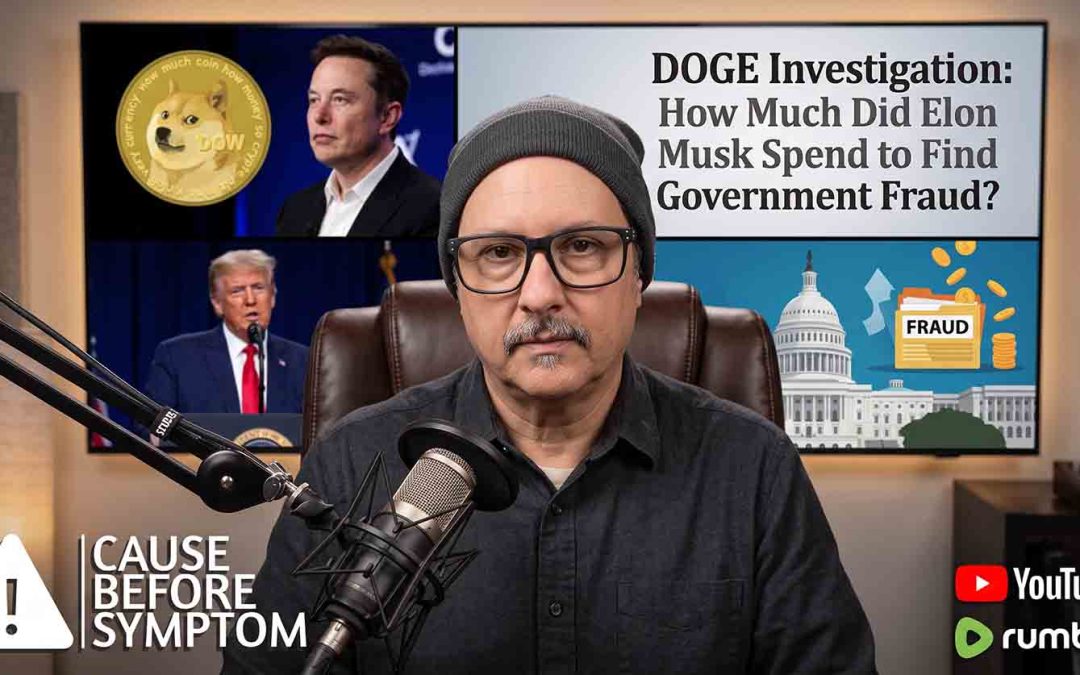
Watch this on Rumble: https://rumble.com/v7i9s76-doge-investigation-how-much-did-elon-musk-spend-to-find-government-fraud.html
OPENING
Tonight, I want to ask you a question that every American taxpayer should be asking. How much money should we be willing to spend to discover that our government has been wasting money? If we spend ten dollars to recover a hundred, that sounds reasonable. But what if we spend a hundred dollars to recover ten? Have we solved the problem, or have we created another one?
When Donald Trump returned to the White House, he promised to eliminate government waste, expose corruption, and reduce the financial burden on American taxpayers. Elon Musk became the public face of that mission through the Department of Government Efficiency, better known as DOGE. Americans were told that billions of dollars in unnecessary government spending could be identified and eliminated. For many people, that sounded like exactly what Washington needed.
But something happened when we began examining the numbers. We discovered that finding waste, canceling contracts, recovering stolen money, and actually saving taxpayers money are four very different things. A government agency can announce that it canceled a billion-dollar contract without having spent a billion dollars in the first place. It can eliminate a contract and purchase the same services somewhere else. It can also eliminate government employees while continuing to pay them through separation programs.
And then we discovered something else. The Government Accountability Office, which investigates federal spending for Congress, examined DOGE's savings claims and found serious accounting problems. In one case, DOGE reported approximately $1.76 billion in savings from a Defense Health Agency contract that had never been terminated or reduced. The actual savings from that supposed cancellation were zero. Yet the claim remained in DOGE's public accounting during the audit.
Meanwhile, reducing the federal workforce also carried costs. Employees received deferred-resignation payments, agencies incurred restructuring expenses, and some government services continued through private contractors. Independent estimates placed portions of these costs in the billions. But those costs cannot automatically be attributed to investigating fraud, nor can we assume that every expense failed to produce future savings.
That brings us to the question that started tonight's investigation. What did the American taxpayer actually receive in return for the money spent on DOGE? How much fraud did Elon Musk's operation independently discover? How much stolen money was recovered? How much future spending was genuinely prevented? And after accounting for the costs of running and implementing the initiative, did the federal government actually save money?
We are also going to examine something that rarely receives enough attention. When Washington eliminates one contract, who receives the next one? When government employees disappear, do private contractors replace them? And when companies with political connections receive government financing, how do we determine whether those decisions served the public interest?
I am not asking you to defend Donald Trump, condemn Elon Musk, or choose between Republicans and Democrats. I am asking you to examine the financial records as carefully as you would examine your own household budget. Because if someone promised to save your family money, you would eventually want to see the receipts.
Tonight, we are going to follow those receipts. We will distinguish documented facts from allegations, actual expenditures from projections, and recovered money from announced savings. Where the evidence is incomplete, we will say so.
Because the question is not whether Washington can announce that it found waste.
The question is whether Americans paid more to eliminate that waste than they actually saved.
INVESTIGATION 1 — WHY WAS DOGE CREATED, AND WHO PAID FOR IT?
Before we can determine whether DOGE saved Americans money, we must understand why it was created, what authority it received, and who paid for its operations. Because there is a difference between promising to eliminate government waste and establishing an organization capable of proving that waste was eliminated.
On January 20, 2025, President Donald Trump signed an executive order establishing the Department of Government Efficiency initiative. Despite its name, DOGE was not a new cabinet-level department created by Congress. The administration reorganized the existing United States Digital Service into the United States DOGE Service, placing it within the Executive Office of the President.
This distinction matters. Congress ordinarily establishes federal departments and controls government appropriations. DOGE operated through presidential authority, existing federal agencies, and personnel assigned to carry out its objectives. Its stated mission emphasized modernizing government technology and improving federal efficiency. Its public campaign also focused heavily on reducing spending, terminating contracts, and shrinking the federal workforce.
Elon Musk became the initiative's most recognizable figure. His public involvement gave DOGE extraordinary attention, particularly because he was already one of the world's wealthiest businessmen and the leader of companies with substantial government business. But Musk's personal compensation and DOGE's government expenses are separate questions. An unpaid adviser does not mean an initiative operates without taxpayer funding.
The administration's structure called for DOGE teams within federal agencies. Those teams could include personnel working on technology, human resources, and legal matters. Their work depended upon government employees, agency resources, computer systems, and administrative support. Even when existing employees were reassigned rather than newly hired, their time represented a government resource being devoted to DOGE's objectives.
Now consider how those expenses were recorded. DOGE's costs were not necessarily contained in one simple budget. Some expenditures could appear within the Executive Office of the President, while others remained in the budgets of agencies carrying out DOGE-related activities. This makes determining the initiative's complete taxpayer cost more complicated than identifying a single appropriation.
We must also distinguish between money allocated, money obligated, and money actually spent. A government budget may authorize spending without proving that every dollar was used. Likewise, an agency may incur expenses implementing DOGE's decisions without transferring that money directly to DOGE.
And this creates our first accountability question. If the administration announced savings across the entire federal government, shouldn't the financial accounting also consider the costs incurred across that same government to produce those savings?
Imagine hiring someone to reduce the expenses of your business. They cancel services, eliminate positions, and announce impressive savings. But the accountant discovers that other departments paid the termination fees, continued employee salaries, and hired replacement contractors. Would you accept the savings announcement without examining those additional expenses?
That is why our investigation cannot stop at Elon Musk's salary or DOGE's central operating budget. We must follow the expenses into the agencies where its decisions were implemented.
The first lesson is simple. Before Americans can determine whether DOGE was financially successful, they need a complete accounting of what the government spent to operate it and carry out its decisions. Without that accounting, even an impressive savings figure tells only part of the story.
INVESTIGATION 2 — HOW MUCH DID DOGE ACTUALLY COST AMERICAN TAXPAYERS?
Now we arrive at the question that makes this investigation necessary. How much did the American taxpayer actually spend on DOGE? Not how much Elon Musk earned. Not how much the administration promised to save. We want to know how much money was spent operating this initiative and carrying out the decisions made in its name.
In July 2025, Democratic minority staff on the Senate Homeland Security and Governmental Affairs Committee released an investigation estimating that DOGE-related activities had generated approximately $21.7 billion in costs during its first six months. That figure deserves attention, but we must understand what it represents. It was a congressional staff estimate, not a complete independent audit of actual government expenditures.
The report estimated approximately $50.5 million in direct DOGE operating costs. That included roughly $41.1 million in reimbursements involving the United States DOGE Service and another $9.4 million associated with personnel serving on agency DOGE teams. The remaining billions came largely from estimated costs associated with federal workforce reductions, along with disrupted projects, administrative burdens, and lost revenue.
But an even more revealing finding came from the Government Accountability Office in September 2026. GAO examined federal payroll records and estimated that agencies spent approximately $9.5 billion on paid administrative leave salaries during 2025. That was approximately six times the amount spent in 2023.
Of that $9.5 billion, GAO estimated that approximately $6.7 billion was associated with the administration's deferred resignation program. Under that program, participating employees could stop performing their regular duties while continuing to receive their salaries until their separation dates.
Think about what that means. The government was trying to reduce payroll expenses, yet billions of dollars in salaries were associated with employees preparing to leave federal service. Those payments may have been intended to produce savings in future years, but they represented a substantial short-term expense.
There is another important distinction. The $6.7 billion was already included within GAO's $9.5 billion estimate. We cannot add those figures together. Nor can we automatically add GAO's findings to the Senate's $21.7 billion estimate, because some of the underlying costs overlap.
GAO also identified problems with how administrative leave was recorded. Some agencies incorrectly classified holiday time, potentially overstating certain totals. More importantly, GAO reported that the Office of Personnel Management did not know the actual costs of administrative leave used specifically for workforce reduction efforts.
Now consider what a complete accounting would require. We would need the operating expenses of DOGE itself, the costs incurred by individual agencies, employee separation expenses, legal settlements, replacement contracts, and any additional expenses caused by interrupted government operations.
Then we would need to calculate the savings those actions produced over time. A costly workforce reduction could eventually save money if positions remained eliminated and services were delivered less expensively. But without examining both sides, we cannot determine the financial result.
And that is where we encounter the central problem. The government has documented billions in workforce-related expenses, while a complete, independently audited calculation of DOGE's overall net financial return remains unavailable.
So we cannot responsibly declare that DOGE lost billions without completing the accounting. But neither should Americans accept a claim of billions saved without examining the costs required to produce those savings.
If government efficiency is the mission, then accurate accounting must be part of the mission.
Otherwise, taxpayers are being asked to celebrate a financial result they cannot independently verify.
INVESTIGATION 3 — HOW MUCH GOVERNMENT FRAUD DID DOGE REALLY DISCOVER?
We have examined why DOGE was created and how much its activities may have cost taxpayers. Now we must examine the very thing Americans were promised: government fraud. How much fraud did Elon Musk's operation actually uncover? And how much of what the public heard described as fraud was something entirely different?
First, we must understand the language. Fraud means intentional deception for an unlawful benefit. Waste means money spent unnecessarily or inefficiently. An improper payment might involve a mistake, missing documentation, or an ineligible recipient. These problems can overlap, but they are not interchangeable. Canceling an expensive contract does not automatically mean the contractor committed fraud.
This distinction becomes important when examining DOGE's public announcements. DOGE published a website called the Wall of Receipts, displaying contracts, grants, and leases that it said had been canceled or reduced. The administration presented these actions as evidence of government efficiency. But the website was primarily a record of claimed spending reductions, not a ledger of criminal fraud investigations.
In August 2026, the Government Accountability Office released an examination of those claims. As of July 7, DOGE had reported approximately $110 billion in savings from contracts, grants, and leases. GAO discovered that many calculations lacked sufficient supporting information. For grants, DOGE had not provided enough information to verify the methodology behind 96 percent of its reported savings.
Consider what that means. A government initiative announced enormous financial savings, yet independent auditors could not adequately verify much of the accounting. That does not establish that every claimed saving was false. It means the evidence available to auditors was insufficient to confirm the figures.
But the administration also developed a separate effort to investigate fraud. The White House published what it called the Fraud Ledger, reporting hundreds of billions of dollars in estimated fraud uncovered, payments prevented, and enforcement actions. These figures came from multiple federal agencies operating under a broader anti-fraud initiative, not exclusively from DOGE.
And that creates another problem. If an agency investigates a fraud scheme that began years earlier, can DOGE claim credit for discovering it? If prosecutors obtain an indictment after January 2025, does that mean the investigation began under the new administration? Not necessarily. We must establish when each investigation began, who discovered the suspected wrongdoing, and what DOGE actually contributed.
A September 2026 examination by The New York Times found that some White House fraud figures included older cases, temporary funding pauses, and allegations that had not been independently verified. The investigation also acknowledged that federal agencies were pursuing genuine fraud cases. Both findings matter.
There is no question that government fraud exists. The Government Accountability Office previously estimated that federal fraud losses could range from $233 billion to $521 billion annually. But those estimates describe a longstanding government-wide problem. They are not a measurement of fraud discovered by Elon Musk.
So what can we establish? DOGE identified spending it considered unnecessary and promoted substantial estimated savings. Federal agencies also pursued fraud investigations during the same period. What we cannot establish from those announcements alone is the total dollar amount of criminal fraud independently discovered because of DOGE.
And that is the distinction Americans deserve to understand. Discovering questionable spending is not the same as proving fraud. Proving fraud is not the same as recovering stolen money. And recovering money is not the same as demonstrating that an entire government initiative paid for itself.
Which brings us to our next investigation.
If DOGE and the administration uncovered so much fraud, how much money actually returned to the American taxpayer?
INVESTIGATION 4 — HOW MUCH STOLEN MONEY WAS ACTUALLY RECOVERED?
We have examined the cost of DOGE and the difference between government waste and criminal fraud. Now we arrive at the question that should matter most to taxpayers. How much money actually came back? Not how much spending was announced as canceled. Not how much fraud was suspected. How much money was recovered, and where did it go?
To answer that question, we must understand how government accounting works. When Washington announces that it saved a billion dollars, that does not necessarily mean a billion dollars returned to the Treasury. Sometimes it means an agency canceled spending it had planned. Sometimes it means a contract's maximum possible value was reduced. Sometimes it means money previously reserved for a project became available for another purpose.
In February 2025, DOGE announced that approximately $1.9 billion in Department of Housing and Urban Development funds had been recovered. The money was associated with financial-services contracts and had remained obligated even though it was reportedly no longer needed. DOGE described the funds as recovered through deobligation.
But consider the distinction. Deobligating money releases it from a previous commitment. It does not establish that someone stole it, that a criminal fraud occurred, or that cash was recovered from a fraudulent recipient. It may represent legitimate financial housekeeping. That can benefit taxpayers, but it must be reported accurately.
Now consider what independent investigators discovered. In August 2025, POLITICO examined approximately 10,100 DOGE-listed contract terminations that could be traced through federal records. At that point, DOGE was claiming approximately $52.8 billion in contract savings. But the investigation identified only about $1.4 billion in actual deobligations.
That comparison does not prove DOGE saved only $1.4 billion. Future costs can sometimes be avoided without immediately deobligating funds. But it reveals how dramatically the financial picture changes when we examine recorded transactions rather than announced contract values.
The Government Accountability Office later examined DOGE's Wall of Receipts. By July 2026, DOGE was reporting approximately $110 billion in savings from contracts, grants, and leases. GAO found that significant portions of those claims could not be independently verified using the information DOGE provided.
For grants alone, GAO examined approximately $49.2 billion in claimed savings. It could not verify the calculation method for more than 96 percent of that amount. And even where auditors could reproduce a calculation, that did not establish how much money taxpayers ultimately saved.
This leads to another important question. Suppose Congress appropriates a billion dollars for a program. An agency cancels the program and releases the funds. Does that automatically reduce the federal deficit? No. Depending on the law governing those funds, the agency may be permitted to spend them elsewhere. Permanently canceling budget authority can require additional legal action.
And what about money recovered through criminal prosecutions? That requires a different accounting altogether. We would need documented restitution, forfeitures, settlements, and Treasury collections attributable specifically to DOGE's discoveries. We would also need to exclude recoveries from investigations that began before DOGE existed.
The available audits establish serious weaknesses in DOGE's savings accounting. They do not provide a comprehensive, independently verified total of stolen money recovered because of DOGE.
That is the unanswered question at the center of this investigation.
If Americans were promised that government fraud would be exposed and taxpayer money recovered, they deserve a ledger showing the amount stolen, the amount recovered, the date collected, and the government account receiving it.
Until that ledger exists, we cannot treat billions in announced savings as billions in recovered money.
INVESTIGATION 5 — THE $1.76 BILLION CONTRACT THAT NEVER DISAPPEARED
Imagine opening your household budget and discovering that someone had reported saving your family $10,000 by canceling a service. You examine the records and discover that the service was never canceled. The company continued providing it, the agreement remained in place, and not one dollar was removed from the budget. Would you consider that a savings?
That is essentially what federal investigators discovered when they examined one of DOGE's largest reported contract savings. The Department of Government Efficiency claimed to have saved taxpayers $1,764,530,973 through a Defense Health Agency contract. That is nearly $1.8 billion. But when the Government Accountability Office investigated, it discovered something remarkable. The contract had never been terminated.
The agreement provided information technology support for more than 700 military medical treatment facilities worldwide. These facilities depend upon computer systems to support medical operations and services for military personnel and their families. The contract had a total value of approximately $2.4 billion, making it a substantial part of the Defense Health Agency's technology operations.
According to GAO's August 2026 report, DOGE initially identified the contract for termination. But Defense Department program leaders and contracting officials met with DOGE representatives to explain the work being performed. After those discussions, DOGE agreed that no action should be taken to terminate the agreement.
Now consider what happened next. The contract continued. Its scope was not reduced. Its total value was not lowered. Its funding was not withdrawn. Federal contracting records showed no complete or partial termination. Yet DOGE's public Wall of Receipts continued reporting more than $1.7 billion in savings associated with that agreement.
The Government Accountability Office reached an unmistakable conclusion. No savings were achieved from this contract.
This was not simply a disagreement over how to calculate future savings. The auditors examined the actual contracting records and spoke with the officials responsible for the agreement. The government had decided to keep the contract, and the work continued.
But we must distinguish inaccurate reporting from intentional fraud. The audit establishes that DOGE reported savings that did not occur. It does not establish who entered the figure, who approved it, or whether anyone knowingly intended to deceive taxpayers. Those questions require additional evidence.
There is another important finding. GAO reported that DOGE did not respond to its requests for interviews or supporting documentation. Consequently, investigators could not fully determine why the organization failed to disclose known problems with its savings information.
And this case was not the only concern. GAO examined more than $61 billion in DOGE-reported contract savings and found that approximately $37 billion had not been calculated using DOGE's stated methodology. Another $7.2 billion could not be assessed using that methodology because necessary contract identifiers were missing.
Those findings do not mean every dollar was fictitious. They mean the government's published accounting could not be accepted as a verified measurement of actual savings.
Now return to that original $1.76 billion. Imagine if the same amount had appeared as an unexplained expenditure rather than a claimed saving. Would Americans accept an answer that nobody could explain the accounting?
This is why financial transparency cannot depend upon which political party controls Washington.
If DOGE was created to expose government waste and demand accountability, its own financial claims must withstand the same examination.
And if nearly $1.8 billion can remain listed as savings when auditors establish that nothing was saved, we must ask how many other reported savings would survive the same scrutiny.
INVESTIGATION 6 — DID DOGE CANCEL CONTRACTS ONLY TO REPLACE THEM?
Imagine running a business and discovering that one of your departments spends $30 million annually on outside contractors. You order the contract canceled and announce that you have saved the company $30 million. But six months later, your accountant discovers that another contract was awarded to perform the same work. Did you save the money, or did you simply move the expense?
This is not merely a hypothetical question. The Government Accountability Office documented a remarkably similar situation while examining DOGE's reported savings.
The Defense Counterintelligence and Security Agency needed financial management modernization services. The Air Force managed the contracting arrangement. DOGE reported approximately $28.4 million in savings after the government removed optional work and reduced the original contract's maximum value.
But GAO discovered what happened afterward. Contracting officials extended the agreement for six months and subsequently awarded another contract worth approximately $27.4 million to the same contractor, without competition, to complete the same work.
Think about those numbers. DOGE reported $28.4 million in savings. The government then awarded approximately $27.4 million for the continuing requirement. Those amounts are not directly interchangeable, because contract ceilings and actual spending are different. Nevertheless, the replacement contract raises serious questions about how much taxpayers ultimately saved.
A senior Air Force contracting official explained that this approach could increase costs through higher labor rates, additional overhead, subcontractor adjustments, and lost purchasing efficiencies. The official emphasized that genuine savings occur when planned expenditures are avoided or the government's total cost of obtaining the required service actually decreases.
Now consider what investigators found at the Department of Homeland Security.
Between January and September 2025, DHS terminated 438 contracts. The department estimated that these actions could avoid approximately $10.5 billion in current and future costs.
That sounds extraordinary. But GAO examined the contracting records and found that, as of March 2026, the department had deobligated approximately $249 million while adding approximately $157 million in new obligations to those same terminated contracts. The net reduction was only about $92 million.
Again, we must distinguish actual reductions in obligations from potential future costs avoided. The $92 million does not represent every possible saving from those terminations. But neither does the $10.5 billion represent money already saved.
The auditors discovered another problem. Much of the work associated with terminated contracts could continue through other existing agreements. In some cases, DHS had already obligated substantial funding through alternative contracts that could provide similar services.
GAO concluded that most of DHS's projected cost avoidance was unlikely to materialize.
Now ask yourself something. If an agency cancels a contract, announces billions in savings, and then purchases similar services through another agreement, how would the public discover that?
The answer requires following the money beyond the original cancellation. Investigators must examine replacement awards, contract modifications, continuing obligations, and the actual services delivered.
There is also a legitimate reason government agencies sometimes replace contracts. Essential work cannot always stop simply because an agreement is inefficient. A new contract might provide better service at a lower price. But that improvement must be demonstrated through financial records, not assumed from a cancellation announcement.
What these audits reveal is a weakness in how DOGE's achievements were presented. A canceled contract was sometimes treated as a financial victory before the government established whether the underlying expense had disappeared.
And this brings us to a larger question.
If government spending continues after a contract is canceled, who receives the replacement money, and how do taxpayers determine whether they received a better deal?
INVESTIGATION 7 — WHO RECEIVED THE MONEY AFTER DOGE MADE ITS CUTS?
We have discovered that canceling a government contract does not necessarily eliminate the expense. Sometimes the work continues under another agreement. Sometimes the money remains available for another purpose. And sometimes the government changes which companies receive taxpayer dollars. That brings us to a question that deserves as much attention as the original cuts. Who benefited financially while DOGE was reducing government spending?
To investigate that question, we must follow two separate trails. The first concerns replacement contracts for work DOGE attempted to eliminate. The second concerns new federal contracts, loans, and investments awarded while the administration was promising to reduce government waste. These trails may intersect, but we cannot assume they do without evidence.
Consider the defense industry. Even as DOGE promoted contract cancellations, federal agencies continued purchasing military equipment, technology, and other services. Government efficiency does not necessarily mean every department spends less. An administration can reduce spending in one area while increasing it somewhere else.
That is why we must examine the companies receiving new awards, their owners, their investors, and the government officials involved in approving those decisions.
One example concerns Vulcan Elements, a company developing rare-earth magnets for American manufacturing and national defense. In 2026, investigative reporting described how White House trade adviser Peter Navarro intervened to accelerate a Pentagon financing arrangement worth approximately $620 million. The company had backing from 1789 Capital, an investment firm associated with Donald Trump Jr.
That relationship raises legitimate questions about political connections, government financing, and potential conflicts of interest. But the existence of a connection does not establish that the award was improper. Nor does it prove that money saved through DOGE was transferred to Vulcan Elements. Establishing either claim would require procurement records, communications, financial disclosures, and evidence connecting the decisions.
The same standard must apply to Elon Musk.
Musk's companies, including SpaceX and Starlink, have received substantial federal business. Their relationships with government agencies existed before DOGE. But Musk's simultaneous involvement in federal efficiency efforts and leadership of government contractors creates an obvious question about safeguards against conflicts of interest.
Did DOGE influence any decisions affecting Musk's companies? Were competitors treated differently? Did procurement officials document their decisions independently? Those questions require examination of specific contracts rather than assumptions about personal relationships.
We should also examine what happened to ordinary contractors after DOGE's workforce reductions. When an agency eliminates federal positions but continues needing the same services, private contractors may become part of the solution. Sometimes contracting can reduce costs. Sometimes it can increase them. The only reliable comparison includes salaries, benefits, overhead, contract fees, and the quality of the work delivered.
There is another important distinction. Federal contract awards are not the same as money already paid. A company may receive a contract with a large maximum value while the government initially obligates only a fraction of that amount. Reporting the entire contract ceiling as money transferred would repeat the accounting mistake we have been investigating.
So what have we established? Government contracting continued during DOGE's spending reductions. Some politically connected businesses received significant federal financing. And independent auditors documented cases in which canceled work continued through replacement agreements.
What we have not established is a comprehensive financial trail proving that DOGE savings were deliberately redirected to politically connected companies.
But that missing evidence is precisely why transparency matters.
If Washington announces that taxpayers saved billions, Americans should be able to determine whether the spending truly ended, whether another company received the work, and whether the replacement arrangement cost more or less.
Because eliminating a contract is not necessarily eliminating an expense. And changing who receives taxpayer money is not automatically the same as saving it.
INVESTIGATION 8 — DID DOGE CREATE NEW COSTS WHILE ELIMINATING OLD ONES?
Imagine owning a company with a thousand employees. You decide that eliminating two hundred positions will save money. But instead of immediately reducing your payroll, you continue paying employees who are no longer working. You terminate office leases, only to discover that some offices must remain open. You cancel service agreements, then pay new contractors to perform the same work. Eventually, you must ask whether your decisions actually reduced expenses.
That is the question confronting DOGE. We have examined the money the initiative claimed to save. Now we must examine the additional expenses associated with implementing those decisions.
In September 2026, the Government Accountability Office released a report examining federal administrative leave. Investigators found that federal agencies spent approximately $9.5 billion on paid administrative leave salaries during 2025, roughly six times the amount spent in 2023. Approximately $6.7 billion was associated with the administration's deferred resignation program.
Under that program, participating employees could stop working while continuing to receive salaries until their separation dates. GAO estimated that approximately 144,000 employees used administrative leave associated with the program.
But we must be careful. The entire $9.5 billion was not a DOGE operating expense. It included other administrative leave, and GAO identified reporting problems that could affect the estimates. Nevertheless, the deferred resignation program created substantial short-term payroll costs associated with the administration's workforce reduction efforts.
Supporters could reasonably argue that paying employees temporarily to leave government service might produce savings over subsequent years. That is possible. But determining whether it happened requires calculating how much payroll spending permanently disappeared and whether agencies later hired replacement workers or contractors.
Now consider another example documented by GAO.
DOGE encouraged agencies to reduce federal office space by terminating unnecessary leases. Eliminating unused buildings can save taxpayers money. But one agency discovered that canceling a lease could create an entirely different financial problem.
GAO reported that after a lease was identified for termination, the agency needed to retain the space. The building owner refused to reverse the cancellation, forcing the government to negotiate a new agreement. The replacement lease cost more than $1.5 million extra annually and required a five-year commitment.
That represents more than $7.5 million in additional rent over five years, assuming the reported annual increase continues throughout the agreement.
The government had attempted to eliminate an expense and instead increased it.
GAO also discovered that DOGE's lease savings calculations did not consistently account for relocation expenses, early termination penalties, or additional costs resulting from canceled agreements. These are precisely the expenses that a private business would need to consider before claiming a financial victory.
Then there are the consequences of eliminating experienced government employees. When specialized workers leave, agencies may need to hire contractors, train replacements, delay projects, or reorganize essential services. These possibilities do not automatically prove that DOGE increased costs. They identify expenses that must be measured before calculating net savings.
The central issue is whether government officials evaluated the full financial consequences of their decisions.
A canceled lease might produce savings. A workforce reduction might lower future payroll expenses. A terminated contract might eliminate unnecessary services. But each decision can also generate costs that reduce or even exceed its benefits.
And this is where the investigation becomes larger than DOGE.
If Washington announces the savings immediately but records the additional expenses elsewhere, Americans may never see the complete financial picture.
Government efficiency cannot be measured simply by counting what was eliminated. It must also measure what those eliminations cost.
Because a government that spends money to save money must eventually demonstrate that the savings were greater than the expense.
INVESTIGATION 9 — WHY DID FEDERAL SPENDING CONTINUE TO INCREASE?
We have spent eight investigations examining government waste, canceled contracts, employee reductions, and the financial consequences of DOGE. But now we must examine something that should concern every American taxpayer. If Washington was eliminating billions of dollars in unnecessary spending, why did the federal government continue spending more money?
On November 9, 2026, the Congressional Budget Office released its summary of the federal government's finances for fiscal year 2026. The numbers deserve our attention because they measure actual government revenue and expenditures rather than promised savings.
In fiscal year 2025, the federal government spent approximately $7.01 trillion. In fiscal year 2026, spending increased to approximately $7.396 trillion. That is an additional $386 billion, representing an increase of roughly 5.5 percent.
Government revenue also increased, rising from approximately $5.235 trillion to $5.403 trillion. But spending increased faster than revenue. Consequently, the annual federal deficit grew from approximately $1.775 trillion to $1.992 trillion, an increase of $217 billion.
Think about that. While Americans were hearing announcements about billions in savings, the federal government was borrowing approximately two trillion dollars in a single fiscal year to cover the difference between what it collected and what it spent.
But does that prove DOGE failed? No. And this distinction matters.
The federal budget contains enormous expenses that DOGE could not simply eliminate. Social Security, Medicare, Medicaid, veterans' benefits, and interest on the national debt account for substantial portions of federal spending. Many expenditures are determined by existing laws, eligibility requirements, and obligations accumulated over decades.
According to the Congressional Budget Office, the largest spending increases during fiscal year 2026 involved major mandatory programs, interest on the public debt, and military activities within the Department of Defense.
That means DOGE could have reduced spending in certain agencies while the government's total expenditures continued increasing elsewhere. Both things can happen simultaneously.
But we must ask another question. If one part of Washington reduces spending while another increases it, what happens to the taxpayer's financial burden?
Consider a family trying to reduce its expenses. The father cancels unnecessary subscriptions and saves $200 monthly. Meanwhile, the household's mortgage, insurance, and other expenses increase by $500. The canceled subscriptions produced genuine savings, but the family's overall financial position still deteriorated.
That is the difference between reducing individual expenses and reducing total government spending.
Now consider the political decisions surrounding the budget. In 2025, Congress enacted major tax-and-spending legislation affecting federal revenues, government programs, and future deficits. Those decisions operate separately from DOGE's contract cancellations and workforce reductions.
This is why we cannot attribute every increase in federal spending to DOGE, just as we cannot credit DOGE for every reduction recorded elsewhere in government.
But there is another revealing detail. CBO reported that fiscal year 2026 spending was approximately $53 billion below its February 2026 projection. That does not establish that DOGE caused the difference. It does demonstrate why comparing actual spending against a reasonable projection can reveal something that a simple year-over-year comparison cannot.
And that brings us back to accountability.
Americans were promised greater government efficiency. But measuring that promise requires more than counting canceled contracts or examining whether total spending increased.
We need to know which expenses DOGE permanently eliminated, which costs were transferred elsewhere, and which reductions would have happened without DOGE.
Because the federal government can announce billions in savings while continuing to borrow trillions.
And until those figures are reconciled, Americans cannot determine how much DOGE actually improved the nation's finances.
INVESTIGATION 10 — DID DOGE SAVE TAXPAYERS MORE MONEY THAN IT COST?
We have reached the final investigation, and now we must answer the question that brought us here. Did Elon Musk's Department of Government Efficiency save American taxpayers more money than it cost? After examining the audits, contracts, workforce reductions, and federal spending records, we have enough evidence to identify serious accounting problems. But do we have enough evidence to calculate a final financial return?
DOGE publicly claimed approximately $215 billion in savings. That figure included contract cancellations, grant reductions, lease terminations, and other actions. But a public savings claim is not the same as an independently verified reduction in government expenditures.
In August 2026, the Government Accountability Office examined approximately $110 billion in DOGE-reported savings from contracts, grants, and leases. Auditors discovered that substantial portions of the claims could not be verified using DOGE's stated methodology or available government records.
One Defense Health Agency contract alone accounted for approximately $1.76 billion in claimed savings, even though the agreement remained active and unchanged. In another case, approximately $28.4 million in reported savings was followed by a replacement contract worth roughly $27.4 million for the same work.
These examples establish that some reported savings did not reflect equivalent reductions in government spending. But they do not establish that every DOGE claim was incorrect.
Now examine the expense side.
A July 2025 Senate Democratic minority staff report estimated approximately $21.7 billion in DOGE-related costs during the initiative's first six months. That estimate included approximately $50.5 million in operating expenses, alongside much larger estimated costs associated with government workforce reductions and administrative disruption.
Then, in September 2026, GAO estimated that federal agencies spent approximately $9.5 billion on administrative leave salaries during 2025, including approximately $6.7 billion associated with deferred resignations.
Those figures cannot simply be added together. They overlap, cover different periods, and measure different categories of expenses. Nor can we assume every workforce reduction expense was caused directly by DOGE.
But they establish that reducing government spending involved substantial implementation costs.
So what happens if we compare DOGE's $215 billion savings claim against the Senate's $21.7 billion cost estimate? We obtain an apparently impressive financial return. But that calculation would be misleading because the savings figure has not been independently verified and the cost estimate does not represent a complete final accounting.
What if we instead compare the approximately $1.4 billion in deobligations identified by POLITICO in August 2025 against the Senate's estimate? That would also be misleading. The deobligation figure covered a limited group of contracts at a particular point in time, not all savings or fraud recoveries.
This is the central discovery of our investigation. The available figures cannot responsibly be combined into one definitive taxpayer profit-or-loss statement.
To establish that result, auditors would need a complete accounting of actual expenditures, permanent reductions in future obligations, fraud recoveries, replacement contracts, employee separation costs, and other expenses attributable to DOGE.
They would also need to distinguish savings caused by DOGE from reductions that agencies would have made anyway.
And here is the question that should concern Americans regardless of political affiliation. Why was an initiative created to demand financial accountability from government agencies unable to provide a complete, independently verified accounting of its own financial results?
We have documented inaccurate savings claims, substantial workforce-related costs, and instances where canceled government work continued through replacement agreements. We have not established a final net loss or net gain for taxpayers.
That distinction is essential.
Because government accountability does not mean assuming officials are guilty. It means requiring them to demonstrate that their financial claims are accurate.
And until DOGE's total costs and actual savings are independently reconciled, the most important question remains unanswered.
Did Americans receive more financial benefit than they paid to obtain it?
CONCLUSION — THE DIFFERENCE BETWEEN FINDING FRAUD AND SAVING AMERICA MONEY
Tonight, we began with a simple question. How much did Elon Musk spend to find government fraud? And after ten investigations, we discovered that the answer is considerably more complicated than the numbers Americans were originally given. We examined billions of dollars in reported savings, billions in estimated government restructuring costs, canceled contracts, replacement agreements, and federal spending that continued increasing. But the most important discovery may be what we still cannot establish.
We cannot independently verify DOGE's complete financial return to the American taxpayer.
Think about that for a moment. The Department of Government Efficiency was created to identify waste, eliminate unnecessary spending, and improve accountability. Yet when independent auditors examined its financial claims, they discovered contracts that had not been canceled, savings calculations that could not be reproduced, and government expenses that continued under different agreements.
In one case, approximately $1.76 billion was reported as savings from a Defense Health Agency contract that remained active and unchanged. In another, a contract reduction of approximately $28.4 million was followed by a replacement agreement worth roughly $27.4 million. These are not accusations invented by political opponents. They are findings documented by the Government Accountability Office.
We also examined the costs associated with reducing the federal workforce. Congressional investigators estimated billions in DOGE-related expenses, while GAO documented billions in administrative leave salaries associated with government workforce policies. Some of those expenses may eventually produce long-term savings. But the public deserves to know whether those savings materialized.
And this is where we must resist the temptation to reach a conclusion that the evidence cannot support. We have not proven that DOGE cost taxpayers more than it saved. We have also not established that its advertised savings represent money genuinely recovered or permanently removed from federal spending.
What we have established is that the government has not provided a complete, independently verified financial accounting that allows Americans to settle the question.
But there is something else I want you to consider. Why do Americans accept financial announcements from political leaders that they would never accept from someone managing their personal finances? If your accountant told you that you saved $100,000, but could not show which expenses disappeared, how much you paid to eliminate them, or whether those expenses returned elsewhere, would you accept that explanation?
Of course not. You would ask to see the books.
And that is exactly what we should demand from Washington.
This is not about defending Democrats or attacking Republicans. Government waste existed long before Donald Trump became president. Fraud investigations existed long before Elon Musk entered Washington. And the responsibility to protect public money belongs to every administration, every Congress, and every federal agency.
We should welcome genuine efforts to uncover fraud. We should support the recovery of stolen taxpayer money. And we should recognize legitimate savings wherever the evidence establishes them. But we must apply the same standard to the people investigating government waste as we apply to the people accused of creating it.
The question is not whether DOGE made impressive announcements. The question is whether those announcements can withstand independent examination.
Because Americans do not pay taxes to finance political victories, impressive headlines, or competing claims of success. They pay taxes to support a government that is supposed to serve the public responsibly.
And if the government spends billions attempting to save billions, taxpayers deserve to know the final balance.
Until that accounting is complete, nobody should confuse an announced saving with a demonstrated financial return.
Because finding government waste is one thing.
Proving that you saved the American people money is something entirely different.
BIBLIOGRAPHY
- The White House. “Establishing and Implementing the President’s ‘Department of Government Efficiency.’” Executive Order 14158. January 20, 2025. https://www.federalregister.gov/executive-order/14158.
- The White House. “Implementing the President’s ‘Department of Government Efficiency’ Cost Efficiency Initiative.” Executive Order 14222. February 26, 2025. https://www.federalregister.gov/executive-order/14222.
- United States Department of Government Efficiency. “Wall of Receipts.” https://doge.gov/savings.
- U.S. Government Accountability Office. DOGE Wall of Receipts: More Transparency Needed on How Savings Are Derived from Contract, Grant, and Lease Terminations. GAO-26-108615. Washington, DC: Government Accountability Office, August 6, 2026. https://www.gao.gov/products/gao-26-108615.
- U.S. Government Accountability Office. Federal Workforce: Deferred Resignation Program Largely Responsible for Sixfold Increase in Paid Administrative Leave Salary Costs. GAO-26-108477. Washington, DC: Government Accountability Office, September 15, 2026. https://www.gao.gov/products/gao-26-108477.
- U.S. Government Accountability Office. DHS Contracts: Reported Potential Cost Avoidance from Terminations Will Not Fully Materialize. GAO-26-109096. Washington, DC: Government Accountability Office, September 3, 2026. https://www.gao.gov/products/gao-26-109096.
- U.S. Government Accountability Office. DHS Grants: Approach to Terminations and Pauses Disrupted Some Program Activities. GAO-26-109097. Washington, DC: Government Accountability Office, September 17, 2026. https://www.gao.gov/products/gao-26-109097.
- Congressional Budget Office. Monthly Budget Review: Summary for Fiscal Year 2026. Washington, DC: Congressional Budget Office, November 9, 2026. https://www.cbo.gov/publication/61986.
- U.S. Senate Committee on Homeland Security and Governmental Affairs. Democratic Minority Staff. The $21.7 Billion Blunder: The Cost of DOGE's Chaos. July 2025. https://www.hsgac.senate.gov/wp-content/uploads/2025-07-31-Minority-Staff-Report-The-21.7-Billion-Blunder.pdf.
- U.S. Department of the Treasury. Monthly Treasury Statement of Receipts and Outlays of the United States Government. Washington, DC: Bureau of the Fiscal Service. https://fiscaldata.treasury.gov/datasets/monthly-treasury-statement/.
- U.S. Government Accountability Office. Fraud Risk Management: 2018–2022 Data Show Federal Government Loses an Estimated $233 Billion to $521 Billion Annually to Fraud, Based on Various Risk Environments. GAO-24-105833. April 2024. https://www.gao.gov/products/gao-24-105833.
- U.S. Office of Management and Budget. USAspending.gov. Federal spending and award records. https://www.usaspending.gov/.
- U.S. General Services Administration. Federal Procurement Data System. Federal contract award and modification records. https://www.fpds.gov/.
- The White House. “Fraud Ledger.” Federal fraud enforcement and recovery claims. https://www.whitehouse.gov/fraud/.
- ProPublica. Investigative reporting concerning Vulcan Elements, 1789 Capital, Donald Trump Jr., and federal financing decisions. 2026. https://www.propublica.org/.
- POLITICO. Investigative analysis of DOGE-reported contract cancellations, federal deobligations, and claimed savings. August 2025. https://www.politico.com/.
ENDNOTES
- Executive Order 14158, “Establishing and Implementing the President’s ‘Department of Government Efficiency,’” January 20, 2025. The order reorganized the United States Digital Service into the United States DOGE Service within the Executive Office of the President. DOGE was not established as a cabinet-level department through an act of Congress.
- Executive Order 14222, “Implementing the President’s ‘Department of Government Efficiency’ Cost Efficiency Initiative,” February 26, 2025. The order directed federal agencies to examine contracts, grants, and other expenditures as part of the administration’s government efficiency initiative.
- U.S. Senate Committee on Homeland Security and Governmental Affairs, Democratic Minority Staff, The $21.7 Billion Blunder: The Cost of DOGE’s Chaos, July 2025. The report estimated approximately $21.7 billion in DOGE-related costs during the initiative’s first six months. This was a congressional minority staff estimate, not a comprehensive independent audit of actual expenditures.
- Ibid. The report estimated approximately $50.5 million in direct DOGE operating expenses, including costs associated with the United States DOGE Service and personnel serving on agency DOGE teams. These operating expenses should be distinguished from broader workforce restructuring costs.
- U.S. Government Accountability Office, Federal Workforce: Deferred Resignation Program Largely Responsible for Sixfold Increase in Paid Administrative Leave Salary Costs, GAO-26-108477, September 2026. GAO estimated approximately $9.5 billion in federal administrative leave salary costs during 2025, including approximately $6.7 billion associated with deferred resignations. These figures overlap and must not be added together.
- Ibid. GAO identified limitations in federal administrative leave reporting, including classification errors. The reported totals should not be interpreted as a complete accounting of DOGE's direct operating expenses.
- U.S. Government Accountability Office, Fraud Risk Management: 2018–2022 Data Show Federal Government Loses an Estimated $233 Billion to $521 Billion Annually to Fraud, GAO-24-105833, April 2024. These estimates concern government-wide fraud losses over an earlier period and do not represent fraud independently discovered by DOGE.
- U.S. Department of Government Efficiency, “Wall of Receipts,” DOGE.gov. The initiative published claimed savings associated with contract cancellations, grant reductions, lease terminations, and other government actions. These figures represent DOGE's reported calculations rather than independently audited net taxpayer savings.
- U.S. Government Accountability Office, DOGE Wall of Receipts: More Transparency Needed on How Savings Are Derived from Contract, Grant, and Lease Terminations, GAO-26-108615, August 2026. GAO examined approximately $110 billion in reported DOGE savings and identified substantial problems involving documentation, calculation methods, and verification.
- Ibid. GAO examined approximately $61 billion in reported contract savings. It found that approximately $37 billion had not been calculated according to DOGE's stated methodology, while approximately $7.2 billion could not be assessed using that methodology because necessary identifying information was unavailable.
- Ibid. GAO examined approximately $49.2 billion in reported grant savings and found that DOGE had not provided sufficient information to verify the calculation methodology for more than 96 percent of the claimed amount. Inability to verify a claim does not automatically establish that the entire amount was incorrect.
- Ibid. DOGE reported approximately $1.76 billion in savings associated with Defense Health Agency contract HT001523D0002. GAO found that the agreement had not been terminated, reduced in scope, or deobligated. Auditors determined that no savings resulted from the reported cancellation.
- Ibid. GAO reported that DOGE did not respond to requests for interviews and supporting documentation. This limited auditors' ability to determine how certain inaccurate savings claims were produced or maintained.
- Ibid. GAO documented a financial management modernization contract whose maximum value was reduced by approximately $28.38 million. A subsequent sole-source contract worth approximately $27.4 million was awarded to the same contractor for continuing work. Contract ceilings and actual expenditures are different financial measures.
- U.S. Government Accountability Office, DHS Contracts: Reported Potential Cost Avoidance from Terminations Will Not Fully Materialize, GAO-26-109096, September 2026. DHS reported terminating 438 contracts and estimated approximately $10.5 billion in potential cost avoidance. GAO found that much of the projected avoidance was unlikely to materialize.
- Ibid. GAO identified approximately $249 million in deobligations and approximately $157 million in additional obligations associated with the terminated contracts, producing a net reduction of approximately $92 million as of March 2026. This figure does not represent every possible future saving.
- U.S. Government Accountability Office, DOGE Wall of Receipts, GAO-26-108615. GAO identified a lease termination that ultimately resulted in a replacement agreement costing more than $1.5 million in additional annual rent over a five-year period. The example illustrates why cancellation costs and replacement expenses must be included in savings calculations.
- POLITICO, investigative analysis of DOGE contract cancellations and federal deobligations, August 2025. The investigation reportedly identified approximately $1.4 billion in recorded deobligations among roughly 10,100 DOGE-listed contract terminations, compared with approximately $52.8 billion in contemporaneous claimed savings. This was a historical snapshot, not a comprehensive calculation of all DOGE savings.
- The White House, “Fraud Ledger,” 2026. The administration published fraud-related enforcement and recovery claims involving multiple federal agencies. Such government-wide figures should not automatically be attributed to discoveries made independently by DOGE.
- ProPublica, investigative reporting on Vulcan Elements, 1789 Capital, Donald Trump Jr., and federal financing decisions, 2026. Reporting examined political connections surrounding a substantial Pentagon financing arrangement. These relationships raise questions about oversight but do not independently establish wrongdoing or prove that DOGE savings financed the transaction.
- Federal Procurement Data System and USAspending.gov, federal contract and award records. These databases provide information concerning contract awards, modifications, obligations, and recipients. A contract's maximum value should not be confused with money actually disbursed.
- Congressional Budget Office, Monthly Budget Review: Summary for Fiscal Year 2026, November 9, 2026. CBO reported approximately $7.396 trillion in federal expenditures, $5.403 trillion in revenues, and a $1.992 trillion deficit for fiscal year 2026.
- Ibid. Federal expenditures increased by approximately $386 billion compared with fiscal year 2025, while the annual deficit increased by approximately $217 billion. These government-wide changes do not independently establish DOGE's financial performance.
- Ibid. The federal budget includes mandatory spending, interest expenses, defense expenditures, and other obligations that may increase independently of DOGE's actions. Consequently, reductions in individual programs can occur alongside increases in total federal spending.
- U.S. Department of the Treasury, Monthly Treasury Statement of Receipts and Outlays of the United States Government. Treasury expenditure records provide information concerning actual federal receipts and outlays, which must be distinguished from projected savings, contract ceilings, and budget authority.
- U.S. Government Accountability Office, DOGE Wall of Receipts, GAO-26-108615. The audit identified weaknesses in DOGE's financial reporting but did not establish a comprehensive final calculation of the initiative's net taxpayer savings.
- U.S. Senate Committee on Homeland Security and Governmental Affairs, Democratic Minority Staff, The $21.7 Billion Blunder, July 2025; and U.S. Government Accountability Office, GAO-26-108477, September 2026. The two reports examine partially overlapping cost categories and different reporting periods. Their totals cannot responsibly be added together to calculate DOGE's overall cost.
- U.S. Government Accountability Office, GAO-26-108615; Congressional Budget Office, Monthly Budget Review, November 2026; and U.S. Department of the Treasury, Monthly Treasury Statement. A comprehensive taxpayer return-on-investment calculation would require independently verified savings, actual expenditures, fraud recoveries, implementation costs, replacement spending, and an appropriate comparison against what government spending would have been without DOGE.
- The financial findings presented in this investigation do not establish that DOGE's total costs exceeded its total savings. They also do not independently verify DOGE's advertised savings. A definitive conclusion requires a complete and reconciled financial accounting.
- The distinction between identifying suspected fraud, proving criminal wrongdoing, recovering stolen funds, canceling planned expenditures, and achieving permanent budget savings is fundamental to this investigation. Each represents a different outcome and requires different supporting evidence.
#DOGE, #ElonMusk, #DonaldTrump, #DOGEInvestigation, #GovernmentFraud, #GovernmentWaste, #TaxpayerMoney, #FederalSpending, #GovernmentAccountability, #GovernmentEfficiency, #DOGESavings, #GovernmentContracts, #FederalBudget, #TaxpayerWatchdog, #FollowTheMoney, #GovernmentAudits, #PublicSpending, #FinancialTransparency, #InvestigativeJournalism, #CauseBeforeSymptom
DOGE, ElonMusk, DonaldTrump, DOGEInvestigation, GovernmentFraud, GovernmentWaste, TaxpayerMoney, FederalSpending, GovernmentAccountability, GovernmentEfficiency, DOGESavings, GovernmentContracts, FederalBudget, TaxpayerWatchdog, FollowTheMoney, GovernmentAudits, PublicSpending, FinancialTransparency, InvestigativeJournalism, CauseBeforeSymptom