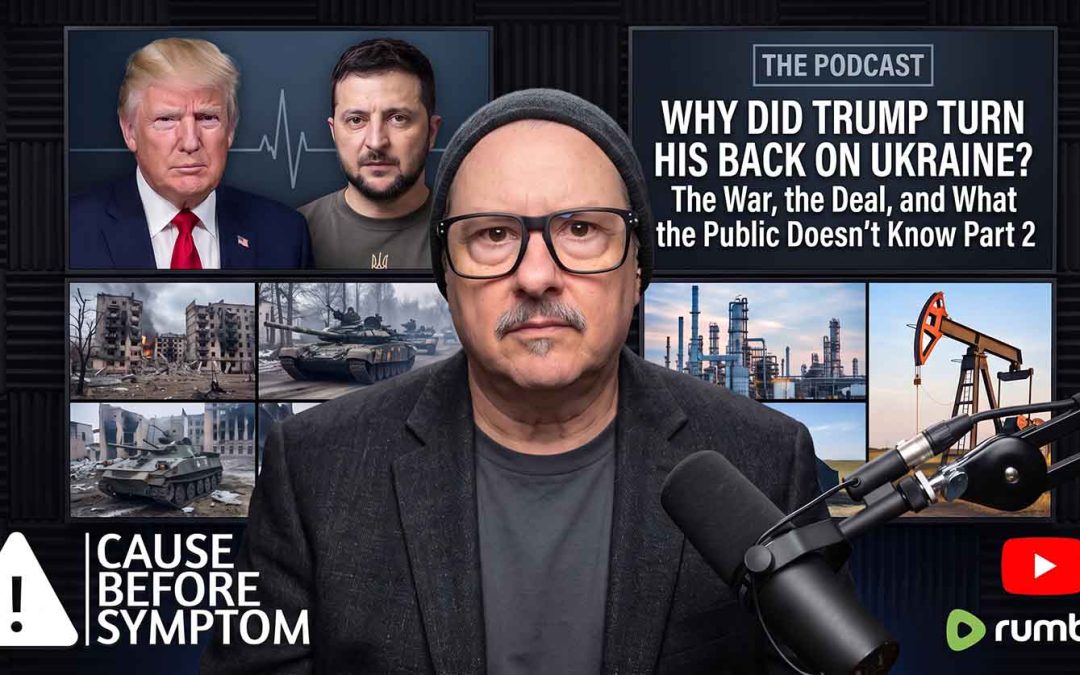
Watch this on Rumble: https://rumble.com/v7h2fj2-why-did-trump-turn-his-back-on-ukraine-the-war-the-deal-and-what-the-public.html
Continued (recap)
Welcome back to Cause Before Symptom, where we don't chase symptoms—we test the cause against Scripture.
Last night, we began our investigation, *Why Did Trump Turn His Back on Ukraine? The War, the Deal, and What the Public Doesn't Know.* We examined how America became involved in Ukraine, what Donald Trump changed when he returned to the White House, what Vladimir Putin wants, and why Washington is placing pressure on Volodymyr Zelenskyy.
Tonight, we continue with the most important question of all. What is Russia actually giving up in exchange for the economic opportunities and diplomatic engagement being offered by Washington?
But first, let's review what we discovered.
In Investigation One, we examined Ukraine's independence following the collapse of the Soviet Union in 1991. We looked at the 1994 Budapest Memorandum, when Ukraine agreed to relinquish the nuclear weapons left on its territory in exchange for assurances from Russia, Britain, and the United States concerning its sovereignty and borders. Those assurances, however, were not equivalent to NATO's collective-defense guarantees.
We followed the history through NATO's expansion, Russia's seizure of Crimea in 2014, and the full-scale invasion of Ukraine in 2022. America was never formally at war with Russia, but American weapons, intelligence, financing, and sanctions became essential components of Ukraine's resistance.
In Investigation Two, we examined what Trump inherited. After years of fighting, enormous expenditures, and failed attempts to achieve a lasting settlement, Trump changed the emphasis of American policy. He placed negotiations at the center of his strategy, used military assistance as leverage, demanded greater European financial responsibility, and pursued economic arrangements involving both Ukraine and Russia.
We examined the temporary suspension of American assistance in March 2025 and its restoration after Ukraine accepted an American ceasefire proposal. This demonstrated that Washington was willing to use Ukraine's dependence on American support as a negotiating instrument.
In Investigation Three, we examined Putin's objectives. Russia wants control over occupied territory, Ukrainian exclusion from NATO, restrictions on Ukraine's military capabilities, and relief from Western economic pressure. Moscow has also demanded territory that Russian forces have not captured.
The important distinction was that Putin's demands extend beyond a ceasefire. They involve Ukraine's sovereignty, military independence, and ability to determine its own future.
Then, in Investigation Four, we examined why Trump is pressuring Zelenskyy.
Ukraine has been attacking Russian oil refineries to weaken Moscow's economy and military operations. But international energy disruptions, particularly those involving the Middle East, have created serious pressure on petroleum markets.
Trump wants to increase fuel availability and reduce costs for American consumers. Ukraine wants to damage the infrastructure that helps sustain Russia's invasion. Those objectives can conflict.
We also examined reports that Washington pressured Ukraine to stop attacking Russian refineries, including warnings concerning American intelligence and weapons assistance. We distinguished those reported warnings from an actual suspension of assistance.
And that brings us to where we left off.
If Ukraine is being asked to limit its military operations, while Russia receives economic opportunities and potential sanctions relief, what exactly is Putin offering in return?
That is the question we begin answering tonight.
In Investigation Five, we examine Russia's actual concessions. Has Putin agreed to withdraw troops, accept a verifiable ceasefire, or abandon territorial demands? Or is Moscow receiving benefits while its central demands remain unchanged?
In Investigation Six, we investigate the energy crisis and whether allowing additional Russian diesel exports can meaningfully reduce international fuel prices. We will examine what the International Energy Agency discovered about Russia's damaged refining capacity.
Investigation Seven takes us to Britain and Europe, where governments are concerned that easing pressure on Moscow without enforceable commitments could create a more dangerous European security environment.
In Investigation Eight, we examine what is happening behind closed doors. We will follow the documented negotiations, economic discussions, sanctions decisions, and congressional oversight without inventing secret agreements or assuming motives we cannot prove.
Investigation Nine asks whether a peace agreement could actually leave Ukraine less secure. We will examine the difference between stopping the fighting and establishing a lasting peace, including the security guarantees necessary to prevent another invasion.
Finally, Investigation Ten asks whether Trump's approach represents a larger transformation of American foreign policy and the international order.
Scripture reminds us in Proverbs 18:17 that the first account of a matter may appear convincing until another comes forward and examines it.
I am not here to assume Trump has betrayed Ukraine, nor to assume that every decision he makes must be part of a brilliant strategy hidden from the public. I want to examine what the evidence establishes.
Because a ceasefire announcement is not necessarily lasting peace. Economic cooperation is not necessarily diplomatic success. And a signed agreement means little if the conditions that produced the war remain unchanged.
Last night, we examined how we arrived at this moment.
Tonight, we examine what is actually being negotiated, who benefits, what Ukraine may be asked to surrender, and whether the agreement being pursued can produce genuine peace.
Let's continue with Investigation Five: What Is Putin Actually Offering in Return?
Part 4 Conclusion
Then came the proposed energy ceasefire. Trump announced that Russia and Ukraine had agreed to stop attacks against energy infrastructure. But Ukrainian officials said they had not received the complete terms, and Moscow had not publicly confirmed a comprehensive reciprocal agreement. Zelenskyy indicated that Ukraine was prepared to suspend attacks on Russian refineries if Russia stopped striking Ukrainian power plants and other critical infrastructure. Reports of additional Russian strikes quickly raised questions about whether the announced arrangement was functioning. A genuine reciprocal ceasefire would require both governments to accept clear terms and a means of determining whether either side had violated them.
There is an additional question concerning Trump's negotiations with Moscow. Reuters reported that American envoys Steve Witkoff and Jared Kushner had explained to Ukrainian officials that allowing Russian diesel exports was intended partly to encourage Putin to return to peace talks. According to that account, the envoys acknowledged that Putin was not yet prepared to negotiate an end to the war. This is a critical distinction. Washington was attempting to create an incentive for negotiations, not implementing a peace agreement already accepted by Russia. The economic opportunity was visible, but the reciprocal Russian commitment remained uncertain.
On October 16, Trump went further by waiving major new sanctions and tariffs under the Graham Act. His executive order cited American national interests and retained existing sanctions imposed under other authorities. The waiver did not end every restriction against Russia, but it prevented substantial additional penalties from taking effect. Critics in Congress, including Republicans and Democrats, argued that this reduced pressure on Putin. The administration maintained that it needed flexibility to assess economic consequences and pursue its objectives. Once again, the dispute concerned whether offering economic relief would encourage negotiations or simply allow Russia to benefit while continuing the war.
And here is the possibility we must examine carefully. Trump may believe that years of sanctions and military assistance have failed to produce a settlement, and that a different combination of incentives and threats is necessary. In that interpretation, pressuring Ukraine to limit refinery attacks is part of a broader effort to stabilize energy markets and create conditions for diplomacy. But there is a competing interpretation: if Ukraine is required to surrender a useful military instrument while Russia receives economic relief without accepting enforceable obligations, the bargaining process could weaken Ukraine's position rather than improve the prospects for lasting peace.
What troubles me most about this situation is not the existence of negotiations. Negotiating with an adversary is sometimes necessary to end a war. The concern is whether the obligations are reciprocal. If Ukraine stops striking Russian refineries, will Russia stop attacking Ukrainian energy facilities? If Washington relaxes additional sanctions, will Moscow agree to a verifiable ceasefire? If Ukraine accepts territorial compromises, what prevents another invasion? These are not peripheral questions. They determine whether an agreement produces security or merely suspends the fighting until one side is ready to resume it.
So why is Trump pressuring Zelenskyy? The evidence identifies several overlapping objectives: reducing energy costs, preventing further disruption of petroleum markets, maintaining leverage over Ukraine, and persuading Putin to negotiate. What the public evidence does not establish is that Trump has secured a private Russian commitment sufficient to justify every concession being discussed. Nor does it establish that his objective is Ukraine's defeat. Those are different claims, and responsible investigation requires us to keep them separate.
We have reached the central conflict. Ukraine believes attacking Russian energy infrastructure helps defend its independence. Trump believes restraining those attacks may serve American economic interests and improve the prospects for negotiations. Putin stands to benefit from reduced attacks on Russian facilities and from any easing of economic restrictions. Whether those benefits produce peace depends on what Moscow agrees to surrender in return.
And that brings us directly to the next investigation. We have examined what Trump wants from Zelenskyy. Now we must ask what he is demanding from Putin. Because if Washington is offering Russia economic opportunities while Ukraine is being asked to limit its military operations, the most important question in this entire investigation becomes unavoidable: what exactly is Russia giving up in exchange?
Investigation 5 — What Is Putin Actually Offering in Return?
We have now arrived at what I consider the central question of tonight's investigation. Donald Trump is pursuing negotiations with Vladimir Putin, Ukraine is being pressured to reconsider parts of its military strategy, and Washington is exploring economic arrangements that could benefit Russia. But negotiations are not measured by how often two presidents speak or how many meetings their representatives attend. They are measured by what each side agrees to do. If Russia receives economic opportunities, reduced sanctions pressure, or restrictions on Ukrainian military operations, what exactly is Putin giving up in return?
To answer that, we must distinguish between a commercial transaction, a negotiating proposal, and an enforceable peace agreement. Russia agreeing to sell diesel is a commercial arrangement. Moscow agreeing to discuss a ceasefire is a diplomatic step. Neither is equivalent to Russia withdrawing troops, ending attacks, or accepting guarantees that protect Ukraine from another invasion. These distinctions are essential because governments frequently announce progress toward peace long before the parties have resolved the issues that caused the war.
The negotiations have a history that reveals the difficulty. In March 2025, American and Russian representatives discussed arrangements involving Black Sea navigation, attacks on energy infrastructure, and measures that could facilitate Russian agricultural and fertilizer exports. Washington presented these discussions as steps toward reducing hostilities. But the announcements also exposed disagreements over implementation and sanctions relief. Russia sought changes to financial restrictions affecting its agricultural trade, while Ukraine insisted that any reduction in attacks had to be reciprocal. The existence of diplomatic discussions did not mean that a comprehensive ceasefire had been secured.
The territorial demands were even more consequential. In June 2025, Russia presented negotiating conditions that included Ukrainian recognition of Russian claims over Crimea and four other regions, Ukrainian neutrality, and restrictions on Ukraine's military capabilities. These demands went far beyond stopping the fighting along existing positions. They would have required Ukraine to accept significant limitations on its sovereignty and future defense arrangements. A proposed agreement containing such terms is not automatically a compromise simply because Moscow is willing to discuss it. We must examine what Russia would relinquish, not merely what it would demand from Ukraine.
By August 2025, reporting surrounding Trump's meeting with Putin in Alaska described possible territorial exchanges. Russia might return certain smaller occupied areas while seeking Ukrainian withdrawal from the remaining Ukrainian-held portions of Donbas. But those were reported negotiating possibilities, not a finalized agreement accepted by Kyiv. Their military significance was also unequal. Ukraine's defensive positions in Donbas are important to protecting cities and transportation routes farther west. Relinquishing those positions could change the military balance even if Russia offered territory elsewhere in return.
Now consider October 2026. Trump announced an arrangement involving Russian diesel at a time when international energy prices were under severe pressure. His representatives reportedly viewed the arrangement as a possible incentive for Putin to resume negotiations. Yet reporting on their discussions with Ukrainian officials indicated that Putin had not agreed to negotiate an end to the war. Moscow also publicly resisted treating the diesel arrangement as a concession tied to a peace settlement. That creates an uncomfortable possibility: Washington may view economic engagement as a tool to produce Russian cooperation, while Moscow views it as a commercial opportunity that does not require changing its political demands.
Then, on October 16, Trump waived major additional sanctions and tariffs under the Graham Act. The administration invoked American national interests and preserved other existing sanctions. This distinction matters because Washington did not eliminate its entire sanctions system. Nevertheless, the waiver meant that substantial new economic pressure would not take effect as scheduled. Russia could benefit from avoiding those penalties even without signing a comprehensive peace agreement. Whether that was a calculated temporary incentive or an unnecessary concession depends partly on what commitments Washington obtained privately, if any.
What has Putin publicly agreed to surrender? The evidence available for this investigation does not establish a comprehensive Russian withdrawal agreement, a mutually verified ceasefire, acceptance of Ukraine's internationally recognized borders, or enforceable security guarantees protecting Ukraine's independence. There have been discussions about energy facilities, maritime activity, prisoner exchanges, and possible negotiating frameworks. Such limited arrangements can have genuine humanitarian or diplomatic value. But none should be confused with Russia accepting the central obligations required to end the invasion.
We must also examine what Russia continues to demand. Putin has repeatedly insisted on Ukrainian neutrality and recognition of Russian territorial claims. Reports from October 2026 indicate that Moscow continues to seek the remaining Ukrainian-held territory in Donbas. Putin has also described a proposed Russian-controlled security zone inside portions of Ukraine as non-negotiable. These positions do not demonstrate a narrowing of Russian demands. They indicate that the territorial and security disputes remain unresolved even as Washington pursues economic engagement.
This is where the negotiating imbalance becomes visible. Ukraine is being asked to consider limiting attacks on Russian refineries, an instrument it uses to impose economic costs on the invading country. Russia may avoid additional sanctions and gain opportunities to sell energy. But if Moscow is not required to stop equivalent attacks, withdraw forces, or accept independent verification, the arrangement is not reciprocal. A government can sincerely seek peace and still construct a negotiation in which one side receives more immediate benefits than the other. The sincerity of the objective does not resolve the question of whether the terms are balanced.
There is another possibility worth considering. Trump may be using a staged negotiating strategy, offering limited economic opportunities first and reserving stronger penalties for later if Putin refuses to cooperate. In diplomacy, incentives can sometimes open conversations that threats alone cannot produce. But such a strategy requires clear conditions, credible consequences, and measurable progress. Otherwise, temporary relief can become a lasting benefit while the promised concessions remain perpetually somewhere in the future. The public record does not yet demonstrate that Washington has secured the reciprocal Russian commitments necessary to judge this strategy successful.
And we cannot ignore Ukraine's position. Zelenskyy has indicated a willingness to consider reciprocal restrictions on attacks against energy infrastructure. Ukraine has also discussed ceasefire arrangements that would stop fighting along existing lines without recognizing Russian sovereignty over occupied territory. That distinction is crucial. A ceasefire can suspend military operations without settling every territorial dispute. But Ukraine fears that accepting permanent territorial losses or severe restrictions on its armed forces could leave the country exposed to another invasion. The question is not merely whether the guns stop firing tomorrow. It is whether they can be prevented from firing again.
Scripture offers a principle that applies to the examination of promises. Matthew 7:16 says that people are known by their fruits. In this investigation, that means examining outcomes rather than accepting declarations at face value. If a leader promises peace, we should look for reduced attacks, fulfilled commitments, verified withdrawals, and agreements that both sides actually honor. A diplomatic announcement may be encouraging, but its value must ultimately be measured by what follows.
So what is Putin offering Trump in return? Based on the publicly established record, Russia has offered commercial cooperation and participated in discussions about limited arrangements, but it has not been shown to accept the comprehensive concessions required for a durable settlement. That does not prove secret understandings are impossible, nor does it prove that negotiations cannot succeed later. It means the public cannot yet verify that the economic benefits being offered to Moscow have purchased meaningful progress toward ending the invasion.
And this is why the next investigation matters. If Russia has not publicly surrendered its major demands, why is Washington pursuing these economic arrangements now? To answer that, we must examine the energy crisis, the international petroleum market, the economic pressure facing the United States, and the possibility that Trump's immediate domestic priorities are reshaping American foreign policy. Because the negotiations may not be driven solely by what is happening on the battlefield in Ukraine. They may also be driven by what Americans are paying at the fuel pump.
# Investigation 6 — Is the Energy Crisis Changing American Foreign Policy?
There is a question we must examine carefully. Why would Donald Trump pursue an arrangement involving Russian diesel while simultaneously pressuring Ukraine to stop attacking Russian oil refineries? The administration has presented additional fuel supplies as a way to relieve an international energy crisis. But after examining the energy data, another question emerges. If the arrangement is unlikely to make a meaningful difference to global diesel supplies, what exactly is the United States gaining, and what is Russia receiving in return?
To understand this, we must begin with the international energy system. The United States produces enormous quantities of petroleum, but that does not mean American consumers are isolated from disruptions elsewhere. Oil and refined petroleum products are traded internationally. Refineries are designed to process particular grades of crude oil, shipping routes connect distant producers and consumers, and international prices respond to changes in supply and demand. A disruption in the Persian Gulf can affect transportation costs in Europe, Asia, and North America, even when those regions produce substantial amounts of their own energy.
Diesel is especially important because it is deeply connected to the movement of goods. Freight trucks, agricultural equipment, construction machinery, and industrial operations depend on diesel or closely related fuels. When diesel becomes more expensive, transportation and production costs rise. Those increases can eventually influence food prices, construction expenses, and the cost of everyday necessities. This is why an international diesel shortage can become a domestic political problem for an American president.
The energy crisis of 2026 cannot be explained by one country or one military operation. The war involving Iran and disruptions to Middle Eastern energy infrastructure and shipping have placed extraordinary pressure on international petroleum markets. The Strait of Hormuz, one of the world's most important energy transit routes, has become a major concern. Damage to infrastructure, interruptions in exports, and uncertainty surrounding tanker movements have affected the availability and price of oil and refined products.
The International Energy Agency reported in October that Middle Eastern disruptions had sharply reduced supplies of refined petroleum products. Diesel markets were under extraordinary pressure, and global diesel exports in September were approximately 700,000 barrels per day lower than a year earlier. Losses involving Russia and the Middle East were only partially offset by increased supplies elsewhere.
This is where Ukraine enters the picture. Ukrainian forces have repeatedly targeted Russian oil refineries and associated facilities, seeking to reduce the fuel available to Russia's economy and military operations. These attacks can impose substantial costs on Moscow. They can damage equipment, interrupt production, complicate distribution, and force Russia to divert resources toward repairs and protection.
From Ukraine's perspective, these operations have a military purpose. Russia uses petroleum revenue to support its economy, and its armed forces depend on fuel for transportation and logistics. Ukraine therefore has an incentive to disrupt Russian refining capacity as part of its broader defense strategy.
But there is an important distinction between Russian oil production and Russian refining capacity. Producing crude oil is not the same as converting that crude into diesel, gasoline, and other petroleum products. If a refinery is damaged, allowing more exports does not automatically create additional diesel. The country must first possess the operational capacity to manufacture the fuel.
And that brings us to one of the most important findings of this investigation.
In its October 14, 2026, Oil Market Report, the International Energy Agency concluded that easing Russian diesel export restrictions was unlikely to materially change the global diesel market balance. The reason was straightforward. Russia's available refinery capacity had been reduced by Ukrainian attacks, leaving Moscow with less diesel to export.
Consider what that means.
If Russia cannot produce substantially more diesel because its refineries have been damaged, permitting additional exports may have only a limited effect on international shortages. An announcement that Russian fuel will become available can sound like a major economic solution. But the actual benefit depends on how much fuel Russia can produce, how much is available for export, and whether that volume is large enough to influence international prices.
This does not mean the arrangement has no possible economic value. Additional supplies can be useful in a tight market, even when the quantities are relatively small. But the evidence does not support assuming that the arrangement will substantially reduce American fuel prices or resolve the international diesel shortage.
And this changes how we must examine Trump's decision.
The administration may genuinely believe that obtaining Russian diesel will help relieve economic pressure. It may also believe that commercial engagement could encourage Putin to negotiate an end to the war. Those are two different objectives. The first concerns energy availability. The second concerns diplomacy. Each must be evaluated independently.
If the fuel arrangement produces little measurable improvement in international supplies, then its energy justification becomes less persuasive. If Russia also fails to offer meaningful concessions toward peace, then the diplomatic justification becomes more difficult to demonstrate.
That does not establish that the administration has a hidden motive. It establishes that the publicly stated objectives require measurable results.
Now consider the sanctions issue. Western restrictions on Russian energy are intended to reduce Moscow's ability to generate revenue and conduct international transactions. Those restrictions affect not only Russian producers, but also the banks, shipping companies, insurers, and foreign buyers involved in petroleum trade.
On October 16, Trump issued an executive order waiving specified additional sanctions, restrictions, and tariffs under the Lindsey O. Graham Sanctioning Russia and Iran Act of 2026. The administration cited American national interests. The waiver did not remove every existing restriction on Russia, but it prevented substantial new economic measures from taking effect.
This decision matters because sanctions are a form of negotiating leverage. A government can offer relief in exchange for verifiable changes in another government's behavior. But the order of those actions is important. If relief comes before the other side makes meaningful commitments, the government receiving the benefit may have less reason to compromise afterward.
That is precisely the concern expressed by Ukrainian officials and American lawmakers who oppose the arrangement. They fear that Russia could receive commercial opportunities while continuing military operations and maintaining its territorial demands.
There is, however, another possible explanation for Trump's strategy. His administration may believe that years of sanctions have failed to compel Putin to end the war, and that additional economic pressure will produce little progress. From that perspective, offering limited commercial opportunities might create an incentive for Moscow to reconsider its position.
Diplomacy sometimes requires offering an adversary something it values. The existence of an economic incentive does not automatically make a negotiation illegitimate. The essential question is whether that incentive produces a measurable concession.
The diesel arrangement therefore appears to involve two separate calculations. The administration hopes to increase available fuel supplies, and it hopes to improve the diplomatic environment. Yet the International Energy Agency's assessment raises serious doubts about the scale of the first benefit, while Russia's continuing demands leave the second benefit unproven.
We must also consider the domestic political environment. The United States is approaching the November 2026 midterm elections. High fuel prices and broader inflation create pressure on the administration to demonstrate that it is taking action. Trump has defended the diesel arrangement as a measure intended to reduce fuel costs.
There is nothing unusual about a president responding to economic conditions. Protecting the economy is a legitimate responsibility of government. But an immediate political or economic objective should still be weighed against the longer-term consequences of foreign policy.
If the arrangement provides only modest relief from high diesel prices while weakening economic pressure on Moscow, the trade-off deserves examination. If it eventually produces significant Russian concessions and contributes to an enforceable peace, that would be a different outcome. We cannot responsibly assume either result in advance.
And there is another issue that has received less attention than it deserves. The United States is involved in the broader Middle Eastern conflict that has contributed substantially to the energy emergency. That means Washington's energy problem cannot be understood solely through the decisions of Ukraine or Russia.
The energy crisis connects conflicts that are geographically separate. Military operations in the Middle East disrupt crude oil production, refining, and shipping. Ukrainian attacks reduce Russian refining capacity. International markets respond to the combined loss of supplies. American consumers experience higher prices, and the White House searches for ways to ease the pressure.
In that environment, a military decision made by Ukraine can become an American economic concern. A sanctions decision made in Washington can become a Russian financial opportunity. And a war involving Iran can influence the terms under which America negotiates with Putin.
This is the larger cause we have been looking for.
Trump's approach to Ukraine is not taking place in isolation. It is being shaped by international energy shortages, domestic economic pressures, the difficulty of sustaining a prolonged war, and the administration's belief that direct bargaining may produce results.
But the most important finding is that the proposed solution may not address the principal constraint.
The International Energy Agency reports that Russian diesel exports are limited substantially by damaged refining capacity. Relaxing restrictions on those exports cannot, by itself, repair the refineries. The agency expects the international diesel market to remain under pressure well into 2027, with recovery dependent in part on restored Middle Eastern supplies.
That means the United States could make concessions concerning Russian energy trade without obtaining a significant reduction in international fuel prices.
And if Putin does not respond with meaningful concessions toward ending the invasion, Washington could also fail to achieve its diplomatic objective.
Both outcomes remain possible. Neither should be presented as inevitable. But the available evidence requires us to examine those risks.
So is the energy crisis changing American foreign policy? The evidence strongly suggests that it is. Energy shortages and high fuel prices are influencing Washington's negotiations with Russia and its pressure on Ukraine. The administration is attempting to address an economic emergency through arrangements that carry military and diplomatic consequences.
What remains uncertain is whether those arrangements will deliver benefits proportionate to their costs.
And I believe that is the most important question of this investigation. If Russia's damaged refineries prevent a substantial increase in diesel exports, and Moscow has not publicly accepted meaningful peace concessions, what measurable American interest is being advanced by offering Russia economic relief?
That question does not require us to accuse Trump of secretly supporting Putin. It does not require us to assume that every decision is part of a brilliant undisclosed strategy. It requires us to examine what has actually been exchanged and what results can be verified.
Because a policy should not be judged merely by the problem it claims to solve. It must be judged by whether it solves that problem and what consequences it creates along the way.
And now we must turn to Britain and Europe. Their concerns are not limited to Russian diesel or American fuel prices. They are looking at the possibility that economic pressure on Russia could be reduced while the territorial and military causes of the war remain unresolved. They are asking what happens to European security if Russia receives economic benefits without accepting enforceable limits on its aggression.
That is why the next investigation must examine the European response. Because Washington may be seeking immediate economic relief, but Britain and its neighbors are asking whether the price of that relief could be a more dangerous Europe tomorrow.
Investigation 7 — Why Are Britain and Europe Opposing Trump's Approach?
There is something about Europe's response to Donald Trump's negotiations with Vladimir Putin that deserves our attention. From Washington, the war in Ukraine can appear to be a distant conflict requiring enormous financial commitments, diplomatic resources, and military assistance. From London, Warsaw, Berlin, and the Baltic capitals, the same war represents a threat to the security arrangements that have protected Europe for generations. Both sides may say they want peace, but they do not necessarily agree on what peace means. And that difference helps explain why Britain's leaders are resisting parts of Trump's approach to Moscow.
To understand the disagreement, we must begin with geography. The United States is separated from the European continent by the Atlantic Ocean. Britain is geographically closer to the conflict, while countries such as Poland, Estonia, Latvia, Lithuania, and Finland face much more immediate concerns about Russian military power. These governments study Ukraine's experience not merely as an international crisis, but as evidence of what could happen if Russia concludes that military force can successfully change borders. For them, the question is not simply how to stop today's fighting. It is how to prevent another confrontation five or ten years from now.
Europe's concerns are also rooted in history. The Soviet Union controlled or dominated much of Eastern Europe during the Cold War. After its collapse, former Soviet-bloc countries sought membership in NATO and the European Union because they wanted political independence, economic integration, and protection against renewed coercion. Russia's annexation of Crimea in 2014, followed by the full-scale invasion in 2022, reinforced those fears. European leaders therefore view Ukraine's survival as connected to the credibility of the broader security system. If Russia can obtain territory through invasion and then secure international acceptance of those gains, other governments may question whether existing security commitments are dependable.
Britain occupies a particularly important position in this history. Although the United Kingdom left the European Union, it remains a leading NATO member, a nuclear-armed state, and an important supplier of military assistance and training to Ukraine. British governments have consistently supported Ukrainian sovereignty and maintained sanctions against Russia. London has also worked with European partners on security arrangements intended to support Ukraine after a ceasefire. Its concern is that an agreement without credible guarantees might temporarily suspend the fighting while allowing Russia to rebuild its forces.
This brings us to the central disagreement over sanctions. Britain and European governments have used financial restrictions, trade controls, export bans, and measures against Russian energy revenues to increase the cost of continuing the invasion. Sanctions have not forced Moscow to withdraw, but they remain one of the principal instruments available to governments that do not want to enter the war directly. Trump is testing a different approach by allowing selected economic opportunities while seeking negotiations. From London's perspective, relaxing pressure before obtaining verifiable Russian commitments risks surrendering leverage. From Washington's perspective, maintaining restrictions indefinitely without producing a settlement may offer diminishing diplomatic returns.
The distinction becomes especially important when we examine energy. Britain and other European countries have worked to reduce their dependence on Russian supplies since the invasion. That adjustment has involved substantial economic costs, new supply relationships, and changes to energy infrastructure. Washington's pursuit of additional Russian diesel therefore creates a difficult question for European policymakers. If Europe is expected to maintain restrictions on Russian commerce while America creates exceptions to address its own energy pressures, how can the alliance maintain a consistent negotiating position? The problem is not simply that the governments disagree. It is that their different economic decisions may reduce the effectiveness of policies they previously pursued together.
But it would be misleading to describe Europe as completely united or uniformly opposed to Trump. European governments have different economic interests, political pressures, energy requirements, and views about negotiations. Some favor maintaining extensive sanctions until Russia accepts a settlement. Others have argued for greater diplomatic engagement or have resisted particular restrictions. Britain itself has continued working with Washington on Ukraine even while disagreeing with specific American decisions. The disagreement is therefore not a complete breakdown of the alliance. It is a serious dispute over how economic and military leverage should be used.
Another issue is the meaning of a security guarantee. Ukraine surrendered the nuclear weapons left on its territory after the Soviet collapse in connection with the 1994 Budapest Memorandum, which included assurances concerning its sovereignty and borders. Yet those assurances did not prevent Russia's subsequent invasion. European governments understand that promises alone may not deter renewed aggression. A future settlement might require continued Ukrainian military capabilities, international monitoring, long-term weapons supplies, or commitments from outside governments. Each option raises difficult questions about enforcement and the possibility of direct confrontation with Russia.
This is why territorial concessions are so controversial. If Ukraine agrees to stop fighting along existing lines, that does not necessarily require recognizing Russian sovereignty over occupied territory. But if Kyiv is pressured to withdraw from additional defensive positions or permanently abandon territory that Russia has not captured, the military consequences could be substantial. Britain and other European governments fear that a settlement built around Ukrainian concessions without comparable Russian obligations could reward the use of force while leaving Ukraine less capable of defending itself.
There is also a financial reality that cannot be ignored. The United States has supplied capabilities that European governments cannot immediately replace in full, particularly in intelligence, air defense, advanced weapons, and military logistics. Trump has increasingly pressed European allies to finance more of Ukraine's defense. This creates both a burden and an opportunity for Europe. Greater European responsibility could eventually strengthen its independence, but the transition carries risks while Ukraine remains at war. European leaders must consider what happens if American assistance becomes conditional or unpredictable before European defense production can meet Ukrainian requirements.
Now consider the larger strategic question. Trump appears to believe that direct negotiations between major powers can produce results that prolonged economic pressure has failed to achieve. European governments worry that a settlement negotiated primarily between Washington and Moscow could leave Ukraine and its neighbors responsible for consequences they did not fully control. This is not simply a disagreement about personalities. It concerns who has authority to negotiate European security, whose interests are represented, and who must enforce the resulting agreement.
I also want to distinguish what Britain fears from what has actually been established. A negotiated ceasefire is not automatically a surrender, and diplomacy with Putin is not inherently a betrayal of Ukraine. Wars frequently end through negotiations between adversaries. But a settlement must be evaluated according to its terms. Does Russia stop attacking? Does Ukraine retain the ability to defend itself? Are sanctions concessions tied to measurable obligations? What happens if Moscow violates the agreement? Those questions matter more than whether the negotiations are described as historic or controversial.
Scripture reminds us in Luke 14:31 that a king considering war must first examine whether he possesses the resources to confront the force approaching him. The principle is not that every war should continue indefinitely or that every proposed peace should be rejected. It is that serious decisions require an honest assessment of strength, consequences, and responsibility. Europe is assessing the possibility of future Russian aggression. Washington is assessing the cost of continued American involvement and the potential benefits of negotiation. Ukraine is assessing whether the terms of peace would leave it capable of surviving as an independent nation.
So why are Britain and Europe resisting Trump's approach? Because they are not convinced that economic incentives and diplomatic engagement, without enforceable Russian concessions, will produce lasting security. They fear that a settlement designed to end the immediate fighting could leave the underlying causes unresolved. Trump, meanwhile, appears willing to test whether direct bargaining can achieve what years of sanctions and military assistance have not.
And this brings us to the next question, perhaps the most difficult one of all. How much of the actual negotiation is visible to the public? Presidents, intelligence agencies, diplomats, and military officials routinely work with information that cannot immediately be disclosed. But where does legitimate national-security secrecy end, and where does public accountability begin? If Trump has received private assurances from Moscow, what evidence would allow us to evaluate them? And if no such assurances exist, how should the public judge the concessions being offered? That is what we must investigate next.
Investigation 8 — What Is Happening Behind Closed Doors?
There is a question that has followed us throughout this investigation. Donald Trump is applying pressure to Ukraine while offering economic opportunities to Russia. Britain and other European governments are concerned about the consequences. Members of Congress are questioning the administration's decisions. Yet Washington continues pursuing negotiations with Vladimir Putin. So what does Trump know that the American public does not?
That question is legitimate. But it can also lead us into dangerous territory if we begin treating information we do not possess as evidence of something we want to believe. A secret agreement cannot be established merely because a president makes an unexpected decision. And an unexpected decision cannot be justified merely by claiming the president must possess classified information. If we want to understand what is happening behind closed doors, we must begin with what governments have actually disclosed.
International diplomacy has always involved private negotiations. Presidents speak with foreign leaders. Intelligence agencies assess military capabilities and political intentions. Diplomatic representatives explore proposals before those proposals become public. Governments sometimes use intermediaries to determine whether an adversary is willing to compromise. There are legitimate reasons for confidentiality. Revealing an intelligence source could endanger lives. Publicizing a tentative proposal could make compromise politically impossible. Disclosing military capabilities could provide an adversary with an advantage.
But confidentiality also creates a problem for democratic accountability. Citizens are expected to evaluate policies without always knowing the information that influenced them. That makes public documents, legislation, official statements, and measurable outcomes especially important. And in October 2026, several developments deserve close examination because they reveal more about the negotiations than speculation ever could.
The first concerns the Russian diesel arrangement. The Trump administration pursued an agreement intended to make additional Russian diesel available to international markets. American officials reportedly believed the arrangement could also encourage Putin to return to peace negotiations. According to Reuters reporting on October 12, Steve Witkoff and Jared Kushner discussed the arrangement with Ukrainian officials. The reporting indicated that the administration hoped economic engagement might soften Moscow's position, even though Putin was not prepared at that point to negotiate an end to the war.
That distinction is important. An incentive offered in the hope of producing a future concession is not the same thing as a concession already secured. Washington may believe that creating economic opportunities will persuade Russia to reconsider its demands. But unless Moscow agrees to specific obligations, the strategy remains an attempt to influence Russian behavior rather than evidence that Russian behavior has changed.
We should also remember what we discovered in the previous investigation. The International Energy Agency's October assessment indicated that easing Russian diesel export restrictions was unlikely to materially change global diesel supplies because damaged refining capacity was a significant constraint. That finding creates a second question. If the arrangement is unlikely to produce a substantial improvement in international diesel availability, is its principal purpose economic, diplomatic, or some combination of both? We cannot establish the administration's private priorities without additional evidence. But we can evaluate the public explanations against the available data.
And that brings us to the second major development: the sanctions waiver. On October 16, Trump issued an executive order waiving specified additional sanctions, restrictions, and tariffs under the Lindsey O. Graham Sanctioning Russia and Iran Act of 2026. The administration cited the national interests of the United States. That phrase deserves examination because it is a legal justification, not a detailed explanation of the underlying reasoning.
Presidents regularly make national-interest determinations involving foreign policy, trade, sanctions, and national security. Such determinations may reflect economic considerations, military assessments, diplomatic opportunities, or a combination of factors. But we should not automatically assume that invoking national interests means classified intelligence required the decision. The legislation provides a more concrete way to examine the administration's reasoning.
Section 115 establishes reporting requirements connected to the exercise of waiver authority. It calls for an explanation to Congress in unclassified form, while allowing classified supporting material where appropriate. The October 16 executive order states that the administration submitted the required written certification and explanatory report. That is significant because the administration did not merely announce an unexplained decision. It invoked a statutory process requiring a justification to be provided to Congress.
But there is a limit to what we can conclude. The executive order establishes that the White House says the report was submitted. It does not reproduce the report's full contents. Without examining that document, we cannot determine whether the administration offered detailed economic calculations, diplomatic assurances, intelligence assessments, or other reasons for its decision. And we should not pretend otherwise.
There is another development that deserves attention. On October 16, Reuters reported that Kirill Dmitriev, Putin's investment envoy, said Russia and the United States were discussing additional economic initiatives, including possible nuclear-powered data centers. Dmitriev also discussed efforts involving the Russian Direct Investment Fund and the United States Treasury to address payment issues connected with the diesel arrangement.
This is important because it suggests the economic discussions may extend beyond a single fuel transaction. We must distinguish a proposal from an agreement. Dmitriev's statements do not establish that the United States has approved joint data-center projects or entered into binding investment commitments. They do establish that a senior Russian representative was publicly describing broader economic cooperation as a subject of discussion.
And that raises another question. Is Washington attempting to establish a wider economic relationship with Russia as part of its diplomatic strategy? That is a plausible interpretation, but it remains an interpretation. The public evidence supports the existence of discussions, not the conclusion that a comprehensive economic partnership has been finalized.
If the administration believes Russia has more to gain from peaceful commercial relationships than from continued warfare, it may view economic engagement as a way to change Putin's calculations. But that strategy depends on an assumption that must be tested. It assumes the economic benefits Russia might receive are valuable enough to persuade Moscow to compromise on territory, military objectives, or its demands concerning Ukraine's future. Russia's continued military operations and territorial demands do not yet demonstrate that such a change has occurred.
And that is why the sequence of concessions matters. If Russia receives commercial opportunities first, what happens if negotiations fail? Does Washington restore the additional sanctions? Does it suspend the commercial arrangements? Does it impose new conditions? Or does the economic relationship continue even though Russia has not changed its position?
The October 16 executive order leaves room for future action. The waiver can be reconsidered through the procedures described in the order. But retaining the legal ability to reverse a decision is different from demonstrating the political willingness to do so.
We should also examine the role of Congress. The sanctions legislation passed with substantial bipartisan support. Its purpose was to impose additional economic costs on Russia and parties supporting its energy trade. The president exercised waiver authority that Congress had included in the legislation. That means the waiver was not necessarily an action outside the statute. It was an exercise of authority expressly provided by law. But lawful authority does not settle whether the decision was wise.
Members of both political parties have questioned why the administration would suspend new pressure on Moscow while Russia continues its military operations. Their objections concern the effectiveness of the strategy, the intent of Congress, and the possibility that Russia will receive economic benefits without corresponding changes in its conduct. Those are legitimate questions for congressional oversight.
There is also the issue of intelligence cooperation with Ukraine. American intelligence and military assistance provide capabilities that Ukraine cannot easily replace. Reports of possible restrictions on those capabilities therefore carry enormous significance. Ukrainian officials have described warnings concerning continued strikes against Russian energy infrastructure. Trump has publicly maintained that intelligence sharing continues.
These statements must not be combined into a claim that assistance was suspended when the public record does not establish such a suspension. But they reveal an important source of American leverage. Washington can influence Ukrainian military choices through its decisions concerning intelligence, weapons, and technical cooperation. Its ability to influence Moscow is different. Russia does not depend on American military assistance to continue its invasion.
Consequently, American pressure on Kyiv can produce more immediate effects than American pressure on Moscow. That imbalance does not prove that Trump favors Russia. It does mean that a strategy described as pressuring both sides must be evaluated according to the actual instruments being used against each side. Ukraine may be asked to change military operations that impose costs on Russia. Russia may be offered economic incentives in the hope that it will eventually change its negotiating position. Those are not identical forms of pressure. And unless Moscow makes reciprocal commitments, the results may be unequal.
Now consider the possibility that the administration possesses private assurances from Putin. It is entirely possible that confidential diplomatic communications contain proposals, warnings, or commitments not yet available to the public. But possibility is not proof. We have not established that Putin privately agreed to withdraw from occupied territory, accept Ukrainian security guarantees, or conclude a comprehensive ceasefire in exchange for the economic arrangements being discussed. We therefore cannot use an imagined agreement to explain away the absence of a publicly verified one.
The same standard applies to accusations against Trump. The fact that Russia may benefit from a policy does not automatically prove that the president intends to strengthen Russia. A government can make a decision for domestic economic reasons that also benefits a foreign adversary. Intent, consequence, and effectiveness are three different questions. A responsible investigation must keep them separate.
Scripture gives us a useful principle in Proverbs 18:17. The first account of a dispute can appear convincing until another person examines it. One account says Trump is sacrificing Ukraine to benefit Putin. Another says Trump is using extraordinary diplomatic skill to achieve peace through economic engagement. Both explanations go beyond what the available evidence conclusively establishes.
What we can establish is narrower and more important. The administration has offered economic opportunities involving Russian energy. It has waived specified additional sanctions. Russian representatives have discussed broader commercial possibilities. Ukraine has faced pressure concerning military operations against Russian energy facilities. And the publicly available record has not established a comprehensive Russian peace concession in exchange. Those are the facts upon which the investigation must rest.
There is one document I would particularly want to examine before making a stronger judgment: the explanatory report submitted to Congress under Section 115 of the Graham Act. That report may provide the clearest official account of why the administration believes the sanctions waiver serves American national interests. Until its contents are examined, the precise reasoning supporting the waiver remains incompletely documented in this investigation.
We should also continue examining whether the diesel arrangement actually increases international supplies, whether broader economic proposals become binding agreements, and whether Russia changes its military or diplomatic position. Those outcomes will reveal more than speculation about private conversations.
So what is happening behind closed doors? The evidence indicates that Washington is exploring economic engagement with Moscow while attempting to influence the negotiations over Ukraine. Russia is publicly discussing additional commercial possibilities, and the administration has already taken significant action concerning sanctions. What remains unproven is that these economic steps have secured the Russian concessions necessary for a durable peace.
That distinction is the central finding. We do not need to claim that Trump has secretly abandoned Ukraine. We do not need to assume that Putin has secretly agreed to peace. And we do not need to invent classified intelligence to explain the decisions already visible. We need to examine the obligations each side accepts and the consequences that follow.
Because a negotiation can appear successful long before it produces a settlement. Economic relationships can expand while military operations continue. And governments can describe progress toward peace without resolving the disputes that caused the war.
That brings us to the next investigation. Suppose Trump succeeds in securing an agreement that stops the fighting. Suppose Putin and Zelenskyy accept a ceasefire, and Washington announces a diplomatic breakthrough. Would Ukraine actually be safer? Would Russia be prevented from attacking again? Would Ukraine retain the military strength needed to defend itself? Would the agreement include enforceable guarantees, or would it depend on assurances similar to those that failed in the past?
Those are the questions that must determine whether the negotiations produce genuine peace or merely postpone the next war.
Investigation 9 — Could a Peace Agreement Leave Ukraine Less Secure?
There is a danger in confusing the end of fighting with the arrival of peace. Two governments can sign an agreement, soldiers can withdraw from certain positions, and presidents can announce a diplomatic victory. But if the underlying causes of the conflict remain unresolved, the agreement may do little more than create an interval before the next confrontation. That is the concern facing Ukraine as Donald Trump attempts to negotiate with Vladimir Putin. The question is no longer simply whether an agreement can be reached. It is whether the agreement would leave Ukraine capable of surviving as an independent country.
History gives us a reason to examine this carefully. In 1994, Ukraine surrendered the nuclear weapons left on its territory after the collapse of the Soviet Union and received security assurances through the Budapest Memorandum. Russia, the United States, and Britain committed to respect Ukraine's independence and existing borders. Yet those assurances did not include an automatic military-defense obligation comparable to NATO's Article 5. When Russia seized Crimea in 2014 and launched its full-scale invasion in 2022, the memorandum did not prevent either event. This does not mean diplomatic agreements are worthless. It means the effectiveness of an agreement depends on the obligations it creates and the consequences of violating them.
The Minsk agreements provide another warning. In September 2014 and February 2015, negotiators established arrangements intended to reduce fighting in eastern Ukraine and create a political process for resolving the conflict. The agreements addressed ceasefires, withdrawal of heavy weapons, monitoring, local governance, and restoration of Ukrainian control over its international border. But the provisions were disputed, implementation repeatedly failed, and the fighting never fully stopped. Russia and Ukraine disagreed over sequencing and responsibility. Ultimately, the agreements did not prevent the full-scale invasion of 2022. Any new settlement must confront the weaknesses that made earlier arrangements so difficult to enforce.
Now consider what a ceasefire along existing battle lines would mean. Such an arrangement could stop large-scale combat without requiring Ukraine to recognize Russian sovereignty over occupied territory. International conflicts have sometimes remained frozen for decades under arrangements that suspend fighting while leaving territorial disputes unresolved. But a frozen conflict is not necessarily a stable peace. Russian forces could remain positioned near Ukrainian cities, both militaries could rebuild, and political disputes could continue. The ceasefire might save lives immediately while leaving the possibility of renewed warfare unresolved.
The alternative could be even more consequential. Russia has demanded that Ukraine relinquish territory it still controls in Donbas, including strategically important defensive areas. If Ukraine withdrew from those positions, the military geography of the country would change. Defensive lines constructed over years could be abandoned, transportation routes could become more vulnerable, and Russian forces could occupy positions closer to additional Ukrainian population centers. The importance of these territories cannot be measured solely by their acreage. Their value lies partly in how they affect the ability of Ukrainian forces to defend the rest of the country.
Security guarantees therefore become essential. A promise that Russia will not attack again is one possible provision, but Ukraine has already experienced the limitations of such assurances. A more substantial arrangement might include long-term weapons supplies, training, air-defense cooperation, intelligence assistance, international monitoring, or commitments from other governments to respond if Russia resumes hostilities. Each possibility raises difficult questions. Who would provide the assistance? Would the commitments be legally binding? Would they survive changes of government? And would outside powers actually be prepared to act if the agreement were violated?
This is where Trump's negotiations face a fundamental test. Russia has demanded Ukrainian neutrality and restrictions on Ukraine's armed forces. Ukraine wants guarantees that it can defend itself against future aggression. These objectives may be difficult to reconcile. A neutral Ukraine with a capable military is one possible model. A neutral Ukraine deprived of effective defenses is something very different. If a settlement limits Ukraine's military strength while leaving Russia's forces largely intact, the agreement could create an imbalance that makes future coercion easier rather than harder.
There is also the question of sanctions. Economic restrictions can be lifted immediately, gradually, or only after verified compliance. A settlement might establish a sequence in which Russia receives limited relief after implementing a ceasefire, additional relief after withdrawing forces, and broader relief after fulfilling longer-term obligations. Alternatively, sanctions might be removed before those obligations are completed. The order matters. Once economic relationships resume and businesses reorganize around them, restoring restrictions can become politically and commercially difficult. A durable agreement therefore requires a credible mechanism for responding to violations.
International monitoring presents another challenge. Observers may be able to document troop movements, weapons deployments, and attacks, but monitoring does not automatically prevent violations. During the conflict in eastern Ukraine, international observers faced restrictions and security threats that limited their effectiveness. A future mission would need a clearly defined mandate, access to relevant territory, adequate technology, and procedures for reporting violations. Even then, the agreement would require governments willing to respond when violations occurred. Verification without enforcement may reveal that peace is failing without providing the means to preserve it.
And what happens if Ukraine refuses the proposed terms? Zelenskyy must consider not only what Washington and Moscow want, but also Ukrainian constitutional requirements, domestic political opposition, military realities, and the views of people living under occupation. Ukraine's constitution defines its territory as integral and inviolable, and territorial changes are subject to constitutional procedures. A foreign government cannot simply negotiate away Ukrainian sovereignty on Kyiv's behalf. If Washington attempts to secure an agreement Ukraine considers unacceptable, the United States may face a choice between continuing support, reducing assistance, or seeking a different negotiating framework. Each option carries consequences.
Russia also has choices. Putin may accept a ceasefire if he believes it preserves gains and provides an opportunity to rebuild. He may reject a settlement if he believes continued fighting will produce additional territory. Or he may accept restrictions that impose genuine costs on Russia in exchange for sanctions relief and international recognition of a new security arrangement. We cannot determine which course he will choose simply by examining his public statements. We must compare those statements with the actual obligations Moscow is prepared to sign and implement.
This is why I do not believe the success of Trump's strategy can be measured by whether he obtains a ceasefire announcement. A ceasefire that saves lives is meaningful, even if it does not resolve every dispute. But declaring the war permanently settled would require more. Ukraine would need a credible means of defending itself, Russia would need to accept enforceable limits on renewed aggression, and the outside governments supporting the agreement would need to specify what they would do if those limits were violated.
Scripture offers a warning in Jeremiah 6:14 concerning those who declare peace when there is no peace. The passage is not a prediction about Ukraine, nor does it tell us which diplomatic proposal to accept. It reminds us that reassuring words are not a substitute for dealing with the condition that produced the danger. A signed document may announce peace, but the agreement's terms and implementation determine whether peace has actually taken root.
So could a peace agreement leave Ukraine less secure? Yes, depending on its provisions. A settlement requiring Ukraine to abandon defensive territory, restrict its military, and rely on unenforceable promises could expose the country to renewed aggression. But an agreement that stops the killing, preserves Ukraine's ability to defend itself, and establishes credible verification and enforcement could improve its security. The outcome cannot be judged from the word peace alone.
And this brings us to the final investigation. Trump may be pursuing more than an end to one war. His approach raises questions about America's alliances, the role of economic leverage, and whether international security will increasingly depend on direct negotiations among major powers. If Washington can pressure Ukraine while offering incentives to Russia, what precedent does that establish? What does it mean for Britain, Europe, China, and other nations watching these negotiations? To understand the full consequences, we must examine whether Trump's approach to Ukraine represents a temporary diplomatic experiment or part of a much larger change in American foreign policy.
Investigation 10 — Is Trump Changing the World Order?
We began tonight with a question about Donald Trump, Vladimir Putin, and Volodymyr Zelenskyy. Why is the American president applying pressure to Ukraine while pursuing economic arrangements with Russia? Why are Britain and other European governments concerned? And what exactly is Moscow offering in exchange? After examining the history, the military situation, the energy crisis, and the negotiations, I believe we have reached a larger question. Are we witnessing an attempt to end one war, or are we watching the United States redefine how it exercises power in the world?
To answer that, we must understand the international order that emerged after the Second World War. The United States helped establish institutions and alliances intended to reduce the likelihood of another catastrophic conflict. The United Nations provided a forum for international diplomacy. NATO created a collective-defense system linking North America and Europe. Economic institutions and international trade arrangements helped organize cooperation among countries with different interests. None of these systems eliminated war, and none operated without contradictions. But they established principles that became central to American foreign policy, including the importance of alliances, territorial sovereignty, and the idea that aggression should carry consequences.
The Cold War reinforced that system. The United States and the Soviet Union competed for military, economic, and political influence across the world. When the Soviet Union collapsed in 1991, many American policymakers believed that a new era of international cooperation might emerge. Former Soviet-bloc countries sought closer relationships with Western institutions. Russia experienced profound economic and political upheaval. Ukraine became independent. Yet the collapse of the Soviet Union did not resolve every dispute over borders, security, or political influence. Those unresolved tensions eventually became part of the conflict we are examining tonight.
For decades, American presidents generally treated NATO as a central instrument of national security. They sometimes disagreed with European governments, demanded greater defense spending, or pursued independent military operations. But the alliance remained an important foundation of American strategy. Trump's approach places greater emphasis on what each partner contributes, what America receives in return, and whether existing commitments serve immediate American interests. That does not mean he has abandoned NATO. It means he is challenging assumptions about how the alliance should function and how its costs should be distributed.
This approach is often described as transactional diplomacy. Instead of beginning with the idea that a relationship must be preserved because of its historical importance, a transactional leader asks what the relationship delivers today. What does America gain? What does the other country contribute? What concessions can be obtained? What economic opportunities might emerge from a negotiated agreement? Such questions are not inherently unreasonable. Governments have always considered national interests. The difference lies in how openly and aggressively those interests are placed ahead of established diplomatic expectations.
Ukraine provides a particularly revealing example. Washington has supplied military equipment, intelligence assistance, economic support, and diplomatic backing to Kyiv. Those commitments have been justified partly as support for Ukrainian sovereignty and partly as a means of resisting Russian aggression without placing American combat forces directly into the war. Trump has questioned the costs and duration of that commitment. He has sought greater European financial participation, pursued direct engagement with Putin, and used American leverage over Ukraine to encourage changes in Kyiv's position. At the same time, he has explored economic incentives that might persuade Russia to negotiate.
The question is whether these methods strengthen America's negotiating position or weaken the relationships that have traditionally supported American influence. Military strength is only one component of national power. Trust matters as well. Countries make long-term defense plans based partly on whether they believe their partners will honor commitments when circumstances become difficult. If allies begin to think that security arrangements can be rapidly renegotiated in response to economic pressure, they may seek greater independence from Washington. That could eventually reduce America's ability to coordinate international action.
But there is another side to this argument. European countries have depended heavily on American military capabilities for decades. Trump and his supporters argue that this dependence has allowed some governments to underinvest in their own defense while expecting Washington to carry disproportionate responsibilities. Greater European military spending and industrial capacity could make the alliance stronger over time. The central question is whether the transition toward greater European responsibility occurs through coordinated planning or through uncertainty that adversaries might exploit.
Russia is watching these developments closely. Putin has long challenged the post-Cold War European security system and opposed Ukraine's movement toward Western institutions. If Moscow concludes that American support for European security is becoming conditional, it may believe it has additional negotiating leverage. But that outcome is not inevitable. A more heavily armed and strategically independent Europe could eventually present Russia with a stronger regional deterrent. The consequences depend on how European governments respond and whether the United States maintains credible commitments during the transition.
China is also observing the negotiations, although we should be careful about claiming to know Beijing's private conclusions. Chinese policymakers have interests involving Taiwan, maritime disputes, international trade, and relations with the United States. They can examine how Washington responds when another major power uses military force to pursue territorial objectives. If economic incentives and territorial concessions appear to reward aggression, that could affect calculations elsewhere. But if negotiations produce an enforceable settlement while preserving Ukraine's independence, the precedent could be different. The lesson other governments draw will depend on the outcome, not merely on the existence of talks.
The energy crisis adds another dimension. We have already examined how disruptions involving Iran, Russian fuel production, and international shipping have placed extraordinary pressure on petroleum markets. These pressures have created incentives for Washington to pursue economic arrangements that might previously have been politically unacceptable. Energy security is becoming intertwined with military strategy and diplomatic bargaining. The United States is discovering that even a major domestic oil producer cannot isolate itself completely from international supply disruptions. In an interconnected economy, a conflict thousands of miles away can influence decisions made in the White House.
This is why I believe it would be too simple to describe Trump's approach as either a brilliant peace strategy or a complete abandonment of Ukraine. The evidence supports a more complicated interpretation. Trump is attempting to use American economic and diplomatic leverage differently from his predecessors. He appears willing to offer selected benefits to an adversary while pressing an American partner to make adjustments. His administration may believe that this combination can produce negotiations more quickly than maintaining sanctions and military assistance alone. But whether that approach works depends on the concessions Russia actually makes and the security arrangements Ukraine ultimately receives.
There is also a distinction between changing diplomatic methods and changing the principles of international order. Negotiating with Putin does not automatically mean accepting Russia's territorial claims. Allowing limited commercial transactions does not automatically mean recognizing the invasion as legitimate. Pressuring Ukraine to consider a ceasefire does not automatically mean abandoning its sovereignty. Those conclusions would require additional evidence. But if a final agreement were to require Ukraine to surrender territory under coercion, weaken its defenses, and accept unenforceable assurances while Russia received substantial economic relief, the consequences would extend beyond Ukraine. Other governments could interpret such an outcome as evidence that military conquest can produce lasting political rewards.
The reverse is also possible. If negotiations secure an enduring ceasefire, preserve Ukraine's independent government, maintain its ability to defend itself, and establish credible consequences for renewed Russian aggression, Trump's approach could demonstrate that direct diplomacy can achieve results despite profound disagreements. The existence of risks does not prove failure, just as the announcement of negotiations does not prove success. The terms of the settlement and the conduct of the parties afterward will determine the result.
There is one more issue we must confront. American foreign policy has always involved tension between national interests and professed principles. The United States has supported sovereignty in some circumstances while compromising with authoritarian governments in others. European powers have also pursued economic interests that sometimes conflicted with their stated commitments. We should not romanticize the past as though international diplomacy was ever free from bargaining, coercion, or inconsistency. What matters is whether the current changes produce a more stable system or make the use of force more attractive.
Scripture provides a principle that applies to the exercise of power. In Luke 12:48, Jesus teaches that much is required from those who have been given much. The United States possesses extraordinary economic, military, and diplomatic influence. That influence creates opportunities, but it also creates responsibilities. Decisions made in Washington can affect whether millions of people live under the threat of bombardment, whether smaller countries retain their independence, and whether future governments believe agreements will be honored. Power should therefore be evaluated not only by what it can obtain, but by what follows from its use.
So is Trump changing the world order? He is certainly challenging important features of the diplomatic approach that has shaped American relations with Europe and Russia for decades. His emphasis on bargaining, burden sharing, economic incentives, and direct negotiations represents a significant shift in priorities. But it is too early to conclude that an entirely new international order has emerged. Institutions such as NATO remain in place. European governments continue making their own decisions. Ukraine continues resisting Russian demands. And Moscow has not publicly accepted the comprehensive concessions required for a durable peace.
What we are witnessing is a contest over how international power should operate. Should security depend primarily on alliances and collective commitments, or on direct bargaining among governments with the greatest economic and military influence? Can economic cooperation restrain an aggressor, or does it sometimes reward aggression? Can a president achieve peace by pressuring both sides when one side invaded the other? And who determines whether the resulting agreement is fair?
Those questions cannot be answered by loyalty to Trump, opposition to Trump, admiration for Putin, or sympathy for Zelenskyy. They must be answered through evidence.
And that brings us back to the question with which we began tonight. Why has Trump changed America's approach to Ukraine? The evidence points toward a combination of strategic frustration, domestic economic pressure, an international energy crisis, demands for greater European responsibility, and a belief that direct bargaining with Putin may achieve what prolonged military and economic pressure has not. These factors help explain the change. They do not establish that the strategy will succeed.
The greatest uncertainty remains Russia's response. If Putin receives economic opportunities while retaining his territorial demands and continuing military operations, Washington may discover that incentives have not produced the concessions it expected. If Russia accepts meaningful restrictions, verifiable commitments, and a settlement that preserves Ukraine's security, the assessment could change dramatically.
For now, the most important question is not whether Trump can announce a deal. It is whether the deal changes the conditions that made this war possible.
Because history will not judge this negotiation solely by the photographs taken when presidents shake hands. It will judge what happened to Ukraine afterward, whether Russia honored its commitments, whether Europe became more secure, and whether the world learned that aggression carries consequences or that aggression can eventually be negotiated into advantage.
And that is why we must always investigate the cause before accepting the symptom.
Conclusion — Trump, Putin, and Ukraine: What Is Really Being Negotiated?
Tonight, we began with a question that seemed simple. Why has Donald Trump changed America's approach to Ukraine, and why is he willing to offer economic opportunities to Vladimir Putin while placing pressure on Volodymyr Zelenskyy? After examining the history, the military conflict, the negotiations, the energy crisis, and the concerns of European governments, I believe we have a clearer understanding of what is happening. But understanding the reasons behind a decision does not automatically mean the decision is correct.
Ukraine did not become the center of this conflict overnight. Its independence emerged from the collapse of the Soviet Union. Its security concerns developed through decades of disagreements over borders, alliances, and Russian influence. The seizure of Crimea in 2014 and the full-scale invasion of 2022 transformed those disagreements into a devastating war. The United States became deeply involved because American leaders believed Ukrainian sovereignty, European security, and the credibility of international borders were connected to American interests.
Trump inherited a war that had already consumed enormous resources and caused extraordinary suffering. His administration questioned whether the existing strategy could produce a satisfactory conclusion. Rather than continuing indefinitely with the same combination of sanctions, military assistance, and diplomatic isolation, Trump pursued direct negotiations with Putin and increased pressure on Ukraine to consider compromises.
That change is real. But it does not, by itself, establish that Trump has abandoned Ukraine.
We examined why Putin wants Ukraine. Russia's demands extend beyond an immediate ceasefire. They involve territory, Ukrainian neutrality, restrictions on military capabilities, and a broader effort to influence the security arrangements of Eastern Europe. Those demands are central to understanding the negotiations because they reveal what Moscow continues to seek even while discussing peace.
We also examined what Russia is offering in return. This was perhaps the most important finding of the entire investigation. The public record establishes diplomatic discussions, limited arrangements, and economic opportunities, but it does not establish that Putin has accepted the comprehensive concessions necessary for a durable settlement. There is no publicly verified agreement requiring Russia to withdraw from all occupied Ukrainian territory, accept Ukraine's internationally recognized borders, or provide enforceable guarantees against renewed aggression.
That does not mean negotiations are pointless. It means negotiations must be measured by results rather than announcements.
Then we discovered something that changes how the entire story should be understood. The international energy crisis has created powerful economic incentives for Washington to seek additional fuel supplies. The war involving Iran, disruptions to shipping and energy infrastructure, and reduced supplies of refined petroleum have placed pressure on markets around the world. Ukraine's attacks on Russian refineries add another element to an already complicated situation.
Trump's pursuit of Russian diesel therefore has an identifiable economic explanation. He wants to reduce energy pressure while attempting to encourage Moscow toward negotiations. But the same arrangement that might help relieve fuel shortages could also provide Russia with economic benefits while its invasion continues.
This is the conflict at the center of American policy. What benefits the American economy in the immediate future may not necessarily strengthen Ukraine's security in the long term.
Britain and other European governments recognize that distinction. Their concern is not simply that Trump is speaking with Putin. Diplomacy is necessary if the war is ever to end through negotiation. Their concern is that Russia could receive concessions before accepting meaningful obligations, leaving Ukraine and its neighbors to face the consequences if the settlement fails.
We also examined the possibility that Trump possesses classified information or private diplomatic assurances that explain his decisions. That possibility cannot be dismissed, because governments routinely conduct sensitive negotiations outside public view. But we found no basis for claiming that a secret peace agreement has already resolved the central disputes. The existence of classified information is not evidence that a particular undisclosed agreement exists.
And that brings us to an important responsibility. We should not condemn a president based on imagined motives, but neither should we excuse every decision by assuming he knows something the public does not. Government officials must be judged by the policies they adopt, the explanations they provide, and the results those policies produce.
A peace agreement could save countless lives. That possibility should never be minimized. Every day the fighting continues, families lose loved ones, communities are damaged, and the future becomes more uncertain. Seeking an end to that suffering is a legitimate and necessary objective.
But a peace agreement could also leave Ukraine less secure if it requires the country to abandon important defensive positions, restrict its military capabilities, and rely on promises that cannot be enforced. The Budapest Memorandum and the failures surrounding the Minsk agreements remind us that diplomatic commitments require more than signatures. They require implementation, verification, and credible consequences when obligations are violated.
The question, therefore, is not whether peace is desirable. Of course it is. The question is what kind of peace is being negotiated.
And finally, we examined whether Trump is changing the world order. His approach challenges established assumptions about alliances, economic sanctions, military assistance, and the responsibilities of powerful nations. He appears willing to use economic incentives and direct bargaining in ways that differ significantly from previous American policy. Whether that produces a more stable international system or weakens existing security arrangements remains unresolved.
I want to return to something that has guided this entire investigation. Proverbs 18:13 warns against answering a matter before hearing it. Proverbs 18:17 reminds us that the first account can appear convincing until another examines it. Those principles apply to presidents, governments, intelligence agencies, news organizations, and investigators alike.
I began this investigation wanting to understand why Trump appeared to be turning away from Ukraine. I did not want to defend him or condemn him before examining the evidence. I wanted to understand the cause.
And the cause appears to involve several pressures converging at once: a prolonged war without a clear military conclusion, growing frustration over American commitments, demands for greater European responsibility, severe international energy disruptions, and Trump's belief that economic bargaining may bring Putin to the negotiating table.
Those factors help explain his decisions. They do not yet prove that his strategy will deliver peace.
The decisive evidence will come from what happens next. Does Russia reduce its attacks? Does Putin accept enforceable obligations? Does Ukraine retain the ability to defend itself? Are sanctions concessions connected to measurable Russian actions? And do the governments expected to guarantee the agreement actually possess the will and means to enforce it?
Until those questions are answered, claims of diplomatic victory remain premature.
There is one final thought I want to leave with you tonight.
Jesus said in Matthew 5:9, “Blessed are the peacemakers: for they shall be called the children of God.”
Notice that He spoke of peacemakers. Making peace requires more than declaring that a conflict has ended. It requires confronting the conditions that produce violence, injustice, fear, and retaliation. It requires wisdom, restraint, courage, and a willingness to recognize the humanity of those who suffer.
I do not want another Ukrainian family to bury a child. I do not want another Russian family to receive news that a son has died. I do not want Americans or Europeans drawn into a wider war. And I do not want a temporary political victory celebrated as peace if it merely postpones another generation of suffering.
I want the killing to stop. But I also want the conditions that made the killing possible to be addressed.
If Trump can accomplish both, the achievement will deserve recognition. If the negotiations relieve economic pressure while leaving Russia's territorial ambitions and Ukraine's insecurity unresolved, the consequences may be far more serious than the immediate diplomatic announcements suggest.
That is not a prediction. It is the question the evidence requires us to keep asking.
Tonight, I have not asked you to choose a side in an American political argument. I have asked you to examine what each government wants, what each is offering, what each is being asked to surrender, and who will live with the consequences.
Because peace should not be judged by the number of leaders standing together for a photograph. It should be judged by whether people can return to their homes, raise their children without fear, and trust that tomorrow will not bring another invasion.
And until that becomes possible, the work of examining the cause is not finished.
Thank you for joining me tonight on Cause Before Symptom, where we don't chase symptoms—we test the cause against Scripture.
God bless you, and good night.
Bibliography
- Allison, Roy. “Russian ‘Deniable’ Intervention in Ukraine: How and Why Russia Broke the Rules.” *International Affairs* 90, no. 6 (2014): 1255–1297. https://doi.org/10.1111/1468-2346.12170.
- Carnegie Endowment for International Peace. “How Will Trump and Putin’s Diesel Deal Impact Russia and Global Markets?” October 2026. https://carnegieendowment.org/russia-eurasia/politika/2026/10/russia-usa-diesel-agreement.
- Charap, Samuel, and Timothy J. Colton. *Everyone Loses: The Ukraine Crisis and the Ruinous Contest for Post-Soviet Eurasia*. London: Routledge, 2017.
- Constitution of Ukraine. June 28, 1996, as amended. Articles 2 and 73.
- European Council. “European Council Conclusions.” June 18, 2026. https://www.consilium.europa.eu/en/european-council/conclusions/.
- International Energy Agency. *Oil Market Report: October 2026*. Paris: International Energy Agency, October 14, 2026. https://www.iea.org/reports/oil-market-report-october-2026.
- International Energy Agency. “Russian Refining Sector Struggles amid Intensifying Ukrainian Attacks.” https://www.iea.org/commentaries/russian-refining-sector-struggles-amid-intensifying-ukrainian-attacks.
- North Atlantic Treaty Organization. “Bucharest Summit Declaration.” April 3, 2008. https://www.nato.int/cps/en/natolive/official_texts_8443.htm.
- North Atlantic Treaty Organization. *The North Atlantic Treaty*. Washington, DC, April 4, 1949. https://www.nato.int/cps/en/natohq/official_texts_17120.htm.
- Plokhy, Serhii. *The Russo-Ukrainian War: The Return of History*. New York: W. W. Norton & Company, 2023.
- President of Russia. “Meeting with the Leadership of the Russian Foreign Ministry.” June 14, 2024. http://en.kremlin.ru/events/president/news.
- Reuters. “What's in the Diesel Deal between Putin and Trump?” October 12, 2026. https://www.reuters.com/business/energy/what-is-diesel-deal-between-putin-trump-2026-10-12/.
- Reuters. “Diesel Deal Opens Way for More Russia-US Cooperation, Kremlin Envoy Says.” October 14, 2026. https://www.reuters.com/business/diesel-deal-opens-way-more-russia-us-cooperation-kremlin-envoy-says-2026-10-14/.
- Sakwa, Richard. *Frontline Ukraine: Crisis in the Borderlands*. London: I.B. Tauris, 2015.
- United Nations. *Charter of the United Nations*. San Francisco, June 26, 1945. https://www.un.org/en/about-us/un-charter.
- United Nations. “Memorandum on Security Assurances in Connection with Ukraine's Accession to the Treaty on the Non-Proliferation of Nuclear Weapons.” Budapest, December 5, 1994.
- United Nations General Assembly. “Territorial Integrity of Ukraine.” Resolution 68/262, March 27, 2014. https://digitallibrary.un.org/record/767883.
- United Nations General Assembly. “Aggression against Ukraine.” Resolution ES-11/1, March 2, 2022. https://digitallibrary.un.org/record/3965290.
- United Nations Security Council. “Resolution 2202 (2015).” February 17, 2015. https://digitallibrary.un.org/record/787968.
- United States Congress. *Lindsey O. Graham Sanctioning Russia and Iran Act of 2026*. September 18, 2026. Section 115. 22 U.S.C. § 10815. https://uscode.house.gov/us/usc/119-118/t22/s10815/.
- United States Energy Information Administration. *Short-Term Energy Outlook*. Washington, DC: U.S. Department of Energy, October 6, 2026. https://www.eia.gov/outlooks/steo/.
- United States Energy Information Administration. “World Oil Transit Chokepoints.” Washington, DC: U.S. Department of Energy. https://www.eia.gov/international/analysis/special-topics/World_Oil_Transit_Chokepoints.
- United States House Committee on Foreign Affairs, Democratic Staff. “Meeks Statement on Trump Waiving Russia Sanctions.” October 16, 2026. https://democrats-foreignaffairs.house.gov/2026/10/meeks-statement-on-trump-waiving-russia-sanctions.
- The White House. “Outcomes of the United States and Russia Expert Groups on the Black Sea.” March 25, 2025.
- The White House. “Outcomes of the United States and Ukraine Expert Groups on the Black Sea.” March 25, 2025.
- The White House. “Implementing the Lindsey O. Graham Sanctioning Russia and Iran Act of 2026.” Executive order, October 16, 2026. https://www.whitehouse.gov/presidential-actions/2026/10/implementing-the-lindsey-o-graham-sanctioning-russia-and-iran-act-of-2026/.
Endnotes
- Ukraine became independent in 1991 following the dissolution of the Soviet Union. Its internationally recognized borders included Crimea and the territories subsequently occupied by Russian forces.
- The Budapest Memorandum, signed December 5, 1994, recorded assurances by Russia, the United States, and the United Kingdom to respect Ukraine's independence, sovereignty, and existing borders. It did not create an automatic military-defense obligation equivalent to NATO's Article 5.
- NATO's Bucharest Summit Declaration of April 3, 2008, stated that Ukraine and Georgia would become members of the alliance. It did not establish a membership date or extend Article 5 protection to either country.
- Russia occupied and annexed Crimea in 2014. United Nations General Assembly Resolution 68/262 reaffirmed Ukraine's territorial integrity and called upon states not to recognize the resulting change in Crimea's status.
- Russia launched its full-scale invasion of Ukraine on February 24, 2022. United Nations General Assembly Resolution ES-11/1, adopted March 2, 2022, condemned the aggression and demanded the withdrawal of Russian forces.
- The United States and European governments subsequently provided Ukraine with military, financial, humanitarian, and intelligence assistance. American support included air-defense systems, artillery, ammunition, and other military capabilities.
- The Minsk agreements of September 2014 and February 2015 established provisions concerning ceasefires, withdrawal of heavy weapons, monitoring, political arrangements, and border control. Disagreements over implementation persisted, and the agreements did not prevent Russia's full-scale invasion in 2022.
- On June 14, 2024, Vladimir Putin publicly demanded Ukrainian withdrawal from the entirety of the Donetsk, Luhansk, Kherson, and Zaporizhzhia regions claimed by Russia, together with abandonment of Ukraine's NATO membership ambitions, as conditions for ending hostilities.
- Donald Trump returned to the presidency in January 2025 and pursued direct diplomatic engagement with Moscow while pressing Ukraine and European governments to reconsider aspects of the existing military and financial assistance arrangements.
- On March 11, 2025, Ukraine expressed readiness to accept an American proposal for an immediate, temporary 30-day ceasefire, subject to Russian acceptance and simultaneous implementation. The United States resumed intelligence sharing and security assistance following talks in Saudi Arabia.
- On March 25, 2025, the White House published separate statements describing American discussions with Russia and Ukraine concerning Black Sea navigation, attacks against energy infrastructure, and related economic arrangements. Those statements did not establish a comprehensive peace agreement.
- In 2025, Washington and Kyiv concluded an economic partnership involving a reconstruction investment fund and Ukrainian natural resources. The arrangement was separate from the military and territorial provisions required for a peace settlement.
- Ukraine has conducted strikes against Russian oil refineries, fuel storage facilities, and related infrastructure. These operations seek to disrupt Russian fuel production, impose economic costs, and complicate military logistics.
- Disruption of Russian refining capacity can also affect international petroleum-product markets, particularly when other supply interruptions have already reduced global diesel availability.
- The United States Energy Information Administration's October 2026 outlook described substantial increases in international crude oil prices associated with disruptions to Middle Eastern energy infrastructure and shipping.
- The International Energy Agency's October 2026 Oil Market Report examined reduced diesel and gasoil availability associated with disruptions affecting Middle Eastern exports, Russian supplies, and other sources of refined petroleum.
- The Strait of Hormuz is a major international energy transit route. Interruptions to shipping through the strait can affect global oil and petroleum-product prices, including prices in countries that produce substantial quantities of crude oil domestically.
- Russian petroleum exports generate revenue for Russian producers and the broader economy. Sanctions, insurance restrictions, payment systems, shipping services, and trade regulations influence the ability of Russian energy products to reach international markets.
- In October 2026, the Trump administration pursued arrangements intended to make additional Russian diesel available to international markets. Contemporary reporting described the arrangement as both an energy-supply measure and a possible incentive for renewed diplomatic engagement.
- Reporting on American discussions with Ukrainian officials indicated that Washington hoped economic engagement could encourage Putin to negotiate. Such expectations did not establish that Russia had accepted a comprehensive ceasefire or territorial settlement.
- On October 16, 2026, Trump issued an executive order waiving specified additional sanctions and tariffs under the Lindsey O. Graham Sanctioning Russia and Iran Act of 2026. The order invoked American national interests.
- The waiver did not automatically eliminate all existing American sanctions against Russia. Its scope concerned the measures identified under the relevant legislation and executive action.
- The Graham Act included congressional reporting requirements concerning the exercise of waiver authority, including provision for an unclassified explanation and potentially classified supporting information.
- American lawmakers from both political parties expressed objections to the administration's Russian energy and sanctions decisions. Their concerns included the possibility that additional commercial revenue could benefit Russia without corresponding concessions concerning Ukraine.
- Ukraine's government objected to easing economic pressure on Russia while Russian military operations continued. Ukrainian officials maintained that restrictions on attacks against energy infrastructure should be reciprocal.
- Britain and European governments continued supporting Ukraine's sovereignty and territorial integrity while advocating credible security arrangements and maintaining economic pressure on Russia.
- European governments differ in their economic exposure to Russian energy, defense capabilities, domestic political priorities, and willingness to engage Moscow. Their policies should not be treated as entirely uniform.
- NATO's Article 5 establishes a collective-defense commitment among alliance members. Ukraine is not a NATO member and does not possess an Article 5 guarantee.
- Ukraine's constitution establishes the country's territorial integrity and requires constitutional procedures concerning changes to its territory. Territorial concessions cannot be decided solely through negotiations between the United States and Russia.
- A ceasefire suspends or restricts military operations under agreed conditions. It does not necessarily resolve sovereignty disputes, determine internationally recognized borders, or establish a permanent peace.
- A ceasefire along existing battle lines can leave territorial claims unresolved. Its durability depends on the conduct of the parties, verification arrangements, military conditions, and mechanisms for responding to violations.
- Security guarantees can take different forms, including political assurances, long-term military assistance, international monitoring, bilateral defense commitments, and collective-defense obligations. These arrangements do not provide identical levels of protection.
- The Budapest Memorandum and the Minsk agreements demonstrate that written commitments alone do not guarantee compliance. Implementation, monitoring, enforcement, and the willingness of governments to respond to violations are separate considerations.
- Russia's publicly stated territorial and security demands have included Ukrainian neutrality, restrictions on Ukraine's military posture, and recognition or acceptance of Russian control over claimed territories.
- The publicly described negotiations examined in this investigation did not establish a finalized agreement providing for comprehensive Russian withdrawal, acceptance of Ukraine's internationally recognized borders, and enforceable guarantees against renewed aggression.
- Diplomatic negotiations can involve confidential proposals, private communications, and classified intelligence assessments. The existence of such communications does not independently establish that a secret agreement has been concluded.
- American foreign policy toward Ukraine has involved military assistance, sanctions, diplomatic negotiations, European burden sharing, and economic considerations. Changes in the relative emphasis placed on these instruments can alter negotiating leverage without necessarily changing formal treaty obligations.
- The outcome of any settlement depends on its actual terms, the commitments accepted by Russia and Ukraine, the ability of Ukraine to defend itself, the conditions governing sanctions relief, and the willingness of outside governments to enforce their guarantees.
- Proverbs 18:13 warns against answering a matter before hearing it. Proverbs 18:17 emphasizes examining competing accounts. These passages provide the scriptural foundation for evaluating evidence before reaching conclusions.
- Matthew 7:16 teaches recognition by fruits. In the context of this investigation, the principle is applied to measurable diplomatic outcomes rather than public promises.
- Luke 14:31 concerns evaluating military strength before entering conflict. The passage illustrates the importance of considering resources and consequences when making decisions involving war.
- Deuteronomy 29:29 distinguishes between secret and revealed matters. The passage supports distinguishing established evidence from speculation about undisclosed information.
- Jeremiah 6:14 warns against declaring peace where peace does not exist. The passage provides a scriptural distinction between the announcement of peace and the resolution of conditions producing conflict.
- Luke 12:48 teaches that greater responsibility accompanies greater trust and authority. The principle applies to evaluating the obligations associated with political and military power.
- Matthew 5:9 blesses peacemakers. The passage provides the concluding scriptural principle that genuine peace should be pursued through actions that produce lasting reconciliation and security.
#Trump, #Putin, #Ukraine, #Zelenskyy, #RussiaUkraineWar, #UkraineWar, #TrumpForeignPolicy, #Russia, #PeaceNegotiations, #NationalSecurity, #USForeignPolicy, #Geopolitics, #NATO, #Sanctions, #EnergyCrisis, #WorldPolitics, #Diplomacy, #InternationalRelations, #WarAndPeace, #CauseBeforeSymptom
Trump, Putin, Ukraine, Zelenskyy, RussiaUkraineWar, UkraineWar, TrumpForeignPolicy, Russia, PeaceNegotiations, NationalSecurity, USForeignPolicy, Geopolitics, NATO, Sanctions, EnergyCrisis, WorldPolitics, Diplomacy, InternationalRelations, WarAndPeace, CauseBeforeSymptom