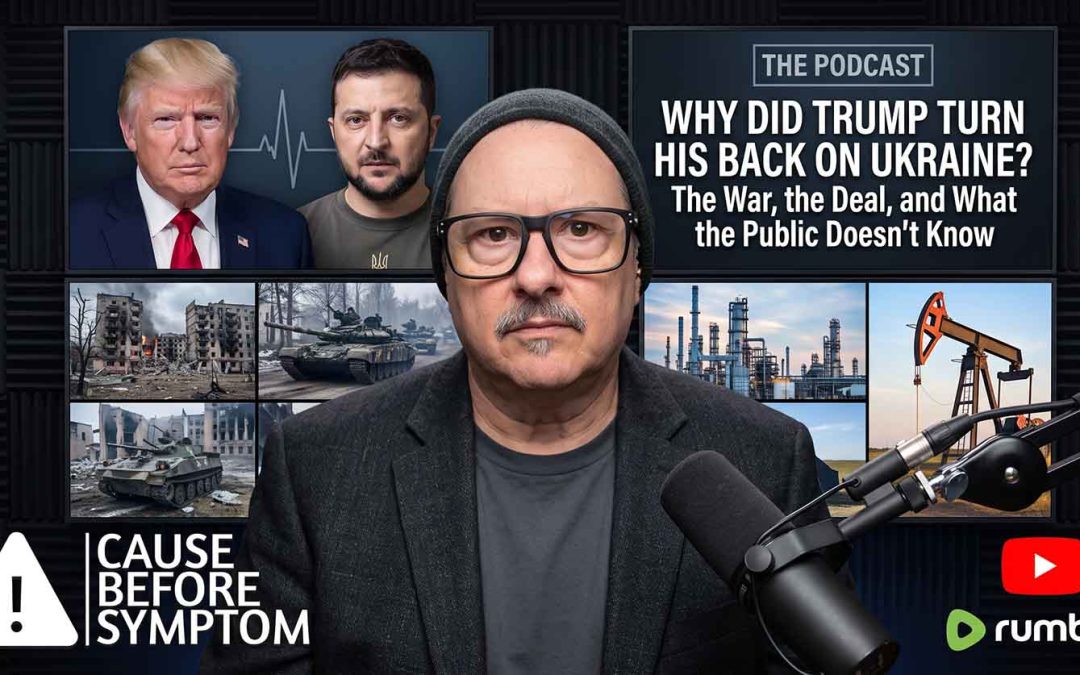
Watch this on Rumble: https://rumble.com/v7h0o2c-why-did-trump-turn-his-back-on-ukraine-the-war-the-deal-and-what-the-public.html#comment-620095004
Opening — Trump, Putin, and Ukraine: What Is Really Being Negotiated?
Welcome to Cause Before Symptom, where we don't chase symptoms—we test the cause against Scripture.
Tonight, I want to examine a question that has divided Americans, frightened Europeans, and left millions of Ukrainians wondering what their future holds. Why does President Donald Trump appear willing to negotiate with Vladimir Putin while placing increasing pressure on Volodymyr Zelenskyy? Why would the United States, after spending years helping Ukraine resist Russia's invasion, begin approaching the conflict differently? And perhaps most importantly, what does Washington know about these negotiations that the American people have not been told?
I want to be very careful with that last question. Just because something happens behind closed doors does not mean there is a conspiracy. Governments conduct confidential negotiations every day. Intelligence agencies protect information that could endanger lives. Presidents sometimes make decisions using information the public cannot see. But secrecy is not evidence that a hidden agreement exists, and national security is not an automatic justification for every decision made in its name.
The war in Ukraine did not begin with Donald Trump. Its roots stretch back through the collapse of the Soviet Union, Ukraine's independence, the struggle over its political future, Russia's seizure of Crimea in 2014, and the full-scale invasion of February 2022. To understand what is happening today, we must understand what Russia wants, what Ukraine is fighting to preserve, and why the United States became involved in the first place.
But something has changed. For years, American policy centered on helping Ukraine resist Russian aggression through military assistance, economic sanctions, intelligence cooperation, and coordination with European allies. Trump has placed greater emphasis on negotiations, economic incentives, and bringing the fighting to an end. Those objectives are not necessarily incompatible with Ukrainian independence. The question is whether the terms being pursued can protect it.
And here is where this investigation becomes particularly important. Ukraine has attacked Russian energy infrastructure because those facilities support the Russian economy and its ability to wage war. Trump has expressed concern about energy prices and pursued economic arrangements involving Russian fuel. Britain and other European governments have emphasized maintaining pressure on Moscow. Suddenly, the same actions that Ukraine considers necessary for its defense may conflict with Washington's economic and diplomatic objectives.
Think about that for a moment. If Ukraine weakens Russia's energy economy, it may strengthen its military position. But if Washington wants Russian energy flowing into international markets, that same Ukrainian strategy can become an obstacle to American policy. Two governments can both say they want peace while pursuing objectives that directly conflict.
Then we arrive at the question I believe deserves the closest examination. What is Putin actually offering in return? Is Russia agreeing to withdraw from occupied territory? Is Moscow accepting a ceasefire that can be independently verified? Is Putin prepared to recognize Ukraine's sovereignty and accept security arrangements that prevent another invasion? Or is Russia being offered economic opportunities while maintaining demands that Ukraine cannot reasonably accept?
Those questions cannot be answered by simply trusting Trump or distrusting him. They cannot be answered by assuming Putin is negotiating in good faith, nor by assuming that every diplomatic conversation is meaningless. We must examine the agreements, the official statements, the military situation, the financial interests, and the concessions each government is actually prepared to make.
Scripture gives us a useful principle in Proverbs 18:13: answering a matter before hearing it is folly and shame. And in Proverbs 18:17, we are reminded that the first person to present a case may appear right until another comes forward and examines it. Those passages do not tell us which government's position is correct. They remind us to investigate before reaching a conclusion.
Tonight, I am not here to defend Donald Trump, condemn Volodymyr Zelenskyy, or explain away Vladimir Putin's invasion. I am here because the consequences are too serious for slogans. Lives are being lost. Families are being displaced. Nations are making decisions that could shape European security for generations.
If Trump has a coherent strategy, I want to understand it. If Putin is making meaningful concessions, I want to identify them. If Ukraine is being asked to surrender something that leaves it vulnerable to another invasion, I want to know that too. And if the evidence leads somewhere different from what I expected, then that is where this investigation must go.
Because the real question tonight is not simply whether Trump has turned his back on Ukraine. The question is what he is attempting to accomplish, what Russia stands to gain, what Ukraine may be required to surrender, and whether the agreement being pursued could actually produce lasting peace.
Let's begin with the history that brought us here.
Investigation 1 — How Did Ukraine Become America's War?
Before I can understand why Donald Trump is changing America's approach to Ukraine, I need to understand something much more fundamental. How did the United States become so deeply involved in a war between Russia and Ukraine? Was America defending an ally, protecting its own national interests, honoring a previous commitment, or participating in a conflict that developed over decades of failed diplomacy? The answer begins long before Trump, Biden, or even Vladimir Putin.
In 1991, the Soviet Union collapsed, and Ukraine emerged as an independent nation. This was not a small event. Ukraine possessed enormous agricultural resources, major industrial facilities, strategic access to the Black Sea, and nuclear weapons left on its territory after the Soviet collapse. Although operational control of those weapons was complicated by Soviet-era command structures, Ukraine had inherited one of the world's largest nuclear arsenals. The question facing Washington, Moscow, and Kyiv was what would happen to those weapons and whether Ukraine's independence could be secured.
In December 1994, Ukraine joined Russia, Britain, and the United States in signing the Budapest Memorandum. Ukraine agreed to relinquish the nuclear weapons on its territory and join the Nuclear Non-Proliferation Treaty as a non-nuclear state. In return, Russia, Britain, and America reaffirmed commitments to respect Ukraine's independence, sovereignty, and existing borders. They also committed to refrain from threatening or using force against Ukraine and to consult if questions arose concerning those assurances. But there was a critical distinction: this was not a NATO-style military defense treaty. America did not promise automatically to enter a war if Ukraine was attacked. Nevertheless, the agreement created serious political and diplomatic expectations.
Meanwhile, NATO was expanding eastward. Countries that had lived under Soviet domination sought membership in a Western military alliance because they feared renewed Russian influence. Moscow increasingly objected, arguing that NATO's expansion threatened Russian security. In 2008, NATO declared that Ukraine and Georgia would eventually become members, although Ukraine received neither immediate membership nor the collective-defense protection that membership would provide. This created a difficult strategic situation. Ukraine was moving closer to Western institutions without receiving the security guarantees that might deter an attack.
Then came 2014. Following months of demonstrations, political violence, and the collapse of President Viktor Yanukovych's government, Russia seized and annexed Crimea. Moscow portrayed its actions as protecting Russian interests and Russian-speaking populations. Ukraine and most United Nations member states rejected the annexation as a violation of Ukrainian sovereignty. Armed conflict also erupted in eastern Ukraine, where Russian-backed separatist forces fought Ukrainian government troops. The Minsk agreements attempted to establish a ceasefire and political settlement, but fighting continued, and the agreements never produced lasting peace.
By February 2022, the crisis had reached another turning point. Russia launched a full-scale invasion of Ukraine. Putin presented the operation through claims involving Russian security, NATO expansion, and the protection of populations in eastern Ukraine. But whatever security concerns Russia raised, invading a sovereign country was not a lawful remedy. Ukraine defended itself, and the United States organized extensive military, financial, and intelligence assistance alongside European partners.
This is where America's involvement became something far greater than a diplomatic dispute. Washington was not formally at war with Russia, and Ukraine was not a NATO member. Yet American weapons, intelligence, financing, sanctions, and international leadership became essential components of Ukraine's resistance. American policymakers also viewed the conflict as a test of whether powerful nations could change international borders through military conquest without facing substantial consequences.
And now we arrive at the question that brings us to tonight's investigation. America never promised Ukraine unlimited military assistance or an unconditional guarantee of victory. But Washington had spent decades supporting Ukrainian sovereignty and helping construct a European security system that opposed territorial conquest. Those commitments created expectations, even where no automatic legal obligation to fight existed.
So when Trump changes the terms of American support, Ukraine sees more than a disagreement over foreign aid. It sees uncertainty about the country whose assistance has helped it survive. Russia sees an opportunity to test whether Western unity can be weakened. And Europe faces the possibility that its security assumptions may no longer hold.
The history establishes something important. This did not begin as America's war, but American decisions gradually became inseparable from its outcome. The next question is what Trump inherited when he returned to the White House, and precisely what he decided needed to change.
Investigation 2 — What Did Trump Inherit, and What Did He Change?
When Donald Trump returned to the White House in January 2025, he inherited a war that had already consumed hundreds of thousands of lives, devastated Ukrainian communities, disrupted international trade, and placed the United States in a prolonged confrontation with Russia. For nearly three years, the Biden administration had provided Ukraine with weapons, intelligence, financial assistance, and diplomatic support. But despite that enormous investment, the war had not ended. Russia still occupied substantial Ukrainian territory, and neither side had accepted terms that could produce a lasting settlement. Trump inherited not simply a foreign war, but a question that Washington had struggled to answer: how much longer could America sustain its existing strategy, and what would ultimately constitute success?
Under Biden, the American approach had largely been to strengthen Ukraine's ability to defend itself while imposing economic costs on Russia. The United States worked with European governments to restrict Russian banking, technology, energy, and access to international markets. Washington supplied advanced military equipment and intelligence while avoiding direct combat between American and Russian forces. The objective was to prevent Russia from conquering Ukraine, strengthen Kyiv's negotiating position, and demonstrate that military aggression carried consequences. But the policy contained a difficult tension. America wanted Ukraine to resist successfully without allowing the conflict to escalate into a direct war between nuclear powers.
Trump approached the problem differently. He placed a negotiated settlement at the center of American policy and began communicating directly with Putin. In February 2025, the two presidents spoke about ending the conflict, and American and Russian representatives subsequently pursued diplomatic discussions. For Ukraine, this raised an immediate concern. Would the future of Ukrainian territory and security be negotiated directly between Washington and Moscow before Kyiv had agreed to the terms? The administration argued that diplomacy was necessary to stop the killing. Critics questioned whether Russia was being given diplomatic opportunities without first making meaningful concessions.
Then came the confrontation that exposed how much American policy had changed. On February 28, 2025, Trump and Zelenskyy clashed publicly during a meeting at the White House. The disagreement involved American support, security guarantees, and the proposed economic partnership between the two countries. Within days, the administration paused military assistance to Ukraine. Intelligence sharing was also temporarily suspended. This was no longer simply a difference in diplomatic language. Washington was demonstrating that assistance previously treated as essential to Ukraine's defense could also become an instrument of negotiating pressure.
On March 11, following talks in Saudi Arabia, Ukraine expressed readiness to accept an American proposal for a thirty-day ceasefire, provided Russia agreed to implement it simultaneously. The United States then resumed military assistance and intelligence sharing. This sequence is important because it reveals the administration's method. Trump was willing to restrict assistance to influence Ukraine's negotiating behavior, then restore that assistance when Kyiv accepted a proposed diplomatic framework. Whether this was effective diplomacy or excessive pressure on a country defending itself remains disputed, but the mechanism itself was visible.
Another change involved money. Trump repeatedly questioned why the United States should continue carrying so much of Ukraine's defense burden. In April 2025, Washington and Kyiv signed an agreement establishing a joint reconstruction investment fund involving Ukrainian resources and future economic development. The administration presented the arrangement as a way to establish a long-term American economic interest in Ukraine's recovery. It was not simply a seizure of Ukraine's minerals, nor did it automatically guarantee American military protection. It represented a different philosophy: American involvement should produce identifiable economic partnerships alongside strategic benefits.
Military support also changed without disappearing altogether. In July 2025, the administration introduced a mechanism allowing NATO allies to finance American military equipment for Ukraine. Rather than returning to the previous model of extensive new American-funded assistance, Washington increasingly expected European governments to pay for additional weapons. This distinction matters. Trump did not immediately sever every military relationship with Kyiv. He altered who would finance assistance, how it would be supplied, and the conditions surrounding continued American involvement. For European governments, the message was that the United States intended to shift more responsibility for Ukraine's defense onto Europe.
But diplomacy with Russia introduced another dimension. In March 2025, the White House announced discussions concerning Black Sea navigation, restrictions on attacks against energy facilities, and possible measures to facilitate Russian agricultural and fertilizer exports. These were presented as steps toward a broader peace process. Yet an agreement to discuss maritime trade or energy infrastructure is not equivalent to Russia agreeing to withdraw from Ukraine. The distinction between limited economic arrangements and a comprehensive peace settlement would become increasingly important.
By October 2026, that distinction had become impossible to ignore. Trump announced an arrangement involving Russian diesel supplies as energy prices became an urgent American concern. On October 16, he signed an executive order waiving major new sanctions and tariffs authorized by Congress under the Graham Act. The order invoked American national interests and preserved the administration's ability to apply other existing restrictions. But the immediate effect was to prevent additional economic penalties from taking effect against Russia and certain purchasers of Russian energy. Moscow welcomed the decision, while Ukraine questioned why Washington would ease pressure on Russia as the invasion continued.
This is where I believe the central change becomes visible. Biden's approach generally sought to improve Ukraine's position by supporting its defense and restricting Russia's resources. Trump's approach increasingly uses military assistance, economic incentives, sanctions, and diplomatic access as bargaining instruments intended to produce an agreement. The difference is not that one administration understood diplomacy and the other did not. Both employed diplomatic and economic tools. The difference lies in how those tools are being combined, which government faces immediate pressure, and what concessions are expected before benefits are granted.
There is also a difficult reality that cannot be ignored. Ukraine depends heavily on American intelligence, weapons technology, and military logistics. Russia does not depend on American assistance in the same way. Consequently, Washington can influence Kyiv's behavior more immediately by restricting support than it can influence Moscow through promises of future cooperation. That creates an imbalance in bargaining power. It does not establish that Trump wants Russia to win, but it does help explain why Ukrainians fear that an American-led settlement could require them to surrender more than Russia.
And there is one more possibility we must examine without pretending it has already been proved. Trump may believe that restoring selected economic relationships with Russia can achieve what years of sanctions have not: persuading Putin that an agreement offers greater benefits than continuing the war. That is a recognizable negotiating strategy. Its weakness is equally recognizable. If Russia receives economic benefits while maintaining its territorial demands, Washington may surrender leverage without obtaining peace. Whether that is happening depends on the actual terms of the negotiations, not on what either side says it hopes to accomplish.
So what did Trump inherit? He inherited a prolonged war, an increasingly expensive international commitment, a heavily armed Russia, a Ukraine fighting for its independence, and European allies deeply concerned about their own security. What did he change? He made negotiations more central, used American assistance more explicitly as leverage, demanded greater European financial responsibility, pursued economic arrangements with both Ukraine and Russia, and showed a willingness to waive additional sanctions in the name of American national interests.
That brings us to the next investigation. If we want to understand whether Trump's approach can produce peace, we must first understand the man on the other side of the negotiating table. What does Vladimir Putin actually want from Ukraine, and what would persuade him to surrender any of it?
Investigation 3 — Why Does Putin Want Ukraine?
If we are going to understand why Donald Trump is negotiating with Vladimir Putin, we must first understand what Putin actually wants. Not what American politicians claim he wants, not what television commentators believe he wants, but what Russia has demanded, what Putin has said publicly, and what Russian forces have attempted to accomplish. Because there is a fundamental difference between negotiating with a leader who wants security guarantees and negotiating with a leader who wants to determine another nation's political future.
Ukraine occupies an extraordinary position in Russian history. Kyiv was a major center of Kyivan Rus, a medieval political and cultural world whose legacy is claimed by Ukrainians, Russians, and Belarusians. Centuries later, large portions of modern Ukraine came under Russian imperial and Soviet rule. Putin has repeatedly invoked this shared history to argue that Russians and Ukrainians are historically connected. But shared history does not erase modern sovereignty. Ukraine became independent in 1991, and Russia subsequently recognized its borders. The historical question is therefore not whether the two nations have common roots. They unquestionably do. The question is whether Moscow believes those roots entitle it to influence Ukraine's government, alliances, territory, and national identity.
Putin's objections to NATO are well documented. For decades, Russian officials have argued that the alliance's eastward expansion threatens Russian security. Moscow particularly objects to the possibility of Ukraine joining NATO because that would extend the alliance's collective-defense system along additional portions of Russia's borders. In December 2021, Russia proposed security agreements demanding restrictions on NATO enlargement and military activity. These concerns form part of the Kremlin's stated justification for its policies. But they do not establish that Ukraine was preparing to attack Russia, nor do they justify Russia's invasion. Ukraine was not a NATO member when Russian forces entered Crimea in 2014 or when the full-scale invasion began in 2022.
To understand the military dimension, we must look at geography. Crimea provides access to the Black Sea and contains Sevastopol, the longstanding base of Russia's Black Sea Fleet. Southern Ukraine connects Crimea to territory farther east, including the land corridor through occupied portions of Zaporizhzhia and Donetsk. Donbas contains industrial infrastructure, transportation networks, and heavily fortified Ukrainian defensive positions. These locations matter militarily and economically. But Russia's ambitions cannot be explained by geography alone, because Moscow has demanded political and military restrictions extending across Ukraine, including areas it does not occupy.
In June 2024, Putin publicly outlined conditions for ending the war. Ukraine would have to withdraw its forces from the entirety of Donetsk, Luhansk, Zaporizhzhia, and Kherson, including territory Russian forces had not captured. Ukraine would also have to abandon its ambition to join NATO, accept neutrality, and address additional Russian demands concerning its military and domestic political arrangements. Putin called for Western sanctions to be lifted as part of a settlement. These were not simply proposals to stop fighting along existing battle lines. They required Ukraine to surrender additional territory and accept limitations on its future security choices.
The demands did not disappear when Trump returned to office. During negotiations in Istanbul in June 2025, Russia presented a memorandum requiring recognition of its claims over Crimea and four other Ukrainian regions, Ukrainian neutrality, and restrictions on the size of Ukraine's armed forces. Another proposed ceasefire arrangement would have required Ukraine to stop military redeployments and accept a halt to foreign military assistance, intelligence, and satellite communications. Consider what that would mean. Ukraine would not merely be agreeing to stop shooting. It would be accepting restrictions on its ability to defend itself while Russian forces remained positioned to resume military operations.
There is another element that deserves examination. Putin has repeatedly spoken about protecting Russian-speaking populations and combating what the Kremlin calls Nazism in Ukraine. Those claims have been central to Russia's public justification for the invasion. Ukraine rejects the accusations and points to its elected government and internationally recognized sovereignty. Protecting language rights is a legitimate subject for international diplomacy, but it does not confer a right to annex territory or dictate another country's political system. When we examine Russia's demands, we must distinguish stated humanitarian concerns from the much broader political and territorial objectives attached to them.
The negotiations surrounding Trump's August 2025 meeting with Putin in Alaska revealed another important distinction. Reporting indicated that Moscow might consider returning relatively small occupied areas while demanding that Ukraine relinquish substantial remaining territory in Donbas. That was a reported negotiating proposal, not an accepted agreement. From Moscow's perspective, exchanging limited territory for strategically important Ukrainian defensive positions could offer substantial military advantages. From Kyiv's perspective, surrendering those positions without enforceable guarantees could expose additional Ukrainian territory to future attack.
Now consider the developments of October 2026. Putin has continued to emphasize Ukrainian neutrality and Russia's interpretation of battlefield realities. On October 16, he announced that Russia was establishing a security zone inside Ukraine along portions of the border, including areas of Sumy and Kharkiv, and said that its existence would not be negotiable. Those regions are not among the four Ukrainian provinces Russia claimed to annex in 2022. This matters because it demonstrates that Moscow's stated territorial requirements can extend beyond its earlier annexation claims. Putin describes the zone as necessary for border security, while Ukraine faces the prospect of additional territory being placed under Russian military control.
So what does Putin want? The evidence points to several connected objectives: control over Crimea and other occupied territories, Ukrainian exclusion from NATO, limits on Ukraine's military independence, reduced Western economic pressure, and a settlement that recognizes Russia as a decisive power in determining Ukraine's security arrangements. Some of these demands are presented as security requirements. Others would directly restrict Ukraine's sovereign right to determine its future. We cannot assume every Russian negotiating demand represents the minimum Moscow would ultimately accept, but neither can we dismiss those demands as mere rhetoric when they are accompanied by military operations.
And this brings us back to Trump. If the American president believes economic incentives and direct negotiations can persuade Putin to compromise, he must determine which Russian demands are genuine security concerns, which are bargaining positions, and which are objectives Moscow has no intention of surrendering. That is a difficult diplomatic problem. Offering Russia a path toward economic cooperation might create incentives for negotiation. But if Moscow believes time and military pressure are working in its favor, economic benefits could become additional gains rather than reasons to compromise.
I believe the most revealing question is not whether Putin says he wants peace. Nearly every government involved in a war claims to want peace under acceptable conditions. The real question is what those conditions require. A ceasefire that leaves Ukraine independent and capable of defending itself is fundamentally different from a settlement that deprives Ukraine of territory, restricts its military, and gives Russia continuing influence over its political future.
We have now established what Russia has publicly demanded. The next investigation turns toward Washington. Why is Trump placing pressure on Zelenskyy, whose country was invaded, while attempting to create economic incentives for Putin? Is this a calculated negotiating strategy, a response to American economic pressures, or a fundamental change in how the United States understands its responsibilities abroad? To answer that, we must examine where Trump's interests and Ukraine's military strategy began to collide.
Investigation 4 — Why Is Trump Pressuring Zelenskyy?
There is something about the relationship between Donald Trump and Volodymyr Zelenskyy that deserves a much closer examination. Ukraine was invaded by Russia. Ukrainian cities have been bombed, millions of people have been displaced, and Ukrainian soldiers have spent years defending their country. Yet in October 2026, the American president is demanding that Ukraine stop attacking Russian oil refineries while simultaneously pursuing economic arrangements with Moscow. Why would the United States pressure the country defending itself instead of concentrating its pressure on the country that launched the invasion? The answer may lie in a collision between military strategy, energy economics, and Trump's approach to ending the war.
To understand this, we must examine what Ukraine has been doing to Russia's energy industry. Oil and natural gas are central to the Russian economy, providing export revenue, government income, and resources that help sustain military operations. Ukraine has increasingly used long-range drones to strike Russian refineries and other energy facilities. These attacks can disrupt fuel production, complicate military logistics, and impose economic costs on Moscow. From Kyiv's perspective, this is a way to weaken a much larger adversary without having to defeat every Russian formation on the battlefield. Ukraine cannot match Russia's population or industrial resources, so it seeks vulnerabilities that can change the economic calculations of the war.
But the consequences do not necessarily stop at Russia's borders. Energy markets are international, and disruptions to refining capacity can affect the availability and pricing of petroleum products. In 2026, those markets have also been affected by the war involving Iran and disruptions in Middle Eastern energy supplies. Rising fuel prices have become a significant American domestic concern. Trump has argued that Ukrainian attacks against Russian refineries are contributing to the problem. Ukraine disputes the importance of those strikes relative to the much larger disruption in the Middle East. The evidence therefore points to several interacting causes of higher prices, not one country or one military operation.
This is where Trump's priorities begin to diverge from Zelenskyy's. Ukraine wants to reduce Russia's ability to finance and sustain its invasion. Trump wants to increase the availability of energy, relieve pressure on American consumers, and create economic incentives that might encourage Putin to negotiate. A refinery strike that Kyiv considers strategically useful may interfere with an economic arrangement Washington considers necessary. That does not mean the two governments disagree about whether Ukrainians should live in peace. It means they disagree about which actions will bring that peace closer and which economic costs are acceptable along the way.
The disagreement became public in October. According to an American official quoted by Axios, Trump had repeatedly asked Zelenskyy to stop striking Russian refineries before announcing an arrangement involving Russian diesel. Reuters subsequently reported that Washington had pressed Ukraine and European governments to suspend these attacks. The reported pressure included warnings that American intelligence cooperation and the European-funded mechanism for purchasing American weapons could be affected. Those reports are important, but they must be described accurately. A reported threat to suspend assistance is not the same thing as confirmation that all assistance has actually stopped.
On October 13, Trump publicly stated that the United States was still sharing intelligence with Ukraine. Zelenskyy also acknowledged that intelligence cooperation continued, although he said Ukrainian military officials had received warnings that it could be reduced or suspended. This distinction matters because American intelligence provides capabilities that Ukraine cannot easily replace. Satellite-based detection of missile launches, early warning of incoming attacks, and other military intelligence can help Ukraine protect its population and infrastructure. If Kyiv believes that continuing its refinery campaign could jeopardize those capabilities, Washington possesses an exceptionally powerful negotiating instrument.
Now consider the imbalance. Russia does not depend on American intelligence to defend itself. Ukraine does. Russia does not purchase its essential defensive weapons through the same American-supported arrangements. Ukraine does. Consequently, Trump can obtain an immediate response from Kyiv by threatening to restrict assistance, while persuading Putin requires a different combination of pressure and incentives. This does not establish that Trump wants Russia to win. It establishes that Washington has much more direct leverage over the government it has been supporting than over the government it is trying to influence.
Continued in Part 2
Bibliography
- Allison, Roy. “Russian ‘Deniable’ Intervention in Ukraine: How and Why Russia Broke the Rules.” *International Affairs* 90, no. 6 (2014): 1255–1297. https://doi.org/10.1111/1468-2346.12170.
- Carnegie Endowment for International Peace. “How Will Trump and Putin’s Diesel Deal Impact Russia and Global Markets?” October 2026. https://carnegieendowment.org/russia-eurasia/politika/2026/10/russia-usa-diesel-agreement.
- Charap, Samuel, and Timothy J. Colton. *Everyone Loses: The Ukraine Crisis and the Ruinous Contest for Post-Soviet Eurasia*. London: Routledge, 2017.
- Constitution of Ukraine. June 28, 1996, as amended. Articles 2 and 73.
- European Council. “European Council Conclusions.” June 18, 2026. https://www.consilium.europa.eu/en/european-council/conclusions/.
- International Energy Agency. *Oil Market Report: October 2026*. Paris: International Energy Agency, October 14, 2026. https://www.iea.org/reports/oil-market-report-october-2026.
- International Energy Agency. “Russian Refining Sector Struggles amid Intensifying Ukrainian Attacks.” https://www.iea.org/commentaries/russian-refining-sector-struggles-amid-intensifying-ukrainian-attacks.
- North Atlantic Treaty Organization. “Bucharest Summit Declaration.” April 3, 2008. https://www.nato.int/cps/en/natolive/official_texts_8443.htm.
- North Atlantic Treaty Organization. *The North Atlantic Treaty*. Washington, DC, April 4, 1949. https://www.nato.int/cps/en/natohq/official_texts_17120.htm.
- Plokhy, Serhii. *The Russo-Ukrainian War: The Return of History*. New York: W. W. Norton & Company, 2023.
- President of Russia. “Meeting with the Leadership of the Russian Foreign Ministry.” June 14, 2024. http://en.kremlin.ru/events/president/news.
- Reuters. “What's in the Diesel Deal between Putin and Trump?” October 12, 2026. https://www.reuters.com/business/energy/what-is-diesel-deal-between-putin-trump-2026-10-12/.
- Reuters. “Diesel Deal Opens Way for More Russia-US Cooperation, Kremlin Envoy Says.” October 14, 2026. https://www.reuters.com/business/diesel-deal-opens-way-more-russia-us-cooperation-kremlin-envoy-says-2026-10-14/.
- Sakwa, Richard. *Frontline Ukraine: Crisis in the Borderlands*. London: I.B. Tauris, 2015.
- United Nations. *Charter of the United Nations*. San Francisco, June 26, 1945. https://www.un.org/en/about-us/un-charter.
- United Nations. “Memorandum on Security Assurances in Connection with Ukraine's Accession to the Treaty on the Non-Proliferation of Nuclear Weapons.” Budapest, December 5, 1994.
- United Nations General Assembly. “Territorial Integrity of Ukraine.” Resolution 68/262, March 27, 2014. https://digitallibrary.un.org/record/767883.
- United Nations General Assembly. “Aggression against Ukraine.” Resolution ES-11/1, March 2, 2022. https://digitallibrary.un.org/record/3965290.
- United Nations Security Council. “Resolution 2202 (2015).” February 17, 2015. https://digitallibrary.un.org/record/787968.
- United States Congress. *Lindsey O. Graham Sanctioning Russia and Iran Act of 2026*. September 18, 2026. Section 115. 22 U.S.C. § 10815. https://uscode.house.gov/us/usc/119-118/t22/s10815/.
- United States Energy Information Administration. *Short-Term Energy Outlook*. Washington, DC: U.S. Department of Energy, October 6, 2026. https://www.eia.gov/outlooks/steo/.
- United States Energy Information Administration. “World Oil Transit Chokepoints.” Washington, DC: U.S. Department of Energy. https://www.eia.gov/international/analysis/special-topics/World_Oil_Transit_Chokepoints.
- United States House Committee on Foreign Affairs, Democratic Staff. “Meeks Statement on Trump Waiving Russia Sanctions.” October 16, 2026. https://democrats-foreignaffairs.house.gov/2026/10/meeks-statement-on-trump-waiving-russia-sanctions.
- The White House. “Outcomes of the United States and Russia Expert Groups on the Black Sea.” March 25, 2025.
- The White House. “Outcomes of the United States and Ukraine Expert Groups on the Black Sea.” March 25, 2025.
- The White House. “Implementing the Lindsey O. Graham Sanctioning Russia and Iran Act of 2026.” Executive order, October 16, 2026. https://www.whitehouse.gov/presidential-actions/2026/10/implementing-the-lindsey-o-graham-sanctioning-russia-and-iran-act-of-2026/.
Endnotes
- Ukraine became independent in 1991 following the dissolution of the Soviet Union. Its internationally recognized borders included Crimea and the territories subsequently occupied by Russian forces.
- The Budapest Memorandum, signed December 5, 1994, recorded assurances by Russia, the United States, and the United Kingdom to respect Ukraine's independence, sovereignty, and existing borders. It did not create an automatic military-defense obligation equivalent to NATO's Article 5.
- NATO's Bucharest Summit Declaration of April 3, 2008, stated that Ukraine and Georgia would become members of the alliance. It did not establish a membership date or extend Article 5 protection to either country.
- Russia occupied and annexed Crimea in 2014. United Nations General Assembly Resolution 68/262 reaffirmed Ukraine's territorial integrity and called upon states not to recognize the resulting change in Crimea's status.
- Russia launched its full-scale invasion of Ukraine on February 24, 2022. United Nations General Assembly Resolution ES-11/1, adopted March 2, 2022, condemned the aggression and demanded the withdrawal of Russian forces.
- The United States and European governments subsequently provided Ukraine with military, financial, humanitarian, and intelligence assistance. American support included air-defense systems, artillery, ammunition, and other military capabilities.
- The Minsk agreements of September 2014 and February 2015 established provisions concerning ceasefires, withdrawal of heavy weapons, monitoring, political arrangements, and border control. Disagreements over implementation persisted, and the agreements did not prevent Russia's full-scale invasion in 2022.
- On June 14, 2024, Vladimir Putin publicly demanded Ukrainian withdrawal from the entirety of the Donetsk, Luhansk, Kherson, and Zaporizhzhia regions claimed by Russia, together with abandonment of Ukraine's NATO membership ambitions, as conditions for ending hostilities.
- Donald Trump returned to the presidency in January 2025 and pursued direct diplomatic engagement with Moscow while pressing Ukraine and European governments to reconsider aspects of the existing military and financial assistance arrangements.
- On March 11, 2025, Ukraine expressed readiness to accept an American proposal for an immediate, temporary 30-day ceasefire, subject to Russian acceptance and simultaneous implementation. The United States resumed intelligence sharing and security assistance following talks in Saudi Arabia.
- On March 25, 2025, the White House published separate statements describing American discussions with Russia and Ukraine concerning Black Sea navigation, attacks against energy infrastructure, and related economic arrangements. Those statements did not establish a comprehensive peace agreement.
- In 2025, Washington and Kyiv concluded an economic partnership involving a reconstruction investment fund and Ukrainian natural resources. The arrangement was separate from the military and territorial provisions required for a peace settlement.
- Ukraine has conducted strikes against Russian oil refineries, fuel storage facilities, and related infrastructure. These operations seek to disrupt Russian fuel production, impose economic costs, and complicate military logistics.
- Disruption of Russian refining capacity can also affect international petroleum-product markets, particularly when other supply interruptions have already reduced global diesel availability.
- The United States Energy Information Administration's October 2026 outlook described substantial increases in international crude oil prices associated with disruptions to Middle Eastern energy infrastructure and shipping.
- The International Energy Agency's October 2026 Oil Market Report examined reduced diesel and gasoil availability associated with disruptions affecting Middle Eastern exports, Russian supplies, and other sources of refined petroleum.
- The Strait of Hormuz is a major international energy transit route. Interruptions to shipping through the strait can affect global oil and petroleum-product prices, including prices in countries that produce substantial quantities of crude oil domestically.
- Russian petroleum exports generate revenue for Russian producers and the broader economy. Sanctions, insurance restrictions, payment systems, shipping services, and trade regulations influence the ability of Russian energy products to reach international markets.
- In October 2026, the Trump administration pursued arrangements intended to make additional Russian diesel available to international markets. Contemporary reporting described the arrangement as both an energy-supply measure and a possible incentive for renewed diplomatic engagement.
- Reporting on American discussions with Ukrainian officials indicated that Washington hoped economic engagement could encourage Putin to negotiate. Such expectations did not establish that Russia had accepted a comprehensive ceasefire or territorial settlement.
- On October 16, 2026, Trump issued an executive order waiving specified additional sanctions and tariffs under the Lindsey O. Graham Sanctioning Russia and Iran Act of 2026. The order invoked American national interests.
- The waiver did not automatically eliminate all existing American sanctions against Russia. Its scope concerned the measures identified under the relevant legislation and executive action.
- The Graham Act included congressional reporting requirements concerning the exercise of waiver authority, including provision for an unclassified explanation and potentially classified supporting information.
- American lawmakers from both political parties expressed objections to the administration's Russian energy and sanctions decisions. Their concerns included the possibility that additional commercial revenue could benefit Russia without corresponding concessions concerning Ukraine.
- Ukraine's government objected to easing economic pressure on Russia while Russian military operations continued. Ukrainian officials maintained that restrictions on attacks against energy infrastructure should be reciprocal.
- Britain and European governments continued supporting Ukraine's sovereignty and territorial integrity while advocating credible security arrangements and maintaining economic pressure on Russia.
- European governments differ in their economic exposure to Russian energy, defense capabilities, domestic political priorities, and willingness to engage Moscow. Their policies should not be treated as entirely uniform.
- NATO's Article 5 establishes a collective-defense commitment among alliance members. Ukraine is not a NATO member and does not possess an Article 5 guarantee.
- Ukraine's constitution establishes the country's territorial integrity and requires constitutional procedures concerning changes to its territory. Territorial concessions cannot be decided solely through negotiations between the United States and Russia.
- A ceasefire suspends or restricts military operations under agreed conditions. It does not necessarily resolve sovereignty disputes, determine internationally recognized borders, or establish a permanent peace.
- A ceasefire along existing battle lines can leave territorial claims unresolved. Its durability depends on the conduct of the parties, verification arrangements, military conditions, and mechanisms for responding to violations.
- Security guarantees can take different forms, including political assurances, long-term military assistance, international monitoring, bilateral defense commitments, and collective-defense obligations. These arrangements do not provide identical levels of protection.
- The Budapest Memorandum and the Minsk agreements demonstrate that written commitments alone do not guarantee compliance. Implementation, monitoring, enforcement, and the willingness of governments to respond to violations are separate considerations.
- Russia's publicly stated territorial and security demands have included Ukrainian neutrality, restrictions on Ukraine's military posture, and recognition or acceptance of Russian control over claimed territories.
- The publicly described negotiations examined in this investigation did not establish a finalized agreement providing for comprehensive Russian withdrawal, acceptance of Ukraine's internationally recognized borders, and enforceable guarantees against renewed aggression.
- Diplomatic negotiations can involve confidential proposals, private communications, and classified intelligence assessments. The existence of such communications does not independently establish that a secret agreement has been concluded.
- American foreign policy toward Ukraine has involved military assistance, sanctions, diplomatic negotiations, European burden sharing, and economic considerations. Changes in the relative emphasis placed on these instruments can alter negotiating leverage without necessarily changing formal treaty obligations.
- The outcome of any settlement depends on its actual terms, the commitments accepted by Russia and Ukraine, the ability of Ukraine to defend itself, the conditions governing sanctions relief, and the willingness of outside governments to enforce their guarantees.
- Proverbs 18:13 warns against answering a matter before hearing it. Proverbs 18:17 emphasizes examining competing accounts. These passages provide the scriptural foundation for evaluating evidence before reaching conclusions.
- Matthew 7:16 teaches recognition by fruits. In the context of this investigation, the principle is applied to measurable diplomatic outcomes rather than public promises.
- Luke 14:31 concerns evaluating military strength before entering conflict. The passage illustrates the importance of considering resources and consequences when making decisions involving war.
- Deuteronomy 29:29 distinguishes between secret and revealed matters. The passage supports distinguishing established evidence from speculation about undisclosed information.
- Jeremiah 6:14 warns against declaring peace where peace does not exist. The passage provides a scriptural distinction between the announcement of peace and the resolution of conditions producing conflict.
- Luke 12:48 teaches that greater responsibility accompanies greater trust and authority. The principle applies to evaluating the obligations associated with political and military power.
- Matthew 5:9 blesses peacemakers. The passage provides the concluding scriptural principle that genuine peace should be pursued through actions that produce lasting reconciliation and security.
#Trump, #Putin, #Ukraine, #Zelenskyy, #RussiaUkraineWar, #UkraineWar, #TrumpForeignPolicy, #Russia, #PeaceNegotiations, #NationalSecurity, #USForeignPolicy, #Geopolitics, #NATO, #Sanctions, #EnergyCrisis, #WorldPolitics, #Diplomacy, #InternationalRelations, #WarAndPeace, #CauseBeforeSymptom
Trump, Putin, Ukraine, Zelenskyy, RussiaUkraineWar, UkraineWar, TrumpForeignPolicy, Russia, PeaceNegotiations, NationalSecurity, USForeignPolicy, Geopolitics, NATO, Sanctions, EnergyCrisis, WorldPolitics, Diplomacy, InternationalRelations, WarAndPeace, CauseBeforeSymptom