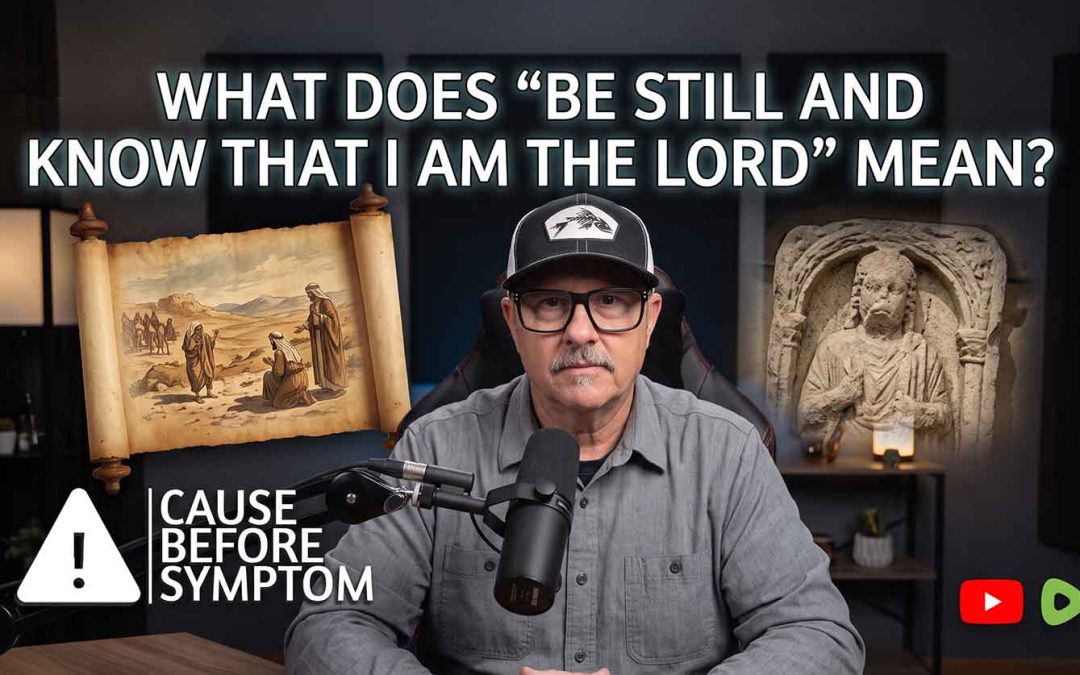
Watch this on Rumble: https://rumble.com/v7czjfq-what-does-be-still-and-know-that-i-am-the-lord-mean.html
The Two Miracles Happening Inside You Right Now
Synopsis
For generations, Christians have quoted the words, "Be still and know that I am the Lord," as a source of comfort during difficult times. But what did God actually mean when He spoke those words? Was He simply telling us to calm down, or was He inviting us to discover something far deeper? In this investigation, we step beyond familiar interpretations and examine Psalm 46:10 through the lenses of Scripture, neuroscience, physiology, and the design of the human body. Rather than approaching the verse as a technique for relaxation, we ask whether stillness itself reveals truths that are hidden by the constant noise of everyday life.
As we become still, two extraordinary realities immediately come into focus. Our heart continues beating without our command, and our breath continues sustaining our life without our conscious effort. These are not occasional events—they are continuous miracles occurring every second of every day. Modern science can explain the remarkable mechanisms behind the heartbeat, breathing, the nervous system, and the body's ability to maintain itself, yet Scripture repeatedly points beyond those mechanisms to the One who continually upholds all things. What happens when these two perspectives are examined together?
Join me as we journey from Genesis to the Psalms, through the teachings of Jesus, the writings of Paul, and the discoveries of modern medicine to uncover what may be one of the Bible's most overlooked invitations. Along the way, we'll explore stress, distraction, the healing power of stillness, and the profound relationship between the heart, the breath, and the God who gives them. By the end of this episode, you may never read Psalm 46:10 the same way again, and you may discover that the greatest evidence of God's sustaining presence has been quietly beating and breathing within you all along.
Monologue
Welcome to Cause Before Symptom, where we don't chase symptoms—we test the cause against Scripture.
Tonight, I'd like to begin a little differently. I'm not going to ask you to open your Bible just yet. I'm not going to ask you to agree with me, disagree with me, or even take notes. Instead, I'd like to ask you to do something that sounds incredibly simple but may be one of the hardest things we do in today's world. For just a moment... be still.
Don't reach for your phone. Don't think about work. Don't think about tomorrow. Simply become still. As you sit there, something extraordinary is already happening. Your heart is beating. Your lungs are breathing. You are not consciously telling either one what to do. They simply continue.
While you were sleeping last night, your heart never asked for your permission to beat another hundred thousand times. Your lungs never waited for your command before taking another breath. Long before you clicked on this video, life was already being sustained inside you. Most of us never stop long enough to notice these two miracles because they have become so familiar that we simply expect them. Yet if either one stopped for only a few moments, every problem we worried about today would instantly become unimportant.
That brings us to one of the most quoted verses in the entire Bible: "Be still, and know that I am the Lord." I've heard this verse preached for many years, usually as a reminder to calm down when life becomes difficult. There is certainly comfort in those words, but I've begun to wonder if we've overlooked something much deeper. Why does God begin with the words, "Be still"? Why not simply say, "Know that I am the Lord"? Why does stillness come first?
Perhaps because there are things we cannot notice while we are constantly distracted.
Our world is filled with noise. News alerts, social media, emails, text messages, endless entertainment, deadlines, responsibilities, and worries about tomorrow compete for our attention every waking moment. Even when the room is quiet, our minds often are not. We replay old conversations, imagine future problems, and carry burdens that haven't even happened yet. We've become so accustomed to noise that silence almost feels uncomfortable.
Yet into all of that noise, God speaks only three simple words: "Be still."
Not because He needs silence.
Because perhaps we do.
As I began researching this topic, I discovered something fascinating. Modern neuroscience has spent decades studying what happens when people intentionally become still. Researchers have measured changes in the brain, the nervous system, the heart, the lungs, stress hormones, and even the immune system. Again and again, they found that when the body slows down, remarkable things begin to happen. Stress decreases. The heart settles. Breathing becomes deeper. The nervous system shifts into a state of restoration. The body begins functioning the way it was designed to function.
Science can explain these processes with incredible detail. It can describe the electrical impulses that move through the heart. It can explain how oxygen enters the bloodstream through the lungs. It can map the pathways of the nervous system and identify the hormones released during times of stress and times of peace. Those discoveries are remarkable, and tonight we're going to explore them together.
But I also realized that science and Scripture are asking different kinds of questions.
Science is incredibly good at explaining how the heart beats. Scripture asks us to consider the One who continually sustains the life of the heart. Science explains how breathing works. Scripture reminds us that life itself was first given through the breath of God and that every moment of our existence depends upon Him. One explains the mechanism. The other points us toward the Sustainer.
This isn't going to be a show about meditation techniques, emptying your mind, or escaping reality. It isn't even primarily about reducing stress, although we'll discover why stillness benefits the body in remarkable ways. This is an investigation into one sentence that millions of people have memorized but very few have stopped to examine.
What does "Be still and know that I am the Lord" really mean?
My hope is that by the end of tonight's investigation, you'll never read Psalm 46:10 the same way again. You may discover that God wasn't simply inviting us to become quiet. He was inviting us to become aware. Aware of the two miracles taking place inside us every moment of every day. The miracle of the heart. The miracle of the breath. And through those miracles, the God who has been faithfully sustaining us from our very first breath to the one you are taking right now.
Part 1 – The Verse Everyone Knows, But Few Understand
If I asked a hundred Christians to finish the sentence, "Be still and know that I am the Lord," I imagine almost every one of them could do it from memory. It has been printed on coffee mugs, wall decorations, greeting cards, and bookmarks. It is one of the most comforting verses in the entire Bible. Yet I wonder how many of us have ever stopped to ask what God actually meant when He spoke those words. We know the verse, but do we know the invitation behind it?
One of the easiest mistakes we can make is reading a single verse without looking at what surrounds it. Psalm 46 is not written during a peaceful afternoon beside a quiet stream. It describes a world in turmoil. The earth gives way. Mountains are moved into the sea. Waters roar and foam. Nations rage. Kingdoms are shaken. It is a picture of chaos, fear, uncertainty, and instability. In the middle of all of that noise, God speaks only a few words that cut through everything: "Be still, and know that I am the Lord."
Notice what He does not say. He doesn't begin by explaining why the mountains are shaking. He doesn't immediately remove the storm. He doesn't tell His people to work harder, think faster, or defend themselves more aggressively. Before anything else, He gives them a command that almost seems impossible during a crisis. He tells them to become still.
That word "still" carries more weight than we often realize. In the Hebrew language, it can mean to cease striving, to let go, to release your grip, to stop fighting. It is not simply the absence of movement. It is the decision to stop relying on your own frantic effort long enough to recognize the authority of God. The command is not passive. It is an intentional act of trust.
Think about how different that is from the world we live in today. We have convinced ourselves that every problem requires immediate action. Every notification demands our attention. Every headline competes for our emotions. We wake up reaching for our phones before we even notice the gift of another day. Our minds begin running long before our feet ever touch the floor. We move from one distraction to the next until we finally collapse into bed, only to repeat the cycle again tomorrow.
Perhaps that is why this verse speaks so powerfully across generations. Human beings have always lived with uncertainty, but never before have we carried so much constant noise with us. We no longer have to seek distraction because distraction now seeks us. It follows us into our homes, our cars, our bedrooms, and even into our moments of worship. Silence has become so rare that many people feel uncomfortable when they experience it.
But what if stillness isn't empty at all?
What if stillness is where we finally begin to notice what has been happening all along?
I'd like you to think back to what we did at the beginning of this episode. For just a few moments, we stopped. We weren't trying to achieve some altered state of consciousness. We weren't performing a ritual. We simply became quiet. Almost immediately, two things became obvious. Your heart was beating. Your breath was moving in and out of your lungs. Neither one was waiting for your instructions.
Those two realities are going to guide our entire investigation tonight.
The more I studied Psalm 46:10, the more I became convinced that God is inviting us to notice something before He asks us to understand something. Before we fill our minds with explanations, arguments, and opinions, He asks us to become still. Not because stillness is the goal, but because stillness removes enough noise for us to recognize the One who has been there all along.
As we continue, we're going to examine what happens inside the human body when we become still. We'll look at the heart, the breath, the brain, and the remarkable discoveries of modern science. Then we'll place those discoveries alongside Scripture to see whether they illuminate one another. My goal isn't to force science to prove the Bible or to use the Bible to explain every scientific discovery. My goal is much simpler. I want to understand why God chose these particular words.
"Be still..."
Perhaps those three words are not merely an instruction.
Perhaps they are the doorway through which we finally begin to know that He is the Lord.
Part 2 – The First Thing You Notice When You Become Still
I'd like to ask you to do something with me again. Wherever you are, if it's safe to do so, stop for just a moment. Don't change your breathing. Don't close your eyes if you don't want to. Don't try to force anything to happen. Simply become still.
What do you notice?
Not your thoughts.
Not the sounds around you.
Notice your body.
Without asking for your permission, your heart is beating. Without your command, your lungs continue drawing in breath and releasing it again. Life is unfolding inside you while you simply sit there doing...nothing.
That may not sound extraordinary because it has been happening since before you were born. Familiarity has a way of hiding wonder. We stop noticing the things that happen every day. The sunrise becomes ordinary. The sound of rain becomes background noise. Even the miracle of being alive can become something we assume rather than something we appreciate.
Imagine if you had never seen a beating heart before. Imagine witnessing one for the very first time. A muscular organ, about the size of your fist, contracts over one hundred thousand times every day. It pumps thousands of gallons of blood through a network of vessels that stretches tens of thousands of miles throughout your body. It never asks for a vacation. It never clocks out for the night. It faithfully continues whether you're working, sleeping, laughing, crying, or sitting perfectly still.
Now think about your breathing.
Every few seconds, another breath enters your lungs. Oxygen passes into your bloodstream. Carbon dioxide leaves your body. This has happened millions of times throughout your life. You can choose to breathe faster or slower for a little while, but eventually your body quietly takes over because life is more fundamental than your will. Even while you sleep, breathing continues.
As I reflected on Psalm 46:10, something occurred to me that I had never considered before. Maybe God begins with the words, "Be still," because stillness allows us to observe what activity causes us to ignore. We spend so much time focused on what we are doing that we rarely notice what is already being done for us.
Think about how much effort we devote to maintaining our lives. We work to earn money. We buy food. We exercise. We take medicine. We make plans for the future. There is wisdom in all of those things. But none of them explains why, at this very moment, your heart continues beating or why your next breath is already on its way.
Science can explain the mechanisms with remarkable precision, and we're going to explore those mechanisms later in this episode. Understanding how the heart works and how breathing functions is one of the great achievements of modern medicine. Yet even after learning every detail of physiology, one fact remains unchanged.
You are not consciously sustaining yourself.
That realization is incredibly humbling.
We often speak as though we are completely in control of our lives. We decide where to live, where to work, what to eat, and how to spend our time. Yet beneath all of those choices is a reality we cannot control. We cannot command one more heartbeat. We cannot guarantee one more breath. We live every moment dependent upon systems that faithfully continue without our awareness.
The Bible begins with a similar picture. Adam did not breathe himself into existence. Life was first received before anything else could be accomplished. Every achievement, every invention, every conversation, every relationship, every dream came after life had already been given. Before humanity could do anything, humanity first had to receive.
Perhaps that pattern has never changed.
Perhaps every heartbeat reminds us that life is still being received.
Perhaps every breath quietly testifies that we are more dependent than we realize.
By the time this episode is over, I hope you'll notice something that has always been present but rarely appreciated. The heart and the breath are not simply biological functions to take for granted. They are continual reminders that before we accomplish anything, before we solve any problem, before we speak our first prayer each morning, life itself has already been faithfully given to us once again.
And maybe that is exactly where God wanted us to begin.
By becoming still long enough to notice.
Part 3 – Miracle Number One: Your Heart Is Beating Without You
Let's begin with the first miracle.
Your heart.
At this very moment, while you're listening to my voice, your heart is quietly doing its job. It isn't asking whether you're having a good day or a bad day. It isn't waiting for your permission before it beats again. It simply continues. Day after day. Year after year. Whether you are awake or asleep, joyful or grieving, healthy or sick, your heart faithfully keeps working.
Most of us know our heart beats, but very few of us stop to appreciate what that actually means. On an average day, your heart beats around one hundred thousand times. Over the course of a year, that's roughly thirty-five million beats. By the time someone reaches seventy years of age, the heart may have beaten well over two and a half billion times without ever taking a break.
Think about that for a moment. If your car engine ran continuously for seventy years without stopping, mechanics from around the world would study it because it would be considered one of the greatest engineering achievements in history. Yet every one of us walks around carrying something far more remarkable inside our chest, and we rarely stop to admire it.
Medical science has taught us an incredible amount about how the heart works. It is a muscular pump made up of four chambers. Tiny electrical signals begin in a specialized group of cells known as the sinoatrial node. Those signals spread through the heart in a carefully coordinated pattern, causing the muscle to contract with astonishing precision. Blood is sent to the lungs to receive oxygen, then pumped throughout the body to nourish every organ, every muscle, and every cell.
The more we learn about the heart, the more impressive it becomes. Every beat depends upon precise timing. Every valve must open and close at exactly the right moment. Every electrical impulse must arrive in perfect order. A disruption lasting only a few seconds can become life-threatening. Yet for most of our lives, this extraordinary system functions quietly in the background while we focus on everything else.
I find that remarkable. Not because science explains it—science should explain it. That's exactly what science is supposed to do. It studies the mechanisms, identifies the processes, and helps us understand how the heart performs its work. Those discoveries have saved countless lives, and we should be grateful for them.
Understanding the mechanism, however, doesn't make the wonder disappear. In many ways, it makes the wonder even greater. The more we discover about the complexity of the human heart, the more we realize how many things must work together every second simply for us to remain alive. Thousands of coordinated processes are occurring inside us at this very moment without a single conscious command from you or me.
Have you ever noticed that we speak as though we're completely in control of our lives? We say, "I'm keeping myself going," or, "I'm hanging in there." There is truth in those expressions because our choices matter. We decide what to eat, whether to exercise, and how we care for our bodies. But beneath every decision lies a reality we cannot escape. We are not consciously keeping our own hearts beating. If that responsibility rested on us, none of us would survive a single night's sleep.
The Bible presents an interesting perspective on this reality. It certainly teaches that God created the human body, but it goes further. Scripture repeatedly describes God as the One who continually sustains life. Paul tells the people of Athens, "In Him we live and move and have our being." The writer of Hebrews describes Christ as "upholding all things by the word of His power." Colossians declares, "In Him all things hold together."
Notice the language. Not "held together." Not "once held together." "Hold together." Present tense. The biblical picture is not of a God who wound up the universe like a clock and walked away. It is the picture of a God who continually sustains His creation from one moment to the next.
As I sat quietly thinking about Psalm 46:10, something struck me. Perhaps one reason God tells us to be still is because stillness allows us to witness His sustaining work in the most personal way imaginable. Every heartbeat becomes a quiet reminder that life is not something we manufacture. It is something we receive.
The heart doesn't announce itself with every beat. It simply serves you faithfully from the day you entered this world. It carries you through childhood and adulthood, through joy and sorrow, through success and failure. It never asks for recognition. It simply continues.
Maybe that's why we rarely notice it.
Faithfulness often becomes invisible.
The sun rises every morning, so we stop looking at it. Our heart beats every second, so we stop marveling at it. Our breath continues every moment, so we stop giving thanks for it.
Perhaps stillness is God's invitation to recover our sense of wonder.
Not because the heartbeat, by itself, proves everything about God. But because it reminds us that our lives are built upon gifts we did not create and cannot ultimately sustain on our own.
Before you ever spoke your first prayer this morning, your heart had already been faithfully beating through the entire night.
Maybe that is one of the first ways we begin to know that He is the Lord. It doesn't begin by looking outward. It begins by becoming still long enough to notice the quiet miracle that has been happening inside your own chest every second of your life.
Part 4 – Miracle Number Two: The Breath of Life
If the heartbeat is the first miracle we notice when we become still, the second is even more personal.
Our breath.
Take a slow breath in.
Now let it out.
You just participated in something so ordinary that you probably didn't think about it. Yet without that single breath, nothing else in your life would matter. Before you earn another paycheck, hug your family, read another chapter of your Bible, or say another prayer, you must first receive another breath.
Unlike the heart, we can control our breathing for a short time. We can breathe faster, breathe slower, or even hold our breath for a while. But eventually something remarkable happens. Your body quietly takes over. Long before you lose consciousness, your brain overrides your decision because life is more important than your temporary choice. Whether you're awake or asleep, your lungs continue their work.
Every day you will take somewhere between twenty thousand and twenty-five thousand breaths. Most of them will pass unnoticed. They require no reminders, no alarms, and no conscious effort. They simply continue, hour after hour, year after year, carrying oxygen to every cell in your body and removing carbon dioxide so life can continue.
Scientists have spent decades studying what happens during every breath. They understand how oxygen moves from the lungs into the bloodstream, how carbon dioxide is removed, and how the brain automatically regulates breathing. They have also discovered something else. The way we breathe affects nearly every major system in our body. Slower, deeper breathing lowers stress hormones, calms the nervous system, slows the heart rate, improves blood pressure, and helps the body move from a state of survival into a state of healing.
I find that fascinating because thousands of years before neuroscience measured any of those effects, Scripture was already directing our attention to breath.
The very first breath recorded in the Bible is not Adam's.
It is God's.
Genesis tells us that the Lord formed man from the dust of the ground and breathed into his nostrils the breath of life, and man became a living soul. Before Adam spoke his first word, before he took his first step, before he named the animals or tended the garden, he first received life. Everything Adam would ever accomplish began with something he did not create.
That pattern continues throughout Scripture. Job declared, "The Spirit of God has made me, and the breath of the Almighty gives me life." The psalmist reminds us that every living creature depends upon God, and when He takes away their breath, they return to the dust. Paul told the philosophers in Athens, "In Him we live and move and have our being." None of these passages describe a God who simply started life long ago. They describe a God who continually sustains it.
Think about how easy it is to overlook this gift. No one wakes up in the morning excited to take their first breath of the day. No one counts the twenty thousand breaths they will receive before going to bed. We simply expect the next one to arrive. Yet if you've ever watched someone struggling to breathe, you quickly realize that nothing becomes more valuable than the next breath.
Knowing how breathing works doesn't make it less amazing. If anything, it makes it even more remarkable. Every breath depends upon an astonishing chain of events taking place inside the body. The lungs expand. Air reaches millions of tiny air sacs. Oxygen crosses into the bloodstream. Red blood cells carry it throughout the body while carbon dioxide makes the return trip to be released with the next exhale. It happens over and over again without our awareness.
Understanding the mechanism doesn't diminish the gift. Knowing how a seed becomes a tree doesn't make the tree less beautiful. Knowing how the eye sees doesn't make a sunset less breathtaking. In the same way, understanding the physiology of breathing doesn't remove the wonder that life itself is continually being sustained.
Perhaps that's why God tells us to be still before He tells us to know. When the distractions fade, we begin noticing what has always been there. The heartbeat. The breath. Two quiet miracles that ask for nothing from us yet faithfully serve us every moment of every day.
Before you thanked God today, you had already taken thousands of breaths.
Before you asked Him for anything, He had already given you everything you needed to remain alive up to this very moment.
Maybe that is one of the deepest meanings of Psalm 46:10. God isn't asking us to become still because He has stopped working. He's asking us to become still long enough to notice that He never has.
Part 5 – What Science Discovered About Stillness
As I continued studying Psalm 46:10, I noticed something unexpected. God never explains why stillness matters. He simply commands it. Thousands of years later, modern science began asking a different question: "What actually happens inside the human body when a person becomes still?" The answers have been fascinating.
Researchers have found that when we intentionally slow down, our nervous system begins to change almost immediately. The body shifts away from what scientists call the "fight-or-flight" response and toward the "rest-and-digest" response. Heart rate slows, blood pressure often decreases, muscles begin to relax, digestion improves, and the body starts repairing itself instead of preparing for danger.
One of the key players in this process is the vagus nerve, the longest cranial nerve in the human body. It acts like a communication highway between the brain, the heart, the lungs, and many other organs. When we become calm and breathe naturally, this nerve helps regulate our heartbeat, reduces stress hormones, lowers inflammation, and promotes healing throughout the body. Scientists now recognize healthy vagal function as one of the most important indicators of physical and emotional well-being.
The brain changes as well. Chronic stress keeps the brain in a constant state of alertness, always scanning for threats. But periods of quiet allow the brain to reduce that constant activity. Concentration improves. Memory improves. Emotional reactions become less intense. People often report greater clarity of thought after simply sitting quietly for a few minutes.
This doesn't mean life suddenly becomes easy. Stillness doesn't eliminate financial problems, difficult relationships, illness, or grief. It doesn't magically remove suffering. What it does is change the condition of the person facing those problems. The circumstances may remain exactly the same, but the mind and body become better equipped to respond wisely instead of reacting impulsively.
I find it remarkable that our bodies seem designed to benefit from stillness. That shouldn't surprise us if the One who created the body also knows exactly how it functions. The Designer would naturally understand what allows His creation to flourish.
At the same time, I want to be careful not to confuse cause and effect. Stillness itself isn't divine. Sitting quietly doesn't automatically make someone closer to God. People from many different cultures and religions have discovered that slowing down benefits the body because these are built-in features of human physiology. Science can measure those effects whether a person believes in God or not.
That distinction is important because Psalm 46:10 is not primarily teaching a health technique. God doesn't say, "Be still because it lowers your blood pressure." He says, "Be still and know that I am the Lord." The stillness is not the destination. It is the doorway. The purpose is not simply a calmer body but a clearer awareness of God.
Perhaps that's where many people misunderstand this verse. We often chase the feeling of peace instead of the God who gives peace. We focus on relaxation while overlooking the relationship. The Bible consistently points beyond the gift to the Giver. Peace is wonderful, but it is never meant to replace the One who provides it.
When I read the scientific literature alongside Scripture, I don't see two competing stories. I see two different perspectives looking at the same reality. Science explains what happens inside the body during stillness. Scripture explains why stillness matters in the first place. One describes the mechanism. The other reveals the meaning.
Maybe that is why God chose such simple words. He didn't tell us to become experts in physiology. He didn't tell us to master neuroscience. He simply invited us to stop striving long enough to recognize the One who has been sustaining us all along.
The more I think about it, the more profound those words become.
"Be still..."
Not because God has become easier to find.
Because the noise has become harder to hear through.
When the distractions finally quiet down, the heartbeat is still there. The breath is still there. And perhaps, for the first time in a long time, we begin to notice that the God who gave both has never left us for even a single moment.
Part 6 – Why We Rarely Notice These Miracles
One question kept coming back to me while I was researching this episode. If our heartbeat and our breath are happening every second of every day, why don't we notice them? Why does something so extraordinary become almost invisible?
I think the answer is surprisingly simple. We become accustomed to the gifts we receive every day. The first time a child sees the ocean, they stand in amazement. The hundredth time, they may walk past it without a second glance. The sunrise still paints the sky with incredible beauty every morning, yet most of us are too busy getting ready for work to stop and watch it. Familiarity has a way of replacing wonder with expectation.
The same thing happens with life itself. Your heart has beaten billions of times, and your lungs have taken hundreds of millions of breaths. Because they have never asked for your attention, you rarely give them any. Their faithfulness has become so consistent that you simply assume it will continue tomorrow.
That assumption changes very quickly when something goes wrong.
Talk to someone who has survived a heart attack. Ask a person who has struggled to breathe because of pneumonia, asthma, or another serious illness. Listen to someone who has waited for a heart transplant or stood beside the bed of a loved one whose breathing had become labored. Suddenly, the next heartbeat and the next breath become the only things that matter. What was once ignored becomes priceless.
Why do we wait until a gift is threatened before we appreciate it?
Perhaps because comfort slowly convinces us that what is normal is somehow guaranteed.
The Bible consistently reminds us that life is a gift, not a possession. James writes that our lives are like a vapor that appears for a little while and then vanishes. Moses prayed, "Teach us to number our days, that we may gain a heart of wisdom." These verses are not meant to make us fearful. They are meant to make us grateful.
Gratitude changes the way we see ordinary things. The heartbeat is no longer just another biological function. The breath is no longer something we expect. They become daily reminders that every moment of life is being received before it is being spent.
I sometimes wonder how different our prayers would be if we noticed these things more often. Instead of beginning every conversation with God by presenting our list of requests, perhaps we would begin by thanking Him for the thousands of heartbeats and breaths He has already given us since we woke up this morning. Before we've asked Him for anything, He has already been giving to us continuously.
That realization also changes the way we see other people. Every person you pass in the grocery store, every coworker, every neighbor, every stranger driving beside you on the highway is living by those same two miracles. Their heart is beating. Their lungs are breathing. Whether they acknowledge God or not, they are being sustained moment by moment just as you are. There is something deeply humbling about recognizing that we all share the same dependence upon the One who gives life.
Maybe this is why God began with the words, "Be still." Stillness interrupts our routine long enough for us to notice what constant activity causes us to overlook. It slows us down just enough to rediscover the wonder that has been hidden inside ordinary moments all along.
The next time you find yourself overwhelmed by the noise of the world, stop for just a moment. Don't worry about finding the perfect words. Don't feel like you have to accomplish something. Simply become still. Listen to your heartbeat. Feel your breath. Remember that both have continued faithfully from the moment you entered this world until this very second.
Perhaps the greatest miracles are not always the ones that happen once in a lifetime.
Perhaps some of God's greatest miracles are the ones that happen every second of our lives, so faithfully and so quietly that we forget they are miracles at all.
Part 7 – "Know That I Am the Lord"
Everything we've explored tonight has been leading to one simple phrase: "Know that I am the Lord." Those words are the destination of Psalm 46:10. God doesn't ask us to become still simply so we can enjoy a few moments of peace. He asks us to become still so that our attention returns to Him. Stillness is never the goal. Knowing God is.
That may sound obvious, but I think we've drifted away from that truth. Today, many people talk about stillness as a way to discover themselves. Others see it as a tool for lowering anxiety or improving mental health. There is certainly value in those benefits, and we've already seen that science supports many of them. But Scripture takes us somewhere entirely different. God's invitation isn't, "Be still and discover your potential." It isn't, "Be still and find your inner strength." It is, "Be still and know that I am the Lord."
There is an enormous difference between those ideas. One places the focus on us. The other places the focus where it has always belonged—on God. When I become still, I don't come away thinking more highly of myself. Quite the opposite. I become aware of just how dependent I really am. I didn't cause my heart to beat while I was sleeping. I didn't command my lungs to keep breathing through the night. Every second of my life has been built upon gifts that I could never manufacture on my own.
I wonder if that is one reason so many people avoid silence. Constant activity creates the illusion that we are in control. As long as we're busy solving problems, making plans, answering messages, and chasing goals, we can begin to believe that everything depends on us. Stillness quietly exposes that illusion. It reminds us that long before we solved today's problems, God was already sustaining the very life that allows us to face them.
The Bible never describes God as a distant Creator who simply started the universe and stepped away. From Genesis to Revelation, He is presented as the One who continually upholds His creation. Paul declared, "In Him we live and move and have our being." The writer of Hebrews says that Christ is "upholding all things by the word of His power." Colossians tells us that "in Him all things hold together." Those verses aren't talking about the past. They describe what is happening right now.
That changes the way I read Psalm 46. The psalm begins with earthquakes, roaring waters, and nations in turmoil. Nothing about the circumstances is peaceful. Yet God doesn't tell His people to put their confidence in the stability of the world because the world isn't stable. He tells them to put their confidence in Him because He is. The circumstances may shake, but the One sustaining their lives does not.
I also noticed something interesting about the word "know." In the Bible, knowing God is much more than possessing information about Him. A person can memorize verses, study theology, and learn the history of Israel without ever truly knowing God. Biblical knowledge is relational. It is the kind of knowledge that comes from trust, experience, and walking with Him through every season of life. God isn't inviting us into an intellectual exercise. He's inviting us into a relationship.
That relationship begins with humility. It begins by recognizing that every heartbeat is a reminder that I am not self-sustaining. Every breath reminds me that I am completely dependent upon the One who first breathed life into humanity. Instead of making me feel weaker, that realization gives me tremendous peace. If my life depended entirely upon me, I would have reason to fear every moment. But if the God who created me is faithfully sustaining me, then I can rest in His care even when I don't understand my circumstances.
Perhaps that is what David wanted us to discover all along. Stillness removes the distractions that keep our attention fixed on ourselves. Once the noise begins to fade, we stop listening only to our fears, our ambitions, and our endless thoughts. We begin to recognize the quiet faithfulness of God that has surrounded us every moment of our lives.
The next time you read Psalm 46:10, I hope you'll pause before rushing through it. Become still for just a moment. Listen to your heartbeat. Feel your next breath. Then remember that neither one belongs to you. Both are gifts. And perhaps, in that quiet moment, you'll understand those final words more deeply than ever before: "Know that I am the Lord."
Part 8 – The God Who Continually Sustains Life
As I was preparing this episode, I kept coming back to one thought that changed the way I read my Bible. We often speak about God as our Creator, and rightly so. Genesis tells us that He created the heavens and the earth. He formed Adam from the dust and breathed into him the breath of life. But Scripture doesn't stop there. It doesn't present God as a Creator who finished His work and walked away. It presents Him as the One who continually sustains everything He has made.
Think about that for a moment. If God simply created life but no longer sustained it, every heartbeat would stop. Every breath would cease. The stars would no longer hold their place. The planets would leave their orbits. The laws of nature themselves would collapse. Creation isn't merely a monument to something God did long ago. According to Scripture, it is a testimony to what He continues to do every moment.
Paul understood this when he stood before the philosophers in Athens. He didn't tell them that God merely gave life in the beginning. He declared, "In Him we live and move and have our being." Every word of that statement is present tense. We live in Him. We move in Him. We have our being in Him. Life is not simply something we were handed at birth. It is something that continues because He faithfully sustains it.
The writer of Hebrews says something equally remarkable about Jesus Christ. He writes that Christ is "upholding all things by the word of His power." Not some things. All things. That means the galaxies, the oceans, the mountains, the smallest living cell, and the human heart are all held together by the One through whom they were created. Colossians echoes the same truth by saying, "In Him all things hold together." Scripture paints a picture of a universe that is continually upheld by God's power rather than operating independently from Him.
I don't believe these verses were written merely to impress us with God's greatness. I think they were written to give us confidence. If God is powerful enough to sustain the universe, then He is certainly capable of sustaining my life. That doesn't mean I won't experience hardship. It doesn't mean I'll never face loss, sickness, disappointment, or grief. The Bible never promises a life free from suffering. It promises something better. It promises that I will never face those things alone.
That truth changes the way I understand anxiety. So much of our worry comes from believing that everything depends upon us. We carry burdens that were never meant to rest on our shoulders. We try to control tomorrow even though we have no authority over the next minute. Becoming still reminds us that the greatest responsibilities have never belonged to us. God has been faithfully carrying the weight of creation since the beginning, and He has never failed.
I think about Jesus calming the storm on the Sea of Galilee. The disciples believed they were moments away from death while Jesus slept peacefully in the boat. The storm was real. The danger was real. Yet the One who sustained the wind and the waves was already present with them. Their circumstances had changed, but His authority had not. Perhaps that's one reason He could sleep while everyone else panicked.
The same principle applies to us. The storms in our lives are real. Financial struggles are real. Broken relationships are real. Disease is real. Loss is real. God never asks us to pretend those things don't exist. Instead, He invites us to remember that the One sustaining our lives is greater than the circumstances surrounding them. Our confidence is never placed in the absence of storms. It is placed in the presence of God.
When we become still, something beautiful happens. Our attention shifts away from our own limited strength and toward God's unlimited faithfulness. We stop measuring our future by our abilities and begin measuring it by His character. The heartbeat continues. The breath continues. The God who has sustained them since the day we were born continues as well.
Perhaps that's the deepest lesson hidden inside Psalm 46:10. God isn't asking us to become still because He needs our silence. He's asking us to become still because we need to remember who has been sustaining us all along. When that truth settles into the heart, fear begins to lose its grip. Not because our circumstances have changed, but because we finally remember the One who never does.
Part 9 – What Happens When We Finally Stop
There is one moment in every person's life when the heart will beat for the last time and the lungs will draw their final breath. It is the one appointment every human being will eventually keep. We spend much of our lives trying not to think about that day, but Scripture never treats death as something to ignore. Instead, it encourages us to look at it honestly because doing so teaches us how to live.
For most of our lives, we assume there will always be another heartbeat. Another sunrise. Another opportunity to tell someone we love them. Another chance to forgive or to ask for forgiveness. Another Sunday. Another tomorrow. Yet none of us has been promised tomorrow. Every day we wake up is another gift that has been placed into our hands.
When someone dies, there is something profoundly sobering about the silence that follows. The heart that faithfully beat billions of times has stopped. The lungs that carried hundreds of millions of breaths are still. Nothing else in the room matters quite as much in that moment. Wealth, status, accomplishments, titles, possessions, and ambitions suddenly lose their importance. We are reminded that everything we built in this world depended upon two quiet miracles that we never truly controlled.
The Bible speaks of death with remarkable honesty. It tells us that our bodies return to the dust from which they were formed and that the spirit returns to God who gave it. From the very beginning, life was received as a gift, and one day that earthly life comes to its conclusion. Scripture doesn't present this reality to make us fearful. It presents it to remind us that our time here is precious and that every day has eternal significance.
This is where the message of Psalm 46 becomes even more beautiful. The God who says, "Be still and know that I am the Lord," is also the God who promises never to leave His people. Our confidence has never rested in the number of heartbeats we have left or in how many breaths remain. Our confidence rests in the One who has been faithful through every heartbeat and every breath from the very beginning.
Jesus changed the way believers look at death. Before raising Lazarus, He declared, "I am the resurrection and the life." He didn't simply promise life after death. He declared that life itself is found in Him. That means death is no longer the end of the story for those who belong to Christ. The body may one day become still, but God's promises do not.
I think that changes the way we should live today. If every heartbeat is a gift, then every day is a gift. If every breath is being sustained by God, then every conversation matters. Every act of kindness matters. Every opportunity to love our neighbor matters. We stop living as though we have unlimited time and begin living with gratitude for the time we've been given.
Perhaps that's another reason God tells us to be still. When we slow down long enough to remember that life is temporary, we begin to see what is truly permanent. Careers will end. Nations will rise and fall. Technology will become obsolete. Even our own bodies will one day wear out. But the Lord remains the same yesterday, today, and forever.
One day, every heartbeat will cease, and every earthly breath will come to an end. Until that day arrives, each one is a quiet reminder that God is still faithfully sustaining the life He has given us. And perhaps the greatest way to honor those gifts is not merely to notice them, but to use them for the One who gave them in the first place.
Part 10 – Living Psalm 46:10
As I finish this investigation, I find myself looking at Psalm 46:10 in a completely different way. For years I read it as a comforting verse during difficult times. It certainly is that, but I now believe it is much more. It is an invitation to wake up to something that has been happening every second of our lives. God isn't simply telling us to quiet our voices. He is inviting us to notice His continual faithfulness.
Tomorrow morning, before you reach for your phone, before you turn on the television, before you check the news or begin thinking about everything waiting for you, I want to challenge you to do something that takes less than a minute. Sit quietly. Don't try to force an emotional experience. Don't worry about saying the perfect prayer. Just become still.
Listen to your heartbeat.
Feel your breathing.
Recognize that both were already taking place before you gave them a single thought. They continued while you slept. They continued while you dreamed. They continued without your permission and without your attention. Before you accomplished anything today, God had already been sustaining your life through the entire night.
Then read Psalm 46:10 again.
"Be still, and know that I am the Lord."
Perhaps those words will no longer sound like an abstract command. Perhaps they will become deeply personal. Every heartbeat will remind you that you are not sustaining yourself. Every breath will remind you that life itself is a gift. Every new day will become another opportunity to thank the One who has faithfully carried you from your first breath until this very moment.
I also hope this changes the way you look at the people around you. Every person you meet today is living by those same two miracles. The stranger in the grocery store, the coworker who frustrates you, the neighbor you've never spoken to, even the person who disagrees with you politically or spiritually—they all woke up this morning because their heart continued to beat and their lungs continued to breathe. God is sustaining their lives just as faithfully as He is sustaining yours.
That realization should produce humility. It should produce compassion. It should produce gratitude. It's difficult to look down on someone when you realize that both of you are completely dependent upon the same Creator for your very next breath.
The older I get, the more convinced I become that some of God's greatest works are also His quietest. We often look for spectacular signs while overlooking the miracles that surround us every moment. We ask God to show Himself, all the while our hearts continue beating and our lungs continue breathing. Perhaps His faithfulness has become so constant that we've stopped recognizing it.
The next time life feels overwhelming, don't begin by focusing on everything that's going wrong. Begin where God told us to begin. Be still. Notice the heart. Notice the breath. Remember that the God who has sustained you through millions of heartbeats and hundreds of millions of breaths has not abandoned you today. If He has been faithful every second until now, He is still faithful in this moment.
Maybe that is the greatest lesson hidden inside Psalm 46:10. Stillness isn't about escaping the world. It's about seeing the world more clearly. It's about recognizing that beneath all of the noise, all of the uncertainty, all of the fear, and all of the distractions, God has been quietly sustaining life from the very beginning.
So the next time you read those familiar words, don't rush past them.
Be still.
Listen.
Breathe.
Then know—not because you forced yourself to believe, but because you've finally stopped long enough to notice—that He is the Lord.
Conclusion
As I began preparing this episode, I thought Psalm 46:10 was simply a verse about finding peace during difficult times. By the time I finished my research, I realized it was inviting me to see something I had overlooked my entire life. God wasn't just telling His people to quiet down. He was inviting them to stop striving long enough to recognize that He was already doing what they could never do for themselves.
When we become still, two miracles immediately reveal themselves. The heart continues to beat. The breath continues to flow. Neither one waits for our permission. Neither one depends on our attention. They simply continue, hour after hour, day after day, year after year. We have become so familiar with these miracles that we rarely stop to appreciate them, yet every dream we've ever pursued, every person we've ever loved, every prayer we've ever spoken, and every page of Scripture we've ever read has depended upon those two quiet gifts.
Modern science has helped us understand how the heart beats and how the lungs breathe. It has uncovered remarkable details about the nervous system, the brain, and the incredible design of the human body. Those discoveries are gifts in themselves. But understanding the mechanism should never cause us to lose sight of the One who continually sustains the mechanism. Explaining how something works does not explain why life exists or why it continues from one moment to the next.
Perhaps that is why God simply says, "Be still and know that I am the Lord." He doesn't ask us to figure everything out. He doesn't answer every question about suffering, illness, or the mysteries of life. Instead, He invites us into trust. He asks us to recognize that while the world changes, He does not. While kingdoms rise and fall, He remains. While our own strength comes and goes, His faithfulness never wavers.
The next time life feels overwhelming, resist the temptation to immediately search for answers. Don't let the noise of the world become louder than the quiet evidence of God's faithfulness. Become still. Listen to your heartbeat. Feel your next breath. Remember that before you ever called upon God today, He had already been sustaining your life through every second of the night.
Maybe the greatest miracles are not always the ones that interrupt the laws of nature. Maybe some of the greatest miracles are the ones so faithful, so constant, and so ordinary that we've stopped seeing them. Every heartbeat is another reminder that life is being sustained. Every breath is another reminder that we are receiving a gift we could never produce on our own.
So when you leave this episode, I hope you don't just remember Psalm 46:10. I hope you experience it. I hope that every time you pause, every time you catch your breath, every time you place your hand over your chest and feel your heart beating, you'll remember the God who has never stopped sustaining you.
Be still.
Notice the heart.
Notice the breath.
Then, perhaps more deeply than ever before, know that He is the Lord.
Bibliography
- Holy Bible. Ethiopian Orthodox Tewahedo Canon. Translated from the Geʽez tradition.
- The Holy Bible, King James Version. Cambridge Edition. Cambridge: Cambridge University Press.
- Ader, Jean-Louis, and Alain Berthoz, eds. The Neurobiology of "Umwelt": How Living Beings Perceive the World. Cham, Switzerland: Springer, 2020.
- Benson, Herbert. The Relaxation Response. New York: HarperCollins, 2000.
- Brown, Richard P., and Patricia L. Gerbarg. The Healing Power of the Breath. Boston: Shambhala Publications, 2012.
- Candace B. Pert. Molecules of Emotion: Why You Feel the Way You Feel. New York: Scribner, 1997.
- Damasio, Antonio. The Feeling of What Happens: Body and Emotion in the Making of Consciousness. New York: Harcourt Brace, 1999.
- Huberman, Andrew D. "Controlling Your Mind & Body with Breath." Huberman Lab Podcast. Stanford University, 2021.
- Kabat-Zinn, Jon. Full Catastrophe Living. Revised ed. New York: Bantam Books, 2013.
- LeDoux, Joseph. The Emotional Brain. New York: Simon & Schuster, 1996.
- Lehrer, Paul M., and Richard Gevirtz. Heart Rate Variability Biofeedback: How and Why Does It Work? Frontiers in Psychology 5 (2014).
- McCraty, Rollin, Mike Atkinson, Dana Tomasino, and Raymond Trevor Bradley. The Coherent Heart: Heart-Brain Interactions, Psychophysiological Coherence, and the Emergence of System-Wide Order. Boulder Creek, CA: HeartMath Research Center, 2009.
- Porges, Stephen W. The Polyvagal Theory: Neurophysiological Foundations of Emotions, Attachment, Communication, Self-Regulation. New York: W. W. Norton & Company, 2011.
- Sapolsky, Robert M. Why Zebras Don't Get Ulcers. 3rd ed. New York: Holt Paperbacks, 2004.
- Sternberg, Esther M. Healing Spaces: The Science of Place and Well-Being. Cambridge, MA: Belknap Press of Harvard University Press, 2009.
- Van der Kolk, Bessel. The Body Keeps the Score. New York: Viking, 2014.
- Walker, Matthew. Why We Sleep: Unlocking the Power of Sleep and Dreams. New York: Scribner, 2017.
- Yancey, Philip. Prayer: Does It Make Any Difference? Grand Rapids, MI: Zondervan, 2006.
- Willard, Dallas. The Spirit of the Disciplines. San Francisco: Harper & Row, 1988.
- Wright, N. T. Simply Christian: Why Christianity Makes Sense. New York: HarperOne, 2006.
Endnotes
- Psalm 46 is a psalm of confidence proclaiming God's sovereignty over creation and the nations. The episode's central interpretation emphasizes the relationship between stillness, trust, and recognizing God's continual sustaining presence rather than treating the passage merely as emotional comfort.
- The Hebrew word translated "be still" in Psalm 46:10 is commonly understood to convey the ideas of ceasing, letting go, relaxing one's grip, or stopping striving before God.
- Genesis 2:7 presents humanity's life as originating with God's breath, establishing the biblical theme that life is first received before any human action or accomplishment.
- Job 33:4 attributes human life to "the breath of the Almighty," reinforcing the Old Testament teaching that life depends upon God's continuing provision.
- Acts 17:28 ("In Him we live and move and have our being") is presented as evidence that Scripture portrays God not only as Creator but also as the continual sustainer of life.
- Hebrews 1:3 describes Christ as "upholding all things by the word of His power," while Colossians 1:17 declares that "in Him all things hold together." These passages form the theological basis for the episode's discussion of God's ongoing sustaining work.
- Medical science explains that the heartbeat is initiated by specialized pacemaker cells within the sinoatrial (SA) node, which coordinate the heart's electrical conduction system and rhythmic contractions.
- A healthy adult heart typically beats approximately 100,000 times each day, resulting in billions of heartbeats over an average lifetime.
- The average adult takes approximately 20,000 to 25,000 breaths each day, most of which occur without conscious awareness through autonomic regulation.
- Breathing is controlled primarily by the brainstem, which automatically regulates respiration during sleep and unconsciousness while also allowing limited voluntary control during waking hours.
- Slow, controlled breathing has been shown in numerous physiological studies to increase parasympathetic nervous system activity, reduce sympathetic activation, lower heart rate, and improve heart-rate variability.
- The vagus nerve serves as a major communication pathway between the brain and many internal organs, playing a significant role in regulating heart function, breathing, digestion, inflammation, and emotional regulation.
- Research in neuroscience and psychophysiology demonstrates that chronic stress elevates cortisol and sympathetic nervous system activity, whereas intentional periods of calm can improve emotional regulation, cognition, and physical recovery.
- The episode distinguishes between scientific explanations of physiological mechanisms and theological claims regarding God's sustaining work, arguing that scientific discovery describes how bodily systems function while Scripture addresses their ultimate source and purpose.
- The discussion intentionally avoids claiming that scientific findings prove the existence of God. Instead, it argues that scientific observations are compatible with the biblical worldview of continual divine sustenance.
- Throughout Scripture, life is consistently portrayed as a gift rather than an autonomous possession, encouraging gratitude, humility, and dependence upon God rather than self-sufficiency.
- References to James 4:14 and Psalm 90 emphasize the brevity of human life and encourage wisdom, gratitude, and faithful stewardship of the time God provides.
- The episode concludes that Psalm 46:10 is not primarily an invitation to meditation or stress reduction, but an invitation to cease striving long enough to recognize the continual faithfulness of God, who sustains every heartbeat and every breath.
#BeStillAndKnow,#Psalm46,#Faith,#BibleStudy,#Christianity,#God,#Jesus,#HolySpirit,#Prayer,#TrustGod,#Peace,#Heart,#BreathOfLife,#Neuroscience,#ScienceAndFaith,#BiblicalTruth,#Scripture,#Hope,#CauseBeforeSymptom,#ChristianPodcast
BeStillAndKnow, Psalm46, Faith, BibleStudy, Christianity, God, Jesus, HolySpirit, Prayer, TrustGod, Peace, Heart, BreathOfLife, Neuroscience, ScienceAndFaith, BiblicalTruth, Scripture, Hope, CauseBeforeSymptom, ChristianPodcast