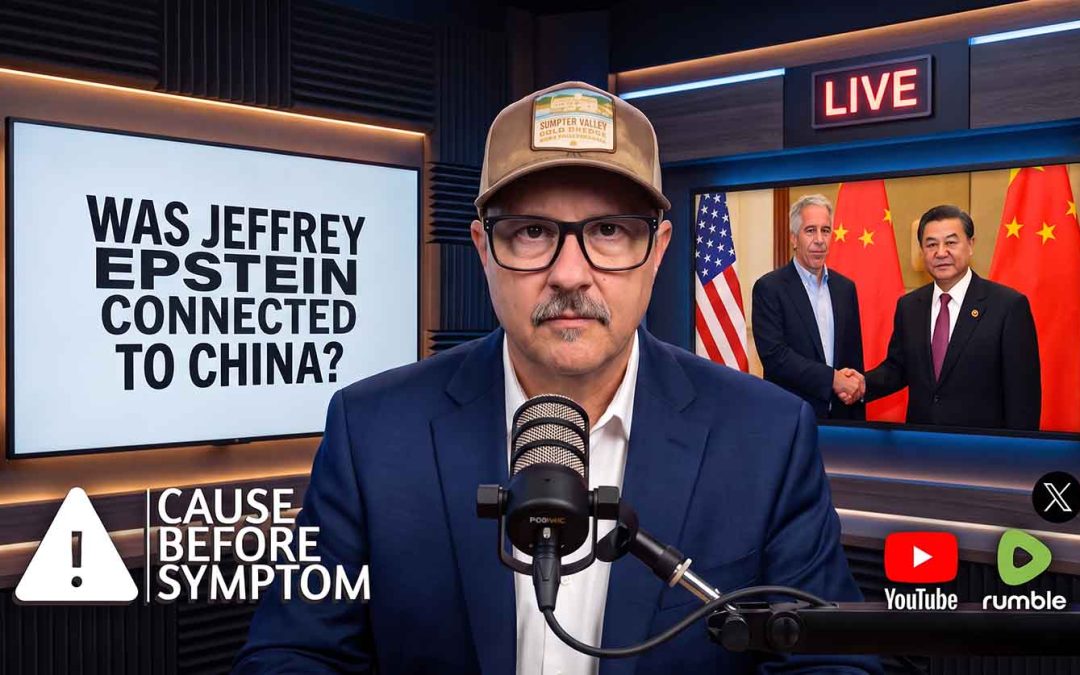
Watch this on Rumble: https://rumble.com/v7frp68-was-jeffrey-epstein-connected-to-china.html
The Intelligence Trail Nobody Is Talking About
Opening — What If We’ve Been Looking at the Wrong Country?
For years, whenever the name Jeffrey Epstein and the word intelligence appeared in the same conversation, most of the speculation traveled in familiar directions. Israel. Mossad. The CIA. Powerful American businessmen. British royalty. Maybe Russia. People have spent years trying to determine whether Epstein belonged to somebody, whether his sexual crimes were part of something larger, and whether the powerful people surrounding him explain why he appeared able to move through circles that should have been inaccessible to a man with his background.
Tonight, I want to investigate another possibility. I am not telling you that I have proved it. In fact, before this investigation is finished, I am going to try as hard to destroy this theory as I am to build it. But while examining the released Epstein records, I found a trail that I don't think can simply be ignored. That trail leads toward China.
The interesting thing is that China doesn't appear in only one isolated email. China appears through businessmen, bankers, investment proposals, Chinese state-linked financial institutions, universities, Prince Andrew's international relationships and people Epstein deliberately connected with one another. A federal court exhibit contains an email in which Epstein introduced Desmond Shum, identifying him as a member of Beijing's Political Consultative Conference and someone associated with the Institute of Finance and Banking at the Chinese Academy of Social Sciences. In another released exchange, Epstein and Shum discussed whether wealthy people in the Middle East might prefer moving money into China rather than Switzerland or Singapore, including discussion of extremely private banking possibilities in Shanghai and Hong Kong.
Then there is David Stern, a man deeply involved in Epstein's later China ambitions and also connected to Prince Andrew. Released correspondence examined by British journalists shows Stern organizing China travel and discussing business structures with Epstein while maintaining extraordinary proximity to Andrew. Some of those plans apparently involved discreet investment activity in Asia. Yet there is also something that complicates the entire story: Epstein apparently had difficulty obtaining permission to enter China and ultimately does not appear to have made the Beijing trip being discussed.
That matters because I don't want to build tonight's investigation by collecting only evidence that supports a theory. If China was operating Jeffrey Epstein, then evidence that China apparently wouldn't even give him a visa is evidence I need to put on the table. If Epstein was China's man, I want to know why. If he wasn't China's man, I want to know why he spent so much effort attempting to build relationships involving Chinese money, institutions and politically connected people.
But the trail becomes considerably stranger when we move backward in time. In February 2026, Representative Nancy Mace formally demanded that the CIA search its classified and unclassified records concerning Jeffrey Epstein and Ghislaine Maxwell. Her letter didn't merely ask the CIA whether Epstein had been an intelligence asset. It identified a series of relationships and allegations she wanted examined, including Adnan Khashoggi, Douglas Leese, Southern Air Transport, DynCorp, Epstein's references to entering a SCIF, an In-Q-Tel-funded project, former CIA Director William Burns and something we are going to spend considerable time examining tonight: Norinco, China's state-owned defense company. Mace's office said Epstein “appears to have been an intermediary” involving Norinco. That is a congressional allegation requesting investigation, not proof that Epstein actually performed that role, and that distinction is extremely important.
Because if that allegation could ever be established with primary evidence, it would change the timeline dramatically. Suddenly, the China question wouldn't begin with emails from 2010 or 2011. It wouldn't begin with Chinese investors, Tsinghua University or wealthy people discussing where to put their money. We would have to go much further backward, into the poorly understood period when Epstein was transforming himself from a former schoolteacher and Wall Street employee into the extraordinarily connected international figure he later became.
And that is where tonight's investigation really begins. I don't want to ask whether Jeffrey Epstein knew Chinese people. That's already too easy. I don't want to ask whether China appears in the Epstein files. It clearly does. I want to ask something much harder. Was Epstein merely trying to make money in China? Was he attempting to gain access to China's emerging centers of wealth and political power? Was someone in China attempting to gain access to him? Was an intelligence service interested in the extraordinary international network Epstein was building? Or have we taken unrelated relationships spread across decades and assembled them into something they never actually were?
Those are very different possibilities. There is another possibility we have to leave open as well. Maybe the mistake is assuming Jeffrey Epstein had to belong exclusively to anybody. Perhaps the more important question isn't whether he was working for China, Israel, the United States, Britain, Russia or another government. Perhaps we should first determine exactly what Epstein had constructed and then ask why people connected to so many centers of international power kept appearing around him.
Tonight, I am going to treat this as though somebody is sitting across the table demanding evidence for every claim I make. When something is documented, I will tell you it is documented. When something is an allegation, I will call it an allegation. When the evidence contradicts our theory, you are going to hear that evidence too.
Because I don't want the answer I expected when we started. I want the answer that survives the investigation.
Investigation 1 — Before the Island: Where Did Jeffrey Epstein Actually Come From?
Before we investigate China, Norinco, intelligence agencies or international arms dealers, there is a more basic question we need to answer. How did Jeffrey Epstein become Jeffrey Epstein? Long before the private island, presidents, billionaires and royalty, there was a young man from Brooklyn without a college degree teaching mathematics and physics at an elite private school in Manhattan. Within little more than a decade, that same man was moving through circles of extraordinary wealth and international influence.
Epstein began teaching at the Dalton School in Manhattan in 1974. Dalton was not an ordinary school. Its students came from some of New York's wealthiest and most influential families, which meant a teaching position there offered something Epstein did not yet possess: proximity. Recent reporting reconstructing Epstein's early career found that a Dalton parent eventually connected him with Alan “Ace” Greenberg, one of the most powerful figures at Bear Stearns. Epstein was hired by the investment bank in 1976 despite having neither a college degree nor traditional Wall Street credentials.
That first transition is important because a pattern begins to emerge. Epstein repeatedly entered worlds for which his résumé would not normally have qualified him through personal relationships with people already inside those worlds. Once inside Bear Stearns, however, he apparently demonstrated considerable ability. He rose rapidly through the company and became a limited partner in 1980, when he was only twenty-seven years old. Contemporary accounts and later interviews describe him developing expertise involving wealthy clients, options, taxes and unusual financial problems.
Then something happened. In early 1981, Bear Stearns investigated Epstein over conduct involving a personal loan and stock allocation. According to a recent reconstruction based on internal material and interviews, the firm's executive committee fined him $2,500 and suspended him for two months. Epstein chose to resign rather than accept the discipline. Other accounts of his departure have differed over the years, which is one reason I don't want to turn the circumstances into something more certain than the evidence allows. What we can establish is that Epstein's remarkably fast Bear Stearns career ended abruptly in 1981.
This should have been a major setback. Instead, it appears to have become another doorway. After leaving Bear Stearns, Epstein established Intercontinental Assets Group and began presenting himself as someone capable of solving unusual financial problems for extremely wealthy people. But this period of his life is much harder to reconstruct than his years at Bear Stearns. The clean corporate biography starts becoming murky. Epstein described himself in different ways over the years, including as someone who recovered money for wealthy clients. What is clear is that he retained the contacts and credibility he had accumulated on Wall Street even after leaving the institution that had given him those credentials.
And then we encounter one of the relationships that changes this entire investigation. Around the period of Epstein's departure from Bear Stearns, he traveled to England with Paula Heil, a woman he knew from the firm. Through that relationship, Epstein met the Leese family and eventually Douglas Leese. Recent reporting describes Leese as a defense contractor with extensive connections in the arms industry and British government. According to interviews with members of the Leese family, Douglas took an interest in Epstein, allowed him to accompany him to meetings and employed him as a consultant with an expense account.
Think about the transition that has just occurred. Epstein goes from teaching wealthy children to working on Wall Street. He goes from Wall Street into private financial consulting. And shortly after leaving Bear Stearns, he gains access to an international businessman operating around defense, government and arms-industry circles.
We are not going to turn that sequence into evidence of espionage. It isn't. But it establishes something essential about Epstein's rise. His greatest talent may not simply have been mathematics or finance. Again and again, Epstein appears to have been extraordinarily effective at getting close to people who could open the next door.
His financial activities during this period also raise questions about the conventional image of Epstein as a brilliant money manager. Recent reporting describes a dispute involving businessman Michael Stroll, who entrusted Epstein with hundreds of thousands of dollars for an investment venture. The transaction deteriorated into litigation, and Epstein ultimately prevailed on the question of his personal liability. Whatever interpretation one places on that episode, it demonstrates that Epstein's early independent financial career was considerably messier than the polished image he would later present.
Then another important figure enters the story: Steven Hoffenberg. By approximately 1987, Epstein was working with Hoffenberg's Towers Financial Corporation. Hoffenberg paid Epstein roughly $25,000 a month as a consultant. Towers later became the center of a massive financial fraud in which investors lost hundreds of millions of dollars. Hoffenberg eventually pleaded guilty and received a twenty-year federal prison sentence. Epstein was never charged in the Towers Financial fraud. Hoffenberg later claimed Epstein participated in it, but those claims must be treated carefully because Hoffenberg himself was a convicted fraudster and Epstein denied involvement.
The significance for us is not that Towers proves Epstein was committing the fraud. It doesn't. The significance is the environment in which Epstein was operating during the period when his wealth and influence were expanding. He had moved from elite education to Wall Street, from Wall Street into private financial dealings, from there into the orbit of an internationally connected defense businessman, and then into a company whose founder would eventually be convicted in one of America's largest financial frauds of its era.
By the late 1980s, Epstein was no longer the former teacher trying to get onto Wall Street. He was presenting himself as an international financial operator. He was attempting corporate transactions, cultivating extremely wealthy people and occupying increasingly prestigious offices and social circles. Within the following years, his relationship with billionaire Leslie Wexner would dramatically expand his wealth, authority and access.
But before we move forward to Wexner, the island and the Epstein everyone recognizes, we need to remain right here. Because something happened between Bear Stearns and the creation of the later Epstein empire that deserves much more attention than it normally receives. Jeffrey Epstein entered an international world involving finance, powerful businessmen, government connections and the defense industry remarkably early in his independent career.
And one of the men who appears at the doorway to that world was Douglas Leese. In the next investigation, we're going to find out who Douglas Leese actually was, what kind of world Epstein entered through him, and why the names surrounding that relationship eventually lead us toward international arms dealing, Adnan Khashoggi and a trail that may ultimately bring us to China.
Investigation 2 — Douglas Leese, Adnan Khashoggi and the World Epstein Entered
When Jeffrey Epstein left Bear Stearns in 1981, he did not simply disappear into private wealth management. Somewhere during this transition, he entered a world that was far more international, politically connected and difficult to understand than the Wall Street environment he had just left. The man standing near the entrance to that world was Douglas Leese.
Leese was a British businessman involved in the defense and international arms industry. Recent investigations into Epstein's early career describe Leese as having connections within both the arms business and the British government. Epstein reportedly met the Leese family through Paula Heil, a woman he knew from Bear Stearns, and the relationship developed rapidly. Leese apparently became sufficiently impressed with Epstein that he employed him as a consultant, provided him with an expense account and allowed him to accompany him to business meetings.
That relationship matters because Epstein was still in the formative period of his independent career. The enormous fortune, private island and famous network were still in the future. Yet Epstein was already learning how international business worked outside the conventional structures of Wall Street. Through Leese, he was exposed to a world where private business, governments, defense companies, wealthy intermediaries and international relationships could intersect.
Later accounts from members of the Leese family portray Douglas as something resembling an early mentor to Epstein. Epstein became close enough to the family that the relationship extended beyond business. Decades later, material prepared for Epstein's fiftieth birthday would document the enduring connection between Epstein and members of the Leese family. That doesn't tell us that Epstein participated in everything Douglas Leese did, but it makes it difficult to dismiss Leese as some insignificant businessman Epstein happened to meet once.
The nature of Leese's business makes the relationship considerably more interesting. Investigative reporting based on corporate records describes Leese as operating through companies and structures connected to international defense commerce. In later litigation, Leese himself claimed that some of his activities concerned highly sensitive projects believed to be classified by the United States Department of Defense and other American government agencies. That was Leese's assertion in litigation, not confirmation by the Department of Defense, so we need to keep that distinction clear.
Then we encounter another name: Adnan Khashoggi. Khashoggi was not merely a wealthy Saudi businessman. The Clinton Presidential Library describes him as a Saudi businessman and arms dealer known for extensive international business dealings and geopolitical relationships. Its records also note that Khashoggi became implicated as an arms-trade middleman in the Iran-Contra affair, the scandal involving secret American efforts to sell weapons to Iran while money was diverted toward the Contra forces fighting in Nicaragua.
The allegation that concerns us is that Douglas Leese introduced Jeffrey Epstein to Khashoggi. That allegation has now reached Congress. Representative Nancy Mace's 2026 request for CIA records concerning Epstein specifically states that Epstein worked for Leese and that Leese introduced Epstein to Khashoggi. Her letter places the relationship among several matters she wants the CIA to search in its classified and unclassified records.
But this is precisely where we have to apply the evidentiary rule we established at the beginning of tonight's investigation. A member of Congress asking the CIA to investigate something does not automatically establish that the underlying claim is true. Some of the historical allegations concerning Epstein and Khashoggi trace back through people such as Steven Hoffenberg, Epstein's former associate at Towers Financial, whose own criminal history requires us to treat his testimony cautiously.
So I am not going to tell you that Jeffrey Epstein was Adnan Khashoggi's financial adviser as though we have already proved it. I am not going to tell you Epstein participated in Iran-Contra. And I am certainly not going to take proximity to international arms dealers and turn it automatically into proof that Epstein was working for an intelligence agency.
What I am willing to say is more limited, but still significant. Epstein had a documented relationship with Douglas Leese. Leese operated in the international defense and arms world. Khashoggi was unquestionably an international arms dealer who became involved as a middleman in the Iran-Contra affair. And the allegation that Leese connected Epstein with Khashoggi is now serious enough that a member of Congress has formally asked the CIA to search its records concerning it.
That gives us something concrete to investigate without pretending we have more evidence than we actually possess. It also places young Epstein inside an extraordinarily unusual environment. Imagine the progression again. A mathematics teacher at Dalton becomes a Wall Street employee. The Wall Street employee becomes a limited partner at Bear Stearns. After his departure, the former banker becomes an independent financial operator. Then he develops a relationship with a British businessman connected to the international defense industry. Soon afterward, allegations place him around one of the most famous international arms intermediaries of the twentieth century.
And Epstein's later life makes this early period even more important. We know what his network eventually became. He would later cultivate billionaires, royalty, presidents, former prime ministers, scientists, bankers, diplomats and people connected to governments around the world. The question is whether the techniques that created that network began much earlier than most people realize.
Maybe Leese simply recognized an intelligent young financier and hired him. Maybe Epstein recognized something equally valuable in Leese: access. That second possibility doesn't require an intelligence conspiracy. It only requires Epstein to have understood a principle that appears repeatedly throughout his later life. Money can get you into expensive rooms, but relationships get you into rooms money alone cannot open.
And this is where the investigation takes its first genuinely unexpected turn. Because when researchers began following Douglas Leese's corporate trail instead of merely studying Epstein's later social circle, another name appeared. It wasn't the CIA. It wasn't Mossad. It wasn't Russia.
It was a Chinese state-owned defense company. The name was Norinco. And if the corporate trail surrounding Leese can actually be connected directly to Jeffrey Epstein, then the China question we're investigating tonight may not begin in 2010. It may begin nearly thirty years earlier.
Investigation 3 — Norinco: The Chinese Connection That Could Change the Timeline
Now we arrive at the first China connection that could fundamentally change the timeline of this investigation. Not an email from 2011. Not a meeting with a Chinese university president. Not a proposed investment fund. This trail potentially takes us all the way back to the early 1980s, shortly after Jeffrey Epstein left Bear Stearns and entered the world surrounding Douglas Leese.
The company at the center of this question is Norinco, the China North Industries Corporation. Norinco was created with the approval of China's State Council and became one of the country's major state-owned defense enterprises. During the 1980s, China emerged as an important international arms supplier, including sales into the Middle East during the Iran-Iraq War. That historical setting matters because Douglas Leese had a Bermuda holding company called Lorad at precisely the period when Chinese weapons were becoming increasingly important in the region.
Then something appears in the corporate record that demands our attention. In June 1983, a company called Norinco Lorad Limited was reportedly formed in Bermuda. Approximately six months later, another company called Lorad Far East Limited was created in Hong Kong. Investigative reporting based on corporate records identifies Lorad as being under Leese's control. The name Norinco appearing beside Lorad is therefore not something somebody invented decades later while trying to construct an Epstein conspiracy theory. The corporate connection between the names existed during the period we are investigating.
But here is where we have to be extremely precise. Establishing Norinco Lorad does not establish Jeffrey Epstein's involvement in Norinco Lorad. Those are two completely different propositions. We established in the previous investigation that Epstein had entered Leese's orbit around this period. Leese's son Julian later acknowledged that Epstein occasionally advised his father and attended some of his business meetings. The relationship between Epstein and the Leese family continued for years. That puts Epstein around the man associated with Lorad, but it does not put Epstein's signature on the incorporation papers, place him inside a weapons transaction or demonstrate that he received money from Norinco.
This distinction becomes critical because the strongest allegation goes much further. Steven Hoffenberg later claimed that Epstein was directly involved with Leese in transactions involving Chinese weapons and Iran. According to Hoffenberg's account, Epstein learned aspects of arms trafficking and international finance through Leese and Adnan Khashoggi and participated in activity involving Norinco. If true, that would be extraordinary. It would place Epstein near Chinese state-owned defense commerce decades before the later China network we are going to uncover tonight.
But Hoffenberg cannot be our smoking gun. He was convicted for his role in the enormous Towers Financial fraud and spent years in federal prison. He also made numerous allegations about Epstein after their relationship collapsed. Some of those claims may ultimately prove accurate, but his criminal history and personal relationship with Epstein mean that anything he says this significant requires independent corroboration. We cannot take one man's allegation and transform it into established history simply because other facts surrounding it are interesting.
There are, however, independent facts surrounding that allegation. Norinco Lorad existed. Lorad was associated with Leese. Lorad Far East appeared in Hong Kong. Epstein was associated with the Leese family during the broader period. Years later, Leese himself claimed in American litigation that some of his work involved highly sensitive projects that he believed were classified by the United States Department of Defense and other American agencies. In 1995, British politician George Galloway publicly alleged that Leese had secretly financed Middle Eastern arms transactions through a Bermuda bank. Those claims do not prove Epstein participated, but they demonstrate why the Leese corporate network deserves considerably more scrutiny than it has traditionally received.
And now something remarkable has happened. This allegation has moved out of obscure books and independent investigations and into an official congressional inquiry. In February 2026, Representative Nancy Mace formally demanded that the CIA search its classified and unclassified records concerning Jeffrey Epstein and Ghislaine Maxwell. Among the specific matters identified by her office was the assertion that Epstein “appears to have been an intermediary to Norinco, the Chinese state-owned defense company.” Her request also identified Epstein's relationship with Douglas Leese and Adnan Khashoggi among the subjects she wanted examined.
Again, listen carefully to the language. “Appears to have been.” Congress did not announce that investigators had conclusively established Epstein was a Norinco intermediary. Mace asked the CIA to search its records because her office believes evidence exists warranting investigation. That makes the allegation important. It does not make the allegation proven.
So what would actually prove it? I would want a contract bearing Epstein's name. A bank transfer. Correspondence between Epstein and Norinco representatives. Corporate records identifying him as an officer, consultant, intermediary or beneficiary. Travel records placing him at negotiations. A contemporaneous government intelligence report describing his involvement. Testimony from multiple independent participants supported by documents. Something that moves us from Jeffrey Epstein being around Douglas Leese to Jeffrey Epstein actually participating in a Norinco transaction.
So far, I have not found that document. And that missing document may be one of the most important missing pieces in tonight's entire investigation. Because if Epstein really participated in Chinese state-owned arms transactions in the early 1980s, then almost everything about the conventional timeline changes. His later fascination with China would no longer represent his first attempt to enter Chinese networks. It would potentially represent the reappearance of a relationship with Chinese state-connected commerce that began near the beginning of his independent career.
But if Epstein had nothing to do with Norinco Lorad, then we have to resist an extremely tempting mistake. Douglas Leese's business relationships are not automatically Jeffrey Epstein's business relationships. A mentor's corporate connections cannot simply be transferred onto the person standing beside him.
Right now, that is where the evidence leaves us. Norinco is real. Norinco Lorad is real. Leese's relationship to Lorad is supported. Epstein's relationship with Leese is supported. Hoffenberg alleged Epstein participated in the Chinese arms world, and Congress has now formally asked the CIA about an apparent Epstein-Norinco intermediary relationship. But the crucial bridge connecting Epstein personally to a specific Norinco transaction remains publicly unproven.
And that creates our next question. If Jeffrey Epstein really spent the early portion of his independent career moving around defense contractors, international arms figures and politically sensitive financial relationships, surely American intelligence agencies would eventually have encountered his name.
So instead of asking China what it knew about Jeffrey Epstein, we're going to Washington. Because the next question is even more uncomfortable. What did American intelligence know about Jeffrey Epstein—and when did it know it?
Investigation 4 — What Did American Intelligence Know About Jeffrey Epstein?
If Jeffrey Epstein spent decades traveling internationally, developing relationships with foreign officials, billionaires, royalty, financiers, scientists and politically connected people, there is an obvious question we have to ask. What did American intelligence know about him? Not whether Epstein was secretly running the CIA. Not whether every person he met was an intelligence officer. The question is much narrower. Did America's intelligence agencies possess information about Jeffrey Epstein, investigate him, monitor him, use him, or regard his extraordinary international network as something worth understanding?
We now know that Epstein himself wanted an answer to at least part of that question. Documents released by the Justice Department show that Epstein's attorneys submitted Freedom of Information Act requests seeking records concerning him from American intelligence agencies. A CIA request sought information that might show an affiliation with the agency. According to a CIA response from 2011, the agency searched for CIA-originated records that might reflect an open or otherwise acknowledged agency affiliation and said it located none. But when addressing records that could reveal a classified CIA connection, the agency refused to confirm or deny whether such records existed.
That response sounds extraordinary until we understand what it actually means. Intelligence agencies routinely use what is commonly called a Glomar response when merely acknowledging whether responsive records exist could reveal classified information. Therefore, the CIA's refusal to confirm or deny the existence of classified records is not evidence that Epstein worked for the CIA. But neither should we misrepresent the other part of the response. The CIA said its search found no records demonstrating an open or acknowledged affiliation. The question of a classified connection received no public answer.
Then Epstein's lawyers went to the National Security Agency. A January 2014 request sought NSA records concerning Epstein from January 2000 through January 2014, including material reflecting monitoring or surveillance. The released correspondence confirms that Epstein's attorney appealed the NSA's initial denial. The NSA subsequently maintained that it could neither confirm nor deny whether intelligence material responsive to the request existed because doing otherwise could expose intelligence information, sources or methods. Again, that does not establish that NSA surveilled Epstein. It establishes that Epstein wanted to know whether NSA possessed material about him and that NSA would not publicly answer the underlying intelligence question.
Why was Epstein asking? That may have an innocent explanation. Epstein had already been investigated and convicted in Florida. He had international relationships and sophisticated attorneys. A lawyer representing someone with Epstein's history might reasonably attempt to determine what government agencies possessed about a client. We cannot take the existence of a FOIA request and transform it into a confession that Epstein knew he was an intelligence operative.
But it does tell us something fascinating. Epstein was sufficiently concerned about American intelligence records to have lawyers ask both the CIA and NSA what they possessed. Congress has now started asking similar questions. Senator Chuck Grassley directly asked FBI Director Kash Patel whether Jeffrey Epstein had been an intelligence asset for the United States or a foreign government. Patel's answer was carefully limited. He said he could speak only for the FBI and that Epstein “was not a source for the FBI.” Grassley immediately identified the limitation and said the broader Intelligence Community should answer the question as well.
That distinction is enormous. “Not a source for the FBI” is not the same statement as “Jeffrey Epstein never had a relationship with any American or foreign intelligence organization.” Patel did not claim to be answering for CIA, NSA, military intelligence or a foreign service. He answered for the organization he directs. That doesn't prove another agency used Epstein. It means the broader question remains unanswered by that testimony.
Representative Nancy Mace has now pushed directly at that unanswered question. In February 2026, she formally requested that CIA Director John Ratcliffe search classified and unclassified CIA records relating to Epstein and Ghislaine Maxwell and make the records available for congressional review. Her request identified several intelligence-adjacent matters she believes deserve examination.
Among them were Epstein's repeated references to entering a Sensitive Compartmented Information Facility, commonly called a SCIF. Mace's office also highlighted a 2015 email in which Epstein described a project as funded by In-Q-Tel, the strategic investment organization associated with the American intelligence community, and wrote that something looked like a “CIA drop.” The letter additionally raised Southern Air Transport, DynCorp and several individuals with intelligence or defense connections. These are subjects Congress is asking CIA to investigate. They are not, by themselves, proof that Epstein worked for CIA.
Then there is William Burns. Released records show Epstein communicated and met with Burns years before Burns became CIA director. Burns had previously served as one of America's most senior diplomats. A spokesperson for Burns has said he met Epstein briefly on two occasions while preparing to leave government service, that Epstein had been introduced as a financial-services expert offering advice about transitioning to the private sector, and that Burns ended contact after learning about Epstein's criminal record. Burns has not been accused of wrongdoing in connection with Epstein.
Once again, the responsible conclusion isn't that Epstein met the future CIA director, therefore Epstein was CIA. That would be terrible evidence. The significance is the continuing pattern of access. Epstein somehow positioned himself where former diplomats, government officials, financiers and internationally connected people considered him worth meeting.
That brings us to perhaps the most interesting possibility of all. Maybe the intelligence question is backwards. Instead of beginning with “Which agency did Epstein work for?” perhaps we should first ask whether Epstein was the kind of American whom intelligence agencies would naturally want information from or about. Someone traveling internationally, meeting foreign officials, dealing with wealthy foreign businessmen, interacting with politically connected individuals and obtaining access to environments ordinary Americans could never enter would present obvious intelligence value whether that person was formally employed by an intelligence service or not.
Mace's congressional request makes essentially that argument regarding the CIA's domestic contact and debriefing functions. Her letter contends that Epstein's international travel and high-level foreign relationships made him the kind of person the agency's National Resources function could potentially have encountered. That is Mace's reasoning, not evidence that such contact actually occurred.
And that is where the American intelligence trail leaves us tonight. We have no public document establishing that Jeffrey Epstein was a CIA officer or asset. The FBI director says Epstein was not an FBI source. CIA reported finding no open or acknowledged affiliation while refusing to confirm or deny a classified connection. NSA likewise refused to confirm or deny whether responsive intelligence material existed. Epstein's own attorneys were asking intelligence agencies what they knew about him. Congress is now demanding that the broader intelligence record be examined.
Those are the facts. But while Washington leaves us with unanswered questions, another part of Epstein's story gives us something much more tangible. Decades after the mysterious world surrounding his early career, Jeffrey Epstein began building a network around China again. And this time, we have the emails.
Investigation 5 — Epstein’s China Network Reappears
For nearly thirty years, the China trail we just examined appears to go quiet. Then, beginning in the late 2000s, China suddenly reappears in Jeffrey Epstein's world. This time we don't have to rely primarily on allegations made years later. We have emails. And one of the most important people inside those emails is a German businessman named David Stern.
Stern was not simply someone who happened to travel to China. A biography contained in the released Epstein records says Stern studied law and Chinese law at the University of London, lived in China and Taiwan while studying Chinese, worked with Deutsche Bank in Shanghai and Siemens in Beijing, and later focused on Chinese mergers and acquisitions. He founded Asia Gateway, a China-focused advisory business with offices in Beijing and London, and later established a Beijing-based healthcare technology company. Stern spoke Mandarin and had spent much of his professional career connecting Western business with China.
His earlier work is particularly interesting. According to material reviewed by TechCrunch, Stern described his time at Siemens as involving negotiations for industrial joint ventures with Chinese state-owned enterprises. His Asia Gateway biography said the firm advised blue-chip companies, Chinese enterprises and the Chinese government on growth strategies and investments. Those claims come from Stern's own professional materials, so they should not be interpreted as proof that he represented the Chinese government. They do establish that China was not a casual interest for him. It was his profession.
And Jeffrey Epstein had a remarkably simple description for Stern. In a May 2012 email to Boris Nikolic, Epstein wrote: “david is my china contact.” The underlying email survives in the released records. Stern had forwarded Epstein a China-related communication and suggested that Epstein speak with the person involved. Epstein then explained Stern's role to Nikolic using those four words.
That description matters because it tells us how Epstein himself apparently viewed the relationship. Stern wasn't merely somebody Epstein knew who happened to live in China. Epstein identified him according to the access he provided. The relationship appears to have been close. Reporting based on hundreds of released documents found Stern referring to Epstein as his mentor and describing himself at various times as Epstein's soldier, while the two exchanged business opportunities, introductions and personal communications for years. Their relationship continued long after Epstein's 2008 conviction.
Then we find an email from November 2009. Stern was in Beijing when he wrote Epstein asking, “Any news or comments re the China fund idea?” He then proposed establishing Epstein's office in London while keeping Epstein's identity “secret/discreet” and making the China fund one of their first projects. Stern offered to assemble the appropriate team.
That email deserves careful treatment. The words “secret” and “discreet” immediately sound suspicious when read through the lens of everything we now know about Epstein. But private investment structures frequently value confidentiality, particularly when dealing with wealthy clients. The email doesn't tell us why Epstein's identity was supposed to remain discreet. What it establishes is that Stern and Epstein were discussing a China-focused financial project in 2009 and that Stern proposed keeping Epstein's involvement out of public view.
This wasn't merely a passing conversation. Released records show Stern continuing to send Epstein potential China-related investments. In 2011, for example, Stern discussed a struggling China-focused investment fund that he believed might become a useful platform if Chinese participants were brought into it. Epstein responded with instructions of his own.
And Stern's network extended into politically connected Chinese business circles. Reporting based on the released documents identifies one of Stern's associates as Li Botan, a businessman connected by marriage to Jia Qinglin, who had been one of China's most senior political leaders. That relationship requires an important qualification: I have found no evidence that Jia Qinglin himself was dealing with Jeffrey Epstein. The documented chain is Epstein to Stern, Stern into Chinese business networks, and some members of those networks having family connections reaching China's political elite. We cannot erase those intermediate steps and pretend Epstein was personally meeting Chinese leaders.
Then another Chinese businessman appears. Desmond Shum was an extraordinarily well-connected entrepreneur operating inside China's political-business environment. A federal court exhibit from the United States Virgin Islands litigation against JPMorgan preserves a 2011 Epstein email describing Shum as vice chairman and CEO of Airport City Development Corporation, a member of Beijing's Political Consultative Conference, a standing committee member of the Institute of Finance and Banking at the Chinese Academy of Social Sciences, founder of the Kaifeng Foundation and an honorary trustee of Tsinghua University.
Epstein forwarded Shum's information to Stern and others and asked whether there was interest in meeting him. Stern responded that he could meet Shum when he was next in Beijing “to see what to do with him.” Again, that does not establish espionage. It establishes networking.
But look at what the network now contains. Epstein has a man he personally calls his China contact. That man has professional experience involving Chinese state-owned enterprises and says his advisory company worked with Chinese enterprises and government. Epstein and Stern discuss establishing a China fund while keeping Epstein's identity discreet. Stern has relationships reaching politically connected Chinese business circles. Epstein is simultaneously communicating with Desmond Shum, a businessman holding positions connecting commerce, finance, academia and Beijing political institutions.
This is considerably stronger than saying Jeffrey Epstein knew somebody from China. He was constructing relationships. And there is another fact we need to remember because eventually we're going to attempt to destroy the theory we're building. When Epstein tried to travel to China in 2012, visa difficulties apparently became a serious obstacle. Released correspondence shows Stern discussing ways of obtaining a visa after an earlier problem, including advice concerning what Epstein should disclose about his criminal history. The available evidence does not establish that Epstein ultimately made the planned Beijing trip.
That creates an important tension. On one side, Epstein possessed a genuine China-facing network. On the other, we do not yet see evidence that the Chinese state was opening every door for him. In at least one extremely basic respect—getting into the country—Epstein apparently encountered resistance.
We're going to save the full significance of that contradiction for later. Because right now we have established the people. David Stern provided China expertise and connections. Desmond Shum brought another level of Chinese political and financial proximity. Other businessmen expanded the network further.
The next question is what Epstein wanted from all of them. And when we follow their conversations instead of merely their names, something becomes increasingly clear. Jeffrey Epstein wasn't only interested in China. He was interested in moving money through it.
Investigation 6 — Follow the Chinese Money
Now that we know who some of the people were, we can stop looking at names and start looking at what Jeffrey Epstein was actually discussing with them. This is where the China story becomes much more concrete, because the emails aren't simply conversations about Chinese politics or introductions between wealthy people. Again and again, they involve capital, investment funds, private banking, wealthy Chinese clients and the possibility of moving enormous amounts of money between China and the rest of the world.
We already established that David Stern asked Epstein in November 2009 about what he called the “China fund idea.” What matters now is what Stern proposed around it. He wanted to establish an Epstein office in London while keeping Epstein's identity discreet and make the China fund one of their first projects. That doesn't establish anything illegal. It does establish that China was being discussed as an actual financial project rather than simply an area of intellectual interest.
The idea evolved further. Released correspondence later described a highly private investment office operating from London with an outpost in Beijing, aimed particularly at high-net-worth Chinese clients. Stern proposed something resembling an extended family office in which Epstein would make or approve investment decisions while Stern handled daily operations. Prince Andrew could potentially be included discreetly for what Stern described as his “aura and access.” We will deal with Andrew's role in the next investigation. For now, concentrate on what the structure tells us. Epstein and Stern were considering building a private financial operation connecting wealthy Chinese individuals with Western investment expertise and international access.
Then there is Desmond Shum. In April 2011, Epstein sent Shum a short message that becomes extremely interesting when placed beside everything else. With political upheaval spreading through the Middle East during the Arab Spring, Epstein suggested that wealthy Middle Easterners might prefer keeping money in China rather than Singapore or Switzerland. Shum replied that someone he knew in wealth management serving Middle Eastern clients had made a similar observation and asked whether anything could be done.
Epstein's answer was remarkably specific. He suggested a very private Shanghai bank. Shum pointed out a basic problem: China's currency wasn't freely convertible. He countered with the possibility of a very private Hong Kong bank with exposure to the renminbi. Epstein responded that they should speak.
That is not evidence of money laundering. It isn't evidence of intelligence activity. It isn't evidence that Middle Eastern money actually moved anywhere. But it is primary-source evidence showing Jeffrey Epstein and a politically connected Chinese businessman discussing whether turmoil in the Middle East created an opportunity for wealthy Middle Easterners to move capital toward China and what kind of private banking structure might accommodate it.
And apparently the conversation didn't end there. The Wire China reviewed thousands of China-related Epstein documents and reported that Shum subsequently discussed creating an offshore banking operation in China. According to its reconstruction, Shum told Epstein that he had discussed the concept with significant Chinese decision-makers, including the chairman of state-owned CITIC, a vice mayor of Shanghai and a senior decision-maker at China's State Administration of Foreign Exchange. The same reporting found later fundraising discussions involving Shum's Great Ocean Group. Yet after reviewing the correspondence, The Wire China found no evidence that Epstein and Shum actually completed a deal together. Shum himself said he had no business or financial transaction with Epstein.
That last fact is extremely important. We're following proposed money, not pretending proposed money became completed money. The distinction becomes even more important when we encounter China's enormous state financial institutions. In November 2009, Epstein forwarded Jes Staley, then a senior JPMorgan executive, information concerning China Investment Corporation, commonly known as CIC. CIC is China's sovereign wealth fund. The surviving record shows Epstein circulating information concerning CIC's financial activities to one of the most powerful bankers in his network. What that email establishes is information flow. It does not establish that CIC invested money with Epstein, employed Epstein or even knew that Epstein was circulating the material.
China International Capital Corporation, or CICC, also appears in the broader network. Emails reported by The Guardian show that Global Counsel, the firm co-founded by Peter Mandelson and Benjamin Wegg-Prosser, was pursuing potential business involving CICC, a major Chinese financial institution with state-linked ownership. Epstein was receiving correspondence concerning Global Counsel's plans, and Wegg-Prosser met Epstein in New York in 2010 to discuss the firm's business. Again, that establishes proximity to people pursuing Chinese state-linked financial business, not that Epstein controlled CICC relationships himself.
There are also signs that Epstein and Stern were looking for existing financial vehicles that could be transformed. In August 2011, Stern sent Epstein information about the Vision China Opportunity Fund, describing it as badly managed but potentially useful as a platform if Chinese participants became involved. Epstein responded with his own instruction concerning finding a Chinese assistant. Whether anything came from the investment idea is unclear from the correspondence we have examined.
So after following the money, what can we actually say? We can say that Epstein and people around him explored a China fund. They considered a discreet investment office aimed partly at wealthy Chinese clients. Epstein discussed Middle Eastern capital potentially moving toward China. He and Shum discussed highly private banking possibilities in Shanghai and Hong Kong. Shum reportedly explored offshore banking ideas with important Chinese financial and political figures. Epstein circulated information involving China's sovereign wealth fund. People within his network pursued opportunities involving Chinese state-linked financial institutions.
But there is something we cannot say. We cannot say we found the giant Chinese payment to Jeffrey Epstein. So far, I haven't found a Chinese state institution secretly transferring millions of dollars into an Epstein-controlled account. I haven't found a completed China fund with Epstein listed as beneficiary. I haven't found evidence that the private Shanghai banking concept actually became a functioning Epstein operation. And the extensive China-focused review by The Wire China similarly reported no evidence that Epstein and Shum closed the deals they discussed.
That absence changes the question. Maybe Epstein wasn't receiving Chinese money. Maybe he was trying to position himself between Chinese money and Western money. That would fit something we are beginning to see repeatedly. Epstein appears interested not merely in possessing wealth, but in occupying the space between people who possessed enormous amounts of it. A Middle Eastern billionaire wants China. A Chinese businessman wants international capital. A Western banker wants Chinese opportunity. Epstein knows somebody on both sides.
And if that was the business model, money was only half of what made it work. The other half was access. Because Epstein's China network didn't stop with bankers and businessmen. It eventually reached a British prince, one of China's most prestigious universities, Western academic institutions and people whose careers revolved around opening doors between Beijing and the West. And that is where the financial network starts looking like something much larger.
Investigation 7 — Building the Access Machine
Money explains part of Jeffrey Epstein's interest in China, but money alone doesn't explain the network he was constructing. As we move deeper into the released correspondence, another pattern becomes visible. Epstein wasn't merely looking for investments. He repeatedly positioned himself between people who wanted access to one another. China specialists, academics, businessmen, bankers and royalty appear in overlapping circles, with Epstein frequently occupying the middle.
Prince Andrew is one of the clearest examples. Andrew served as the United Kingdom's Special Representative for International Trade and Investment from 2001 until 2011. That position gave him extensive contact with governments and business leaders around the world, including China. Released Epstein correspondence shows that David Stern was closely connected with Andrew and involved in his China-facing activities. This gave Epstein's China network something money couldn't purchase as easily: proximity to a member of the British royal family with official international trade experience.
An email released by the Justice Department makes the China angle unusually explicit. In September 2010, Epstein wrote to JPMorgan executive Jes Staley that “prince Andrew would like much more to represent casanov in china.” The exact commercial context requires caution, but the email demonstrates Epstein discussing Andrew as someone who could potentially represent a business interest in China.
That becomes more interesting when placed beside Stern's later proposal for the private investment operation we examined previously. Stern suggested that Andrew could participate quietly and provide what he described as “aura and access.” Those two words may tell us more about Epstein's network than pages of financial records. The prince's value wasn't necessarily his ability to analyze an investment. His value was the doors his name could potentially open.
But Epstein's China access wasn't limited to royalty. In May 2016, Epstein had breakfast in New York with Qiu Yong, then president of Tsinghua University, one of China's most prestigious universities. Afterward, Qiu sent Epstein a remarkably warm letter thanking him for the meeting and describing potential cooperation. Qiu discussed creating opportunities for talented Tsinghua students to participate in programs connected with Harvard and MIT and thanked Epstein for offering to make introductions. He also invited Epstein to visit Tsinghua in Beijing.
Stop there for a moment. This meeting occurred in 2016. Epstein's Florida criminal case was not some future revelation. His 2008 conviction was already public. Yet eight years later, the president of one of China's premier universities was corresponding with him about international academic opportunities and thanking him for offering access to Harvard- and MIT-associated programs.
That doesn't establish espionage. It establishes something perhaps more fundamental to understanding Epstein: his criminal conviction had not destroyed his ability to operate as a connector among elite institutions. Reporting by the Harvard Crimson and South China Morning Post has described broader discussions involving Tsinghua and possible academic expansion in the Boston area. Some ideas apparently never materialized. Once again, the difference between a proposal and a completed project matters. But the correspondence demonstrates that Epstein had reached a position where senior academic leaders believed he could help connect Chinese students and institutions with elite American academic networks.
Then there is Joshua Cooper Ramo. Ramo built a career around understanding and interpreting China for Western institutions. He served as co-CEO of Kissinger Associates and had extensive experience dealing with China. In October 2016, Epstein introduced Ramo and Stern by email, writing that they had “mutual china interesting ideas.” Ramo responded while traveling between New York and Beijing, while Stern responded from Hong Kong.
Another released exchange is even more revealing about how Epstein thought about these people. In introducing Stern and Ramo, Epstein reportedly characterized Stern through his relationship with Prince Andrew and China while identifying Ramo through Kissinger Associates and China. Both spoke Chinese. Epstein was essentially matching two people based upon their respective positions inside Western networks dealing with Beijing.
Again, the important fact isn't merely that Jeffrey Epstein knew Joshua Cooper Ramo. The important fact is that Jeffrey Epstein was making introductions. That pattern appears repeatedly throughout the larger Epstein archive. A scientist needs funding. A businessman needs an introduction. A banker needs access to another investor. A foreign figure wants entry into an American institution. Epstein often appears somewhere between them.
This may help explain something about his influence that money alone cannot. A billionaire has money. A university president has institutional authority. A prince has status. A banker controls financial relationships. A China specialist understands Beijing. A scientist possesses knowledge. Individually, each person has something valuable. But the person who can connect all of them possesses a different kind of power.
He possesses the network. And networks can become more valuable as they grow because every new relationship potentially increases the value of every existing relationship. If Epstein could tell a Chinese businessman that he knew Western bankers, tell a Western banker that he knew politically connected Chinese businessmen, tell a university leader that he could reach Harvard or MIT, and tell somebody seeking government access that he knew a prince, then Epstein himself became increasingly difficult to replace.
This also gives us another way to understand the extraordinary collection of people surrounding him. Perhaps some individuals weren't interested primarily in Jeffrey Epstein. Perhaps they were interested in whoever Jeffrey Epstein could introduce them to.
That distinction matters enormously when we begin asking intelligence questions. An intelligence service doesn't necessarily need to recruit every person inside a network to benefit from understanding the network. Knowing who speaks to whom, who wants money, who needs introductions, who possesses sensitive information, who has political ambitions and who has private vulnerabilities can itself be enormously valuable.
But we have not yet established that Chinese intelligence possessed Epstein's network. We have established something narrower. Epstein had developed relationships reaching Chinese finance, politically connected business circles and one of China's premier universities. He had a China specialist he used to make connections. He discussed using Prince Andrew's access. He introduced prominent Western China specialists to one another. And he presented himself as someone capable of opening doors between elite Chinese and Western institutions.
The question we've been postponing can no longer be postponed. At what point does an international access network become an intelligence network? In the next investigation, we're going to deliberately make the strongest case we can that China may have been using Jeffrey Epstein. And then, before this show ends, we're going to try to tear that case apart.
Investigation 8 — Make the Case: Was Epstein Being Used by China?
We have spent seven investigations refusing to make the accusation. Now I want to do the opposite. For the next several minutes, I want to assume that the China hypothesis deserves the strongest case we can possibly make for it. I am not going to invent evidence, but I am going to take everything we have established and ask the question directly. Could Jeffrey Epstein's network have been useful to Chinese intelligence?
To answer that responsibly, we first need to understand what Chinese intelligence actually looks for. The Ministry of State Security, commonly called the MSS, is China's principal civilian foreign intelligence service. According to the United States Justice Department, its interests include political, economic, military, scientific and technical information. Recent American counterintelligence cases also demonstrate that MSS operations can involve intermediaries, recruitment, money, seemingly ordinary relationships and people who possess access to information or other valuable individuals. That doesn't mean Epstein was part of such an operation. It tells us what kind of access would potentially have intelligence value.
Now look at Jeffrey Epstein's network from that perspective. Epstein had relationships with billionaires and major bankers. He knew politicians, diplomats and royalty. He cultivated scientists working in advanced fields. He had connections to Harvard and MIT. He interacted with people involved in nuclear technology, artificial intelligence and international finance. He communicated with individuals moving between Western governments and private industry. And by the period we have just examined, he was actively constructing relationships reaching into Chinese finance, business and academia.
That would make Epstein interesting to almost any major intelligence service. But China gives us several additional reasons to investigate. First is the unresolved historical question we discovered earlier. Epstein entered Douglas Leese's orbit shortly after leaving Bear Stearns. The corporate trail surrounding Leese reaches Norinco, China's state-owned defense company, through Norinco Lorad. Representative Nancy Mace has now formally asked the CIA to investigate an allegation that Epstein appears to have acted as an intermediary involving Norinco. We still don't possess the document proving Epstein personally performed that role. But if such evidence eventually emerges, the significance would be enormous because it could place Epstein around Chinese state-owned defense commerce near the beginning of his independent career rather than merely during his later China networking.
Then, decades later, China appears again. By then Epstein has a person he describes in his own correspondence as his China contact. He is discussing Chinese investment structures. He is communicating with Desmond Shum, whom a federal court exhibit identifies as having served on Beijing's Political Consultative Conference and within an institute of the Chinese Academy of Social Sciences. Epstein is discussing introductions and opportunities with people possessing access to Chinese political, financial and academic institutions.
Now add the Western side of the network. Epstein could potentially connect Chinese interests with Western bankers, investors, scientists, universities and influential political figures. He had access to Prince Andrew. He communicated with senior people around JPMorgan. He offered introductions involving Harvard and MIT. He connected China specialists with one another. He operated in exactly the territory where money, technology, political influence and personal relationships overlap.
If I were trying to make the China-intelligence case tonight, this is where I would focus. I wouldn't begin by claiming Epstein was an MSS officer. I would ask whether somebody like Epstein even needed to be one. Intelligence relationships don't always begin with somebody being handed a badge and told that they now work for a foreign government. Publicly documented MSS cases show efforts to identify people with useful access and cultivate or recruit them, sometimes through intermediaries or apparently commercial opportunities. In 2026, the Justice Department even seized websites allegedly backed by suspected Chinese intelligence actors that used promises of paid consulting work to attract Americans possessing security clearances and potentially valuable information.
That gives us an important distinction. The question might not be, “Was Jeffrey Epstein a Chinese spy?” The better question could be, “Was Jeffrey Epstein or anyone inside his network being cultivated, exploited or used for access?” Because Epstein possessed something intelligence agencies spend enormous resources trying to obtain naturally: trusted relationships.
If you want information about a billionaire, getting close to the billionaire is difficult. Epstein already knew billionaires. If you want access to influential bankers, Epstein already knew bankers. If you want scientists, Epstein funded scientists.
If you want elite American universities, Epstein had relationships inside them. If you want political access, Epstein knew politicians and royalty. And if you want to understand the private motivations, financial needs and personal vulnerabilities of powerful people, Epstein's network potentially offered something even more valuable than formal government documents.
It offered proximity. There is also a reason I take the intelligence question seriously even though we haven't proved it. Congress itself has begun asking intelligence-specific questions surrounding Epstein. Representative Mace has demanded CIA records concerning his possible intelligence relationships. The House Oversight Committee is continuing a broad investigation into Epstein's business operations, financial arrangements, influential relationships and the federal government's handling of his crimes.
And during the congressional questioning of longtime Epstein assistant Sarah Kellen, investigators tested the China question directly. Kellen was asked whether she had heard of China's Ministry of State Security and whether Epstein had contact with Xi Jinping. She answered no.
That testimony doesn't establish a Chinese intelligence relationship. But the fact that investigators asked the question tells us that the hypothesis has at least entered the congressional investigation. We cannot infer what evidence, if any, prompted the question. Congress asking about something is not proof that Congress already knows the answer.
So if I had to make the strongest China case using only what we have uncovered tonight, this is what I would say. There is a possible early connection through the world surrounding Norinco that remains unresolved. Decades later, there is a documented China-facing network involving people with connections to Chinese political, financial and academic institutions. Epstein explored financial structures involving China. He cultivated people capable of opening doors inside China. At the same time, he possessed extraordinary access to powerful Western individuals and institutions. That combination would have obvious potential intelligence value.
But notice what I still haven't said. I haven't said China controlled Jeffrey Epstein. I haven't said the MSS recruited him. I haven't said Beijing received compromising material from him. I haven't said Chinese intelligence financed his trafficking operation.
And I haven't said Norinco proves he was a Chinese asset. Because none of those conclusions has been established by the public evidence we have examined. What we have built is a circumstantial case for why Chinese intelligence could have found Epstein extremely useful and why the possibility deserves investigation.
And if I stopped the show right here, that case might sound extremely compelling. But we're not stopping here. Because now I'm going to do something that conspiracy investigations almost never do. I'm going to take the case I just made and try to destroy it. And there are some serious problems with the China theory.
Investigation 9 — Now Try to Destroy the Case
We just constructed the strongest case I can make that Jeffrey Epstein's network could have been useful to Chinese intelligence. Now I want to prosecute the other side. If I were sitting across the table from someone claiming that Epstein was a Chinese intelligence asset, what evidence would I use against them? There is more than I expected.
The first problem is remarkably simple. China apparently wouldn't let Jeffrey Epstein into the country. Released correspondence examined by The Guardian shows that Epstein had been denied a Chinese visa before a planned 2012 trip. David Stern then discussed trying to obtain a visa through another Chinese embassy. According to the correspondence, Stern advised Epstein about how the application might be handled and discussed whether Epstein needed to disclose his previous visa denial and criminal history. The available evidence reviewed by the newspaper did not establish that Epstein ultimately made the planned Beijing trip.
That is a significant problem for the simplest version of the China theory. If Jeffrey Epstein were a protected, high-level asset of Chinese intelligence, why couldn't somebody get him a visa? There could theoretically be explanations. Different parts of a government don't always know what intelligence services are doing. Intelligence agencies sometimes deliberately avoid providing visible privileges to people they are using. Bureaucracies make mistakes. But notice what just happened. We moved from evidence to hypothetical explanations designed to preserve the theory.
We cannot do that. The visa problem therefore belongs in the evidence column against the proposition that Epstein was a protected Chinese asset. The second problem is much larger. Where is the handler? Millions of pages connected to Epstein have now entered the public record. We have found bankers, businessmen, politicians, academics, scientists, lawyers, assistants, royalty and people operating across numerous countries. Yet I have not found a document identifying an MSS officer directing Epstein. I have not found instructions from Chinese intelligence telling him whom to cultivate, what information to obtain or where to deliver it.
That absence isn't proof that such a relationship never existed. Intelligence operations are designed to remain hidden. But if we're claiming one existed, the burden is on us to establish it. Secrecy cannot become evidence of itself. Then follow the money.
We found proposals. We found discussions. We found potential funds. We found private-banking ideas. We found Epstein circulating information concerning Chinese financial institutions. But after looking through the China trail, I still have not found the thing that would dramatically change this investigation: a demonstrated payment from the Chinese government or Chinese intelligence to Jeffrey Epstein.
That matters enormously. If China financed Epstein, show me the money. If an intermediary financed him on China's behalf, identify the intermediary and the transaction. If a Chinese state enterprise secretly compensated him for intelligence activity, show me the contract, account, wire transfer or contemporaneous intelligence record.
Until then, Chinese financial discussions are evidence of Epstein seeking Chinese business, not proof that China was secretly paying him. There is another problem. Many of the Chinese opportunities we've examined appear to have remained opportunities.
The Wire China reviewed roughly two thousand China-related email threads from the released Epstein material and found extensive discussion of investments, banking and fundraising. But its investigation did not find evidence that Epstein and Desmond Shum actually completed a business transaction together. Shum told the publication that he never conducted business or financial transactions with Epstein.
That changes how we should interpret Epstein's emails. A person can sound extraordinarily powerful while discussing what he intends to accomplish. Proposed funds aren't completed funds. Proposed introductions aren't completed deals. Invitations aren't evidence of influence. And correspondence with powerful people doesn't necessarily mean those people trusted Epstein with anything important.
Epstein may have exaggerated his own reach. Then we arrive at the darkest part of the intelligence hypothesis: kompromat. If the theory is that Epstein's sexual exploitation operation existed to obtain compromising material for China, where is the evidence that the material reached China?
I haven't found it. I haven't found an MSS recipient. I haven't found a transfer mechanism. I haven't found a Chinese intelligence report derived from Epstein. I haven't found a payment tied to compromising material. I haven't found evidence that Chinese officials directed Epstein to target particular Western individuals.
And I haven't found evidence establishing a China-based component of Epstein's trafficking operation. Those missing pieces don't prove that no intelligence service ever exploited Epstein. They mean something narrower and extremely important: the publicly available evidence we have examined does not establish the operational chain required to call the trafficking enterprise a Chinese intelligence operation.
Congressional testimony also cuts against the hypothesis, at least based on what one important witness said. During Sarah Kellen's June 2026 interview with the House Oversight Committee, Representative Raja Krishnamoorthi asked her whether she was familiar with China's Ministry of State Security. She said no. He then asked whether Epstein ever had contact with Xi Jinping. Again, she said no. The questioning demonstrates that congressional investigators tested the China-intelligence possibility. Kellen's answers provided no support for it.
And there is a methodological trap here that I want us to avoid. If an email mentions China, that isn't Chinese intelligence. If someone belongs to a Chinese political consultative body, that doesn't automatically make that person an intelligence officer.
If a Chinese university president meets Epstein, that isn't espionage. If Epstein receives information concerning a Chinese sovereign wealth fund, that doesn't mean the fund is financing him. If Epstein knows someone who knows a senior Chinese official, we cannot erase the middle person and claim Epstein knew the official.
And if Congress asks whether Epstein had an MSS connection, the question itself isn't evidence that the answer is yes. Once we impose those standards, the China case changes considerably. We still have a real China network. That part survives.
We still have the unresolved Norinco allegation. That survives as an important question. We still have Epstein attempting to build relationships involving Chinese money, businessmen and institutions. But the proposition that China controlled Jeffrey Epstein does not survive as an established fact.
In fact, another possibility now looks at least as worthy of investigation. Instead of China recruiting Epstein, perhaps Epstein was trying to penetrate China. The visa difficulty, uncompleted projects and constant search for intermediaries could fit a man attempting to gain access rather than a man already protected by Beijing.
And that leaves us with one final problem. If the evidence doesn't allow us to say Jeffrey Epstein belonged to China, we have to apply exactly the same standard when somebody tells us he belonged to Israel, the CIA, Russia or anyone else. So maybe we've been asking the wrong question from the beginning.
Maybe the question isn't who owned Jeffrey Epstein. Maybe the question is what Jeffrey Epstein had built that made so many different powerful people interested in being around him.
Investigation 10 — If China Didn’t Own Epstein, Who Did?
After trying to build the China case and then trying to destroy it, we have arrived at a strange place. Jeffrey Epstein unquestionably developed significant relationships involving China, but the public evidence we have examined does not establish that Chinese intelligence controlled him. That forces us to confront the question that has followed Epstein almost from the moment his world became public.
If China didn't own Jeffrey Epstein, who did? The most famous answer is Israel. For years, allegations have circulated that Epstein's operation was connected to Israeli intelligence, particularly Mossad. Some of those suspicions arise from Ghislaine Maxwell's father, Robert Maxwell, whose alleged intelligence relationships have been examined extensively. Other suspicions center on Epstein's later relationship with former Israeli Prime Minister Ehud Barak and people in Barak's orbit. Released FBI material has also included an allegation from a confidential human source claiming Epstein had been “co-opted” by Mossad.
But an allegation recorded by the FBI is not the same thing as an FBI conclusion. That distinction matters just as much here as it did with China. If I refuse to call Epstein an MSS asset without evidence of recruitment, tasking or control, I cannot turn around and call him a Mossad asset because an informant told the FBI that he was one. The Israeli relationships are worthy of investigation. They do not, on the public record we have examined, establish Israeli control of Epstein's operation.
Then there is the CIA. We already know Epstein's attorneys sought CIA records that could reveal an affiliation. We know CIA reported finding no records reflecting an open or acknowledged agency affiliation while refusing to confirm or deny whether records revealing a classified connection existed. That sounds mysterious, but intelligence agencies use that response precisely because confirming or denying classified relationships can itself disclose classified information. It cannot responsibly be converted into “CIA admitted Epstein was theirs.”
The FBI gives us another important distinction. FBI Director Kash Patel has said Epstein was not an FBI source. That answers one narrow question about one organization. It doesn't answer every possible question involving the American intelligence community, which is why members of Congress have continued seeking information about Epstein's foreign and intelligence relationships.
Then there is Russia. Epstein cultivated Russian contacts as well, and newly released material has generated congressional scrutiny of his relationships with Russian officials and other foreign governments. In July 2026, Representative Jamie Raskin announced an investigation after Judiciary Committee staff reviewing Epstein material identified extensive interactions involving officials and interests from Russia, Israel, Saudi Arabia and Kuwait. The committee's Democratic staff characterized some of the material as evidence suggesting Epstein sought to influence American policy on behalf of foreign interests. Those are allegations under congressional investigation, not a final judicial determination that Epstein acted as an intelligence officer or illegal foreign agent.
And suddenly the problem with the original question becomes obvious. China doesn't explain Israel. Israel doesn't explain Russia. Russia doesn't explain Epstein's relationships in Britain. The CIA theory doesn't automatically explain the foreign relationships.
And none of these theories, by themselves, explains why Epstein spent so much effort cultivating scientists, academics, financiers, technology entrepreneurs, diplomats, politicians and billionaires who had nothing obvious to do with a single country's intelligence service. So perhaps asking who “owned” Epstein forces the evidence into a model it doesn't require.
Consider another possibility. What if Epstein's primary asset was Epstein? Imagine building a private network in which the currency isn't simply money. The currency is access. One person wants a meeting with a billionaire. Another wants access to a government official. A scientist needs funding. A banker wants foreign investors. A politician wants introductions. A businessman wants access to another country. A university wants wealthy donors. Somebody else wants information.
Epstein places himself between them. Now every introduction creates another relationship. Every relationship potentially produces information. Every piece of information makes Epstein more useful to the next person. And every powerful person who enters the network increases the perceived importance of the man standing in the middle.
That model doesn't require Jeffrey Epstein to be an intelligence officer. It makes him something intelligence services would potentially find extremely interesting. There is a fundamental difference between an intelligence asset and an intelligence target. There is also a difference between somebody formally recruited by an intelligence service and somebody whose relationships are occasionally exploited by governments, businessmen, politicians or intelligence-connected people. Those categories can overlap, but they are not interchangeable.
That distinction may help explain why the evidence surrounding Epstein feels so strange. If Epstein belonged exclusively to one intelligence organization, we might expect eventually to find a clearer operational fingerprint: a handler, payments, tasking, reporting, communications procedures or government records identifying the relationship.
Instead, what repeatedly appears is Epstein moving among competing centers of power. The United States. Israel. Russia. Britain. China. The Middle East. International banking. Science. Technology. Academia. Royalty. And enormous private wealth.
That pattern could mean multiple intelligence services encountered or investigated him. It could mean individuals connected to intelligence services used him without controlling him. It could mean Epstein deliberately cultivated intelligence-connected people because they increased his own access and importance. It could even mean different things happened at different periods of his life.
Those possibilities are not nearly as satisfying as discovering a document saying, “Jeffrey Epstein worked for Agency X.” But they fit the evidence without requiring us to invent that document. There is another reason we should remain cautious. The Justice Department's Epstein Library now contains millions of pages gathered from multiple investigations, and DOJ itself warns that some material submitted to the FBI may contain false or sensational claims. A person's name appearing in the archive therefore proves neither guilt nor participation in Epstein's crimes. The evidence has to be evaluated document by document.
And the investigation is still moving. As of September 2026, the House Oversight Committee says it has conducted nineteen depositions and transcribed interviews, released approximately 65,000 pages from the Epstein estate, Justice Department and interview transcripts, and obtained Epstein's bank records. Congress is still examining what happened and how institutions failed Epstein's victims.
So I cannot tell you tonight who owned Jeffrey Epstein. The evidence doesn't allow me to. But I can tell you that the question we started with now looks too small. Maybe Jeffrey Epstein wasn't valuable because he secretly belonged to one government.
Maybe he was valuable because he had spent decades constructing something governments, financiers, politicians, academics and intelligence organizations all understand the value of. A network. And once we recognize that possibility, the final question of this investigation changes completely.
Instead of asking which flag Jeffrey Epstein was standing underneath, perhaps we should follow the relationships themselves. Because the network may ultimately tell us more than the flag ever could.
Ending — Follow the Network, Not the Flag
When I started looking into this, I expected one of two things to happen. Either we would find enough evidence to make a serious case that Jeffrey Epstein had a hidden relationship with China, or the entire idea would collapse almost immediately. Neither happened.
Instead, we found something more complicated. The China trail is real. It isn't something created from a single photograph or somebody's theory on the internet. Epstein communicated with people deeply involved in China. He pursued Chinese financial opportunities. He discussed private banking and international capital. He cultivated relationships reaching Chinese business, academia and politically connected circles. And hanging over the beginning of his career is an unresolved allegation involving Norinco that Congress is now asking the CIA to examine.
But there is a line I cannot cross. I cannot tell you China ran Jeffrey Epstein because I haven't seen the evidence that proves it. I haven't found the MSS handler. I haven't found the Chinese intelligence payment. I haven't found the tasking order. I haven't found evidence showing compromising material being delivered to Beijing. I haven't found the document proving that Epstein's trafficking operation was created or directed by China.
And if those things aren't there, I am not going to manufacture them. That same standard has to apply everywhere else. A relationship with an Israeli leader doesn't prove Mossad control. An allegation recorded by an FBI source doesn't become an FBI conclusion simply because it appears inside an FBI document. A meeting with somebody who later became CIA director doesn't prove CIA employment. Russian relationships don't automatically make somebody a Russian asset. A connection to Prince Andrew doesn't make someone British intelligence.
Names aren't evidence of control. Relationships aren't evidence of recruitment. Access isn't evidence of tasking. And suspicion isn't proof. But neither should the absence of proof cause us to ignore what we actually discovered. Jeffrey Epstein somehow constructed a network extending across countries, governments, banks, universities, technology, science, enormous private fortunes and political power. He repeatedly positioned himself between people who wanted something from somebody else. He introduced people. He offered access. He collected relationships.
That may be the most important thing we learned tonight. Because perhaps we have spent years asking which intelligence agency Jeffrey Epstein worked for when we should have been asking why a man like Jeffrey Epstein would be valuable to intelligence agencies in the first place.
An intelligence service wants access. Epstein had access. An intelligence service wants information. Epstein lived inside a network where information moved constantly. An intelligence service wants relationships with people who would normally be difficult to approach.
Epstein already had those relationships. And an intelligence service wants to understand the ambitions, weaknesses, financial interests and private lives of powerful people. Jeffrey Epstein surrounded himself with exactly those kinds of people.
None of that proves he worked for an intelligence service. It explains why the intelligence question refuses to disappear. And now Congress is asking questions that once existed almost entirely outside official investigations. Members of Congress are demanding intelligence records. They are asking about the CIA. They are asking about foreign governments. They are asking about Norinco. They are asking whether Epstein had contact with China's Ministry of State Security. They are examining his finances, his associates and the government's handling of his crimes.
Maybe those investigations eventually produce the missing document. Maybe they don't. If somebody eventually produces evidence showing that China recruited Epstein, I will follow it. If evidence proves Mossad controlled him, I will follow that.
If CIA records eventually establish an American intelligence relationship, I will follow that. And if the evidence ultimately shows Jeffrey Epstein primarily worked for Jeffrey Epstein, I will follow that too. Because I don't care which theory wins.
I care which theory survives the evidence. That is why the unanswered Norinco question matters so much. If someone can produce primary evidence placing Epstein personally inside those transactions, the timeline changes dramatically. If nobody can, then we leave Norinco where the evidence currently leaves it: an unresolved connection surrounding Douglas Leese that deserves investigation, not a proven Chinese intelligence relationship.
And perhaps that is exactly where this investigation should end. Not with China. Not with Israel. Not with Russia. Not with America. With Jeffrey Epstein standing in the middle of all of them. A man who somehow traveled from a classroom in Manhattan into Wall Street, from Wall Street into international financial and defense-connected circles, and eventually into a world containing presidents, prime ministers, royalty, billionaires, scientists, bankers and people connected to governments around the planet.
Maybe someday we'll discover that someone owned that network. But until the evidence proves it, I think there is a more important possibility sitting directly in front of us. Maybe nobody needed to own Jeffrey Epstein. Maybe they only needed access to what he had built.
And if that is true, then asking which country controlled him may have distracted us from the much larger question. Who used the network? That is the question I would follow next. Because if we want to understand Jeffrey Epstein, we should stop staring at the flags surrounding him. Follow the network.
Bibliography
- Bloomberg. “Jeffrey Epstein Files and Correspondence Concerning Jes Staley, JPMorgan, and International Financial Relationships.” Bloomberg News. 2026.
- Clinton Presidential Library. Records and Archival Materials Concerning Adnan Khashoggi, International Arms Trading, and the Iran-Contra Affair. Little Rock, Arkansas: William J. Clinton Presidential Library and Museum.
- The Guardian. “David Stern, Prince Andrew and Jeffrey Epstein’s China Connections.” The Guardian, February 6, 2026.
- The Guardian. “David Stern Advised Jeffrey Epstein over China Visa after Previous Refusal.” The Guardian, February 14, 2026.
- Harvard Crimson. “Epstein, Tsinghua, and Discussions of a Boston Academic Presence.” The Harvard Crimson, February 11, 2026.
- House Committee on the Judiciary, Democratic Staff. “Ranking Member Raskin Launches Investigation into Evidence Epstein Acted as Unregistered Agent for Foreign Powers.” Washington, DC, July 21, 2026.
- House Committee on Oversight and Government Reform. “Chairman Comer and Republican Lawmakers Seek DOJ Investigation into Sexual Assault Allegations Made During Epstein Investigation.” Washington, DC, June 4, 2026.
- House Committee on Oversight and Government Reform. Transcribed Interview of Sarah Kellen. Washington, DC, May 21, 2026.
- Mace, Nancy. “Rep. Nancy Mace Demands CIA Disclosure on Jeffrey Epstein, Ghislaine Maxwell Connections.” Office of Representative Nancy Mace, February 17, 2026.
- South China Morning Post. Reporting on Jeffrey Epstein’s relationships with Hong Kong academics, artificial-intelligence researchers, Tsinghua University, and China-related academic networks. Hong Kong: South China Morning Post, 2026.
- TechCrunch. Reporting on David Stern, Siemens, Asia Gateway, Chinese state-owned enterprises, and Stern’s China business background. TechCrunch, 2026.
- The Times. Reporting on Douglas Leese, the Leese family, and Jeffrey Epstein’s early relationship with the British defense and arms businessman. London: The Times, 2026.
- The Wire China. “Epstein and China.” The Wire China, 2026.
- United States Department of Justice. Epstein Library. Washington, DC: U.S. Department of Justice, updated September 11, 2026.
- United States Department of Justice. Epstein Library, DOJ Disclosures. Washington, DC: U.S. Department of Justice, 2026.
- United States Department of Justice. Epstein Library, Memoranda and Correspondence. Washington, DC: U.S. Department of Justice, 2026.
- United States Department of Justice. EFTA00029434. Released correspondence from Jeffrey Epstein to Jes Staley concerning Prince Andrew and China. Epstein Library, 2010; released 2026.
- United States Department of Justice. EFTA00605791. Correspondence concerning Jeffrey Epstein’s Freedom of Information Act request to the National Security Agency. Epstein Library, 2014; released 2026.
- United States Department of Justice. EFTA00648252. Correspondence concerning Peter Mandelson, Desmond Shum, and a proposed China fund. Epstein Library; released 2026.
- United States Department of Justice. EFTA00665256. Correspondence between Jeffrey Epstein and Desmond Shum concerning Middle Eastern capital, China, Shanghai, Hong Kong, and private banking. Epstein Library, 2011; released 2026.
- United States Department of Justice. EFTA00768945. Correspondence from David Stern concerning Beijing, a proposed China fund, and a discreet Jeffrey Epstein investment office. Epstein Library, 2009; released 2026.
- United States Department of Justice. EFTA00813582. Correspondence involving Jeffrey Epstein, David Stern, and Joshua Cooper Ramo concerning China. Epstein Library, 2016; released 2026.
- United States Department of Justice. EFTA00827019. Correspondence involving Tsinghua University president Qiu Yong and Jeffrey Epstein concerning Tsinghua, Harvard, MIT, and a proposed visit to Beijing. Epstein Library, 2016; released 2026.
- United States Department of Justice. EFTA01300328. Correspondence involving Jeffrey Epstein, Jes Staley, and information concerning China Investment Corporation. Epstein Library, 2009; released 2026.
- United States Department of Justice. EFTA01885249. Correspondence in which Jeffrey Epstein described David Stern as “my China contact.” Epstein Library, 2012; released 2026.
- United States Department of Justice. EFTA02575089. Correspondence concerning Jeffrey Epstein’s introductions involving David Stern, Joshua Cooper Ramo, Prince Andrew, Kissinger Associates, and China. Epstein Library; released 2026.
- United States District Court for the Southern District of New York. Government of the United States Virgin Islands v. JPMorgan Chase Bank, N.A., No. 1:22-cv-10904. Exhibit 285-41. New York: U.S. District Court, 2023.
- United States House of Representatives. Committee and investigative materials concerning Jeffrey Epstein’s business operations, financial relationships, foreign contacts, and interactions with public officials. Washington, DC, 2025–2026.
- United States Senate. Committee materials and testimony involving Senator Charles Grassley’s questioning of FBI Director Kash Patel concerning whether Jeffrey Epstein served as a source or intelligence asset. Washington, DC, 2026.
- Yirah.fi. Epstein Document Archive. Primary-source reproductions of released Epstein correspondence, including documents EFTA00665256, EFTA00768945, and EFTA02575089.
- Threats.Watch. Epstein Files Document Archive. Primary-source reproductions and searchable copies of released Epstein documents, including EFTA00813582 and EFTA00827019.
Endnotes
- United States Department of Justice, Epstein Library, DOJ Disclosures and released correspondence, 2025–2026. The DOJ collection serves as the principal primary-source archive for many of the emails and records examined throughout this investigation.
- Office of Representative Nancy Mace, “Rep. Nancy Mace Demands CIA Disclosure on Jeffrey Epstein, Ghislaine Maxwell Connections,” February 17, 2026. Mace requested classified and unclassified CIA records and specifically raised Douglas Leese, Adnan Khashoggi, Norinco, Southern Air Transport, DynCorp, SCIF references, In-Q-Tel, and William Burns. The congressional request establishes that these subjects are being investigated; it does not establish the underlying allegations as fact.
- Reporting on Jeffrey Epstein’s early career reconstructs his employment at Manhattan’s Dalton School beginning in 1974 and his subsequent introduction to Bear Stearns executive Alan “Ace” Greenberg through a Dalton family connection. Epstein joined Bear Stearns in 1976 despite lacking a college degree and became a limited partner in 1980.
- Contemporary and retrospective accounts of Epstein’s departure from Bear Stearns describe an internal disciplinary matter involving a personal loan and stock allocation. Epstein left the firm in 1981. Accounts have differed regarding the circumstances, so the show deliberately avoids assigning motives beyond the documented disciplinary episode and resignation.
- Reporting based on interviews with members of the Leese family describes Epstein’s introduction to Douglas Leese after Epstein’s departure from Bear Stearns. Family accounts describe Leese employing Epstein as a consultant, providing him with an expense account, and allowing him to attend some business meetings.
- The Times and other investigative reporting describe Douglas Leese as a British businessman operating in defense and international arms-related commerce. Later litigation involving Leese included his own assertions that some of his activities involved sensitive or classified American defense matters. Those statements represent Leese’s claims and are not presented in the show as independent confirmation by the U.S. Department of Defense.
- William J. Clinton Presidential Library archival material and historical records identify Adnan Khashoggi as a Saudi businessman and international arms dealer who became involved as a middleman in matters connected with the Iran-Contra affair.
- Mace, “CIA Disclosure.” Mace’s congressional request states that Leese introduced Epstein to Khashoggi. Because the request seeks further intelligence records rather than presenting a final investigative finding, the show treats the Epstein-Khashoggi relationship as an allegation requiring additional corroboration.
- Claims by Steven Hoffenberg concerning Epstein’s early financial and arms-related activities require particular caution. Hoffenberg pleaded guilty in the Towers Financial fraud and was sentenced to twenty years in federal prison. Epstein was not charged in that fraud. Hoffenberg’s later allegations concerning Epstein are therefore treated as leads requiring independent corroboration rather than standalone proof.
- Corporate-record reporting concerning Douglas Leese identifies Lorad and companies bearing the names Norinco Lorad Limited and Lorad Far East Limited during the early 1980s. The existence of the corporate trail does not independently establish Jeffrey Epstein’s participation in Norinco transactions.
- China North Industries Corporation, commonly known as Norinco, was established with Chinese state approval and developed into a major state-owned defense enterprise. Its international weapons business expanded during the period in which the Leese-related corporate structures examined in the show appeared.
- Mace, “CIA Disclosure.” Mace’s office stated that Epstein “appears to have been an intermediary” involving Norinco and requested that CIA records concerning that allegation be produced for congressional review. The wording “appears to have been” is important because the congressional inquiry does not itself prove that Epstein served as a Norinco intermediary.
- United States Department of Justice, EFTA00605791. Released correspondence documents a January 2014 Freedom of Information Act request seeking National Security Agency records concerning Epstein, including records potentially involving monitoring or surveillance. The NSA response did not publicly confirm or deny the existence of responsive intelligence material.
- Released CIA correspondence concerning Epstein-related Freedom of Information Act requests indicates that CIA found no records reflecting an open or acknowledged CIA affiliation while declining to confirm or deny whether records concerning a classified connection existed. Such a response does not constitute confirmation of a classified relationship.
- United States Senate materials concerning Senator Charles Grassley’s questioning of FBI Director Kash Patel, 2026. Patel stated that Epstein “was not a source for the FBI.” The answer was expressly limited to the FBI and did not purport to resolve possible relationships with every component of the U.S. Intelligence Community or foreign intelligence services.
- Mace, “CIA Disclosure.” The February 2026 request also identified Epstein references involving a Sensitive Compartmented Information Facility, an In-Q-Tel-funded project, the phrase “CIA drop,” Southern Air Transport, DynCorp, and other intelligence-adjacent matters. These references are presented as subjects of congressional inquiry rather than proof of CIA employment.
- Released records document contacts between Epstein and William Burns before Burns became director of the Central Intelligence Agency. Burns’s representatives have said the contacts concerned Burns’s transition from government service and that Burns ended contact after learning of Epstein’s criminal history. The show does not allege wrongdoing by Burns.
- United States Department of Justice, EFTA01885249, 2012. In correspondence with Boris Nikolic, Epstein described David Stern as “my china contact,” providing unusually direct primary-source evidence of the role Epstein himself associated with Stern.
- Biographical material concerning David Stern describes studies involving Chinese law, time spent in China and Taiwan, employment with Deutsche Bank in Shanghai and Siemens in Beijing, Chinese mergers and acquisitions work, and the creation of the China-focused advisory business Asia Gateway.
- TechCrunch reporting on Stern’s professional history describes his work involving Siemens joint ventures with Chinese state-owned enterprises and reproduces professional descriptions of Asia Gateway’s work involving Western companies, Chinese enterprises, and Chinese government-related clients. These professional claims establish Stern’s China-focused business background, not an intelligence affiliation.
- United States Department of Justice, EFTA00768945, November 2009. Writing from Beijing, Stern asked Epstein about the “China fund idea” and discussed establishing an Epstein office in London while keeping Epstein’s identity “secret/discreet.” The correspondence identifies the China fund as one of the proposed operation’s early projects.
- Released Epstein correspondence and subsequent reporting document Stern’s relationships within politically connected Chinese business circles, including contacts involving Li Botan. Li’s family relationship to senior Chinese political figure Jia Qinglin does not establish that Jia personally dealt with Epstein.
- Government of the United States Virgin Islands v. JPMorgan Chase Bank, N.A., No. 1:22-cv-10904, Exhibit 285-41. A preserved Epstein introduction describes Desmond Shum as a businessman holding positions that included membership in Beijing’s Political Consultative Conference and association with the Institute of Finance and Banking at the Chinese Academy of Social Sciences.
- In the same correspondence, Epstein circulated Shum’s information to people within his network, and David Stern indicated that he could meet Shum in Beijing “to see what to do with him.” The exchange demonstrates networking and proposed business contact; it does not establish intelligence activity.
- United States Department of Justice, EFTA00665256, April 2011. Epstein and Shum discussed whether instability in the Middle East might encourage wealthy Middle Easterners to place money in China rather than Switzerland or Singapore. Their exchange included discussion of a highly private Shanghai bank and a possible Hong Kong structure with renminbi exposure.
- The Wire China, “Epstein and China,” 2026. Its review of China-related Epstein correspondence reported further discussions involving Shum and an offshore/private-banking concept, including reported conversations with significant Chinese financial and political figures. The publication nevertheless found no evidence that Epstein and Shum completed a business transaction, and Shum stated that he had no business or financial transaction with Epstein.
- United States Department of Justice, EFTA00648252. Correspondence involving Peter Mandelson referenced Shum’s intention to raise a China-focused fund. The document contributes to the broader record showing that Epstein’s China network involved proposed fundraising and investment activity.
- United States Department of Justice, EFTA01300328, November 2009. Epstein forwarded Jes Staley information relating to China Investment Corporation, China’s sovereign wealth fund. The correspondence demonstrates information moving through Epstein’s network but does not demonstrate that CIC invested with Epstein or employed him.
- Correspondence involving Peter Mandelson, Benjamin Wegg-Prosser, Global Counsel, and China International Capital Corporation demonstrates additional China-focused financial activity among individuals in Epstein’s broader network. The evidence does not establish that Epstein controlled or represented CICC.
- Released correspondence concerning the Vision China Opportunity Fund documents Stern presenting the investment vehicle to Epstein as a possible platform and discussing bringing Chinese participants into the structure. The available evidence examined for the show does not establish that the proposed arrangement was completed.
- United States Department of Justice, EFTA00029434, September 28, 2010. Epstein wrote to Jes Staley that “prince Andrew would like much more to represent casanov in china.” The document demonstrates Epstein discussing Prince Andrew in connection with a China-facing commercial opportunity.
- Reporting based on Stern-Epstein correspondence describes a proposed private investment office involving London and Beijing in which Prince Andrew might provide what Stern characterized as “aura and access.” The show uses the proposal as evidence of how Epstein’s network valued relationships and access, not as evidence that Andrew participated in intelligence activity.
- United States Department of Justice, EFTA00827019, 2016. Correspondence from Tsinghua University president Qiu Yong followed a New York meeting with Epstein and discussed potential opportunities involving Tsinghua students and programs associated with Harvard and MIT. Qiu also invited Epstein to visit Tsinghua in Beijing.
- Harvard Crimson and South China Morning Post reporting examined Epstein-related discussions involving Tsinghua and possible academic activity in the Boston area. Some contemplated projects apparently did not materialize, reinforcing the distinction made throughout the show between proposed relationships and completed ventures.
- United States Department of Justice, EFTA00813582, October 2016. Epstein introduced David Stern and Joshua Cooper Ramo because of what he described as their “mutual china interesting ideas.” Ramo had extensive China expertise and served in senior leadership at Kissinger Associates.
- United States Department of Justice, EFTA02575089. Additional correspondence concerning Stern and Ramo demonstrates Epstein matching individuals according to their China expertise and institutional relationships, illustrating his repeated role as an intermediary and connector.
- Publicly documented U.S. counterintelligence cases involving China’s Ministry of State Security demonstrate recruitment and cultivation techniques involving intermediaries, commercial relationships, money, consulting opportunities, and individuals possessing potentially valuable access or information. These cases provide context for evaluating what an intelligence service might value; they do not establish that such techniques were used against or through Epstein.
- United States Department of Justice, 2026 counterintelligence enforcement materials. DOJ announced the disruption of websites allegedly backed by suspected Chinese intelligence actors and designed to attract Americans possessing security clearances or sensitive information through apparently legitimate paid consulting opportunities. The episode illustrates a documented recruitment methodology and is not presented as connected to Epstein.
- House Committee on Oversight and Government Reform, Transcribed Interview of Sarah Kellen, May 21, 2026, released June 4, 2026. Representative Raja Krishnamoorthi questioned Kellen about China’s Ministry of State Security and asked whether Epstein had contact with Xi Jinping. Kellen answered negatively. The questioning demonstrates that the China-intelligence hypothesis was examined during the congressional investigation; the questions themselves do not establish an MSS relationship.
- Reporting on Epstein’s attempted China travel indicates that Chinese authorities had previously denied him a visa before a contemplated 2012 visit. Correspondence shows Stern discussing alternative approaches to obtaining a visa and questions surrounding disclosure of Epstein’s criminal history. The evidence reviewed does not establish that Epstein ultimately completed the contemplated Beijing trip.
- The visa evidence is treated in this investigation as potentially contrary evidence against the simplest version of a protected Chinese-asset theory. Alternative explanations are possible, but no such explanation is assumed without supporting evidence.
- No primary document examined for this investigation established an MSS handler directing Epstein, intelligence tasking from Beijing, a Chinese intelligence payment to Epstein, delivery of compromising material to Chinese authorities, or a China-based component of Epstein’s sexual-trafficking operation. The absence of such public evidence does not prove that no undisclosed intelligence relationship ever existed; it limits what can responsibly be claimed from the presently available record.
- Released FBI material contains an allegation from a confidential human source claiming Epstein had been “co-opted” by Israeli intelligence. The allegation is significant enough to investigate but represents information supplied by a source, not an FBI finding establishing that Epstein was a Mossad agent.
- Epstein’s documented relationships with former Israeli Prime Minister Ehud Barak and people within Barak’s orbit provide evidence of significant Israeli relationships. Those relationships do not independently establish Mossad direction or control of Epstein’s criminal enterprise.
- House Committee on the Judiciary, Democratic Staff, “Ranking Member Raskin Launches Investigation into Evidence Epstein Acted as Unregistered Agent for Foreign Powers,” July 2026. Committee staff described records involving Epstein’s interactions with interests connected to Russia, Israel, Saudi Arabia, Kuwait, and other foreign actors and announced further investigation. The committee’s characterization represents an investigative position rather than a judicial finding that Epstein acted as a foreign intelligence agent.
- United States Department of Justice, Epstein Library. DOJ cautions that the archive includes material collected from numerous sources and that some submissions to law enforcement may contain false or sensational claims. Accordingly, appearance of a name, allegation, or document in the archive does not by itself establish criminal conduct or intelligence activity.
- House Committee on Oversight and Government Reform, 2026 investigative releases. The committee has continued obtaining records, conducting depositions and transcribed interviews, examining Epstein’s financial relationships, and reviewing the federal government’s handling of his crimes. The congressional investigation therefore remains ongoing.
- The central evidentiary conclusion of this episode is deliberately limited. The released record establishes a substantial China-facing network involving Epstein, financial proposals, business intermediaries, academic relationships, and people with access to Chinese institutions. The public evidence examined does not establish that China’s Ministry of State Security controlled Epstein or directed his criminal enterprise.
- Likewise, the evidence examined does not conclusively establish exclusive control of Epstein by Mossad, CIA, FBI, Russian intelligence, or another intelligence service. Claims concerning those organizations require the same evidentiary standard applied to the China hypothesis: recruitment, tasking, payment, reporting, operational records, corroborated testimony, or other evidence demonstrating an actual intelligence relationship.
- Taken together, the records support a narrower conclusion that does not require identifying a controlling government: Jeffrey Epstein spent decades constructing an international network connecting wealth, finance, politics, academia, science, technology, royalty, and foreign relationships. Whether any intelligence service formally recruited or controlled him remains unresolved in the public evidence examined for this investigation.
#JeffreyEpstein #EpsteinFiles #EpsteinInvestigation #China #ChineseIntelligence #MSS #Norinco #DouglasLeese #AdnanKhashoggi #DavidStern #DesmondShum #PrinceAndrew #TsinghuaUniversity #Intelligence #CIA #Mossad #InternationalFinance #FollowTheMoney #FollowTheNetwork #CauseBeforeSymptom
JeffreyEpstein, EpsteinFiles, EpsteinInvestigation, China, ChineseIntelligence, MSS, Norinco, DouglasLeese, AdnanKhashoggi, DavidStern, DesmondShum, PrinceAndrew, TsinghuaUniversity, Intelligence, CIA, Mossad, InternationalFinance, FollowTheMoney, FollowTheNetwork, CauseBeforeSymptom