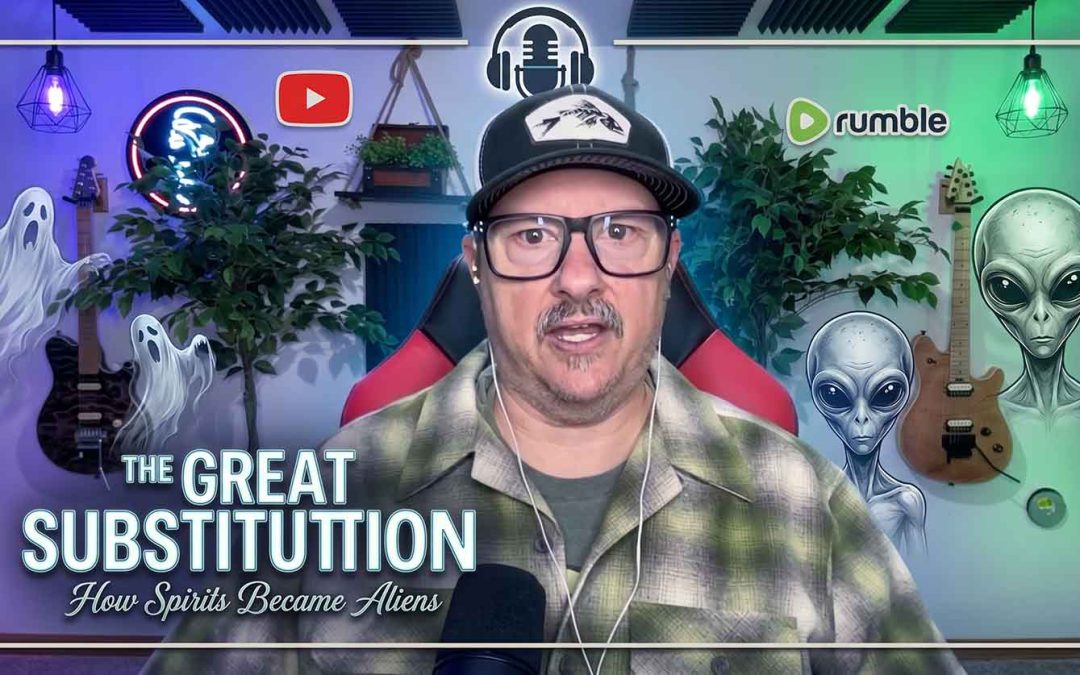
Watch this on Rumble: https://rumble.com/v7asn1u-the-great-substitution-how-spirits-became-aliens.html
Synopsis
For thousands of years, humanity reported encounters with angels, demons, spirits, fairies, celestial messengers, and visitors from unseen realms. Ancient religions, medieval chronicles, folklore, and eyewitness testimony describe strange lights, non-human intelligences, journeys into other worlds, missing time, and transformative encounters that altered the lives of those who experienced them. Then, in the middle of the twentieth century, something remarkable happened. The encounters did not disappear. The language changed. Spirits became extraterrestrials. Fairy realms became other planets. Celestial visitors became space brothers. What previous generations understood through a spiritual lens was increasingly interpreted through a technological one.
Drawing from the research of Jacques Vallée, Robert Kirk, W. Y. Evans-Wentz, George Adamski, and other investigators of both folklore and UFO phenomena, this episode follows an evidence trail stretching from the fairy mounds of Celtic Europe to the flying saucer reports of the modern era. Along the way, it examines striking similarities between ancient accounts of supernatural encounters and contemporary reports of alien contact. Why do stories separated by centuries describe many of the same patterns? Why do the beings seem to change their appearance according to the beliefs of the age encountering them? And why did some of the most respected UFO researchers eventually question whether the extraterrestrial explanation was too simple?
This is not a show about proving that aliens are demons or that every strange encounter has a spiritual origin. It is a show about examining the historical record and asking whether modern civilization may have inherited an ancient mystery and given it a new name. If the experiences remained remarkably similar while the explanations evolved, then the greatest mystery may not be who the visitors are, but why humanity stopped calling them spirits and started calling them aliens. Through folklore, religion, psychical research, contactee literature, and modern UFO investigations, this episode explores the possibility that the greatest substitution of the modern age was not political or technological—but spiritual.
Monologue
For most of human history, the greatest mysteries did not come from outer space. They came from just beyond the edge of the campfire. They came from the darkness beyond the village. They came from dreams, visions, apparitions, strange lights in the sky, and encounters that seemed to exist between this world and another. Every civilization had names for these mysteries. Angels. Demons. Spirits. Fairies. Watchers. Messengers. Ancestors. The names changed from culture to culture, but the stories remained. Human beings repeatedly reported encounters with intelligences that appeared to exist outside the ordinary world.
Then the twentieth century arrived. Humanity built airplanes, split the atom, and began looking toward the stars. Science fiction captured the imagination of millions. Telescopes revealed a universe larger than anything previous generations could have imagined. Suddenly, when people looked into the sky, they no longer expected angels. They expected astronauts. They no longer imagined celestial kingdoms. They imagined distant planets. The heavens had not changed. Humanity's expectations had.
That shift created one of the most fascinating questions in modern history. What if the phenomenon did not change at all? What if the visitors remained the same while the explanation evolved? What if the modern extraterrestrial narrative is not the discovery of something new, but the reinterpretation of something old? It is a question that sounds radical until the historical record is examined. Then it begins to sound unavoidable.
Long before Roswell, long before flying saucers, long before governments created UFO investigations, people described encounters with strange beings who appeared suddenly and vanished just as quickly. They spoke of lights moving through the sky. They spoke of journeys into other realms where time behaved differently. They spoke of receiving messages from entities who claimed knowledge beyond human understanding. They spoke of returning transformed by the experience. The details vary. The pattern persists.
One of the reasons this subject creates so much controversy is because modern culture assumes progress automatically produces better explanations. Ancient people saw spirits because they were primitive. Modern people see extraterrestrials because they are enlightened. That assumption feels reasonable until the similarities begin piling up. The same missing time. The same luminous beings. The same journeys. The same warnings. The same transformations. The same overwhelming sense that the witness has encountered something beyond ordinary reality.
The purpose of this episode is not to prove that every UFO is a spirit or that every supernatural encounter was an alien. It is not to force a conclusion before the evidence is presented. The purpose is much simpler. It is to follow the trail wherever it leads. If the same patterns appear in folklore, religion, psychical research, and modern UFO literature, then that fact deserves investigation. Ignoring it would be intellectually dishonest.
What makes this journey especially interesting is that some of the strongest voices raising these questions are not pastors, theologians, or Christian apologists. They are researchers from within the UFO field itself. Jacques Vallée spent decades studying the phenomenon and eventually concluded that the extraterrestrial explanation alone could not account for the evidence. He noticed that encounters reported in modern UFO literature often resembled stories recorded centuries earlier in folklore and religious traditions. The names changed. The experiences remained remarkably familiar.
That observation leads directly into the heart of tonight's investigation. If a farmer in medieval Europe reported seeing beings emerge from a glowing craft in the sky, historians might call it folklore. If a modern witness reports seeing beings emerge from a glowing craft in the sky, many call it extraterrestrial contact. The experience may be nearly identical. The interpretation is completely different. Which explanation is correct? Perhaps neither. Perhaps both are incomplete.
The challenge facing every generation is learning how to distinguish the phenomenon from the story built around the phenomenon. Human beings naturally explain mysteries according to the language available to them. Ancient cultures used spiritual language. Modern cultures use technological language. But language is not evidence. Labels are not proof. Calling something a fairy, an angel, a spirit, an extraterrestrial, or a non-human intelligence does not tell us what it actually is. It only tells us how the observer interpreted it.
That is why tonight's discussion matters. This is not merely a conversation about UFOs. It is a conversation about worldview. It is a conversation about how civilizations understand the unknown. It is a conversation about whether humanity may have exchanged one explanation for another without fully understanding the phenomenon itself. And if that possibility is true, then the greatest substitution of the modern age may not have occurred in politics, economics, or technology. It may have occurred in the way humanity interprets the unseen world.
Tonight, the evidence trail begins in the ancient world, passes through fairy traditions, crosses into religious history, enters the era of flying saucers, and arrives in the modern UFO movement. Along the way, a simple but profound question will guide the investigation: Did the visitors change, or did the story we tell about them change? The answer may reveal more about our civilization than about the phenomenon itself.
Part 1: Before Flying Saucers
The modern UFO story usually begins in June of 1947. A private pilot named Kenneth Arnold reported seeing a formation of strange objects moving at incredible speeds near Mount Rainier. Newspapers seized upon the story, and the term "flying saucer" entered the public imagination. To many people, this moment marked the birth of the UFO phenomenon. It became the dividing line between the ordinary world and the age of extraterrestrials. Yet there is a problem with that narrative. The reports did not begin in 1947. The label began in 1947.
For centuries before the first flying saucer headline appeared, people across the world reported encounters with strange lights, aerial objects, mysterious beings, and visitors from unseen realms. Ancient chronicles describe luminous objects moving through the heavens. Medieval records speak of ships in the sky. Religious writings contain accounts of messengers descending from above and delivering warnings, instructions, or revelations. These reports emerged from cultures separated by oceans, languages, and centuries, yet they often shared surprisingly similar characteristics.
One of the strongest pieces of evidence comes from the very researchers who spent their lives studying UFOs. Jacques Vallée, one of the most respected figures in the field, noted that traditions of visitations from another world appear throughout history and across many cultures. He observed that while the interpretation changes according to the beliefs of a particular era, the underlying experiences often display remarkable similarities. In other words, the phenomenon appears older than the extraterrestrial explanation attached to it.
Consider what that means. If a mysterious light appeared over a village in the twelfth century, the witnesses had no concept of interstellar travel. They had never seen science fiction films. They had never heard of galaxies or exoplanets. They interpreted what they saw using the language available to them. If the light seemed divine, they called it an angelic sign. If it seemed dangerous, they called it demonic. If it appeared connected to local traditions, they might associate it with fairies or spirits. The experience was filtered through the worldview of the observer.
Modern humanity does the same thing. A witness today is surrounded by spacecraft imagery, discussions of alien life, and decades of UFO culture. When something unexplained appears in the sky, the mind naturally reaches for the explanations it already understands. This does not prove the modern witness is wrong any more than it proves the medieval witness was wrong. It simply demonstrates that interpretation is shaped by culture.
The historical record becomes even more interesting when specific examples are examined. Vallée discusses accounts from centuries before the modern UFO era, including reports from Europe and Asia involving luminous aerial objects and strange visitors. These stories are often dismissed as myths, yet they contain themes that modern researchers still encounter today. The witnesses describe lights that move intelligently. They describe encounters that leave lasting psychological effects. They describe beings associated with the phenomena. They describe experiences that challenge ordinary explanations.
This is where many investigations stop. Skeptics dismiss the ancient reports as superstition. Believers dismiss the similarities as coincidence. Neither response addresses the actual question. The issue is not whether every historical report is true. The issue is why the same types of stories appear repeatedly throughout history. If these accounts are entirely fictional, then humanity has independently created remarkably similar narratives for thousands of years. If some of the accounts are based on genuine experiences, then those experiences seem to predate the flying saucer era by a very long time.
That realization changes the starting point of the conversation. The question is no longer whether flying saucers appeared in the twentieth century. The question becomes whether humanity encountered something throughout history and simply described it differently from one age to the next. The extraterrestrial hypothesis assumes the story began with modern sightings. The historical record suggests the story may be much older than that.
As the evidence begins to accumulate, the distinction between phenomenon and interpretation becomes critical. The phenomenon may be ancient. The interpretation may be modern. The lights may be old. The language used to describe them may be new. Before the discussion can move to aliens, spacecraft, or advanced civilizations, it must first confront a simple historical fact. Human beings were reporting encounters with strange visitors, mysterious lights, and unseen intelligences long before anyone imagined life on another planet. The flying saucer did not create the mystery. It may have simply given the mystery a new name.
Part 2: The Secret Commonwealth
More than two hundred and fifty years before the first flying saucer headline appeared in an American newspaper, a Scottish minister named Robert Kirk was wrestling with a mystery that sounds strangely familiar today. In 1691, he wrote a work known as The Secret Commonwealth of Elves, Fauns and Fairies. Unlike the fairy tales that would later fill children's books, Kirk treated the subject seriously. He did not describe fairies as imaginary characters. He described them as a hidden order of beings existing alongside humanity, occupying a realm that was normally invisible but occasionally intersected with our own.
To modern ears, such a claim sounds absurd. Yet it is important to remember that Kirk was not writing a fantasy novel. He was documenting beliefs and experiences that were widely reported throughout Scotland and other parts of Europe. He approached the subject much as a modern investigator might approach reports of UFO encounters. Witnesses described strange beings. They reported unusual lights. They spoke of encounters that occurred at the edge of ordinary reality. Kirk's goal was not to entertain. His goal was to understand.
The details become even more intriguing when examined closely. According to these traditions, the beings occupied a world that existed alongside the human world but remained largely hidden from normal perception. Witnesses described them as intelligent, organized, and capable of interacting with humanity under certain conditions. They could appear suddenly and disappear just as quickly. They could influence human perception. They could communicate messages. In some stories, they could even transport individuals into their realm and return them later, often with altered perceptions of time.
Anyone familiar with modern UFO literature should immediately recognize some of these themes. Reports of alien encounters frequently include missing time, altered states of consciousness, transportation to another environment, communication with non-human intelligences, and a sense that the experience occurred partly outside ordinary reality. The vocabulary is different, but the structure of the experience often appears remarkably similar.
This does not prove that fairies and aliens are the same phenomenon. Such a conclusion would go far beyond the evidence. What it does demonstrate is that modern reports are not as unique as many people assume. When investigators encounter recurring patterns separated by centuries, they are obligated to ask whether a deeper connection exists. Ignoring the similarities because the terminology sounds outdated would be poor scholarship.
The situation becomes even more compelling when viewed through the lens of cultural interpretation. A seventeenth-century farmer had no concept of extraterrestrials. He had never heard of spacecraft, interstellar travel, or advanced civilizations on distant planets. If he encountered something beyond his understanding, he interpreted it using the language and beliefs available to him. He spoke of fairies because fairies were part of his worldview. A modern witness uses different language because modern culture offers different explanations.
The same principle appears throughout history. Ancient cultures spoke of spirits. Medieval cultures spoke of supernatural beings. Religious cultures spoke of angels and demons. Scientific cultures increasingly speak of extraterrestrials and non-human intelligences. Each civilization explains the unknown using the concepts it already possesses. That does not necessarily change the phenomenon itself. It changes the framework through which the phenomenon is understood.
This is one of the reasons Jacques Vallée became so interested in folklore. He realized that many UFO researchers were examining only a tiny slice of a much larger historical puzzle. By focusing exclusively on modern sightings, they were ignoring centuries of reports that displayed similar characteristics. The fairy traditions preserved in works like Kirk's may not provide answers, but they do provide context. They reveal that encounters with mysterious beings did not suddenly appear in the twentieth century. They were already deeply woven into human history.
There is another lesson hidden within these old accounts. The witnesses often displayed the same certainty that modern witnesses display today. They were convinced they had encountered something real. Some were educated. Some were respected members of their communities. Some gained nothing from telling their stories. Whether they were correct in their interpretations is another question, but dismissing them as simple superstition becomes increasingly difficult when the same patterns emerge generation after generation.
The importance of The Secret Commonwealth is not that it proves the existence of fairies. Its importance lies in showing that humanity was already describing encounters with non-human intelligences long before the extraterrestrial hypothesis existed. The phenomenon may be debated. The reports may be questioned. But the historical record cannot be ignored. Before there were aliens, there were fairies. Before there were flying saucers, there were hidden realms. Before there were extraterrestrials, there were visitors from another world. The names changed, but the mystery remained.
Part 3: Fairyland and Abduction
If the similarities between fairy traditions and modern UFO reports ended with strange lights and mysterious beings, the comparison would be interesting but inconclusive. What makes the subject far more compelling is that the deeper details often begin to overlap. As researchers moved beyond the surface stories and examined witness testimony, they discovered recurring patterns that appear in both traditions. These patterns involve missing time, transportation to another realm, altered consciousness, and profound changes in the witness after the encounter.
In Celtic folklore, people frequently described being taken into what was called Fairyland. Sometimes the journey appeared voluntary. More often it seemed to happen unexpectedly. A person would encounter unusual beings, follow strange music, enter a hidden place, or simply experience a sudden break in ordinary reality. Upon returning, they often discovered that time had behaved differently than expected. Hours had become days. Days had become years. In some stories, entire lifetimes seemed to pass differently between the two worlds.
Modern UFO literature contains a remarkably similar theme. Witnesses describe periods of missing time that cannot easily be explained. They report discovering gaps in memory, finding themselves in locations they do not remember traveling to, or realizing that hours have passed during what felt like only a few moments. These reports became so common that missing time eventually became one of the defining characteristics of many alleged abduction cases.
Again, this does not prove the two phenomena are identical. It does raise an important question. Why do cultures separated by centuries describe experiences that share such unusual characteristics? Missing time is not a normal human experience. Yet it appears repeatedly in both traditions.
Another parallel emerges in the description of the beings themselves. In fairy traditions, the entities are often described as human-like but somehow different. They possess unusual abilities. They seem to operate according to rules that do not apply to ordinary people. They communicate information. They sometimes warn, instruct, or influence those they encounter. In many cases, witnesses report feeling overwhelmed by the presence of these beings, sensing that they possess knowledge or power beyond normal human understanding.
Modern encounter reports often describe similar reactions. Witnesses speak of beings who appear intelligent, purposeful, and strangely detached from ordinary human behavior. The details vary from case to case, but the emotional impact remains consistent. Fear. Awe. Curiosity. Confusion. Transformation. These reactions appear repeatedly regardless of whether the witness interprets the encounter as spiritual, extraterrestrial, or psychological.
Perhaps the most striking similarity involves the aftermath of the experience. In both fairy lore and modern UFO reports, the encounter often changes the witness. People describe becoming obsessed with understanding what happened. They report altered beliefs, new interests, spiritual awakenings, or profound shifts in their worldview. The event becomes a dividing line in their lives. There is a before and an after.
This transformation is important because it suggests the phenomenon is not merely about seeing something strange. It is about experiencing something that affects a person's understanding of reality itself. Whether the cause is external, internal, spiritual, psychological, or some combination of these factors remains a matter of debate. The effect on the witness is often undeniable.
Researchers who dismiss folklore as primitive superstition often overlook this point. The stories survived for generations because people believed they were describing real experiences. The same can be said of many modern UFO witnesses. Some may be mistaken. Some may be fabricating. Some may be misinterpreting ordinary events. Yet it becomes increasingly difficult to explain away thousands of reports spanning centuries simply by assuming everyone was either dishonest or delusional.
The deeper investigators look, the more they encounter a recurring pattern. Human beings report contact with non-human intelligences. They describe transportation into another realm or environment. They experience altered perceptions of time. They return changed. Then they struggle to explain the experience using the language available within their culture. A medieval witness calls it Fairyland. A modern witness calls it an abduction. The terminology differs. The structure often remains surprisingly familiar.
This realization creates a challenge for both believers and skeptics. Believers cannot simply assume that every ancient story validates modern extraterrestrial theories. Skeptics cannot simply dismiss centuries of testimony because the language sounds old-fashioned. The evidence demands a more careful approach. It suggests that humanity may be confronting a phenomenon that is larger than any single explanation.
As the comparison between folklore and modern encounters grows stronger, a new possibility begins to emerge. Perhaps the greatest mistake investigators make is assuming the labels are the phenomenon. Perhaps fairies, spirits, visitors, and extraterrestrials are not necessarily different categories of experience. Perhaps they are different attempts to describe encounters with something that has accompanied humanity far longer than the modern world realizes. The farther back the trail extends, the harder it becomes to argue that the mystery began with flying saucers. The evidence increasingly points toward something much older.
Part 4: The Birth of the Flying Saucer
The year 1947 occupies a special place in modern mythology. To many people, it marks the moment humanity first discovered that it was not alone. The story is familiar. Kenneth Arnold reported seeing nine unusual objects moving at tremendous speed near Mount Rainier. Newspapers spread the account across the nation. Reporters described the objects as moving like saucers skipping across water, and before long the phrase "flying saucer" entered public vocabulary. Within months, sightings multiplied. Within years, an entirely new belief system had begun to emerge.
What is often forgotten is that 1947 was not simply the beginning of a UFO era. It was the beginning of a new interpretation. Humanity had entered the atomic age. The Second World War had ended only two years earlier. Rocket technology had advanced dramatically. The possibility of reaching other planets no longer seemed impossible. Science fiction filled bookstores and movie theaters. Public imagination shifted from heavenly realms to distant solar systems.
This cultural transformation matters because it provided a new framework for understanding the unknown. Previous generations looked upward and saw divine messengers, spirits, or supernatural forces. Modern society increasingly looked upward and saw technology. The mystery remained, but the explanation changed. The heavens had become mechanized.
This shift can be seen clearly when examining the earliest contactee literature. Rather than describing encounters with angels or spirits, witnesses began describing encounters with advanced beings from Venus, Mars, or other worlds. Yet something curious happened. Although the packaging changed, the messages often sounded remarkably familiar. The visitors frequently spoke about peace, human transformation, higher consciousness, moral evolution, and the future destiny of mankind. The subject matter was often spiritual rather than technological.
George Adamski became the most famous example of this trend. His accounts described meetings with visitors from other planets who presented themselves not merely as explorers but as teachers. They offered warnings about humanity's future. They encouraged spiritual growth. They promoted a vision of cosmic brotherhood and planetary unity. The language sounded less like engineering and more like revelation.
This is one of the most important observations in the entire investigation. If extraterrestrials had traveled across unimaginable distances to contact humanity, why were so many of the early messages focused on spiritual development rather than scientific instruction? Why did they sound more like religious teachings than technical briefings? Why were the encounters producing belief systems rather than technological breakthroughs?
The contactee movement expanded rapidly throughout the 1950s. Books, lectures, newsletters, and organizations emerged around claims of communication with visitors from space. Thousands of people became fascinated by the possibility that advanced civilizations were guiding humanity's development. For many, the extraterrestrial narrative offered a new source of hope in an age overshadowed by nuclear fear.
Yet beneath the excitement, another process was taking place. The old spiritual vocabulary was gradually being replaced. Concepts that once belonged to religion and folklore were being translated into technological language. Heaven became another planet. Celestial messengers became space brothers. Spiritual enlightenment became cosmic evolution. The framework shifted from supernatural to extraterrestrial.
Not everyone accepted this transition. Even within the UFO community, some researchers began noticing that the phenomenon seemed strangely adaptive. It appeared to present itself in forms that matched the expectations of the culture observing it. Earlier generations reported fairies and supernatural beings. Modern generations reported extraterrestrials. The experiences looked different on the surface but often produced similar effects on the witnesses.
This observation leads to an uncomfortable possibility. What if the flying saucer era did not reveal the true identity of the phenomenon? What if it simply reflected the hopes, fears, and expectations of a technological civilization? The question does not deny that something unusual was being reported. Instead, it challenges the assumption that the extraterrestrial explanation automatically follows from the reports themselves.
The more closely the early flying saucer movement is examined, the more it resembles a cultural crossroads. Humanity was leaving behind an older spiritual worldview while embracing a new scientific one. The unknown did not disappear during that transition. It was reinterpreted. The visitors were given new names. The stories were rewritten using modern language. The mystery adapted to the age.
That is why 1947 is so important. Not because it necessarily marks the arrival of something new, but because it marks the moment when civilization adopted a new lens through which to view an ancient mystery. The flying saucer became the modern symbol of the unknown. Yet behind that symbol may have been questions humanity had been asking for centuries. The label changed. The fascination remained. And as the evidence continues to unfold, it becomes increasingly difficult to determine whether the modern age discovered a new phenomenon—or simply renamed an old one.
Part 5: The Contactees and the Cosmic Gospel
The contactee movement occupies a unique place in UFO history because it reveals something many modern researchers prefer to avoid. The earliest and most influential UFO encounters were often less about spacecraft and more about belief systems. The visitors were not merely described as travelers from another world. They were described as teachers, guides, protectors, and messengers. They brought warnings. They brought philosophies. They brought visions for humanity's future. In many cases, they brought something that looked remarkably similar to religion.
No figure represents this better than George Adamski. To millions of people during the 1950s, Adamski became the face of extraterrestrial contact. He claimed to have met visitors from Venus and other planets. These beings were not portrayed as conquerors or scientists conducting experiments. They were presented as enlightened guardians concerned about the future of Earth. They warned about war. They warned about nuclear weapons. They encouraged humanity to evolve beyond its destructive tendencies. Their message centered on peace, spiritual growth, and global harmony.
At first glance, this sounds noble. Many people found comfort in the idea that advanced civilizations were watching over humanity. Yet a closer examination reveals something unusual. The messages rarely contained information that could be independently verified. They rarely offered technological breakthroughs capable of transforming civilization. Instead, they delivered teachings. They offered wisdom. They described humanity's spiritual destiny. The focus consistently returned to belief rather than evidence.
This pattern appears repeatedly throughout the contactee era. Different individuals claimed encounters with different visitors from different worlds, yet the themes remained strikingly similar. Humanity was entering a new age. Old divisions would disappear. Higher consciousness would emerge. Advanced beings were guiding the process. A transformation of civilization was approaching. The language varied, but the structure remained familiar.
What makes this significant is how closely these messages resemble older spiritual movements. Throughout history, prophets, mystics, mediums, and visionaries have reported receiving revelations about humanity's future. They described messengers from beyond the visible world. They claimed access to hidden knowledge. They spoke of coming transformations and higher truths. The contactee movement did not abandon these themes. It translated them into the language of space travel.
The opening pages of The Flying Saucers Have Landed make this connection especially clear. The book immediately draws upon Theosophy, Alice Bailey, occult teachings, ancient masters, and cosmic evolution. The visitors are not simply pilots from another planet. They are presented as part of a much larger spiritual framework. The extraterrestrial narrative becomes intertwined with concepts that had existed within esoteric movements for decades before the UFO era began.
This observation raises an important question. If the contactee movement represented genuine extraterrestrial communication, why did it so often resemble preexisting spiritual systems? Why did the messages align so closely with ideas already circulating within Theosophy, occultism, and New Age thought? One possible explanation is that the visitors were communicating profound spiritual truths. Another possibility is that human expectations shaped the encounters. A third possibility is that the phenomenon itself adapts to the beliefs of those experiencing it.
Whatever conclusion one reaches, the historical record is difficult to ignore. The earliest UFO movement was deeply connected to spiritual concepts. The extraterrestrial hypothesis did not emerge in a vacuum. It emerged within a culture already searching for meaning, transformation, and hope in the aftermath of world war and nuclear anxiety. The visitors filled a role that previous generations often assigned to angels, spirits, or celestial messengers.
This is why the contactee era is so important to understanding the larger story. It reveals that the UFO phenomenon was never simply about objects in the sky. It was also about ideas. It was about humanity's search for guidance. It was about the desire to believe that a higher intelligence possessed answers to our deepest problems. The spacecraft attracted attention, but the message created the movement.
As the decades passed, many researchers became increasingly skeptical of the contactees. Some claims were exposed as exaggerations or fabrications. Others could not be verified. Yet the importance of the movement does not depend on whether every story was true. Its importance lies in what it reveals about the evolution of the phenomenon. The flying saucer became a vehicle for transmitting beliefs. The extraterrestrial visitor became a modern messenger.
That realization brings us closer to the central question of this investigation. If ancient cultures interpreted mysterious encounters through a spiritual lens and modern cultures interpret similar encounters through an extraterrestrial lens, what exactly changed? Was it the phenomenon itself? Or was it the framework used to understand it? The contactee movement suggests that while the language became technological, the underlying themes remained profoundly spiritual. The messenger wore a new face, but the message sounded remarkably familiar.
Part 6: Jacques Vallée Changes the Question
Most UFO researchers spend their careers trying to answer a single question: Are aliens visiting Earth? It sounds like the obvious place to begin. Strange objects are reported in the sky. Witnesses describe unusual beings. Military pilots encounter unexplained phenomena. Governments investigate sightings. The natural assumption is that the mystery concerns extraterrestrial visitation. For many years, Jacques Vallée followed that path like everyone else. Then he encountered a problem. The evidence refused to stay inside the extraterrestrial box.
Unlike many researchers, Vallée possessed a unique advantage. He was not merely interested in modern UFO reports. He was willing to look backward into history. As he examined older accounts, he noticed something unsettling. The same patterns appearing in contemporary UFO cases also appeared in folklore, religious traditions, fairy legends, and reports of supernatural encounters stretching back centuries. The details changed. The framework changed. The witnesses changed. Yet the structure of the experiences remained remarkably consistent.
This observation forced Vallée to ask a different question. Instead of asking whether aliens were visiting Earth, he began asking whether humanity had been encountering the same phenomenon throughout history and simply interpreting it according to the beliefs of each age. It was a radical shift in perspective. Suddenly the mystery was no longer limited to the twentieth century. It extended across civilizations and centuries.
In Passport to Magonia, Vallée assembled evidence suggesting that reports of strange visitors from another realm existed long before modern discussions of extraterrestrials. He examined folklore, historical records, and accounts of supernatural beings. Again and again he encountered familiar themes. Strange lights. Non-human intelligences. Abductions. Missing time. Journeys into other worlds. Messages delivered by mysterious entities. The similarities were too numerous to dismiss casually.
One of Vallée's most important insights was recognizing that the phenomenon appears to adapt itself to the expectations of the observer. Medieval witnesses described fairies. Religious witnesses described angels. Mystics described spiritual beings. Modern witnesses describe extraterrestrials. The appearance changes according to culture, but the underlying patterns often remain intact. This does not prove the phenomenon is spiritual. It does suggest that the extraterrestrial explanation may be incomplete.
The implications are enormous. If Vallée is correct, then modern UFO research may be studying only the latest chapter of a much older story. The flying saucer becomes one mask among many. The extraterrestrial visitor becomes one interpretation among many. Instead of discovering a new phenomenon after World War II, humanity may have simply developed a new way of talking about an ancient mystery.
This idea becomes even more challenging when applied to the contactee movement. If the phenomenon is adapting to culture, then the appearance of space brothers during the 1950s makes perfect sense. Humanity had entered the atomic age. Science and technology dominated public imagination. Space exploration captured global attention. In such an environment, mysterious visitors would naturally be interpreted as advanced beings from other worlds rather than spirits from another realm.
Vallée's research also undermines one of the most common assumptions in UFO culture. Many people believe the extraterrestrial hypothesis is the most scientific explanation available. Vallée argued that the opposite may be true. The extraterrestrial explanation often rests on assumptions rather than evidence. It assumes that because something appears technological, it must originate from another planet. Yet the historical record demonstrates that similar encounters occurred long before anyone imagined interstellar travel. The appearance of technology may tell us more about the observer's expectations than about the phenomenon itself.
This is why Vallée's work remains so influential decades after it was published. He did not claim to possess all the answers. In fact, he often seemed more interested in asking better questions. He challenged researchers to stop assuming that every mystery involving lights in the sky must involve extraterrestrials. He encouraged them to examine folklore, religion, mythology, and psychical research alongside modern UFO reports. The result was a much larger and more complex picture than most investigators were prepared to confront.
For the purposes of this investigation, Vallée serves as a bridge between two worlds. On one side stands the ancient record of spirits, fairies, apparitions, and supernatural encounters. On the other side stands the modern world of flying saucers, alien contact, and non-human intelligences. Most researchers choose one side or the other. Vallée examined both and concluded that they may be connected.
That conclusion does not solve the mystery. It deepens it. If the phenomenon has appeared throughout history under different names, then the question is no longer whether aliens exist. The question becomes far more profound. What exactly is humanity encountering? And why does it seem to wear whatever mask each generation is most prepared to recognize? The farther the evidence trail extends into the past, the harder it becomes to argue that the flying saucer era created the mystery. Increasingly, it appears that the mystery simply found a new face.
Part 7: The Control System
As Jacques Vallée continued his research, he began moving further away from the simple extraterrestrial explanation that dominated UFO discussions. He was not becoming a skeptic. He never denied that something unusual was occurring. In fact, he repeatedly argued that the phenomenon was real. What changed was his understanding of its significance. The more cases he examined, the more he became convinced that UFOs were not merely objects moving through space. They appeared to influence human beliefs, cultures, expectations, and even the direction of history itself.
This led Vallée to one of the most controversial ideas in all of UFO research: the possibility that the phenomenon functions as a form of control system. The phrase sounds technological, but the concept is much broader than machines or computers. A control system shapes behavior. It influences decisions. It guides development. It encourages certain outcomes while discouraging others. Vallée observed that encounters often seemed to arrive at moments when societies were experiencing major cultural, religious, or psychological shifts. The phenomenon appeared to interact with humanity in ways that extended beyond simple observation.
Whether one agrees with his conclusion or not, the historical evidence that led him there is fascinating. Every age seems to receive a version of the phenomenon that fits its worldview. Ancient societies encountered gods, spirits, and divine messengers. Medieval societies encountered fairies, elves, and supernatural beings. Religious societies encountered angels, saints, and apparitions. Technological societies encounter extraterrestrials and non-human intelligences. The phenomenon appears to adapt its presentation to the expectations of the observer.
That observation should immediately capture the attention of anyone interested in spiritual matters. If something consistently presents itself in forms that human beings are willing to accept, then the appearance itself may be less important than the effect produced by the encounter. The real question becomes: what changes afterward? What beliefs are adopted? What assumptions are altered? What worldview shifts occur in the witness and in the surrounding culture?
Throughout history, major religious movements often began with extraordinary encounters. Prophets received visions. Mystics reported revelations. Entire civilizations reorganized themselves around experiences interpreted as contact with higher intelligences. Whether one views these events as divine, psychological, or something else entirely, their influence on history cannot be denied. Vallée noticed that UFO encounters often produce similar effects. Witnesses frequently emerge with transformed beliefs, heightened spiritual interests, and a conviction that they have been exposed to a greater reality.
This is where the investigation begins moving beyond lights in the sky and into questions of influence. If the phenomenon consistently changes human beliefs, then perhaps the central issue is not transportation between planets. Perhaps the central issue is information. Ideas have always been more powerful than machines. A single belief can reshape a civilization. A single revelation can redirect the course of history. A single worldview can influence generations.
What makes the modern era unique is that these influences now operate on a global scale. In earlier centuries, a strange encounter might affect a village or a region. Today, a single UFO report can reach millions of people within hours. Books, documentaries, social media, and news broadcasts can transform isolated events into worldwide discussions. The potential influence of the phenomenon has expanded dramatically.
This expansion creates an interesting parallel with religion itself. Religions do not spread primarily through physical evidence. They spread through narratives, testimonies, experiences, and belief systems. The UFO movement often functions in a surprisingly similar manner. Witnesses share encounters. Communities form around those encounters. New interpretations emerge. Competing explanations develop. Over time, entire worldviews are built around the phenomenon. The object in the sky becomes less important than the meaning assigned to it.
This does not prove that the UFO phenomenon is spiritual in nature. It does demonstrate that its influence often extends far beyond physical sightings. Vallée recognized that reducing the mystery to extraterrestrial spacecraft left too many questions unanswered. Why do encounters so often involve symbolic messages? Why do they produce profound psychological effects? Why do they seem to adapt to cultural expectations? Why do they repeatedly intersect with folklore, religion, and mythology? These questions point toward a phenomenon that appears deeply connected to human consciousness and belief.
For those approaching the subject from a Christian perspective, this raises an unavoidable question. Throughout Scripture, spiritual beings are frequently described not merely as entities but as influencers. They communicate messages. They inspire beliefs. They guide, deceive, warn, encourage, and transform. The battlefield is often the human mind. The struggle concerns truth and deception, not merely physical manifestations. Whether or not one accepts Vallée's conclusions, his observations push the conversation into territory that sounds surprisingly familiar.
The idea of a control system does not solve the mystery. It reframes it. Instead of asking only what the witnesses saw, it asks what the encounter accomplished. Instead of focusing solely on the appearance of the visitor, it examines the effect on the culture receiving the visitation. The result is a far more challenging investigation. The question is no longer whether something is present. The question is whether that presence has been shaping human beliefs for centuries while wearing whatever mask each generation was most prepared to recognize.
Part 8: Messengers of Deception
By the time Jacques Vallée wrote Messengers of Deception, something had changed. The researcher who had spent years investigating UFO sightings was no longer focused exclusively on lights in the sky. His attention had shifted toward the people surrounding the phenomenon. He had begun asking a different question. Not merely, "What are UFOs?" but, "What happens when people believe they know what UFOs are?" That distinction may sound subtle, but it fundamentally changes the investigation.
Vallée observed that UFO beliefs were often accompanied by movements, organizations, leaders, and ideologies that attempted to direct human behavior. Some groups promoted harmless ideas. Others became increasingly authoritarian. Some promised secret knowledge available only to the initiated. Others claimed direct communication with advanced beings who possessed answers to humanity's problems. The phenomenon was no longer confined to unexplained sightings. It was generating entire systems of belief.
One of the most striking warnings in the book concerns the danger of assuming that every message attributed to extraterrestrials is automatically trustworthy. Throughout history, human beings have been vulnerable to claims of hidden wisdom. Whether delivered by priests, prophets, mediums, gurus, or contactees, the promise remains remarkably consistent. Someone claims access to knowledge unavailable to ordinary people. Followers gather around that claim. A belief system forms. Authority begins to concentrate around those who possess the message.
This pattern did not begin with UFOs. It can be found throughout religious history, political history, and even financial history. What fascinated Vallée was how easily the extraterrestrial narrative could become a vehicle for the same process. A visitor from another planet automatically carries an aura of superior knowledge. If such a being claims to possess answers about humanity's future, many people will be inclined to listen. The authority is assumed before the message is even examined.
The historical examples discussed by Vallée are revealing. Certain UFO groups evolved into tightly controlled organizations centered around charismatic leaders. Followers were encouraged to separate themselves from outsiders. Independent questioning was discouraged. Predictions about the future became increasingly elaborate. In some cases, the consequences became tragic. The issue was not whether UFOs existed. The issue was how belief in UFOs could be used to influence human behavior.
This is where the discussion intersects directly with the spiritual dimension of our investigation. Throughout Scripture, one of the recurring themes is discernment. The warning is not merely against obvious evil. The warning is against deception. The danger lies in accepting a messenger simply because the messenger appears impressive. The message itself must be tested. The source must be examined. The fruit must be evaluated.
That principle becomes especially important when examining the contactee movement. Many of the so-called space brothers presented messages that sounded attractive. They promised peace, unity, enlightenment, and a better future. Yet they often dismissed traditional religious teachings. They frequently minimized the concepts of sin, judgment, repentance, and moral accountability. Humanity's problem was no longer rebellion against God. Humanity's problem became a lack of cosmic awareness. Salvation became evolution. Redemption became enlightenment.
Notice how subtle that substitution is.
The vocabulary changes.
The framework changes.
The authority changes.
The spiritual questions remain.
This is precisely why Messengers of Deception is such an important book for this show. Vallée is not arguing that every UFO report is false. He is not claiming that every witness is mistaken. He is warning that belief systems can emerge around the phenomenon and that those belief systems deserve careful scrutiny. The phenomenon itself may be real. The explanations built around it may not be.
The warning becomes even more relevant when viewed through the lens of modern culture. Today, millions of people openly discuss non-human intelligences, interdimensional entities, channeling, cosmic consciousness, and extraterrestrial guidance. Entire communities have formed around these ideas. Conferences are held. Books are published. Influencers build large audiences discussing revelations allegedly received from advanced beings. The movement continues to grow.
What makes this remarkable is that the structure often resembles older spiritual systems far more than scientific investigation. Science seeks evidence. Science tests claims. Science attempts replication. Many UFO belief systems function differently. They rely on revelation, testimony, authority figures, and personal experiences that cannot easily be verified. In that sense, they often operate more like religions than scientific theories.
This realization brings us back to the central theme of the show. The question is not whether strange phenomena occur. The evidence suggests they do. The question is what conclusions humanity draws from those experiences. A light in the sky is one thing. A worldview built around the light is something else entirely.
Vallée's greatest contribution may be his refusal to accept easy answers. While others rushed to declare the visitors extraterrestrials, he stepped back and asked who benefited from that conclusion. While others embraced new belief systems, he urged caution. While others focused on the spectacle, he examined the influence. His warning remains relevant today. The greatest danger may not be the phenomenon itself. The greatest danger may be the willingness of human beings to accept a messenger before carefully examining the message.
Part 9: The New Religion of the Modern Age
Every civilization develops a story that explains humanity's place in the universe. Ancient cultures told stories of gods and spirits. Medieval societies viewed reality through a religious lens. The modern world often sees itself as scientific, rational, and liberated from mythology. Yet human beings have not stopped searching for meaning. They have not stopped looking for higher intelligence. They have not stopped asking who we are, why we exist, and where history is heading. The questions remain. Only the vocabulary changes.
This is one of the reasons the UFO phenomenon has proven so resilient. It offers something that pure materialism struggles to provide. Materialism can explain how things work. It often struggles to explain why they matter. Human beings naturally seek purpose, destiny, and meaning. The extraterrestrial narrative fills that need for many people. It provides a cosmic story in which humanity is part of something larger than itself.
Whitley Strieber recognized this dynamic and warned that the UFO phenomenon possessed the potential to become a new religion. He observed that the mystery had already begun generating beliefs, communities, doctrines, and expectations that extended far beyond the sightings themselves. The phenomenon was no longer merely an object of investigation. It was becoming a framework through which many people interpreted reality.
The parallels to religion are difficult to ignore.
There are messengers.
There are revelations.
There are chosen individuals who receive special knowledge.
There are prophecies concerning humanity's future.
There are warnings about coming catastrophes.
There are promises of transformation and salvation.
There are communities of believers who gather around a shared worldview.
The structure is familiar because humanity has seen it before.
What changes is the source of authority.
Traditional religion points upward toward God. The modern extraterrestrial narrative often points outward toward advanced civilizations. The role once occupied by angels is increasingly occupied by visitors from the stars. The source of wisdom shifts from heaven to the cosmos. Yet the human need being addressed remains largely the same.
This transition becomes especially visible when examining the language used throughout much of the UFO movement. Humanity is told that it stands on the edge of a great transformation. Higher consciousness is approaching. Old systems will collapse. A new era will emerge. Advanced beings are guiding the process. The themes sound remarkably similar to religious expectations found throughout history. The difference is that the supernatural framework has been replaced with a technological one.
The contactee movement demonstrated this pattern early. Adamski's visitors did not simply arrive and depart. They delivered teachings. They offered a vision of humanity's future. They encouraged spiritual evolution and global unity. Later movements expanded these ideas even further. Channelers began receiving messages from extraterrestrial councils. New Age teachers incorporated alien wisdom into broader spiritual systems. Entire belief structures emerged around communications allegedly originating from non-human intelligences.
Notice what is happening beneath the surface. The phenomenon is no longer functioning as a scientific question. It is functioning as a source of authority. People are changing their beliefs, lifestyles, and worldviews based on messages they believe originate from higher beings. Whether those beings are real, imagined, spiritual, extraterrestrial, or psychological becomes almost secondary to the influence they exert.
This is where the historical comparison becomes impossible to avoid. Earlier generations attributed similar authority to spirits, gods, saints, and angels. Modern society often attributes similar authority to extraterrestrials and non-human intelligences. The mechanism remains strikingly familiar. Humanity continues looking beyond itself for answers. Humanity continues seeking guidance from sources perceived as higher, wiser, and more advanced.
For Christians, this raises a profound question. If a being appears and delivers teachings that contradict Scripture, should the teaching be accepted simply because the being appears powerful or knowledgeable? The biblical answer has always been no. The messenger does not determine truth. The message must be tested. Throughout Scripture, discernment is presented as a necessity because appearances can be deceptive. The most dangerous deception is not the obvious lie. It is the lie wrapped in enough truth to appear trustworthy.
That concern becomes increasingly relevant in a world fascinated by non-human intelligence. The modern age is preparing itself to accept guidance from sources it does not fully understand. Governments discuss unexplained phenomena. Researchers discuss interdimensional theories. Influencers discuss cosmic consciousness. The cultural resistance that once existed toward these ideas continues to weaken.
Whether intentional or not, the result is the emergence of a new spiritual framework. It may not call itself a religion. It may reject that label entirely. Yet it often performs many of the same functions religion has always performed. It explains humanity's place in the universe. It offers a vision of the future. It identifies higher intelligences. It provides meaning and purpose. It supplies answers to questions that science alone cannot fully address.
This does not prove that extraterrestrials are spirits or that every UFO report is part of a grand deception. It does reveal something important about human nature. Humanity has never stopped searching for transcendence. Remove one set of messengers and another eventually appears. Change the language and the deeper questions remain. The modern world may believe it has abandoned the supernatural, but the evidence suggests something different. It may simply have given the supernatural a new name and wrapped it in the imagery of a technological age.
Part 10: The Great Substitution
At the beginning of this investigation, a simple question was asked. Did humanity discover something new after 1947, or did it rename something old? After examining folklore, fairy traditions, contactee literature, psychical research, and the work of Jacques Vallée, the answer appears far more complicated than either believers or skeptics often admit.
The traditional extraterrestrial hypothesis assumes that modern UFO encounters represent contact with advanced civilizations from other planets. It is an attractive explanation because it fits the technological worldview of the modern age. We live in an era of rockets, satellites, and space exploration. If strange objects appear in the sky, it seems natural to assume they originate from somewhere else in the cosmos.
Yet the historical record creates a problem for that assumption.
Long before telescopes revealed distant galaxies, people reported encounters with non-human intelligences. Long before science fiction filled bookstores, witnesses described strange lights and mysterious visitors. Long before flying saucers became part of popular culture, stories of abduction, missing time, hidden realms, and supernatural encounters were already deeply woven into human history. The reports existed. Only the interpretation was different.
This is where the idea of the Great Substitution emerges.
The substitution was not necessarily deliberate. It may not have been organized. It may not have been planned by any institution or individual. It may simply be the result of cultural evolution. Every age explains mysteries according to the tools available to it. Ancient civilizations used spiritual language. Medieval civilizations used religious language. Modern civilizations use scientific and technological language.
The phenomenon remains.
The explanation changes.
That possibility should force both sides of the debate to slow down.
Those who insist every UFO is an extraterrestrial spacecraft must explain why similar encounters were being reported centuries before the extraterrestrial hypothesis existed. They must explain why fairy lore, spirit encounters, and religious apparitions often contain patterns that closely resemble modern reports. They must explain why some of the most respected UFO researchers eventually questioned whether the alien explanation was too simplistic.
At the same time, those who dismiss all reports as fantasy or superstition face their own challenge. Human beings from vastly different cultures continue reporting experiences that share unusual characteristics. The recurrence of those patterns does not prove a specific explanation, but it makes simple dismissal increasingly difficult. The mystery persists because the reports persist.
What makes this subject especially important is that it extends beyond unidentified objects in the sky. It touches the foundations of worldview itself. If a civilization believes it is receiving guidance from advanced beings, that belief will influence its values, expectations, and understanding of reality. Throughout history, encounters with perceived higher intelligences have shaped religions, cultures, and entire societies. The source of authority matters because authority shapes belief.
This is precisely why Vallée's warnings deserve attention. His concern was never limited to the existence of UFOs. His concern centered on the belief systems forming around them. He recognized that people often rush toward explanations before understanding the phenomenon itself. He observed that entire movements were developing around assumptions that had not yet been proven. The messenger was being trusted before the message was fully examined.
From a Christian perspective, this creates an additional layer of responsibility. Scripture consistently teaches discernment. The issue is not whether spiritual realities exist. Christianity begins with that assumption. The issue is learning how to test claims, evaluate messages, and distinguish truth from deception. Throughout biblical history, appearances alone were never considered sufficient evidence. The source and content of the message mattered just as much as the experience itself.
Perhaps that is the greatest lesson hidden within this entire investigation.
The modern world often assumes that replacing spiritual language with technological language automatically produces a better explanation. Yet calling something extraterrestrial does not explain it any more than calling it a spirit explains it. Both labels are interpretations. Both labels carry assumptions. Both labels attempt to describe a phenomenon that remains largely mysterious.
The farther back the evidence trail extends, the harder it becomes to argue that humanity suddenly encountered a completely new phenomenon in the twentieth century. The lights were already there. The visitors were already there. The encounters were already there. The stories were already there.
What changed was the vocabulary.
Fairies became extraterrestrials.
Hidden realms became other planets.
Messengers became space brothers.
Spiritual encounters became alien contact.
The old mystery received a modern name.
Whether the phenomenon is ultimately spiritual, psychological, extraterrestrial, interdimensional, or something humanity has not yet learned how to describe, one conclusion appears increasingly difficult to escape. The story did not begin with flying saucers. It began long before modern civilization looked toward the stars. And if that is true, then the greatest substitution of the modern age may not have occurred in the heavens at all.
It may have occurred in the human mind.
Conclusion: The Visitor Behind the Mask
The purpose of this investigation was never to prove that every UFO is a spirit, every spirit is an alien, or every encounter can be reduced to a single explanation. The evidence does not support such simple conclusions. What the evidence does support is something far more interesting. The phenomenon humanity associates with extraterrestrials appears to possess a history that extends far beyond the modern UFO era.
When the journey began, the assumption seemed straightforward. Flying saucers appeared in the twentieth century. Reports increased. Governments investigated. Researchers searched for evidence of visitors from other worlds. Yet as the historical record unfolded, a different picture emerged. The lights were older than the saucers. The visitors were older than the spaceships. The encounters were older than the extraterrestrial hypothesis itself.
In the fairy traditions of Europe, people spoke of hidden realms existing alongside our own. In religious history, witnesses described angels, spirits, and supernatural messengers. In folklore, travelers entered strange worlds where time behaved differently. In psychical research, investigators documented encounters with non-human intelligences and unexplained phenomena. Then, in the modern age, many of the same themes reappeared wearing a technological disguise. Fairies became extraterrestrials. Hidden realms became other planets. Celestial messengers became advanced beings from distant star systems.
This does not mean every story describes the same thing. History is rarely that simple. Human imagination, misunderstanding, fraud, psychology, and genuine mystery all exist together. Yet the recurring patterns remain difficult to dismiss. The similarities appear too frequently, across too many centuries and cultures, to be ignored entirely.
Perhaps the greatest mistake both believers and skeptics make is assuming that the label explains the phenomenon. It does not. Calling something a fairy explains nothing. Calling it an extraterrestrial explains nothing. Calling it a spirit explains nothing. These are categories created by human beings attempting to describe experiences that often exceed ordinary understanding. The label may reveal more about the observer than about the reality being observed.
This is why Jacques Vallée's work remains so important. He refused to stop asking questions once he realized the evidence did not fit neatly into the extraterrestrial box. Rather than forcing the phenomenon into a preferred explanation, he followed the trail backward through history. What he discovered was not certainty. It was continuity. The mystery appeared again and again under different names, adapting itself to the beliefs of the age encountering it.
For Christians, this continuity carries a warning. Scripture repeatedly teaches that not every messenger should be trusted simply because the messenger appears powerful, wise, or impressive. Truth is not determined by appearances. It is tested. Discerned. Examined. The issue is not whether spiritual realities exist. The issue is whether humanity possesses the wisdom to recognize them accurately. A civilization willing to question every religious tradition but willing to accept messages from unknown intelligences without scrutiny may not be escaping deception. It may simply be exchanging one framework for another.
That possibility should give pause to everyone involved in the UFO discussion. If advanced beings appeared tomorrow and offered humanity a new vision of the future, would the world examine the message carefully, or would it embrace the messenger because the messenger appeared more advanced than ourselves? History suggests human beings have always been vulnerable to authority that claims access to higher knowledge.
Perhaps that is why the central question of this show was never really about aliens.
The real question is this:
What if humanity has been encountering the same mystery for thousands of years?
What if the forms change but the pattern remains?
What if each generation receives a version of the phenomenon it is prepared to understand?
And what if the greatest substitution of the modern age was not replacing religion with science, but replacing ancient spiritual language with technological language while continuing to describe many of the same experiences?
The evidence does not prove that conclusion beyond doubt.
It does, however, make it impossible to dismiss.
The lights remain.
The encounters remain.
The visitors remain.
Only the masks change.
And until humanity learns what stands behind those masks, the mystery will continue to follow us from age to age, wearing whatever face we are most willing to believe.
Bibliography
- Adamski, George, and Desmond Leslie. Flying Saucers Have Landed. London: T. Werner Laurie, 1953.
- Bailey, Alice A. A Treatise on Cosmic Fire. New York: Lucis Publishing Company, 1925.
- Blum, Deborah. Ghost Hunters: William James and the Search for Scientific Proof of Life After Death. New York: Penguin Press, 2006.
- Evans-Wentz, W. Y. The Fairy-Faith in Celtic Countries. Oxford: Oxford University Press, 1911.
- Foy, Robin. Witnessing the Impossible: The Physical Phenomena of the Scole Experiment. Great Britain: White Crow Books, 2008.
- Greyson, Bruce. After: A Doctor Explores What Near-Death Experiences Reveal About Life and Beyond. New York: St. Martin's Essentials, 2021.
- Haraldsson, Erlendur. The Departed Among the Living: An Investigative Study of Afterlife Encounters. Guildford, UK: White Crow Books, 2012.
- Kirk, Robert. The Secret Commonwealth of Elves, Fauns and Fairies. Aberfoyle, Scotland, 1691. Reprint editions consulted.
- Lodge, Oliver. The Survival of Man. New York: George H. Doran Company, 1909.
- Moody, Raymond A. Life After Life. Covington, GA: Mockingbird Books, 1975.
- Myers, Frederic W. H. Human Personality and Its Survival of Bodily Death. London: Longmans, Green, and Co., 1903.
- Ring, Kenneth. Life at Death: A Scientific Investigation of the Near-Death Experience. New York: Coward, McCann & Geoghegan, 1980.
- Solomon, Grant, and Jane Solomon. The Scole Experiment: Scientific Evidence for Life After Death. London: Piatkus Books, 1999.
- Strieber, Whitley. Communion: A True Story. New York: William Morrow and Company, 1987.
- Strieber, Whitley. Transformation: The Breakthrough. New York: William Morrow and Company, 1988.
- Vallée, Jacques. Passport to Magonia: From Folklore to Flying Saucers. Chicago: Henry Regnery Company, 1969.
- Vallée, Jacques. Dimensions: A Casebook of Alien Contact. New York: Ballantine Books, 1988.
- Vallée, Jacques. Confrontations: A Scientist's Search for Alien Contact. New York: Ballantine Books, 1990.
- Vallée, Jacques. Messengers of Deception: UFO Contacts and Cults. Berkeley, CA: And/Or Press, 1979.
- van Lommel, Pim. Consciousness Beyond Life: The Science of the Near-Death Experience. New York: HarperOne, 2010.
- Williamson, George Hunt. Other Tongues, Other Flesh. Amherst, WI: Amherst Press, 1953.
- Wilson, Colin. Poltergeist!: A Study in Destructive Haunting. New York: Random House, 1981.
- Primary source materials from The Secret Commonwealth of Elves, Fauns and Fairies, The Fairy-Faith in Celtic Countries, Passport to Magonia, Dimensions, Messengers of Deception, and Flying Saucers Have Landed were utilized extensively in the development of this presentation.
Endnotes
- Jacques Vallée argued that reports of strange aerial phenomena and encounters with non-human intelligences predate the modern UFO era and can be found throughout folklore, mythology, and religious history. His research challenged the assumption that the phenomenon began in 1947 and suggested that modern UFO reports may represent a continuation of much older traditions.
- Robert Kirk's The Secret Commonwealth of Elves, Fauns and Fairies (1691) described a hidden order of beings existing alongside humanity. Kirk treated the subject as a serious investigation into reported experiences rather than as fantasy or folklore alone.
- W. Y. Evans-Wentz's The Fairy-Faith in Celtic Countries collected testimony from witnesses, clergy, scholars, and local traditions concerning encounters with fairy beings, hidden realms, unusual lights, and altered states of perception.
- The concept of "missing time," commonly associated with modern UFO abduction reports, bears similarities to older folklore accounts in which individuals entered fairy realms and returned to discover that time had passed differently than expected.
- George Adamski's accounts of contact with beings from Venus and other worlds helped establish the modern contactee movement. His writings emphasized spiritual evolution, peace, planetary unity, and cosmic brotherhood rather than technological instruction.
- The opening sections of Flying Saucers Have Landed draw heavily from Theosophy, Alice Bailey, Helena Blavatsky, and occult evolutionary concepts, illustrating the close relationship between early contactee literature and existing esoteric traditions.
- Vallée's Passport to Magonia introduced the idea that UFO encounters share significant similarities with fairy lore, religious apparitions, and other historical reports of supernatural encounters.
- The medieval account of Magonia, recorded by Archbishop Agobard of Lyons, described a belief that aerial ships traveled through the clouds and interacted with humanity. Vallée used this account to demonstrate that reports of visitors from the sky existed centuries before the flying saucer era.
- In Dimensions, Vallée explored the possibility that the UFO phenomenon functions as a cultural or psychological influence system rather than simply a visitation from another planet.
- Vallée proposed that each civilization interprets anomalous experiences through its prevailing worldview. Thus, ancient cultures reported spirits and supernatural beings while modern cultures increasingly report extraterrestrials and non-human intelligences.
- Messengers of Deception examined UFO groups, cult dynamics, and the potential for manipulation through claims of extraterrestrial communication. Vallée warned against accepting extraordinary messages without critical examination.
- Vallée's work does not conclude that all UFO reports are fraudulent or imaginary. Rather, he consistently argued that the extraterrestrial explanation alone fails to account for the full range of historical and contemporary evidence.
- Whitley Strieber observed that the UFO phenomenon possesses many characteristics traditionally associated with religion, including revelation, transformation, belief systems, and expectations regarding humanity's future.
- Near-death researchers such as Raymond Moody, Bruce Greyson, Kenneth Ring, and Pim van Lommel have documented recurring reports of beings of light, altered states of consciousness, life reviews, and experiences that many witnesses interpret as encounters with a reality beyond physical death.
- Frederic Myers, William James, Oliver Lodge, and other members of the Society for Psychical Research spent decades investigating apparitions, mediumship, and survival-of-consciousness claims, contributing significantly to the historical study of non-material phenomena.
- The Scole Experiment remains one of the most discussed modern investigations into physical mediumship, involving claims of direct voice communication, spirit lights, apport phenomena, and other unusual events observed over several years.
- Throughout history, reports of encounters with non-human intelligences have appeared in religious writings, folklore traditions, psychical research, and modern UFO literature. While interpretations differ, the recurrence of similar themes remains a subject of ongoing debate among researchers.
- The central thesis of this presentation is not that all spiritual encounters and UFO encounters are identical phenomena, but that the historical record demonstrates significant continuity in reported experiences across cultures and centuries.
- The phrase "The Great Substitution" refers to the possibility that modern civilization replaced older spiritual explanations with extraterrestrial explanations while continuing to describe many of the same underlying experiences.
- The question explored throughout this presentation remains open: Did humanity discover a new phenomenon in the twentieth century, or did it inherit an ancient mystery and give it a modern name? The evidence presented suggests that the answer deserves careful examination rather than immediate dismissal.
#TheGreatSubstitution, #HowSpiritsBecameAliens, #UFOs, #Aliens, #Spirits, #Fairies, #PassportToMagonia, #JacquesVallee, #FlyingSaucers, #Contactees, #GeorgeAdamski, #WhitleyStrieber, #Magonia, #FairyFaith, #SecretCommonwealth, #Folklore, #AncientMysteries, #HiddenRealm, #NonHumanIntelligence, #Paranormal, #Supernatural, #SpiritualWarfare, #ChristianPerspective, #Discernment, #EndTimes, #Deception, #MessengersOfDeception, #CauseBeforeSymptom, #HistoryMysteries, #TruthSeekers
The Great Substitution, How Spirits Became Aliens, UFOs, Aliens, Spirits, Fairies, Passport to Magonia, Jacques Vallee, Flying Saucers, Contactees, George Adamski, Whitley Strieber, Magonia, Fairy Faith, Secret Commonwealth, Folklore, Ancient Mysteries, Hidden Realm, Non Human Intelligence, Paranormal, Supernatural, Spiritual Warfare, Christian Perspective, Discernment, End Times, Deception, Messengers of Deception, Cause Before Symptom, History Mysteries, Truth Seekers