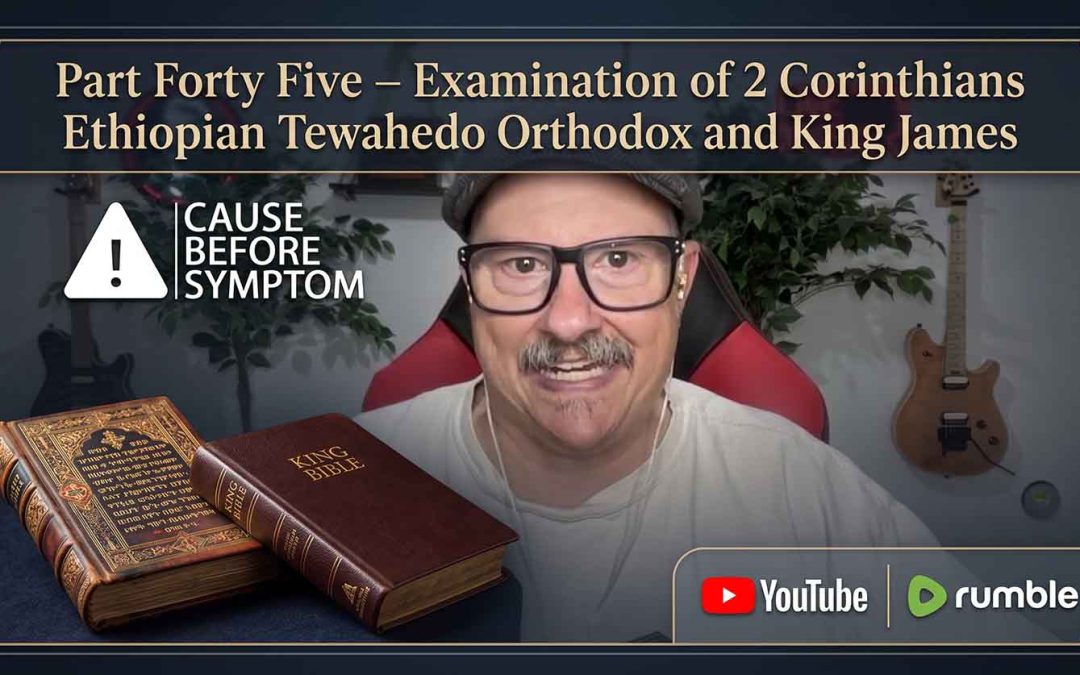
Watch this on Rumble: https://rumble.com/v7bn4o2-part-forty-five-examination-of-2-corinthians-ethiopian-tewahedo-orthodox-an.html
Synopsis
The book of Second Epistle to the Corinthians is unlike any other letter written by the Apostle Paul. While Romans explains the Gospel and 1 Corinthians corrects a troubled church, 2 Corinthians opens a window into the heart of a servant who endured suffering, opposition, criticism, and hardship while remaining faithful to Christ. It is a deeply personal letter that reveals how God works through weakness, comforts those who suffer, and transforms ordinary people into ministers of reconciliation.
In this examination, we will place the Ethiopian translation directly beside the King James Version and compare the text chapter by chapter. Rather than relying upon later traditions, theological systems, or denominational interpretations, we will examine the actual wording of the Scriptures themselves. Where the translations agree, we will observe that agreement. Where differences appear, we will carefully examine whether they affect meaning, emphasis, or understanding.
The letter begins with one of the most encouraging descriptions of God found anywhere in Scripture. Paul calls Him the Father of mercies and the God of all comfort. Writing from personal experience, Paul explains that suffering is not evidence of God's absence. Instead, affliction often becomes the very means through which believers learn dependence upon Him and receive comfort that can then be shared with others.
As the epistle progresses, Paul discusses forgiveness, restoration, and the triumph of Christ. He then moves into a powerful explanation of the New Covenant, contrasting the temporary glory of the old covenant with the surpassing glory found in Christ. Believers are described as living letters, transformed by the Spirit of God and changed from glory to glory.
The middle chapters contain some of the most profound teachings in the New Testament. Paul describes believers as earthen vessels carrying heavenly treasure. He explains that outward weakness often conceals inward strength and that temporary afflictions cannot compare with eternal glory. The letter also presents one of Scripture's clearest explanations of reconciliation, declaring that God was in Christ reconciling the world to Himself and entrusting believers with that same ministry.
Paul then addresses holiness, repentance, and separation from spiritual corruption. He explains the difference between worldly sorrow and godly sorrow, showing that true repentance produces transformation rather than despair. The discussion continues into stewardship and generosity, where Paul teaches that giving should flow from willingness, gratitude, and love rather than pressure or obligation.
The final chapters become increasingly personal as Paul responds to critics who questioned his authority and ministry. Rather than boasting in accomplishments, Paul recounts imprisonments, beatings, shipwrecks, dangers, persecutions, and hardships. He presents suffering not as evidence of failure but as evidence of faithful service. In doing so, he overturns the world's understanding of power and success.
The climax of the letter comes in Paul's discussion of the thorn in the flesh. Three times he asks the Lord to remove it. Three times the answer remains the same: God's grace is sufficient. Through this experience Paul learns one of the greatest lessons in all of Scripture—that God's strength is made perfect in weakness.
As we compare the Ethiopian translation and the King James Version, we will discover a remarkable consistency in the message of 2 Corinthians. Both traditions preserve Paul's teachings concerning comfort, reconciliation, holiness, generosity, endurance, and divine strength. While occasional differences in wording or emphasis may appear, the central message remains unchanged.
Ultimately, 2 Corinthians is a letter about perspective. It teaches believers how to view suffering, weakness, ministry, opposition, and faithfulness through God's eyes rather than through human standards. Again and again, Paul reminds the church that God's power is often most visible when human strength comes to an end. What the world calls weakness, God often uses as the very place where His glory is revealed.
Monologue
The first letter to the Corinthians showed us a church that needed correction. Paul addressed division, immorality, spiritual gifts, worship, and the resurrection. He spoke firmly because the church needed guidance. But when we open 2 Corinthians, we encounter something very different. We are no longer looking primarily at the problems of the church. We are looking into the heart of the apostle himself.
This letter feels personal from the very beginning. Paul writes not merely as a teacher but as a man who has suffered. He writes as someone who has been opposed, criticized, misunderstood, and tested. Yet through every hardship, he continually points back to the faithfulness of God. More than any other letter he wrote, 2 Corinthians reveals what ministry actually costs.
The world often celebrates strength. It admires power, influence, success, and recognition. Human beings naturally gravitate toward those who appear victorious. Yet Paul presents a completely different picture of spiritual leadership. He does not defend himself by listing accomplishments. He does not point to wealth, popularity, or status. Instead, he points to suffering, endurance, weakness, and dependence upon God.
That should immediately capture our attention because it stands in direct contrast to much of what people admire today. If Paul were evaluated by worldly standards, many would dismiss him. He was imprisoned, beaten, rejected, opposed, and constantly facing hardship. Yet the very things that appeared to make him weak became evidence of God's work in his life.
Throughout this letter we encounter a recurring pattern. Affliction produces comfort. Weakness reveals strength. Suffering creates endurance. Trials produce faith. Again and again, Paul shows that God's perspective is often the opposite of man's perspective. What appears to be defeat may actually be preparation. What appears to be weakness may actually be the place where God's power becomes visible.
As always in this series, we are not examining denominational traditions, theological systems, or the opinions of commentators. We are placing the Ethiopian translation beside the King James Version and examining the text itself. Where the translations agree, we will acknowledge that agreement. Where differences appear, we will examine them carefully and allow the Scriptures to speak for themselves.
One of the reasons 2 Corinthians is so important is because it reveals the difference between appearance and reality. False teachers often appeared impressive. They possessed confidence, eloquence, and influence. Paul appeared weak by comparison. Yet throughout the letter he demonstrates that true authority does not come from appearance. It comes from faithfulness to Christ.
This becomes especially important as we move deeper into the epistle. Paul speaks about the New Covenant, the ministry of reconciliation, treasure in earthen vessels, and walking by faith rather than sight. These are not abstract theological concepts. They are truths forged through experience. Paul teaches them because he lived them.
The letter also contains some of the most encouraging passages in the New Testament. We meet the God of all comfort. We learn that believers are new creations in Christ. We discover that God has entrusted His people with the ministry of reconciliation. We are reminded that present afflictions are temporary while eternal glory is everlasting.
Yet perhaps the most powerful lesson comes near the end of the letter. Paul speaks of a thorn in the flesh that he repeatedly asked God to remove. The answer he received was not the answer he wanted. Instead of removing the weakness, God provided grace. Instead of eliminating the struggle, God revealed His strength through it.
That lesson speaks across every generation. Human beings often ask God to remove every hardship. Paul learned something deeper. Sometimes God does not remove the burden because He intends to reveal His power through the burden. Sometimes the very thing we want taken away becomes the place where God teaches us dependence upon Him.
As we begin this examination of 2 Corinthians, we will encounter a different side of Paul than we saw in previous letters. We will see a servant who has been broken, tested, and refined. We will see a man who discovered that God's comfort is real, God's promises are trustworthy, and God's grace is sufficient.
Ultimately, 2 Corinthians is a letter about perspective. It teaches us how to view suffering, weakness, ministry, opposition, generosity, and faithfulness through the eyes of God rather than through the standards of the world. It reminds us that strength is not always what it appears to be and that God's greatest works are often accomplished through people the world considers weak.
Because in the kingdom of God, weakness is not necessarily a liability. Very often, it becomes the place where His strength is revealed most clearly.
Part 1 – 2 Corinthians 1–2 Comfort in Affliction and the Call to Forgiveness
The second letter to the Corinthians opens with a very different tone than the first. In 1 Corinthians, Paul immediately addressed problems within the church. In 2 Corinthians, he begins with suffering, comfort, and the faithfulness of God. The opening chapters reveal that Paul is writing as a man who has endured tremendous hardship and has learned through experience that God remains faithful in the midst of affliction.
The letter begins with a blessing.
My Ethiopian translation records:
“Blessed be the God and Father of our Lord Jesus Christ, the Father of mercies and God of all comfort.”
The King James Version reads:
“Blessed be God, even the Father of our Lord Jesus Christ, the Father of mercies, and the God of all comfort.”
The wording is nearly identical. Both translations introduce one of the central themes of the entire epistle. God is not merely a source of comfort. He is the God of all comfort. Every true comfort ultimately originates from Him.
Paul immediately explains why this matters.
“Who comforts us in all our tribulation, that we may be able to comfort those who are in any trouble.”
This statement reveals an important principle. God's comfort is not intended to stop with us. The comfort we receive becomes something we can extend to others. Suffering often creates compassion because those who have been comforted by God are able to minister to others facing similar struggles.
The Ethiopian translation continues:
“For as the sufferings of Christ abound in us, so our consolation also abounds through Christ.”
The King James preserves the same thought.
Notice that Paul does not promise a life free from suffering. Instead, he teaches that comfort increases alongside suffering. The presence of trials is not evidence that God has abandoned His people. Often it is precisely in those trials that His comfort becomes most evident.
Paul then becomes personal. He describes a severe affliction he experienced in Asia.
“For we do not want you to be ignorant, brethren, of our trouble which came to us in Asia.”
The Ethiopian and King James texts remain closely aligned. Paul explains that the burden became so heavy that he despaired even of life itself. This is a remarkable admission. The apostle who preached faith, hope, and endurance openly acknowledges moments of overwhelming pressure.
Yet Paul explains the purpose behind the experience.
“That we should not trust in ourselves but in God who raises the dead.”
This becomes one of the foundational lessons of the letter. Human strength eventually reaches its limits. God's strength does not. The trial forced Paul to place his confidence entirely in God.
The chapter then shifts toward a practical issue that had apparently troubled some Corinthians. Paul had changed his travel plans. Critics seem to have interpreted this as inconsistency or unreliability. Paul responds by pointing them back to the faithfulness of God.
“For the Son of God, Jesus Christ, who was preached among you by us... was not Yes and No, but in Him was Yes.”
The point is clear. Human plans may change. God's promises do not.
The Ethiopian translation preserves Paul's famous statement:
“For all the promises of God in Him are Yes, and in Him Amen.”
The King James conveys the same truth. Every promise finds its fulfillment in Christ.
Paul then reminds the Corinthians that God has established, anointed, and sealed believers through the Holy Spirit. The imagery is powerful. The seal represents ownership. The Spirit serves as a guarantee of what God has promised. Even amid uncertainty, believers possess assurance because God's work has already begun within them.
Chapter two continues the discussion concerning Paul's relationship with the church. Paul explains that his previous correspondence was written out of deep concern rather than a desire to cause pain.
“For out of much affliction and anguish of heart I wrote to you.”
This statement reveals Paul's motivation. Correction was never about punishment. Correction was about love. The goal was restoration.
The discussion then turns toward a believer who had apparently undergone discipline within the church. Most scholars connect this individual with the situation described in 1 Corinthians 5. Paul now urges forgiveness.
My Ethiopian translation states:
“You ought rather to forgive and comfort him, lest perhaps such a one be swallowed up with too much sorrow.”
The King James preserves essentially the same wording.
This is a crucial balance. The first letter emphasized discipline. The second emphasizes restoration. The purpose of correction is never destruction. It is repentance and healing.
Paul continues:
“Therefore I urge you to reaffirm your love to him.”
The church had demonstrated discipline. Now it needed to demonstrate mercy. Both are necessary. Truth without love becomes harsh. Love without truth becomes compromise. Paul seeks both.
The chapter then transitions into one of the most beautiful images in the epistle.
“Now thanks be to God who always leads us in triumph in Christ.”
The Ethiopian and King James texts remain closely aligned. Paul pictures believers participating in Christ's triumph. Despite suffering, opposition, and hardship, Christ remains victorious.
The imagery continues.
“For we are to God the fragrance of Christ among those who are being saved and among those who are perishing.”
This metaphor is striking. A fragrance affects everyone who encounters it. Some respond positively. Others respond negatively. Yet the fragrance remains the same. Likewise, the Gospel produces different reactions depending upon the heart receiving it.
Paul concludes the section by emphasizing sincerity. He is not a merchant selling religion for personal gain. He speaks as one sent by God. His ministry is rooted in truth rather than manipulation.
Throughout these opening chapters, the Ethiopian translation and the King James Version remain remarkably consistent. The same themes appear clearly in both traditions: suffering, comfort, trust in God, forgiveness, restoration, sincerity, and triumph in Christ.
The opening of 2 Corinthians establishes the foundation for everything that follows. Paul does not hide his struggles. He does not pretend that faith removes hardship. Instead, he demonstrates how God works through hardship.
Affliction teaches dependence. Comfort produces compassion. Correction leads to restoration. And through it all, God's promises remain faithful.
The Corinthians needed to understand that Christian maturity is not measured by the absence of suffering. It is measured by faithfulness within suffering. That lesson becomes one of the defining themes of the entire letter.
Part 2 – 2 Corinthians 3 The Ministry of the New Covenant
After speaking about suffering, comfort, forgiveness, and sincerity, Paul turns to one of the most profound subjects in the entire letter: the New Covenant. Chapter three explains the difference between external religion and inward transformation. It also contains one of the clearest descriptions of how God changes a person from within.
The chapter begins with a question. Paul asks whether he needs letters of recommendation to prove his ministry. Apparently some of his opponents carried impressive credentials and sought to establish authority through human endorsements. Paul responds in a surprising way.
My Ethiopian translation records:
“You are our epistle written in our hearts, known and read by all men.”
The King James Version states:
“Ye are our epistle written in our hearts, known and read of all men.”
The meaning remains the same. Paul points to the transformed lives of the Corinthians themselves as evidence of his ministry. They are his letter of recommendation. This immediately shifts the focus from documents to people. The strongest evidence of ministry is not paperwork. It is transformed lives.
Paul continues:
“Clearly you are an epistle of Christ, ministered by us, written not with ink but by the Spirit of the living God.”
This statement introduces one of the chapter's central themes. The New Covenant is not merely information written on stone or parchment. It is God's work written upon the human heart.
The contrast becomes even clearer.
“Not on tablets of stone but on tablets of flesh, that is, of the heart.”
The Ethiopian and King James texts preserve the same imagery. Paul is not attacking God's law. He is explaining that the New Covenant accomplishes something deeper than external instruction. The Spirit of God changes the inner person.
The chapter then introduces one of Paul's most famous statements.
“Not that we are sufficient of ourselves to think of anything as being from ourselves, but our sufficiency is from God.”
This perfectly fits the overall theme of 2 Corinthians. Paul refuses to place confidence in himself. His ability, authority, and effectiveness come from God.
The discussion then moves into the contrast between the old and new covenants.
My Ethiopian translation reads:
“Who also made us sufficient as ministers of the New Covenant, not of the letter but of the Spirit; for the letter kills, but the Spirit gives life.”
The King James presents nearly identical wording. This passage is often misunderstood. Paul is not saying Scripture is harmful. He is contrasting an external covenant that reveals sin with the Spirit's work that brings life through Christ. The law reveals the problem. The Spirit provides transformation.
The chapter continues by comparing the glory associated with Moses and the glory revealed through Christ. Paul refers to the moment when Moses descended from Mount Sinai with his face shining. The Israelites could not look directly at him because of the glory reflected there. Paul acknowledges that this glory was real. Yet he argues that something even greater has arrived.
“For if the ministry of condemnation had glory, the ministry of righteousness exceeds much more in glory.”
The Ethiopian and King James texts remain strongly aligned. The point is not that the old covenant lacked glory. The point is that the New Covenant possesses a surpassing glory. One pointed toward redemption. The other reveals its fulfillment.
Paul then introduces the image of a veil. When Moses spoke to the people, a veil covered his face. Paul uses this historical event as a spiritual illustration.
“But their minds were blinded.”
The veil becomes a symbol of spiritual blindness. People can hear truth and yet fail to perceive its meaning.
The Ethiopian translation continues:
“Nevertheless when one turns to the Lord, the veil is taken away.”
This is one of the most hopeful statements in the chapter. The blindness is not permanent. The veil can be removed. The solution is turning toward Christ.
Paul then presents another famous declaration.
“Now the Lord is the Spirit; and where the Spirit of the Lord is, there is liberty.”
The King James preserves the same wording. The freedom Paul describes is not freedom from responsibility. It is freedom from condemnation, blindness, and bondage to sin. The New Covenant does not merely reveal what is wrong. It empowers transformation.
The chapter reaches its climax in the final verse.
My Ethiopian translation states:
“But we all, with unveiled face, beholding as in a mirror the glory of the Lord, are being transformed into the same image from glory to glory, just as by the Spirit of the Lord.”
The King James reads:
“But we all, with open face beholding as in a glass the glory of the Lord, are changed into the same image from glory to glory.”
The wording differs slightly. The Ethiopian translation uses “mirror.” The King James uses “glass.” Modern readers generally understand the Ethiopian rendering more easily, but both convey the same idea.
The phrase “transformed into the same image” is especially significant. Christianity is not merely about information. It is about transformation. Believers are gradually being changed into the likeness of Christ.
Notice that Paul does not describe transformation as an instant event. He describes it as a process.
“From glory to glory.”
Growth occurs progressively. The Spirit continues His work throughout a believer's life.
This final verse serves as one of the clearest summaries of the New Covenant found anywhere in Scripture. God removes the veil. God reveals His glory. God transforms His people. God accomplishes this work through His Spirit.
Throughout chapter three, the Ethiopian translation and the King James Version remain remarkably consistent. Most differences involve readability and modern phrasing rather than doctrine. Both traditions preserve Paul's central message concerning the superiority of the New Covenant and the transforming work of the Spirit.
The chapter ultimately shifts the focus away from external religion and toward inward transformation. The Corinthians lived in a culture that valued appearances, credentials, and status. Paul points them toward something greater.
The evidence of God's work is not found primarily in documents, titles, or human approval. It is found in transformed lives. The New Covenant is written upon hearts rather than stone. The veil is removed through Christ. The Spirit brings life. And believers are being transformed from glory to glory into the image of the One they follow.
Part 3 – 2 Corinthians 4 Treasure in Earthen Vessels
After explaining the glory of the New Covenant and the transforming work of the Spirit, Paul continues by describing the nature of Christian ministry itself. Chapter four serves as a bridge between the glory revealed in chapter three and the suffering discussed throughout the remainder of the letter. Here Paul explains how God's power operates through fragile human beings.
The chapter opens with encouragement.
My Ethiopian translation records:
“Therefore, since we have this ministry, as we have received mercy, we do not lose heart.”
The King James Version states:
“Therefore seeing we have this ministry, as we have received mercy, we faint not.”
The wording differs slightly, but the meaning remains the same. Paul's perseverance is not rooted in personal strength. It is rooted in God's mercy. Ministry exists because mercy was first received.
Paul then contrasts his approach with that of false teachers.
“But we have renounced the hidden things of shame, not walking in craftiness nor handling the word of God deceitfully.”
The Ethiopian and King James texts remain closely aligned. This statement reveals an important concern within the early church. Some individuals manipulated truth for personal advantage. Paul rejects such methods completely. His ministry depends upon honesty rather than manipulation.
The chapter then addresses a difficult reality. Not everyone responds to the Gospel.
Paul explains:
“But even if our gospel is veiled, it is veiled to those who are perishing.”
The language immediately recalls the veil discussed in chapter three. The problem is not that the Gospel lacks clarity. The problem is that some hearts remain unable or unwilling to perceive it.
Paul then identifies the source of this blindness.
“Whose minds the god of this age has blinded.”
The King James reads “the god of this world,” while the Ethiopian translation often renders the phrase as “the god of this age.” The difference is subtle but meaningful. “World” emphasizes the present system. “Age” emphasizes the current era of rebellion against God. Both point toward the same reality: spiritual blindness exists and must be overcome through God's intervention.
Paul immediately redirects attention toward Christ.
“For we do not preach ourselves, but Christ Jesus the Lord.”
This statement summarizes Paul's entire ministry. He does not proclaim himself. He does not promote his own greatness. He proclaims Christ. The messenger is secondary. The message is primary.
The chapter then reaches one of its most famous images.
My Ethiopian translation states:
“But we have this treasure in earthen vessels, that the excellence of the power may be of God and not of us.”
The King James Version preserves nearly identical wording.
The image is powerful. The treasure represents the Gospel. The vessel represents the believer. Earthen vessels were common clay containers. They were inexpensive, fragile, and easily broken. Paul intentionally compares himself to such a vessel.
The point is clear. The value lies not in the container but in what the container carries. God places heavenly treasure within fragile human beings so that His power, rather than human ability, receives the glory.
Paul then describes the realities of ministry.
“We are hard pressed on every side, yet not crushed.”
“We are perplexed, but not in despair.”
“Persecuted, but not forsaken.”
“Struck down, but not destroyed.”
These statements form one of the most memorable passages in the letter. Notice the pattern. Difficulty is acknowledged. Defeat is denied. Paul does not pretend suffering is absent. He demonstrates that suffering does not have the final word.
The Ethiopian and King James texts preserve this progression with remarkable consistency.
The chapter continues:
“Always carrying about in the body the dying of the Lord Jesus, that the life of Jesus also may be manifested in our body.”
Paul sees his sufferings as participation in the pattern established by Christ. Death and life. Weakness and power. Suffering and glory. These themes appear repeatedly throughout the epistle.
The apostle then explains a principle that often seems backward to human thinking.
“For we who live are always delivered to death for Jesus' sake, that the life of Jesus also may be manifested in our mortal flesh.”
Paul understands that God's power often becomes visible through weakness rather than strength. This theme will reach its climax later in the letter when Paul discusses the thorn in the flesh. For now, he simply introduces the principle. Weakness creates opportunity for God's power to be displayed.
The chapter then shifts toward hope. Paul quotes from the Psalms:
“I believed and therefore I spoke.”
Faith produces testimony. Because Paul trusts God, he continues proclaiming the Gospel despite hardship. His confidence rests upon the resurrection.
“Knowing that He who raised up the Lord Jesus will also raise us up with Jesus.”
Again, resurrection appears as the foundation of Christian endurance. Present suffering is not the end of the story. The future resurrection changes how believers view present circumstances.
Paul then moves toward one of the most beloved passages in the chapter.
“Therefore we do not lose heart.”
This phrase repeats the thought introduced at the beginning.
The reason follows.
“Even though our outward man is perishing, yet the inward man is being renewed day by day.”
The contrast is striking. The body grows older. Strength declines. The outward person weakens. Yet inward renewal continues. Paul measures reality differently than the world. The world focuses upon external appearance. Paul focuses upon spiritual transformation.
The chapter culminates in a profound statement.
My Ethiopian translation records:
“For our light affliction, which is but for a moment, is working for us a far more exceeding and eternal weight of glory.”
The King James preserves essentially the same wording. Considering Paul's experiences—imprisonments, beatings, persecution, and constant danger—the phrase “light affliction” is astonishing. Paul is not minimizing suffering. He is comparing temporary suffering with eternal glory.
The comparison changes everything. What appears overwhelming in the present becomes small when viewed against eternity.
The final verse summarizes the chapter.
“While we do not look at the things which are seen, but at the things which are not seen.”
This is one of the defining themes of 2 Corinthians. The visible world is temporary. The unseen realities of God's kingdom are eternal. Faith learns to evaluate life according to eternal realities rather than temporary appearances.
Throughout chapter four, the Ethiopian translation and the King James Version remain strongly aligned. Most differences involve readability and modern expression rather than doctrinal content. Both traditions preserve Paul's central message concerning weakness, endurance, resurrection, and eternal perspective.
The chapter teaches that believers carry extraordinary treasure within ordinary vessels. They experience hardship without being defeated. They suffer without losing hope. They endure because they understand that what is visible is temporary, but what God has promised is eternal.
The Corinthians lived in a culture that admired strength, appearance, and success. Paul points them toward something greater. The true measure of a life is not found in outward circumstances. It is found in the treasure carried within and the eternal glory that awaits beyond present suffering.
Part 4 – 2 Corinthians 5 Reconciliation and the New Creation
After teaching that believers carry heavenly treasure in fragile vessels, Paul continues by lifting the Corinthians' eyes beyond present suffering and toward eternal realities. Chapter five stands at the center of the epistle and contains some of the most powerful statements about salvation, reconciliation, and the believer's identity in Christ.
The chapter opens with a contrast between the temporary and the eternal.
My Ethiopian translation records:
“For we know that if our earthly house, this tent, is destroyed, we have a building from God, a house not made with hands, eternal in the heavens.”
The King James Version reads:
“For we know that if our earthly house of this tabernacle were dissolved, we have a building of God, an house not made with hands, eternal in the heavens.”
The imagery is clear in both translations. Paul compares the human body to a tent. A tent is temporary. It serves a purpose for a season but is not intended to be permanent. In contrast, God has prepared something eternal.
This perspective changes how Paul views suffering and even death. The body may weaken. The tent may eventually be taken down. Yet God's promises extend beyond the limitations of the present life.
Paul continues:
“For in this we groan, earnestly desiring to be clothed with our habitation which is from heaven.”
The apostle acknowledges a reality familiar to every generation. Human beings recognize that something is incomplete. We long for restoration, permanence, and the fulfillment of God's promises.
The Ethiopian and King James texts remain closely aligned throughout this section. Paul is not expressing a desire to escape existence. He is expressing a desire for completion. The believer's hope is not annihilation. It is resurrection and renewal.
The chapter then introduces the role of the Holy Spirit.
“Now He who has prepared us for this very thing is God, who also has given us the Spirit as a guarantee.”
The Spirit serves as a pledge of what is still to come. Just as chapter one described the Spirit as a seal, chapter five presents the Spirit as a guarantee. God's work has already begun, and its completion is certain.
Paul then makes one of the most famous declarations in the entire letter.
“For we walk by faith, not by sight.”
The King James preserves exactly the same wording. This short statement summarizes much of Paul's argument. The visible world often presents uncertainty, suffering, and weakness. Faith allows believers to live according to God's promises rather than merely according to present circumstances.
The Corinthians lived in a culture that valued appearances. Paul continually directs them beyond appearances toward eternal realities.
The discussion then moves toward accountability.
My Ethiopian translation states:
“For we must all appear before the judgment seat of Christ.”
The King James conveys the same meaning. Paul is speaking to believers. His emphasis is not condemnation but accountability. Every life will ultimately be evaluated by Christ. This reality gives significance to present choices. What believers do matters. How they live matters. Faithfulness matters.
Paul then explains one of the motivations behind ministry.
“Knowing therefore the fear of the Lord, we persuade men.”
The fear of the Lord does not refer to terror. It refers to reverence, awe, and recognition of God's authority. Paul's ministry is driven by a deep awareness of who God is and what God has entrusted to him.
The chapter then reaches a crucial turning point.
“For the love of Christ compels us.”
The King James reads:
“For the love of Christ constraineth us.”
Both translations communicate the same truth. Paul is not driven by personal ambition. He is not motivated by wealth, recognition, or status. The love of Christ drives everything he does.
The reason follows immediately.
“Because we judge thus: that if One died for all, then all died.”
Christ's death changes the believer's relationship to life itself. Those who belong to Him no longer live solely for themselves. Their lives now belong to the One who died and rose again on their behalf.
The chapter then presents one of the most quoted verses in the New Testament.
My Ethiopian translation states:
“Therefore, if anyone is in Christ, he is a new creation; old things have passed away; behold, all things have become new.”
The King James Version reads:
“Therefore if any man be in Christ, he is a new creature: old things are passed away; behold, all things are become new.”
The difference between “new creation” and “new creature” is primarily one of modern expression. The meaning remains the same. Paul is describing transformation. Salvation is not merely the forgiveness of past sins. It is the beginning of a new life. The old identity no longer defines the believer. A new identity has emerged in Christ.
The chapter then moves into one of Paul's most important teachings.
“Now all things are of God, who has reconciled us to Himself through Jesus Christ.”
Reconciliation becomes the central theme of the remainder of the chapter. Humanity was separated from God. Christ made reconciliation possible. The Gospel is not merely information. It is the announcement that reconciliation has been accomplished through Christ.
Paul continues:
“And has given us the ministry of reconciliation.”
This is a remarkable statement. Believers are not merely recipients of reconciliation. They become messengers of reconciliation. The same message that restored them is now entrusted to them.
The Ethiopian translation then preserves one of the clearest summaries of the Gospel.
“God was in Christ reconciling the world to Himself, not imputing their trespasses to them.”
The King James follows closely. This verse stands at the heart of Christian theology. God takes the initiative. God provides the solution. God accomplishes reconciliation through Christ.
Paul then describes believers as representatives of God's kingdom.
“Now then, we are ambassadors for Christ.”
An ambassador represents the authority and interests of another kingdom. Paul sees every believer as carrying that responsibility. The church does not merely belong to this world. It represents the kingdom of God within this world.
The chapter concludes with one of the most profound statements in all of Scripture.
“For He made Him who knew no sin to be sin for us, that we might become the righteousness of God in Him.”
The Ethiopian and King James traditions preserve this verse with virtually identical meaning. Christ was without sin. Yet He bore the consequences of sin. Through Him, believers receive righteousness they could never achieve on their own.
This verse summarizes the heart of the Gospel. The innocent bears the burden of the guilty. The guilty receive what belongs to the innocent. Reconciliation becomes possible because of Christ.
Throughout chapter five, the Ethiopian translation and the King James Version remain remarkably consistent. The themes of resurrection hope, faith, accountability, reconciliation, and new creation appear with extraordinary agreement between both traditions.
This chapter ultimately calls believers to see life differently. The body is temporary. Eternity is permanent. Faith sees beyond what is visible. Christ has made reconciliation possible. Believers have become new creations. And those new creations are now entrusted with the ministry of reconciliation to the world.
For Paul, this is not merely doctrine. It is the very purpose of Christian existence.
Part 5 – 2 Corinthians 6–7 Separation, Holiness, and Godly Sorrow
After explaining the ministry of reconciliation, Paul moves into the practical implications of belonging to Christ. Reconciliation is not merely a theological concept. It changes how believers live. Chapters six and seven focus on holiness, separation from corruption, endurance through hardship, and the transforming power of genuine repentance.
Chapter six begins with an appeal.
My Ethiopian translation records:
“We then, as workers together with Him also plead with you not to receive the grace of God in vain.”
The King James Version reads:
“We then, as workers together with him, beseech you also that ye receive not the grace of God in vain.”
The wording differs slightly, but the meaning remains the same. Paul is reminding the Corinthians that grace is not merely something to be received intellectually. Grace is intended to produce transformation.
Paul then quotes the prophet Isaiah.
“In an acceptable time I have heard you, and in the day of salvation I have helped you.”
The point is immediate and urgent.
“Behold, now is the accepted time; behold, now is the day of salvation.”
Paul does not direct attention toward a distant future. He points toward the present moment. God's invitation demands a response today.
The chapter then shifts toward Paul's own ministry. He explains that he strives to give no unnecessary offense that might hinder the Gospel. His concern is not personal reputation. His concern is the credibility of the message he carries.
Paul then presents one of the most remarkable descriptions of ministry found anywhere in Scripture.
“In much patience, in tribulations, in needs, in distresses.”
The list continues. Beatings. Imprisonments. Tumults. Labors. Sleeplessness. Fasting.
The Ethiopian and King James texts remain closely aligned throughout this section.
What is striking is what Paul does not mention. He does not point to wealth. He does not point to influence. He does not point to popularity. Instead, he presents endurance through suffering as evidence of faithful ministry.
The list continues with positive qualities.
“By purity, by knowledge, by longsuffering, by kindness, by the Holy Spirit, by sincere love.”
Paul's authority is demonstrated through character rather than appearance. This stands in direct contrast to many of the critics who challenged him.
The chapter then reaches a beautiful series of contrasts.
“As sorrowful, yet always rejoicing.”
“As poor, yet making many rich.”
“As having nothing, and yet possessing all things.”
These statements capture the paradox of Christian life. External circumstances do not determine spiritual reality. A believer may suffer outwardly while possessing great joy inwardly.
Paul then turns directly toward the Corinthians.
“O Corinthians! We have spoken openly to you, our heart is wide open.”
This is one of the most personal moments in the letter. Paul is not merely teaching doctrine. He is appealing from the heart. He desires a restored relationship with the believers he loves.
The discussion then moves into one of the most frequently discussed passages in the epistle.
My Ethiopian translation states:
“Do not be unequally yoked together with unbelievers.”
The King James preserves the same wording. The image comes from agriculture. A yoke joins two animals together for work. Paul uses the image to describe partnerships that create spiritual conflict.
He asks a series of questions.
“What fellowship has righteousness with lawlessness?”
“What communion has light with darkness?”
“What accord has Christ with Belial?”
The point is not isolation from the world. Paul has already taught believers to live within society. The concern is spiritual compromise. The Corinthians lived in a culture saturated with idolatry and pagan practices. Paul warns them against relationships and partnerships that pull them away from faithfulness to God.
The chapter then reaches a powerful declaration.
“For you are the temple of the living God.”
This theme appeared previously in 1 Corinthians and returns again here. Believers belong to God. Therefore holiness matters. God's dwelling place must not be treated casually.
Paul follows with promises drawn from the Old Testament.
“I will dwell in them and walk among them.”
“I will be their God, and they shall be My people.”
The relationship between God and His people remains central to the discussion.
The chapter concludes with a call to separation.
“Come out from among them and be separate.”
The emphasis is not withdrawal from humanity. The emphasis is separation from corruption and idolatry.
Chapter seven continues this thought.
My Ethiopian translation reads:
“Therefore, having these promises, beloved, let us cleanse ourselves from all filthiness of the flesh and spirit.”
The King James conveys the same meaning. Notice that Paul's focus is both outward and inward. Holiness involves conduct. Holiness also involves the heart.
The discussion then returns to Paul's relationship with the Corinthians. He expresses relief because Titus has brought encouraging news regarding their response to his previous letter. The church had listened. The correction had produced change.
Paul then introduces one of the most important distinctions in the chapter.
“For godly sorrow produces repentance leading to salvation, not to be regretted; but the sorrow of the world produces death.”
The Ethiopian and King James texts preserve this teaching with remarkable consistency. This distinction is crucial. Not all sorrow is the same.
Worldly sorrow focuses on consequences. Godly sorrow focuses on sin. Worldly sorrow often produces despair. Godly sorrow produces repentance. One leads toward death. The other leads toward life.
Paul explains that the Corinthians experienced godly sorrow. Their response produced diligence, correction, concern, and renewed commitment. The result was restoration.
This demonstrates the true purpose of correction. The goal is not humiliation. The goal is transformation. Paul's earlier rebuke had accomplished what it was intended to accomplish. The church had repented and grown.
The chapter concludes with joy. Paul rejoices because the Corinthians responded faithfully. Trust has been restored. The relationship has been strengthened. The correction has produced fruit.
Throughout chapters six and seven, the Ethiopian translation and the King James Version remain remarkably consistent. The major themes of holiness, separation, endurance, repentance, and restoration appear clearly in both traditions.
These chapters reveal an important truth about the Christian life. Grace does not eliminate the call to holiness. Reconciliation does not eliminate the need for repentance. God's love does not remove accountability.
Instead, God's grace provides the power to change. God's love provides the motivation to change. And godly sorrow becomes the doorway through which genuine transformation enters.
For Paul, repentance is not merely feeling bad about sin. Repentance is turning toward God and allowing Him to produce lasting change. That kind of sorrow does not lead to despair. It leads to life.
Part 6 – 2 Corinthians 8–9 Generosity, Stewardship, and Cheerful Giving
After discussing repentance, holiness, and restoration, Paul turns to a practical expression of Christian faith: generosity. Chapters eight and nine form the most extensive teaching on giving found in Paul's letters. Yet unlike systems built upon obligation, pressure, or religious taxation, Paul's approach centers on grace, willingness, and love.
Chapter eight begins with an example.
My Ethiopian translation records:
“Moreover, brethren, we make known to you the grace of God bestowed on the churches of Macedonia.”
The King James Version presents essentially the same wording.
Paul points the Corinthians toward the Macedonian churches as an example of generosity. What makes this example remarkable is that the Macedonians were not wealthy.
In fact, Paul explains:
“In a great trial of affliction the abundance of their joy and their deep poverty abounded in the riches of their liberality.”
This statement appears almost contradictory. Affliction. Poverty. Joy. Generosity. Yet Paul presents all of them together. The Macedonians did not give because they possessed abundance. They gave because they possessed willing hearts.
The Ethiopian and King James texts remain closely aligned throughout this section.
Paul continues:
“For I bear witness that according to their ability, yes, and beyond their ability, they were freely willing.”
Notice the emphasis. The giving was voluntary. Paul does not describe coercion. He does not describe manipulation. He describes willingness. The believers desired to participate in helping others. This willingness becomes one of the central themes of both chapters.
The Macedonians viewed generosity as a privilege rather than a burden.
Paul then reveals the deeper reason for their generosity.
“And not only as we had hoped, but they first gave themselves to the Lord.”
This is the foundation of Christian stewardship. Money is not the primary issue. The heart is. Once a person belongs to God, everything else naturally follows.
The chapter then shifts directly toward the Corinthians. Paul encourages them to complete the collection they had previously begun. Yet his language remains careful. He does not issue a command. Instead, he appeals to sincerity.
“I speak not by commandment, but I am testing the sincerity of your love.”
The distinction is important. Love expresses itself through action. Generosity becomes evidence of that love.
Paul then points to the greatest example possible.
My Ethiopian translation states:
“For you know the grace of our Lord Jesus Christ, that though He was rich, yet for your sakes He became poor, that you through His poverty might become rich.”
The King James preserves the same meaning.
Paul roots generosity in Christ Himself. The Lord gave not merely resources. He gave Himself. Every act of Christian giving ultimately reflects the example of Christ.
The chapter then addresses practical stewardship. Paul explains that equality is not achieved by forcing everyone into identical circumstances. Rather, those who have abundance help meet the needs of those who lack. This creates mutual support within the body of Christ.
Paul also demonstrates concern for integrity. Several trusted brothers accompany the collection. Transparency matters. Accountability matters. The Gospel should never be damaged by careless handling of resources.
Chapter nine continues the discussion. Paul expresses confidence in the Corinthians' willingness while encouraging them to complete what they have promised. The focus again remains upon readiness rather than pressure.
Then comes one of the most famous principles in the chapter.
“He who sows sparingly will also reap sparingly, and he who sows bountifully will also reap bountifully.”
The agricultural image is simple. A farmer who plants little should not expect a large harvest. A farmer who plants generously anticipates greater results. Paul applies this principle to generosity.
The emphasis, however, is not a prosperity formula. It is a principle of stewardship and trust. God often multiplies what is willingly placed into His hands.
The chapter then reaches one of the most quoted verses concerning giving.
My Ethiopian translation records:
“So let each one give as he purposes in his heart, not grudgingly or of necessity; for God loves a cheerful giver.”
The King James reads almost identically.
This verse reveals Paul's entire philosophy of giving. Not grudgingly. Not under compulsion. Not through manipulation. Giving should flow from a willing heart. A cheerful giver is one who understands that everything ultimately belongs to God.
Paul then reassures the Corinthians concerning God's provision.
“And God is able to make all grace abound toward you.”
The emphasis remains upon God's faithfulness. Generosity does not place believers outside God's care. The God who supplies seed to the sower continues supplying what His people need.
The chapter continues:
“Now may He who supplies seed to the sower, and bread for food, supply and multiply the seed you have sown.”
The image returns to agriculture. God provides the seed. The believer plants it. God produces the increase. The same principle appeared earlier in 1 Corinthians. Human beings participate. God provides the growth.
Paul then explains that generosity accomplishes more than meeting material needs. It produces thanksgiving. It strengthens unity. It glorifies God. Giving becomes a form of ministry.
The Corinthians were not merely sending resources. They were demonstrating the reality of their faith. The recipients would see evidence of God's work through their generosity.
The chapter concludes with one of Paul's brief but powerful declarations.
“Thanks be to God for His indescribable gift!”
The immediate context points toward Christ and the grace of God revealed through Him. Every act of Christian generosity ultimately reflects the greatest gift ever given. God gave His Son. Everything else flows from that reality.
Throughout chapters eight and nine, the Ethiopian translation and the King James Version remain remarkably consistent. The major themes of generosity, stewardship, willingness, integrity, and gratitude appear clearly in both traditions. Differences are generally stylistic rather than doctrinal.
These chapters provide one of the healthiest biblical perspectives on giving. Paul never uses fear. He never uses manipulation. He never uses guilt as a fundraising strategy.
Instead, he appeals to grace. He appeals to love. He appeals to the example of Christ. Generosity becomes an act of worship flowing from a transformed heart.
For Paul, the true measure of giving is not the amount given. The true measure is the willingness of the heart. A gift offered freely in gratitude honors God far more than a larger gift offered under pressure.
That is why these chapters continue to speak so powerfully today. They remind believers that stewardship is ultimately not about money. It is about trust. It is about gratitude. And it is about reflecting the generosity of the God who first gave everything for us.
Part 7 – 2 Corinthians 10 Spiritual Warfare and Apostolic Authority
After discussing generosity and stewardship, the tone of the letter changes noticeably. Beginning in chapter ten, Paul turns directly toward those who questioned his authority and criticized his ministry. Some individuals in Corinth apparently viewed Paul as weak, unimpressive, and lacking the presence expected of a leader. In response, Paul addresses the nature of true authority and introduces one of the most important discussions of spiritual warfare found in the New Testament.
The chapter opens with a personal appeal.
My Ethiopian translation records:
“Now I, Paul, myself am pleading with you by the meekness and gentleness of Christ.”
The King James Version reads:
“Now I Paul myself beseech you by the meekness and gentleness of Christ.”
The meaning remains the same. Paul does not begin with threats or demands. He appeals through the character of Christ Himself. Even when defending his ministry, he does so with humility.
Paul then addresses a criticism that had been directed toward him. Apparently some claimed that he was bold in his letters but weak in person. Paul acknowledges the accusation while rejecting the conclusion. The issue is not whether he can be forceful. The issue is whether forcefulness is necessary. His goal is restoration, not domination.
The chapter then introduces one of the most famous passages in the epistle.
“For though we walk in the flesh, we do not war according to the flesh.”
The Ethiopian and King James texts remain closely aligned. Paul recognizes that believers live in physical bodies and inhabit a physical world. Yet the battle confronting the church cannot ultimately be won through merely human methods.
The warfare is real. But the weapons are different.
Paul continues:
“For the weapons of our warfare are not carnal but mighty in God for pulling down strongholds.”
This statement has generated centuries of discussion. The key point is that spiritual battles require spiritual weapons. Human manipulation cannot accomplish what only God can accomplish. Political power cannot replace spiritual transformation. Force cannot produce genuine repentance. God works through truth, prayer, obedience, and the power of His Spirit.
Paul then explains what these weapons accomplish.
“Casting down arguments and every high thing that exalts itself against the knowledge of God.”
The King James uses the phrase “imaginations,” while the Ethiopian translation often renders the thought as “arguments” or “reasonings.” The emphasis is similar in both traditions. Paul is speaking about ideas, beliefs, philosophies, and ways of thinking that oppose God's truth.
The battle is not merely external. It often begins in the mind. False beliefs produce destructive actions. Truth exposes those false beliefs and brings them into submission to Christ.
Paul continues:
“Bringing every thought into captivity to the obedience of Christ.”
This may be one of the most practical descriptions of spiritual warfare found anywhere in Scripture. The struggle is not only against external influences. Believers must also evaluate their own thoughts. Every thought is not automatically trustworthy. Every idea is not automatically true. Thoughts must be tested against the truth of Christ.
The chapter then shifts back toward Paul's critics. Some individuals were evaluating ministry according to outward appearances.
Paul responds:
“If anyone is confident in himself that he is Christ's, let him consider this again in himself, that just as he is Christ's, even so we are Christ's.”
The point is simple. No group possesses exclusive ownership of Christ. Paul's authority comes from the same Lord whom the Corinthians claim to follow.
The discussion then turns toward the purpose of authority itself.
My Ethiopian translation states:
“For even if I should boast somewhat more about our authority, which the Lord gave us for edification and not for your destruction.”
The King James presents essentially the same wording. This statement reveals an important principle. God-given authority exists to build up. Not to tear down. Not to control. Not to dominate. Its purpose is edification. Whenever authority becomes destructive, it departs from its intended purpose.
Paul then addresses another criticism.
Some had apparently remarked:
“His letters are weighty and powerful, but his bodily presence is weak, and his speech contemptible.”
This is a fascinating glimpse into how Paul was perceived by some opponents. Many people expected authority to look impressive. Paul did not fit their expectations. Yet Paul reminds them that God's evaluation differs from man's evaluation.
The chapter reaches another key statement.
“For we dare not class ourselves or compare ourselves with those who commend themselves.”
Comparison had become a problem. Some teachers measured success by comparing themselves to others. Paul rejects this approach entirely. The standard is not another minister. The standard is faithfulness to God's calling.
The Ethiopian translation continues:
“But they, measuring themselves by themselves, and comparing themselves among themselves, are not wise.”
This remains one of the most relevant warnings in the chapter. Comparison creates pride in some and discouragement in others. Neither result is healthy. Wisdom comes from measuring life according to God's standards rather than human competition.
Paul then explains that his ministry has boundaries established by God. He does not boast in work belonging to others. He seeks faithfulness within the field God assigned to him. The emphasis is stewardship rather than self-promotion.
The chapter concludes with a powerful summary.
“He who glories, let him glory in the Lord.”
The King James preserves the same wording. Paul understands that any success in ministry ultimately belongs to God. Human beings may participate. God receives the glory.
The final verse reinforces the point.
“For not he who commends himself is approved, but whom the Lord commends.”
This statement overturns the world's system of evaluation. Human approval is temporary. Divine approval is what ultimately matters.
Throughout chapter ten, the Ethiopian translation and the King James Version remain remarkably consistent. The major themes of spiritual warfare, authority, humility, obedience, and divine approval appear clearly in both traditions.
The chapter teaches that spiritual warfare is not primarily a battle for territory, influence, or status. It is a battle for truth. Strongholds often exist in minds before they appear in actions. Ideas, beliefs, and arguments that oppose God must be confronted with His truth.
At the same time, Paul redefines authority. True authority is not measured by appearance, eloquence, popularity, or personal influence. True authority is measured by faithfulness to Christ and its ability to build others up.
The Corinthians lived in a culture that admired strength, rhetoric, and public recognition. Paul points them toward something greater. God's kingdom advances not through human boasting but through humble obedience. The greatest victory is not defeating an opponent. It is bringing every thought into obedience to Christ and allowing His truth to transform the heart.
Part 8 – 2 Corinthians 11 False Apostles and True Servanthood
As chapter eleven begins, Paul continues defending his ministry, but the tone becomes even more personal. The Corinthians were being influenced by teachers who appeared impressive on the surface. These individuals possessed confidence, eloquence, and a strong public presence. Yet Paul warns that appearance alone is a poor measure of truth. The chapter becomes a powerful contrast between false apostles who seek recognition and true servants who endure suffering for the sake of Christ.
The chapter opens with an expression of concern.
My Ethiopian translation records:
“Oh, that you would bear with me in a little folly—and indeed you do bear with me.”
The King James Version reads:
“Would to God ye could bear with me a little in my folly: and indeed bear with me.”
Paul is preparing to speak about himself, something he generally avoids. He considers such boasting foolish, yet he believes it has become necessary because the Corinthians are being misled.
He immediately explains his motivation.
“For I am jealous for you with godly jealousy.”
This is not selfish jealousy. It is protective concern. Paul views himself as a spiritual father who fears that those he loves are being led away from Christ.
The chapter then introduces a comparison reaching back to Genesis.
“But I fear, lest somehow, as the serpent deceived Eve by his craftiness, so your minds may be corrupted.”
The Ethiopian and King James texts remain closely aligned. Paul's concern is not merely doctrinal error. His concern is deception itself. Just as Eve was deceived through subtlety, believers can be led away from simplicity and devotion to Christ.
Paul then identifies the danger.
“For if he who comes preaches another Jesus whom we have not preached, or if you receive a different spirit.”
This warning remains one of the most important in the New Testament. Not every message using the name of Jesus is the true Gospel. Not every spiritual experience originates from God. Paul calls believers to exercise discernment. The standard is not popularity. The standard is truth.
The discussion then turns toward those opposing Paul. Apparently some individuals viewed themselves as superior apostles.
Paul responds carefully.
“For I consider that I am not at all inferior to the most eminent apostles.”
The King James refers to “the very chiefest apostles.” Paul is not claiming superiority. He is rejecting the accusation that he is somehow less legitimate than others.
The chapter reveals another criticism directed against him. Paul had often refused financial support while ministering among the Corinthians. Rather than appreciating this sacrifice, some apparently used it against him.
Paul responds with irony.
“Did I commit sin in humbling myself that you might be exalted?”
The answer is obvious. His willingness to serve without charge was not evidence of weakness. It was evidence of love.
Paul explains that he accepted assistance from other churches while ministering in Corinth. His purpose was simple. He wanted to remove any opportunity for critics to accuse him of preaching for personal gain.
The discussion then becomes more direct.
My Ethiopian translation records:
“For such are false apostles, deceitful workers, transforming themselves into apostles of Christ.”
The King James preserves essentially the same wording. This is one of the strongest warnings in the letter. Not everyone claiming spiritual authority actually possesses it. Paul does not judge these individuals by charisma or eloquence. He judges them by truthfulness.
The warning intensifies.
“And no wonder! For Satan himself transforms himself into an angel of light.”
This statement explains why discernment is necessary. Deception rarely presents itself openly. Falsehood often appears attractive. Error often disguises itself as truth. Paul reminds the Corinthians that appearances can be misleading.
The chapter then takes a remarkable turn. Since his opponents boast about their credentials, Paul reluctantly responds. Yet his boasting is unlike theirs. He does not begin with achievements. He begins with suffering.
Paul lists his experiences.
“In labors more abundant, in stripes above measure, in prisons more frequently.”
The list continues. Beatings. Shipwrecks. Danger from robbers. Danger from his own countrymen. Danger from Gentiles. Danger in cities. Danger in wildernesses. Danger at sea.
The Ethiopian and King James texts preserve these descriptions with remarkable consistency. This is one of the most detailed autobiographical sections in all of Paul's writings.
What is striking is what Paul considers evidence of authentic ministry. His opponents boasted in strength. Paul points to suffering. His opponents emphasized appearance. Paul emphasizes endurance. His opponents highlighted success. Paul highlights sacrifice.
The list continues:
“In weariness and toil, in sleeplessness often, in hunger and thirst.”
Paul presents ministry not as a path to comfort but as a life of service. The hardships do not prove failure. They demonstrate faithfulness.
The chapter then reaches an especially revealing statement.
“Besides the other things, what comes upon me daily: my deep concern for all the churches.”
After describing physical suffering, Paul identifies another burden. Responsibility. Concern for believers. The care of the churches weighs heavily upon him. This reveals the heart of a true shepherd. His concern extends beyond himself.
The chapter concludes with an unexpected example. Rather than ending with a great victory, Paul recounts his escape from Damascus.
“Through a window in a basket I was let down by the wall.”
The story appears almost embarrassing. Yet Paul includes it intentionally. The world celebrates heroic triumphs. Paul concludes with an account of weakness and dependence. This perfectly prepares the reader for chapter twelve.
Throughout chapter eleven, the Ethiopian translation and the King James Version remain remarkably consistent. The major themes of deception, discernment, suffering, endurance, and authentic ministry appear clearly in both traditions.
The chapter forces readers to reconsider how spiritual leadership should be evaluated. False apostles often appeared strong. Paul appeared weak. Yet the evidence points in the opposite direction.
True ministry is not measured by popularity. It is not measured by eloquence. It is not measured by appearance. It is measured by faithfulness to Christ.
Paul's scars become his credentials. His sacrifices become his testimony. His endurance becomes evidence of God's work.
And through it all, he reminds the Corinthians that truth must never be judged merely by how impressive it appears. The most dangerous deception often arrives disguised as light, while the most faithful servant may appear weak in the eyes of the world.
Part 9 – 2 Corinthians 12 Visions, Revelations, and the Thorn in the Flesh
After describing the hardships and sufferings that marked his ministry, Paul continues his defense by addressing another subject his critics may have valued highly: supernatural experiences. If his opponents wished to boast in visions and revelations, Paul could do so as well. Yet even here, he approaches the subject reluctantly. The chapter ultimately becomes one of the most profound lessons in all of Scripture concerning weakness, grace, and the power of God.
The chapter opens with Paul acknowledging the necessity of continuing his defense.
My Ethiopian translation records:
“It is doubtless not profitable for me to boast. I will come to visions and revelations of the Lord.”
The King James Version reads similarly.
Immediately we see Paul's attitude. He does not enjoy speaking about himself. He views boasting as unprofitable, yet circumstances require him to address the matter.
Paul then describes an extraordinary experience.
“I know a man in Christ who fourteen years ago... was caught up to the third heaven.”
The Ethiopian and King James texts remain closely aligned. Most readers recognize that Paul is speaking about himself, though he does so indirectly. The experience was so personal and sacred that he distances himself from it in the telling.
Paul explains that this individual was caught up into Paradise and heard things that could not be adequately expressed.
“He heard inexpressible words, which it is not lawful for a man to utter.”
This statement is fascinating because Paul provides very few details. Many people would have focused on the vision itself. Paul focuses on what happened afterward.
The experience was real. Yet it was not the center of his ministry. The center remained Christ.
This restraint is important. Throughout history, people have often become fascinated with extraordinary experiences. Paul refuses to build his ministry upon them. He mentions the revelation only because his opponents seem to value such things.
He then immediately redirects attention elsewhere.
“Of such a one I will boast; yet of myself I will not boast, except in my infirmities.”
This introduces one of the great paradoxes of the chapter. Most people boast in strengths. Paul boasts in weaknesses. Most people highlight victories. Paul highlights dependence upon God.
The chapter then reveals why.
My Ethiopian translation states:
“And lest I should be exalted above measure by the abundance of the revelations, a thorn in the flesh was given to me.”
The King James preserves the same wording. This is one of the most discussed passages in the entire New Testament.
What exactly was the thorn? Paul never tells us. Theories have included physical illness, poor eyesight, persecution, spiritual opposition, and numerous other possibilities. The fact that Paul leaves it unidentified may actually be intentional. Because the specific nature of the thorn remains unknown, believers throughout history have been able to recognize their own struggles in the passage.
What matters is not the exact identity of the thorn. What matters is its purpose.
Paul explains:
“Lest I should be exalted above measure.”
The thorn served as a reminder of dependence. The revelations could have produced pride. The thorn produced humility.
The chapter continues:
“Concerning this thing I pleaded with the Lord three times that it might depart from me.”
This statement reveals Paul's humanity. He did not casually accept the difficulty. He prayed. Repeatedly. Earnestly. He desired relief. The request itself was not wrong. Even the Apostle Paul brought his burdens before the Lord.
Then comes one of the most important responses in all of Scripture.
My Ethiopian translation records:
“And He said to me, ‘My grace is sufficient for you, for My strength is made perfect in weakness.’”
The King James Version preserves virtually identical wording. Everything in the chapter points toward this moment.
Paul asked for removal. God provided grace. Paul asked for strength. God provided Himself.
Notice what God does not say. He does not promise immediate relief. He does not promise the thorn will disappear. Instead, He promises that His grace will be enough.
The answer changes Paul's perspective entirely.
“Therefore most gladly I will rather boast in my infirmities, that the power of Christ may rest upon me.”
This is one of the most countercultural statements in the Bible. The world teaches people to hide weaknesses. Paul openly acknowledges them. The world teaches people to project strength. Paul embraces dependence upon God.
The reason is simple. Weakness creates space for God's power to become visible.
Paul continues:
“Therefore I take pleasure in infirmities, in reproaches, in needs, in persecutions, in distresses, for Christ's sake.”
This does not mean Paul enjoys suffering itself. Rather, he has learned to see suffering differently. He understands that God works through circumstances the world would consider undesirable.
The chapter reaches its famous conclusion.
“For when I am weak, then I am strong.”
The Ethiopian and King James texts preserve this declaration with the same force. This statement summarizes not only the chapter but much of the entire letter.
Strength is not always what it appears to be. Sometimes apparent strength produces pride and self-reliance. Sometimes apparent weakness produces humility and dependence upon God.
Paul then returns briefly to his relationship with the Corinthians. He reminds them that he demonstrated the signs of an apostle among them through patience, works, and faithful service. Yet even here he refuses to make himself the center. His concern remains the spiritual health of the church.
Paul expresses concern that when he arrives he may find lingering problems. Contentions. Jealousies. Outbursts of wrath. Strife. Backbiting. Pride. Disorder. The list sounds familiar because many of these issues were addressed in the first letter.
Paul's desire is not to condemn but to see genuine growth.
The chapter closes with a father's heart. He reminds the Corinthians that everything he does is for their edification. His goal is not personal vindication. His goal is their maturity in Christ.
Throughout chapter twelve, the Ethiopian translation and the King James Version remain remarkably consistent. The major themes of revelation, humility, grace, weakness, and divine strength appear clearly in both traditions.
The chapter stands as one of the most encouraging passages in all of Scripture because it addresses a question every believer eventually faces. What happens when God does not remove the burden? What happens when the prayer is not answered in the way we expect?
Paul's experience provides the answer. Sometimes God removes the obstacle. Sometimes He does not. But in every case, His grace remains sufficient.
The thorn remained. The weakness remained. Yet God's power remained as well.
And Paul learned a truth that continues to strengthen believers today: the greatest demonstrations of God's power often occur not when human weakness disappears, but when His grace sustains us in the midst of it.
Part 10 – 2 Corinthians 13 Self-Examination, Restoration, and Paul's Final Blessing
As Paul reaches the conclusion of his letter, he brings together many of the themes that have appeared throughout the epistle. The final chapter is not primarily about defending his authority anymore. It is about preparing the Corinthians for his arrival and urging them toward maturity. The letter that began with comfort in suffering ends with a call to self-examination, restoration, unity, and faithfulness.
The chapter opens with a warning.
My Ethiopian translation records:
“This will be the third time I am coming to you. By the mouth of two or three witnesses every word shall be established.”
The King James Version reads almost identically.
Paul reminds the Corinthians of a principle rooted in Scripture. Matters are to be confirmed through proper testimony and evidence. This reflects Paul's commitment to justice and truth rather than impulsive judgment.
He then warns those who continue in unrepentant sin.
“I have told you before, and foretell as if I were present the second time, and now being absent I write to those who have sinned before.”
The tone is serious. Paul has shown patience. He has written letters. He has sent messengers. He has given opportunities for correction. Now he warns that continued rebellion will require direct confrontation. Yet even here, his goal remains restoration rather than punishment.
The chapter then addresses another criticism. Some apparently questioned whether Christ truly spoke through Paul.
In response, Paul writes:
“Since you seek a proof of Christ speaking in me.”
The Corinthians wanted evidence. Paul points them back to Christ Himself.
The Ethiopian translation continues:
“Who is not weak toward you, but mighty in you.”
This statement echoes one of the major themes of the letter. Christ's power often operates through what appears weak. Paul had already taught that God's strength is perfected in weakness. Now he applies that truth to his own ministry.
The chapter continues:
“For though He was crucified in weakness, yet He lives by the power of God.”
The King James preserves the same meaning. This statement reaches back to the example of Christ. The crucifixion appeared weak in the eyes of the world. Yet through that apparent weakness came the greatest demonstration of God's power.
Paul then makes the connection.
“For we also are weak in Him, but we shall live with Him by the power of God toward you.”
Again, weakness and power are linked together. Paul refuses to measure ministry according to worldly standards. The Corinthians had been tempted to judge by appearance. Paul continues to judge according to spiritual reality.
The chapter then reaches one of the most famous commands in the epistle.
My Ethiopian translation states:
“Examine yourselves as to whether you are in the faith. Test yourselves.”
The King James Version reads:
“Examine yourselves, whether ye be in the faith; prove your own selves.”
This is a profound shift. The Corinthians had been examining Paul. Paul now tells them to examine themselves. The question is not whether Paul is authentic. The question is whether they are walking faithfully with Christ.
This command remains relevant for every generation. Believers are often tempted to evaluate everyone else while neglecting their own condition. Paul directs the focus inward. Self-examination is a necessary part of spiritual growth.
The purpose is not doubt. The purpose is honesty. The purpose is allowing God's truth to reveal what needs correction.
Paul then expresses confidence.
“Do you not know yourselves, that Jesus Christ is in you?”
The assumption is that genuine faith produces evidence. Christ's presence transforms a person's life.
The chapter continues with another important theme. Paul explains that he prays not for his own reputation but for their growth.
“Now I pray to God that you do no evil.”
His concern has always been their spiritual well-being. Whether people recognize his authority is secondary. What matters is that they walk in truth.
The Ethiopian translation preserves another beautiful statement.
“For we can do nothing against the truth, but for the truth.”
The King James expresses the same idea. Truth does not need human manipulation to survive. Paul understands that authentic ministry serves truth rather than controlling it.
The chapter then returns to the purpose of authority.
“According to the authority which the Lord has given me for edification and not for destruction.”
This theme appeared earlier in chapter ten. Authority exists to build up. Not to tear down. Not to dominate. Not to exalt the leader. God grants authority for the benefit of His people.
The final exhortations follow.
Paul writes:
“Finally, brethren, farewell. Become complete. Be of good comfort. Be of one mind. Live in peace.”
These instructions summarize much of the letter. Become complete. Grow toward maturity. Be comforted by God. Pursue unity. Live in peace.
The same concerns present in 1 Corinthians remain visible here, but now they are expressed with greater hope and encouragement.
The promise follows immediately.
“And the God of love and peace will be with you.”
This title is significant. The letter opened with the God of all comfort. It closes with the God of love and peace. The consistency reveals Paul's view of God's character. God comforts. God reconciles. God strengthens. God brings peace.
The chapter then concludes with greetings and a final blessing.
My Ethiopian translation records:
“The grace of the Lord Jesus Christ, and the love of God, and the fellowship of the Holy Spirit be with you all.”
The King James preserves virtually identical wording. This closing blessing has become one of the most beloved benedictions in Christian history.
Notice the fullness of the blessing. The grace of Christ. The love of the Father. The fellowship of the Holy Spirit. The entire work of God is presented as a source of encouragement for believers.
Throughout chapter thirteen, the Ethiopian translation and the King James Version remain remarkably consistent. The themes of self-examination, truth, authority, restoration, unity, and peace appear clearly in both traditions. Differences are generally stylistic rather than doctrinal.
As the letter concludes, Paul leaves the Corinthians with a challenge that reaches far beyond their generation. Examine yourselves. Walk in truth. Pursue maturity. Live in peace. Trust the grace of Christ. Rely upon the love of God. Remain in fellowship with the Holy Spirit.
The apostle who began this letter speaking of suffering now ends it speaking of peace. The man who described weakness now points to God's power. The servant who endured criticism now focuses on restoration rather than vindication.
And in doing so, he leaves behind one of the central lessons of 2 Corinthians: God's strength is revealed through weakness, His comfort sustains His people through suffering, and His grace remains sufficient through every trial.
For those who remain faithful, the God of love and peace continues to walk with them.
Conclusion
The book of Second Epistle to the Corinthians stands apart from every other letter written by Paul. Romans explains the Gospel. First Corinthians corrects a troubled church. Second Corinthians reveals the heart of a servant who endured suffering, opposition, disappointment, criticism, and hardship while remaining faithful to Christ. More than any other Pauline letter, it allows readers to see the man behind the ministry and the God who sustained him through every trial.
Through this examination of the Ethiopian translation alongside the King James Version, a remarkable consistency emerges. While occasional differences in wording and expression appear, both traditions preserve the same central themes. The God of all comfort remains the source of strength for suffering believers. The New Covenant remains superior to the old. Reconciliation remains at the heart of the Gospel. God's power continues to be revealed through human weakness.
The letter begins with suffering and comfort. Paul does not pretend that faithful believers are exempt from affliction. In fact, his own experiences demonstrate the opposite. Yet he teaches that comfort flows from God and that the comfort believers receive equips them to comfort others. Suffering is not presented as evidence of abandonment but as an opportunity to learn deeper dependence upon God.
As the letter progresses, Paul introduces one of the most beautiful themes in the New Testament: reconciliation. Through Christ, God has acted to restore what was broken. Humanity's separation from God has been addressed through the work of Christ. More than that, believers are entrusted with the ministry of reconciliation themselves. They become ambassadors representing the kingdom of God in a world desperately in need of restoration.
The discussion of the New Covenant reveals another major theme. The old covenant exposed sin and demonstrated humanity's need for redemption. The New Covenant accomplishes something greater. Through the Spirit of God, transformation occurs within the heart itself. Believers become living letters, and the work of God is written not upon stone but upon human lives.
The imagery of treasure in earthen vessels further develops this theme. The Gospel is a priceless treasure, yet God places it within fragile human beings. This arrangement ensures that glory belongs to God rather than man. The Corinthians lived in a culture that admired appearance, status, and outward strength. Paul repeatedly directs their attention elsewhere. The power of God is not dependent upon impressive vessels. The power belongs to the treasure itself.
The chapters concerning holiness and repentance remind readers that grace is never an excuse for compromise. Godly sorrow leads to repentance. Repentance leads to transformation. Correction exists not for condemnation but for restoration. Throughout the letter, Paul consistently seeks the spiritual growth of the Corinthians rather than their humiliation.
The discussion of generosity in chapters eight and nine presents one of the healthiest biblical perspectives on stewardship. Paul never relies upon manipulation, fear, or obligation. Instead, he appeals to grace, gratitude, and the example of Christ. Generosity becomes an expression of worship flowing from a transformed heart.
The final chapters shift toward spiritual warfare and apostolic authority. Yet even here, Paul's perspective remains radically different from worldly expectations. He does not boast in accomplishments, influence, wealth, or status. He boasts in suffering, endurance, and weakness. His scars become evidence of faithfulness. His hardships become testimony to God's sustaining grace.
This theme reaches its climax in chapter twelve. Paul's thorn in the flesh remains one of the most discussed passages in Scripture. Yet the identity of the thorn is ultimately less important than the lesson it teaches. Paul prayed for its removal. God's answer was not deliverance but grace.
“My grace is sufficient for you, for My strength is made perfect in weakness.”
That statement becomes the theological center of the entire epistle.
The world teaches people to hide weakness. Paul embraces it. The world teaches people to project strength. Paul points toward dependence upon God. The world measures success by appearance. Paul measures success by faithfulness.
Throughout the examination, the Ethiopian translation and the King James Version preserve these truths with remarkable agreement. The language may occasionally differ. The emphasis may sometimes feel more direct in one translation than the other. Yet the message remains the same. God's comfort is real. God's promises are trustworthy. God's grace is sufficient.
Perhaps the greatest lesson of 2 Corinthians is that God's power is often revealed in places where human strength comes to an end. The Corinthians admired eloquence, influence, and outward displays of power. Paul points them toward something greater. He points them toward Christ.
The Christ who was crucified in apparent weakness. The Christ who rose in power. The Christ who reconciles sinners to God. The Christ whose grace remains sufficient.
Second Corinthians ultimately teaches believers how to see life through God's perspective rather than the world's perspective. Suffering becomes an opportunity for comfort. Weakness becomes an opportunity for strength. Trials become opportunities for faith. Opposition becomes an opportunity for endurance. Through every circumstance, God remains faithful.
The letter begins with comfort and ends with peace. It begins with affliction and ends with blessing. It begins with weakness and ends with the assurance of God's power.
And through every chapter, Paul leaves the church with a truth that continues to encourage believers today:
When human strength fails, God's strength remains.
When burdens seem overwhelming, God's grace remains sufficient.
When the road is difficult, the God of all comfort continues to walk beside His people.
That is the enduring message of Second Corinthians, preserved in both the Ethiopian and King James traditions and still speaking to the church today.
Bibliography
- The Holy Bible: King James Version. Cambridge: Cambridge University Press, 1769.
- The Holy Bible: King James Version with Apocrypha. 1611 Edition. London: Robert Barker, 1611.
- Carner, James, trans. The Ethiopian Bible Restoration Project. JamesCarner.com, 2025.
- The Ethiopian Orthodox Tewahedo Church Canonical Scriptures. Geʽez Manuscript Tradition. Addis Ababa: Ethiopian Orthodox Tewahedo Church Patriarchate Editions.
- Metzger, Bruce M. The Text of the New Testament: Its Transmission, Corruption, and Restoration. 4th ed. Oxford: Oxford University Press, 2005.
- Aland, Kurt, and Barbara Aland. The Text of the New Testament: An Introduction and to the Critical Editions and to the Theory and Practice of Modern Textual Criticism. Grand Rapids: Eerdmans, 1995.
- Harris, Murray J. The Second Epistle to the Corinthians. Grand Rapids: Eerdmans, 2005.
- Barnett, Paul. The Second Epistle to the Corinthians. Grand Rapids: Eerdmans, 1997.
- Garland, David E. 2 Corinthians. Nashville: Broadman & Holman, 1999.
- Furnish, Victor Paul. II Corinthians. Garden City, NY: Doubleday, 1984.
- Kruse, Colin G. 2 Corinthians: An Introduction and Commentary. Downers Grove, IL: InterVarsity Press, 1987.
- Tasker, R. V. G. The Second Epistle of Paul to the Corinthians. Grand Rapids: Eerdmans, 1987.
- Bruce, F. F. Paul: Apostle of the Heart Set Free. Grand Rapids: Eerdmans, 1977.
- Keener, Craig S. The IVP Bible Background Commentary: New Testament. Downers Grove, IL: InterVarsity Press, 2014.
- Wright, N. T. Paul and the Faithfulness of God. Minneapolis: Fortress Press, 2013.
- Martin, Ralph P. 2 Corinthians. Waco, TX: Word Books, 1986.
- Witherington III, Ben. Conflict and Community in Corinth: A Socio-Rhetorical Commentary on 1 and 2 Corinthians. Grand Rapids: Eerdmans, 1995.
- Beker, J. Christiaan. Paul the Apostle: The Triumph of God in Life and Thought. Philadelphia: Fortress Press, 1980.
- Sanders, E. P. Paul and Palestinian Judaism. Philadelphia: Fortress Press, 1977.
- Cowley, Roger W. The Biblical Canon of the Ethiopian Orthodox Church Today. Cambridge: Cambridge University Press, 1974.
- Ullendorff, Edward. Ethiopia and the Bible. Oxford: Oxford University Press, 1968.
- Getatchew Haile. The Faith of the Unctionists and the Ewostatheans: The Ethiopian Orthodox Tewahedo Church Tradition. Addis Ababa: Ethiopian Orthodox Church Publications, 1981.
- Kaplan, Steven. The Beta Israel (Falasha) in Ethiopia: From Earliest Times to the Twentieth Century. New York: New York University Press, 1992.
- Brock, Sebastian P. The Bible in the Syriac Tradition. Piscataway, NJ: Gorgias Press, 2006.
- Pelikan, Jaroslav. The Christian Tradition: A History of the Development of Doctrine. Vol. 1, The Emergence of the Catholic Tradition (100–600). Chicago: University of Chicago Press, 1971.
Endnotes
1. Second Corinthians is generally regarded as Paul's most personal and autobiographical letter, revealing his sufferings, concerns, and relationship with the Corinthian church.
2. The epistle was written after a period of tension between Paul and the believers in Corinth and reflects both correction and reconciliation.
3. The Ethiopian translation used in this examination derives from the Ethiopian Bible Restoration Project and reflects the Geʽez manuscript tradition preserved within the Ethiopian Orthodox Tewahedo Church.
4. The King James Version comparisons were presented in modern English form for readability while preserving the meaning of the traditional text.
5. The opening chapter establishes God as “the Father of mercies and God of all comfort,” introducing one of the central themes of the letter.
6. Paul's teaching demonstrates that affliction and divine comfort often operate together in the believer's life.
7. The phrase “all the promises of God in Him are Yes, and in Him Amen” emphasizes Christ as the fulfillment of God's covenant promises.
8. Chapter two balances church discipline with forgiveness and restoration, demonstrating that correction is intended to lead to repentance rather than destruction.
9. Paul's description of believers as “the fragrance of Christ” illustrates how the Gospel produces different responses depending upon the condition of the hearer's heart.
10. Chapter three introduces the concept of believers as living letters written by the Spirit of God rather than by ink.
11. The contrast between the old and new covenants forms one of the most significant theological discussions in the epistle.
12. The statement “the letter kills, but the Spirit gives life” contrasts the revealing function of the law with the transforming work of the Spirit.
13. The veil imagery connects Moses' experience in Exodus with spiritual understanding through Christ.
14. “Where the Spirit of the Lord is, there is liberty” remains one of the defining declarations of New Covenant freedom.
15. The transformation “from glory to glory” describes the ongoing sanctification of believers through the Spirit.
16. Chapter four presents the Gospel as a treasure entrusted to fragile human vessels.
17. The expression “treasure in earthen vessels” emphasizes that the power belongs to God rather than to the messenger.
18. Paul's description of being “hard pressed, yet not crushed” illustrates Christian endurance amid suffering.
19. The contrast between temporary affliction and eternal glory forms a recurring theme throughout the letter.
20. The statement “we walk by faith, not by sight” summarizes Paul's perspective on Christian living.
21. Chapter five presents one of the clearest explanations of reconciliation found in the New Testament.
22. The phrase “new creation” describes the transformed identity of those who are in Christ.
23. Believers are described as ambassadors representing Christ and His kingdom.
24. “God was in Christ reconciling the world to Himself” serves as a foundational statement of the Gospel.
25. The declaration that Christ “knew no sin” yet became sin for humanity lies at the heart of Paul's understanding of redemption.
26. Chapters six and seven emphasize holiness, separation from corruption, and spiritual maturity.
27. The warning against being “unequally yoked” addresses partnerships that compromise faithfulness to God.
28. The image of believers as the temple of the living God reinforces the call to holiness.
29. Paul's distinction between godly sorrow and worldly sorrow remains one of the most important biblical teachings concerning repentance.
30. Godly sorrow produces repentance leading to life, while worldly sorrow ultimately produces spiritual destruction.
31. Chapters eight and nine provide the most extensive Pauline teaching concerning Christian stewardship and generosity.
32. The Macedonian churches are presented as examples of sacrificial generosity despite material poverty.
33. Paul's approach to giving emphasizes willingness, gratitude, and sincerity rather than compulsion.
34. “God loves a cheerful giver” remains a foundational principle of Christian stewardship.
35. Paul's teaching on sowing and reaping emphasizes stewardship rather than guaranteed material prosperity.
36. Chapters ten through thirteen contain Paul's defense of his apostolic ministry.
37. Spiritual warfare is described as a battle involving ideas, arguments, and thoughts opposed to the knowledge of God.
38. The command to bring “every thought into captivity to the obedience of Christ” highlights the importance of mental and spiritual discipline.
39. Paul's understanding of authority centers upon edification rather than domination.
40. The warning concerning false apostles demonstrates the need for spiritual discernment within the church.
41. Paul's statement that Satan transforms himself into an angel of light explains why deception often appears attractive.
42. The extensive list of sufferings in chapter eleven serves as evidence of faithful ministry rather than failure.
43. Paul's concern for the churches reveals the pastoral burden carried by spiritual leaders.
44. Chapter twelve records Paul's vision of the third heaven while intentionally avoiding excessive focus upon extraordinary experiences.
45. The thorn in the flesh remains one of the most discussed passages in Pauline literature.
46. Paul never identifies the thorn specifically, allowing the principle of dependence upon God to remain universally applicable.
47. God's response, “My grace is sufficient for you,” forms the theological center of the epistle.
48. “My strength is made perfect in weakness” summarizes Paul's understanding of divine power and human limitation.
49. Paul's declaration, “When I am weak, then I am strong,” reveals the paradox at the heart of Christian discipleship.
50. Chapter thirteen shifts attention from examining others to examining oneself.
51. “Examine yourselves whether you are in the faith” remains one of the strongest calls to self-evaluation in the New Testament.
52. Paul's statement that “we can do nothing against the truth, but for the truth” emphasizes the enduring authority of God's truth.
53. The final chapter reiterates that spiritual authority exists for building up believers rather than tearing them down.
54. The exhortations to pursue maturity, unity, comfort, and peace summarize the practical goals of the letter.
55. The closing blessing invokes the grace of Christ, the love of God, and the fellowship of the Holy Spirit.
56. Throughout the examination, the Ethiopian translation and the King James Version demonstrated substantial agreement in doctrine, structure, and message.
57. Most observed differences involved wording, readability, and emphasis rather than significant theological disagreement.
58. The Ethiopian translation frequently presents concepts in language that modern readers may find more direct and relational while preserving the underlying meaning of the text.
59. The King James Version often preserves a more formal literary style reflecting its historical translation tradition.
60. Second Corinthians consistently teaches that suffering does not disqualify a believer from service but often becomes the context through which God's power is revealed.
61. The epistle presents reconciliation, holiness, endurance, generosity, humility, and faithfulness as essential characteristics of Christian maturity.
62. The central message of the letter remains unchanged across both traditions: God's comfort is real, God's promises are trustworthy, God's grace is sufficient, and God's strength is perfected in weakness.
63. The examination supports the conclusion that both textual traditions faithfully preserve Paul's purpose of encouraging believers to endure hardship, pursue holiness, and depend upon the sustaining grace of God.
64. Second Corinthians ultimately teaches believers to evaluate life through eternal realities rather than temporary appearances.
65. The letter closes with confidence that the God of love, peace, comfort, and grace remains faithful to His people through every trial.
#2Corinthians, #SecondCorinthians, #PaulTheApostle, #EthiopianBible, #KingJamesBible, #BibleStudy, #ScriptureComparison, #BiblicalTruth, #NewTestament, #PaulineEpistles, #ChristianTeaching, #VerseByVerse, #BibleExamination, #GodOfAllComfort, #ComfortInAffliction, #StrengthInWeakness, #GraceOfGod, #MinistryOfReconciliation, #NewCovenant, #WalkByFaith, #NotBySight, #TreasureInEarthenVessels, #AmbassadorsForChrist, #NewCreation, #ChristianEndurance, #Faithfulness, #Repentance, #Holiness, #SpiritualGrowth, #CheerfulGiver, #ChristianStewardship, #SpiritualWarfare, #PullingDownStrongholds, #FalseApostles, #ThornInTheFlesh, #MyGraceIsSufficient, #PowerMadePerfectInWeakness, #ChristianHope, #EthiopianOrthodox, #Tewahedo, #CauseBeforeSymptom
2Corinthians, SecondCorinthians, PaulTheApostle, EthiopianBible, KingJamesBible, BibleStudy, ScriptureComparison, BiblicalTruth, NewTestament, PaulineEpistles, ChristianTeaching, VerseByVerse, BibleExamination, GodOfAllComfort, ComfortInAffliction, StrengthInWeakness, GraceOfGod, MinistryOfReconciliation, NewCovenant, WalkByFaith, NotBySight, TreasureInEarthenVessels, AmbassadorsForChrist, NewCreation, ChristianEndurance, Faithfulness, Repentance, Holiness, SpiritualGrowth, CheerfulGiver, ChristianStewardship, SpiritualWarfare, PullingDownStrongholds, FalseApostles, ThornInTheFlesh, MyGraceIsSufficient, PowerMadePerfectInWeakness, ChristianHope, EthiopianOrthodox, Tewahedo, CauseBeforeSymptom