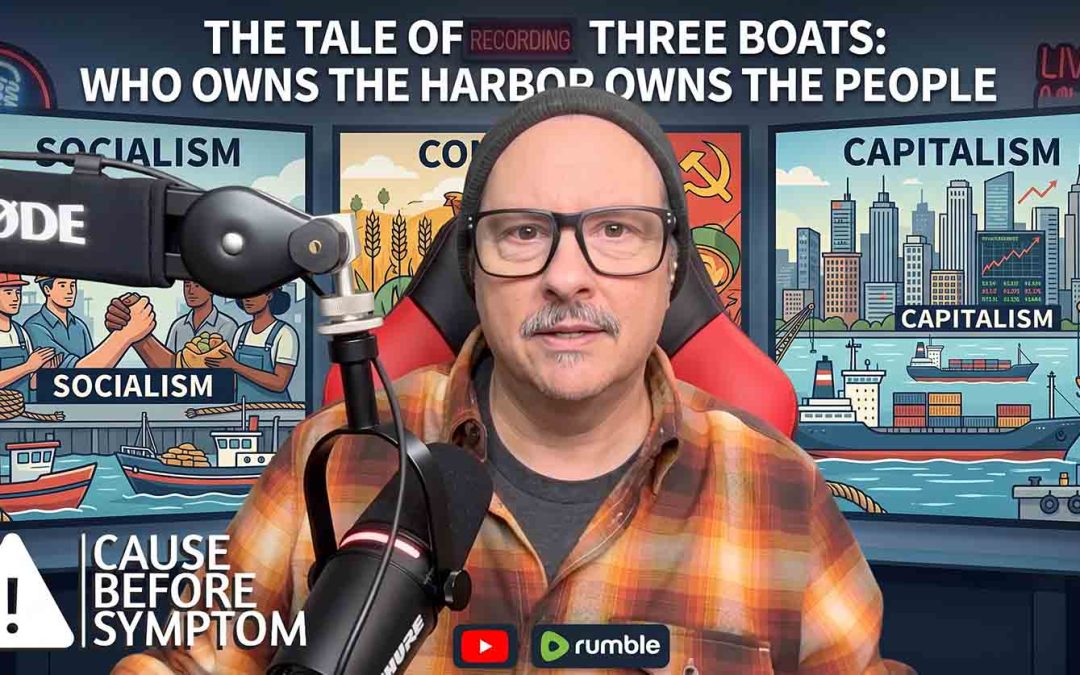
Watch this on Rumble: https://rumble.com/v7im0r4-the-tale-of-three-boats-who-owns-the-harbor-owns-the-people.html
OPENING — THREE MEN, THREE BOATS, THREE PROMISES
Good evening, everybody, and welcome to Cause Before Symptom. Tonight, I want to tell you a story about three men who wanted to own a boat. It is a simple story, but behind it are some of the biggest questions mankind has ever faced. Who should own property? Who should control the economy? Who should receive the rewards of hard work? And what happens when the people making the rules become greedy?
An old friend once explained communism, socialism, and capitalism to me using boats. He said that under communism, you cannot own a boat because the government owns all the boats. Under socialism, you can own a boat, but you have to share it with your neighbors. Under capitalism, you can own two boats. I always remembered that story because it made something complicated sound simple. But tonight, we are going to take that story further, because the truth is more complicated than the joke.
Imagine three fishermen living in three different countries. Each wants to catch fish, feed his family, and perhaps earn enough money to improve his life. The first lives under a communist government. The fishing boats and commercial equipment are controlled by the state. He receives an assignment, works according to a plan, and contributes his catch to a system that promises to provide for everyone. The second lives in a socialist community where the fishermen collectively own their fishing business. They decide how the boats will operate and how the earnings will be distributed. The third lives in a capitalist country. He saves his money, purchases a boat, sells his fish, and eventually buys another boat.
Now, these are simplified examples. Communism, in its original theory, envisioned common ownership and ultimately a society without economic classes or a state. Socialism includes different arrangements involving public or collective ownership of productive businesses, not necessarily compulsory sharing of personal belongings. Capitalism centers on private ownership and market exchange. Real countries usually combine elements of different systems.
But our story is not finished. One day, the capitalist fisherman becomes wealthy enough to purchase the docks, the fuel station, and the fish market. He begins charging every other fisherman for access. Eventually, he persuades the government to create regulations that make it difficult for anyone else to compete. The other fishermen technically remain free to own boats, but their opportunities have changed.
Meanwhile, in the other countries, the people responsible for managing the boats discover that controlling the equipment, assigning the work, and distributing the fish gives them tremendous power. Some use that authority responsibly. Others use it to reward friends, punish critics, or protect themselves.
Now we have discovered something that no economic label can explain away. Human beings do not suddenly become honest because a government changes its economic system. Greed can enter a corporate boardroom, a government ministry, a workers' cooperative, or a fishing village.
Jeremiah 17:9 warns us that the human heart can deceive us. Proverbs 16:2 reminds us that people may consider their own ways pure while the Lord weighs their motives.
Tonight, we are going to examine the history of communism, socialism, and capitalism. We will investigate their promises, their achievements, their failures, and the people who gained power under each. We will look at history, economics, and Scripture. We will also ask whether America is becoming so distracted by arguments over socialism that we are overlooking the growing relationship between government and powerful corporations.
But I want everyone to remember something before we begin. We are not here to defend a political party or condemn ordinary people who believe differently. We are here to understand why economic systems repeatedly promise justice and prosperity, yet human beings continue struggling with exploitation, poverty, corruption, and inequality.
Perhaps the problem begins long before someone decides who owns the boats. Perhaps it begins with what is happening inside the fisherman.
INVESTIGATION 1 — WHERE DID THESE THREE IDEAS COME FROM?
Before we examine what communism, socialism, and capitalism have done to the world, we need to understand why people developed these ideas in the first place. None of them appeared out of nowhere. They grew from real problems involving land, labor, wealth, poverty, and power. People were asking questions that are still familiar today. Why do some families own everything while others own almost nothing? Why does one person work all day and remain poor while another grows wealthy from owning property? And who should decide how a nation's resources are used?
Long before Karl Marx, Adam Smith, or the modern factory, people traded goods, owned property, borrowed money, and employed workers. Ancient civilizations had markets, merchants, taxation, public works, and systems of land ownership. But modern capitalism developed gradually as European commerce expanded, financial institutions grew, industrial production increased, and markets became more important to everyday life. In 1776, Adam Smith published The Wealth of Nations. Smith argued that specialization, exchange, and competition could increase prosperity. He also recognized that business owners might cooperate against the public and that government had responsibilities involving justice, defense, and public works.
Now imagine our fisherman living in Smith's world. Instead of building every tool himself, he purchases nets from someone who specializes in making nets. Another person repairs boats. Someone else transports fish to distant markets. Each person concentrates on a particular task, and through exchange, the community becomes more productive. Smith recognized that this division of labor could produce wealth that would have been difficult for isolated individuals to create.
But industrialization brought serious problems. During the nineteenth century, factories employed men, women, and children under conditions that could be dangerous and exhausting. Wealth accumulated among industrial owners while many workers lived in crowded housing with little economic security. Socialism developed partly as a response to these conditions. Early socialist thinkers proposed cooperative communities, shared ownership, and different ways of distributing economic rewards. They disagreed among themselves about how much authority governments should possess.
Karl Marx and Friedrich Engels offered a more revolutionary explanation. In 1848, they published The Communist Manifesto. They argued that history was shaped by struggles between economic classes and that capitalism contained contradictions that would eventually lead to its replacement. Marx believed that workers could collectively control the productive resources that had previously belonged to capitalists. His vision ultimately involved a classless society rather than permanent rule by an all-powerful government.
But here is where history becomes important. An idea written in a book is not the same as an institution operated by human beings. Once a movement gains political power, somebody must make decisions. Somebody must allocate resources, enforce laws, settle disagreements, and determine who receives what. The question becomes whether those people can be held accountable.
Genesis 4 tells us about Cain and Abel, two brothers whose work and offerings became part of a much deeper conflict. Cain's anger was not caused by capitalism or socialism. His struggle was with sin, jealousy, and his response to God's correction. God warned him that sin was crouching at the door and that he must rule over it.
That warning came thousands of years before modern economics. We should remember this as we examine history. Economic systems can shape incentives and distribute authority, but they do not eliminate jealousy, pride, resentment, or greed. People can create institutions that restrain those impulses, or institutions that reward them.
The first question is not whether someone can write a beautiful promise about equality or freedom. The question is what happens when imperfect human beings are given the power to carry it out.
INVESTIGATION 2 — COMMUNISM: EVERYONE OWNS THE BOATS
Imagine our fisherman waking up one morning to discover that the government has taken control of the commercial fishing fleet. Officials explain that the boats will no longer be operated for private profit. Instead, production will serve the entire community. Every fisherman will work according to a plan, and the catch will be distributed through a system intended to meet people's needs. On paper, the promise sounds appealing. Nobody should go hungry because another man owns the only fishing boat.
But what happens when the people managing the fleet make mistakes? What happens when the officials responsible for distributing the fish begin favoring their friends? And what happens when fishermen are not permitted to challenge the people making those decisions?
In 1917, the Bolsheviks seized power in Russia. Vladimir Lenin and his followers promised a revolutionary transformation of society. The new government confronted civil war, economic breakdown, food shortages, and resistance. During the civil war, authorities imposed extensive controls over production and distribution. In 1921, Lenin introduced the New Economic Policy, which restored some private trade and small-scale enterprise after the failures and disruptions of the preceding years.
That decision is important. Even Lenin's government found reasons to permit markets after attempting far-reaching economic controls.
After Lenin's death, Joseph Stalin consolidated power and pursued rapid industrialization through central planning. The government directed investment toward heavy industry, machinery, steel, and military production. The Soviet Union achieved substantial industrial growth and eventually became a major military and scientific power. But those achievements came alongside political terror, forced labor, repression, and enormous human suffering.
Agricultural collectivization was particularly destructive. Farmers were pressured or forced into collective farms, private agricultural arrangements were dismantled, and grain procurement policies contributed to catastrophic famine. Millions died during the famines of the early 1930s, including the devastating famine in Ukraine known as the Holodomor. Historians debate particular questions of intent and classification, but the scale of suffering and coercion is beyond serious dispute.
Now return to our fisherman. Suppose the central authority orders every boat to catch a particular quantity of fish. Officials measure success by whether the quota is met. A fisherman discovers that the equipment is damaged, but reporting the problem could threaten his supervisor's position. Another fisherman exaggerates his catch to avoid punishment. A third realizes that the government has ordered too many boats to one harbor and too few to another.
The problem is not simply that people are greedy. It is also that a highly centralized system can struggle to collect accurate information, respond to local conditions, and correct mistakes when criticism is punished.
The Soviet economy demonstrated that central planning could mobilize enormous resources for selected priorities. It also demonstrated serious weaknesses involving shortages, quality, incentives, and political accountability. The Soviet Union dissolved in 1991, although its collapse involved political, national, and institutional factors as well as economic problems.
We should not pretend that Marx personally designed every policy later implemented in his name. But neither should we ignore the record of governments that claimed his revolutionary tradition as their foundation.
In 1 Samuel 8, the Israelites demanded a king. Samuel warned them that a ruler could take their sons, daughters, fields, vineyards, and livestock for his own purposes. The warning was about monarchy, not modern communism, but the principle remains relevant: concentrated political authority can become dangerous when people lose the ability to resist its demands.
If the government owns every commercial boat, who protects the fisherman when the government becomes unjust? A promise to eliminate economic exploitation cannot succeed merely by transferring unchecked power from private owners to political officials. The people making the promises must also answer to the people living with the consequences.
INVESTIGATION 3 — SOCIALISM: THE BOATS BELONG TO THE COMMUNITY
Socialism is probably one of the most misunderstood words in American politics. Some people hear socialism and immediately imagine the Soviet Union. Others hear socialism and imagine affordable healthcare, public schools, retirement security, and protection from poverty. Those are not necessarily the same thing, and confusing them makes it difficult to understand what people are actually proposing.
Socialism, broadly speaking, emphasizes social or collective ownership and control of productive resources. But there are many versions. Some socialists favor government ownership of major industries. Others favor businesses owned and managed by their workers. Democratic socialists generally seek socialist economic arrangements through democratic political institutions. Social democrats typically support private markets combined with taxation, regulation, labor protections, and extensive public benefits.
Let's return to the fishing village. Instead of one wealthy owner controlling the fleet, ten fishermen decide to purchase boats together. Each contributes labor, shares responsibility, and participates in decisions. The cooperative purchases equipment, negotiates prices, and distributes earnings according to agreed rules. This is one example of collective ownership. It does not require the government to confiscate anyone's personal fishing rod or family boat.
Worker cooperatives exist in the real world. Spain's Mondragon cooperative network, founded in the Basque region during the 1950s, developed into a major collection of worker-owned businesses. Its history shows that collective ownership can operate within competitive markets. It also shows that cooperatives face difficult decisions about wages, investment, management, and economic survival.
But socialist governments have taken very different paths. After the Second World War, Britain established a broad welfare state and nationalized several major industries. Its National Health Service began operating in 1948. These policies expanded public provision, although Britain retained extensive private ownership and market activity. Later governments reversed some nationalizations and introduced new forms of private participation.
Other socialist experiments concentrated economic and political power far more extensively. Venezuela provides a more recent example of severe economic deterioration associated with a combination of oil dependence, policy failures, institutional breakdown, corruption, sanctions, and political conflict. We should not attribute every Venezuelan problem to socialism alone, but government controls, expropriations, and mismanagement were significant parts of the economic story.
Now consider Sweden and Denmark. Politicians sometimes call them socialist countries, but their economies contain extensive private ownership, competitive businesses, international trade, and entrepreneurship. Their social protections are financed largely through taxation within market economies. That is why distinguishing social democracy from comprehensive state socialism matters.
Here is where Scripture offers a particularly interesting comparison. Acts 4 describes believers sharing possessions and helping those in need. Some people point to this passage as evidence that Christianity teaches socialism. But Acts 5 provides important context. When Peter confronts Ananias, he acknowledges that the property belonged to him before it was sold and that the proceeds remained under his authority afterward. The sin involved deception, not a refusal to surrender all private property.
The early believers were practicing generosity within a community of faith. Their example does not automatically establish a complete economic program for a modern nation. But it does challenge people who use private property as an excuse to ignore suffering.
The question is not whether sharing is good. Sharing can be an expression of love, responsibility, and wisdom. The harder question is how collective systems make decisions, resolve disagreements, protect minorities, and prevent leaders from using the community's resources for themselves.
Our fishermen might build a successful cooperative. They might also disagree about who works hardest, who deserves higher compensation, and whether earnings should be reinvested or distributed.
Collective ownership does not remove those problems. It changes the institutions responsible for solving them. And when greed enters the cooperative, the same fishermen who promised equality may discover that controlling the meetings, the accounts, and the rules can be just as valuable as owning the boats.
INVESTIGATION 4 — CAPITALISM: THE MAN WHO BUYS TWO BOATS
Now let's visit the third fisherman. He lives in a country where individuals can own businesses, purchase property, borrow money, invest, and exchange goods in markets. He begins with a small boat. Every morning, he rises before sunrise, prepares his equipment, and goes fishing. Some days he catches enough to make a comfortable living. Other days, bad weather keeps him home. He must pay for fuel, repairs, insurance, and equipment whether the fishing is good or bad.
Over time, he becomes successful. He saves money and purchases a second boat. He hires another fisherman to operate it, creating employment while expanding his business. Eventually, he purchases a third boat. He is not guaranteed success, but he has the opportunity to build something that belongs to him.
This is one of capitalism's central promises. Individuals can use private property, investment, specialization, and voluntary exchange to create goods and services. When businesses compete, they have incentives to improve quality, control costs, and satisfy customers. Successful investments can generate wealth, employment, and additional productive capacity.
The Industrial Revolution transformed economies through these processes, although the transformation involved scientific discoveries, institutions, government policies, colonial relationships, and many other forces. Steam power, mechanized manufacturing, railroads, electricity, and modern communications helped dramatically increase productive capacity.
But early industrial capitalism also produced serious abuses. Factory workers sometimes labored in dangerous conditions for long hours. Children worked in mines and factories. Industrial cities struggled with pollution, overcrowding, and disease. Workers organized unions, reformers demanded safety standards, and governments introduced labor protections.
These reforms did not necessarily abolish capitalism. In many cases, they changed the rules under which capitalist businesses operated.
That distinction matters. Capitalism is not synonymous with an absence of government. Property rights require legal institutions. Contracts require enforcement. Competition can require antitrust laws. Markets depend on rules governing fraud, theft, liability, and fair dealing.
Consider the American economy during the nineteenth and twentieth centuries. Entrepreneurs developed businesses that changed transportation, manufacturing, agriculture, and communications. But industrial growth also produced powerful trusts, financial panics, labor conflicts, and periods of severe unemployment.
The Great Depression demonstrated that market economies can experience devastating breakdowns. Beginning in 1929, financial collapse, bank failures, falling demand, and policy mistakes contributed to widespread unemployment and hardship. Governments responded with financial reforms, public programs, and new economic institutions.
Now return to our fisherman. Suppose he works hard, saves money, and builds a successful business. There is nothing inherently dishonest about that achievement. But suppose another fisherman works just as hard and loses his boat because of an illness, a storm, or an unexpected expense. Does the first man's success prove that he is morally superior? Does the second man's failure prove that he is lazy?
Of course not. Markets reward many things, including useful innovation, good judgment, capital, timing, and sometimes luck. They do not perfectly measure virtue or human worth.
Jesus' parable of the talents in Matthew 25 describes servants entrusted with resources and held accountable for their stewardship. The passage can teach responsibility and faithfulness, but it should not be reduced to an endorsement of modern capitalism. Jesus was teaching about accountability before the master, not writing an economics textbook.
The biblical principle remains important. We are responsible for how we use what has been entrusted to us.
Capitalism creates opportunities for private ownership and enterprise, but it does not guarantee that every person will have equal opportunities or that successful owners will act justly.
And that is why our story cannot end with the fisherman buying two boats. We must ask what happens when he becomes wealthy enough to control the harbor itself.
INVESTIGATION 5 — WHEN THE FISHERMAN BUYS THE HARBOR
Our fisherman has become successful. He owns several boats, employs workers, and supplies fish to the surrounding towns. But one day, he realizes that he could make even more money by purchasing the docks. Every fisherman needs a place to unload his catch, so controlling the docks gives him a new source of revenue.
Then he purchases the fuel station. After that, he buys the repair shop. Eventually, he purchases the fish market where everyone sells their catch. Other fishermen still own boats, but nearly every part of their business now depends on him.
At first, he might provide better services. He could modernize the docks, improve refrigeration, and reduce transportation costs. Large businesses sometimes achieve efficiencies that smaller businesses cannot. But if he begins excluding competitors, charging excessive fees, or using political connections to prevent alternatives from developing, his economic power becomes a threat to competition.
This is where American history gives us a useful lesson.
During the late nineteenth century, industrial corporations grew enormously. Standard Oil, founded by John D. Rockefeller and his partners in 1870, became a dominant force in petroleum refining. Its expansion involved efficient operations, aggressive acquisitions, preferential transportation arrangements, and business practices that generated serious antitrust concerns.
In 1911, the United States Supreme Court ordered Standard Oil to be divided under federal antitrust law. The case demonstrated that private ownership did not grant unlimited permission to restrain competition.
The Sherman Antitrust Act of 1890 had already established federal prohibitions against certain forms of monopolization and restraints of trade. Later laws strengthened oversight of mergers and anticompetitive conduct.
But there is something important we should understand. A large company is not automatically an unlawful monopoly. A business might grow because customers prefer its products. The legal concern arises when companies unlawfully maintain monopoly power, coordinate to restrict competition, or engage in other prohibited conduct.
Now think about our harbor. If one fisherman builds a better dock and customers voluntarily choose it, that is different from bribing officials to close every competing dock. The first involves competition based on service. The second involves using political power to protect private advantage.
This is why corruption can become especially damaging when government and business interests cooperate against the public.
A company may seek regulations that appear to protect consumers but actually impose costs that only large firms can afford. An established business may lobby for licensing restrictions that prevent smaller competitors from entering the market. A politically connected corporation may seek subsidies or contracts unavailable to its rivals.
These arrangements can produce what economists call rent-seeking: using political or institutional advantages to obtain economic benefits rather than creating additional value.
The Bible addresses the moral problem directly. Micah 2:1–2 condemns people who devise wrongdoing, covet fields, and seize property because they possess the power to do so. The passage concerns injustice and the abuse of power, not a particular modern economic theory.
But the principle fits our investigation. Ownership itself is not the wrongdoing. Using power to deprive others unjustly is the wrongdoing.
This also means that our fisherman does not become evil merely because he owns several boats. Wealth is not proof of corruption. Poverty is not proof of righteousness. The question is how people acquire wealth, how they use it, and whether they respect the rights of others.
A functioning capitalist economy requires more than the freedom to accumulate property. It also requires institutions capable of preventing fraud, protecting competition, and enforcing laws without favoritism.
Otherwise, the harbor owner may eventually discover that controlling the rules is more profitable than catching fish.
And when that happens, the other fishermen might remain legally free while becoming economically dependent on someone who no longer needs to compete for their business.
INVESTIGATION 6 — WHEN THE GOVERNMENT OWNS THE HARBOR
Now imagine the fishermen becoming frustrated with the wealthy harbor owner. They complain about high docking fees, expensive fuel, and unfair treatment. Eventually, they demand that the government take control of the harbor.
Their argument sounds reasonable. The harbor is essential to the entire community. Why should one private owner decide who can use it and how much everyone must pay?
The government purchases or nationalizes the harbor and promises to operate it for the public good. Officials announce that fees will be fair, access will be equal, and profits will no longer determine every decision.
But a new set of questions immediately appears. Who appoints the harbor manager? Who decides how much money should be spent on repairs? What happens when the equipment breaks? Can fishermen challenge unfair decisions? And what prevents political officials from giving preferential treatment to their supporters?
Public ownership can work differently depending on the institutions involved. Some publicly owned utilities provide reliable services at reasonable prices. Others experience political interference, inadequate investment, corruption, or inefficient management.
Consider the Tennessee Valley Authority. Established in 1933, the TVA developed electricity generation, flood control, navigation improvements, and regional infrastructure in parts of the southeastern United States. Its history illustrates how public institutions can undertake large projects that private investors might have struggled to coordinate under the conditions of the time.
But public enterprises also raise questions about environmental effects, displacement, financing, and accountability. The TVA's dam projects transformed communities and landscapes, and their benefits came with significant social costs.
Another example comes from Britain's postwar nationalizations. The government brought several major industries into public ownership, including coal, railways, and electricity. Supporters believed nationalization could coordinate investment and protect essential services. Critics argued that political management and weak competitive pressures could reduce efficiency.
During the 1980s and 1990s, British governments privatized numerous enterprises. Some changes introduced competition and investment, while others created continuing disputes over regulation, service quality, prices, and infrastructure maintenance.
The lesson is not that government ownership always fails or private ownership always succeeds. It is that ownership alone does not settle questions about incentives, governance, investment, and accountability.
Now let's return to Scripture.
In 1 Kings 21, King Ahab desired Naboth's vineyard. Naboth refused to surrender his inherited property. Jezebel then arranged false accusations that led to Naboth's death, allowing Ahab to take possession of the land.
The story is about far more than property. It reveals what happens when rulers treat their desires as more important than justice. The king already possessed tremendous wealth and authority, yet he wanted something belonging to another man.
That is the danger of unchecked political power.
But we should also remember that Scripture condemns wealthy private individuals who exploit others. The Bible does not teach that government officials are uniquely corrupt or that business owners are automatically trustworthy.
Both possess the capacity to misuse authority.
Our harbor might function well under public ownership if decisions are transparent, managers are accountable, budgets are examined, and citizens have meaningful ways to challenge abuse.
It might also function poorly if political leaders appoint unqualified friends, conceal financial records, or neglect maintenance while protecting themselves from criticism.
The essential issue is whether the institution serves its stated purpose.
If the government owns the harbor, the fishermen should not have to surrender their right to question how it is operated.
And if private ownership returns, they should not be forced to accept a monopoly merely because someone promises that private management will be more efficient.
The people need honest information about costs, performance, rights, and responsibilities. Because replacing one powerful owner with another does not automatically produce justice.
INVESTIGATION 7 — WHEN GOVERNMENT AND CORPORATIONS SHARE THE HARBOR
Now we arrive at something that should sound familiar to Americans. Imagine that the government owns the harbor, but instead of operating it directly, officials hire a private corporation to manage everything. The government continues collecting taxes to maintain the harbor. The corporation receives a contract, hires employees, purchases equipment, and earns revenue for its services.
The government announces that it has found a way to combine public responsibility with private efficiency. The company promises better management, modern technology, and lower operating costs. The fishermen are told that everyone will benefit.
And sometimes such arrangements do produce improvements. Private contractors may possess specialized knowledge, equipment, or operational capabilities that government agencies lack. Competition for contracts can encourage innovation and reduce costs. But these advantages depend on how contracts are written, how performance is measured, and whether genuine competition exists.
Suppose the corporation receives a twenty-year contract to operate the only harbor in town. After five years, the government discovers that maintenance costs have increased. Officials want to change contractors, but the existing company owns the software controlling the docks, maintains the operational records, and employs nearly everyone who understands the system.
The government technically owns the harbor, but replacing the operator has become difficult and expensive.
This is a simplified example of vendor lock-in, a problem that can occur when customers become dependent on particular suppliers.
Now consider what has happened in American healthcare.
Medicare was established in 1965 to provide health insurance primarily for older Americans. Over time, private insurers became increasingly involved in delivering Medicare benefits. Medicare Advantage allows eligible beneficiaries to receive Medicare-covered services through privately operated plans.
According to KFF's analysis of federal enrollment data, approximately 19 percent of eligible Medicare beneficiaries were enrolled in Medicare Advantage in 2007. By 2026, that figure had increased to 55 percent, representing approximately 35.2 million people. UnitedHealth Group and Humana together accounted for approximately 46 percent of Medicare Advantage enrollment.
Think about what those numbers mean. A public insurance program remains financed through government arrangements, but private companies administer coverage for a majority of eligible participants. Those companies receive payments, negotiate with healthcare providers, manage benefits, and make decisions affecting patients.
Some beneficiaries value the additional benefits and lower premiums offered by particular plans. Others encounter problems involving provider networks, prior authorization, or coverage decisions. We cannot determine the merits of the entire system merely by observing that private companies are involved.
But we can ask whether the arrangement delivers better outcomes for the money spent.
And this is where our earlier discussion about socialism and privatization becomes important. A government can expand public spending while simultaneously expanding opportunities for private corporations. Those developments are not opposites.
The Bible gives us a powerful warning in Amos 8:4–6. The prophet condemns merchants who exploit the needy, manipulate measurements, and use dishonest business practices to enrich themselves.
The wrongdoing is not that they operate businesses. The wrongdoing is that they use economic power dishonestly against vulnerable people.
Now imagine our harbor corporation discovering that it can increase profits by reducing maintenance, charging additional fees, or persuading officials to renew its contract without meaningful competition.
The question becomes whether public officials will protect the fishermen or the corporation.
This is why financial transparency matters. Taxpayers should know what government contracts cost, what services they purchase, who owns the companies receiving payments, and whether the public receives measurable value.
Privatization does not automatically eliminate public expense. Public ownership does not automatically eliminate waste. And government contracting does not automatically produce competition.
Every arrangement requires accountability. Because when the government and corporations share control of the harbor, the fishermen need to know which institution is responsible when something goes wrong.
INVESTIGATION 8 — THE GREAT ECONOMIC PROMISES AND THEIR HISTORICAL RESULTS
Now that we understand the basic ideas, let's examine what history can actually teach us. We have heard the promises of communism, socialism, and capitalism. Each offers an explanation for how economic life should be organized. But what happened when countries attempted to put those ideas into practice?
The Soviet Union demonstrated that centralized planning could rapidly mobilize resources for industrialization, military production, and scientific projects. Soviet scientists and engineers achieved major accomplishments, including launching Sputnik in 1957 and sending the first human into space in 1961.
But the same system struggled with consumer shortages, weak incentives, political repression, and the difficulty of coordinating millions of economic decisions through central authorities.
China provides another important comparison. After the Communist Party established the People's Republic in 1949, the government pursued extensive state control over economic activity. Mao Zedong's Great Leap Forward, launched in 1958, attempted to accelerate agricultural and industrial production through sweeping campaigns and collective organization.
The policies contributed to a catastrophic famine in which tens of millions of people died, although estimates vary. Political pressure, unrealistic production reporting, coercive procurement, and disastrous policy decisions contributed to the suffering.
Beginning in 1978, China introduced major economic reforms under Deng Xiaoping. Agricultural incentives changed, private enterprise expanded, foreign investment increased, and market mechanisms became more important. These reforms helped produce extraordinary economic growth and poverty reduction over subsequent decades.
But China did not become a conventional liberal capitalist democracy. The Communist Party retained political authority, state-owned enterprises remained important, and government influence over economic life continued.
That distinction matters. China's experience demonstrates that markets and private incentives can operate within an authoritarian political system. Economic liberalization does not automatically produce political freedom.
Now examine postwar Western Europe. Countries such as Sweden and Denmark developed extensive welfare systems while retaining private businesses, international trade, and market competition. Their experience demonstrates that substantial social spending can coexist with capitalism.
These systems have also faced difficult questions involving taxation, demographic changes, immigration, productivity, and the financing of public benefits.
Then consider the United States. American capitalism helped support enormous increases in productive capacity, technological development, and household consumption over the twentieth century. But the country also experienced the Great Depression, financial crises, unequal access to opportunity, and persistent poverty.
The historical record does not support the claim that every capitalist economy produces the same outcomes. Nor does it support treating every government-funded social program as equivalent to communist central planning.
Institutions matter. Political freedom matters. Education, public health, infrastructure, competition, corruption, geography, and historical circumstances all influence economic results.
We also need to distinguish wealth creation from wealth distribution. A society can become substantially wealthier while particular communities experience stagnation. Another society can distribute existing resources more equally while struggling to generate new wealth.
A serious investigation must examine both.
Ecclesiastes 5:10 tells us that the person who loves money will not be satisfied with money. The passage exposes something that economic statistics alone cannot measure: human desires can continue expanding even after material needs have been met.
A wealthy businessman can become obsessed with accumulating more. A political official can become obsessed with controlling more. A community leader can become obsessed with deciding how everyone else's resources are distributed.
But greed does not explain every economic failure. Bad information, destructive institutions, war, natural disasters, and mistaken policies can cause suffering even when individual participants believe they are doing good.
The moral lesson and the historical explanation must work together.
Our fishermen need productive boats, honest rules, reliable information, and institutions that can correct mistakes.
They also need people willing to recognize that possessing power does not give them permission to abuse it.
History teaches us that economic promises must be judged by actual results, not merely by the intentions of the people making them.
INVESTIGATION 9 — WHY AMERICANS ARE FIGHTING OVER THE BOATS
Let's bring our investigation home to America. Why are Americans arguing so intensely about capitalism and socialism? Why do some people believe government should provide more economic security while others believe government has already become too powerful?
Part of the answer involves the difference between economic growth and the everyday experience of ordinary households.
A nation can report increasing economic output while families struggle with housing costs, medical bills, childcare expenses, and debt. A rising stock market does not mean every worker owns substantial investments. A profitable corporation does not necessarily mean every employee receives higher wages.
And when people believe they are working hard without getting ahead, they begin questioning the economic system around them.
Some conclude that private corporations have too much power. They support stronger public programs, greater taxation of wealthy households, or more collective control over essential services. Others conclude that government regulation, taxation, and spending are preventing businesses and workers from prospering.
These disagreements involve genuine differences about policy, responsibility, and the proper role of government.
But political campaigns can also simplify complicated economic problems into emotionally powerful labels.
One candidate warns that socialism will destroy freedom. Another warns that corporations are exploiting working families. Both messages can contain legitimate concerns, but neither automatically explains the full economic situation.
And here is where our harbor story becomes especially useful.
Suppose one political party promises to protect the fishermen from an overbearing government. Another promises to protect them from wealthy harbor owners. Yet both support arrangements in which government money flows to private companies operating essential services.
Does that prove the parties secretly agreed to deceive the public?
No. But it gives citizens a reason to examine whether political promises match legislative decisions.
Consider Social Security. Established in 1935, it provides retirement, disability, and survivor benefits through a public insurance system. It is not simply an individual savings account. Workers and employers pay dedicated taxes that help finance benefits under federal law.
The program also faces serious long-term financial pressure.
According to the 2026 Social Security Trustees Report, the combined trust funds are projected to exhaust their reserves in 2034 if the law remains unchanged. Continuing income would then cover approximately 83 percent of scheduled benefits. The separate retirement and survivors trust fund faces an earlier projected depletion date of 2032.
That is a genuine financial challenge. But it does not mean Social Security will stop collecting revenue or disappear.
Policymakers could consider changes to taxes, benefits, retirement rules, or investment arrangements. Each approach has consequences for workers, retirees, taxpayers, and future generations.
Now suppose someone proposes allowing private investment managers to oversee additional retirement assets. We should examine the expected returns, management fees, investment risks, governance arrangements, and who would bear losses.
We should not assume private management is automatically a rescue or automatically a scheme. We need the actual financial details.
James 4:1–3 examines the desires that produce conflict among people. James directs attention toward motives, covetousness, and the misuse of desires.
That passage gives us a useful question for modern politics. Are people pursuing policies because they believe those policies will serve their neighbors, or because they want wealth, status, influence, or victory over their opponents?
We cannot read another person's heart. But we can examine conduct, promises, financial relationships, and measurable results.
And that is what Americans should demand.
If someone says socialism is the danger, ask what policy they are describing. If someone says capitalism is the solution, ask whether the proposal protects competition or merely benefits established corporations. If someone promises that government will solve everything, ask who will administer the program and how its performance will be measured.
We do not have to choose between blind faith in government and blind faith in corporations.
We can demand honesty from both.
INVESTIGATION 10 — THE PROBLEM WAS NEVER JUST THE BOATS
We have traveled through centuries of economic history. We have examined the promises of communism, socialism, and capitalism. We have seen governments take control of industries, workers organize cooperatives, entrepreneurs build businesses, and corporations develop enormous influence.
Now we must return to the question that brought us here. Why do systems that promise prosperity and fairness so often produce disappointment, conflict, or abuse?
Part of the answer is that every economic system must operate through human institutions. Those institutions require rules, information, incentives, and enforcement. They also require people willing to obey limits on their own power.
Under a centrally planned economy, officials may control production, distribution, and investment. If their authority is unchecked, they can reward allies, punish opponents, and conceal mistakes.
Under collective ownership, managers and members must make decisions about wages, investments, and responsibilities. If the organization lacks accountability, influential members can manipulate those decisions for their own benefit.
Under capitalism, private owners can build productive enterprises and create opportunities. But if wealthy businesses gain control over competitors, regulators, or essential infrastructure, economic freedom can become increasingly unequal.
These risks are not identical, and history does not show that every system performs equally well. But they reveal a common vulnerability: people can use institutions intended to serve others as instruments of personal advantage.
And this is where the Bible reaches beyond economic theory.
First Timothy 6:10 identifies the love of money as a root of many kinds of evil. Notice what Scripture does not say. It does not teach that money itself is evil. Money can purchase food, build homes, support families, finance useful businesses, and provide assistance to people in need.
The danger arises when money becomes the object of devotion.
But greed can also involve power. A person may desire authority over other people even when personal wealth is not the immediate reward. Political control, social status, prestige, and the ability to command others can become objects of unhealthy desire.
That is why changing ownership structures does not automatically change the human heart.
Suppose our three fishermen are invited to manage the harbor. Each begins with a different economic philosophy. One believes the state should control the fleet. Another believes the workers should own it together. The third believes private enterprise provides the best opportunities.
Now imagine that each receives the same temptation. A wealthy merchant offers a personal reward in exchange for changing the rules. A political leader offers protection in exchange for loyalty. A friend asks for special treatment at everyone else's expense.
Their economic philosophies may influence how they respond. Their institutions may make corruption easier or harder. But none of their labels guarantees integrity.
The Bible repeatedly teaches that justice requires more than good intentions. Leaders must resist favoritism. Merchants must use honest measurements. Workers must fulfill their responsibilities. Those with resources must remember the vulnerable.
We also need to recognize that laws and institutions matter. It would be a mistake to conclude that because greed exists, economic reforms are pointless. Honest accounting, independent courts, competitive markets, democratic accountability, and protections against corruption can reduce opportunities for abuse.
Human nature gives us a reason to build safeguards, not an excuse to abandon them.
Now look at America. We have public institutions, private corporations, nonprofit organizations, cooperatives, and countless arrangements combining their resources. Each should be evaluated according to its purpose and actual performance.
The question should never be merely whether a program is called capitalist or socialist.
We should ask whether it creates opportunities, protects rights, uses resources responsibly, and treats people justly.
Because if the people controlling the harbor become greedy, the fishermen may suffer regardless of the economic philosophy written above the entrance.
CONCLUSION — WHO OWNS THE HEART OF THE FISHERMAN?
Tonight, we began with three men who wanted to own a boat. One lived under a communist government, another participated in a collectively owned fishing business, and the third operated within a capitalist economy.
Each system offered a different answer to the question of ownership.
Communism promised to overcome class divisions through common ownership of productive resources. Socialism offered different ways for workers or communities to exercise economic control. Capitalism allowed individuals and businesses to own productive property, compete, and pursue profit.
But history showed us something important. Promises alone cannot tell us whether an economic system will serve ordinary people.
We examined the Soviet Union, where central planning helped build major industries but also operated alongside political repression, coercion, and devastating economic failures. We examined socialist and cooperative arrangements that attempted to give workers greater control over their economic lives. We examined capitalist economies that generated enormous wealth while also experiencing exploitation, monopolies, and financial crises.
We also discovered that real countries frequently combine private enterprise, public programs, and collective institutions. That is why political labels alone are poor substitutes for serious investigation.
But there is another lesson that reaches deeper than economics.
A man can own one boat and become greedy. He can own a hundred boats and remain generous. He can manage a public harbor and serve his neighbors faithfully. He can also use that same position to reward his friends and punish his enemies.
The economic arrangement affects his opportunities and responsibilities, but it does not determine his character.
Luke 12:15 records Jesus warning people to guard against covetousness because life does not consist in the abundance of possessions.
That warning should challenge the wealthy businessman who measures his worth by the number of companies he owns. It should challenge the politician who measures success by the amount of authority he controls. And it should challenge ordinary citizens who begin believing that acquiring more possessions will finally give their lives meaning.
But we must be careful not to use the language of greed to excuse injustice. Telling struggling families to be content does not relieve employers of their responsibility to pay fairly. Telling citizens to be generous does not relieve government officials of their responsibility to manage public resources honestly.
The Bible calls people to personal righteousness and public justice.
And perhaps that is what Americans need to remember as we argue about capitalism, socialism, and communism.
We should not surrender our judgment to political slogans. We should not assume that every government program is socialism or that every private corporation represents free-market competition. We should examine the actual rules, the actual money, and the actual results.
If a public program helps people, we should be willing to acknowledge it. If a private business creates opportunities, we should recognize its contribution. If either becomes corrupt, we should demand accountability.
We should also remember that wealth is not the only measure of a successful society. Families need trust, responsibility, honesty, knowledge, and opportunities to build meaningful lives.
Now imagine our three fishermen meeting at the same harbor.
One believes government should manage the fleet. Another believes the workers should own it together. The third believes each fisherman should be free to purchase his own boat.
They disagree about economics, but all three need honest rules, safe docks, reliable equipment, and protection against exploitation.
And all three face the same moral question.
Will they use whatever power they possess to serve their neighbors, or will they use it to serve themselves at everyone else's expense?
That question cannot be answered by changing the name of an economic system.
It must be answered by the choices people make.
Because the greatest danger is not simply that one man owns the boats, another controls the harbor, or a government manages the fleet.
The greatest danger begins when people stop seeing their neighbors as human beings and start seeing them as instruments of wealth and power.
And that brings us back to the cause before the symptom.
Before we can understand why our economic systems fail, we must examine what happens when greed takes control of the human heart.
BIBLIOGRAPHY
Acemoglu, Daron, and James A. Robinson. Why Nations Fail: The Origins of Power, Prosperity, and Poverty. New York: Crown Business, 2012.
Applebaum, Anne. Gulag: A History. New York: Doubleday, 2003.
Applebaum, Anne. Red Famine: Stalin's War on Ukraine. New York: Doubleday, 2017.
Bernstein, Eduard. Evolutionary Socialism: A Criticism and Affirmation. Translated by Edith C. Harvey. London: Independent Labour Party, 1909.
Engels, Friedrich. Socialism: Utopian and Scientific. London: Swan Sonnenschein, 1892.
Hayek, Friedrich A. The Road to Serfdom. Chicago: University of Chicago Press, 1944.
Kornai, János. The Socialist System: The Political Economy of Communism. Princeton, NJ: Princeton University Press, 1992.
Marx, Karl. Capital: A Critique of Political Economy. Vol. 1. Translated by Ben Fowkes. London: Penguin Books, 1976.
Marx, Karl, and Friedrich Engels. Manifesto of the Communist Party. London: Workers' Educational Association, 1848.
North, Douglass C. Institutions, Institutional Change and Economic Performance. Cambridge: Cambridge University Press, 1990.
Ostrom, Elinor. Governing the Commons: The Evolution of Institutions for Collective Action. Cambridge: Cambridge University Press, 1990.
Polanyi, Karl. The Great Transformation: The Political and Economic Origins of Our Time. New York: Farrar & Rinehart, 1944.
Smith, Adam. An Inquiry into the Nature and Causes of the Wealth of Nations. London: W. Strahan and T. Cadell, 1776.
Stiglitz, Joseph E. The Price of Inequality: How Today's Divided Society Endangers Our Future. New York: W. W. Norton, 2012.
Tocqueville, Alexis de. Democracy in America. Translated by Harvey C. Mansfield and Delba Winthrop. Chicago: University of Chicago Press, 2000.
United States Social Security Administration. The 2026 Annual Report of the Board of Trustees of the Federal Old-Age and Survivors Insurance and Federal Disability Insurance Trust Funds. Washington, DC: Social Security Administration, 2026.
KFF. Medicare Advantage in 2026: Enrollment Update and Key Trends. San Francisco: KFF, 2026.
ENDNOTES
1. Adam Smith's The Wealth of Nations provides the historical foundation for the discussion of specialization, exchange, and competition. Smith also recognized the danger of business interests acting against the public.
2. Marx and Engels' Manifesto of the Communist Party explains their theory of class struggle and revolutionary economic transformation. Their theoretical vision should be distinguished from the institutions established by later communist governments.
3. Anne Applebaum's Red Famine documents the Ukrainian famine of 1932–1933 and the political decisions surrounding Soviet agricultural collectivization.
4. János Kornai's The Socialist System examines structural features of communist economic planning, including shortages, incentives, and the relationship between political authority and economic institutions.
5. Elinor Ostrom's Governing the Commons demonstrates that communities can develop institutions for managing shared resources without assuming that either unrestricted private ownership or centralized state control is always necessary.
6. The Standard Oil decision of 1911 remains a major historical example of American antitrust enforcement against unlawful monopolization.
7. The Tennessee Valley Authority provides an example of public ownership and coordinated regional development, alongside debates about environmental consequences, displacement, and accountability.
8. Medicare Advantage enrollment figures are drawn from KFF's 2026 analysis of federal enrollment data. These figures describe participation in privately administered Medicare plans, not a transfer of Medicare itself into private ownership.
9. The 2026 Social Security Trustees Report provides projections for the program's trust funds. Projected reserve depletion does not mean all benefit payments cease, because continuing payroll-tax revenue remains available.
10. Biblical passages are used to examine moral principles involving greed, stewardship, justice, and authority. They are not presented as direct endorsements of modern economic ideologies.
#CauseBeforeSymptom, #ThreeBoats, #Capitalism, #Socialism, #Communism, #EconomicHistory, #Greed, #BiblicalTruth, #ChristianPerspective, #EconomicJustice, #CorporatePower, #GovernmentAccountability, #FreeMarkets, #FaithAndEconomics, #FollowTheMoney
CauseBeforeSymptom, ThreeBoats, Capitalism, Socialism, Communism, EconomicHistory, Greed, BiblicalTruth, ChristianPerspective, EconomicJustice, CorporatePower, GovernmentAccountability, FreeMarkets, FaithAndEconomics, FollowTheMoney