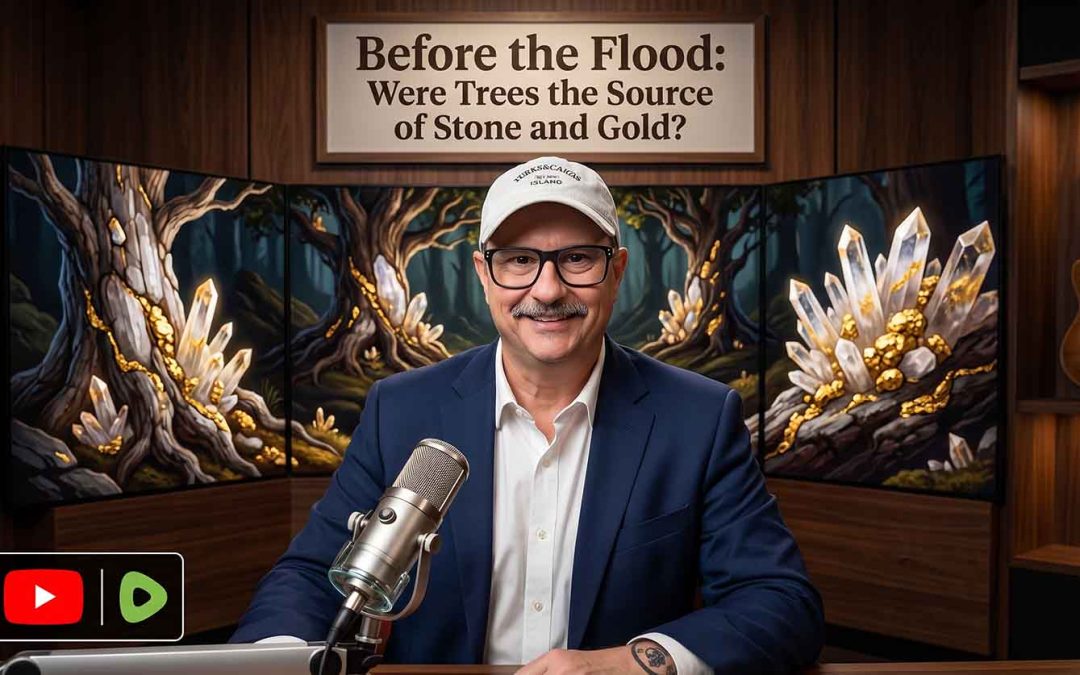
Watch this on Rumble: https://rumble.com/v7cikiw-before-the-flood-were-trees-the-source-of-stone-and-gold.html
Synopsis
Have you ever looked at a petrified forest and wondered how a living tree could become solid stone? Or noticed that some of the richest gold deposits on Earth are found alongside quartz and asked whether those two mysteries could somehow be connected? In this episode, I investigate one of the most unusual questions I have ever explored: could the great forests that existed before Noah's Flood have played a role in the formation of the stone and gold we find today?
Together, we examine what modern geology says about petrified wood, how silica replaces living tissue, why quartz and gold are so often found together, and whether living organisms are capable of concentrating minerals in ways that most people never consider. We also explore the growing field of biomineralization, where scientists have discovered that bacteria, fungi, and even modern trees can interact with precious metals and minerals in surprising ways. Could the world before the Flood have contained biological systems unlike anything that exists today, or does the evidence point in another direction?
Most importantly, this is not an episode built on speculation or sensational claims. It is an honest investigation that compares Scripture, geology, biology, and ancient history while carefully separating established evidence from unanswered questions. Genesis tells us that the gold of Havilah was "good" long before kingdoms and civilizations arose. Why does God mention gold so early in the biblical account, and could that detail reveal something about the world that was lost? Join me as we follow the evidence wherever it leads and ask whether the greatest forests in history may have left behind far more than petrified wood.
Monologue
Welcome to Cause Before Symptom, the show where I don't chase symptoms—I test the cause against Scripture.
Tonight, I want to begin with a question that, at first, may sound completely ridiculous. In fact, when I first started thinking about it, I almost dismissed it myself. Trees... stone... gold. What possible connection could there be? Trees are made of wood. Stone is rock. Gold is metal. Three completely different things. Or are they?
Then I remembered something that changed the way I looked at the question. All over the world are forests that are no longer made of wood. They are made of stone. Scientists call them petrified forests. They tell us that over time, mineral-rich water slowly replaced the wood with silica while preserving the original cellular structure. In other words, what was once living became stone. That alone should make every curious mind stop and ask a few more questions.
Then I noticed something else. Gold is very often found alongside quartz. Quartz is made primarily of silica. Petrified wood is also commonly replaced by silica. Is that simply a coincidence, or are we looking at pieces of a much larger story that has been separated over time? I don't know the answer. That's exactly why we're doing this episode.
One of the greatest mistakes we can make is believing that asking an unusual question automatically means believing an unusual answer. It doesn't. Honest investigation begins with curiosity, not conclusions. Throughout history, some of the greatest discoveries were made because someone was willing to ask a question that everyone else laughed at. Sometimes those questions led nowhere. Other times, they completely changed how we understood the world.
The Bible tells us something fascinating in Genesis. Before there were kingdoms, before there were coins, before there were merchants, before there was an economy, God pauses to tell us that the gold of a particular land was good. I've often wondered why. Why introduce gold so early in the biblical narrative? Why would that detail matter unless it was telling us something about the world that existed before the Flood? I don't intend to force an answer where Scripture remains silent, but I do believe it's worth asking why God chose to include that detail.
As I began researching this topic, I discovered something I never expected. Modern science has already proven that living organisms interact with minerals in remarkable ways. Certain bacteria can concentrate metals. Some fungi interact with gold. Even modern trees have been found to contain microscopic amounts of gold absorbed from deep underground. Living things are capable of far more mineral chemistry than most of us ever learned in school.
That doesn't prove ancient trees produced gold. It doesn't prove giant pre-Flood forests were somehow different from the forests we know today. But it does tell me that the relationship between life and minerals is more complex than many people realize. Once I learned that, I became less interested in defending a theory and more interested in following the evidence.
Tonight, we're going to examine geology, biology, chemistry, and Scripture together. We'll look at what scientists know, where they disagree, and where unanswered questions still remain. We'll separate established facts from speculation, and I'll do my best not to stretch the evidence beyond what it actually says. If a theory doesn't hold up, we'll say so. If a question deserves more investigation, we'll say that too.
The world before the Flood was not our world. Whether you approach Genesis literally, symbolically, or somewhere in between, almost everyone agrees that the biblical account describes a world profoundly different from the one we inhabit today. If that world truly existed, then we should not be surprised if it contained ecosystems, geological processes, and environmental conditions unlike anything we observe now.
So tonight, I invite you to think like an investigator. Set aside assumptions for just a little while. Don't believe something simply because it sounds exciting, and don't reject something simply because it sounds strange. Let's examine the evidence with open minds, measure every claim against Scripture and observable facts, and see where the trail leads.
Because sometimes the greatest discoveries begin with the simplest question.
What if the forests that once covered the earth left behind far more than petrified wood?
Part 1 – Why Ask Such a Strange Question?
I want to begin tonight with a question that most people have probably never considered. Were the great trees that existed before Noah's Flood the source of the stone and gold we find in the earth today? I know that sounds unbelievable. In fact, if someone had asked me that question a few years ago, I probably would have laughed and moved on. But sometimes the strangest questions force us to look more closely at things we've taken for granted our entire lives.
Think about what we already know. Petrified forests exist all over the world. They were once living trees. Today they are solid stone. According to modern geology, mineral-rich water carrying dissolved silica slowly entered the buried wood. Over time, that silica replaced the organic material while preserving the tree's microscopic cellular structure. What was once alive became stone. That's not speculation. That's an observable fact. You can walk through places like Petrified Forest National Park in Arizona and put your hand on what was once a living tree that is now nearly pure quartz.
Now let's add another observation. Gold and quartz have a remarkable relationship. If you've ever watched gold prospectors or studied mining, you've probably heard them talk about quartz veins. Some of the richest gold deposits on Earth are found inside or near quartz. Geologists explain that hot, mineral-rich fluids moved through fractures in the earth, eventually cooling and depositing quartz along with precious metals like gold. Again, this is established geology. But here's where my curiosity began. If petrified trees become silica, and quartz is silica, and gold is commonly associated with quartz, could there be a relationship that no one has seriously explored?
Notice what I'm not saying. I'm not saying ancient trees produced gold. I'm not saying geology has been wrong for two hundred years. I'm not asking you to believe a theory simply because it's unusual. What I am saying is that good investigations begin by noticing patterns and then asking whether those patterns are connected or merely coincidental. There is a big difference between asking a question and declaring an answer.
As Christians, we should never fear honest questions. Scripture repeatedly encourages us to seek wisdom, search diligently, and test what we hear. Proverbs tells us that it is the glory of God to conceal a matter and the glory of kings to search it out. That verse doesn't encourage wild speculation. It encourages careful investigation. If God created this world, then every truthful scientific discovery should ultimately point back to Him, not away from Him.
Genesis introduces another interesting detail that often gets overlooked. In Genesis 2, while describing the rivers flowing out of Eden, the Bible pauses to tell us about the land of Havilah. Then it says something surprisingly specific: "And the gold of that land is good." Think about that for a moment. Humanity hasn't built cities yet. There are no kingdoms, no merchants, no jewelry stores, no coins, and no economies. Yet God specifically mentions the quality of the gold. Why? The text doesn't explain. It simply records the fact and moves on. That alone should make us curious.
As I continued researching this subject, I realized that the relationship between life and minerals is far more complex than I had ever imagined. Modern science has documented organisms that build shells, create crystal structures, produce silica, concentrate iron, and even interact with precious metals. The living world is not separate from geology. It participates in it every single day. That doesn't prove the existence of giant pre-Flood trees that concentrated gold, but it does remind us that biology is capable of remarkable things.
Tonight, I want to investigate this mystery with an open Bible and an open mind. We'll examine what geologists know about petrified wood. We'll look at what biologists have discovered about living organisms and minerals. We'll compare those findings with Scripture and ask whether the world before the Flood may have functioned differently than the world we know today. Maybe the evidence will completely reject the idea. Maybe it will support parts of it. Or maybe it will simply leave us with better questions than the ones we started with.
Whatever the outcome, my goal is not to defend a theory. My goal is to follow the evidence honestly, because truth never has anything to fear from investigation.
Part 2 – What Does Petrified Wood Actually Tell Us?
Before we go any further, we need to understand exactly what petrified wood is, because almost everyone has seen pictures of it, but very few people know how scientists believe it forms. If we're going to ask whether ancient trees could have been the source of stone and gold, we first have to understand how a tree becomes stone in the first place.
According to modern geology, petrification begins when a tree is buried rapidly by volcanic ash, mud, sediment, or flood deposits. The quick burial limits oxygen, slowing the normal process of decay. Instead of the wood simply rotting away, groundwater rich in dissolved minerals begins to move through the buried trunk. The most common of these minerals is silica, which is derived from volcanic ash and other silica-rich rocks. Over time, the silica enters the microscopic spaces within the wood, replacing the original organic material while preserving the tree's cellular structure in astonishing detail.
What's remarkable is that petrified wood doesn't merely resemble a tree. Under a microscope, scientists can still identify growth rings, vessels that once carried water, and even individual plant cells. The chemistry has changed, but the structure remains. It's as though nature made a perfect stone copy of the original tree. This is why paleobotanists can often identify the species of a petrified tree even though no wood remains. The stone preserves the architecture of life.
The mineral that replaces the wood is usually quartz, although not the clear crystals we often imagine. Most petrified wood is composed of microscopic quartz crystals known as chalcedony. Sometimes traces of opal are present as well. The beautiful colors found in petrified wood are not caused by the silica itself but by tiny amounts of other minerals. Iron can create reds and yellows. Manganese can produce pinks and purples. Carbon can leave black streaks, while copper may contribute blues and greens. Every color tells a story about the chemistry of the groundwater that flowed through the buried tree.
One of the biggest debates surrounding petrified wood is not whether it exists, but how long the process takes. Traditional geology generally teaches that petrification occurs over thousands to millions of years under the right conditions. However, laboratory experiments and modern observations have shown that mineral replacement can happen much more quickly than people once believed if the environment is rich in dissolved silica and other minerals. That doesn't mean every petrified forest formed rapidly, but it does remind us that the rate of petrification depends heavily on environmental conditions rather than on a single fixed timetable.
For those who hold to a global Flood described in Genesis, this becomes an interesting point of discussion. A catastrophic flood would have buried enormous forests beneath vast quantities of sediment while circulating mineral-rich water through those deposits. That scenario could provide ideal conditions for widespread petrification. Many creation geologists point to this possibility as an explanation for the extensive petrified forests found around the world. Mainstream geologists generally attribute those forests to multiple local events occurring over long periods of Earth's history. Both models seek to explain the same evidence, but they begin with different assumptions about Earth's past.
As I studied this process, one detail kept catching my attention. Why silica? Of all the minerals that could replace wood, why is silica so overwhelmingly common? Silica is one of the most abundant compounds in Earth's crust, but it also has a remarkable ability to preserve microscopic detail. It doesn't simply coat the tree; it gradually occupies the space where living tissue once existed. That relationship between living wood and silica is real, observable, and accepted by scientists. Whether it carries any deeper significance is another question entirely.
This is where I want to slow down and be careful. The existence of petrified wood does not prove that ancient trees produced quartz. The accepted explanation is that silica dissolved in groundwater replaced the wood after burial. That is the current scientific model, and it explains many of the observations we see today. However, understanding that process also opens the door to additional questions about the relationship between biology and minerals—questions that lead us into a fascinating field of study that most people have never heard of. It's called biomineralization, and it may change the way we think about what living organisms are capable of doing.
Part 3 – Could Living Organisms Produce Stone?
If I had asked you before this episode whether living things can produce stone, you probably would have said no. We tend to think of biology and geology as two completely separate worlds. Living things are soft. Rocks are hard. Plants grow. Minerals form deep underground. But the more I researched this subject, the more I realized that nature doesn't recognize the boundaries we've created.
There is an entire field of science called biomineralization. It studies how living organisms build minerals into their own bodies. Once you begin looking into it, the examples are everywhere. Coral reefs are built by tiny living creatures that extract calcium from seawater and construct massive limestone structures. Clams, oysters, and mussels produce shells. Snails build protective homes. Birds create eggshells. Our own bodies constantly produce bone and teeth by carefully organizing minerals into incredibly strong structures. Living organisms have been shaping the Earth's geology since the beginning of life.
Then I discovered something even more fascinating. Not all organisms build with calcium. Some build with silica. Tiny marine organisms called diatoms surround themselves with intricate shells made almost entirely of silica. Under a microscope, these shells look like works of art, filled with perfectly arranged geometric patterns that engineers still struggle to reproduce. Radiolarians do something similar, creating delicate silica skeletons that settle to the ocean floor after they die. Entire layers of sedimentary rock have formed from the accumulated remains of these microscopic organisms. In other words, living creatures have been manufacturing silica on a massive scale for ages.
Plants also use silica, although most people never notice it. Grasses, bamboo, horsetails, and many other species absorb dissolved silica from the soil and deposit it within their tissues. These tiny deposits, known as phytoliths, strengthen stems, discourage insects from feeding on them, and help the plants remain upright. Farmers sometimes complain that certain grasses dull the blades of their equipment more quickly because of the silica locked inside the plants themselves. Modern trees are not made of stone, but even they participate in the movement and storage of minerals.
As incredible as that sounds, biology's abilities don't stop there. Certain bacteria produce tiny crystals of magnetite, the same mineral used in magnets and compasses. These microorganisms use the crystals to navigate along Earth's magnetic field. Other microbes interact with iron, sulfur, manganese, and a wide variety of metals, changing the chemistry of the environments in which they live. What appears to be lifeless geology is often influenced by countless microscopic organisms carrying out chemical reactions every second.
When I learned all of this, my thinking changed. Instead of asking whether living things can interact with minerals, the evidence showed that they already do. The real question became one of degree. Are today's organisms showing us only a small glimpse of what biology is capable of? Could the world before the Flood have supported organisms with mineral-processing abilities that no longer exist? That is a very different question, and it's one that science cannot answer simply by observing the modern world.
The Bible describes the world before the Flood as dramatically different from our own. People lived for centuries. The earth had not yet experienced the judgment of a global Flood. Genesis presents a world that was later transformed by catastrophe. If that account is historically accurate, then it isn't unreasonable to ask whether the ecosystems of that world also differed in significant ways. Asking the question isn't the same as claiming to know the answer.
This is where I want to be especially careful. Nothing we've discussed so far proves that ancient trees produced stone or participated in the formation of quartz. Biomineralization demonstrates that living organisms can manufacture and organize minerals, but it does not establish that prehistoric forests functioned in the way some have suggested. We should resist the temptation to fill gaps in our knowledge with confident speculation. At the same time, we shouldn't ignore the remarkable evidence that life and minerals are deeply connected.
As I continued digging into the scientific literature, I found that the surprises didn't end with silica. Some living organisms don't just interact with common minerals—they interact with precious metals. That discovery led me to the next question that changed the direction of this entire investigation. Can living organisms actually collect, concentrate, or even help form gold? The answer, as it turns out, is far more surprising than I expected.
Part 4 – Can Trees Really Contain Gold?
By this point, we've established something important. Living organisms are not passive observers of the earth—they actively interact with minerals every day. They build shells, produce bone, create silica structures, and even influence the chemistry of the soil around them. That naturally leads to the next question. If life can manipulate so many different minerals, what about gold?
At first, I assumed the answer would be no. Gold seems too rare and too chemically stable to be involved in biology. Unlike nutrients such as calcium, magnesium, or iron, gold serves no known biological purpose in plants or animals. It doesn't help build tissue, transport oxygen, or support metabolism. In fact, because gold is so chemically unreactive, most scientists assumed for many years that living organisms had almost nothing to do with it.
Then researchers started making some surprising discoveries.
In Australia, scientists studying eucalyptus trees found microscopic particles of gold inside the leaves. These trees were growing above buried gold deposits hundreds of feet below the surface. During periods of drought, the trees extended deep roots into fractures in the rock, absorbing tiny amounts of groundwater that contained dissolved gold. The gold traveled upward through the tree and eventually accumulated in the leaves. The amounts were incredibly small, far too little to mine, but the discovery proved something important. Trees can absorb gold from the earth.
Even more surprising were the discoveries involving microorganisms. Certain bacteria can dissolve gold from surrounding minerals and later cause it to precipitate again as tiny particles. Other microbes appear to coat gold with biological films, helping stabilize it in the environment. Scientists studying gold nuggets have even found evidence suggesting that some nuggets may have grown larger over time through biological activity occurring on their surfaces. The earth beneath our feet is far more alive than most of us imagine.
Fungi add another fascinating piece to the puzzle. Their underground networks, known as mycelium, spread through the soil like vast communication systems. These networks break down rock, transport nutrients, and interact chemically with countless minerals. Some studies suggest that fungi can mobilize precious metals, including gold, helping move them through the surrounding environment. Once again, we're reminded that biology and geology often work together rather than separately.
Now let's put all of these observations together. Modern trees absorb trace amounts of gold. Bacteria interact with gold. Fungi interact with gold. Microorganisms influence mineral chemistry on a scale that scientists are still trying to understand. None of this proves that ancient trees produced gold, but it completely changes the way we frame the question. We're no longer asking whether biology can interact with gold. We know it can. The real question is whether biology in the ancient world functioned differently than biology does today.
This is where I believe we need to exercise great caution. It would be easy to take these discoveries and leap to the conclusion that the giant forests before the Flood were producing enormous quantities of gold. But the evidence simply doesn't support making that claim. Modern organisms interact with gold on a microscopic scale. Moving from microscopic interactions to massive gold deposits requires evidence we do not currently possess. As investigators, we have to resist the temptation to let an interesting possibility become an established fact.
At the same time, I don't think these discoveries should be dismissed simply because they don't fit the way we've traditionally imagined the natural world. A hundred years ago, the idea that bacteria could manufacture minerals or that trees could contain measurable gold would have sounded unbelievable. Today those observations are part of the scientific record. History reminds us that nature often turns out to be more complex than our first assumptions.
Perhaps the most interesting question isn't whether trees made gold at all. Perhaps it's whether living organisms once played a much larger role in Earth's mineral cycles than they do today. If the world before the Flood truly differed from the world we now inhabit, as Genesis suggests, then we should at least be willing to ask whether its ecosystems also operated differently. That isn't a conclusion. It's an invitation to keep investigating.
And that brings us to another mystery that has puzzled geologists for generations. Why are quartz and gold so frequently found together? If the connection is purely geological, what process brings them together so consistently? And if biology played any role at all, could there be evidence hiding in plain sight? That's where our investigation goes next.
Part 5 – Why Are Quartz and Gold So Often Found Together?
By now we've learned that petrified wood is commonly replaced by silica, that quartz is made primarily of silica, and that living organisms can interact with minerals in ways that scientists are still discovering. But there's one more piece of the puzzle that keeps showing up in geology, and it's impossible to ignore. Gold and quartz seem to have a remarkable relationship.
If you've ever watched a gold prospector, you've probably heard the phrase, "Look for the quartz." That's because some of the richest gold deposits in the world are found inside white quartz veins. From California's Mother Lode to Australia's goldfields and South Africa's famous mines, quartz has become one of the most recognizable indicators that gold may be nearby. But why?
According to modern geology, the answer begins deep beneath the earth's surface. Hot water, heated by magma or the natural heat of the crust, dissolves silica and tiny amounts of gold as it moves through cracks and fractures in the surrounding rock. These hot fluids are known as hydrothermal solutions. As they rise toward the surface, they cool, pressure decreases, and the dissolved minerals begin to come out of solution. Silica crystallizes into quartz while gold is deposited within or alongside those newly formed quartz veins. Over long periods of time, these veins become the gold-bearing deposits that miners search for today.
That explanation fits a tremendous amount of geological evidence, and it deserves to be taken seriously. Around the world, geologists can study these hydrothermal systems, analyze their chemistry, and observe similar mineral deposits forming in volcanic regions today. It is a well-developed scientific model supported by decades of research. If we're going to challenge any part of it, we need evidence—not simply imagination.
At the same time, I find it interesting that geology itself acknowledges how important water is in this process. Water transports the silica. Water transports the dissolved metals. Water carries the chemistry that eventually becomes quartz and gold. Whether one believes those waters flowed over millions of years or during a much shorter catastrophic period, water is the vehicle that makes the entire process possible. That observation immediately brings the Flood account back into the conversation. Genesis describes an event unlike anything the modern world has experienced—a global catastrophe involving unimaginable volumes of water reshaping the earth. If such an event occurred, it certainly would have had enormous geological consequences.
Some creation geologists have suggested that the Flood could have accelerated mineral movement on a global scale. As volcanic activity, tectonic upheaval, and circulating hot water accompanied the catastrophe, vast amounts of dissolved silica and metals could have been transported through freshly fractured rock. In that model, the same event that buried forests and produced widespread petrification might also have contributed to the formation of quartz veins and the concentration of precious metals. While this remains a model rather than an established fact, it demonstrates that catastrophic geology attempts to explain many of the same observations using a different timescale.
Now let's return to the question that started this episode. Could the ancient forests themselves have contributed to this process? At this point, I have to answer honestly: we don't know. We have evidence that trees absorb minerals. We have evidence that microorganisms influence mineral chemistry. We have evidence that silica replaces buried wood. We have evidence that quartz and gold commonly occur together. What we do not yet have is direct evidence showing that ancient trees were the source of the quartz or the gold. That distinction is extremely important. Curiosity should never outrun the evidence.
Sometimes in research, eliminating possibilities is just as valuable as confirming them. If the evidence eventually shows that hydrothermal processes completely explain the relationship between quartz and gold, then we should accept that conclusion. But if future discoveries reveal that biology played a larger role than we currently understand, then we should be willing to adjust our thinking. Good science has always worked that way. It follows the evidence rather than defending assumptions.
As I continued studying this subject, I realized that perhaps I had been asking the wrong question all along. Maybe the issue isn't whether trees directly produced stone and gold. Maybe the better question is this: what was the world actually like before the Flood? If Genesis is describing a creation untouched by judgment, then understanding that world may be the key to understanding why so many mysteries still remain buried beneath our feet.
Part 6 – The World Before the Flood
Everything we've discussed so far has been based on observations we can make today. We can study petrified wood. We can analyze quartz. We can examine gold deposits. We can observe bacteria, fungi, and living trees interacting with minerals. But now we come to the question that changes the entire investigation. Was the world before the Flood the same world we live in now?
The Bible presents a picture of an earth that was fundamentally different. Adam lived 930 years. Methuselah lived 969 years. Noah was 600 years old when the Flood began. Whether someone interprets those ages literally or symbolically, Genesis clearly describes a world unlike our own. It also describes a time before mountains were reshaped by the Flood, before continents as we know them existed, and before humanity experienced the greatest geological catastrophe recorded in Scripture.
Genesis also gives us an intriguing detail that is often overlooked. As the river flowed out of Eden, it divided into four great rivers. One of those rivers surrounded the land of Havilah, and the Bible pauses to make an unusual statement: "The gold of that land is good." It doesn't tell us how the gold formed. It doesn't tell us why it was there. It simply identifies the region by one of its defining characteristics. That raises an interesting question. If God specifically mentions gold before the Flood, was it already abundant in the original creation, or was there something unique about that land that made it stand apart?
The Ethiopian tradition and books such as Jubilees and 1 Enoch also describe the pre-Flood world as a place of extraordinary conditions. They speak of immense lifespans, widespread corruption, heavenly beings interacting with mankind, and knowledge spreading throughout the earth. While these writings are not always intended to answer geological questions, they consistently portray the antediluvian world as dramatically different from the one that emerged after the Flood. That doesn't prove anything about stone or gold, but it reminds us that the biblical tradition itself views the pre-Flood world as unique.
If the Flood truly covered the earth, the consequences would have been almost impossible to imagine. Entire forests would have been buried beneath enormous layers of sediment. Rivers would have changed course. Mountains could have risen while valleys sank. Vast quantities of volcanic ash, mud, sand, and mineral-rich water would have been transported across continents. Whether one accepts the Flood as global or interprets it differently, Genesis is describing an event capable of reshaping the landscape on an immense scale.
This is where I believe humility is important. Sometimes we assume that because we understand how something works today, we automatically understand how it worked in the distant past. But every scientist knows that we can only directly observe the present. The past must be reconstructed from evidence that remains. That's why different geological models sometimes reach different conclusions while examining the same rocks. The evidence is real; the interpretation depends on the model being used.
Suppose, just for a moment, that the pre-Flood world supported ecosystems unlike anything we know today. Larger forests. Different atmospheric conditions. Different groundwater systems. Organisms with biological capabilities that no longer exist. If that were true, we would expect the Flood to erase much of that world while leaving only fragments behind. Petrified forests, massive coal deposits, fossil beds, and unusual mineral formations might represent pieces of a creation that no longer exists in its original form. That idea remains a hypothesis, but it is one worth examining rather than dismissing without investigation.
As I continued researching, I realized something else. The debate may not simply be about trees or minerals. It may be about scale. We often picture ancient forests as larger versions of today's forests, but what if the forests before the Flood operated on a scale we have difficulty imagining? What if they covered vast regions of the earth and interacted with the environment in ways that modern ecosystems simply cannot? That possibility leads directly into one of the most controversial parts of this entire investigation—the giant forest hypothesis and the evidence that some researchers believe points toward an ancient world unlike anything we see today.
Part 7 – The Giant Forest Hypothesis
As I worked through this research, I kept running into a theory that has become increasingly popular on the internet. Some researchers believe that many of the flat-topped mountains, mesas, buttes, and isolated rock formations scattered around the world are not simply products of erosion. They argue that these formations may actually be the fossilized remains of enormous tree stumps from a world that existed before the Flood. If you've spent any time online, you've probably seen photographs comparing places like Devils Tower or other unusual rock formations to the cross-section of a giant tree.
It's certainly a fascinating idea, but before we accept it—or reject it—we need to ask what the evidence actually says. Mainstream geology explains these formations through volcanic activity, intrusive magma, sedimentary layering, uplift, and erosion. At places like Devils Tower, geologists point to the vertical columns of igneous rock as evidence that molten material cooled underground before the surrounding softer rock gradually eroded away. That explanation is supported by field observations, mineral analysis, and decades of geological research.
Supporters of the giant tree hypothesis look at the same formations and notice different details. They point to the circular shapes, the apparent resemblance to growth rings in some locations, and what they believe are root-like patterns extending into the surrounding landscape. They also argue that modern biology may limit our imagination because we assume ancient ecosystems could not have been dramatically larger than those we see today.
This is where I think it's important to slow down. Similar appearance does not automatically mean similar origin. Nature often produces patterns that resemble one another without sharing the same cause. A river delta can resemble the branches of a tree. Lightning can resemble the roots of a plant. Crystal growth can resemble flowers. Our brains are naturally designed to recognize patterns, but recognizing a pattern is only the beginning of an investigation, not the end of it.
At the same time, we shouldn't dismiss every unusual idea simply because it challenges conventional thinking. Earth's history contains examples of plants that were far larger than many people realize. Fossil evidence shows that giant club mosses, horsetails, and ferns once reached heights that dwarf their modern descendants. Ancient forests looked very different from today's forests. The fossil record demonstrates that the Earth's vegetation has changed dramatically over time. That much is beyond dispute.
The question is one of scale. Could forests before the Flood have contained trees much larger than anything alive today? The answer is certainly yes. We already know that giant sequoias, redwoods, and ancient conifers reached astonishing sizes, and the fossil record preserves evidence of extinct plants that exceeded many modern species. But moving from very large trees to mountains that were once trees is an enormous leap, and at this point, there is no scientific evidence that conclusively supports that conclusion.
I think there's another possibility that's often overlooked. What if the greatest mystery isn't the size of the trees but the size of the forests? Imagine continents covered by vast, uninterrupted forests unlike anything that exists today. Imagine ecosystems operating for centuries without modern industrial disruption, with organisms living far longer than they do now, according to the Genesis account. Such forests could have profoundly influenced soil chemistry, groundwater movement, atmospheric conditions, and even the cycling of minerals through the environment. That idea doesn't require mountains to have once been tree stumps. It simply asks us to consider whether ancient forests were far more significant to Earth's systems than modern forests are today.
As Christians, we should be careful not to build our faith on claims that go beyond the available evidence. If a theory is true, it should withstand careful examination. If it cannot, we shouldn't feel obligated to defend it. Our confidence rests in God's Word, not in every popular idea that circulates on the internet. At the same time, curiosity is not the enemy of faith. God gave us minds capable of asking questions, observing creation, and seeking understanding.
So where does that leave us? We have evidence that giant forests existed. We have evidence that trees can become stone through petrification. We have evidence that living organisms interact with minerals in remarkable ways. We have evidence that quartz and gold are closely associated. But we also have unanswered questions that deserve honest investigation. The next step is to ask a simple but important question: if the hypothesis we're exploring were true, what evidence should we expect to find? That's where our investigation turns next.
Part 8 – If Trees Were the Source, What Evidence Should We Find?
One of the most important principles in science is that a good hypothesis should make predictions. It shouldn't simply explain what we already know; it should tell us what we ought to discover if the idea is true. So let's approach this like investigators. If ancient trees somehow played a significant role in the formation of stone and gold, what evidence would we expect to find?
First, we would expect to find evidence that the silica replacing petrified wood came directly from the tree itself rather than entirely from surrounding groundwater. This would require careful chemical analysis of petrified wood at the microscopic level. Scientists have studied petrified wood extensively, and the overwhelming conclusion is that the silica was introduced after the tree was buried. The original organic material was gradually replaced by dissolved minerals carried in water. At the moment, there is no accepted evidence showing that living trees produced the massive quantities of silica found in petrified forests.
Second, we would expect to discover unusually high concentrations of gold inside petrified trees or immediately surrounding their fossilized remains. Modern trees absorb only microscopic amounts of gold, measured in tiny fractions that require sophisticated instruments to detect. If pre-Flood trees were major concentrators of gold, we should occasionally find fossilized trunks containing exceptionally rich deposits of the metal. To date, that evidence has not been documented in the scientific literature.
Third, we would expect to see a consistent relationship between petrified forests and major gold deposits around the world. Some petrified forests are located near mineral-rich regions, while many others are not. Likewise, many of the world's richest gold mines contain no petrified forests at all. If trees were the primary source of gold, we would expect that relationship to be much stronger and much more consistent than what we currently observe.
Another prediction involves biology itself. If ancient organisms possessed mineral-processing abilities far beyond those of modern life, perhaps traces of those biological systems remain in the fossil record. Scientists routinely examine fossil cells, mineral structures, and microscopic textures using powerful electron microscopes. If extinct organisms concentrated gold in extraordinary ways, we might expect to find unusual mineral patterns that differ from those produced by ordinary geological processes. So far, those discoveries have not been confirmed, but the search continues as analytical technology becomes more advanced.
There's another piece of evidence we should consider, and that's isotopes. Different geological processes sometimes leave distinctive isotopic signatures within minerals. If biology played a major role in concentrating gold or silica, researchers might eventually identify chemical fingerprints that separate biological activity from purely hydrothermal processes. This field is still developing, and new discoveries are being made every year. It's one of the reasons I hesitate to say that every question has already been answered.
This is where I think it's important to distinguish between an interesting hypothesis and a demonstrated conclusion. The hypothesis we've explored raises thoughtful questions and encourages us to examine creation more carefully. But at the present time, several of its strongest predictions have not been confirmed by the available evidence. That doesn't automatically make the idea false, but it does remind us to hold it with humility rather than certainty. As Christians, our confidence should rest in truth, not in theories that may or may not withstand future investigation.
I've often found that the most valuable research doesn't always give us the answer we expected. Sometimes it removes weak ideas and leaves us with stronger questions. This investigation has certainly done that for me. I began by wondering whether ancient trees might have been the source of stone and gold. Along the way, I discovered that living organisms interact with minerals in astonishing ways, that petrified wood preserves life with incredible detail, and that the relationship between biology and geology is far more complex than I had imagined. Even if the original hypothesis ultimately proves incorrect, the journey has revealed a creation that is far more remarkable than I realized.
As we come to the final part of this investigation, it's time to step back and compare the major explanations side by side. Which model best accounts for the evidence? Where do the strengths and weaknesses of each approach lie? And perhaps most importantly, what can we honestly say we know—and what remains a mystery waiting to be solved?
Part 9 – Comparing the Evidence
After everything we've examined, it's time to step back and ask the question that matters most. Which explanation best fits the evidence? Rather than choosing sides based on what we already believe, let's compare the major models honestly. Every model has strengths. Every model has weaknesses. Every model makes assumptions. The goal isn't to defend one at all costs, but to see which explanation accounts for the greatest amount of evidence with the fewest unanswered questions.
The first model is conventional geology. According to this view, petrified wood forms when buried trees are gradually replaced by silica carried in groundwater. Quartz veins develop as hot, mineral-rich hydrothermal fluids move through fractures in the Earth's crust, eventually depositing quartz and gold together as the fluids cool. Modern geology explains these processes through chemistry, pressure, temperature, and immense spans of time. It is supported by countless field studies, laboratory experiments, and observations from active geothermal regions around the world. For many scientists, this model explains the evidence well without requiring additional assumptions.
The second model is Flood geology. This approach accepts much of the chemistry described by conventional geology but places those processes within the context of a global catastrophe. Instead of occurring gradually over millions of years, enormous geological changes are proposed to have happened during and shortly after Noah's Flood. Rapid burial could explain widespread fossilization, while mineral-rich floodwaters and intense volcanic activity could have accelerated petrification and the formation of quartz-bearing deposits. This model begins with Scripture as a historical account and seeks geological explanations that are consistent with that framework.
The third model is the biological hypothesis that inspired tonight's investigation. It asks whether the great forests of the pre-Flood world may have played a much larger role in Earth's mineral cycles than modern forests do today. Rather than viewing trees as passive victims of petrification, it considers whether ancient biology actively participated in concentrating silica, moving minerals, or influencing the formation of stone and gold. It's an intriguing idea because modern science has already shown that living organisms interact with minerals in extraordinary ways. However, at this point, the evidence supporting such a large biological role remains incomplete.
This is where I think intellectual honesty becomes essential. The biological hypothesis asks fascinating questions, but several of its strongest predictions have not yet been demonstrated. We have no verified evidence that ancient trees produced massive quantities of silica internally. We have no confirmed discoveries of petrified forests containing extraordinary concentrations of gold that would suggest the trees themselves were the source. And while biology clearly influences mineral chemistry, we don't yet have evidence showing it operated on the scale this hypothesis would require.
On the other hand, I don't believe this investigation has been a dead end. Quite the opposite. It has revealed that biology and geology are far more interconnected than many of us ever imagined. Living organisms build minerals, reshape landscapes, influence groundwater chemistry, and even participate in the movement of precious metals. Those are not speculative ideas—they are observable facts. Whether those processes were once greater in the pre-Flood world remains an open question worthy of continued research.
I've also learned something else during this study. It's easy to fall into one of two traps. One trap is accepting every unconventional theory simply because it challenges mainstream thinking. The other trap is rejecting every unconventional idea simply because it sounds unusual. Neither approach is helpful. Truth doesn't care whether an idea is popular or unpopular. It simply asks whether the evidence supports it.
As followers of Christ, we should be the last people afraid of evidence. If God created both His Word and His creation, then genuine discoveries in either one cannot ultimately contradict the other. When there appears to be a conflict, it may be because we've misunderstood the science, misunderstood the Scripture, or simply haven't gathered enough information yet. That realization should make us patient investigators rather than quick judges.
So where does that leave us? I don't believe we can honestly say that trees were the source of stone and gold. The evidence simply isn't there yet. But I also don't believe we should stop asking questions. The relationship between living organisms, silica, quartz, and precious metals is real, fascinating, and still being explored by scientists around the world. Sometimes the greatest value of an investigation isn't proving a theory—it's discovering just how much there is left to learn. That brings us to the final question of the evening. Why does any of this matter to our understanding of God's creation, and what should we take away from this journey?
Part 10 – What This Investigation Really Teaches Us
As we reach the end of this investigation, I want to return to the question that started it all. Were trees before the Flood the source of stone and gold? After examining the evidence from geology, biology, chemistry, and Scripture, I don't believe we can honestly answer that question with a confident yes. The evidence simply isn't sufficient. But I also don't believe we can dismiss the question as foolish. Sometimes asking a difficult question leads us to discoveries we never expected to make.
When I began this research, I thought I was investigating trees. Instead, I found myself learning about an incredible world where living organisms constantly shape the earth beneath our feet. Tiny bacteria build minerals. Microscopic organisms create silica structures of astonishing complexity. Trees draw minerals from deep within the ground. Fungi weave enormous underground networks that influence the chemistry of entire forests. The deeper I looked, the more I realized that God's creation is far more interconnected than I had ever imagined.
Perhaps that's one of the greatest lessons from tonight's episode. We often divide the world into separate categories. Biology belongs over here. Geology belongs over there. Chemistry belongs somewhere else. But creation doesn't recognize those boundaries. Every system works together. Water, soil, minerals, plants, microorganisms, animals, and mankind are all part of a single creation designed by the same Creator. The more science advances, the more we discover how deeply connected everything really is.
This investigation has also reminded me of something else. There is a difference between mystery and ignorance. A mystery is not something that cannot be known; it's something that has not yet been fully understood. Throughout history, people have mistaken mysteries for impossibilities. There was a time when no one believed microorganisms existed because they couldn't be seen. There was a time when no one imagined that trees could contain traces of gold or that bacteria could influence the formation of minerals. Today those things are accepted scientific observations. That should teach us humility.
At the same time, humility requires restraint. As Christians, we should never feel pressured to fill every unanswered question with speculation. If the evidence isn't there, we should be comfortable saying, "I don't know." That isn't a weakness of faith. It's a strength of character. God has never asked us to defend ideas that extend beyond His Word or beyond the evidence He has allowed us to discover.
I also think Genesis teaches us something profound. Before sin entered the world, before the Flood reshaped the earth, creation reflected God's perfect order. Whether that world contained forests unlike anything we know today, mineral cycles beyond our present understanding, or ecosystems that no longer exist, one thing is certain: it was designed with wisdom far beyond our own. Every time we uncover another piece of creation, we're not discovering something God forgot—we're discovering something He has known since the beginning.
Maybe that's why Genesis quietly mentions that "the gold of that land was good." Not to encourage us to chase wealth, but to remind us that every good thing originates with God. Gold was valuable before mankind ever minted a coin. Trees were magnificent before anyone ever harvested timber. Creation existed first to display the glory of its Creator. Everything else came later.
So, were trees the source of stone and gold? Tonight, I think the most honest answer is that we don't know. The current evidence doesn't support making that claim, but it does reveal a fascinating relationship between life, minerals, water, and the earth that deserves continued study. More importantly, this investigation has shown us that asking careful questions is not an act of doubt—it's an act of stewardship. God gave us minds to explore His creation, not merely to admire it from a distance.
As always, I encourage you not to take my word for any of this. Open your Bible. Read the scientific literature. Examine the evidence for yourself. Test every claim, including the ones I've made tonight. Because here on Cause Before Symptom, the goal has never been to win an argument. The goal is to follow the evidence wherever it leads, trusting that every honest search for truth ultimately points back to the One who is Himself the Truth.
Conclusion
Tonight, we began with a question that sounded almost impossible. Could the great trees of the world before the Flood have been the source of the stone and gold we find today? It wasn't a question I expected to answer in a single evening, and after following the evidence through Scripture, geology, biology, and chemistry, I don't think anyone can honestly claim to have a final answer. But I do believe we've accomplished something just as valuable.
We discovered that petrified wood is one of the most extraordinary fossils on Earth, preserving the microscopic structure of living trees while replacing them with stone. We learned that living organisms already manufacture minerals, organize silica, and even interact with precious metals like gold. We saw that quartz and gold are closely connected in nature and that the world beneath our feet is far more dynamic than most of us realize. Those aren't theories—they're observations supported by scientific research.
At the same time, we also learned where the evidence ends. There is currently no direct proof that ancient trees produced the quartz or gold found in the earth today. That distinction matters because truth deserves honesty. If we allow speculation to become certainty, we weaken our credibility. But if we're willing to admit what we know, what we don't know, and what deserves further investigation, then we become better students of both God's Word and God's creation.
I think that's one of the greatest lessons from this episode. The Bible never tells us to stop asking questions. It tells us to seek wisdom, test everything, and hold fast to what is good. There is nothing unspiritual about careful investigation. In fact, every time we uncover another layer of God's creation, we're reminded of how much greater His wisdom is than our own. The more we learn, the more we realize how much there is left to discover.
Perhaps the world before the Flood was far different than we imagine. Perhaps its forests were unlike anything that exists today. Perhaps many of its mysteries were buried beneath the judgment of the Flood and are now scattered across the earth in the form of fossils, minerals, and stone. Or perhaps the answers are simpler than we think. Either way, our responsibility is the same: follow the evidence honestly, refuse to exaggerate what cannot yet be proven, and never stop pursuing the truth.
I hope tonight's investigation has encouraged you to look at creation with fresh eyes. The next time you see a piece of petrified wood, a vein of quartz, or even a simple tree growing beside the road, remember that creation still has stories to tell. Some of those stories have already been understood. Others are waiting for someone willing to ask the next good question.
Thank you for joining me on another episode of Cause Before Symptom. Until next time, keep testing every claim against Scripture, keep examining the evidence with humility, and never be afraid to ask difficult questions. Because truth has never been threatened by honest investigation, and every genuine discovery brings us one step closer to understanding the incredible work of our Creator.
Bibliography
- Allaby, Michael. A Dictionary of Geology and Earth Sciences. 4th ed. Oxford: Oxford University Press, 2013.
- Daniels, Frank. Petrified Wood. Tucson, AZ: Geoscience Press, 1998.
- Daniels, Frank, and Ronald Bonewitz. Petrified Wood: The World of Fossilized Wood, Cones, Ferns and Cycads. Atglen, PA: Schiffer Publishing, 2009.
- Genesis. In The Holy Bible: King James Version.
- Heiser, Michael S. The Unseen Realm: Recovering the Supernatural Worldview of the Bible. Bellingham, WA: Lexham Press, 2015.
- Mann, Stephen. Biomineralization: Principles and Concepts in Bioinorganic Materials Chemistry. Oxford: Oxford University Press, 2001.
- Morris, Henry M., and John C. Whitcomb Jr. The Genesis Flood: The Biblical Record and Its Scientific Implications. 50th Anniversary ed. Phillipsburg, NJ: P&R Publishing, 2011.
- Prothero, Donald R., and Fred Schwab. Sedimentary Geology: An Introduction to Sedimentary Rocks and Stratigraphy. 3rd ed. New York: W. H. Freeman, 2014.
- Skinner, Brian J., Stephen C. Porter, and Jeffrey Park. The Dynamic Earth: An Introduction to Physical Geology. 6th ed. Hoboken, NJ: John Wiley & Sons, 2020.
- Snelling, Andrew A. Earth's Catastrophic Past: Geology, Creation & the Flood. 2 vols. Dallas, TX: Institute for Creation Research, 2009.
- Woodmorappe, John. Noah's Ark: A Feasibility Study. El Cajon, CA: Institute for Creation Research, 1996.
- The Book of Jubilees. In The Old Testament Pseudepigrapha. Edited by James H. Charlesworth. 2 vols. New York: Doubleday, 1983–1985.
- 1 Enoch. In The Old Testament Pseudepigrapha. Edited by James H. Charlesworth. 2 vols. New York: Doubleday, 1983–1985.
- The Ethiopian Orthodox Tewahedo Bible. Addis Ababa: Ethiopian Orthodox Tewahedo Church, various editions.
- U.S. Geological Survey. Gold. Reston, VA: U.S. Geological Survey.
- U.S. Geological Survey. Petrified Wood and Silicification. Reston, VA: U.S. Geological Survey.
- U.S. Geological Survey. Mineral Resources of the United States. Reston, VA: U.S. Geological Survey.
- National Park Service. Petrified Forest National Park: Geology and Paleontology. Washington, DC: U.S. Department of the Interior.
- Pacella, Roberto. Gold in Nature: Geological and Environmental Processes. Berlin: Springer, 2015.
- Konhauser, Kurt O. Introduction to Geomicrobiology. Malden, MA: Blackwell Publishing, 2007.
- Ehrlich, H. L., and D. K. Newman. Geomicrobiology. 5th ed. Boca Raton, FL: CRC Press, 2008.
Endnotes
- Genesis 2:10–12 introduces the land of Havilah and notes that "the gold of that land is good." This episode examines why gold is mentioned so early in the biblical narrative but does not claim the passage explains how gold formed.
- Petrified wood forms when buried wood is gradually replaced by minerals, most commonly silica, while preserving much of the original cellular structure. This process is widely accepted in paleobotany and geology.
- Most petrified wood consists primarily of quartz in the form of chalcedony. Colors are typically produced by trace elements such as iron, manganese, carbon, and copper.
- Modern geology generally attributes gold-bearing quartz veins to hydrothermal fluids transporting dissolved silica and metals through fractures in the Earth's crust before depositing them as temperatures and pressures change.
- Biomineralization is the process by which living organisms produce or organize minerals. Examples include bone, teeth, shells, coral, diatom shells, and silica-containing plant tissues.
- Diatoms and radiolarians construct intricate silica-based skeletal structures, demonstrating that living organisms can manufacture complex mineral architectures.
- Many grasses, horsetails, bamboo, and other plants absorb dissolved silica and deposit it within their tissues as microscopic structures known as phytoliths.
- Scientific studies have shown that certain eucalyptus trees growing above buried gold deposits contain microscopic quantities of gold absorbed through deep root systems. The concentrations are extremely small and are not economically recoverable.
- Research in geomicrobiology has demonstrated that bacteria and fungi can influence the movement, concentration, and precipitation of various metals, including gold, under specific environmental conditions.
- The existence of biological interactions with gold does not demonstrate that ancient trees produced gold deposits. Current scientific evidence supports only trace biological involvement under known conditions.
- Creation geologists generally interpret widespread petrified forests and extensive fossil deposits as the result of rapid burial associated with Noah's Flood, while conventional geology attributes these formations to multiple local geological events occurring over long periods of time.
- Fossil evidence confirms that many prehistoric plants were substantially larger than their modern descendants. However, claims that mountains or mesas are fossilized tree stumps have not been accepted within mainstream geological research and remain speculative.
- Throughout this investigation, observable scientific findings have been distinguished from hypotheses. Questions regarding pre-Flood ecosystems, giant forests, and possible extinct biological processes remain subjects of speculation unless supported by direct evidence.
- Proverbs 25:2 states, "It is the glory of God to conceal a thing: but the honour of kings is to search out a matter." This verse serves as a guiding principle for careful investigation while recognizing the difference between evidence and conjecture.
- The purpose of this episode is not to establish a new geological model but to encourage thoughtful examination of Scripture and creation, following the evidence honestly while remaining willing to revise conclusions as new information becomes available.
#BeforeTheFlood, #PetrifiedWood, #AncientTrees, #BiblicalArchaeology, #NoahsFlood, #Genesis, #Quartz, #Gold, #Biomineralization, #Geology, #CreationScience, #EarthHistory, #AncientWorld, #LostCivilization, #BibleStudy, #ChristianResearch, #CauseBeforeSymptom, #TruthMatters, #FollowTheEvidence, #BiblicalWorldview
BeforeTheFlood, PetrifiedWood, AncientTrees, BiblicalArchaeology, NoahsFlood, Genesis, Quartz, Gold, Biomineralization, Geology, CreationScience, EarthHistory, AncientWorld, LostCivilization, BibleStudy, ChristianResearch, CauseBeforeSymptom, TruthMatters, FollowTheEvidence, BiblicalWorldview