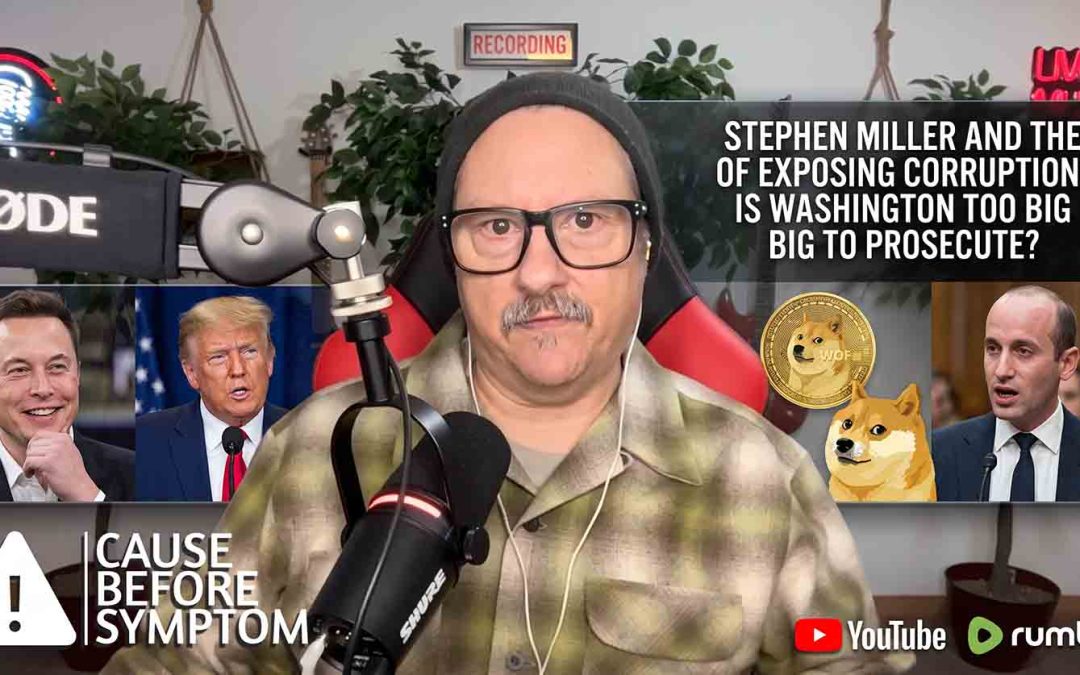
Watch this on Rumble: https://rumble.com/v7iew7c-stephen-miller-and-the-cost-of-exposing-corruption-is-washington-too-big-to.html
Opening — An Apology, an Explanation, and a Responsibility
Before we begin tonight, I owe my audience an apology. Not because someone disagreed with our investigation, but because we failed to examine something important. And when you claim to investigate the truth, an omission can be just as damaging as an incorrect conclusion.
Recently, we examined the Department of Government Efficiency, commonly known as DOGE. We wanted to know what it cost taxpayers, how much money it actually saved, and whether its discoveries of government fraud justified its existence. We examined reported savings, government spending, and the difference between identifying waste and recovering stolen money.
But we missed USAID.
Think about that. USAID was one of the most prominent agencies targeted by DOGE. Its grants, contracts, foreign assistance programs, and canceled spending commitments were central to the entire controversy. Yet we failed to give that agency the attention our investigation required.
How did that happen?
Our research concentrated too narrowly on selected financial claims instead of examining every major agency affected by DOGE. We failed to cross-check the scope of our investigation against DOGE's actual activities. And we treated an incomplete examination as though it were comprehensive.
I cannot establish why that failure occurred internally, and I will not invent an explanation. But I can identify the research failure itself. We did not adequately investigate USAID, and that omission weakened our conclusions.
That responsibility belongs to me. I am the one presenting these findings to you. I am the one asking you to trust that we have done our homework.
For that, I apologize.
Now, this failure raises a much larger question. If our investigation could overlook something so important, what happens when the institutions responsible for investigating themselves overlook evidence of wrongdoing?
Tonight, we turn our attention to Stephen Miller, a powerful figure in President Donald Trump's administration, whose allegations concerning Democrats, immigration, taxpayer funding, and government fraud deserve careful examination.
What does Miller actually know? What evidence has he presented? And if investigators uncover financial wrongdoing connected to election interference, does he possess the authority to bring those responsible to justice?
But there is another question that troubles me.
What happens if exposing corruption threatens the very institutions upon which America's economy depends?
We have watched Washington investigate scandals for generations. Hearings are announced. Witnesses testify. Politicians promise accountability. Television networks argue over who is guilty. And when the headlines disappear, Americans are left wondering what actually changed.
My concern is that we may be preparing to watch that process again.
Perhaps investigations will come. Perhaps powerful people will take public stands. Perhaps evidence will emerge that demands prosecution. But will the underlying system change, or will economic interests, political calculations, and institutional self-preservation prevent meaningful reform?
I do not know the answer, and I will not pretend that suspicion is proof.
But I believe the question deserves to be asked.
Because this investigation is not about protecting Republicans or condemning Democrats. It is about determining whether the American government can hold powerful people accountable without protecting itself from the consequences.
And after our failure to examine USAID properly, we must begin by holding ourselves to that same standard.
Tonight, we return to the cause before the symptom.
Investigation 1 — Stephen Miller: Who Put Him in Power, and Why?
Before we investigate Stephen Miller's allegations against Democrats, we need to understand something fundamental. Who is this man, how did he acquire so much influence, and what was he originally hired to accomplish?
Miller did not arrive in Washington as a fraud investigator. He began as a political activist and conservative commentator, eventually graduating from Duke University in 2007. He worked for Republican members of Congress before joining Senator Jeff Sessions's staff in 2009.
That relationship matters. Sessions was a prominent opponent of expanding immigration protections and creating pathways to citizenship for undocumented immigrants. Miller became involved in those policy battles years before Donald Trump entered the White House.
In 2015, Miller began assisting Trump's presidential campaign. In January 2016, he became a paid senior policy adviser. We know this partly because Miller described his responsibilities under oath during an April 2022 congressional deposition. He explained that his work included policy advice, speeches, hiring staff, and developing the campaign's platform.
Notice what is missing from that description. He was not hired to investigate Democratic financial crimes. His original assignment was to help develop and communicate Trump's political agenda.
After Trump's election, Miller joined the presidential transition and became a senior White House adviser. During Trump's first administration, he helped develop immigration policies, including restrictions on entry into the United States and changes to asylum enforcement.
Supporters regarded these measures as necessary border-security reforms. Critics argued that several policies were excessively restrictive, harmful to families, or inconsistent with legal protections. Courts challenged or limited portions of the administration's immigration program.
When Trump left office in 2021, Miller helped establish America First Legal, an organization that challenged Biden administration policies through litigation. This gave him a way to continue pursuing political and legal objectives outside government.
When Trump returned to office in 2025, Miller became deputy chief of staff for policy and homeland security adviser. His responsibilities extended across immigration enforcement and the coordination of executive policy.
Then something significant happened.
On November 6, 2026, President Trump appointed Miller White House Chief of Staff, replacing Susie Wiles. This placed him at the center of White House operations as the administration prepared to confront a newly empowered Democratic Congress.
That appointment substantially expanded his administrative influence. The chief of staff helps coordinate presidential priorities, manage access to the president, and organize the work of senior officials.
But influence is not unlimited legal authority.
Miller cannot personally convict anyone. He cannot simply order a federal judge to accept evidence, and he does not possess the constitutional authority to dissolve an opposition political party. Criminal investigations and prosecutions must proceed through legally authorized institutions.
Nevertheless, his proximity to the president gives him opportunities to shape policy priorities, coordinate officials, and encourage examination of suspected wrongdoing.
And that raises a question worth considering.
If Miller possesses credible evidence of extensive government fraud or election interference, could he use his position to encourage a serious federal investigation?
Yes, he could advocate for one. But whether that investigation produces charges or convictions depends on evidence, law, prosecutors, and courts.
His career establishes a long history of political advocacy and executive-policy work. It does not, by itself, establish that he possesses evidence of a coordinated Democratic criminal operation.
That distinction is essential.
Because before we ask whether Stephen Miller can bring powerful people to justice, we must first determine what he can actually prove.
Investigation 2 — What Evidence Does Stephen Miller Actually Possess?
Stephen Miller has made an extraordinary accusation. He claims Democrats established a system that directed hundreds of billions, potentially trillions, of taxpayer dollars toward migrants. If true, this would raise serious questions about government spending, oversight, and political accountability.
But what evidence supports his accusation?
On March 16, 2026, President Trump signed an executive order establishing a federal Task Force to Eliminate Fraud. Vice President JD Vance was designated chairman, with Federal Trade Commission Chairman Andrew Ferguson serving as vice chairman.
During the signing ceremony, Miller accused Democrats of creating a massive funding system benefiting migrants, including people from Somalia. He also described an informal account of immigration detainees reportedly acknowledging Medicaid enrollment.
That is an allegation, not an audited financial finding. We have not been given the underlying detainee interviews, eligibility records, or a transaction-level accounting supporting his nationwide estimate.
However, dismissing his concerns entirely would ignore documented wrongdoing.
Consider Minnesota's Feeding Our Future scandal. Federal prosecutors uncovered a scheme involving approximately $250 million intended to provide meals to children. Defendants used fraudulent meal claims to obtain public funds. The investigation produced criminal convictions and exposed serious weaknesses in program oversight.
This was not imaginary corruption. Real money was stolen from a program intended to help vulnerable children.
But there is an important distinction. Feeding Our Future involved federal child-nutrition funding administered through government programs. Its existence does not establish that Democratic Party leadership organized the fraud, nor does it prove election interference.
The administration's March executive order went considerably further. It alleged that public officials tolerated weak eligibility controls, allowed fraudulent payments, and used benefit programs to strengthen their political influence.
The order also directed federal agencies to improve eligibility verification, coordinate investigations, and examine whether officials facilitated fraud.
That creates a potentially important investigative pathway.
If officials knowingly authorized unlawful payments, concealed fraudulent activity, or redirected public money toward prohibited political purposes, investigators could examine those actions through financial records, communications, contracts, and witness testimony.
But the legal distinction between wrongdoing and political responsibility remains essential.
A government program may be poorly administered without being criminal. A fraudulent contractor may steal money without the knowledge of elected officials. And an official may support expanding benefits for political reasons without committing election fraud.
Miller's accusations must survive those distinctions.
There is another revealing development. Reporting published in November described a December 2025 meeting in which Miller repeatedly pressed officials for evidence involving Minnesota and Somali immigrants. According to a recording obtained by journalists, he showed less interest when officials discussed fraud elsewhere.
The White House defended the focus on Minnesota, citing the scale of documented fraud there.
This raises a legitimate question about investigative priorities. Was Miller following the strongest available evidence, or concentrating on cases that supported an existing political argument?
We cannot answer that merely from his statements.
And we must not confuse the actions of convicted individuals with the conduct of an entire immigrant community.
So what does Miller actually possess?
Public records establish that he has made sweeping allegations, helped advance an administration-wide fraud initiative, and pressed officials to investigate particular programs.
They do not yet establish that he possesses evidence proving a coordinated, trillion-dollar Democratic criminal operation.
That is where our investigation must become more demanding.
We need the payment records, the responsible officials, the communications, and the legal findings.
Because discovering fraud is only the beginning.
**Proving who knowingly enabled it—and whether it was connected to elections—is an entirely different investigation.**
Investigation 3 — USAID: The Missing Piece of Our DOGE Investigation
When we investigated DOGE, we asked whether the government had uncovered enough fraud and waste to justify its actions. But we overlooked USAID, one of the agencies most dramatically affected by the administration's spending cuts. Tonight, we need to understand why that omission mattered.
According to a September 2026 Government Accountability Office report, USAID terminated approximately 6,780 of its 7,510 foreign-assistance awards between January 2025 and March 2026. Those terminated awards represented $79.1 billion in cumulative obligations. Another $52.1 billion remained associated with active awards transferred to the State Department.
Those are extraordinary figures. But they require careful interpretation. The $79.1 billion represents obligations accumulated over the lives of those awards, not $79.1 billion recovered from criminals or saved in a single year.
Now consider what government investigators discovered before DOGE arrived.
In April 2024, the GAO examined USAID operations in Somalia, Nigeria, and Ukraine. Investigators found that USAID had not comprehensively assessed and documented fraud risks in those conflict-affected countries. Particularly concerning, the Somalia mission had not conducted the financial reviews used by some other missions to detect financial irregularities.
That is a documented oversight failure.
In July 2025, USAID's inspector general released another investigation examining five democracy, stabilization, and governance programs in Somalia, totaling more than $120 million.
Investigators found incomplete performance records, inconsistent reporting, and weaknesses in financial oversight. They questioned $82,870 in costs.
Notice the distinction. The inspector general did not conclude that the entire $120 million had been stolen. It identified specific weaknesses and questioned particular expenditures.
Nevertheless, these findings demonstrate why investigating USAID was essential.
And there is another discovery.
In May 2025, USAID's inspector general reported 208 ongoing investigative matters involving foreign assistance. These included potential fraud, corruption, and diversion of humanitarian aid.
That means serious investigative work was already underway. DOGE did not invent the problem of foreign-aid oversight.
But did DOGE solve it?
In August 2026, the GAO examined DOGE's publicly claimed savings and discovered serious accounting problems. Some contracts listed as terminated had not actually been terminated. Other savings lacked sufficient documentation.
The GAO also found that DOGE's public records initially omitted identifying information for thousands of contracts, including 3,506 USAID contracts, making independent verification more difficult. Investigators recovered earlier information to continue their examination.
Here is the uncomfortable reality.
USAID had documented oversight weaknesses before DOGE intervened. But DOGE's own accounting also contained weaknesses.
And reducing USAID's workforce created another concern. Inspectors warned that diminished oversight could make it harder to protect billions of dollars in humanitarian assistance from misuse or diversion.
So we have two responsibilities that should never have been separated: preventing government fraud and maintaining the investigators capable of detecting it.
Now consider Stephen Miller's allegations concerning Somalia and taxpayer-funded assistance.
USAID operated programs in Somalia. Federal prosecutors separately uncovered extensive fraud involving Minnesota's Feeding Our Future child-nutrition program. But those facts alone do not establish that USAID money financed Minnesota's fraud or Democratic election operations.
To establish such a connection, we would need matching recipients, bank transactions, contracts, communications, and evidence of unlawful political activity.
Those records have not established that connection in our examination.
This is why missing USAID damaged our original DOGE investigation. We overlooked documented financial risks, major spending decisions, and serious questions about the accuracy of claimed savings.
And we missed the larger lesson.
**Eliminating an agency does not automatically eliminate fraud. Sometimes it also eliminates the people responsible for finding it.**
Investigation 4 — From Government Fraud to Election Interference
We have established that government fraud exists. We have examined weaknesses in federal oversight, questionable expenditures, and criminal cases involving taxpayer money. But Stephen Miller's broader allegations raise a much more serious question. Could government funding have been used to influence American elections illegally?
To answer that, we must understand how the money would have to move.
Imagine a federal agency awards a grant to a nonprofit organization. That organization provides food, housing, legal assistance, or other services. Some recipients may later become politically active. None of that automatically constitutes election interference.
But suppose investigators discover that grant money was secretly redirected into campaign operations, illegal political contributions, or payments intended to produce fraudulent votes. Now we are examining something entirely different.
The Federal Election Commission prohibits foreign nationals from making contributions or expenditures in American elections. Federal law also restricts the use of government resources for partisan political activity. Other laws regulate campaign financing, voter registration, and fraudulent voting.
The question is whether investigators can document violations of those laws.
And here we encounter an important development.
In September 2026, the Justice Department announced election-related charges and guilty pleas involving twelve individuals across several states. The allegations included unlawful voting, false citizenship claims, fraudulent registration, and the destruction of mail-in ballots.
Separately, federal prosecutors announced indictments against ten foreign nationals accused of election-related offenses in Minnesota.
These cases demonstrate that election-law violations are being investigated and prosecuted. But an indictment is not a conviction, and individual offenses do not automatically establish a coordinated political operation.
The administration has also conducted a much larger investigation into noncitizen voting.
According to September reporting by the Associated Press, Homeland Security Investigations identified approximately 1,600 cases that produced 160 arrests. The Justice Department reported charges against seventy people for unlawful voting and registration offenses since January 2025.
Those numbers deserve examination. Arrests, charges, and convictions are different outcomes. And they must be considered against a national electorate containing more than 200 million registered voters.
Administration officials argue that even a small number of illegal votes threatens public confidence and deserves prosecution. Election specialists counter that the investigations have not established widespread noncitizen voting capable of altering national election outcomes.
Both positions raise legitimate questions about enforcement and evidence.
But what about the money?
This is where Stephen Miller's allegations require another level of proof.
If federal funds were deliberately used to finance illegal election operations, investigators would need to identify the originating agency, the receiving organization, the financial transfers, the individuals directing those transfers, and the prohibited political activity.
They would also need evidence establishing who knew the money was being misused.
A nonprofit receiving government assistance is not automatically a political conspiracy. A fraudulent contractor is not automatically working for the Democratic Party. And a person receiving public benefits is not automatically an unlawful voter.
Those distinctions protect innocent people while helping prosecutors identify actual wrongdoing.
Our examination has not established a documented financial chain connecting USAID, Minnesota's major benefit-fraud prosecutions, and a coordinated Democratic election-interference operation.
That does not eliminate the need to examine suspicious transactions. It establishes what remains to be proven.
And it brings us to the central question.
If Stephen Miller possesses documents showing that powerful officials knowingly directed taxpayer money into illegal election activity, the consequences could extend far beyond ordinary government fraud.
But without those documents, we cannot responsibly tell Americans that an entire political party participated in a criminal scheme.
Because the difference between suspicion and prosecution is evidence.
And the difference between prosecution and conviction is proof beyond a reasonable doubt.
Investigation 5 — Does Stephen Miller Have the Power to Bring Down the Democratic Party?
Suppose Stephen Miller possesses documents proving that powerful Democratic officials knowingly participated in government fraud or illegal election activities. Suppose those documents identify financial transactions, communications, and individuals responsible. Would Miller have enough power to bring down the Democratic Party?
To answer that question, we must separate political influence from constitutional authority.
On November 6, 2026, President Donald Trump appointed Miller White House Chief of Staff following Republican losses in the midterm elections. With Democrats gaining control of Congress, Miller entered his new position during a major political confrontation.
The chief of staff is one of Washington's most influential positions. Miller can coordinate presidential priorities, manage access to the president, organize policy discussions, and help determine which issues receive the administration's attention.
But there is something Americans should understand.
The White House Chief of Staff is not a federal prosecutor. Miller cannot personally indict a governor, arrest a member of Congress, convict a political opponent, or order a judge to accept an accusation as evidence.
Those responsibilities belong to legally authorized investigators, prosecutors, and courts.
Even the president's authority has limits. The Justice Department operates within federal law, and criminal proceedings require evidence sufficient to satisfy constitutional protections.
Now consider what would happen if Miller possessed credible evidence of a coordinated election-fraud operation.
Investigators would need to establish specific criminal acts. Prosecutors would need to identify responsible individuals, demonstrate knowledge and intent where required, and prove their allegations in court.
Political affiliation alone would establish nothing.
Even convictions involving numerous Democratic officials would not automatically dissolve the Democratic Party. American political parties are organizations composed of millions of voters, candidates, committees, and state institutions. Criminal responsibility does not transfer automatically from one individual to everyone sharing a political affiliation.
But legal consequences are only part of the equation.
Imagine a scandal involving federal agencies, major contractors, elected officials, financial institutions, and organizations receiving billions in taxpayer funding.
Investigating such a network could involve extensive subpoenas, financial examinations, congressional hearings, and years of litigation.
Now ask yourself who might resist that process.
Some officials could challenge subpoenas to protect legitimate constitutional interests. Others might resist disclosure for political reasons. Businesses could fear reputational damage or financial losses. Witnesses might refuse voluntary cooperation.
Those possibilities do not establish a cover-up. But they demonstrate why exposing wrongdoing inside powerful institutions can be difficult.
There is another complication.
With Democrats controlling Congress, Miller and the administration face legislative oversight of their own conduct. Congressional investigators can examine executive-branch decisions, request records, and issue subpoenas within their lawful authority.
That means the White House cannot assume it will control every investigation or determine which questions Congress asks.
And here is the larger issue.
Even if Miller possesses compelling evidence, he cannot guarantee that investigators will obtain convictions. He cannot guarantee that Congress will enact reforms. And he cannot guarantee that the institutions involved will change their practices.
Evidence creates the possibility of accountability. It does not guarantee the outcome.
This brings us to a distinction that matters more than party politics.
A political scandal can damage public confidence without proving a criminal conspiracy. A criminal prosecution can establish individual guilt without establishing wrongdoing by an entire political party.
So Miller's power is considerable, but it is not absolute.
The decisive question is not whether he can destroy the Democratic Party.
It is whether credible evidence can move through America's legal institutions without being distorted by political pressure, institutional interests, or the desire to protect powerful people.
Because the true test of accountability is not how many accusations are made.
It is what can be proven, who is held responsible, and whether the system changes afterward.
Investigation 6 — Who Finances and Influences the Investigators?
When powerful people promise to expose corruption, Americans naturally want to know what they have discovered. But there is another question we should ask. Who finances the investigators, who benefits from their work, and who holds them accountable?
Stephen Miller's influence extends beyond his government positions. After Donald Trump left office in 2021, Miller helped establish America First Legal, an organization dedicated to challenging government policies through litigation.
America First Legal became involved in disputes over immigration, federal employment, education, civil rights, and the authority of government agencies. Its legal work placed it in direct conflict with policies associated with the Biden administration.
This matters because litigation can do more than win or lose a case. Lawsuits can obtain government records, challenge agency decisions, compel officials to defend their actions, and bring information into public view.
But lawsuits are not criminal convictions. A legal complaint contains allegations that must be tested against evidence and applicable law.
Now consider the organization's financing.
America First Legal operates within the nonprofit sector, where financial disclosures can reveal revenue, compensation, grants, and organizational relationships. But publicly available nonprofit filings do not necessarily identify every donor.
That creates a legitimate transparency question. When an organization helps shape national political debates through litigation, how much should the public know about the people financing its activities?
The same question applies to organizations opposing Miller.
One of his most prominent critics has been the Southern Poverty Law Center. In 2019, the SPLC published material drawn from Miller's earlier correspondence with Breitbart News, arguing that the messages demonstrated connections to white nationalist ideas and publications.
Miller and his supporters disputed the characterization of his views. Evaluating that controversy requires examining the original correspondence rather than relying exclusively on either side's interpretation.
But criticism of Miller does not establish misconduct by the SPLC, just as criticism of the SPLC does not invalidate every document it has published.
That distinction becomes important when examining allegations about the SPLC's own financial practices and relationships with confidential sources.
If an organization improperly handled money, the relevant evidence would include financial records, contracts, communications, witness testimony, and judicial findings. Allegations alone cannot establish guilt.
We must also ask whether Miller personally uncovered any alleged misconduct involving the SPLC.
Our examination has not established that connection.
And that is precisely where investigative discipline matters. Two organizations may have opposed one another for years without evidence that one secretly directed an investigation into the other.
There is a broader issue here.
Political organizations, nonprofit groups, contractors, and advocacy networks can all influence public policy without holding elected office. They may finance litigation, publish investigations, lobby officials, or support campaigns.
Much of that activity is lawful. Some arrangements may raise ethical questions. Criminal wrongdoing requires evidence of an actual legal violation.
The public deserves transparency about those distinctions.
If Stephen Miller is investigating corruption, his allegations deserve scrutiny. If organizations opposing him uncover wrongdoing, their evidence deserves the same scrutiny.
And if either side receives financial support from powerful interests, those relationships should be examined without automatically assuming criminal coordination.
Because the problem is not simply that powerful organizations influence Washington.
The problem arises when Americans cannot distinguish legitimate advocacy from undisclosed conflicts, financial misconduct, or the misuse of public authority.
Our responsibility is to follow the evidence in every direction.
Not merely toward the people we already suspect.
But toward anyone whose actions the records actually implicate.
Investigation 7 — Christian Nationalism: What Can America Learn From Germany Before World War II?
Before World War II, Germany was overwhelmingly Christian. Approximately forty million Germans belonged to Protestant churches, while another twenty million were Catholic. Yet within a few years, a government claiming to restore national greatness would dismantle democratic institutions and carry out systematic persecution.
How could a predominantly Christian nation allow that to happen?
The answer requires examining more than Adolf Hitler. We must examine the relationship between religious institutions, nationalism, economic hardship, and political authority.
Following World War I, Germany experienced humiliation, political instability, and economic suffering. Many citizens believed their government had failed them. Hitler promised national restoration, economic recovery, and protection against perceived enemies.
Some Christians welcomed those promises.
A movement called the German Christians emerged within Protestant churches. Its supporters attempted to combine Christianity with Nazi nationalism and racial ideology. They promoted the idea that the church should reflect the political identity of the German nation.
This was not simply patriotism. It involved subordinating religious teaching to political and racial objectives.
Other Christians resisted.
The Confessing Church opposed attempts to place the church under Nazi ideological control. Its 1934 Barmen Declaration insisted that Jesus Christ, rather than a political leader, was the church's ultimate authority.
Pastor Dietrich Bonhoeffer eventually participated in resistance against the Nazi regime and was executed in 1945. Martin Niemöller was imprisoned for years.
But history contains an uncomfortable detail. Much of the Confessing Church concentrated on defending its institutional independence rather than consistently opposing the persecution of Jewish people.
Even religious resistance had limitations.
Meanwhile, Hitler's government transformed Germany's political structure. Following the Reichstag fire in February 1933, emergency measures suspended civil liberties. The Enabling Act subsequently allowed the government to legislate without parliamentary approval. By July, Germany had become a one-party state.
These were identifiable legal and institutional changes, not merely offensive political speeches.
Now consider contemporary America.
Christian nationalism has several meanings. Some people use the term to describe the belief that Christianity should influence public morality. Others advocate a more formal connection between Christian identity and governmental authority.
Those positions should not automatically be treated as identical.
Nor does supporting immigration enforcement, investigating government fraud, or voting for a particular candidate establish that someone embraces authoritarian government.
The historical comparison becomes meaningful when we examine specific conduct.
Are political leaders demanding loyalty above constitutional limits? Are religious institutions excusing wrongdoing because the accused belongs to their preferred party? Are entire populations being blamed for crimes committed by particular individuals?
And are Christians willing to defend the rights of people with whom they disagree?
The Bible offers a demanding standard.
James 2:1 warns believers against holding faith in Jesus Christ with respect of persons. In other words, our judgments should not change according to someone's status or influence.
That principle applies equally to Stephen Miller, Donald Trump, Democratic officials, and those investigating them.
America today is not Nazi Germany. Its constitutional protections, independent courts, competing political organizations, and historical circumstances are fundamentally different.
But studying Germany reminds us that institutions must be evaluated by their conduct, not simply by their religious language or patriotic promises.
The question for Christians is not whether their preferred political movement can obtain power.
It is whether they remain faithful to Christ when that movement exercises power unjustly.
Because when political loyalty becomes more important than truth, religion can stop correcting government and begin protecting it.
And history shows why that distinction matters.
Investigation 8 — Would Exposing Political Corruption Damage the American Economy?
Suppose Stephen Miller possesses evidence of a massive financial operation involving government agencies, contractors, nonprofit organizations, and elected officials. Suppose investigators can prove that taxpayer money was deliberately misused. What would happen if exposing that corruption threatened the institutions supporting America's economy?
This is where our investigation moves beyond politics.
America's economy depends upon confidence. Businesses invest because they expect contracts to be honored. Banks lend because they expect borrowers to repay. Investors purchase government debt because they believe the United States will meet its obligations.
Now imagine a major investigation implicating officials responsible for billions in government spending. Contracts could face scrutiny. Organizations could lose funding. Businesses might delay investments while investigators determine which transactions were legitimate.
But would that destroy the economy?
There is no evidence establishing that prosecuting political corruption would, by itself, cause an economic collapse.
In fact, the opposite danger deserves equal attention.
In March 2026, the Organization for Economic Cooperation and Development published an examination of corruption across sixty-two countries. Its findings connected weak government integrity with reduced investment, distorted competition, higher costs, and declining public trust.
The report also identified a troubling pattern. Governments frequently establish anti-corruption rules but fail to implement them effectively.
That distinction sounds familiar.
Washington announces investigations. Congress holds hearings. Agencies promise reforms. But unless those reforms change financial practices and enforcement, the underlying weaknesses can survive.
Now consider America's financial position.
According to the Congressional Budget Office, the federal deficit reached approximately two trillion dollars in fiscal year 2026. Federal debt held by the public reached roughly one hundred percent of the nation's annual economic output.
These figures do not prove corruption. But they demonstrate the importance of government financing and investor confidence.
There is also evidence that political disruption carries economic costs.
The Congressional Budget Office estimated that the six-week federal shutdown in 2025 would leave approximately eleven billion dollars in economic output permanently lost.
That was a temporary funding interruption, not a nationwide corruption prosecution. We cannot assume the consequences would be identical.
Interestingly, a September 2026 financial study found that the shutdown produced limited disruption across many major financial markets, although certain investments experienced greater volatility.
In other words, political turmoil does not automatically produce economic disaster.
So why might powerful institutions resist an investigation?
Consider a contractor dependent upon government payments. A bank financing that contractor. Employees whose livelihoods depend upon continued operations. Political officials responsible for maintaining essential services.
Each may have legitimate reasons to avoid sudden disruption.
But protecting economic continuity is not the same as protecting criminal wrongdoing.
Here is where my concern begins.
If an investigation threatens influential organizations, those organizations may have incentives to challenge its findings, delay proceedings, or argue that enforcement would harm innocent workers.
Such arguments must be examined carefully. They can reflect genuine economic concerns, but they could also be used to defend existing arrangements.
We have not established that officials are suppressing Miller's allegations to protect the economy.
Nevertheless, the economic incentives are worth investigating.
Because corruption itself carries a cost. Stolen funds reduce resources available for legitimate purposes. Favoritism disadvantages honest businesses. Weak oversight makes future fraud easier.
And when citizens conclude that powerful people operate under different rules, public confidence suffers.
Perhaps the greatest economic danger is not exposing corruption.
Perhaps it is allowing corruption to become an accepted cost of doing business.
That leaves us with a question Washington cannot answer through another press conference.
**What costs America more: holding powerful institutions accountable today, or allowing their misconduct to burden future generations?**
Investigation 9 — Decades of Investigations: Why Does Washington Keep Surviving Its Scandals?
For generations, Americans have watched their government investigate itself. Congressional committees summon witnesses. Prosecutors announce charges. Documents are released. Politicians promise reforms. Yet years later, another scandal appears, and the public begins asking the same question: Did anything really change?
Consider Watergate.
In 1972, burglars connected to President Richard Nixon's reelection campaign were arrested inside Democratic National Committee headquarters. The investigation eventually exposed abuses of presidential power, obstruction of justice, and attempts to conceal wrongdoing.
Nixon resigned in August 1974. Several senior officials went to prison. Congress subsequently enacted reforms intended to strengthen oversight and government transparency.
Watergate demonstrated that even a president could face serious consequences.
But it also demonstrated something else. President Gerald Ford pardoned Nixon before he faced criminal trial. Americans were left debating whether the pardon protected national stability or denied the country full accountability.
Now consider Iran-Contra.
During the 1980s, officials in President Ronald Reagan's administration participated in secret arms sales involving Iran, while proceeds were diverted to support Nicaraguan rebels despite congressional restrictions.
Investigators uncovered illegal conduct, and several officials were convicted. But some convictions were overturned, and President George H. W. Bush later pardoned six individuals involved in the affair.
The investigation established serious wrongdoing. Yet the combination of legal complications, pardons, and political controversy limited its lasting criminal consequences.
Then came the savings-and-loan crisis.
During the 1980s and early 1990s, hundreds of financial institutions failed, leaving taxpayers responsible for enormous losses. Investigators documented reckless lending, regulatory failures, and criminal misconduct.
Unlike the popular belief that financial executives never face prosecution, this crisis produced numerous criminal cases and convictions.
But the underlying questions about financial regulation and institutional risk did not disappear.
In 2008, America experienced another financial catastrophe.
Major financial institutions collapsed or required extraordinary government assistance. Millions of Americans lost jobs, homes, or retirement savings. Investigations identified dangerous lending practices, excessive leverage, misleading financial products, and serious regulatory weaknesses.
Banks paid substantial settlements. Congress enacted the Dodd-Frank financial reforms. Yet relatively few senior executives faced criminal prosecution for conduct associated with the crisis.
Why?
One explanation involves the difficulty of proving individual criminal intent inside complex financial organizations. Another concerns the distinction between harmful business practices and conduct prosecutors can establish as criminal beyond a reasonable doubt.
Critics also argued that financial institutions had become so important to the economy that authorities were reluctant to impose consequences threatening their survival.
That brings us back to Stephen Miller.
If investigators uncover fraud involving powerful officials, contractors, or organizations, Americans may witness another lengthy process involving hearings, lawsuits, criminal referrals, and political accusations.
Some cases could produce convictions. Others might collapse because the evidence fails to establish criminal responsibility. Still others could produce reforms without prosecutions.
History does not establish that every investigation is deliberately buried. Watergate and the savings-and-loan crisis demonstrate otherwise.
But history does establish that exposure, prosecution, punishment, and institutional reform are four different outcomes.
And perhaps that is why so many Americans remain dissatisfied.
They hear that wrongdoing has been exposed, but they want to know whether stolen money was recovered, whether responsible individuals were punished, and whether the system was changed to prevent another scandal.
That is the standard we should apply to Miller's allegations.
Not the number of hearings.
Not the number of headlines.
Not even the number of indictments.
But whether investigators establish the truth, courts determine responsibility, and government institutions correct the failures that allowed wrongdoing to occur.
Because an investigation can end while the underlying problem survives.
And when that happens, Americans are left preparing for the next scandal before the consequences of the last one have been resolved.
Investigation 10 — The Investigation That Could Change America, or Another Investigation That Changes Nothing?
We began tonight with an apology because our investigation into DOGE overlooked USAID. We failed to examine a major part of the evidence, and that failure weakened our conclusions. Now consider what happens when the same problem occurs inside the institutions responsible for investigating government corruption.
Stephen Miller has accused Democrats of participating in a massive system of taxpayer-funded benefits and financial misconduct. We have examined documented fraud, weaknesses in government oversight, and the extraordinary authority Miller now possesses within the White House.
But we have not established that he possesses evidence proving a coordinated Democratic operation to interfere with American elections.
That distinction matters because accusations can generate political consequences long before courts determine whether crimes occurred.
Now consider what may happen next.
Congress can conduct investigations. Federal agencies can review payments. Prosecutors can examine financial transactions. Witnesses can testify, and organizations can challenge allegations through the courts.
All of those activities may produce important evidence.
But none guarantees that the underlying system will change.
My concern is that Americans have seen this process before. Political leaders promise accountability. Hearings attract enormous attention. Supporters become convinced that justice is approaching, while opponents insist the investigation is politically motivated.
Eventually, public attention shifts elsewhere.
But we should be careful. History does not prove that every investigation is deliberately buried. Watergate produced resignations and convictions. Financial scandals have resulted in prosecutions, settlements, and regulatory reforms.
The problem is that consequences do not always address the conditions that allowed misconduct to occur.
Suppose investigators uncover fraudulent government payments. Recovering the money would matter. Prosecuting those responsible would matter. But if agencies retain the same weaknesses in eligibility verification, financial monitoring, and contractor oversight, future fraud may continue.
Now suppose investigators establish that public funds were knowingly redirected into unlawful election activity.
That would demand an entirely different response, involving election law, criminal accountability, and safeguards protecting the integrity of future elections.
But we cannot assume such a connection exists merely because both government fraud and election violations have occurred.
And what about the economy?
Major contractors, nonprofit organizations, banks, and government agencies may have financial reasons to resist sudden disruptions. Those incentives deserve investigation. Yet we have not established that officials are suppressing Miller's allegations to prevent economic damage.
In fact, refusing to address proven corruption could create greater economic harm over time.
So perhaps we should stop measuring accountability by the number of investigations Washington announces.
Instead, we should ask what the investigations actually accomplish.
Were financial records examined? Were unlawful payments identified? Were responsible individuals prosecuted? Was stolen money recovered? Were innocent people protected from unsupported accusations? And were the institutional weaknesses corrected?
Those questions apply equally to Republican and Democratic administrations.
They also apply to our own work.
If we demand complete evidence from Washington, we cannot excuse incomplete research simply because its conclusions support our expectations.
I remain concerned that another political investigation could produce years of accusations without meaningful reform.
But concern is not certainty.
Stephen Miller's allegations deserve examination. So do the administration's investigative methods, financial claims, and exercise of power.
And if wrongdoing is established, accountability must follow the evidence rather than political affiliation.
Because the greatest failure would not be discovering that our suspicions were mistaken.
It would be discovering the truth and then refusing to act upon it.
**America does not need another investigation that merely identifies its problems. It needs institutions capable of correcting them.**
Conclusion — If the System Cannot Hold Itself Accountable, Who Will?
Tonight, we began with an apology. We acknowledged that our investigation into DOGE failed to examine USAID adequately, even though USAID was central to the administration's efforts to reduce government spending. That omission mattered because it left us with an incomplete understanding of what DOGE discovered, what it accomplished, and what its actions actually cost taxpayers.
And that failure taught us something important.
An investigation can contain accurate information and still produce an incomplete picture when critical evidence is overlooked.
Now consider what we discovered about Stephen Miller.
We examined his political history, his rise to power, his accusations against Democrats, and the documented government fraud that gives Americans legitimate reasons to demand stronger financial oversight.
We also discovered something that must not be ignored. Evidence of government fraud is not automatically evidence of election interference. And evidence against individual officials does not establish criminal responsibility for an entire political party.
If Miller possesses additional evidence connecting taxpayer money to unlawful election activities, that evidence deserves examination. But until those connections are established, we cannot responsibly declare that a nationwide political conspiracy has been proven.
Then we asked a more troubling question.
What happens when exposing corruption threatens the institutions responsible for maintaining America's economy?
Government contractors employ workers. Financial institutions provide credit. Federal agencies distribute enormous amounts of money. Political organizations depend upon donors, relationships, and public confidence.
If investigators discover wrongdoing within those networks, the consequences could extend far beyond the individuals accused.
But economic disruption cannot become an excuse for protecting criminal activity.
And this is where history becomes important.
We examined Watergate, Iran-Contra, the savings-and-loan crisis, and the financial collapse of 2008. These investigations produced different outcomes. Some people went to prison. Others received pardons. Financial institutions paid settlements. Congress passed reforms.
Yet Americans continue to confront questions about corruption, accountability, and the influence of powerful institutions.
Why?
Because identifying wrongdoing and correcting the conditions that allowed it are two different responsibilities.
My concern is that we may be preparing to watch another investigation unfold without meaningful institutional change.
Perhaps Congress will hold hearings. Perhaps prosecutors will announce charges. Perhaps politicians will accuse one another of protecting criminals. And perhaps Americans will once again become divided over which political party deserves their loyalty.
But what happens when the hearings end?
Will stolen money be recovered? Will financial safeguards improve? Will officials who knowingly violated the law face consequences? Will innocent people be protected from accusations unsupported by evidence?
Or will the underlying arrangements remain intact?
I cannot tell you that nothing will happen. I cannot establish that Washington has already decided to bury an investigation. And I will not claim that economic interests are suppressing evidence without proof.
But I can tell you what we should demand.
The same standard of evidence for every political party. The same financial scrutiny for every government agency. The same accountability for powerful officials and ordinary citizens.
And the same willingness to admit when our own investigations fall short.
Scripture reminds us in Ecclesiastes 5:8 that when we witness oppression and the corruption of judgment, we should not be surprised that powerful officials exist above other officials.
That observation is not permission to surrender. It is a warning to examine how authority operates.
Our faith must never depend upon a political party delivering justice.
And our pursuit of truth must never depend upon an accusation being politically convenient.
So I leave you with one final question.
**If Washington can investigate corruption for generations without consistently correcting the systems that allow it, are Americans witnessing accountability—or simply another process through which powerful institutions survive?**
That is the question we must continue examining.
Because the cause is not merely the corruption we discover.
It is also the failure to correct what allowed that corruption to happen.
And until we understand that distinction, we will continue treating the symptoms while leaving the cause untouched.
Bibliography
- America First Legal Foundation. Form 990, Return of Organization Exempt from Income Tax. Fiscal year 2024. Internal Revenue Service. https://projects.propublica.org/nonprofits/organizations/862190372.
- Barnett, Victoria. For the Soul of the People: Protestant Protest against Hitler. New York: Oxford University Press, 1992.
- Bergen, Doris L. Twisted Cross: The German Christian Movement in the Third Reich. Chapel Hill: University of North Carolina Press, 1996.
- Ericksen, Robert P. Complicity in the Holocaust: Churches and Universities in Nazi Germany. New York: Cambridge University Press, 2012.
- Federal Deposit Insurance Corporation. Crisis and Response: An FDIC History, 2008–2013. Washington, DC: FDIC. https://www.fdic.gov/publications/crisis-and-response-fdic-history-2008-2013.
- Federal Deposit Insurance Corporation. The S&L Crisis: A Chrono-Bibliography. Washington, DC: FDIC. https://www.fdic.gov/publications/sl-crisis-chrono-bibliography.
- Federal Election Commission. “Foreign Nationals.” Campaign Finance Guidance. https://www.fec.gov/help-candidates-and-committees/foreign-nationals/.
- Federal Election Commission. “11 CFR § 110.20: Prohibition on Contributions, Donations, Expenditures, Independent Expenditures, and Disbursements by Foreign Nationals.” Code of Federal Regulations. https://www.govinfo.gov/content/pkg/CFR-2025-title11-vol1/pdf/CFR-2025-title11-vol1-sec110-20.pdf.
- Government Accountability Office. DOGE Wall of Receipts: More Transparency Needed on How Savings Are Derived from Contract, Grant, and Lease Terminations. GAO-26-108615. Washington, DC: Government Accountability Office, August 6, 2026. https://www.gao.gov/products/gao-26-108615.
- Government Accountability Office. Foreign Assistance: USAID Should Strengthen Risk Management in Conflict Zones. GAO-24-106192. Washington, DC: Government Accountability Office, April 2024. https://www.gao.gov/assets/gao-24-106192.pdf.
- Miller, Stephen N. Executive Branch Personnel Public Financial Disclosure Report. Annual filing, 2026. Executive Office of the President. https://www.whitehouse.gov/wp-content/uploads/2026/09/Miller-Stephen-2026-Annual.pdf.
- National Archives and Records Administration. “Records of the Watergate Special Prosecution Force.” https://www.archives.gov/research/investigations/watergate.
- National Archives and Records Administration. “Special Prosecutors and Independent Counsels Records.” https://www.archives.gov/research/investigations/special-prosecutors-indept-counsels.
- Organisation for Economic Co-operation and Development. Anti-Corruption and Integrity Outlook 2026: Harnessing the Integrity Advantage. Paris: OECD Publishing, 2026. https://doi.org/10.1787/16708b78-en.
- Southern Poverty Law Center. “Stephen Miller.” Extremist Files. https://www.splcenter.org/resources/extremist-files/stephen-miller/.
- Southern Poverty Law Center. “SPLC Publishes Extremist File for White House Senior Policy Adviser Stephen Miller.” July 15, 2020. https://www.splcenter.org/presscenter/splc-publishes-extremist-file-white-house-senior-policy-adviser-stephen-miller/.
- The Holy Bible. King James Version. 1611. Ecclesiastes 5:8; James 2:1.
- United States Holocaust Memorial Museum. “The German Churches and the Nazi State.” Holocaust Encyclopedia. https://encyclopedia.ushmm.org/content/en/article/the-german-churches-and-the-nazi-state.
- U.S. Department of Justice, U.S. Attorney's Office, District of Minnesota. “Federal Jury Finds Feeding Our Future Mastermind and Co-Defendant Guilty in $250 Million Pandemic Fraud Scheme.” March 19, 2025. https://www.justice.gov/usao-mn/pr/federal-jury-finds-feeding-our-future-mastermind-and-co-defendant-guilty-250-million.
- U.S. Department of Justice, U.S. Attorney's Office, District of Minnesota. “Couple in Feeding Our Future Fraud Scheme Sentenced to 97 Months' Imprisonment.” September 9, 2026. https://www.justice.gov/usao-mn/pr/couple-feeding-our-future-fraud-scheme-sentenced-97-months-imprisonment.
Endnotes
- The Department of Government Efficiency, commonly known as DOGE, was established in January 2025 through a reorganization of the United States Digital Service. Its stated objectives included improving government efficiency, modernizing technology, and reducing wasteful spending. Claims of savings must be distinguished from independently verified reductions in expenditures and actual recovery of fraudulent payments.
- USAID was among the federal agencies most extensively affected by DOGE's restructuring efforts. The agency's foreign-assistance contracts, grants, personnel reductions, and transfer of responsibilities to the State Department are essential to evaluating DOGE's financial and administrative consequences.
- The Government Accountability Office's August 2026 report, DOGE Wall of Receipts: More Transparency Needed on How Savings Are Derived from Contract, Grant, and Lease Terminations, identified weaknesses in the documentation and transparency supporting DOGE's publicly reported savings. Contract termination values should not automatically be interpreted as money recovered or actual taxpayer savings.
- The Government Accountability Office's April 2024 report, Foreign Assistance: USAID Should Strengthen Risk Management in Conflict Zones, documented weaknesses in fraud-risk assessment and oversight of assistance programs operating in conflict-affected countries, including Somalia, Nigeria, and Ukraine. These findings establish administrative vulnerabilities, not proof that all associated expenditures were fraudulent.
- USAID's inspector general examined financial oversight and program administration in Somalia. Questioned expenditures, incomplete documentation, and weaknesses in monitoring must be distinguished from criminal findings. Establishing fraud requires additional evidence concerning the transactions, responsible individuals, and applicable law.
- Stephen Miller developed his political career through congressional work, including service with Senator Jeff Sessions, before joining Donald Trump's 2016 presidential campaign. His early responsibilities centered on immigration policy, political communications, and executive-policy development rather than criminal fraud investigations.
- Miller served as a senior adviser during Trump's first administration and subsequently helped establish America First Legal. The organization pursued litigation concerning immigration, federal administrative authority, education, employment, and other government policies.
- America First Legal Foundation's publicly available IRS Form 990 filings provide information concerning organizational revenue, expenditures, compensation, and financial relationships. Such filings do not necessarily identify every donor or establish the financing of individual investigations.
- Miller's executive-branch financial disclosures provide another source for examining reported income, assets, business relationships, and potential conflicts of interest. Disclosed financial relationships do not independently establish improper influence or criminal conduct.
- Miller's November 2026 appointment as White House Chief of Staff expanded his administrative responsibilities and access to presidential decision-making. The position provides substantial influence over executive priorities but does not independently confer prosecutorial or judicial authority.
- Federal criminal investigations ordinarily operate through legally authorized investigative agencies and prosecutors. Criminal charges must satisfy applicable legal requirements, while convictions require proof beyond a reasonable doubt. Political influence cannot lawfully substitute for those requirements.
- The Department of Justice's Feeding Our Future prosecutions established extensive fraud involving federal child-nutrition funds in Minnesota. The approximately $250 million scheme involved fraudulent claims for meals and misuse of program funds. The prosecutions do not, by themselves, establish involvement by Democratic Party leadership or a coordinated election-interference operation.
- Government spending estimates, suspected fraud, improper payments, criminally established losses, canceled obligations, and recovered funds represent different financial categories. Combining them without reconciliation can substantially distort the apparent scale of wrongdoing or savings.
- Allegations concerning government benefits provided to migrants require examination of program eligibility, citizenship and immigration classifications, federal and state funding sources, and the legal authority governing expenditures. Receipt of a government benefit does not independently establish fraud or unlawful voting.
- Federal Election Commission regulations, including 11 CFR § 110.20, prohibit foreign nationals from making certain contributions, donations, expenditures, and disbursements in connection with American elections. Other federal and state laws govern election administration, voter eligibility, registration, and fraudulent voting.
- Establishing a connection between government fraud and election interference requires evidence linking financial transactions to prohibited electoral conduct. A nonprofit organization's receipt of government funding, political advocacy, or voter-registration activity does not automatically establish an election-law violation.
- Individual election-law prosecutions demonstrate that specific violations may occur. They do not automatically establish widespread coordinated interference or criminal responsibility extending to an entire political party.
- The United States Constitution distributes governmental authority among the executive, legislative, and judicial branches. Congressional oversight, executive investigations, prosecutorial decisions, and judicial proceedings involve distinct legal powers and limitations.
- Political parties are composed of numerous organizations, candidates, committees, officeholders, and voters. Criminal wrongdoing by particular members does not automatically establish collective criminal responsibility for the entire party.
- The Southern Poverty Law Center published material concerning Stephen Miller's correspondence with Breitbart News and argued that portions reflected connections to white nationalist ideas. Evaluating those allegations requires examining the original correspondence and distinguishing documented statements from interpretations of their meaning.
- Allegations concerning the Southern Poverty Law Center's own financial practices must be evaluated independently. Criticism of Miller does not establish wrongdoing by the organization, and allegations against the organization do not automatically invalidate its previously published documents.
- No publicly established financial chain has been demonstrated in this investigation connecting USAID assistance in Somalia, the Minnesota Feeding Our Future fraud, and a coordinated Democratic election-interference operation. Establishing such a connection would require transaction records, identifiable participants, and evidence of unlawful conduct.
- The United States Holocaust Memorial Museum documents the relationship between German Protestant churches and the Nazi state. The German Christians movement attempted to align Protestant religious institutions with Nazi nationalist and racial ideology.
- The Confessing Church opposed aspects of Nazi interference in Protestant church affairs. Historical scholarship also documents limitations in the movement's resistance, particularly regarding the persecution of Jewish people. Religious opposition to state control was not necessarily equivalent to comprehensive opposition to Nazi policies.
- Victoria Barnett's For the Soul of the People, Doris Bergen's Twisted Cross, and Robert Ericksen's Complicity in the Holocaust examine the relationships among German religious institutions, nationalism, political authority, and resistance during the Nazi period.
- Contemporary American Christian nationalism encompasses differing political and theological positions. Historical comparisons with Germany require identifying specific institutional practices and differences rather than treating all Christian political participation as equivalent to authoritarianism.
- James 2:1 warns believers against respect of persons in matters of faith and judgment. Within the investigation, the passage provides a biblical standard for examining political allies and opponents without favoritism.
- The Organisation for Economic Co-operation and Development's Anti-Corruption and Integrity Outlook 2026examines government integrity, corruption prevention, institutional accountability, and the economic consequences of weak enforcement.
- Government corruption can distort competition, increase public expenditures, discourage investment, and undermine confidence in public institutions. The economic consequences of corruption must be considered alongside the possible short-term disruption caused by investigations and prosecutions.
- Government contractors, financial institutions, nonprofit organizations, and public agencies may face financial disruption when major programs are suspended or investigated. The existence of economic incentives to resist disruption does not establish that officials have conspired to suppress evidence.
- The Federal Deposit Insurance Corporation's historical studies document the savings-and-loan crisis and the financial crisis of 2008–2013. These episodes demonstrate the consequences of financial instability, regulatory weaknesses, institutional failures, and government intervention.
- The Watergate investigation exposed abuses of presidential power and resulted in criminal convictions, political resignations, and President Richard Nixon's departure from office. President Gerald Ford subsequently pardoned Nixon, producing continuing debate over accountability and national stability.
- The Iran-Contra investigation uncovered secret arms transactions and the diversion of proceeds to Nicaraguan rebels. Criminal proceedings, overturned convictions, and presidential pardons demonstrate how investigations can establish wrongdoing while producing complicated legal outcomes.
- The savings-and-loan crisis produced criminal prosecutions and substantial taxpayer losses. Its history demonstrates that financial investigations can result in individual accountability without necessarily eliminating broader regulatory vulnerabilities.
- The 2008 financial crisis produced major investigations, settlements, and regulatory reforms, including the Dodd-Frank Act. Relatively few senior financial executives faced criminal prosecution for conduct associated with the crisis, contributing to public debate over institutional accountability.
- Historical investigations must be evaluated according to their actual outcomes, including convictions, acquittals, settlements, pardons, financial recoveries, regulatory reforms, and unresolved allegations. Public attention and congressional hearings are not equivalent to criminal accountability.
- Ecclesiastes 5:8 addresses oppression, the perversion of judgment, and the existence of officials exercising authority over other officials. The passage provides a biblical perspective on institutional hierarchy without establishing that every government investigation is deliberately obstructed.
- The hypothesis that Stephen Miller's allegations will generate investigations without substantial institutional reform remains unproven. Historical examples demonstrate both meaningful consequences and unresolved failures. Future conclusions should depend upon documented evidence and measurable outcomes.
- No evidence examined in this investigation establishes that federal officials have decided to suppress prosecutions concerning Miller's allegations specifically to protect the American economy. Such a conclusion would require documentary evidence, testimony, or other independently verifiable findings.
- The investigation's central accountability standard is whether authorities identify unlawful transactions, establish individual responsibility, recover misappropriated funds, protect innocent parties, and correct the institutional weaknesses that permitted wrongdoing. Those measures provide a more reliable assessment than political accusations, announcements, or the number of hearings conducted.
#StephenMiller, #DOGE, #USAID, #GovernmentCorruption, #PoliticalAccountability, #GovernmentFraud, #ElectionIntegrity, #WashingtonDC, #TaxpayerMoney, #FollowTheMoney, #PoliticalPower, #GovernmentOversight, #FederalInvestigations, #DemocraticParty, #RepublicanParty, #EconomicConsequences, #ChristianNationalism, #PoliticalInfluence, #InstitutionalCorruption, #RuleOfLaw, #Transparency, #Justice, #CauseBeforeSymptom, #JamesCarner
StephenMiller, DOGE, USAID, GovernmentCorruption, PoliticalAccountability, GovernmentFraud, ElectionIntegrity, WashingtonDC, TaxpayerMoney, FollowTheMoney, PoliticalPower, GovernmentOversight, FederalInvestigations, DemocraticParty, RepublicanParty, EconomicConsequences, ChristianNationalism, PoliticalInfluence, InstitutionalCorruption, RuleOfLaw, Transparency, Justice, CauseBeforeSymptom, JamesCarner