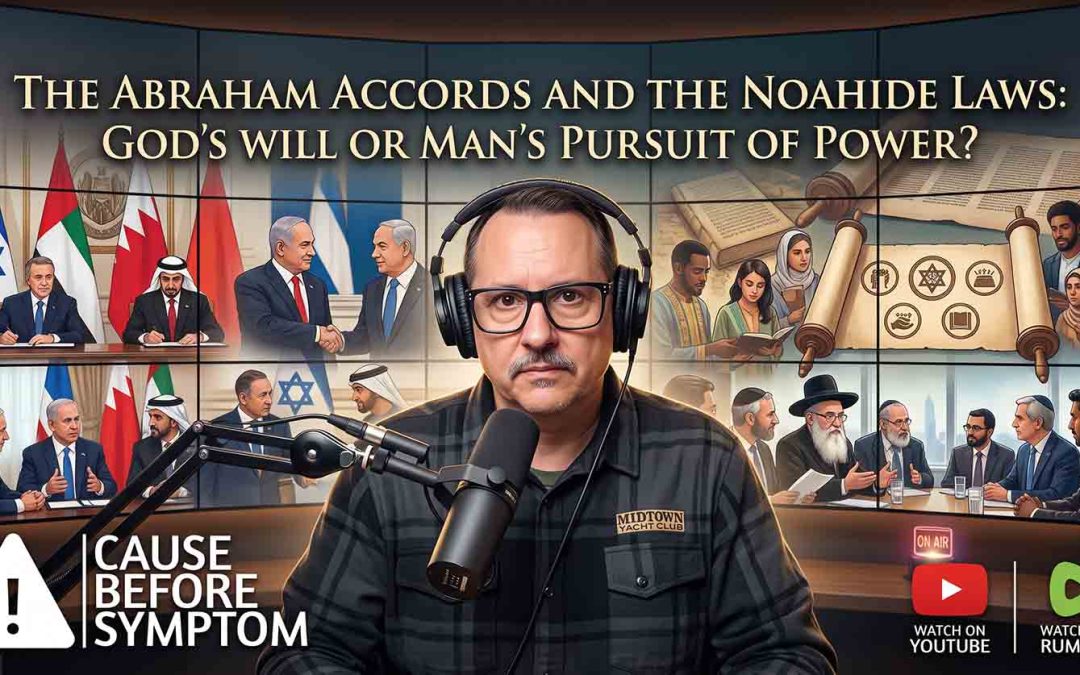
Watch this on Rumble: https://rumble.com/v7i0za0-the-abraham-accords-and-the-noahide-laws-gods-will-or-mans-pursuit-of-power.html
Opening — When Men Borrow God's Name
Throughout history, powerful men have invoked the name of God to justify decisions that changed the lives of millions. Kings claimed divine authority to rule. Governments called upon God before sending soldiers into battle. Religious institutions declared that obedience to their teachings was obedience to God. And ordinary people, believing they were serving something greater than themselves, often accepted decisions they might otherwise have questioned.
But there is something we should consider. God gave humanity free will. He did not force Adam and Eve to obey Him. Jesus did not establish a government, command an army, or demand that Rome enforce His teachings. Instead, He invited people to follow Him. He taught them to love their neighbors, forgive their enemies, and place their faith in God rather than the riches of this world.
So what happens when men begin using God's name to establish political agreements, influence governments, or promote religious rules intended for all humanity? Are they advancing God's will, or are they advancing their own objectives while borrowing the authority of His name?
Tonight, we are examining two initiatives that appear very different but raise an important common question. The first is the Abraham Accords, introduced in 2020 as an effort to establish peace and cooperation between Israel and several Arab nations. The second is the Seven Noahide Laws, ancient commandments from Jewish rabbinic tradition that organizations including Chabad promote as obligations for all humanity.
One operates through governments, diplomacy, economic agreements, and security partnerships. The other operates through religious teaching, moral authority, and efforts to gain wider recognition. Both invoke biblical figures. Both speak about improving the world. And both involve human institutions seeking to influence how people and nations behave.
But we are not going to accept their explanations simply because they sound noble. We are going to examine what these initiatives actually accomplish, what kinds of authority they establish, and whether their actions match their stated principles.
We will examine the economic and strategic interests behind the Abraham Accords, the political recognition sought by Noahide advocates, and the documented relationships between the people and institutions involved. We will also look beyond Washington and Israel, including perspectives from Russia, China, Iran, and people whose interests may not be represented in these agreements.
And we will ask a question that governments rarely ask themselves. If peace is truly the objective, why should friendship depend upon political alliances, economic opportunities, or strategic advantages? Jesus instructed His followers to love even their enemies. He did not say to love only those who could offer something in return.
This investigation is not an accusation against Jewish people, Muslims, Christians, or any other religious community. It is an examination of human institutions and the power they seek. We will consider what the documents establish, what human behavior suggests, and what remains hidden or unanswered.
Because there is a difference between serving God and using God's name to persuade others to serve you.
And tonight, we intend to examine that difference.
Welcome to Cause Before Symptom.
Investigation 1 — What Are We Actually Being Asked to Accept?
Before we can understand the Abraham Accords and the Noahide Laws, we need to examine something more important than their names. We need to understand what the people promoting them want humanity to accept. Because throughout history, the language used to introduce an idea has not always revealed the full extent of the authority that idea eventually creates.
The Abraham Accords were introduced in 2020 as diplomatic agreements establishing relations between Israel and several Arab nations. The public heard about peace, religious tolerance, cooperation, and a new beginning for the Middle East. Those are admirable objectives. But governments do not negotiate international agreements simply because they admire one another. They negotiate because they expect something in return.
Behind the language of peace were questions involving trade, investment, security, military cooperation, technology, and regional influence. These were not imaginary concerns. They were part of the diplomatic and economic arrangements being established. And that raises our first question. When governments call something a peace agreement, should we judge it by the beautiful words spoken at the signing ceremony, or by the obligations and advantages created afterward?
Now consider the Noahide Laws. These are seven commandments developed within Jewish rabbinic tradition and presented as moral obligations for all humanity. They address matters such as murder, theft, idolatry, sexual conduct, blasphemy, cruelty to living animals, and the establishment of courts of justice.
Some of these principles resemble moral rules found throughout the world. But others involve religious beliefs that billions of people do not share. That distinction becomes important when religious organizations encourage governments to recognize these commandments.
A person voluntarily accepting religious instruction is exercising freedom of conscience. A government adopting religious standards as enforceable law raises an entirely different question. Who determines the meaning of those commandments? Who interprets violations? And what happens to people who believe differently?
We must also distinguish advocacy from actual governmental enforcement. Promoting the Noahide Laws does not mean they have become the law of every nation. But efforts to obtain political recognition deserve examination because recognition can become a source of influence.
Here is where the two initiatives become interesting. The Abraham Accords ask governments to accept diplomatic relationships that can create lasting economic and strategic commitments. Noahide advocates ask humanity to recognize a religious moral framework, sometimes seeking governmental acknowledgment of its importance.
These are not the same undertaking, and we have not established that they are coordinated. Yet both raise questions about the relationship between public ideals and institutional authority.
Jesus warned in Matthew 15:9 about teaching the commandments of men as doctrines. His warning gives us a standard worth applying whenever human institutions claim religious authority.
We should ask whether participation is voluntary, whether dissent remains protected, who interprets the rules, and who gains influence when those rules are accepted.
Because the question tonight is not whether peace is good or morality is necessary. Of course they are.
The question is whether the people invoking these ideals are asking humanity to embrace principles freely, or to accept forms of authority whose full consequences have not been clearly explained.
Investigation 2 — Why Put God's Name on a Political Agreement?
When the Abraham Accords were announced in 2020, the world was presented with a remarkable story. Israel and several Arab nations were moving toward diplomatic relations, and the agreement carried the name of Abraham, a biblical patriarch recognized by Judaism, Christianity, and Islam. The message was powerful. People who had been separated by generations of political and religious conflict were supposedly finding common ground through their shared spiritual heritage.
But something important happened before the public heard that name. Much of the diplomatic work had already been completed. According to former American ambassador David Friedman, the name Abraham Accords was suggested shortly before the announcement. The negotiations had involved governments, security concerns, economic opportunities, and regional strategy. The religious name came afterward.
That sequence deserves attention. If the negotiations were driven by political and economic interests, why was religious identity chosen to represent their outcome? Why not call them the Middle East Normalization Agreements? Why not identify the participating governments directly? Why introduce a biblical figure into an agreement negotiated by politicians?
The official explanation is that Abraham represents a common ancestor within the three Abrahamic religions. That explanation is understandable. But it does not exhaust the political significance of the decision.
Human beings respond differently to sacred language than they do to ordinary government announcements. A trade agreement invites questions about money. A security agreement invites questions about military interests. But an agreement presented through a revered religious figure can invite people to see something greater than politics. It can suggest reconciliation, moral responsibility, and even spiritual significance.
This is where we must examine human behavior rather than simply repeat official statements. Political leaders understand the importance of public perception. They choose words, symbols, ceremonies, and historical references because these influence how people interpret their actions. Religious language can make a political project appear morally elevated without changing the underlying obligations.
That does not prove the negotiators were insincere. Some may have genuinely believed the name reflected their hopes for peace. But sincere religious symbolism and political advantage can exist together. The question is whether the symbolism encouraged people to overlook interests they would otherwise examine more critically.
Consider what Jesus taught in Matthew 5:9: “Blessed are the peacemakers: for they shall be called the children of God.” He did not say that signing an agreement automatically makes someone a peacemaker. His teaching directs our attention toward conduct.
Were the agreements designed to reduce suffering throughout the region, or primarily to improve relations among selected governments? Did the benefits reach ordinary people? What happened to those who remained outside the arrangements?
These questions matter because invoking Abraham does not answer them.
And there is another issue. Abraham belongs to a religious history that governments did not create. Political leaders can borrow his name, but they cannot establish divine approval simply by placing that name on a document.
We should therefore examine the Abraham Accords as political agreements first, and religiously branded agreements second.
Because if the negotiations were about strategic interests before Abraham's name was introduced, we must ask whether the religious symbolism helped explain the agreement to the public, or helped protect its political objectives from closer examination.
Those possibilities are not mutually exclusive. And the documents, decisions, and consequences deserve more attention than the ceremony.
Investigation 3 — What Was Really Being Negotiated?
When people hear the words Abraham Accords, they are encouraged to think about peace. But international diplomacy is rarely built upon goodwill alone. Governments negotiate because they want something. Sometimes that means security. Sometimes it means access to markets, advanced technology, military equipment, or political recognition. And sometimes the greatest advantages are found in arrangements the public barely notices.
Consider the United Arab Emirates. Normalizing relations with Israel opened opportunities for investment, technology cooperation, trade, and security coordination. The agreement also emerged alongside American discussions about selling advanced F-35 fighter aircraft to the Emirates. Although that sale was not guaranteed by the accords and later stalled, the connection reveals how diplomatic normalization intersected with military interests.
Israel gained something equally important. Diplomatic recognition from Arab governments weakened its regional isolation and opened new commercial relationships. Israeli companies could pursue opportunities in markets previously difficult to enter. Security cooperation also offered possibilities for addressing threats perceived by participating governments.
And what did the United States gain? Washington strengthened relationships among regional partners, encouraged commercial opportunities, and advanced a strategy that could reduce certain diplomatic burdens while increasing cooperation among countries concerned about Iran.
Now consider the Palestinian people. For decades, Arab governments had generally linked normalization with Israel to progress toward resolving the Palestinian question. The Abraham Accords demonstrated that some governments were willing to normalize relations without first achieving Palestinian statehood.
That was a major diplomatic change. It meant that benefits could be negotiated among governments even while one of the region's central disputes remained unresolved.
Morocco's normalization came alongside American recognition of Moroccan sovereignty over Western Sahara, a territory whose final status remains disputed internationally. Sudan's normalization process was associated with efforts to remove the country from America's state sponsors of terrorism list and restore financial relationships. These examples demonstrate that the agreements were not simply expressions of religious brotherhood. They involved distinct national interests and political concessions.
None of this automatically makes diplomacy dishonest. Governments have legitimate reasons to pursue security and prosperity. But it does expose the difference between the public message and the negotiating incentives.
Follow the agreements beyond the signing ceremonies. Look at the businesses receiving new market access, the defense relationships being discussed, the governments gaining recognition, and the populations whose political demands remained unsettled.
Then ask whether peace was the final objective or one of several instruments through which governments pursued strategic advantage.
There is also an important biblical distinction. Jesus taught in Matthew 6:24 that no man can serve two masters, warning specifically about serving God and mammon. His words do not prohibit trade or diplomacy. They challenge us to examine what ultimately governs human decisions.
If governments invoke a biblical patriarch while negotiating military relationships, commercial advantages, and geopolitical influence, we should not assume those interests disappear beneath the religious language.
And we should not assume every participant shares the same motives. The evidence points to different governments pursuing different benefits under one diplomatic banner.
Perhaps the most revealing question is not whether the Abraham Accords produced some genuine benefits. They did create diplomatic and commercial opportunities.
The deeper question is whether those benefits explain the agreements more convincingly than the religious message used to introduce them.
Because when we examine what was actually negotiated, we find governments pursuing recognizable human interests.
And that leaves us asking why God's name was needed to describe what governments were already prepared to do.
Investigation 4 — The Noahide Laws: God's Commandments or Human Authority?
The Seven Noahide Laws are often introduced as universal commandments given by God to humanity through Noah. Their supporters describe them as a foundation for civilization, justice, and peaceful coexistence. But before accepting that explanation, we need to ask where these laws actually came from, who interpreted them, and who claims the authority to apply them to everyone else.
The Bible records God's covenant with Noah in Genesis chapter nine. It discusses human life, bloodshed, and the relationship between humanity and living creatures. But Genesis does not present the familiar numbered list of seven Noahide commandments. That formulation appears in later Jewish rabbinic literature, including the Babylonian Talmud, Sanhedrin 56a.
The seven prohibitions and obligations concern idolatry, blasphemy, murder, theft, forbidden sexual relationships, eating flesh taken from a living animal, and establishing courts of justice. Some correspond to moral principles recognized across many cultures. Others depend upon specifically Jewish religious interpretations.
Here is the distinction we cannot overlook. A religious tradition may sincerely believe its interpretation expresses God's will. But believing something came from God and demonstrating that every human being must accept a particular institution's interpretation are two different matters.
The modern Chabad-Lubavitch movement has actively promoted Noahide observance. Rabbi Menachem Mendel Schneerson encouraged efforts to teach these principles beyond the Jewish community. His followers have continued that work through education, outreach, and relationships with public officials.
American presidents and Congress have also recognized Schneerson's educational and moral contributions. Public Law 102-14, enacted in 1991, referred to the seven Noahide laws as a foundation of civilization. But congressional recognition of religious principles is not the same as making those principles enforceable American law.
Still, we should examine why political recognition matters.
When a government publicly acknowledges a religious framework, that framework can gain credibility beyond its own community. When advocates seek additional recognition, educational influence, or legislative consideration, religious teaching begins entering the political arena.
And that is where questions about authority become unavoidable.
Who decides what constitutes idolatry? Who determines what qualifies as blasphemy? Would Christians, Muslims, Hindus, or people without religious beliefs be free to reject those interpretations? And would religious disagreements remain matters of conscience, or become questions for civil authorities?
These questions do not establish that governments are preparing to enforce the Noahide Laws. They identify the consequences that would need examination if religious advocacy became coercive legislation.
Jesus confronted a similar problem involving religious authority. In Matthew 15:9, He warned against teaching the commandments of men as doctrines. His concern was not simply whether people had rules. It was whether human traditions were being elevated to a position they did not deserve.
Christians must also remember that Jesus invited people to follow Him. His ministry did not establish a civil government empowered to punish everyone who rejected His teachings.
The Noahide movement therefore deserves examination at two different levels. First, as a religious tradition whose followers have the freedom to teach and practice their beliefs. Second, as an organized effort whose political advocacy must be judged by the same standards applied to every institution seeking governmental influence.
Because religious freedom includes the freedom to believe, but also the freedom not to believe.
And when anyone claims to speak for God on behalf of all humanity, we should ask whether they are inviting people toward faith or seeking authority over their conscience.
Investigation 5 — The Power of Making Others Dependent
When Americans hear that powerful institutions are pursuing wealth, they often imagine someone collecting enormous personal fortunes. But there is another kind of wealth that can be more valuable than money sitting in a bank account. It is the ability to influence what other people, businesses, and governments can do.
Consider the Abraham Accords. Normalization between Israel and participating Arab nations created opportunities for trade, investment, technology partnerships, transportation, and security cooperation. These relationships can benefit ordinary people. But they can also create dependencies that outlast the politicians who negotiated them.
Imagine a country that begins relying upon another nation's technology for essential infrastructure. Its businesses adopt foreign software, its security agencies purchase specialized equipment, and its investors become connected to international financial institutions. Over time, changing those relationships becomes expensive.
Nobody needs to conquer that country. Nobody needs to issue a public threat. The relationship itself creates incentives to preserve the existing arrangement.
This is how institutional influence can operate. Governments make decisions based not only upon what they want, but also upon what they fear losing.
The same principle applies to international commerce. A company that controls an important technology, financial service, or supply chain can influence decisions far beyond its own headquarters. The influence does not require a secret agreement. It can emerge naturally from economic dependence.
But dependence is not automatically exploitation. Countries sometimes become stronger through cooperation. The question is whether the relationship remains mutually beneficial and whether either party can realistically walk away.
Now consider religious institutions.
Their influence generally operates differently. Instead of controlling markets or military equipment, they may gain authority through education, moral credibility, political recognition, and relationships with public officials.
When governments recognize a religious movement's teachings, that recognition can increase the movement's public influence. When religious leaders gain access to political institutions, they may obtain opportunities to shape public discussions and proposed policies.
Again, influence is not the same as control. But influence deserves scrutiny because it can accumulate gradually, without the public recognizing how much authority an institution has acquired.
This brings us to an important distinction between the Abraham Accords and the Noahide movement. We have evidence of economic and security relationships created through diplomatic normalization. We also have evidence of religious advocacy seeking governmental recognition. We do not have evidence that these activities form one coordinated system.
Nevertheless, both illustrate why investigators should examine institutional relationships rather than concentrate exclusively upon personal wealth.
Who becomes necessary to whom? Who controls access to important resources? Who gains credibility from governmental recognition? And who bears the consequences if those relationships become unequal?
Jesus warned in Matthew 6:24 that no man can serve God and mammon. His warning concerns the danger of allowing wealth to become a master.
That principle also invites us to examine institutions whose decisions increasingly revolve around preserving their own influence.
If a peace agreement creates prosperity, we should acknowledge it. If it creates dependency, we should examine that too. If a religious organization teaches moral responsibility, we should recognize its freedom to do so. But if it seeks governmental authority, we should question the limits of that authority.
Because power is not always measured by what someone owns.
Sometimes it is measured by how many people believe they cannot function without that person or institution.
And that is a form of power worth investigating.
Investigation 6 — Chabad: From Religious Teaching to Political Recognition
To understand the modern promotion of the Noahide Laws, we need to examine Chabad-Lubavitch, an international Hasidic Jewish movement known for religious education, outreach, and community institutions. Chabad did not invent the Noahide tradition. Its roots reach back into ancient rabbinic literature. But Chabad's modern leadership helped bring these teachings into public discussions far beyond the Jewish community.
Rabbi Menachem Mendel Schneerson, who led Chabad during much of the twentieth century, encouraged his followers to teach the Seven Noahide Laws to non-Jews. He presented these commandments as a universal moral foundation capable of improving society.
But Schneerson also understood something important about modern institutions. Religious teachings gain a different kind of visibility when political leaders publicly recognize them.
In 1991, the United States Congress passed legislation honoring Schneerson and recognizing his contributions to education and morality. Public Law 102-14 specifically referred to the seven Noahide laws as a foundation of civilized society.
Now consider what that means. Congress did not make the Noahide Laws enforceable federal law. Americans were not ordered to follow rabbinic interpretations of idolatry or blasphemy. Nevertheless, the world's most influential legislature had formally acknowledged a religious moral framework.
For a movement seeking wider recognition, that acknowledgment carried symbolic value.
And it raises a question. If these commandments already possess divine authority, why is recognition from human governments important?
One answer is that political recognition can encourage education and public awareness. Another is that recognition can increase institutional influence. Both possibilities deserve consideration.
We also examined the Institute of Noahide Code, an organization associated with promoting Noahide principles internationally. The institute obtained consultative status with the United Nations Economic and Social Council. That status permits certain forms of participation in UN-related activities. It does not give the organization authority to write international law or command governments.
Yet its advocacy is significant because it illustrates how religious principles can be presented within political and international institutions.
Here we must distinguish three things: teaching religious beliefs, persuading governments to recognize those beliefs, and obtaining legal authority to enforce them. These are different stages, and evidence of the first two does not establish the third.
But an investigator should not ignore the direction of an organization's advocacy simply because its ultimate objectives have not become law.
The important questions concern what recognition is being requested, what legislation is being proposed, and whether people outside the religious tradition would retain complete freedom of conscience.
This is especially important because the Noahide framework includes religious prohibitions, not merely rules against murder and theft. Governments already prohibit murder and theft without requiring citizens to accept a particular religious interpretation.
So why introduce religious authority into matters that civil law can already address?
Supporters may believe that morality requires acknowledgment of God. Critics may worry that governmental endorsement of particular religious teachings could undermine equal freedom for other believers.
Jesus warned in Matthew 15:9 against elevating human commandments into religious doctrine. That warning gives Christians reason to examine every claim of spiritual authority, including claims made by their own institutions.
Chabad's charitable and educational work should not be confused with evidence of coercion. But neither should its political advocacy be exempt from scrutiny.
Because the central issue is not whether religious people may participate in public life. They certainly may.
The question is what happens when religious influence seeks recognition from the very governments that possess the power to make rules binding upon everyone.
Investigation 7 — Where the Two Movements Intersect
We have now examined the Abraham Accords as diplomatic agreements and the Noahide Laws as a religious framework promoted by organizations including Chabad. But what happens when we look at the people and institutions operating around both initiatives? Are these entirely separate worlds, or do their relationships reveal something about how religious influence and political power interact?
Before the Abraham Accords were announced in 2020, Jewish religious communities were already developing relationships in the United Arab Emirates. Rabbi Levi Duchman, associated with Chabad, had been active in the country, helping establish religious services and community infrastructure.
In 2019, the United States organized an economic conference in Bahrain called Peace to Prosperity. The conference was connected to the Trump administration's broader Middle East peace initiative. Duchman participated in the gathering, placing a religious representative within an environment where political and economic relationships were being developed.
Following normalization, Jewish religious life in the Emirates gained greater public visibility. Religious gatherings and community events also brought together individuals connected to American diplomacy and regional leadership.
These contacts are important, but we must understand what they establish. They demonstrate access, relationships, and overlapping interests. They do not establish that Chabad negotiated the Abraham Accords or secretly directed American foreign policy.
Yet stopping there would leave a larger question unanswered.
Why do political leaders cultivate relationships with religious representatives? And why do religious organizations value access to political leaders?
Governments can benefit from religious communities that encourage public acceptance, cultural cooperation, and confidence in diplomatic initiatives. Religious organizations can benefit from political relationships that provide recognition, opportunities for expansion, and access to decision-makers.
Neither side needs to control the other for the relationship to become useful.
Consider the timing. Diplomatic normalization opened new opportunities for religious communities. Meanwhile, visible religious cooperation helped demonstrate the tolerance and coexistence that governments wanted associated with the agreements.
This can create a reinforcing relationship. Political agreements provide opportunities for religious activity, while religious activity helps demonstrate the agreements' public benefits.
But that observation raises another question. Does the public see the full range of interests operating behind these relationships, or mainly the ceremonies and messages chosen for public presentation?
Now consider the Noahide movement's broader pursuit of political recognition. Its advocates have sought acknowledgment of religious principles from governments and international institutions. That activity is documented independently of the Abraham Accords.
What we have not established is a formal arrangement connecting Noahide legislative advocacy to the diplomatic negotiations.
That distinction matters. Shared religious language, overlapping contacts, and institutional benefits may justify further investigation, but they do not prove a coordinated plan.
The more revealing issue may be how influence develops without anyone needing to announce a common agenda.
Political leaders seek legitimacy. Religious institutions seek recognition. Business interests seek access. Each can benefit from relationships with the others while pursuing its own objectives.
Jesus taught in Matthew 7:16, “Ye shall know them by their fruits.” His words encourage us to examine outcomes rather than appearances.
So we should ask what these relationships produced. Did they expand religious freedom? Did they improve ordinary lives? Did they encourage voluntary cooperation? Or did they create opportunities for institutions to accumulate influence beyond public scrutiny?
Those questions cannot be answered by photographs of religious leaders standing beside politicians.
They require examining decisions, policies, and consequences.
Because the existence of a relationship is not proof of wrongdoing. But neither is a public ceremony proof that everyone involved is pursuing the purpose proclaimed from the podium.
Investigation 8 — Peace for Friends, but What About Everyone Else?
When the Abraham Accords were announced, the world heard a message of peace. Israel and several Arab governments were establishing diplomatic relationships, opening commercial opportunities, and promising greater cooperation. For people who had lived through generations of regional hostility, that was a meaningful development.
But peace is a word that deserves examination. Does it mean ending hostility wherever it exists, or establishing cooperation among governments whose interests already overlap?
The Abraham Accords did not create a universal peace agreement. They established relationships among participating governments. Other nations, including Iran, remained outside those arrangements. And the Palestinian question, one of the central disputes in the region, remained unresolved.
That does not mean the agreements were worthless. Diplomatic normalization can reduce tensions and create opportunities for cooperation. But it does mean that the public promise of regional peace was broader than the specific obligations governments accepted.
Consider Iran. American and Israeli officials frequently described Iranian influence as a regional security threat. Some Arab governments shared those concerns. Their cooperation with Israel therefore had a strategic dimension extending beyond trade and religious tolerance.
Iran's government viewed normalization differently, criticizing the agreements and emphasizing Palestinian rights. Russia and China also approached the developments through their own diplomatic interests, generally supporting regional dialogue while emphasizing the need for a Palestinian settlement.
These governments do not represent a single opposing position. Nor should their disagreements automatically make their populations enemies.
And this is where the biblical question becomes unavoidable.
Jesus said in Matthew 5:44, “Love your enemies, bless them that curse you, do good to them that hate you, and pray for them which despitefully use you, and persecute you.”
Notice what He did not say. He did not instruct His followers to love only governments that cooperate economically. He did not limit compassion to nations sharing the same security concerns. His teaching challenged the human tendency to divide the world into those who benefit us and those who oppose us.
Governments, of course, have responsibilities involving public safety and national defense. But when political leaders invoke biblical language to celebrate peace, it is reasonable to compare their actions with the moral principles that language represents.
Were the Abraham Accords intended to reconcile everyone involved in the region's conflicts, or primarily to normalize relations among selected partners?
The answer matters because those are different objectives.
We should also consider the Palestinian people. Their political future was not resolved by normalization between Israel and other governments. Some Palestinians criticized the agreements because they believed their interests had been set aside.
Their concerns deserve examination alongside the economic opportunities celebrated by participating governments.
And we should apply the same scrutiny to everyone. Iran's government, Israel's government, Arab governments, and Western governments must all be judged by their conduct rather than their declarations.
A nation does not become righteous merely because it calls itself a defender of peace. Nor does a nation become evil simply because another government identifies it as an adversary.
Perhaps that is the most important distinction tonight.
The Abraham Accords may have created genuine cooperation among their participants. But cooperation among selected governments is not the same as reconciliation among all peoples.
And when God's name is associated with peace, Christians have reason to ask whether the peace being celebrated reflects the breadth of the love Jesus commanded.
Because loving those who can benefit us is ordinary human behavior.
Loving those we have been taught to fear is something far more demanding.
Investigation 9 — When Religion Becomes an Instrument of Power
Throughout history, religion has inspired extraordinary acts of compassion. People have built hospitals, fed the hungry, cared for strangers, and sacrificed their own comfort because they believed they were serving God. But history also reveals another pattern. Religious language has sometimes been used to justify political authority, economic ambition, and the obedience of entire populations.
The danger begins when people stop distinguishing between God and the institutions claiming to represent Him.
Consider the Roman Empire. After Christianity gained imperial recognition, religious institutions gradually became entangled with governmental authority. Questions that had once been debated among believers could acquire political consequences. Religious disagreement was no longer always a matter of conscience. Under certain rulers, it became a matter of law.
Centuries later, European monarchs invoked divine authority to defend their right to govern. Religious institutions sometimes supported those claims, while political rulers offered protection, property, and privileges in return.
These arrangements did not require every participant to be dishonest. Some sincerely believed they were defending God's will. But sincerity did not prevent religious authority from becoming intertwined with worldly power.
That historical lesson matters when examining modern institutions.
The Abraham Accords were diplomatic agreements negotiated by governments pursuing recognizable political and economic objectives. Yet their public identity invoked Abraham, giving the agreements a religious significance beyond their legal provisions.
The Noahide movement presents a different situation. Its advocates promote religious commandments as a universal moral framework. Some have also sought recognition from political institutions, raising questions about the relationship between voluntary religious instruction and governmental authority.
Neither example proves a hidden conspiracy. But both deserve examination because religious legitimacy can strengthen institutional influence.
Consider how that influence works.
When political leaders associate their decisions with sacred history, criticism can become emotionally difficult. People may begin defending the religious symbolism rather than examining the actual policy.
When religious organizations receive governmental recognition, their teachings may acquire public credibility that extends beyond their own followers.
And when political and religious institutions benefit from one another's recognition, each may have reasons to preserve the relationship.
This is not proof of wrongdoing. It is a reason to examine whether institutional interests are being confused with divine purposes.
Jesus repeatedly challenged religious leaders who placed human authority above genuine obedience to God. In Matthew 15:9, He warned against teaching the commandments of men as doctrines.
In Matthew 6:24, He warned that no man can serve both God and mammon. His concern was not merely the possession of money, but the danger of allowing worldly interests to become masters.
James 4:1–2 also directs attention toward human desires as sources of conflict. The passage challenges us to consider whether struggles arise from righteousness or from ambitions people refuse to surrender.
And Revelation 18 presents a powerful image of commercial wealth intertwined with a corrupt worldly system. Whatever interpretation Christians give that prophecy, its warning against exploitation and misplaced trust deserves attention.
But these passages must also be applied to ourselves. Christians cannot condemn another religious institution for seeking political influence while excusing identical behavior within their own churches.
The standard must remain consistent.
Does an institution encourage people to seek God freely, or demand obedience to human authority? Does it serve those without power, or primarily cultivate relationships with those who possess it? Does it welcome examination, or treat criticism as disloyalty?
Those questions matter more than religious titles, public ceremonies, or declarations of good intentions.
Because the greatest danger may not be that powerful people openly reject God.
It may be that they discover how effectively His name can be used to advance purposes that are entirely human.
Investigation 10 — What Do Their Actions Reveal?
We began tonight by asking whether the Abraham Accords and the Noahide Laws represent God's will or man's pursuit of power. After examining their histories, institutions, political relationships, and stated objectives, we must now consider what their actions actually reveal.
The Abraham Accords were presented as a breakthrough for peace. And in one important sense, they were. Governments that previously lacked formal diplomatic relations established new channels for cooperation. Businesses gained opportunities, religious communities experienced greater public recognition, and participating countries developed relationships that had previously been restricted.
But the agreements also served recognizable political interests. Israel gained diplomatic recognition and commercial access. Arab governments pursued economic opportunities and security relationships. The United States advanced its regional strategy. Morocco received American recognition of its claim to Western Sahara, while Sudan pursued changes in its relationship with Washington.
These were not incidental details. They help explain why governments were willing to negotiate.
And yet the public presentation emphasized Abraham, religious coexistence, and the promise of peace.
That contrast does not prove deception. But it does show why citizens should examine diplomatic agreements beyond their ceremonial language.
Now consider the Noahide Laws.
Their advocates describe them as universal moral principles intended to improve civilization. Chabad has promoted their observance through religious education, while other organizations have sought political recognition and opportunities to influence public policy.
The distinction between voluntary teaching and governmental enforcement remains essential. We have not established that the Noahide Laws have become a universal legal system, nor that the Abraham Accords were negotiated to advance such a system.
But we have established that religious teachings can become subjects of political advocacy, and that governmental recognition can increase an institution's public influence.
That is precisely why questions about freedom of conscience deserve attention before religious principles become proposed legal requirements.
Now we must examine the most important issue of all.
What happens when an institution's public explanation differs from the interests revealed by its behavior?
Sometimes the difference reflects ordinary complexity. Governments can pursue security and genuinely desire peace. Religious organizations can seek recognition and sincerely believe they are helping humanity.
But sometimes noble language can also conceal ambition, discourage criticism, or make institutional interests appear morally unquestionable.
We cannot determine which explanation applies merely by accepting official statements. Nor can we determine it by assuming every powerful institution is dishonest.
We must examine who benefits, who sacrifices, who gains authority, and whether the promises survive contact with reality.
Jesus offered a remarkably simple standard in Matthew 7:16: “Ye shall know them by their fruits.”
He did not instruct His followers to judge righteousness by political titles, institutional prestige, or carefully chosen words.
And this standard applies equally to governments, religious movements, corporations, and churches.
If peace is the objective, examine who experiences peace. If morality is the objective, examine whether people retain freedom of conscience. If service to humanity is the objective, examine whether the powerless receive the same consideration as the powerful.
We should also remember what remains unproven. Shared religious language and overlapping relationships do not establish that the Abraham Accords and Noahide advocacy are parts of one coordinated political program.
But the absence of that proof does not excuse us from examining their separate claims to authority.
Because perhaps the central lesson is not that we have uncovered one hidden organization directing everything.
Perhaps it is that human institutions repeatedly discover the same advantage.
When people believe an institution speaks with God's authority, they may surrender their judgment before examining what that institution actually asks them to accept.
And that is why discernment must never end where religious language begins.
Conclusion — God Gave Man Free Will. Who Gave Man Authority Over Others?
Tonight, we examined two initiatives that invoke biblical history while operating through very different human institutions. The Abraham Accords brought governments together through diplomacy, economic agreements, and security cooperation. The Noahide Laws represent a religious moral framework promoted by organizations seeking to influence how humanity understands its obligations to God. Both speak of peace, morality, and a better world. But neither should escape examination simply because its supporters invoke sacred names.
What we discovered is that the Abraham Accords were not merely about religious reconciliation. They involved trade, military relationships, diplomatic recognition, and strategic interests. Governments negotiated advantages for themselves, and afterward presented those arrangements through the name of Abraham. That does not mean peace was impossible or that every participant was dishonest. It means the religious message was only part of a much larger political story.
We also discovered that the Noahide Laws did not originate as a modern international agreement. They emerged from Jewish rabbinic tradition and were later promoted internationally by religious organizations, including Chabad. Their advocates have sought public recognition, and some have pursued opportunities to influence political institutions. Yet recognition is not enforcement, and we found no evidence that the Abraham Accords secretly established the Noahide Laws as international law.
But perhaps the most important discovery concerns something neither initiative openly places at the center of its public message. Human institutions seek influence. Governments seek security, markets, and strategic advantages. Religious organizations seek recognition, acceptance, and opportunities to spread their teachings. These objectives are not automatically evil. The danger arises when institutions begin treating their own ambitions as though they carry God's unquestionable authority.
And that brings us back to free will.
God gave humanity the ability to choose. Throughout His ministry, Jesus invited people to follow Him. He taught love, mercy, forgiveness, and humility. He warned against serving wealth and elevating human commandments above God's truth. He even instructed His followers to love their enemies, a commandment that challenges the very foundations of political rivalry.
So why do human institutions so often seek authority over the choices of others? Why must governments invoke sacred history to justify agreements negotiated around worldly interests? And why should religious movements seek political recognition for commandments they already believe came from God?
These questions do not require us to accuse anyone of secretly controlling the world. They require us to recognize something history repeatedly demonstrates. Power can accumulate behind noble language, and the people exercising that power may sincerely believe their objectives justify their methods.
But sincerity is not the same as righteousness.
Jesus said in Matthew 7:16, “Ye shall know them by their fruits.” Perhaps that is the standard we have been missing. Instead of judging institutions by their declarations, we should examine what they produce. Do they protect freedom? Do they relieve suffering? Do they serve those who cannot offer anything in return? Or do they primarily strengthen the institutions making the promises?
And we must apply those questions to ourselves, our churches, and our own governments, not merely to people whose beliefs differ from ours.
Because God does not need a diplomatic agreement to establish His authority. He does not need a congressional resolution to make His commandments meaningful. And He does not need powerful men to grant humanity permission to love one another.
The question is not whether men can speak God's name.
The question is whether their actions reflect the God they claim to serve.
This has been Cause Before Symptom.
Bibliography
- American Jewish Committee. “Behind the Breakthrough: Architects of Peace, Episode 2.” Podcast transcript. https://www.ajc.org/index.php/news/podcast/behind-the-breakthrough-architects-of-peace-episode-2.
- Babylonian Talmud. Sanhedrin 56a–59b. Sefaria. https://www.sefaria.org/Sanhedrin.56a.
- Chabad.org. “The 7 Noahide Laws.” https://www.chabad.org/library/article_cdo/aid/62221/jewish/The-7-Noah.
- Maimonides, Moses. Mishneh Torah. Hilchot Melachim uMilchamot (Laws of Kings and Wars), chapters 8–10. Translated by Eliyahu Touger. Sefaria. https://www.sefaria.org/Mishneh_Torah%2C_Kings_and_Wars.8.11.
- Schneerson, Menachem Mendel. “Educating Mankind: The Seven Noachide Commandments.” Sichos in English. Chabad.org. https://www.chabad.org/therebbe/article_cdo/aid/3294954/jewish/Educating-Mankind-The-Seven-Noachide-Commandments.htm.
- Schneerson, Menachem Mendel. “The Seven Noachide Laws.” Sichos in English. Chabad.org. https://www.chabad.org/therebbe/article_cdo/aid/2516760/jewish/The-Seven-Noachide-Laws.htm.
- The Holy Bible. King James Version. 1611. Genesis 9; Matthew 5:9, 5:44, 6:24, 7:16, 15:9; James 4:1–2; Revelation 18.
- United Nations. “Abraham Accords Peace Agreement: Treaty of Peace, Diplomatic Relations and Full Normalization between the United Arab Emirates and the State of Israel.” Signed September 15, 2020. United Nations Treaty Series, vol. 3378, no. 56565. https://treaties.un.org/Pages/showDetails.aspx?clang=_en&objid=08000002805a7d1f.
- United Nations, Department of Economic and Social Affairs. “Institute of Noahide Code: Activities.” Civil Society Participation Database. https://esango.un.org/civilsociety/showProfileDetail.do?method=showProfileDetails&profileCode=7195&tab=3.
- United Nations, Economic and Social Council. “Institute of Noahide Code: Consultative Status.” Civil Society Participation Database. https://esango.un.org/civilsociety/consultativeStatusSummary.do?profileCode=7195.
- United States Congress. Education Day, U.S.A. Public Law 102-14. 102nd Congress. March 20, 1991. https://www.congress.gov/102/statute/STATUTE-105/STATUTE-105-Pg44.pdf.
- United States Department of State. “The Abraham Accords.” Archived official documents and declarations, 2020. https://2017-2021.state.gov/the-abraham-accords/.
- United States Department of the Treasury. “Secretary Steven T. Mnuchin to Lead U.S. Delegation to Israel, Bahrain and the United Arab Emirates in Support of the Abraham Accords.” October 16, 2020. https://home.treasury.gov/news/press-releases/sm1156.
- United States Department of the Treasury. “Secretary of the Treasury Steven T. Mnuchin Abraham Accords Dinner Keynote Address October 20, 2020.” Published November 30, 2020. https://home.treasury.gov/news/press-releases/sm1195.
- United States Government. “Abraham Accords: Declaration of Peace, Cooperation, and Constructive Diplomatic and Friendly Relations.” Israel and Bahrain, September 15, 2020. Trump White House Archives. https://trumpwhitehouse.archives.gov/wp-content/uploads/2020/09/DECLARATION-OF-PEACE.pdf.
- United States Government. “The Abraham Accords Declaration.” September 15, 2020. Compilation of Presidential Documents, DCPD-202000685. https://www.govinfo.gov/content/pkg/DCPD-202000685/html/DCPD-202000685.htm.
Endnotes
- The Abraham Accords and the Seven Noahide Laws are distinct initiatives with different origins, purposes, and legal significance. The Abraham Accords are diplomatic agreements between governments. The Noahide Laws are a religious and legal tradition developed within Judaism. Their use of biblical figures and religious language does not establish that they are part of a coordinated political program.
- The Abraham Accords began with the announcement of normalization between Israel and the United Arab Emirates in August 2020. Agreements involving Bahrain followed, while Morocco and Sudan pursued separate normalization arrangements. These developments differed in their legal terms, political circumstances, and degree of implementation. They should not be treated as identical agreements.
- Former United States ambassador David Friedman described the selection of the name Abraham Accords as occurring near the announcement of the initial agreement. His account supports examining religious symbolism as part of the diplomatic presentation. It does not establish that the name was selected to deceive the public or conceal the negotiators' objectives.
- The Israel–United Arab Emirates treaty contains provisions addressing diplomatic relations, security cooperation, investment, trade, finance, aviation, technology, and cultural exchange. These provisions demonstrate that the agreement involved substantial economic and strategic interests beyond religious reconciliation.
- The proposed American sale of F-35 aircraft to the United Arab Emirates became closely associated with the normalization period. However, the proposed sale was not an enforceable provision of the Abraham Accords. Its political significance should be examined separately from the treaty's actual obligations.
- The United States recognized Moroccan sovereignty over Western Sahara in December 2020 during the normalization process. The territory's final political status remains disputed internationally. This decision illustrates how diplomatic normalization could be accompanied by additional political concessions unrelated to the religious symbolism of the agreements.
- Sudan's normalization process occurred alongside American decisions concerning terrorism-related sanctions, diplomatic relations, and financial reintegration. The country's political instability and subsequent conflict complicated implementation. Announcing normalization should not be confused with completing every legal and diplomatic step.
- Palestinian leaders criticized the Abraham Accords because normalization proceeded without first resolving Palestinian statehood. Supporters argued that establishing relations between Israel and Arab governments could create new opportunities for regional cooperation. These competing interpretations should be evaluated against the agreements' actual provisions and subsequent consequences.
- Russia and China expressed support for diplomatic dialogue while emphasizing the importance of addressing Palestinian rights and the broader regional conflict. Iran's government criticized normalization and its strategic implications. These positions represent governmental interests and should not be interpreted as the religious or moral character of their populations.
- The Seven Noahide Laws are traditionally derived from rabbinic interpretations of biblical passages, particularly Genesis and related commandments. Their familiar seven-part formulation appears in the Babylonian Talmud, including Sanhedrin 56a. Genesis chapter nine does not independently present the complete numbered list in its later rabbinic form.
- The traditional Noahide commandments concern idolatry, blasphemy, murder, theft, prohibited sexual relationships, consuming flesh taken from a living animal, and establishing courts of justice. Their precise interpretation and historical treatment are subjects of rabbinic legal discussion. Modern educational presentations should not be assumed to reproduce every historical legal interpretation.
- Rabbi Menachem Mendel Schneerson promoted awareness of the Noahide Laws among non-Jews. His teachings contributed to modern outreach efforts by Chabad-Lubavitch. Chabad's international religious, charitable, and educational activities should be distinguished from the political advocacy of particular organizations or individuals.
- Public Law 102-14, enacted by the United States Congress in 1991, recognized Schneerson's contributions and referred to the seven Noahide laws as foundational moral principles. The legislation did not establish the Noahide commandments as enforceable federal criminal law or require Americans to adopt Jewish religious beliefs.
- The Institute of Noahide Code obtained consultative status with the United Nations Economic and Social Council. Consultative status provides opportunities for participation in specified UN activities. It does not confer legislative authority, permit the organization to impose religious laws, or demonstrate that the United Nations has adopted the Noahide Laws as binding international law.
- Religious advocacy seeking governmental recognition raises legitimate questions about freedom of conscience, religious equality, and the separation of voluntary belief from compulsory civil law. However, political recognition, educational advocacy, and enforceable legislation are different matters. Evidence of one must not be presented as proof of another.
- Rabbi Levi Duchman's religious activities in the United Arab Emirates predated the Abraham Accords. His participation in regional events and interactions with diplomatic figures demonstrate relationships between religious communities and political institutions. Those contacts do not independently establish that Chabad directed the negotiations or that Noahide legislation formed part of the agreements.
- Economic relationships can create mutual benefits as well as dependencies. Trade, investment, defense cooperation, and technological integration may increase the cost of changing political relationships. Determining whether such dependencies become exploitative requires examining contractual terms, bargaining power, alternatives, and actual consequences rather than assuming every economic relationship represents coercion.
- The show's examination of religious symbolism is an analysis of political communication and institutional behavior. Religious language may strengthen public legitimacy, but the existence of that possibility does not establish that every leader invoking religion is acting dishonestly. Sincere religious convictions and political incentives can coexist.
- Matthew 5:44 records Jesus' instruction to love one's enemies. Matthew 6:24 warns against serving God and mammon. Matthew 15:9 addresses the danger of teaching human commandments as religious doctrine. Matthew 7:16 emphasizes examining conduct through its fruits. These passages provide the show's Christian moral framework, not documentary proof of hidden political arrangements.
- Revelation chapter eighteen portrays the relationship between worldly power, commercial wealth, and judgment. Christians interpret its prophetic imagery in different ways. Its application to modern institutions should be presented as theological reflection rather than proof that a particular contemporary agreement fulfills biblical prophecy.
- The historical examples of Roman imperial Christianity and European claims of divine monarchy illustrate how religious and governmental authority have sometimes become intertwined. They provide comparative context but do not establish that modern Jewish religious advocacy or Middle Eastern diplomatic normalization will necessarily produce similar outcomes.
- No authenticated evidence examined for this investigation establishes that the Abraham Accords were created to impose the Noahide Laws, that Chabad secretly controls participating governments, or that a unified religious-political command structure directs both initiatives. These remain unsupported claims and should not be presented as established findings.
- The investigation's central distinction is between documented conduct, reasonable interpretation, and unproven allegations. Official statements deserve scrutiny, but the absence of public documentation does not itself establish concealed wrongdoing. Institutional incentives, relationships, beneficiaries, contradictions, and consequences provide legitimate avenues for continued investigation.
- The final question remains one of discernment. When governments or religious institutions invoke God's name, their claims should be examined against their actions, the authority they seek, and the freedoms they preserve. Neither political recognition nor religious symbolism alone demonstrates divine authorization.
#AbrahamAccords, #NoahideLaws, #CauseBeforeSymptom, #GodsWill, #PursuitOfPower, #ReligiousFreedom, #FaithAndPolitics, #ReligionAndGovernment, #BiblicalTruth, #ChristianDiscernment, #FollowTheMoney, #PoliticalInfluence, #ReligiousAuthority, #Chabad, #MiddleEastPeace, #Geopolitics, #InstitutionalPower, #FreedomOfConscience, #BiblicalProphecy, #JesusChrist, #KingJamesBible, #QuestionEverything, #SeekTheTruth, #SpiritualDiscernment, #PeaceAndPower, #saturween, #november, #bluewave, #citytastetest, #patientzero
AbrahamAccords, NoahideLaws, CauseBeforeSymptom, GodsWill, PursuitOfPower, ReligiousFreedom, FaithAndPolitics, ReligionAndGovernment, BiblicalTruth, ChristianDiscernment, FollowTheMoney, PoliticalInfluence, ReligiousAuthority, Chabad, MiddleEastPeace, Geopolitics, InstitutionalPower, FreedomOfConscience, BiblicalProphecy, JesusChrist, KingJamesBible, QuestionEverything, SeekTheTruth, SpiritualDiscernment, PeaceAndPower, saturween, november, bluewave, citytastetest, patientzero