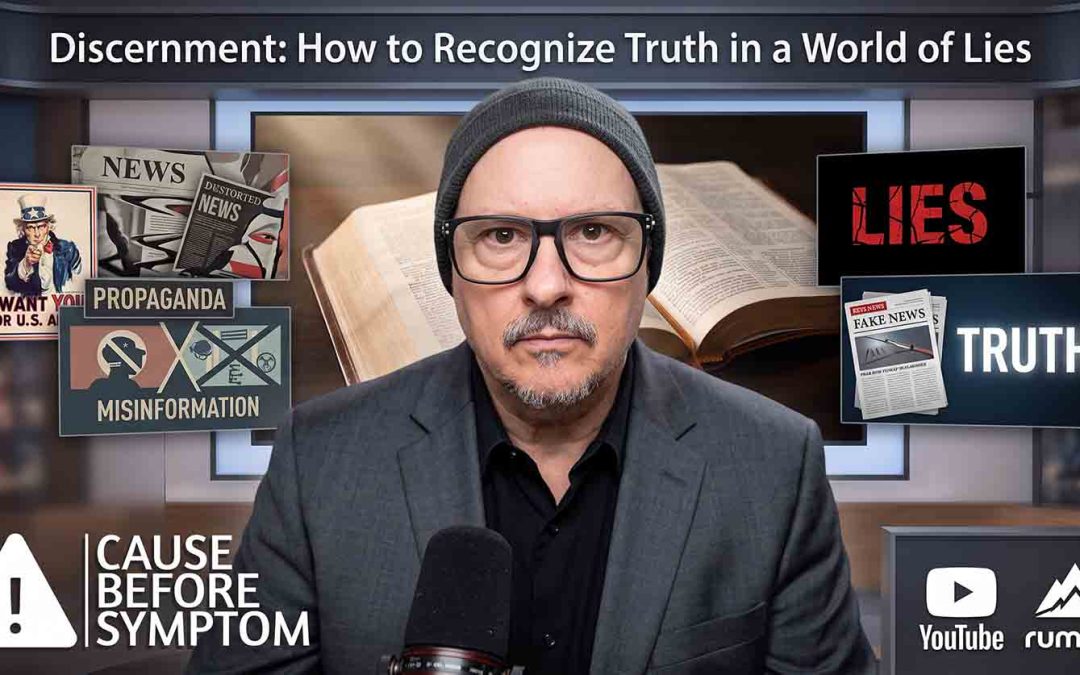
Watch this on Rumble: https://rumble.com/v7hu46g-discernment-how-to-recognize-truth-in-a-world-of-lies.html
Opening — God Never Told Us to Stop Thinking
Good evening, everyone, and welcome to Cause Before Symptom. Tonight, I want to begin with a question that may make some of us uncomfortable. How many things do you believe today that you have never personally investigated? How many opinions do you hold because someone you respect told you they were true? And how many times have you repeated something without knowing where the information originally came from?
We live in a world where information travels faster than understanding. A headline appears, a politician makes an accusation, a preacher offers an interpretation, or someone posts a frightening video. Within minutes, thousands of people have decided what happened, who is responsible, and what everyone else should believe. But very few have examined the original evidence. Even fewer have considered whether there might be another explanation.
And here's something worth thinking about. The people spreading false information are not always lying. Sometimes they sincerely believe what they are telling you. They may have been deceived themselves. That means sincerity is not proof of accuracy, confidence is not proof of knowledge, and popularity is certainly not proof of truth.
But what does the Bible tell us to do about this?
In 1 Thessalonians 5:21, the Apostle Paul writes, "Prove all things; hold fast that which is good." Think about those words. Prove all things. Not simply the things we disagree with. Not merely the claims made by our political opponents. We must also examine the things we want to believe, the things our friends tell us, and even the things spoken by people we admire.
Now, in its original context, Paul was speaking about spiritual discernment, particularly in connection with prophecy. We should respect that context. But the broader lesson is supported throughout Scripture. Proverbs 18:13 warns against answering a matter before hearing it. Proverbs 18:17 reminds us that the first person to present a case may sound convincing until someone else examines the account.
And then we have the Bereans in Acts 17:11. These people listened to the Apostle Paul himself, yet they searched the Scriptures daily to determine whether his teachings were correct. Scripture calls them noble for doing so. They were not criticized for asking questions. They were praised for examining what they heard.
So why do we sometimes behave as though questioning an authority is the same thing as rejecting the truth?
Tonight, we're going to learn something practical. We're going to develop a method for examining the stories presented to us every day. We're calling it the Narrative Credibility Index. It is not a magical formula, and it cannot tell us with absolute certainty whether someone is telling the truth. It is simply a structured way to examine evidence, compare competing accounts, recognize conflicts of interest, and identify what we still do not know.
We'll examine how fear influences judgment, how money can shape information, how religious authority can be misused, and why our own beliefs may sometimes become obstacles to understanding. Most importantly, we're going to learn how to investigate a claim ourselves rather than depending entirely on someone else to interpret the world for us.
And I want to make something clear before we begin. This applies to me, too. Don't believe something simply because I say it on this program. Examine my sources. Read the Scriptures for yourself. Challenge my conclusions when the evidence warrants it. If I am mistaken, I would rather discover the mistake than continue teaching it.
Because discernment is not about proving that we are right. It is about being willing to discover when we are wrong.
Tonight, we're not asking you to abandon your faith, distrust everyone, or become suspicious of everything. We're asking you to exercise the wisdom that Scripture encourages, to listen carefully, examine patiently, and distinguish what is known from what is merely believed.
God never instructed us to surrender our judgment to the loudest voice in the room.
So tonight, before we examine the world around us, we're going to examine something much closer to home: how we decide what is true.
Let's begin.
Investigation 1 — What Does the Bible Actually Teach About Discernment?
Before we can learn how to recognize truth in the world around us, we need to understand what the Bible actually teaches about discernment. Because discernment is not simply knowing the difference between right and wrong. It is the ability to examine what we hear, recognize what is supported by evidence, and avoid being deceived by appearances. Scripture teaches that wisdom requires more than listening. It requires understanding.
Let's begin with 1 Thessalonians 5:21, where Paul writes, "Prove all things; hold fast that which is good." The Greek word translated as "prove" is dokimazete, from dokimazo, meaning to test, examine, or determine whether something is genuine. The word was used for examining the quality or authenticity of something. Paul was not telling believers to accept every spiritual claim without question. He was instructing them to test what they encountered and retain what was good.
Now, context matters. In the preceding verses, Paul tells believers not to despise prophesyings. His instruction to test everything belongs within that discussion. We should not pretend Paul was writing about television networks or modern politics. Nevertheless, Scripture repeatedly teaches the importance of careful judgment, and that principle extends beyond this single passage.
Consider Proverbs 18:13: "He that answereth a matter before he heareth it, it is folly and shame unto him." Think about how often this happens today. Someone sees a headline, watches thirty seconds of a video, or hears an accusation, and immediately reaches a conclusion. They may even begin arguing with others before understanding what actually happened. Solomon warns that responding before hearing the matter is foolish.
Then Proverbs 18:17 tells us, "He that is first in his own cause seemeth just; but his neighbour cometh and searcheth him." This is one of the clearest biblical descriptions of why we must examine competing accounts. The first person presenting a story may sound completely convincing. But when another person questions the account, missing details and contradictions may become visible. Hearing one side is not the same as understanding the whole matter.
We find another example in Acts 17:11. Paul and Silas preached in Berea, and the people received their message with readiness of mind. But they also searched the Scriptures daily to determine whether those teachings were true. Notice something important. These people were listening to an apostle, yet they still examined his message. Scripture describes their conduct as noble. Their willingness to investigate was treated as a virtue, not an act of rebellion.
First John 4:1 adds another warning: "Beloved, believe not every spirit, but try the spirits whether they are of God: because many false prophets are gone out into the world." John was addressing spiritual claims and false teachers, particularly teachings concerning Jesus Christ. His instruction was not to trust every person claiming spiritual authority. Believers were expected to examine those claims against the teaching they had received.
But discernment also requires examining ourselves. Proverbs 12:15 says, "The way of a fool is right in his own eyes: but he that hearkeneth unto counsel is wise." This reminds us that confidence can become an obstacle to wisdom. If we assume we are always correct, we may reject the very evidence that could help us understand.
So here is our first lesson. Biblical discernment is not automatic suspicion, and it is not blind acceptance. It is the willingness to listen, examine, compare, and remain open to correction. It requires patience because the truth is not always immediately obvious.
And remember this distinction. Faith in God is not the same as unquestioning trust in every human being who claims to speak for Him. Scripture repeatedly warns us that people can be mistaken, deceptive, or misled.
If we want to practice discernment, we must begin by accepting a simple responsibility. Before deciding what is true, we must be willing to investigate what we have been told.
That is where wisdom begins.
Investigation 2 — Why Do We Believe Things Without Evidence?
Have you ever wondered why two intelligent people can examine the same information and reach completely different conclusions? One sees proof of corruption while the other sees evidence of good intentions. One believes a political leader is saving the country while another believes that same leader is destroying it. Both may be sincere, both may be educated, and both may be absolutely convinced they are right. How does that happen?
The answer begins with understanding how the human mind works. We like to believe that we gather information, examine the evidence, and then form an opinion. But often, we do things in the opposite order. We develop beliefs through our experiences, upbringing, friendships, religious traditions, and personal loyalties. Then, without realizing it, we begin looking for information that supports what we already believe.
Psychologists call this confirmation bias. It is the tendency to notice, remember, and favor information that agrees with our existing beliefs while giving less attention to evidence that challenges them. This does not mean people are deliberately dishonest. It means our minds can protect familiar conclusions even when we sincerely believe we are being objective.
Consider a simple example. Imagine that two news organizations report the same government decision. One describes it as a necessary measure to protect the country. The other describes it as an attempt to expand government power. Both may report genuine facts, but they emphasize different consequences. A person who already supports the government may accept the first explanation. Someone who distrusts it may accept the second. Neither person has necessarily investigated the original decision.
Now consider what happens when we hear the same claim repeatedly. A statement appears on television, then on social media, then in a conversation with friends. Eventually, it begins to feel familiar. Researchers call this the illusory truth effect. Repetition can increase the feeling that a statement is true, even when the repetition provides no additional evidence. Hearing something a hundred times does not make it a hundred times more accurate.
The Bible recognized the danger of careless belief long before modern psychology gave these tendencies names. Proverbs 14:15 tells us, "The simple believeth every word: but the prudent man looketh well to his going." Notice that the warning is not against listening. It is against accepting everything without examination. Prudence requires looking carefully before deciding which direction to take.
But there is another danger. Some people become so distrustful that they automatically reject anything reported by an institution they dislike. They may believe that rejecting official information makes them independent thinkers. Yet automatic rejection is no more discerning than automatic acceptance. Both allow the source's identity to determine the conclusion before the evidence has been examined.
This becomes especially important when information threatens our identity. If we have spent years supporting a political movement, defending a religious interpretation, or trusting a particular commentator, admitting that we were mistaken can feel like admitting something is wrong with us. So we defend the belief, sometimes without realizing that we have stopped investigating it.
James 1:19 offers a practical correction: "Wherefore, my beloved brethren, let every man be swift to hear, slow to speak, slow to wrath." Imagine how different our conversations would become if we practiced that instruction. Instead of immediately defending our position, we could ask questions. Instead of becoming angry, we could examine the evidence. Instead of treating disagreement as an attack, we could consider whether someone else knows something we have overlooked.
Here is something I want everyone listening tonight to try. Think of one belief you hold very strongly. It might concern politics, religion, history, or something you recently heard in the news. Now ask yourself a difficult question. What evidence would convince me that I am mistaken?
If your answer is that nothing could change your mind, then you may no longer be investigating that particular claim. You may simply be defending it.
And that brings us to our second lesson. Discernment begins when we recognize that our own minds can mislead us. We must examine not only the information being presented, but also the reasons we are inclined to believe it.
Because the easiest person to deceive may sometimes be ourselves.
Investigation 3 — The First Story Is Not Always the True Story
Imagine walking into a room where two people are arguing. The first person tells you that the other has stolen money. They describe what happened, explain why they are angry, and present details that sound convincing. Before the second person speaks, you may already have decided who is guilty. But then you discover that the money was borrowed, that a repayment agreement existed, and that the first person left those details out. Suddenly, the story changes. The original accusation may have contained some true facts, but the conclusion was misleading.
This is exactly the danger described in Proverbs 18:17: "He that is first in his own cause seemeth just; but his neighbour cometh and searcheth him." Solomon understood something that remains important today. The first account we hear often becomes the foundation of what we believe. Every explanation that follows is then judged against that original story, even when the first account was incomplete.
This is particularly dangerous in modern news reporting. A government official makes an announcement, a journalist writes a headline, a commentator interprets the headline, and someone on social media summarizes the commentary. By the time the story reaches us, we may be hearing an interpretation of an interpretation rather than the original statement. Each person in that chain can unintentionally remove important context.
Let's say a politician announces that a government program will receive an additional billion dollars. One headline declares that the politician is investing in the nation's future. Another claims that taxpayers are being forced to finance a political agenda. Both headlines describe the same expenditure, but neither tells us enough to determine whether the decision is wise. We would need to examine the legislation, the funding source, the intended recipients, and the expected results.
This is why primary sources matter. A primary source is evidence directly connected to the event being investigated. It might be a court document, a recorded speech, an original contract, a government financial report, or testimony from someone who witnessed an event. Primary sources are not automatically truthful or complete, but they allow us to examine what was actually said or recorded rather than relying entirely on someone else's description.
We also need to understand the difference between independent confirmation and repetition. If ten websites repeat the same allegation from one anonymous source, we do not necessarily have ten pieces of evidence. We may have one unverified claim repeated ten times. Genuine corroboration requires evidence that does not simply depend on the original report.
The Bible provides an interesting example of careful examination in Deuteronomy 19:15, where a single witness was not sufficient to establish certain legal accusations. The passage required two or three witnesses. This was a judicial safeguard in ancient Israel, not a mathematical formula for modern journalism. Nevertheless, it illustrates the importance of corroboration when serious accusations are being considered.
We must also be careful with opposing accounts. Hearing both sides does not automatically mean the truth lies somewhere in the middle. Sometimes one account is supported by overwhelming evidence while another is demonstrably false. Discernment requires weighing the quality of the evidence, not simply giving every explanation equal credibility.
So how do we apply this lesson? When you encounter an important claim, begin by asking who made it first. Find the original statement if possible. Determine when it was made and what circumstances surrounded it. Then examine the strongest credible evidence that challenges the account. Look for missing dates, omitted statements, conflicting records, and assumptions presented as established facts.
And perhaps most importantly, learn to separate what happened from what someone believes it means. A documented event is one thing. An explanation of someone's motives is another. We should not treat an interpretation as an established fact simply because it sounds reasonable.
Remember, Proverbs does not tell us that the first person is always lying. It tells us that the first account may seem convincing until it is examined.
That is our third lesson. Before accepting a story, make sure you have examined the evidence behind it. The first explanation may be correct, but being first does not make it true.
Sometimes the most important question we can ask is not, "Who is telling the truth?" It is, "What part of the story have I not heard yet?"
Investigation 4 — Who Benefits If I Believe This?
Whenever someone presents a story and asks us to believe it, there is another question worth asking. Who benefits if I accept this explanation? It is a simple question, but it can reveal interests that are not immediately obvious. Governments want public support. Corporations want customers and profits. Political organizations want votes and donations. Religious organizations may seek followers and financial support. None of these interests automatically makes their statements false, but understanding what someone stands to gain can help us examine their claims more carefully.
Consider how advertising works. A company spends money convincing people that its product will improve their lives. The company may present genuine research, satisfied customers, and accurate information. But it also has a financial interest in persuading us to purchase something. We understand this relationship when watching a commercial. Yet we sometimes forget to ask the same questions when information comes from political campaigns, advocacy organizations, news commentators, or influential personalities.
The Bible repeatedly warns about the influence of money on human judgment. Proverbs 15:27 tells us, "He that is greedy of gain troubleth his own house; but he that hateth gifts shall live." The warning concerns the destructive influence of dishonest gain and improper rewards. Money can create pressures that interfere with sound judgment, particularly when someone benefits from reaching a particular conclusion.
First Timothy 6:10 is another passage frequently quoted incorrectly. It does not say that money itself is the root of all evil. The King James Bible says, "For the love of money is the root of all evil." In context, Paul warns about the spiritual dangers of pursuing riches. The distinction matters because possessing money does not establish wrongdoing. The problem arises when the desire for wealth begins controlling decisions and behavior.
Now let's apply this to the information we receive. Suppose an organization publishes a report claiming that a particular government policy will create thousands of jobs. Before accepting the conclusion, we should examine who funded the research, what assumptions were used, and whether independent studies reached similar findings. If the organization represents companies that will receive government contracts, that relationship deserves attention. But it does not automatically invalidate the report. We still have to examine the evidence.
The same principle applies to alternative media. A commentator may accuse traditional news organizations of manipulating the public while earning money from advertising, subscriptions, donations, or merchandise. That does not mean the commentator is dishonest. It means financial incentives are not limited to one side of the information industry. Anyone who profits from maintaining an audience may face pressure to tell that audience what it wants to hear.
And we should be especially careful about assuming that the person who benefits must be the person responsible. If a company profits from a crisis, that does not prove the company caused the crisis. If a politician gains popularity after an event, that does not establish that the politician arranged it. Benefits can help identify questions worth investigating, but they are not proof of hidden coordination.
This is where discernment requires discipline. We must distinguish between a documented financial relationship, a possible conflict of interest, and an allegation of wrongdoing. Those are three different things. Moving from one to another requires additional evidence.
So here is a practical exercise. The next time someone asks you to believe an important claim, investigate who produced the information. Who paid for the research? Who owns the organization? What would happen financially or politically if the audience accepted its conclusion? Then ask whether the evidence would remain convincing even if those interests did not exist.
We should apply this standard to everyone, including people whose conclusions agree with our own beliefs.
Our fourth lesson is simple. Follow the money, but do not allow suspicion to replace proof. Financial interests can explain why a story is promoted, but they cannot establish whether that story is true.
And remember, sometimes the greatest reward is not money at all. It is power, influence, attention, or the satisfaction of controlling what other people believe.
Investigation 5 — How Fear and Anger Can Overpower Discernment
Have you ever noticed how often the news tells us that something terrible is about to happen? A war is coming. The economy is collapsing. Democracy is ending. Our freedoms are disappearing. A new disease is spreading. A politician is going to destroy the country. Every day, someone seems to have another reason for us to be afraid. And before we have time to investigate one warning, another appears to take its place.
Now, some dangers are real. Wars happen, economies suffer, governments make harmful decisions, and people sometimes face genuine threats. Discernment does not mean ignoring those dangers. It means learning to distinguish a documented threat from a frightening prediction, and a reasonable warning from an attempt to manipulate our emotions.
Fear has a powerful effect on human judgment. When we believe something threatens our safety, family, livelihood, or future, our attention naturally moves toward that danger. This response can help protect us. But it can also make us more vulnerable to accepting information without careful examination, especially when someone insists that immediate action is necessary.
Consider a headline announcing that a country is preparing for war. The report may contain genuine military movements, statements from officials, or intelligence assessments. But there is an important difference between saying that a country has moved troops and claiming that an invasion is inevitable. The first statement may be independently verified. The second is a prediction that requires additional evidence. Fear can cause us to treat both statements as equally certain.
Anger creates another problem. When someone tells us that a person or organization is responsible for our suffering, anger can make the accusation feel satisfying. We may stop asking whether the explanation is accurate because we already have someone to blame. This is particularly dangerous when a story identifies an entire population, religion, political movement, or nationality as the enemy.
James 1:19–20 gives us a valuable instruction: "Wherefore, my beloved brethren, let every man be swift to hear, slow to speak, slow to wrath: For the wrath of man worketh not the righteousness of God." James was teaching believers about conduct and righteousness, but the instruction also reminds us that anger is a poor substitute for careful judgment.
Proverbs 29:25 adds, "The fear of man bringeth a snare: but whoso putteth his trust in the LORD shall be safe." In its biblical setting, this concerns the danger of allowing fear of people to control our behavior. It also gives us reason to examine whether social pressure is influencing what we say or believe.
Now consider the modern information business. Television programs compete for viewers. Websites compete for clicks. Social media personalities compete for attention. Frightening or outrageous stories can attract audiences, particularly when they provoke strong emotional reactions. That creates an incentive to emphasize conflict, urgency, and danger. But an incentive is not proof that any particular story was deliberately manufactured.
Religious communities are not immune to this problem. A preacher may sincerely warn about moral decline or spiritual deception. Those concerns deserve examination in their proper biblical context. But when someone repeatedly uses fear to demand loyalty, money, or unquestioning obedience, listeners should carefully examine what is being taught and why.
So how do we protect ourselves? Begin by separating the emotional message from the factual claim. Ask what actually happened, what evidence supports it, and what remains a prediction. Look for original documents and reliable confirmation. Consider whether the same information would seem convincing if it were presented without frightening music, dramatic language, or an angry commentator.
And ask yourself another question. Is someone encouraging me to understand a problem, or simply demanding that I become afraid of it?
Our fifth lesson is that emotions are important signals, but they are not evidence. Fear may alert us to danger, and anger may alert us to injustice. Neither emotion can establish what actually happened.
The next time a headline frightens you or a commentator makes you angry, remember the instruction in James. Be swift to hear, slow to speak, and slow to wrath.
Because when someone gains control of our fear, they may also gain influence over our judgment. And discernment begins when we refuse to let emotion make our decisions before the evidence has been examined.
Investigation 6 — When Religious Authority Replaces Biblical Examination
There is something particularly dangerous about deception when it comes from someone claiming to speak for God. When a politician makes a statement, we understand that political interests may be involved. When a corporation advertises a product, we recognize that it wants our money. But when a preacher stands before a congregation and declares, "God told me," something different happens. For many believers, questioning that statement can feel like questioning God Himself.
But is that what Scripture teaches us to do? Are Christians supposed to accept every religious claim simply because the person making it carries a Bible, holds a title, or has thousands of followers? Or does God expect us to examine those claims for ourselves?
Let's return to Acts 17:11. The Bereans received Paul's teaching with readiness of mind, but they also searched the Scriptures daily to determine whether what he taught was true. Think about that. They were listening to an apostle, someone whose ministry helped establish the early Church. Yet they were commended for examining his message rather than accepting it without investigation.
This distinction is essential. Respecting spiritual leadership is not the same as surrendering responsibility for understanding Scripture. A pastor can teach, explain, encourage, and guide. But the authority of Scripture should not be confused with the personal authority of the person interpreting it.
Jesus Himself warned about religious deception. In Matthew 7:15, He said, "Beware of false prophets, which come to you in sheep's clothing, but inwardly they are ravening wolves." Notice that the warning concerns people who appear harmless or trustworthy. Their outward appearance does not necessarily reveal their intentions. Jesus continues by teaching that people can be recognized by their fruits, directing attention toward what their lives and actions produce.
In Matthew 24:4, Jesus gives another warning: "Take heed that no man deceive you." The following verses concern false messianic claims and the dangers surrounding the events He describes. We should examine that passage in its historical and prophetic context rather than automatically applying every detail to modern events. Nevertheless, Jesus plainly warns His followers against religious deception.
First John 4:1 reinforces this responsibility: "Beloved, believe not every spirit, but try the spirits whether they are of God." John was addressing spiritual teachings, particularly claims about Jesus Christ. The instruction was not to accept every spiritual message merely because someone presented it with confidence or religious language.
Now consider how this applies to us. Suppose a preacher quotes a single verse and declares that it proves a particular doctrine. Before accepting that conclusion, we should read the surrounding passage. Who was speaking? Who was being addressed? What question was being answered? Does the interpretation agree with the broader teaching of Scripture? And if different translations use different wording, what do the underlying manuscripts and original languages actually support?
These questions are not attacks on faith. They are part of responsible biblical study.
But there is another problem we must acknowledge. Religious leaders can sometimes use spiritual authority to obtain money, political influence, personal loyalty, or control over others. This does not mean every successful ministry is corrupt or every preacher who requests donations is dishonest. It means we must examine conduct and evidence rather than assuming that religious language guarantees righteous motives.
We should also be willing to examine our favorite teachers. If we only investigate preachers whose doctrines we dislike, we are practicing loyalty rather than discernment. The same standard must apply to everyone, including the person speaking to you tonight.
And as a pastor, I believe this responsibility is especially important. My calling is not to replace your relationship with God or prevent you from examining Scripture. It is to encourage you to seek understanding and remain faithful to what is true.
Our sixth lesson is that biblical authority and human authority are not interchangeable. A preacher may explain Scripture, but that explanation must still be examined.
Remember the Bereans. They listened with open minds and searched the Scriptures for themselves. They demonstrated that sincere faith and careful investigation can work together.
Because genuine spiritual leadership should encourage understanding, not demand unquestioning obedience. And a believer who examines Scripture carefully is not abandoning faith. That believer is taking the responsibility of discernment seriously.
Investigation 7 — The Narrative Credibility Index: A Tool for Testing Claims
Now that we understand what the Bible teaches about discernment, let's put those lessons into practice. Tonight, I want to introduce a simple research method that anyone can use. We're calling it the Narrative Credibility Index, or NCI. Its purpose is not to tell you what to believe. Its purpose is to help you examine why you believe something and whether the available evidence supports your conclusion.
Think of the NCI as a checklist for investigating a story. Instead of immediately deciding whether something is true or false, we examine seven areas. Each area contributes to a possible score of one hundred points. But remember, this is a teaching tool we're developing, not a scientifically validated truth detector. A score cannot replace sound judgment, and a claim with insufficient evidence may need to remain unresolved.
The first category is primary-source evidence, worth twenty-five points. This is the foundation of our investigation. Can we locate the original document, recording, contract, court filing, or statement? If someone claims a politician said something, can we hear the complete speech? If someone claims a law authorizes a particular action, can we read the law? The closer we get to the original evidence, the less dependent we become on someone else's interpretation.
The second category is independent corroboration, worth twenty points. Can we find other evidence supporting the claim that does not simply repeat the original source? Remember, ten websites copying the same allegation do not necessarily provide ten independent confirmations. We want separate witnesses, records, or observations that genuinely strengthen the conclusion.
The third category is historical accuracy and context, worth fifteen points. Does the story fit the documented timeline? Are statements being presented in their original context? Has an old photograph been described as a recent event? Are important circumstances being omitted? A statement can be factually accurate yet create a misleading impression when separated from its context.
The fourth category examines financial and institutional interests, worth ten points. Who produced the information, who funded it, and who might benefit from its acceptance? We are not deducting points simply because someone has money or influence. We are examining whether relevant interests have been disclosed and whether those interests may have affected the presentation of evidence.
The fifth category is internal consistency, worth ten points. Does the explanation contradict itself? Do the dates, numbers, and statements agree? Are conclusions being drawn that the evidence cannot support? An internally consistent story is not necessarily true, but contradictions may reveal weaknesses requiring further investigation.
The sixth category is transparency and missing evidence, worth ten points. Does the person presenting the claim explain where the information came from? Are uncertainties acknowledged? Can we examine the methods used? And perhaps most importantly, are we being told what remains unknown? Someone who admits the limits of their knowledge may be more reliable than someone who pretends to have every answer.
The seventh category concerns predictive accuracy and subsequent outcomes, worth ten points. If a narrative made specific predictions, what happened afterward? Did the predicted events occur? Were important claims later confirmed or contradicted? We must be careful here because an incorrect prediction does not automatically disprove every other statement someone makes.
Now, here's how we use the index. Write down one specific claim. Examine each category and record the evidence supporting your assessment. Award points only when there is a defensible reason to do so. If evidence is unavailable, mark that category unresolved rather than pretending you know the answer. Record those unknowns separately, because a numerical total can otherwise create a false impression of certainty.
There is one more important safeguard. We must distinguish between the credibility of a particular claim and the reputation of the person making it. A generally reliable person can make a mistake, and an unreliable person can occasionally tell the truth. We are investigating the evidence behind the statement, not simply judging the individual.
This brings us back to 1 Thessalonians 5:21: "Prove all things; hold fast that which is good." Paul was addressing spiritual discernment, but the principle of careful examination is supported throughout Scripture.
Our seventh lesson is that discernment becomes stronger when we follow a consistent method. We should not change our standards depending on whether we like the person making the claim.
And if our investigation ends with the words "I don't know yet," that is not failure. Sometimes those are the most responsible words an investigator can speak.
Because truth does not become more certain simply because we assign it a number. The evidence must always come first.
Investigation 8 — Let's Investigate a Real Story Together
Now it's time to put everything we've learned into practice. Rather than simply telling you how to investigate a story, I want to walk you through an actual historical example. And I've chosen one that demonstrates how an entire nation can be influenced by a narrative that contains genuine evidence, official statements, and conclusions that go far beyond what the evidence establishes.
Our example is the claim that Iraq possessed weapons of mass destruction before the American-led invasion in March 2003. This is an important case because the people presenting the claims included government officials, intelligence agencies, and respected news organizations. The consequences were enormous, and the historical record allows us to examine what was claimed, what was known, and what investigators discovered afterward.
First, let's identify the narrative. The Bush administration argued that Saddam Hussein's government possessed chemical and biological weapons and was pursuing nuclear capabilities. Officials presented intelligence assessments, photographs, intercepted communications, and descriptions of suspected weapons facilities. In February 2003, Secretary of State Colin Powell appeared before the United Nations Security Council to present the American case.
Now consider how an ordinary citizen might have evaluated those claims at the time. The information came from powerful institutions with access to classified intelligence. Much of the underlying evidence was unavailable to the public. That created a serious problem for independent examination. People were being asked to accept conclusions without being able to inspect much of the material supporting them.
Our first NCI category is primary-source evidence. We can now examine Powell's United Nations presentation, the October 2002 National Intelligence Estimate, and subsequent investigative reports. These are genuine historical documents. But the existence of an official document does not establish that every conclusion within it was accurate. A primary source proves what was reported or asserted. It does not necessarily prove the underlying allegation.
Our second category is independent corroboration. Before the invasion, United Nations weapons inspectors were conducting inspections in Iraq. Hans Blix and Mohamed ElBaradei reported their findings to the Security Council. Their reports did not establish that Iraq possessed the active weapons stockpiles alleged by American officials. Important questions remained unresolved, but unresolved questions were not the same thing as confirmed weapons.
Our third category is historical context. Iraq had previously developed and used chemical weapons, including against Kurdish civilians. That history made concerns about weapons programs understandable. But evidence of weapons possessed or used in earlier years could not, by itself, establish what Iraq possessed in 2003. This distinction between historical capability and current evidence was essential.
Our fourth category examines interests and incentives. The United States government had strategic and security objectives concerning Iraq. Those interests were relevant to understanding why officials advocated military action. But identifying an interest does not establish that officials knowingly fabricated intelligence. That would require separate evidence about their knowledge, decisions, and intentions.
The fifth and sixth categories concern consistency and transparency. Some intelligence assessments contained serious uncertainties and disagreements. The public presentation often communicated greater confidence than the underlying evidence justified. The later United States Senate Intelligence Committee investigations documented significant problems with intelligence assessments and the presentation of claims before the war.
Finally, we examine subsequent outcomes. After the invasion, the Iraq Survey Group investigated Iraq's weapons programs. Its findings did not substantiate the alleged active stockpiles of chemical and biological weapons at the time of invasion. The central public justification concerning those stockpiles was not supported by what investigators subsequently found.
So what score should we assign this narrative? Here is where discernment becomes especially important. We could invent a number, perhaps twenty or thirty out of one hundred, but that would suggest a level of precision our unvalidated index cannot honestly provide. Instead, we should record that the central stockpile allegation was contradicted by the subsequent investigation, while examining other claims separately.
And that is the lesson. We must never allow an impressive score, a respected title, or an official presentation to replace examination of the evidence.
Our eighth lesson is that a narrative can contain genuine documents, accurate historical facts, and sincere concerns while still reaching a conclusion that the available evidence does not support.
The question is not simply whether someone presented evidence. The question is whether that evidence actually established what the audience was being asked to believe.
And that is a distinction every American should understand.
Investigation 9 — What Happens When the Evidence Challenges Our Beliefs?
Now we come to what may be the most difficult part of discernment. What happens when the evidence tells us something we do not want to hear? What happens when we discover that a person we trusted was mistaken, that a story we repeated was inaccurate, or that something we believed for years may not be true? Are we willing to change our minds, or do we begin searching for reasons to protect what we already believe?
Think about our previous investigation into Iraq. Millions of Americans believed their government when it said Iraq possessed weapons of mass destruction. Others questioned those claims. After the invasion, investigators failed to find the active weapons stockpiles that had been described. For people who supported the war because of those claims, the evidence presented a difficult challenge. Accepting the findings meant reconsidering something they had once believed with confidence.
But this problem is not limited to governments or wars. It happens in churches, families, political movements, and everyday conversations. We become attached to our beliefs because they are connected to our experiences and identities. Sometimes changing our minds feels like betraying our friends, our community, or even ourselves.
Psychologists describe one part of this experience as cognitive dissonance. It is the discomfort we may experience when new information conflicts with our existing beliefs. Rather than immediately changing our conclusions, we may dismiss the evidence, question the messenger, or search for explanations that allow us to preserve our original position.
Now, questioning evidence is not necessarily wrong. New information should be examined carefully, especially when it contradicts well-established facts. But there is a difference between investigating a challenge and rejecting it simply because we dislike its implications.
Proverbs 12:15 tells us, "The way of a fool is right in his own eyes: but he that hearkeneth unto counsel is wise." Notice that wisdom is associated with the willingness to listen. The fool assumes his own judgment is sufficient. The wise person recognizes that another perspective may reveal something he has overlooked.
Proverbs 19:20 adds, "Hear counsel, and receive instruction, that thou mayest be wise in thy latter end." Wisdom is not presented as something we acquire once and possess forever. It is something we continue developing through instruction, experience, and correction.
And James 3:17 describes the wisdom that comes from above as pure, peaceable, gentle, and easy to be intreated. That last expression is particularly important. It describes a willingness to listen to reason and respond appropriately. Biblical wisdom is not stubbornness disguised as conviction.
But we must also distinguish between faith and factual assumptions. A Christian may hold firmly to faith in God while recognizing that a particular interpretation of prophecy, historical claim, or political prediction was mistaken. Correcting a human interpretation does not automatically mean abandoning faith. Sometimes it means becoming more careful about separating what Scripture actually says from what we have assumed it means.
This is especially important for those of us who teach others. A pastor, journalist, researcher, or commentator can influence many people. If we discover an error, our responsibility is not to hide it to protect our reputation. Our responsibility is to correct it as clearly as possible.
And I include myself in that responsibility. If I present evidence on this program and later discover that I misunderstood a document or reached an unsupported conclusion, I should tell you. The purpose of our investigations is not to prove that I am always right. It is to pursue understanding, even when that requires correcting something I previously taught.
So here is an exercise for everyone listening. Think about a belief you once held but later changed. What caused that change? Was it new evidence, personal experience, careful study, or simply pressure from someone else? Now ask yourself whether you are still willing to reconsider other beliefs when the evidence warrants it.
Our ninth lesson is that discernment requires intellectual humility. We must have the courage to question popular narratives, but also the humility to question our own conclusions.
There are three statements that every honest investigator should be comfortable making. I was wrong. I need more evidence. And I don't know.
Those statements do not demonstrate weakness. They demonstrate that our commitment to truth is greater than our desire to appear correct.
Because the goal of discernment is not to win an argument. It is to understand what is true, even when discovering that truth requires us to change our minds.
Investigation 10 — How to Practice Discernment Every Day
Tonight, we have examined what Scripture teaches about discernment, why our minds sometimes mislead us, how information can be manipulated, and why even respected authorities must be examined. But none of this matters very much unless we can put it into practice. So for our final investigation, I want to give you something you can begin using tomorrow morning, whether you're watching the news, reading your Bible, listening to a preacher, or talking with a friend.
Let's imagine that you wake up tomorrow and discover a frightening headline. It claims that the government has passed a new law allowing officials to take money directly from your bank account. The story is spreading across social media. People are angry, commentators are warning of disaster, and thousands are sharing the information. What should you do?
First, identify exactly what is being claimed. Is there actually a new law, or is someone discussing a proposal? Does the measure apply to everyone or only to particular circumstances? Is the headline describing something that has already happened or something someone predicts might happen? Until we know precisely what is being asserted, we cannot properly investigate it.
Second, locate the original evidence. If someone says Congress passed a law, find the bill number and read the legislation. If a politician supposedly made a statement, locate the complete recording or transcript. If a court issued a ruling, examine the actual decision. We do not have to become lawyers or professional researchers, but we should learn to move beyond headlines whenever the claim is important.
Third, investigate independent confirmation. Look for other sources that have examined the same evidence. But remember what we learned earlier. Ten websites repeating one allegation do not necessarily provide ten independent confirmations. We want separate evidence, not simply repeated opinions.
Fourth, examine the strongest credible opposing explanation. Proverbs 18:17 reminds us that the first account may sound convincing until someone else examines it. This does not mean every opposing argument deserves equal weight. It means we should understand the evidence that challenges our preferred conclusion before deciding what to believe.
Fifth, consider who benefits from the narrative. Does someone want your vote, your money, your attention, or your loyalty? Are there financial relationships or institutional interests worth examining? Remember, identifying a benefit does not prove deception. It simply helps us understand the circumstances surrounding the claim.
Sixth, separate facts from interpretations. A government may genuinely pass a law, but someone claiming that the law will destroy the economy is making a prediction. A company may receive a government contract, but claiming that the contract proves corruption requires additional evidence. We must learn to recognize when a documented event becomes the foundation for an unsupported conclusion.
Seventh, acknowledge what remains unknown. Sometimes the evidence is incomplete. Sometimes records are unavailable, witnesses disagree, or important details have not been established. There is nothing wrong with withholding judgment. In fact, refusing to reach a conclusion before the evidence is sufficient may be one of the clearest demonstrations of discernment.
This is where our Narrative Credibility Index becomes useful. We can examine primary sources, independent corroboration, historical context, incentives, consistency, transparency, and subsequent outcomes. We can record what supports the claim, what challenges it, and what remains unresolved. The purpose is not to manufacture a perfect score. It is to make our reasoning visible so that we can recognize weaknesses and correct mistakes.
And we can apply the same method to religious teachings. When someone quotes Scripture, read the surrounding passage. Examine who was speaking and who was being addressed. Compare the interpretation with other relevant passages. If a preacher claims that God has revealed a particular future event, distinguish what Scripture actually says from the preacher's prediction.
Acts 17:11 tells us that the Bereans searched the Scriptures daily to determine whether the teachings they received were true. They listened, examined, and considered the evidence. Their example reminds us that sincere faith and careful investigation are not enemies.
So here is my challenge. During the next seven days, choose one important claim that you encounter. Don't immediately share it or argue about it. Investigate it. Find the original evidence, examine competing explanations, and write down what you actually know.
And if you discover that your first impression was mistaken, consider that a success rather than a defeat.
Because our tenth lesson is simple. Discernment is not something we practice only when a controversy arises. It is a habit we develop through patience, honesty, humility, and a willingness to learn.
God gave us the responsibility to examine what we hear. We should not surrender that responsibility simply because someone speaks with confidence, possesses authority, or tells us exactly what we want to believe.
The next time someone tells you what to think, remember Paul's instruction in 1 Thessalonians 5:21: "Prove all things; hold fast that which is good."
And then do exactly that.
Conclusion — Truth Does Not Fear Examination
Tonight, we began with a simple question. If God instructed us to examine what we hear, why are we so willing to allow other people to decide what is true? After everything we've investigated, I believe the answer has become clearer. Thinking for ourselves requires effort. It takes time to read original documents, compare competing explanations, examine Scripture, and admit when we don't have enough information. It is much easier to trust someone who already agrees with us and allow that person to do the thinking.
But convenience is not wisdom, and agreement is not evidence.
Throughout this investigation, we have discovered that deception does not always begin with a deliberate lie. Sometimes it begins with an incomplete story, a misunderstood statement, an exaggerated prediction, or a sincere person repeating something that was never verified. A narrative can contain genuine facts while leading us toward a conclusion those facts do not establish. And sometimes the person most responsible for misleading us is the person looking back at us in the mirror.
That is why discernment must begin with humility. We cannot examine the beliefs of others while refusing to question our own. We cannot demand evidence from our political opponents while accepting unsupported claims from our friends. And we cannot criticize religious leaders for misinterpreting Scripture while refusing to examine the interpretations we personally prefer.
Proverbs 18:13 warns us about answering a matter before hearing it. Proverbs 18:17 reminds us that the first account may seem convincing until another person examines it. And 1 Thessalonians 5:21 gives us the instruction that has guided tonight's program: "Prove all things; hold fast that which is good."
Notice something important about that final instruction. Paul does not merely tell believers to reject what is false. He also tells them to hold fast to what is good. Discernment is not an endless search for reasons to distrust everyone. Its purpose is to recognize what deserves our confidence and retain it.
That distinction matters because suspicion can become just as dangerous as gullibility. A person who believes every official statement without examination can be deceived. But so can a person who automatically rejects every official statement. Both have allowed their assumptions to determine the conclusion before investigating the evidence.
Tonight, we introduced the Narrative Credibility Index as a practical method for examining claims. We learned to look for primary evidence, independent confirmation, historical context, financial interests, internal consistency, transparency, and subsequent outcomes. But I want you to remember something. No number, formula, or computer program can replace the responsibility of careful judgment. A score may help organize our findings, but it cannot transform an unsupported assumption into a fact.
And there is another lesson here that reaches beyond politics, news, and public controversy. As Christians, we must be careful not to confuse faith in God with unquestioning confidence in human beings. A preacher can misunderstand Scripture. A respected teacher can make a mistake. A religious organization can become more concerned with influence than understanding. That is why the Bereans remain such an important example. They received Paul's teaching with open minds, but they searched the Scriptures to examine what they had heard.
Their example teaches us that faith and examination can exist together. We do not honor God by pretending to know what we have never investigated. Nor do we demonstrate wisdom by claiming certainty where the evidence remains incomplete.
So I want to leave you with a challenge. The next time someone presents a frightening headline, an exciting discovery, a political accusation, or a religious interpretation, resist the temptation to immediately agree or disagree. Ask questions. Find the original source. Examine the strongest credible challenge. Consider what might be missing. And be willing to say, "I don't know yet."
Most importantly, apply that same standard to this program. Don't believe something simply because I said it. Read the documents. Examine the history. Open your Bible. If you find that I have made a mistake, bring the evidence forward. I would rather correct an error than defend it simply because the words came out of my mouth.
Because our purpose here at Cause Before Symptom has never been to replace one authority with another. It is to investigate the causes behind the stories we are told, so that we can better understand the world in which we live.
Truth does not become false because someone questions it. And falsehood does not become truth because millions of people repeat it.
So let us be patient enough to listen, courageous enough to question, humble enough to learn, and wise enough to recognize when the evidence does not yet justify a conclusion.
And when we do discover what is good and true, let us hold fast to it.
God bless you all, and thank you for joining me tonight on Cause Before Symptom.
Selah.
Bibliography
- The Holy Bible. King James Version. 1611. Cambridge: Cambridge University Press, various editions.
- Aland, Kurt, and Barbara Aland. The Text of the New Testament: An Introduction to the Critical Editions and to the Theory and Practice of Modern Textual Criticism. 2nd rev. ed. Translated by Erroll F. Rhodes. Grand Rapids, MI: William B. Eerdmans, 1989.
- Aristotle. On Rhetoric: A Theory of Civic Discourse. Translated by George A. Kennedy. 2nd ed. New York: Oxford University Press, 2007.
- Baron, Jonathan. Thinking and Deciding. 4th ed. New York: Cambridge University Press, 2008.
- Blix, Hans. Disarming Iraq. New York: Pantheon Books, 2004.
- Cialdini, Robert B. Influence: Science and Practice. 5th ed. Boston: Pearson Education, 2009.
- Festinger, Leon. A Theory of Cognitive Dissonance. Stanford, CA: Stanford University Press, 1957.
- Festinger, Leon, Henry W. Riecken, and Stanley Schachter. When Prophecy Fails. Minneapolis: University of Minnesota Press, 1956.
- Gilovich, Thomas. How We Know What Isn't So: The Fallibility of Human Reason in Everyday Life. New York: Free Press, 1991.
- Haidt, Jonathan. The Righteous Mind: Why Good People Are Divided by Politics and Religion. New York: Pantheon Books, 2012.
- Kahneman, Daniel. Thinking, Fast and Slow. New York: Farrar, Straus and Giroux, 2011.
- Kunda, Ziva. "The Case for Motivated Reasoning." Psychological Bulletin 108, no. 3 (1990): 480–498. https://doi.org/10.1037/0033-2909.108.3.480.
- Lewandowsky, Stephan, Ullrich K. H. Ecker, Colleen M. Seifert, Norbert Schwarz, and John Cook. "Misinformation and Its Correction: Continued Influence and Successful Debiasing." Psychological Science in the Public Interest 13, no. 3 (2012): 106–131. https://doi.org/10.1177/1529100612451018.
- Liddell, Henry George, Robert Scott, and Henry Stuart Jones. A Greek-English Lexicon. 9th ed. Oxford: Clarendon Press, 1940.
- Metzger, Bruce M., and Bart D. Ehrman. The Text of the New Testament: Its Transmission, Corruption, and Restoration. 4th ed. New York: Oxford University Press, 2005.
- Nickerson, Raymond S. "Confirmation Bias: A Ubiquitous Phenomenon in Many Guises." Review of General Psychology 2, no. 2 (1998): 175–220. https://doi.org/10.1037/1089-2680.2.2.175.
- Pennycook, Gordon, and David G. Rand. "The Psychology of Fake News." Trends in Cognitive Sciences 25, no. 5 (2021): 388–402. https://doi.org/10.1016/j.tics.2021.02.007.
- Powell, Colin L. "Remarks to the United Nations Security Council." New York, February 5, 2003. U.S. Department of State, archived historical record.
- Ross, Lee, and Richard E. Nisbett. The Person and the Situation: Perspectives of Social Psychology. New York: McGraw-Hill, 1991.
- Schwarz, Norbert, Lawrence J. Sanna, Ian Skurnik, and Carolyn Yoon. "Metacognitive Experiences and the Intricacies of Setting People Straight: Implications for Debiasing and Public Information Campaigns." Advances in Experimental Social Psychology 39 (2007): 127–161. https://doi.org/10.1016/S0065-2601(06)39003-X.
- Stanley, Jason. How Propaganda Works. Princeton, NJ: Princeton University Press, 2015.
- Strong, James. The Exhaustive Concordance of the Bible. New York: Hunt & Eaton, 1890.
- Tavris, Carol, and Elliot Aronson. Mistakes Were Made (But Not by Me): Why We Justify Foolish Beliefs, Bad Decisions, and Hurtful Acts. Orlando, FL: Harcourt, 2007.
- United Nations Monitoring, Verification and Inspection Commission. Reports and Briefings to the United Nations Security Council on Weapons Inspections in Iraq. New York: United Nations, 2002–2003.
- United Nations Security Council. Official Records of the 4701st Meeting, February 5, 2003. S/PV.4701. New York: United Nations, 2003.
- United States Central Intelligence Agency. Iraq's Weapons of Mass Destruction Programs. Washington, DC: Central Intelligence Agency, October 2002.
- United States Commission on the Intelligence Capabilities of the United States Regarding Weapons of Mass Destruction. Report to the President of the United States. Washington, DC: U.S. Government Printing Office, 2005.
- United States Senate Select Committee on Intelligence. Report on the U.S. Intelligence Community's Prewar Intelligence Assessments on Iraq. S. Rep. 108-301. Washington, DC: U.S. Government Printing Office, 2004.
- United States Senate Select Committee on Intelligence. Report on Whether Public Statements Regarding Iraq by U.S. Government Officials Were Substantiated by Intelligence Information. S. Rep. 110-345. Washington, DC: U.S. Government Printing Office, 2008.
- United States Special Advisor to the Director of Central Intelligence on Iraq's Weapons of Mass Destruction. Comprehensive Report of the Special Advisor to the DCI on Iraq's WMD. Washington, DC: Central Intelligence Agency, September 30, 2004.
- Vosoughi, Soroush, Deb Roy, and Sinan Aral. "The Spread of True and False News Online." Science 359, no. 6380 (2018): 1146–1151. https://doi.org/10.1126/science.aap9559.
- Wood, Thomas, and Ethan Porter. "The Elusive Backfire Effect: Mass Attitudes' Steadfast Factual Adherence." Political Behavior 41 (2019): 135–163. https://doi.org/10.1007/s11109-018-9443-y.
Endnotes
- The central biblical instruction for this investigation comes from 1 Thessalonians 5:21, "Prove all things; hold fast that which is good." The Greek verb dokimazete, derived from dokimazo, conveys the idea of testing, examining, or approving after examination. In its immediate context, Paul's instruction follows his discussion of prophecy and spiritual conduct. Applying the principle to evaluating modern factual claims is an extension of the broader biblical teaching on wisdom, not a claim that Paul was specifically discussing journalism or politics.
- Proverbs 18:13 warns against answering a matter before hearing it. Proverbs 18:17 describes how an initial account may appear convincing until another person examines it. Together, these passages provide a biblical foundation for listening carefully, considering competing testimony, and withholding judgment until sufficient information has been examined. Neither passage requires treating all competing explanations as equally credible.
- Acts 17:11 describes the Bereans examining the Scriptures daily to determine whether the message preached by Paul and Silas was consistent with their sacred writings. The passage commends both their willingness to receive the message and their diligence in examining it. Their example supports responsible biblical investigation without implying that every religious or historical question can be resolved through Scripture alone.
- First John 4:1 instructs believers to test the spirits because false prophets had entered the world. The immediate context concerns religious teaching, particularly claims about Jesus Christ. The passage should not be presented as a direct instruction about modern news organizations, although its emphasis on examining spiritual claims is relevant to the broader discussion of discernment.
- Proverbs 14:15 contrasts the person who believes every word with the prudent person who carefully considers his actions. Proverbs 12:15 and Proverbs 19:20 likewise emphasize the importance of receiving counsel and correction. These passages support the distinction between genuine wisdom and confidence that refuses examination.
- The psychological concept of confirmation bias describes the tendency to seek, interpret, remember, or favor information consistent with existing beliefs. Raymond Nickerson's 1998 review in Review of General Psychology provides a substantial examination of this phenomenon. Confirmation bias does not mean that every strongly held belief is mistaken or that people are incapable of evaluating contradictory evidence.
- Motivated reasoning concerns the influence of desired conclusions on how people evaluate information. Ziva Kunda's 1990 article in Psychological Bulletin explains how motivation can affect reasoning while remaining constrained by available knowledge and perceived plausibility. The existence of motivated reasoning does not establish that a particular individual's conclusions are false.
- The illusory truth effect refers to the tendency for repeated statements to become more believable through familiarity. Research on processing fluency and repetition helps explain why frequently encountered claims may feel credible even without additional supporting evidence. The effect is not universal, and repetition alone does not guarantee belief.
- Cognitive dissonance, developed as a psychological theory by Leon Festinger, describes discomfort arising from conflicting beliefs, attitudes, or behaviors. People may respond by changing their beliefs, reconsidering evidence, or developing explanations that reduce the conflict. Festinger's work does not establish that everyone confronted with contradictory evidence will reject it.
- James 1:19–20 emphasizes being swift to hear, slow to speak, and slow to wrath. Its immediate purpose concerns Christian conduct and righteousness. Applying these principles to public debate encourages patience and emotional restraint without suggesting that anger always makes accurate judgment impossible.
- Proverbs 29:25 warns that fear of man brings a snare. The passage concerns the danger of allowing human fear or approval to govern one's actions. Its application to modern information environments is interpretive rather than a direct historical reference to media manipulation.
- Proverbs 15:27 addresses the destructive effects of greed and improper gain. First Timothy 6:10 warns about the love of money, not the mere possession of wealth. These passages should not be used to claim that financial success proves corruption. Financial interests may identify possible conflicts requiring investigation, but wrongdoing must be established through evidence.
- Matthew 7:15–20 warns against false prophets and describes recognition through their fruits. Matthew 24:4–5 warns against deception, particularly false messianic claims. Both passages must be understood within their biblical contexts before being applied to modern religious movements or individual teachers.
- The Narrative Credibility Index introduced in this program is a proposed educational framework rather than an established or scientifically validated measurement. Its seven categories and numerical weights were developed for this investigation. No empirical validation has established that these particular weights accurately predict truthfulness. Scores should therefore be treated as provisional research aids, not objective probabilities that a claim is true.
- Primary-source evidence includes original documents, recordings, direct testimony, and records created in connection with the event being examined. Such evidence can establish what was recorded or asserted, but its authenticity, accuracy, completeness, and context must still be evaluated. A primary source is not automatically a truthful source.
- Independent corroboration requires evidence that does not merely reproduce an earlier allegation. Multiple publications relying on the same anonymous source may represent one evidentiary chain rather than several independent confirmations. The quality, independence, and relevance of supporting evidence matter more than the number of sources repeating a claim.
- The requirement for multiple witnesses in Deuteronomy 19:15 belongs to the legal framework of ancient Israel. Its use in this program illustrates the historical importance of corroboration. It should not be treated as a universal rule that two witnesses automatically establish truth or that modern investigations must follow ancient Israelite judicial procedures.
- The October 2002 U.S. intelligence assessment concerning Iraq's weapons programs contained judgments about chemical, biological, and nuclear capabilities. Subsequent investigations identified serious weaknesses in several central assessments. The historical fact that intelligence agencies issued these judgments does not establish that the judgments were accurate.
- Colin Powell's February 5, 2003, presentation to the United Nations Security Council publicly summarized intelligence allegations concerning Iraqi weapons programs. The official United Nations record preserves the presentation. Later investigations found that important claims were unsupported or incorrect. Evaluating the presentation requires distinguishing the intelligence available at the time from what subsequent investigations established.
- United Nations weapons inspectors Hans Blix and Mohamed ElBaradei reported findings to the Security Council before the March 2003 invasion. Their reports described inspection activities, unresolved disarmament questions, and the status of nuclear-related allegations. They did not establish the existence of the active weapons stockpiles claimed by American officials.
- The Iraq Survey Group's 2004 Comprehensive Report, commonly associated with Charles Duelfer, examined Iraq's weapons programs following the invasion. Its findings did not substantiate the alleged active chemical and biological weapons stockpiles existing at the time of the invasion. The report also examined Iraq's historical capabilities, intentions, and the effects of sanctions, which should not be confused with proof of active stockpiles.
- The U.S. Senate Select Committee on Intelligence issued major reports in 2004 and 2008 examining prewar intelligence assessments and the relationship between public statements and available intelligence. These investigations identified significant intelligence failures and instances in which public claims were not substantiated by the underlying intelligence. Such findings should not automatically be interpreted as proof that every official knowingly lied.
- Research by Vosoughi, Roy, and Aral, published in Science in 2018, examined the diffusion of true and false news stories on Twitter. The researchers found that falsehood spread farther, faster, more deeply, and more broadly than truth within the studied dataset. These findings should not be generalized without qualification to every platform, topic, or period.
- Research by Pennycook and Rand examines psychological mechanisms associated with misinformation, including the importance of analytical reasoning and attention to accuracy. Their work supports the usefulness of encouraging people to evaluate evidence carefully, but no single intervention guarantees that individuals will consistently identify false claims.
- Research by Lewandowsky and colleagues addresses the continued influence of misinformation even after corrections are provided. Corrections can improve understanding, but their effectiveness depends on circumstances, presentation, and the beliefs of the audience. The persistence of misinformation does not mean correction is futile.
- The concept of a backfire effect, in which corrections supposedly strengthen false beliefs, has received considerable attention. Research by Wood and Porter found limited evidence for a widespread factual backfire effect in the political claims they examined. It would therefore be misleading to suggest that correcting misinformation generally makes people believe it more strongly.
- The distinction between evidence and interpretation is essential throughout this investigation. A documented event, an explanation of why it happened, and a prediction of its consequences are separate propositions requiring different kinds of support. Evidence establishing one proposition does not automatically establish the others.
- Financial benefit, political advantage, institutional influence, and personal reputation may provide useful investigative context. However, identifying someone who benefits from an event does not establish that the person caused, planned, or knowingly misrepresented it. Claims of coordination or intentional deception require independent supporting evidence.
- The final principle of this investigation is that uncertainty should be acknowledged rather than concealed. When evidence is incomplete, contradictory, or unavailable, withholding judgment may be more responsible than assigning a confident conclusion. Biblical discernment, historical investigation, and responsible research all benefit from distinguishing established knowledge from reasonable inference and unresolved speculation.
#CauseBeforeSymptom, #Discernment, #BiblicalDiscernment, #TruthMatters, #ProveAllThings, #TestEverything, #FaithAndReason, #SpiritualDiscernment, #CriticalThinking, #NarrativeCredibilityIndex, #QuestionEverything, #SeekTheTruth, #BiblicalWisdom, #ChristianFaith, #MediaManipulation, #Misinformation, #ConfirmationBias, #FollowTheEvidence, #ThinkForYourself, #BibleStudy, #KingJamesBible, #TruthAndDeception, #WisdomAndUnderstanding, #FaithAndTruth, #DoYourOwnResearch
CauseBeforeSymptom, Discernment, BiblicalDiscernment, TruthMatters, ProveAllThings, TestEverything, FaithAndReason, SpiritualDiscernment, CriticalThinking, NarrativeCredibilityIndex, QuestionEverything, SeekTheTruth, BiblicalWisdom, ChristianFaith, MediaManipulation, Misinformation, ConfirmationBias, FollowTheEvidence, ThinkForYourself, BibleStudy, KingJamesBible, TruthAndDeception, WisdomAndUnderstanding, FaithAndTruth, DoYourOwnResearch