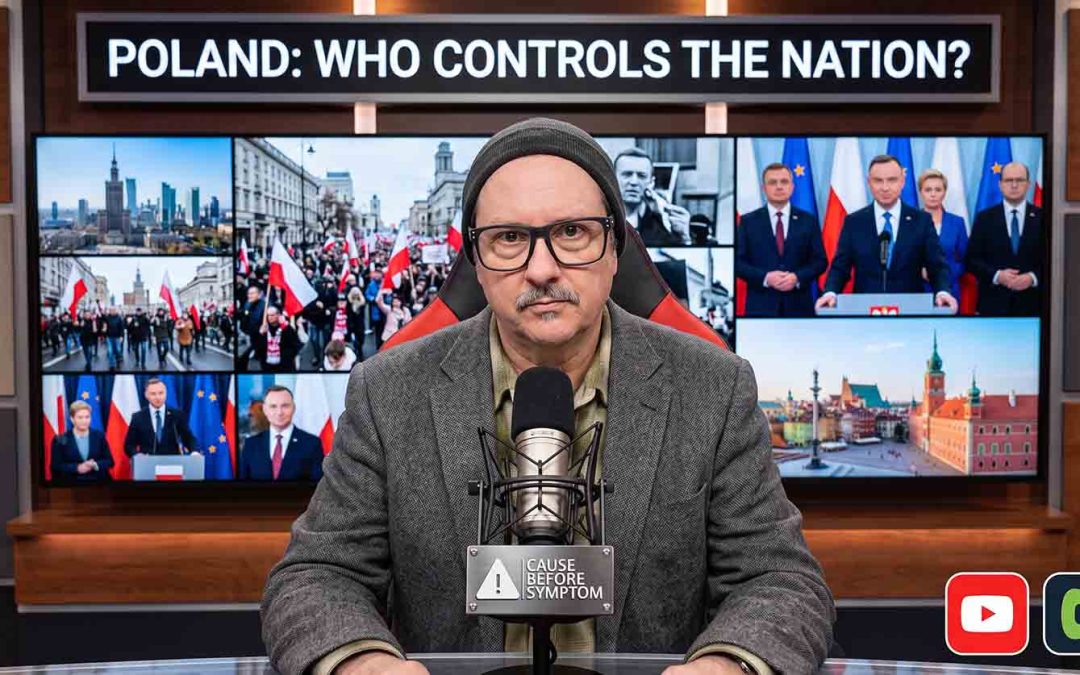
Watch this on Rumble: https://rumble.com/v7hor2s-poland-who-controls-the-nation.html
Opening
Good evening, and welcome to Cause Before Symptom.
Tonight, we are going to Poland, a nation that has fought for centuries to preserve its independence. What is happening there may appear to be another political disagreement between conservatives and liberals, but beneath the headlines are questions about constitutional authority, military spending, national debt, and who ultimately controls a country's future.
On October 30, 2026, Poland experienced a confrontation inside its Constitutional Tribunal. A judge announced the suspension of the court's president and deputy president. Police surrounded the building. Protesters gathered. President Karol Nawrocki interrupted an overseas trip and returned home. Prime Minister Donald Tusk defended the effort to restore what his government considers lawful judicial authority. His opponents accused the government of attempting a coup.
But was it a coup? Or was it an effort to correct years of political interference with the courts? Those are competing claims, and neither should be accepted without examining the evidence.
To understand Poland, we must first understand its history.
This is a nation that disappeared from the map for 123 years. Russia, Prussia, and Austria divided its territory among themselves. Its people endured foreign domination, two world wars, Nazi occupation, and decades under a communist government supported by the Soviet Union.
Through these experiences, Poland developed a strong attachment to national independence. Christianity, particularly the Catholic Church, became closely connected with its national identity. For generations, preserving Polish culture and faith was part of resisting foreign domination.
Now consider February 2022.
Russia launched its full-scale invasion of Ukraine. European governments suddenly faced questions about their military readiness, weapons production, energy supplies, and national security. Defense spending increased, and European leaders began searching for ways to finance a much larger military establishment.
The European Union eventually established a program called Security Action for Europe, or SAFE, offering up to 150 billion euros in defense loans.
Poland became its largest intended recipient, with approximately 43.7 billion euros available.
And here is where the money enters our investigation.
Poland's president challenged the European borrowing arrangement, while Prime Minister Tusk supported it. Their disagreement raised questions about debt, European financing conditions, and how Poland should pay for its military defenses.
Meanwhile, Poland possesses something many European countries no longer have: its own national currency.
Poland uses the złoty, not the euro. Its National Bank controls national monetary policy and manages substantial financial reserves, including gold.
That independence matters because adopting the euro would fundamentally change who makes Poland's monetary decisions.
Does that mean Brussels is attempting to seize Poland's gold? We have not established that. Does European defense financing create financial obligations for Poland? Absolutely. And has Russia's invasion made those decisions more urgent? The historical sequence clearly shows that it has.
But there is another important fact.
Poland's constitutional conflict began in 2015, years before Russia's full-scale invasion. We cannot pretend the war created every political disagreement now unfolding in Warsaw.
Tonight, we will examine how these separate developments came together.
We will investigate Poland's history, Christianity's role in its independence, the war in Ukraine, European borrowing, the national bank, and the political movements fighting over constitutional authority.
We will distinguish evidence from accusation and financial influence from outright ownership.
Because our central question is not simply whether the Christian right or the pro-European coalition controls Poland's courts.
It is whether Poland can preserve meaningful national independence while financing its security and participating in an increasingly integrated Europe.
Who makes the decisions? Who receives the money? Who repays the debt? And who has the final constitutional authority?
Those are the questions we must answer.
And tonight, as always, we will search for the cause before we accept the symptom.
Investigation 1 — The Nation That Disappeared
To understand what is happening in Poland today, we must begin with something almost unimaginable. There was a time when Poland was one of the largest and most influential political powers in Europe. Then, through a combination of internal political weakness and foreign intervention, the country disappeared from the map for 123 years.
This did not happen overnight. And that is what makes Poland's history so important to our investigation.
During the sixteenth and seventeenth centuries, the Polish-Lithuanian Commonwealth governed an enormous territory stretching across much of Eastern Europe. It was a powerful political union with an elected monarchy, a parliament, and an unusual tradition of religious tolerance for its time. Catholics, Protestants, Orthodox Christians, and Jews lived within its borders, although their rights and circumstances were not equal.
But the Commonwealth had a weakness. Powerful nobles enjoyed political privileges that made effective government increasingly difficult. One practice, known as the liberum veto, allowed a single parliamentary deputy to disrupt legislative proceedings. What had been defended as protection against tyranny became an obstacle to reform.
Foreign governments learned how to exploit that weakness.
Russia, Prussia, and Austria recognized that a divided Poland was easier to influence than a strong one. They cultivated relationships with powerful nobles, interfered in political decisions, and eventually used military force to advance their territorial interests.
In 1772, those three powers carried out the First Partition of Poland. They seized enormous portions of Polish territory while the weakened Commonwealth remained on the map.
But something remarkable happened next.
Polish reformers recognized that their political system needed repair. On May 3, 1791, they adopted one of the world's earliest modern written national constitutions. It strengthened the government, limited political obstruction, and attempted to protect the country against further foreign interference.
The constitution was not a modern democracy. Political rights remained unequal, and the monarchy continued. Nevertheless, it represented a serious effort to restore effective national government.
And that frightened Poland's powerful neighbors.
Some conservative Polish nobles opposed the reforms because they threatened their privileges. They formed the Targowica Confederation with Russian backing and appealed to Catherine the Great for assistance.
Russian forces invaded in 1792.
Notice what happened. Polish leaders disagreed about their constitution. Some invited foreign intervention to defend their political position. Russia used that opportunity to impose its will.
In 1793, Russia and Prussia carried out the Second Partition. Poland lost more territory.
Then, in 1794, General Tadeusz Kościuszko led an uprising to defend what remained of Polish independence. His forces included ordinary people willing to fight for their country. But the uprising failed.
In 1795, Russia, Prussia, and Austria completed the Third Partition. Poland ceased to exist as an independent state.
Its people remained. Its language remained. Its religious traditions, literature, and national identity survived. But its government, territory, and political authority were divided among foreign empires.
Poland would not regain independence until 1918.
Now, why does this matter in 2026?
Because Poland's history teaches us that national sovereignty involves more than having a flag, a parliament, or elected leaders. It also involves whether those institutions can make decisions without unlawful outside coercion.
But history teaches another lesson. Not every foreign relationship is domination, and not every domestic political disagreement is treason.
Today's European Union is not the Russian Empire, Prussia, or Austria. Poland voluntarily joined the EU through a democratic process and accepted treaty obligations.
Nevertheless, the historical experience helps explain why arguments about constitutional authority, national currency, foreign financing, and political independence provoke such strong reactions.
The question for modern Poland is whether its institutions can resolve their disagreements lawfully while preserving the authority its constitution gives them.
Because the lesson of the partitions is not that compromise destroys nations.
It is that political paralysis, foreign coercion, and the failure to protect lawful government can make a nation vulnerable.
And that brings us to the next investigation: how Christianity became one of the institutions through which Polish national identity survived.
Investigation 2 — Christianity, Communism, and Polish Independence
To understand Poland's political struggles, we must understand the role Christianity has played in preserving its national identity. For many Polish families, Christianity was never simply a matter of attending church on Sunday. It became connected with their language, their history, their independence, and their resistance to foreign domination.
That relationship began more than a thousand years ago.
In 966, Mieszko I, ruler of the early Polish state, accepted Christianity through the Latin Church. His baptism helped connect Poland with the Christian kingdoms of Western Europe and strengthened his position as a recognized ruler.
Over the following centuries, the Catholic Church became an important institution in Polish society. Churches, monasteries, and schools helped preserve written records, education, and cultural traditions.
But Poland was never entirely Catholic. Its history also includes Orthodox Christians, Protestants, Jews, and other religious communities. The Polish-Lithuanian Commonwealth became known for an unusual degree of religious tolerance during parts of the sixteenth century, although that tolerance was never universal.
The relationship between Christianity and Polish independence became especially important after the partitions of the eighteenth century.
When Russia, Prussia, and Austria divided Poland, the country lost its independent government. Polish communities were placed under different foreign administrations, each pursuing its own political and cultural policies.
Catholic churches and religious institutions helped preserve Polish language and traditions in many communities. Religious celebrations became occasions for expressing national identity.
But the situation was complicated. Some Catholic leaders supported independence movements, while others favored cooperation with existing authorities. Poland's religious history cannot be reduced to one united political movement.
Then came the twentieth century.
After Poland regained independence in 1918, it experienced political instability, economic hardship, and eventually the devastating German and Soviet invasions of 1939.
Nazi Germany persecuted Polish religious leaders and murdered thousands of clergy and religious workers. The occupation also brought the systematic destruction of Poland's Jewish population, including communities that had lived in Polish lands for centuries.
Following World War II, Poland came under a communist government closely aligned with the Soviet Union.
Communist authorities attempted to restrict the Catholic Church's public influence, control religious institutions, and weaken independent organizations. Cardinal Stefan Wyszyński, one of Poland's leading religious figures, was detained by the communist government from 1953 until 1956.
Yet the Church remained one of the country's most influential institutions outside direct communist control.
In 1978, something extraordinary happened.
Karol Wojtyła, the archbishop of Kraków, was elected Pope John Paul II.
The following year, he visited Poland. Millions attended religious gatherings, and his message emphasized human dignity, spiritual freedom, and the importance of national identity.
His visit did not single-handedly overthrow communism. Economic problems, workers' protests, political organizing, and changing Soviet policies were all essential. But his influence helped strengthen the confidence of people who wanted greater freedom.
In 1980, workers established the Solidarity movement. Catholic institutions provided important moral support and, in some cases, meeting places and assistance.
By 1989, Poland had begun its transition toward democratic government.
Now consider the present conflict.
Poland's national-conservative Law and Justice movement emphasizes traditional Catholic values, national identity, and resistance to what it regards as excessive European interference.
Prime Minister Donald Tusk's coalition emphasizes European cooperation, constitutional reform, and restoring judicial independence. But it would be misleading to describe his entire coalition as anti-Christian. Polish Catholics hold different political opinions, and Christianity does not belong to one political party.
That distinction is essential.
The historical Church helped many Poles resist foreign domination. But religious identity does not automatically make a modern political leader constitutional, truthful, or correct.
Likewise, supporting European integration does not automatically mean rejecting Christianity or Polish independence.
So when we examine the confrontation between Poland's conservative president and its pro-European government, we must judge their actions by evidence rather than religious labels.
Because the question is not which political party can claim Christianity.
The question is whether political leaders are protecting the freedoms, institutions, and human dignity that generations of Polish Christians struggled to preserve.
Investigation 3 — The War That Changed Europe's Finances
On February 24, 2022, Russian forces launched a full-scale invasion of Ukraine. Within days, European governments faced questions they had spent decades trying to avoid. Was Europe prepared for a major war on its eastern borders? Could its factories produce enough weapons? And where would the money come from to rebuild its military capabilities?
To understand the financial consequences, we must remember what Europe looked like before the invasion.
For decades, European governments had expanded trade with Russia. Russian natural gas supplied homes, factories, and power stations across the continent. Germany, in particular, developed extensive energy relationships with Russian suppliers. European businesses invested in Russian markets, while Russia earned substantial revenue selling energy to Europe.
This relationship created economic benefits, but it also created dependence.
When Russia invaded Ukraine, European leaders began imposing sanctions and reducing their reliance on Russian energy. Russia also sharply reduced gas deliveries through major pipelines. Energy prices surged, inflation accelerated, and governments spent enormous sums protecting households and businesses from rising costs.
Meanwhile, Ukraine needed weapons, ammunition, financial assistance, and humanitarian support.
European governments began providing that assistance while also examining their own military shortages.
The war revealed how difficult it could be to replace equipment quickly. Ammunition production had to increase. Military factories needed investment. Governments reconsidered their defenses, transportation networks, and the security of their eastern borders.
Poland became especially important.
It borders Ukraine and serves as a major transportation and logistics center for Western assistance. It also borders Belarus and Russia's Kaliningrad region. Its geographical position makes Polish security important to the wider European defense system.
Poland responded by expanding military spending and purchasing substantial quantities of equipment, including tanks, aircraft, artillery, and air-defense systems.
But military equipment costs money, and governments must decide how to finance it.
That brings us to the European Union.
In 2025, the EU established Security Action for Europe, known as SAFE. The program authorized up to 150 billion euros in loans to help participating countries invest in defense capabilities and military production.
Poland was allocated approximately 43.7 billion euros, the largest national share.
Now consider the distinction between a grant and a loan.
A grant generally does not have to be repaid. A loan does. Borrowing can provide money immediately, but it also creates future obligations. Governments must consider interest costs, repayment schedules, procurement rules, and the conditions attached to financing.
Poland's political leaders disagreed over those obligations.
President Karol Nawrocki opposed the SAFE financing legislation, expressing concerns about dependence on European institutions. Prime Minister Donald Tusk supported the program, arguing that European financing could help Poland strengthen its military capabilities.
Their disagreement was not simply about whether Poland needed protection. It concerned how that protection should be financed and what obligations the country should accept.
But we must be careful about another claim.
European governments increasing military spending does not prove they have decided to start a war against Russia. They describe much of this spending as deterrence, readiness, and support for Ukraine. Critics question the costs, risks of escalation, and long-term consequences.
Both the stated objectives and the financial obligations deserve examination.
And here is the larger issue.
Russia's invasion did not create Poland's constitutional crisis. That struggle began years earlier. But the war increased the importance of Poland's military, financial resources, and decisions about European cooperation.
Suddenly, arguments about national authority involved tens of billions of euros and decisions affecting European security.
The war changed the financial environment in which Poland's political struggle is taking place.
And that leads us to our next question.
With European governments borrowing heavily, increasing military expenditures, and supporting Ukraine, how much financial pressure is the European Union actually facing?
And who will ultimately pay the bill?
Investigation 4 — Is the European Union Running Out of Money?
When people hear that the European Union is borrowing billions to finance military spending, they naturally ask a question. Is Europe running out of money? And if European governments are struggling financially, could that explain why Poland's resources and financial independence have become so important?
To answer that, we must first understand what the European Union actually is.
The EU is not a single country with one treasury responsible for every government expense. It is a political and economic union of twenty-seven member states. Each government maintains its own budget, collects taxes, and manages public debt, although European rules influence those decisions.
Some member countries carry enormous debts. Others have comparatively stronger public finances. France and Italy, for example, face substantial debt burdens, while Germany has historically maintained a lower debt ratio than several major European economies.
But high government debt does not automatically mean bankruptcy.
A government can continue borrowing as long as investors are willing to lend at sustainable rates. Problems arise when debt grows faster than the economy, interest payments consume more public revenue, or lenders lose confidence in repayment.
Europe faces genuine financial pressures.
Its population is aging. Governments must finance pensions, healthcare, infrastructure, and public services. Economic growth has been relatively weak in parts of the continent. Energy disruptions following Russia's invasion of Ukraine increased costs for households and industries.
Now add military spending.
European governments are purchasing weapons, expanding ammunition production, improving infrastructure, and strengthening their defenses. Supporting Ukraine creates additional financial commitments.
Every euro allocated to defense must come from somewhere. Governments can raise taxes, reduce other spending, borrow money, or combine those approaches.
The European Union has increasingly turned toward collective borrowing for certain major programs.
During the COVID-19 pandemic, the EU created NextGenerationEU, allowing the European Commission to borrow hundreds of billions of euros to support economic recovery.
That borrowing created repayment obligations extending into future decades.
Then came the SAFE defense program, authorizing up to 150 billion euros in additional lending to participating countries.
But there is an important distinction.
SAFE is not simply Brussels collecting 150 billion euros and spending it without repayment. The European Commission raises money in capital markets and lends it to participating governments under established arrangements.
Those governments are responsible for repaying their loans.
This means European institutions can expand their influence through financing arrangements without acquiring ownership of national assets.
Borrowing may involve procurement requirements, reporting obligations, and legal conditions. Those conditions deserve scrutiny because they affect how governments spend public money.
But they are not the same thing as confiscating a country's gold or natural resources.
And this brings us back to Poland.
Poland has undertaken one of Europe's largest military expansion programs. Its leaders must decide how to pay for equipment, personnel, maintenance, and future obligations.
President Nawrocki questioned whether European loans might create unacceptable financial dependence. Prime Minister Tusk argued that participating in SAFE would help Poland finance necessary defenses.
Both positions concern real financial choices.
Now consider the larger European picture.
The EU has significant borrowing capacity, a large economic base, and access to international capital markets. It also faces serious budgetary disagreements and competing spending priorities.
Therefore, describing the entire European Union as bankrupt would be misleading.
But describing Europe as financially unconstrained would be equally misleading.
Its governments must make difficult choices about debt, taxation, defense, and economic growth.
And those choices have political consequences.
When a government borrows money, the important questions are who approves the borrowing, what conditions apply, how the money is spent, and who must repay it.
That is where sovereignty and finance meet.
For Poland, the issue is not simply whether Europe has enough money. It is whether Polish institutions retain lawful authority over the financial obligations they accept.
And that brings us to something Poland has deliberately preserved: its own currency, central bank, and gold reserves.
Investigation 5 — Poland's Gold, Currency, and Central Bank
When we talk about a nation's independence, we usually think about its borders, its military, and its elected government. But there is another kind of independence that is just as important. It concerns who controls the nation's money.
And in Poland, that question has a long and painful history.
When Poland was divided among Russia, Prussia, and Austria, its territories came under different financial systems. After independence returned in 1918, Polish leaders had to rebuild their monetary institutions and establish a stable national currency.
In 1924, Poland introduced a reformed złoty and established a new Bank Polski. Following World War II, the National Bank of Poland, known as the NBP, became the country's central bank.
Under communist rule, banking was closely tied to government economic planning. After 1989, Poland began rebuilding a market economy and reforming its financial institutions.
Then came the Constitution of 1997.
Article 227 established the National Bank of Poland as the country's central bank and gave it the exclusive right to issue money and formulate and implement monetary policy. The Constitution also identifies maintaining the value of Polish currency as the bank's primary objective.
That matters because monetary policy affects inflation, interest rates, borrowing costs, and the value of people's savings.
Poland joined the European Union in 2004, but it did not adopt the euro.
Instead, Poland retained the złoty.
This means the National Bank of Poland continues to make monetary-policy decisions for the country rather than having those decisions made by the European Central Bank.
Now consider Poland's gold.
The National Bank has accumulated substantial gold reserves as part of its international reserve assets. Gold can help diversify reserves and provide protection against certain financial risks.
But we must distinguish between possessing gold and having money available for government spending.
Central-bank gold is not simply a pile of coins that politicians can withdraw whenever they want. It is an asset held by the central bank, subject to accounting rules, monetary responsibilities, and legal protections.
That distinction became politically important in 2026.
President Karol Nawrocki proposed an alternative to European defense borrowing that involved financial gains associated with the National Bank's reserves.
Prime Minister Donald Tusk favored the European Union's SAFE defense-loan program.
This was a genuine disagreement over how Poland should finance its military expansion.
But neither proposal meant that Poland's gold automatically belonged to the president, prime minister, or European Union.
Now consider what would happen if Poland eventually adopted the euro.
Monetary-policy authority would move into the Eurosystem, where the European Central Bank and participating national central banks conduct monetary policy together.
Poland would lose the ability to set its own independent interest-rate policy for the złoty because the złoty would be replaced.
That would be a substantial change in national monetary authority.
But adopting the euro would not automatically mean Brussels could confiscate Poland's entire gold reserve or take ownership of its mines, factories, or natural resources.
The legal arrangements are more complicated, and any such claims require specific evidence.
There is another important point. EU membership already creates obligations concerning eventual euro adoption for member states without a permanent exemption. However, Poland has no fixed adoption date and does not currently meet all the necessary requirements.
So Poland faces a long-term decision about monetary integration, even while retaining its national currency today.
This brings us to the heart of the financial question.
The issue is not whether Poland has valuable assets. It does.
The issue is who has the lawful authority to manage those assets, authorize borrowing, and make decisions affecting future generations.
A country can own gold and still accumulate debt. It can maintain its currency and still depend on foreign lenders. And it can participate in an economic union while retaining important constitutional protections.
Financial sovereignty is therefore not simply about what a nation owns.
It is about who has the authority to decide what happens to that wealth.
And that leads us to the European defense-loan program, where those questions become immediate.
Investigation 6 — The €150 Billion Defense Program
When the European Union announced a defense-financing program worth up to 150 billion euros, the headline sounded straightforward. Europe needed stronger defenses, and its governments needed money to purchase weapons, ammunition, and military equipment.
But behind that announcement was a much larger question. Who would borrow the money, who would control how it was spent, and who would be responsible for paying it back?
The program is called Security Action for Europe, or SAFE. It was adopted in May 2025 as part of the European Union's effort to increase defense readiness following Russia's invasion of Ukraine.
SAFE allows the European Commission to borrow money from financial markets and lend it to participating member countries.
This is important because the European Union is not simply handing out free money. These are loans, and participating governments must repay them according to their agreements.
The program also encourages countries to coordinate military purchases and strengthen European defense production. Its rules generally favor equipment containing a substantial proportion of components produced within the European Union and certain eligible partner countries.
That means SAFE is about more than financing weapons. It is also about building industrial capacity, securing supply chains, and directing military investment toward approved suppliers.
Now consider Poland.
Poland received the largest national allocation, approximately 43.7 billion euros. That represented almost thirty percent of the program's total lending capacity.
For a country expanding its armed forces, access to that amount of financing could make an enormous difference.
But borrowing also creates obligations.
Poland would have to repay the loans. Its purchases would need to satisfy program requirements. European institutions would review the arrangements under the applicable regulations.
Supporters argued that this financing could reduce immediate budgetary pressure, provide favorable borrowing terms, and accelerate military modernization.
Opponents questioned whether the conditions could create long-term dependence on Brussels.
President Karol Nawrocki became one of the program's most prominent critics.
In March 2026, he vetoed legislation associated with Poland's participation in SAFE. He argued that European financing could expose Poland to political pressure if payments were suspended while repayment obligations remained.
Prime Minister Donald Tusk disagreed.
His government maintained that European borrowing offered Poland a practical way to strengthen its defenses without bearing all the immediate financing costs through ordinary national borrowing.
Here we should distinguish a legitimate financial concern from an allegation that has not been proven.
A loan agreement can impose binding obligations. It can limit how borrowed money is used. It can require reporting, inspections, and compliance with established conditions.
But that does not automatically give the lender ownership of a country's central bank, gold reserves, or natural resources.
Nor does receiving a European defense loan mean that Poland has surrendered control of its armed forces.
Those claims would require specific legal provisions establishing such transfers.
There is another issue worth examining.
When European governments borrow collectively to finance national defense programs, they create financial relationships that can last for decades. Future taxpayers may be responsible for obligations approved by today's political leaders.
That makes transparency essential.
Citizens deserve to know the interest rates, repayment schedules, procurement conditions, and consequences of failing to comply with the agreements.
They also deserve to know whether the financing strengthens domestic industry or directs a substantial share of purchases toward foreign manufacturers.
And we should ask whether European financing provides better terms than Poland could obtain independently.
These are questions that can be answered through contracts, budgets, and procurement records.
So the argument over SAFE is not merely about supporting Ukraine or preparing for possible aggression.
It concerns the price of military security and the degree of financial independence Poland wishes to preserve.
And when the president and prime minister disagree over commitments involving tens of billions of euros, the authority of Poland's constitutional institutions becomes especially important.
That brings us to the political crisis itself.
Who has the lawful authority to decide Poland's future, and how did the struggle over that authority begin?
Investigation 7 — Who Started the Constitutional Crisis?
When a president and a prime minister disagree, that does not necessarily mean a country is facing a constitutional crisis. Democracies are designed to handle political disagreements. The trouble begins when the people responsible for enforcing the law cannot agree about which institutions have lawful authority.
That is the problem Poland has struggled with for more than a decade.
To understand it, we must return to 2015, long before the latest dispute over European defense financing.
That year, Poland's outgoing parliament, controlled by Civic Platform and its coalition partner, selected five judges for the Constitutional Tribunal. The appointments became controversial because some of the seats would become vacant only after the newly elected parliament took office.
After the Law and Justice party won the election, the incoming parliament rejected those selections and appointed its own candidates.
The Constitutional Tribunal subsequently ruled that three of the earlier selections had been lawful, while two had not.
That distinction mattered. The outgoing parliament had exceeded its authority concerning two seats, but the incoming majority was not entitled to disregard the three lawful selections.
President Andrzej Duda declined to swear in those three judges.
The new government then pursued further changes to the Tribunal and the judicial system.
Supporters of Law and Justice argued that the courts needed reform because they remained influenced by an entrenched legal establishment. Critics argued that the changes weakened judicial independence and allowed politicians to exercise improper influence over judges.
The dispute expanded to the National Council of the Judiciary, the Supreme Court, and the rules governing judicial appointments.
European institutions became involved because Poland had accepted obligations concerning judicial independence when it joined the European Union.
The European Commission brought legal challenges. The Court of Justice of the European Union issued rulings concerning aspects of Poland's judicial reforms. European human-rights institutions also identified serious problems involving judicial appointments and independence.
Law and Justice leaders argued that Brussels was interfering in matters reserved for Poland's constitutional institutions.
Their opponents argued that the Polish government was violating commitments it had voluntarily accepted.
Now notice something important.
The original dispute was not created by the war in Ukraine, European defense loans, or Poland's gold reserves.
It began with contested judicial appointments and developed into a struggle over the independence and legitimacy of the courts.
In 2023, voters changed Poland's political direction.
Donald Tusk returned to power at the head of a coalition promising to restore the rule of law and repair relations with European institutions.
But winning an election did not automatically resolve the judicial dispute.
Judges appointed under the previous government remained in office. Existing laws and constitutional procedures still applied. President Duda, and later President Karol Nawrocki, could exercise presidential powers that complicated the government's reform efforts.
Tusk's coalition faced a difficult question: how could it reverse disputed judicial changes without itself disregarding the law?
That question divided legal experts and political leaders.
Supporters of the government argued that extraordinary corrective measures were necessary to restore lawful institutions. Critics warned that dismissing officials or refusing to recognize existing institutions could create new constitutional violations.
This is why Poland's crisis cannot fairly be explained as one side defending the constitution while the other side simply opposes it.
The record contains documented abuses, contested remedies, and genuine disagreements over constitutional procedure.
But those disagreements are not all equally supported by judicial rulings. Decisions from Polish and European courts must be examined individually, rather than treated as interchangeable political opinions.
And this brings us to the most important lesson.
A constitution is supposed to place limits on everyone, including the people we support.
If one government can disregard legal protections because it believes its cause is righteous, another government may claim the same power tomorrow.
For Poland, the challenge is to restore public confidence in institutions whose legitimacy has been disputed for years.
And now that constitutional struggle has become entangled with military financing, European relations, and competing claims about national sovereignty.
To understand who benefits politically, we must examine the leaders and movements on both sides.
Investigation 8 — The Christian Right, Tusk, and Brussels
Poland's political struggle is often described as a battle between Christians defending their nation and European leaders trying to take away its independence. But that description leaves out something important. Both sides claim to be protecting Poland. They simply disagree about what threatens the country most.
To understand the disagreement, we must examine what each side actually wants.
The Law and Justice party, commonly known as PiS, has built much of its political identity around Polish sovereignty, traditional family values, national history, and Catholic culture.
Its leaders argue that Poland must remain free to make its own decisions about immigration, social policy, the courts, and national security.
Many conservative voters remember the country's long experience under foreign rule. They worry that decisions made in Brussels could gradually replace decisions made in Warsaw.
Those concerns deserve to be examined rather than dismissed.
But there is another side to the record.
When Law and Justice governed Poland from 2015 to 2023, its changes to the judiciary produced serious disputes over judicial independence. European courts found that aspects of those reforms failed to meet applicable legal standards.
That matters because defending national sovereignty does not give a government permission to disregard its own constitutional limits.
Now consider Donald Tusk.
Tusk previously served as Poland's prime minister and later as president of the European Council. He returned to the Polish premiership in 2023, leading a coalition that promised closer European cooperation and restoration of the rule of law.
His supporters argue that Poland gains security and economic strength by working with European partners.
They point to European trade, investment, infrastructure funding, and cooperation against Russian aggression.
But Tusk's government must also answer difficult questions.
When it attempts to reverse disputed judicial appointments or change institutions established under previous governments, are its methods consistent with Polish law?
A government cannot restore respect for the constitution by assuming that its own good intentions excuse unlawful actions.
Now consider Brussels.
The European Union has an interest in ensuring that member countries follow the treaties they accepted. Those treaties include obligations concerning judicial independence and the rule of law.
European institutions also have an interest in keeping Poland closely involved in European defense, particularly because of its location near Ukraine, Belarus, and Russia.
But Brussels is not a single person directing every decision.
The European Commission proposes and administers policies. The European Parliament participates in legislation and oversight. The Council represents member governments. European courts interpret applicable European law.
Poland participates in those institutions. It is not merely an outsider receiving orders.
Still, European cooperation creates real obligations, and those obligations can limit what national governments are free to do.
That is the central disagreement.
Conservative leaders tend to emphasize the dangers of outside influence. Tusk's coalition tends to emphasize the dangers of isolation and weakened democratic institutions.
Both arguments can contain legitimate concerns. Neither should be accepted without evidence.
And where does Christianity fit?
Catholicism has played an important role in Poland's national history. But no political party owns the Christian faith.
Some Polish Catholics support Law and Justice. Others support Tusk's coalition or different political movements entirely. Some believe close European cooperation protects peace and human dignity. Others believe stronger national authority is necessary to preserve religious and cultural freedom.
We must also distinguish the Catholic Church itself from politicians who use Christian language.
A politician quoting Scripture does not prove that his policies reflect Christian principles. And a politician disagreeing with Church leaders does not automatically make him an enemy of Christianity.
The question is whether leaders act with justice, honesty, restraint, and respect for human dignity.
This is where our investigation must remain disciplined.
We have evidence of political competition, disputed judicial reforms, European legal pressure, and disagreements over defense financing.
We do not have evidence that every European institution is secretly working to destroy Polish Christianity, or that every conservative leader is motivated only by faith.
Those claims would require proof.
The struggle is therefore not simply Christianity against Brussels.
It is a contest over political authority, constitutional limits, national identity, and the benefits and costs of European cooperation.
And behind that contest stands a much larger security question.
Does Europe need Poland because it wants to protect its eastern border, or is Poland being drawn into commitments that its people may not fully understand?
Investigation 9 — Does Europe Need Poland to Confront Russia?
Look at a map of Europe, and something becomes clear. Poland occupies one of the most important positions on the continent. To its east are Ukraine and Belarus. To its north is Russia's Kaliningrad region. To its west are Germany and the economic centers of Western Europe.
That geography helps explain why Poland matters so much to European security.
When Russia launched its full-scale invasion of Ukraine in 2022, Poland became a major route for Western military and humanitarian assistance. Supplies moving toward Ukraine passed through Polish transportation networks, including roads, railways, and airports.
Poland also welcomed large numbers of Ukrainians fleeing the fighting.
These actions made Poland important not because it possessed something Europe intended to seize, but because of its location, infrastructure, military capabilities, and political decisions.
Now consider NATO.
Poland joined the North Atlantic Treaty Organization in 1999, five years before entering the European Union.
NATO is a military alliance. Its members have agreed that an armed attack against one can trigger collective defense obligations under Article 5.
But Article 5 does not automatically require every member to declare war or take identical military action. Each country determines what action it considers necessary under the treaty.
The European Union is different.
The EU coordinates economic policy, trade, legislation, and certain security initiatives. It also has a mutual-assistance clause, but it is not the same institution as NATO.
That distinction matters because people sometimes describe Brussels as though it directly commands Poland's armed forces.
It does not.
Poland retains its own military command, constitutional authorities, and national defense responsibilities. Alliance commitments and international agreements influence its choices, but they do not erase its government.
Now consider Russia.
Polish leaders across much of the political spectrum regard Russia's military aggression as a serious security threat. Their concern is grounded in geography, Poland's historical experience, and Russia's ongoing war against Ukraine.
European leaders have argued that stronger defenses can discourage further aggression.
Critics, however, warn that expanding military spending and increasing confrontation can raise the risk of escalation.
That concern deserves attention.
Military deterrence is intended to prevent war by making aggression more costly. But deterrence can fail, and governments must carefully manage the danger of miscalculation.
So we must ask a direct question.
Does Europe's military buildup prove that European leaders are preparing to invade Russia?
No. Increased military spending alone does not establish that intention. To support such a claim, we would need evidence of an offensive decision, operational plans, or other reliable documentation.
Now consider another allegation: that European institutions need Poland's gold or national resources to finance a future war.
Poland possesses substantial gold reserves and valuable economic assets. But those facts do not establish that Brussels has a plan to confiscate them.
European defense financing operates through identifiable laws, borrowing arrangements, budgets, and repayment obligations. If someone claims that a financial agreement permits seizure of Polish assets, we should demand the specific legal provision.
Without that evidence, suspicion remains suspicion.
But that does not mean Poland faces no difficult choices.
Its military expansion is expensive. Its international commitments matter. Its location makes it a key participant in European security planning.
And its citizens deserve to know what their government has promised, how much those promises will cost, and whether those commitments increase or reduce the risk of war.
This is where national sovereignty becomes practical.
Poland cannot change its geography. It can, however, debate its military spending, scrutinize financing agreements, and insist that major decisions follow constitutional procedures.
Europe needs a secure Poland because instability along its eastern borders could affect the entire continent.
Poland needs dependable partners because defending itself entirely alone would carry enormous risks.
The challenge is finding cooperation that strengthens security without weakening democratic accountability.
And that leads us to our final investigation.
When Poland's president, prime minister, courts, central bank, and European partners disagree, who ultimately has the authority to decide the nation's future?
Investigation 10 — Who Will Control Poland's Future?
We began this investigation by examining a nation that disappeared from the map for 123 years. We followed Poland through foreign occupation, world wars, communist rule, and its struggle to regain political independence.
Now, in 2026, Poland faces another test.
But this time, foreign armies have not divided the country. Poland has its own government, its own military, its own currency, and a constitution intended to protect its institutions.
The question is whether those institutions can govern effectively when their leaders disagree about the law.
President Karol Nawrocki and Prime Minister Donald Tusk represent competing political visions. Nawrocki emphasizes national sovereignty, conservative values, and resistance to what he considers excessive European influence. Tusk emphasizes European cooperation, judicial reform, and stronger ties with Poland's Western partners.
Both claim to be defending the country.
But neither the president nor the prime minister possesses unlimited authority.
Poland's constitution divides power among its institutions. Parliament makes laws. The president exercises defined constitutional powers. The government administers national policy. Courts interpret and apply the law within their jurisdiction.
The National Bank of Poland has its own constitutional responsibilities.
These divisions are not weaknesses. They are protections against concentrating too much authority in one place.
But protections work only when political leaders respect them.
The judicial disputes that began in 2015 demonstrate what happens when institutions lose confidence in one another. If rival political camps recognize different judges, challenge different rulings, or refuse to accept established procedures, ordinary citizens can no longer be certain which decisions will stand.
That uncertainty affects more than politics.
Businesses need dependable courts. Families need enforceable rights. Investors need predictable laws. And governments need legitimate authority to make decisions involving billions of euros.
Now consider the European Union.
Poland voluntarily joined the EU in 2004. Membership brought economic opportunities, access to a large common market, and obligations under European treaties.
Those obligations are real. But membership does not mean Poland has ceased to exist as a sovereign state.
The challenge is determining which decisions belong to Polish institutions, which responsibilities Poland has accepted through treaties, and how disputes should be resolved lawfully.
Then there is the question of money.
Poland retains the złoty and its national central bank. It possesses substantial gold reserves. It also faces enormous military expenditures and decisions about borrowing.
The SAFE defense-financing dispute illustrates the problem.
One side argues that European loans can strengthen Poland's defenses at favorable financial terms. The other fears that borrowing through European institutions could create political dependence.
Neither position should be accepted simply because a political leader announces it.
The contracts, repayment obligations, legal conditions, and alternatives must be examined.
And we must ask who benefits financially from military purchases, which companies receive contracts, and what future taxpayers will owe.
These questions matter regardless of which party controls the government.
Now consider Christianity.
For generations, Polish Christians helped preserve their nation's identity during periods of foreign domination. But the lesson of that history is not that one political party has inherited God's authority.
Christian faith cannot replace constitutional accountability.
A leader who speaks about God must still tell the truth. A leader who promises national independence must still obey the law. And a leader who promises European cooperation must still answer to the people whose future is being decided.
That brings us to the central finding of this investigation.
We have established that Poland faces genuine disputes over judicial legitimacy, European obligations, military financing, and national monetary authority.
We have not established that Brussels plans to seize Poland's gold, that European leaders have secretly decided to invade Russia, or that Poland's political crisis was created solely to transfer its wealth abroad.
Those are different claims, and evidence matters.
Poland's future will not be decided by a single loan, election, or court ruling.
It will be shaped by whether its people can demand transparent agreements, lawful government, independent institutions, and honest public debate.
Because a nation can lose control without losing its flag.
And a nation can cooperate with others without surrendering its independence.
The difference is whether its people remain able to hold those who govern accountable.
That is the question Poland must answer.
And it is a question every nation should ask before its leaders make promises that future generations will have to keep.
Bibliography
- Davies, Norman. God's Playground: A History of Poland. 2 vols. Revised ed. Oxford: Oxford University Press, 2005.
- Kłoczowski, Jerzy. A History of Polish Christianity. Cambridge: Cambridge University Press, 2000.
- Prażmowska, Anita J. A History of Poland. 2nd ed. Basingstoke: Palgrave Macmillan, 2011.
- Zamoyski, Adam. The Polish Way: A Thousand-Year History of the Poles and Their Culture. New York: Hippocrene Books, 1987.
- Constitution of the Republic of Poland. April 2, 1997. Particularly Articles 10, 122, 126, 173, 188–197, and 227.
- European Union. Consolidated Version of the Treaty on European Union. Official Journal of the European Union, 2012. Particularly Articles 4, 5, 7, 19, and 42.
- North Atlantic Treaty Organization. The North Atlantic Treaty. Washington, DC, April 4, 1949. Particularly Articles 4 and 5.
- European Commission. 2026 Rule of Law Report: Country Chapter on the Rule of Law Situation in Poland. Brussels, 2026.
- European Commission. Convergence Report 2026. Brussels, 2026.
- European Commission. NextGenerationEU: Borrowing and Lending Operations. European Commission, official financing documentation.
- Council of the European Union. Council Regulation (EU) 2025/1106 of 27 May 2025 Establishing the Security Action for Europe (SAFE) through the Reinforcement of the European Defence Industry Instrument. Official Journal of the European Union, 2025.
- European Commission. Security Action for Europe (SAFE). Official program documentation, financing arrangements, and national allocations.
- National Bank of Poland. Annual Report 2025. Warsaw: Narodowy Bank Polski.
- National Bank of Poland. Official Reserve Assets. Statistical publications and gold-reserve disclosures.
- European Central Bank. Convergence Report. Frankfurt am Main: European Central Bank. Sections concerning Poland's monetary framework and euro-adoption requirements.
- European Court of Human Rights. Reczkowicz v. Poland. Application no. 43447/19. Judgment of July 22, 2021.
- European Court of Human Rights. Dolińska-Ficek and Ozimek v. Poland. Applications nos. 49868/19 and 57511/19. Judgment of November 8, 2021.
- Court of Justice of the European Union. European Commission v. Republic of Poland. Case C-791/19. Judgment of July 15, 2021.
- European Commission for Democracy through Law (Venice Commission). Opinion on Amendments to the Act of 25 June 2015 on the Constitutional Tribunal of Poland. Opinion No. 833/2015. March 11–12, 2016.
- Institute of National Remembrance, Poland. Historical research and archival publications concerning the communist period, Cardinal Stefan Wyszyński, Father Jerzy Popiełuszko, and the Solidarity movement.
- Reuters. Reporting on Poland's SAFE defense-financing dispute, President Karol Nawrocki, Prime Minister Donald Tusk, and the judicial and constitutional confrontation, 2026.
- Associated Press. Reporting on Poland's constitutional institutions, judicial reforms, European relations, and political disputes, 2025–2026.
- Biskupski, M. B. B. The History of Poland.
- Dabrowski, Patrice M. Poland: The First Thousand Years.
- Davies, Norman. God's Playground: A History of Poland. Volume 1, The Origins to 1795.
- Davies, Norman. God's Playground: A History of Poland. Volume 2, 1795 to the Present.
- Halecki, Oskar, W. F. Reddaway, J. H. Penson, and others, editors. The Cambridge History of Poland. Volume 1.
- Reddaway, W. F., J. H. Penson, Oskar Halecki, and others, editors. The Cambridge History of Poland. Volume 2.
- Kłoczowski, Jerzy. A History of Polish Christianity.
- Lukowski, Jerzy, and Hubert Zawadzki. A Concise History of Poland.
- Michnik, Adam, and Agnieszka Marczyk, editors. Against Anti-Semitism: An Anthology of Twentieth-Century Polish Writings.
- Prażmowska, Anita J. A History of Poland.
- Roe, Michael. Polish Shipping Under Communism.
- Rospond, Vincent W. Polish Armies of the Partitions, 1770–1795.
- Snyder, Timothy. The Reconstruction of Nations: Poland, Ukraine, Lithuania, Belarus, 1569–1999.
- Zamoyski, Adam. The Polish Way: A Thousand-Year History of the Poles and Their Culture.
Endnotes
- Poland's disappearance from the political map resulted from three partitions in 1772, 1793, and 1795, carried out by Russia, Prussia, and Austria. Polish independence was restored in 1918. Norman Davies, God's Playground; Adam Zamoyski, The Polish Way.
- The Constitution of May 3, 1791, attempted to reform the Polish-Lithuanian Commonwealth. Its adoption was followed by internal opposition, Russian military intervention, and further partitions. Jerzy Lukowski and Hubert Zawadzki, A Concise History of Poland; Norman Davies, God's Playground.
- Mieszko I's baptism in 966 is traditionally regarded as a defining event in the Christianization of the early Polish state. Poland's religious history also includes Orthodox Christians, Protestants, Jews, and other communities. Jerzy Kłoczowski, A History of Polish Christianity; Patrice M. Dabrowski, Poland: The First Thousand Years.
- During the partitions, religious institutions helped preserve Polish language and identity in many communities. The Catholic Church's relationship with political authorities varied by region, period, and individual leader. Jerzy Kłoczowski, A History of Polish Christianity; Adam Zamoyski, The Polish Way.
- Cardinal Stefan Wyszyński was detained by Poland's communist authorities from 1953 to 1956. Father Jerzy Popiełuszko was murdered by communist security officers in 1984. Institute of National Remembrance, Poland, historical and archival publications.
- Karol Wojtyła became Pope John Paul II in 1978. His 1979 visit to Poland contributed to the growth of public confidence and religious solidarity, although the collapse of communist rule resulted from several political, economic, and social developments. Norman Davies, God's Playground; Jerzy Kłoczowski, A History of Polish Christianity.
- The Solidarity movement emerged from labor protests in 1980. Its membership included religious believers, secular workers, intellectuals, and political reformers. The Catholic Church provided significant support, but Solidarity was not exclusively a religious organization. Anita J. Prażmowska, A History of Poland; Norman Davies, God's Playground.
- Russia launched its full-scale invasion of Ukraine on February 24, 2022. The war accelerated European defense spending, energy diversification, and financial assistance to Ukraine. European Commission and European Council, official policy and financing documentation.
- Poland's position along NATO's eastern flank makes it important to regional defense and the movement of assistance to Ukraine. Poland joined NATO in 1999 and the European Union in 2004. NATO, The North Atlantic Treaty; European Union, official enlargement records.
- NATO's Article 5 establishes collective-defense obligations following an armed attack, but each member determines the action it considers necessary. NATO and the European Union are separate organizations with different legal responsibilities. NATO, The North Atlantic Treaty, Article 5; Treaty on European Union, Article 42.
- The European Union's NextGenerationEU program authorized substantial common borrowing in response to the COVID-19 pandemic. Its financing and repayment arrangements create obligations extending into future decades. European Commission, NextGenerationEU: Borrowing and Lending Operations.
- The European Union established Security Action for Europe, known as SAFE, in May 2025. The program provides up to €150 billion in loans for eligible defense investment. Council Regulation (EU) 2025/1106.
- SAFE financing involves European Commission borrowing and lending to participating states. Repayment obligations, procurement requirements, and applicable financial conditions must be distinguished from grants or transfers of national ownership. Council Regulation (EU) 2025/1106; European Commission, SAFE program documentation.
- Poland received the largest proposed national allocation under SAFE, approximately €43.7 billion. This allocation does not mean that the money is a grant or that all funds were immediately disbursed. European Commission, SAFE national financing documentation.
- President Karol Nawrocki opposed the SAFE financing legislation in March 2026, while Prime Minister Donald Tusk supported participation. Their disagreement concerned financing terms, national authority, and defense policy. Chancellery of the President of Poland, official statements; Reuters, March 2026 reporting.
- Article 227 of Poland's 1997 Constitution establishes the National Bank of Poland as the country's central bank and assigns it responsibility for issuing currency and monetary policy. Constitution of the Republic of Poland, Article 227.
- Poland continues to use the złoty rather than the euro. Adoption of the euro would transfer independent national monetary-policy decisions into the Eurosystem, subject to the applicable European treaty framework. European Commission, Convergence Report 2026; European Central Bank, Convergence Report.
- Poland's gold reserves are central-bank reserve assets. Their existence does not establish that European institutions have authority to confiscate them or that the Polish government may spend them without legal restrictions. National Bank of Poland, official reserve-assets disclosures; Constitution of the Republic of Poland, Article 227.
- The Constitutional Tribunal appointment dispute began in 2015 when the outgoing and incoming parliamentary majorities selected competing candidates. The Tribunal distinguished between appointments that were constitutionally valid and those that were not. Venice Commission, Opinion No. 833/2015.
- Judicial changes introduced during Law and Justice governments led to adverse rulings from European courts concerning aspects of judicial independence and lawful tribunal composition. Court of Justice of the European Union, Case C-791/19; European Court of Human Rights, Reczkowicz v. Poland; Dolińska-Ficek and Ozimek v. Poland.
- Donald Tusk's coalition returned to government in December 2023, promising judicial reform and improved relations with European institutions. Disagreements continued over how disputed judicial arrangements could lawfully be corrected. European Commission, 2026 Rule of Law Report: Poland.
- The European Union's legal authority derives from treaties accepted by member states. EU institutions possess defined responsibilities, while member governments retain powers not transferred under those treaties. Treaty on European Union, Articles 4 and 5.
- The Polish president, parliament, government, courts, and central bank exercise different constitutional responsibilities. Political disagreement does not suspend those legal limits. Constitution of the Republic of Poland, Articles 10, 122, 126, 173, and 227.
- The claim that European institutions intend to seize Poland's gold or natural resources has not been established by the legal and financial evidence examined in this investigation. SAFE's published framework does not itself establish such a transfer of ownership. Council Regulation (EU) 2025/1106; National Bank of Poland, official reserve disclosures.
- Increased European defense spending does not, by itself, prove a decision to launch an offensive war against Russia. Claims about military intentions require evidence beyond spending figures, procurement contracts, or political rhetoric. NATO, official defense and deterrence statements; European Council, security and defense documentation.
- Poland's constitutional confrontation involves competing claims about institutional legitimacy, judicial independence, and the limits of political authority. Contemporary reporting records the dispute, but disputed political allegations should not be treated as settled judicial findings. European Commission, 2026 Rule of Law Report: Poland; Reuters and Associated Press, October 2026 reporting.
- The central question of Polish sovereignty concerns the lawful exercise of authority over legislation, national finances, monetary policy, defense commitments, and constitutional institutions. Poland's historical experience provides context, but modern legal obligations must be evaluated through current constitutional provisions, treaties, and documented government decisions. Constitution of the Republic of Poland; Treaty on European Union; Norman Davies, God's Playground.
#CauseBeforeSymptom #Poland #PolishSovereignty #PolandPolitics #EuropeanUnion #EU #RussiaUkraineWar #UkraineWar #NATO #PolishHistory #Christianity #CatholicChurch #Communism #DonaldTusk #KarolNawrocki #ConstitutionalCrisis #RuleOfLaw #PolishConstitution #EuropeanDefense #SAFEProgram #DefenseSpending #EuropeanDebt #CentralBank #PolishZloty #GoldReserves #FinancialSovereignty #NationalSovereignty #Geopolitics #PoliticalPower #FollowTheMoney
CauseBeforeSymptom, Poland, PolishSovereignty, PolandPolitics, EuropeanUnion, EU, RussiaUkraineWar, UkraineWar, NATO, PolishHistory, Christianity, CatholicChurch, Communism, DonaldTusk, KarolNawrocki, ConstitutionalCrisis, RuleOfLaw, PolishConstitution, EuropeanDefense, SAFEProgram, DefenseSpending, EuropeanDebt, CentralBank, PolishZloty, GoldReserves, FinancialSovereignty, NationalSovereignty, Geopolitics, PoliticalPower, FollowTheMoney