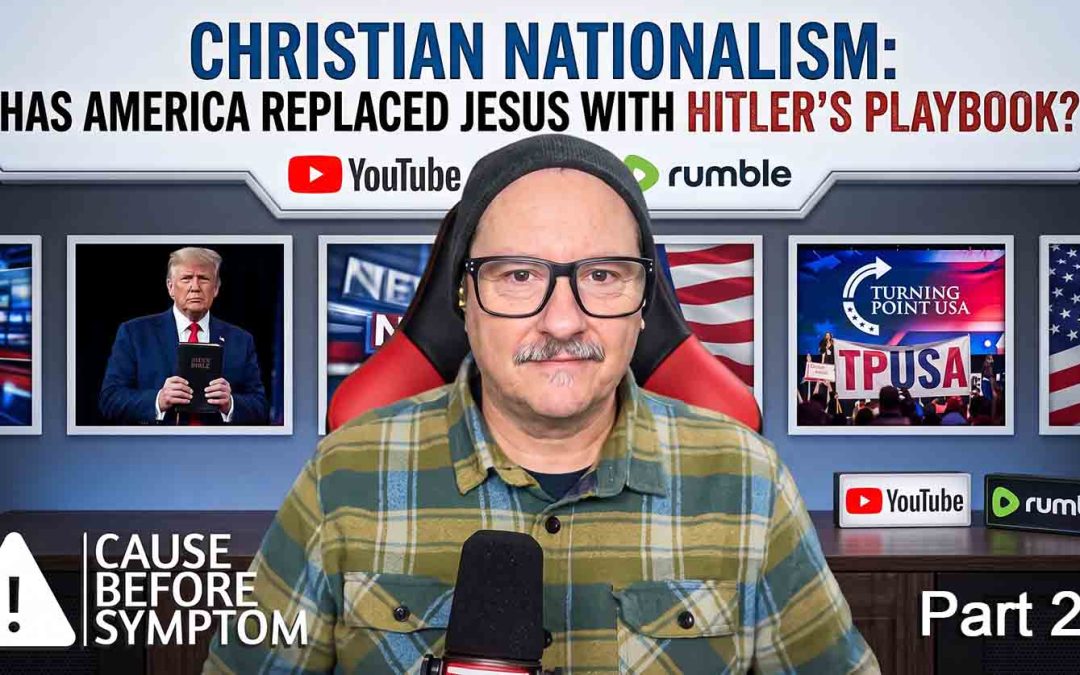
Watch this on Rumble: https://rumble.com/v7hhsgq-christian-nationalism-has-america-replaced-jesus-with-hitlers-playbook-part.html
Recap of Investigations 1–5 and Introduction to Investigations 6–10
Welcome back to Cause Before Symptom. Last night, we began an investigation into a question that I believe every Christian in America should consider. Is Christianity changing the political movement, or is the political movement changing the public meaning of Christianity?
We began by examining America's founding. We established that Christianity was the dominant religious tradition in colonial America. The Bible influenced the culture, churches played an important role in communities, and many of the Founders believed religion was essential to a moral society. But we also discovered that the Constitution did not establish Christianity as the official religion of the United States. Instead, it prohibited religious tests for federal office, and the First Amendment protected religious freedom.
In our second investigation, we examined why men such as James Madison and Thomas Jefferson were concerned about combining government authority with religious institutions. They had witnessed a society where government favored certain Christian denominations while restricting others. They understood that when politicians gain authority over religion, they can influence which religious teachings receive protection and which do not. Religious freedom was not simply about protecting government from religion. It was also about protecting religion from government control.
Then we traveled to Germany in 1933.
We discovered that Germany was overwhelmingly Christian when Adolf Hitler came to power. His political movement publicly embraced something it called Positive Christianity while promoting racial nationalism, antisemitism, and the restoration of German greatness. Hitler understood the importance of Christian identity in German society. Religious language helped his movement gain acceptance among people who might otherwise have questioned its ideology.
But our fourth investigation revealed something even more disturbing. Nazi-aligned religious leaders began attempting to change Christianity itself. The German Christians movement sought to reshape Christian teaching around German racial identity and loyalty to the state. Some even attempted to separate Jesus from His Jewish heritage. Political ideology was no longer simply seeking support from Christianity. It was attempting to determine what Christianity should teach.
Not every Christian accepted this transformation. The Confessing Church emerged in opposition to political interference in Protestant church doctrine and leadership. Dietrich Bonhoeffer and other religious figures resisted aspects of the Nazi regime. Yet their resistance also revealed the complexity of the period. Some Christians opposed interference with their churches while failing to defend others who were being persecuted.
That brought us to our fifth investigation, where we examined what happened when loyalty to the nation competed with loyalty to Christ.
As the Nazi government stripped Jews of their rights and intensified persecution, many Christian institutions accommodated the regime or remained largely silent. Some individuals resisted, sometimes at the cost of their freedom or their lives. Others cooperated with policies that violated the very moral principles their churches claimed to teach.
And we must remember that Nazi Germany was a racial dictatorship responsible for genocide. We cannot casually equate that history with modern American politics.
But we can learn from the mechanism.
A political movement can invoke Christianity without submitting itself to the teachings of Jesus. Religious leaders can become so invested in national restoration and political influence that they fail to challenge the people they support. And believers can begin treating loyalty to a political movement as though it were the same thing as loyalty to Christ.
That is where we ended last night.
Tonight, we bring this investigation home to America.
In Investigation Six, we will examine how Christianity became connected to organized political and economic interests in the United States. We will look at the business leaders, religious organizations, and political strategists who helped associate Christianity with particular policies, political parties, and ideas about American identity.
In Investigation Seven, we will ask what Christian nationalism actually means. Is it simply Christians participating in government, or do some advocates want a government that officially privileges Christianity? And if government begins defining Christian identity, whose interpretation of Christianity will it enforce?
In Investigation Eight, we will examine modern politicians, including Donald Trump, and organizations such as Turning Point USA and TPUSA Faith. We will ask whether their political activities are being corrected by the teachings of Jesus or whether their political objectives are influencing how Christianity is presented to the public.
In Investigation Nine, we will follow the money. We will examine nonprofit financial records, political spending, religious outreach, and the institutional benefits that arise when churches and political organizations work together. We will distinguish documented financial relationships from accusations that the evidence does not support.
And finally, in Investigation Ten, we will return to the comparison in our title. Is America following Hitler's playbook, or are we overlooking a different danger? We will examine the genuine historical similarities, the enormous differences, and what the teachings of Jesus reveal about the proper relationship between faith and political power.
I am not conducting this investigation to tell Christians which political party they must support. Nor am I suggesting that Christians should withdraw from public life.
I want to discover whether we are allowing Jesus Christ to shape our political convictions or allowing political movements to reshape our understanding of Jesus Christ.
Because the danger may not be that Christianity disappears from American politics.
The danger may be that the name of Jesus becomes more prominent while His teachings become less important.
And with that question before us, let's begin Investigation Six.
Investigation 6 — How Did Christianity Become a Political Industry in America?
In our first five investigations, we examined Christianity's influence on America's founding, the Founders' concerns about government control of religion, and the terrible consequences of political ideology reshaping Christianity in Nazi Germany. Now I want to return to the United States, because the relationship between Christianity and political power did not begin with Donald Trump, the Religious Right, or Turning Point USA. Its modern history reaches back through the twentieth century, when business leaders, religious organizations, and political strategists discovered that Christian identity could become a powerful instrument for advancing economic and political objectives.
And I want to begin with an important distinction. Christians participating in politics is not evidence of corruption. A pastor opposing slavery, a congregation defending civil rights, or a believer advocating for the poor may be acting directly from religious conviction. The question is different. What happens when powerful interests finance religious messaging because it supports their political goals? And when that happens, who is influencing whom?
Historian Kevin Kruse examines this question in his book *One Nation Under God: How Corporate America Invented Christian America*. His research traces how influential business leaders and conservative ministers developed campaigns linking Christianity, free enterprise, and opposition to expanded federal government during the 1930s and afterward. The title is provocative, and it should not be misunderstood. Kruse does not establish that Christianity in America was invented by corporations. Christianity had shaped American life for centuries. His argument concerns the deliberate promotion of a particular political understanding of Christian America.
During the Great Depression, President Franklin Roosevelt introduced the New Deal, expanding federal involvement in economic recovery, employment, regulation, and social welfare. Supporters viewed these programs as necessary responses to widespread suffering. Critics believed they threatened private enterprise, individual liberty, and the traditional limits of government. Some corporate leaders began supporting religious voices that presented free enterprise as compatible with Christianity and portrayed excessive government intervention as a threat to moral and spiritual freedom.
One important figure was the Reverend James W. Fifield Jr., a Congregational minister in Los Angeles. Fifield became associated with Spiritual Mobilization, an organization that promoted religious arguments against government expansion and in favor of individual liberty and free enterprise. His message reached ministers and religious audiences through publications, conferences, and organized outreach. Business supporters recognized that a minister could communicate arguments about economic policy in a different moral language from that of a corporate executive.
Think about the significance of that arrangement. If an industrialist argued against federal regulation, listeners might interpret the argument as an attempt to protect corporate profits. But if a respected minister described the same political question as a struggle for spiritual liberty, the argument could carry an entirely different authority. Economic preferences could be presented as religious obligations, and opposition to government policy could acquire the emotional weight of defending Christianity.
This does not prove that Fifield or every participating minister lacked sincere convictions. They may genuinely have believed that free enterprise and religious freedom were inseparable. But sincerity does not eliminate the importance of financial support, institutional relationships, and political outcomes. When business interests fund religious campaigns that advance their economic positions, the public deserves to understand those connections.
Industrialist J. Howard Pew was among the wealthy business figures who supported conservative religious and political causes. Other corporate executives and business organizations participated in efforts to challenge New Deal liberalism through religious and moral appeals. The resulting movement was not controlled by one individual, and it would be misleading to imagine a single secret organization directing American Christianity. What the historical record reveals is a network of overlapping interests that found political value in associating Christian identity with particular economic principles.
After the Second World War, the political environment changed. The United States entered the Cold War against the Soviet Union, whose communist government officially promoted atheism and suppressed or controlled many religious institutions. American leaders increasingly presented religious belief as a distinguishing feature of national identity. Christianity, patriotism, democracy, and anticommunism became closely associated in public rhetoric.
In 1954, Congress added the words “under God” to the Pledge of Allegiance. In 1956, “In God We Trust” became the official national motto. These changes are often cited today as evidence that America was founded as an explicitly Christian nation. But their dates tell us something important. They occurred during the Cold War, more than a century and a half after the Constitution was written. They demonstrate how religious language became increasingly prominent in twentieth-century national identity, not what the delegates in Philadelphia established in 1787.
The public religious culture of this period also involved politicians from both major parties. President Dwight Eisenhower participated in highly visible religious observances and emphasized faith as part of American civic identity. Religious leaders gained access to political officials, while public ceremonies reinforced the association between national loyalty and belief in God. Yet this civil religion was not identical to a specific denomination's theology. It often emphasized broad religious affirmation rather than the distinctive teachings of Jesus.
That difference matters. A politician can speak about God, morality, freedom, and national greatness without explaining what Jesus taught about wealth, enemies, humility, or serving the poor. Broad religious language can unite voters who disagree about theology. It can also allow political movements to borrow religious authority without submitting their policies to serious religious examination.
By the late twentieth century, another transformation was underway. Evangelical Christians became increasingly organized within conservative electoral politics. Jerry Falwell Sr. helped establish the Moral Majority in 1979, promoting conservative positions on abortion, school prayer, sexuality, family policy, and other cultural issues. The organization worked to mobilize religious voters and influence elections, particularly through the Republican Party.
But the history of the Religious Right is more complicated than a single issue or a single leader. Abortion became an especially important mobilizing cause, but battles over private Christian schools, federal tax policy, desegregation, and government authority also influenced the movement's development. Historians disagree about the relative importance of these issues, and we should not reduce millions of believers to one motivation. Many Christians sincerely opposed abortion on moral grounds. Others were concerned about religious liberty, family life, or cultural change. Political organizers brought these concerns together into a durable electoral coalition.
And this is where Christianity became increasingly connected to a sophisticated political infrastructure. Religious broadcasters could reach millions of viewers. Direct-mail campaigns could raise money from supporters across the country. Advocacy organizations could publish voter guides, organize conferences, recruit volunteers, and build relationships with elected officials. Churches provided communities of trust and existing networks of personal relationships. Political campaigns recognized that those networks could be extraordinarily valuable.
None of these activities is automatically improper. Religious Americans possess the same rights to political speech and association as other citizens, subject to the legal rules governing particular organizations. But the structure creates questions about incentives. If political fundraising depends upon convincing Christians that their faith is under constant attack, does the organization benefit from resolving those fears or from keeping them alive? If religious leaders gain political access by delivering loyal voters, are they still free to condemn the conduct of the politicians they support?
We must distinguish those questions from proven accusations. The existence of donations, religious advocacy, or cooperation between churches and politicians does not establish fraud or manipulation. To determine whether particular organizations are financially dependent on political messaging, we need financial disclosures, organizational records, documented relationships, and evidence of actual conduct. That is why our later investigation will examine donors, nonprofit structures, and political spending rather than relying on suspicion.
Now return to the words of Jesus. In Matthew 6, He warned against making religious devotion into a public performance for recognition. In Matthew 23, He criticized religious leaders who sought status while neglecting justice, mercy, and faithfulness. And in Mark 10, He told His disciples that greatness among them should be measured by service rather than domination.
Those teachings do not prohibit Christians from engaging in public life. They challenge the motives and methods through which religious authority is exercised.
What we have discovered is that American political Christianity did not emerge from one event. It developed through decades of cooperation among religious leaders, business interests, political organizations, and public officials. Sometimes those relationships reflected genuine shared convictions. Sometimes they also advanced financial, institutional, and electoral interests.
The historical question is not whether Christianity belongs in American public debate. Religious citizens have every right to bring their convictions into that debate. The question is whether political organizations have increasingly shaped which parts of Christianity receive public attention, which moral issues define Christian identity, and which political leaders are treated as defenders of the faith.
And that brings us directly to Christian nationalism.
Because if Christianity can become closely associated with particular economic policies, political parties, and national symbols, we must ask what happens when a movement goes further and argues that America itself should be formally governed according to a particular understanding of Christianity.
What does Christian nationalism actually mean? What do its supporters want? And where is the boundary between Christians participating in democracy and a government claiming authority to establish Christian political rule?
That is what we will investigate next.
Investigation 7 — What Is Christian Nationalism Actually Trying to Establish?
In our previous investigation, we traced how Christianity became increasingly connected to American political organizations, corporate interests, national identity, and electoral campaigns. We discovered that religious language could help advance economic policies, mobilize voters, and give political movements moral credibility. But now we must examine the movement at the center of tonight's investigation. Christian nationalism. What does that term actually mean? Who supports it? What kind of government do its advocates envision? And most importantly, does Christian nationalism seek to bring American politics under the teachings of Jesus, or does it risk bringing Christianity under the authority of American politics?
Before answering, I want to establish something important. Not every Christian who loves America is a Christian nationalist. Not every Christian who votes Republican is a Christian nationalist. A believer can oppose abortion, support traditional marriage, pray for elected officials, and advocate for laws consistent with personal convictions without believing the government should establish Christianity as the nation's privileged religion. Christians possess the same political rights as everyone else. The issue is not whether Christians should participate in government. The issue is what kind of relationship they believe should exist between Christianity, national identity, and political authority.
Sociologists Andrew Whitehead and Samuel Perry examined this question in their book *Taking America Back for God*. They describe Christian nationalism as a framework of beliefs, symbols, traditions, and narratives that seeks to fuse Christianity with American civic identity. Their research distinguishes Christian nationalism from ordinary religious commitment. A person can be deeply devoted to Christianity while rejecting the idea that American identity should be defined through government-sponsored Christianity. Conversely, someone may strongly support Christian national identity without demonstrating the personal religious practices traditionally associated with Christian discipleship.
That distinction is essential because the word Christian can describe several different things. It can identify someone who follows Jesus, someone who belongs to a church, someone who inherited a cultural tradition, or someone who believes Christianity should define the nation's public identity. These meanings overlap, but they are not interchangeable. A political movement can emphasize Christian symbols and national heritage without necessarily emphasizing repentance, forgiveness, humility, or love of enemies.
Christian nationalism itself is not a single organization with one official constitution. Its supporters disagree about what they want. Some advocate greater public acknowledgment of America's Christian heritage. Others want laws reflecting biblical moral principles. Still others argue that civil government should explicitly recognize Christianity and exercise authority in accordance with a Christian understanding of national life. Those differences matter. We cannot evaluate the movement fairly if we pretend that every person using the term advocates the same policies.
One of the clearest examples of an explicitly political vision appears in Stephen Wolfe's book *The Case for Christian Nationalism*. Wolfe argues for a Christian nation whose political institutions promote a distinctly Christian social order. His approach goes beyond asking Christian citizens to vote according to conscience. It envisions a Christian political community and a magistrate charged with advancing its religious and civil good. His argument also allows a degree of outward governmental restraint against public expressions of false religion. Whatever one thinks of that proposal, it raises an unmistakable constitutional question. Who decides which religion is true, and what authority should government possess over those who disagree?
Return with me to James Madison and Thomas Jefferson. They lived in a predominantly Christian society, yet they opposed government arrangements that compelled religious support or made civil rights dependent upon religious profession. Their concern was not that Christianity would disappear from public life. It was that political power could corrupt religious institutions and violate freedom of conscience. A government empowered to privilege one understanding of Christianity must decide which understanding receives that privilege. And once government makes that decision, disagreements among Christians can become struggles for political control.
Consider the differences among Baptists, Catholics, Pentecostals, Orthodox Christians, Presbyterians, Lutherans, and other traditions. They do not agree on every matter of doctrine, worship, church authority, or biblical interpretation. If the United States were formally governed as a Christian nation, whose Christianity would define the laws? Who would settle theological disputes? Would a Christian who rejected the government's preferred interpretation possess the same rights as someone who accepted it? And what would happen to Jewish, Muslim, Hindu, Buddhist, or nonreligious Americans?
These questions are not attacks on Christianity. They are questions about the proper limits of civil authority. Religious freedom protects the right to preach Christianity, build churches, publish Scripture, evangelize, and advocate for public policy. It also protects the right of others to disagree. The constitutional system does not require religious citizens to abandon their convictions. It prevents the government from making religious conformity a condition of full civic participation.
Now consider what Americans actually believe. In February 2026, the Public Religion Research Institute published findings from more than twenty-two thousand interviews conducted during 2025. Its Christian nationalism scale classified approximately eleven percent of Americans as adherents and twenty-one percent as sympathizers. The remaining respondents were primarily classified as skeptics or rejecters, with some not classified. In other words, roughly one-third of Americans fell into the two categories most supportive of the ideas measured by the survey.
But we must understand what those numbers mean. PRRI measures agreement with statements about Christianity, American identity, and government. Its classifications do not establish that every respondent belongs to an organized movement or supports the same constitutional changes. A survey category is not a diagnosis of someone's spiritual condition. It is a measurement of attitudes toward particular political and religious propositions.
The findings nevertheless reveal important patterns. PRRI reported that fifty-six percent of Republicans qualified as adherents or sympathizers, compared with twenty-five percent of independents and seventeen percent of Democrats. Support also varied considerably among religious traditions. This tells us that Christian nationalism is strongly associated with contemporary partisan identity, although it is not exclusive to one political party or denomination.
The same research found correlations between stronger Christian nationalist attitudes and support for more authoritarian political positions. Thirty percent of adherents agreed with a statement suggesting that patriotic Americans might need to resort to violence to save the country. But notice the other side of that finding: most adherents did not agree with that statement. It would be misleading to claim that Christian nationalists generally support political violence. The evidence supports a narrower conclusion: people scoring higher on this particular scale were more likely than other respondents to express support for that possibility.
And correlation is not proof of causation. The survey cannot by itself establish whether Christian nationalist beliefs produce authoritarian attitudes, whether existing political loyalties encourage Christian nationalist beliefs, or whether both are influenced by other factors. That uncertainty brings us back to the question guiding tonight's examination. Which direction is the influence moving?
Now I want to test this against Scripture rather than political slogans. In John 18:36, Jesus told Pilate that His kingdom was not of this world. In Mark 10, He taught His disciples that leadership among them should not imitate rulers who exercise domination over others. In Matthew 5, He commanded love for enemies. In Matthew 22, He distinguished what belongs to Caesar from what belongs to God.
Christians have interpreted these passages differently when considering the responsibilities of civil government. Some believe a Christian society should explicitly acknowledge Christ's authority in its political institutions. Others believe the Church best fulfills its mission by remaining independent of governmental power. The disagreement is real, and it cannot be settled simply by attaching the label Christian to one political position.
But one question remains unavoidable. If the government acquires greater authority to define and defend Christianity, does that make citizens more faithful to Jesus? Or does it give politicians greater influence over what the public understands Christianity to mean?
The historical examples we have examined suggest that political authority can be attractive to religious movements precisely because it promises to accomplish what preaching and persuasion cannot guarantee. It can enforce rules, reward institutions, and establish public symbols. Yet none of those powers can compel sincere repentance, love of neighbor, or faith in Christ.
So what is Christian nationalism trying to establish? There is no single answer. For some supporters, it means recovering Christian cultural influence. For others, it means aligning public law with biblical morality. For its more explicitly political theorists, it means establishing a national order in which Christianity receives recognized governmental authority and preference.
Those objectives are different, and we must examine them separately. But they share a central concern: the relationship between Christian identity and the power of the state.
And that brings us to the next investigation. Because abstract political theories are only part of the story. We must examine the actual politicians and organizations claiming to defend Christianity today. We must look at their statements, their behavior, their institutional relationships, and the message they are bringing into American churches.
In particular, we need to examine Donald Trump, other political leaders who publicly profess Christianity, and Turning Point USA's religious organizing efforts.
Are these political movements being transformed by the teachings of Jesus? Or are they teaching Christians to interpret Jesus through the priorities of political loyalty?
That is the question we will take into Investigation Eight.
Investigation 8 — Are Politicians and Turning Point USA Changing the Public Meaning of Christianity?
Throughout tonight's investigation, I have asked one central question. Is Christianity changing the political movement, or is the political movement changing the public meaning of Christianity? We have examined America's founding, the separation of religious conscience from government authority, the manipulation of Christianity in Nazi Germany, and the development of organized religious politics in the United States. Now I want to examine the people and institutions operating in front of us today. Because the question is no longer theoretical. Politicians are speaking from church platforms, religious organizations are mobilizing voters, and Christian identity has become an important part of American political competition.
I want to begin with Donald Trump, because his relationship with evangelical Christianity illustrates the distinction between religious profession and political alliance. Trump has repeatedly presented himself as a defender of Christians and religious liberty. He has supported policies favored by many religious conservatives, including appointing Supreme Court justices who helped overturn *Roe v. Wade*. For many voters, those outcomes matter more than his personal conduct. They argue that a president is elected to govern, not to serve as a pastor, and that imperfect leaders can still advance policies consistent with Christian convictions.
That argument deserves to be understood before it is criticized. Scripture contains accounts of rulers whose actions served purposes beyond their personal righteousness. Christians also disagree about how to weigh a candidate's character against the consequences of public policy. Supporting a political candidate does not necessarily mean endorsing everything that candidate says or does.
But there is a difference between voting for an imperfect politician and presenting that politician as a spiritual model or uniquely appointed defender of Christianity. Trump has a documented history of making false claims, engaging in personal insults, and using inflammatory language toward political opponents. Courts have also made serious findings against him in civil proceedings. Christians may disagree about his policies or the political significance of those cases, but they cannot responsibly evaluate his public example while pretending his conduct is irrelevant.
In Matthew 7, Jesus taught His followers to recognize people by their fruits. In Matthew 5, He commanded love for enemies. In Matthew 23, He condemned religious hypocrisy. Those standards do not become meaningless when the person being examined belongs to a preferred political party.
And this examination must not stop with Trump. Democratic politicians also invoke Christianity when defending their policies. Joe Biden has spoken extensively about his Catholic faith. Other Democratic leaders have appealed to biblical teachings concerning poverty, immigration, justice, and care for vulnerable people. Those appeals deserve the same scrutiny. Does a politician accurately represent the passage being invoked? Does the policy follow from the teaching, or is Scripture being selectively employed to give an existing political position religious authority?
For example, politicians across party lines have used biblical language to defend competing approaches to immigration. Some emphasize hospitality toward strangers, while others emphasize civil authority and the enforcement of law. Both subjects appear in Scripture, but quoting one passage does not eliminate the responsibility to examine the others. The same applies to abortion, poverty, war, criminal justice, and economic policy. A politician's declaration that God supports a position is not evidence that the position has been faithfully derived from Scripture.
Now consider Turning Point USA. Founded by Charlie Kirk in 2012, the organization developed into a major conservative political network, particularly among students and young adults. Its activities included campus organizing, conferences, media production, and political advocacy. Christianity was not originally the sole organizing principle of the institution. Its central public identity was conservative political activism.
In 2021, Turning Point USA established TPUSA Faith, extending its work into churches and religious communities. This development matters because it represents an organized effort to connect an existing political movement with Christian institutions. The initiative has promoted pastor engagement, church partnerships, training, and Christian participation in civic and political affairs. Its supporters argue that churches should not retreat from public questions and that believers have a responsibility to influence their communities.
That position is not inherently illegitimate. Churches have participated in American political and moral debates for centuries. Religious leaders opposed slavery, participated in the civil rights movement, challenged unjust laws, and defended religious freedom. Political involvement alone does not establish that a church has surrendered its independence.
The question is what happens when a political organization develops a ministry-oriented structure that operates through churches. Is the political organization being corrected and transformed by Christian teaching? Or are churches being encouraged to adopt the organization's existing political priorities as expressions of Christian duty?
Charlie Kirk's public ministry and political work increasingly overlapped. He spoke about Christianity, biblical morality, the role of pastors, and the need for churches to engage with political issues. His approach appealed to Christians who believed their religious convictions had been pushed out of public life. Yet his speeches and organizing also connected religious mobilization with conservative political outcomes. That combination requires examination rather than automatic condemnation or endorsement.
Kirk was killed in September 2025. His death was a violent tragedy, and the fact that he was a controversial political figure does not diminish the wrongfulness of his killing. Following his death, his widow, Erika Kirk, publicly expressed forgiveness toward the accused killer. That response deserves recognition within an investigation centered on the teachings of Jesus. Forgiveness of an enemy is not merely a political slogan. It is one of the most demanding commands Christ gave His followers.
But neither an act of forgiveness nor the sincerity of individual believers settles every question about an organization's political activities. Institutions must be examined through their structure, messaging, relationships, and conduct. TPUSA Faith may conduct activities its participants sincerely regard as Christian ministry while also advancing political objectives. Those two functions can coexist. The investigative question is whether they remain distinguishable and whether the religious message is free to challenge the political agenda.
Imagine a church inviting a political organizer to speak about defending Christianity. If that speaker challenges both Republicans and Democrats to repent of dishonesty, cruelty, greed, and the pursuit of power, the message may demonstrate that Scripture is exercising authority over politics. But if the message consistently excuses one party's misconduct while condemning identical behavior in the other, something different is happening. Political allegiance may be determining which biblical teachings are emphasized and which are ignored.
This is not a conclusion about every pastor associated with Turning Point USA or every Christian who attends its events. Those individuals may have widely different motives and convictions. Nor can we determine someone's private faith merely by examining their organizational affiliations. What we can evaluate is the public message and the incentives surrounding it.
The same principle applies to politicians who appear in churches. When a candidate speaks from a pulpit, the setting itself carries religious significance. A congregation may perceive the speaker as possessing spiritual credibility because its pastor has welcomed that person into a sacred space. The politician gains access to an audience whose trust was developed through religious relationships. The church, meanwhile, may gain political attention, visibility, or influence.
That exchange is not necessarily corrupt. But it creates the possibility that political access becomes more valuable to religious leadership than the freedom to confront political wrongdoing.
Consider how Jesus treated powerful people. He did not flatter rulers to gain their favor. He challenged religious authorities who valued status and public recognition. He told His disciples that leadership should be expressed through service. When Peter attempted to defend Him with a sword during His arrest, Jesus rejected that response. His mission was not dependent upon securing political control through force.
Now compare that example with the language sometimes used in contemporary political campaigns. Politicians are described as warriors, national saviors, or uniquely chosen instruments of divine restoration. Political defeats are portrayed as spiritual catastrophes. Opponents are sometimes treated not merely as people with mistaken policies but as enemies of God.
Those expressions do not represent every Christian conservative or every Christian nationalist. But where they appear, they deserve careful examination. They can encourage believers to treat political loyalty as a test of religious faithfulness. And once that happens, criticism of a politician may be interpreted as opposition to Christianity itself.
This is precisely the confusion our investigation is attempting to identify.
The evidence does not establish that all Christian political organizations manipulate religion, nor that every religious politician is insincere. It does establish that political movements actively seek religious support, that religious institutions can provide substantial political legitimacy, and that organizations such as TPUSA Faith deliberately operate at the intersection of Christian ministry and political mobilization.
The question is whether those relationships preserve the Church's freedom to challenge political power or gradually encourage believers to identify Christian faithfulness with loyalty to a political movement.
And there is another dimension we have not yet examined. Political organizing requires money, personnel, communications infrastructure, and institutional relationships. Conferences must be financed. Media operations need revenue. Advocacy campaigns depend upon donors. Religious networks can become valuable channels for fundraising and political influence.
So our next investigation must follow the organizational structure and the money. Who benefits when Christianity becomes a source of political power? Who finances these organizations? What do their public records reveal? And how can we distinguish legitimate religious advocacy from situations in which faith becomes a political product?
Because if we want to understand whether politics is changing Christianity, we cannot examine sermons and speeches alone. We must also examine the institutions that make those messages possible.
Investigation 9 — Who Benefits When Christianity Becomes Political Power?
In our previous investigation, we examined Donald Trump, Democratic politicians who invoke Christianity, and the expansion of Turning Point USA into religious organizing through TPUSA Faith. We asked whether political movements are being transformed by Christian teaching or whether Christian institutions are increasingly adopting the priorities of political organizations. But there is another dimension to this investigation that we cannot ignore. Money. Because political movements do not operate on speeches and convictions alone. They require financing, employees, media production, conferences, advertising, legal support, and organizational infrastructure. And when Christianity becomes part of that infrastructure, we need to understand who pays for it, who benefits from it, and what the financial records actually reveal.
I want to begin with a distinction that is essential to an honest investigation. Receiving donations does not prove corruption. Paying employees does not prove corruption. A religious organization raising money to advance its mission is not automatically exploiting Christianity. Churches, charities, universities, and advocacy organizations all depend upon financial support. The question is whether the money creates incentives that influence what religious leaders teach, which politicians they support, and which moral questions they choose to ignore.
Fortunately, we do not have to rely entirely on speculation. American nonprofit organizations operate under different legal structures, and many are required to disclose financial information. The Internal Revenue Service receives annual Form 990 filings from most tax-exempt organizations, although churches and certain church-related organizations generally are not required to file them. These records can reveal revenue, expenses, compensation, grants, related organizations, and certain financial transactions. They do not necessarily identify every donor, and they cannot tell us what anyone privately believes. But they provide a starting point for understanding the financial scale of organized political and religious activity.
Let's examine Turning Point USA, because we discussed its religious outreach in our previous investigation. According to its publicly available IRS Form 990 filings, Turning Point USA reported approximately eighty-five million dollars in revenue for the fiscal year ending June 2024. Its expenses were approximately eighty-one million dollars. In the following fiscal year, ending June 2025, the organization reported approximately one hundred fifteen million dollars in revenue and nearly one hundred four million dollars in expenses.
Those figures deserve attention. We are not examining a small volunteer organization operating out of a church basement. We are examining a large national nonprofit with substantial financial resources, employees, events, communications programs, and affiliated activities. Its financial scale gives it the ability to reach audiences and maintain institutional relationships that ordinary individual believers could never finance independently.
Now look at something particularly relevant to tonight's subject. Turning Point USA's fiscal 2024 tax filing reported approximately ten point six million dollars in expenses associated with TPUSA Faith. The organization described that program as an effort to mobilize believers, strengthen churches, and encourage engagement with religious and constitutional questions. It also reported working with more than thirty-five hundred church partners and training nearly ten thousand pastors and church leaders during that fiscal year.
Those participation figures are the organization's own reported numbers, not independently verified counts of unique active churches or pastors. Nevertheless, the financial expenditure is significant. It demonstrates that religious outreach was not merely an occasional speech by a political activist. It was a substantial organizational program supported by millions of dollars.
But what does that prove?
It proves that Turning Point USA devoted substantial resources to religious organizing. It does not prove that participating pastors were paid to endorse candidates. It does not establish that the churches involved surrendered their independence. And it certainly does not demonstrate that every dollar spent on TPUSA Faith was improper. To make those claims, we would need specific financial transactions, agreements, communications, or other documentary evidence.
There is also an important distinction between Turning Point USA and political committees operating within the broader Turning Point network. Turning Point USA is a tax-exempt charitable organization. Separately organized political committees are subject to different rules governing election activity and campaign finance. The Federal Election Commission maintains public records for Turning Point PAC, for example. During the 2023–2024 election cycle, that committee reported approximately seven million dollars in total disbursements, including roughly one point four million dollars in independent expenditures.
We must not combine those figures as though they represent one unrestricted bank account. Different legal entities have different purposes, reporting obligations, and restrictions. A charitable organization's reported revenue cannot simply be treated as campaign spending. Nor can spending by a political committee automatically be attributed to a church or religious program. Following the money responsibly means identifying each organization and tracing actual transactions rather than treating similar names as proof of financial coordination.
The legal distinctions are important. Under federal tax law, organizations recognized under Section 501(c)(3), including churches, are generally prohibited from intervening in political campaigns on behalf of or against candidates. They may discuss public policy, teach religious principles, and conduct qualifying nonpartisan voter education and registration activities. Religious leaders may also express personal political views, subject to the distinction between speaking individually and speaking officially for their organizations.
Political committees operate under different rules. Super PACs may accept unlimited contributions from permitted domestic sources to finance independent political expenditures, while remaining subject to disclosure requirements and restrictions on coordination. Other politically active nonprofits may have different reporting obligations. These structures can make the overall financial landscape complicated, particularly when organizations share personnel, audiences, or broad ideological objectives.
And that complexity is exactly why we need evidence rather than insinuation.
Now consider the benefits that may arise when religious institutions and political organizations cooperate. Politicians gain access to established communities of trust. Political advocacy groups gain audiences, volunteers, donors, and credibility. Religious organizations may gain publicity, financial support, legal resources, or access to elected officials. Media personalities may gain viewers, subscribers, advertising revenue, and invitations to speak.
None of those benefits necessarily means that anyone is acting dishonestly. But each creates an incentive worth examining.
Imagine a pastor who becomes widely known because of close relationships with influential politicians. Invitations increase. Donations rise. Media appearances become more frequent. That pastor may still be completely sincere in his beliefs. But what happens when the politician who helped create that visibility behaves in a way that plainly conflicts with the pastor's preaching? Is the pastor equally willing to condemn the misconduct, even if doing so threatens access, donors, or influence?
That is not an accusation against a particular minister. It is a test of institutional independence.
The same question applies to political fundraising. Fear can be an effective way to motivate supporters. If an organization repeatedly tells Christians that their faith is on the verge of being destroyed unless they donate or vote a particular way, we should examine the evidence supporting that claim. We should also ask whether the organization's financial model depends upon presenting every election as an existential spiritual crisis.
But we cannot assume that an alarming fundraising message is deliberately fabricated merely because it raises money. The appropriate investigation compares the message with documented circumstances, follows the resulting expenditures, and examines whether leaders accurately represent the threats they describe.
Now return to the historical pattern we discovered in Investigation Six. During the twentieth century, business leaders helped finance religious messaging that aligned with their economic and political interests. The important lesson was not that Christianity had been invented by wealthy donors. It was that money could amplify particular interpretations of Christianity and help make them prominent in American political life.
Modern technology has expanded that possibility enormously. A political organization can distribute sermons, interviews, campaign messages, and religious commentary through social media, streaming platforms, email, and large conferences. A message that once reached one congregation can now reach millions. Financial resources help determine which messages receive the greatest amplification.
That creates an important distinction between the popularity of a religious message and its faithfulness to Scripture. A well-financed message may reach more people than a quiet pastor teaching an unpopular truth. Its audience size does not establish its theological authority.
Jesus addressed the relationship between money and spiritual loyalty directly. In Matthew 6:24, He warned that no one can serve both God and money. In Mark 10, He challenged the assumption that worldly status defines greatness. In Matthew 23, He criticized religious leaders who valued recognition while neglecting the weightier demands of justice, mercy, and faithfulness.
These passages do not mean that churches should have no budgets or that religious workers should receive no compensation. They mean that money must remain subordinate to the mission rather than becoming the force that determines the mission.
So who benefits when Christianity becomes political power? The documented answer is that political organizations can gain resources, influence, and access to voters, while religious organizations can gain visibility, institutional support, and political relationships. Financial records demonstrate the considerable scale of some of these operations. What those records do not establish, by themselves, is that religious beliefs are insincere or that particular leaders are intentionally deceiving their followers.
That distinction matters because I do not want this investigation to become another exercise in accusing people without evidence. I want to understand the mechanism.
When a political movement finances religious outreach, the Church should remain free to challenge that movement. When a politician gains support from Christians, those Christians should remain free to hold that politician accountable. And when religious organizations depend upon political audiences for money and influence, believers should ask whether the teachings of Jesus are still determining the message.
We have now examined the history, theology, politics, institutions, and financial incentives surrounding Christian nationalism. That leaves us with the most difficult question of the entire investigation.
Are we witnessing a historical pattern that resembles the political manipulation of Christianity in Nazi Germany? Or would comparing modern America with Hitler's regime obscure crucial differences and prevent us from identifying the actual danger?
In our final investigation, I want to separate genuine historical parallels from exaggerated accusations. Because if we are going to warn people about the political misuse of Christianity, we must be just as careful not to misuse history ourselves.
Investigation 10 — Is America Following Hitler's Playbook, or Are We Missing the Real Danger?
Throughout tonight's investigation, I have examined a question that deserves more than a political slogan. Is Christianity changing the political movement, or is the political movement changing the public meaning of Christianity? We began with America's founding, examined the dangers of combining religious authority with government power, investigated the manipulation of Christianity in Nazi Germany, and followed the development of modern Christian political organizations. Now we must confront the comparison in our title. Has America replaced Jesus with Hitler's playbook? The answer requires us to distinguish genuine historical similarities from differences so substantial that ignoring them would make our investigation dishonest.
Let's begin with what the historical record actually establishes. Adolf Hitler appealed to a predominantly Christian population while advancing an ideology rooted in racial nationalism, antisemitism, authoritarian government, and the exclusion of those considered enemies of the German nation. His political movement invoked Christianity publicly, while Nazi-aligned religious organizations attempted to reshape Christian teaching around racial identity and loyalty to the state. As his dictatorship consolidated power, the government interfered with religious institutions, persecuted minorities, destroyed political opposition, and ultimately carried out genocide.
Those are not incidental details. They define the Nazi regime. If we remove dictatorship, racial persecution, aggressive war, and genocide from the comparison, we risk turning Hitler into a generic symbol for politicians we dislike. That would diminish the historical reality of what happened in Germany and weaken our ability to recognize genuine threats.
The United States today is not Nazi Germany in 1933. America retains constitutional protections for religious freedom, competitive elections, independent religious institutions, an opposition press, and courts capable of reviewing government actions. Those protections can be challenged, weakened, or inconsistently enforced, but their continued existence is a fundamental difference. Modern Christian nationalism also contains competing interpretations, ranging from cultural advocacy to explicit proposals for Christian political authority. We cannot truthfully assign the most extreme position to everyone who uses Christian language in politics.
But rejecting a false equivalence does not mean there is nothing to learn from history.
The first mechanism worth examining is the use of religious identity to establish political legitimacy. Hitler's movement understood that Christianity mattered deeply to German society. Publicly associating the Nazi Party with Christianity helped reassure some religious voters and leaders, even though the movement's racial ideology contradicted essential elements of Christian teaching.
In contemporary America, politicians also seek legitimacy through religious language. They attend church events, receive endorsements from religious figures, invoke Scripture, and describe political causes as battles for faith and civilization. Those activities are not automatically improper. The danger emerges when religious identity becomes a substitute for examining a leader's conduct. If someone is considered a defender of Christianity simply because that person promises political victories for Christians, the meaning of Christian leadership has already begun to shift.
The second mechanism is the elevation of national identity above religious obligation. Nazi-aligned German Christians attempted to reinterpret their faith through racial and nationalist commitments. Their political ideology influenced how they understood Jesus, Scripture, and the membership of the Church.
In America, the relevant question is whether national loyalty ever becomes the standard by which Christian teaching is judged. When a biblical command challenges the behavior of a favored politician, which authority wins? When Jesus commands love for enemies, does that teaching remain binding when the enemy belongs to another political party? When Scripture condemns dishonesty, greed, and pride, do Christians apply those standards equally to their political allies?
The third mechanism is institutional dependence. In Nazi Germany, political influence over church leadership and organization became a direct instrument of control. The German Christians movement sought to align Protestant institutions with the new regime, while the state increasingly used coercive authority against dissent.
Modern American relationships between churches and political organizations are different. A church voluntarily partnering with an advocacy group is not equivalent to a dictatorship imposing a Reich bishop. But voluntary relationships can still create incentives. Political organizations may provide publicity, resources, training, and access to influential leaders. Religious institutions may provide trusted audiences and moral credibility. The concern is whether those exchanges make churches less willing to criticize the movements they support.
The fourth mechanism is the creation of enemies whose supposed danger justifies extraordinary loyalty. Nazi propaganda portrayed Jews and political opponents as threats to Germany's survival. That propaganda helped prepare the public for exclusion, persecution, and violence.
American political rhetoric sometimes portrays opponents as enemies of the nation, enemies of Christianity, or existential threats whose victory would destroy the country. Those claims must be evaluated individually. Ordinary partisan hostility is not equivalent to Nazi racial persecution. But rhetoric that dehumanizes opponents, excuses political violence, or presents entire populations as inherently dangerous deserves serious scrutiny before it becomes normalized.
And here I want to identify what may be the greatest danger of all. A Christian can become so determined to defend Christianity politically that he stops allowing Christianity to correct his politics.
That is not a problem confined to Republicans, Democrats, conservatives, or progressives. It can happen whenever believers begin with a political conclusion and then search Scripture for language to justify it. It can happen when a politician's moral failures are dismissed because that politician advances a preferred policy. It can happen when Christians condemn dishonesty among opponents while treating dishonesty among allies as an acceptable strategy.
At that point, the political movement is no longer merely receiving Christian influence. It is beginning to determine which parts of Christianity matter.
Consider the teachings of Jesus in Matthew 5. He instructed His followers to love their enemies and pray for those who persecuted them. That is an extraordinarily difficult command in a political culture built around identifying enemies and defeating them. In Matthew 7, He warned against hypocrisy and taught that people should be recognized by their fruits. In Matthew 23, He condemned religious leaders who emphasized public appearances while neglecting justice, mercy, and faithfulness.
In Mark 10, Jesus described rulers who exercise authority over others and then told His disciples that greatness among them must take a different form. The one who wanted to be great was to become a servant. In John 18, standing before Pilate, Jesus distinguished His kingdom from the political kingdoms of this world.
These teachings do not provide a complete modern political program. Christians can reasonably disagree about taxation, immigration, national defense, and the responsibilities of government. But they establish moral obligations that cannot simply be suspended whenever political victory is at stake.
Now return to the evidence we examined about Turning Point USA, TPUSA Faith, and the broader Christian political movement. We found organized efforts to connect churches, pastors, and religious audiences with conservative political activism. We examined substantial financial expenditures supporting that outreach. Those facts demonstrate institutional political engagement. They do not establish that participating Christians have abandoned Jesus or that the organizations are equivalent to Nazi institutions.
What they do establish is the importance of asking who possesses the authority to correct whom. Can a pastor publicly challenge a politician supported by the organization without losing the relationship? Can Christian teaching condemn the movement's preferred methods? Can a church reject a political objective when its leaders conclude that the objective conflicts with Scripture?
If the answer is yes, then religious conviction may still be exercising meaningful independence over political activity. If the answer is no, then political loyalty may have become the controlling authority.
And this is where our investigation produces a conclusion more useful than simply calling someone a Nazi.
America is not presently following the full historical course of Nazi Germany, and the evidence does not justify claiming that Christian nationalism as a whole is a Nazi movement. But the history of Germany demonstrates how a political movement can use Christian identity to gain legitimacy and how religious institutions can accommodate political priorities that conflict with their own teachings.
In contemporary America, the documented overlap between political organizations, religious institutions, and partisan identity gives us legitimate reasons to examine whether similar mechanisms of influence are operating. The existence of those mechanisms does not establish that the outcomes will be the same. It establishes why institutional independence, freedom of conscience, and consistent moral accountability matter.
So I want to answer the question that has guided tonight's examination.
Is Christianity changing the political movement, or is the political movement changing the public meaning of Christianity?
The evidence suggests that both influences exist. Christians have shaped political policies, organizations, and public debates. At the same time, political movements have shaped which religious issues receive attention, which leaders gain credibility, and which expressions of Christian identity become associated with partisan loyalty. In some cases, political objectives appear to be influencing how Christianity is publicly presented.
But we should not claim more than the evidence demonstrates. We cannot determine the sincerity of every believer, and we cannot reduce an entire religious movement to the motives of its most prominent political figures.
What we can do is establish a standard.
When Christians defend truth even when it damages their political interests, Christianity is exercising authority over politics. When they insist upon justice and mercy for people outside their political community, they are following the example of Jesus. When they refuse to excuse wrongdoing simply because it benefits their preferred candidate, they demonstrate that their loyalty is not for sale.
But when a politician becomes exempt from moral accountability, when national identity determines religious belonging, or when political victory becomes more important than the commandments of Christ, the relationship has been reversed.
The danger is not simply that politicians might use Christianity.
The danger is that Christians might become so accustomed to defending politicians that they forget how to examine them.
And that leads us to our final question, the one I want every listener to consider personally.
When Christianity and political loyalty demand different things, which one will we follow?
Because the ultimate test of this investigation is not whether a politician can convince us that he represents Jesus Christ.
It is whether the teachings of Jesus Christ still have the authority to tell us when that politician is wrong.
Conclusion — Who Is Really Being Followed?
Tonight, I began with a question that I believe every Christian in America should be willing to examine. Is Christianity changing the political movement, or is the political movement changing the public meaning of Christianity? After examining America's founding, the rise of Adolf Hitler, the corruption of religious institutions in Nazi Germany, and the modern relationship between Christianity and American politics, I believe the evidence has revealed something far more important than whether one political party is right and another is wrong.
It has revealed how easily the name of Jesus Christ can become associated with objectives that Jesus Himself never commanded His followers to pursue.
We began by establishing that Christianity was deeply rooted in America's founding culture. The Bible influenced the language, morality, and political thinking of the colonial population. Many of the Founders believed religion was essential to a healthy society. Yet the federal Constitution did not establish Christianity as the nation's official religion. Instead, it prohibited religious tests for federal office, and the First Amendment protected religious liberty. Men such as Madison and Jefferson understood that allowing government to control religious belief could threaten both freedom of conscience and the independence of religious institutions.
That distinction is important. They were not necessarily attempting to remove Christianity from American life. They were limiting the government's authority to determine what Americans must believe. They understood that a government powerful enough to promote a preferred religion could also become powerful enough to manipulate it.
Then we examined Germany.
In 1933, Germany was overwhelmingly Christian. Yet millions of Christians witnessed the rise of a political movement that invoked Christianity while advancing racial nationalism, persecution, and dictatorship. Nazi-aligned religious leaders attempted to reshape Christianity around German identity and political loyalty. Some Christians resisted. Others accommodated the regime, and some actively participated in its institutions and persecution.
The consequences were catastrophic.
But I want to be absolutely clear about something. Our investigation has not established that modern America is Nazi Germany, that every Christian nationalist is a Nazi, or that supporting Donald Trump makes someone equivalent to a supporter of Hitler. Those conclusions would exceed the evidence, and I refuse to use history that way.
The comparison has value because it reveals a mechanism, not because it establishes an identical outcome. Political movements can use religious identity to gain legitimacy. Religious leaders can become dependent upon political influence. And believers can begin measuring faithfulness by loyalty to a nation, party, or leader rather than by the teachings they claim to follow.
That is the danger worth recognizing.
When we returned to American history, we discovered that the political use of Christianity did not begin with today's politicians. During the twentieth century, business leaders, religious organizations, and political strategists helped associate Christian identity with particular economic and political positions. During the Cold War, public religious language became an important symbol of American national identity. Later, the Religious Right developed powerful organizations capable of mobilizing Christian voters.
We then examined Christian nationalism itself and discovered that it does not represent one uniform political program. Some supporters want greater recognition of Christian heritage. Others want laws informed by Christian morality. Still others advocate a government that explicitly privileges Christianity. Those differences matter, because truth requires us to distinguish ordinary religious participation in politics from efforts to give government authority over religious identity.
And finally, we examined contemporary political organizations, including Turning Point USA and TPUSA Faith. Their public activities and financial records demonstrate that religious outreach and political mobilization can operate through substantial institutional networks. That does not prove dishonesty or corruption. But it does raise legitimate questions about whether religious institutions remain independent enough to challenge the political organizations with which they cooperate.
So what is my conclusion?
I believe the evidence shows that Christianity continues to influence American politics, but political movements are also influencing how Christianity is presented to the public. The danger becomes most visible when political loyalty determines which teachings of Jesus receive attention and which are quietly set aside.
If a politician speaks about God while repeatedly disregarding truth, should Christians ignore the dishonesty because they approve of his policies? If a political leader treats opponents with contempt, should Christians excuse that conduct because he promises to defend their religious freedom? If a religious organization gains money, influence, and political access by supporting a particular movement, can its leaders still confront that movement when it violates the moral principles they preach?
Those questions apply to Republicans and Democrats alike.
And they apply to me.
Because it is easy to examine the hypocrisy of someone whose politics I already oppose. It is much harder to examine a person whose political conclusions I share. It is easy to demand repentance from an opponent. It is harder to insist upon repentance from someone whose victory I desire.
Yet Jesus never instructed His followers to suspend His commandments when political circumstances became inconvenient.
He commanded love for enemies. He warned against hypocrisy. He taught that greatness was found in service rather than domination. He confronted religious leaders who sought recognition while neglecting justice, mercy, and faithfulness.
And when He stood before Pontius Pilate, He did not ask Pilate to establish His kingdom through the authority of Rome.
That should cause every Christian to consider what we are actually asking political power to accomplish.
A government can protect religious freedom, establish laws, and administer justice. It can also misuse its authority. But it cannot create faith in the human heart. It cannot compel sincere love for God. It cannot manufacture repentance through legislation. And no politician, regardless of party, can take the place of Jesus Christ.
I am not suggesting that Christians should abandon politics. I am suggesting that Christians must never abandon their responsibility to examine politics.
Vote according to conscience. Defend the rights of others. Speak against injustice. Support policies you believe are consistent with Scripture. But never surrender the authority to question your own political leaders. Never allow a party to decide which commandments of Jesus are convenient enough to obey. And never confuse winning an election with advancing the kingdom of God.
There is something else I want to leave with you tonight.
Fear has become an extraordinarily powerful force in American political life. People are repeatedly told that the next election may be their last, that their faith is about to be destroyed, or that their neighbors represent an existential threat to everything they hold sacred. Some dangers are real and deserve serious attention. But fear can also make people willing to accept behavior they would otherwise recognize as wrong.
When someone convinces you that the survival of Christianity depends upon the success of a particular politician, that person has placed an enormous burden upon your faith.
Christianity survived the Roman Empire. It survived persecution, political upheaval, wars, and the collapse of kingdoms. Its message did not originate in Washington, and its future does not depend upon the fortunes of an American political party.
Perhaps that is the most important lesson of this entire examination.
The Church does not need to control the government to remain the Church. But it does need the freedom and courage to tell the truth, including when that truth challenges people who promise to protect it.
I began tonight by asking whether America had replaced Jesus with Hitler's playbook. The evidence does not support that sweeping accusation. But history does warn us about the consequences of allowing political identity to become the authority by which religious truth is measured.
And that warning is serious enough without exaggerating it.
I cannot tell you what is in the heart of Donald Trump, a Democratic politician, a pastor, or a political organizer. That judgment does not belong to me. But I can examine their words, their conduct, their institutions, and the consequences of their decisions. And I can compare those things with the teachings of Jesus.
That is the standard I want to preserve.
Not whether a politician says the name of Jesus loudly enough.
Not whether a movement displays enough crosses or quotes enough Bible verses.
Not whether a candidate promises Christians the greatest amount of political power.
But whether the people claiming to follow Christ are willing to let His teachings correct them, even when doing so costs them something.
Because when political loyalty demands that we excuse what Jesus condemned, the question is no longer which party deserves our support.
The question is who we are really following.
And perhaps the answer begins with something much simpler than another political campaign.
Love God. Love your neighbor. Tell the truth. Show mercy. Refuse to make an idol of earthly power.
And remember that the kingdom Jesus proclaimed was never dependent upon the approval of Caesar.
This has been Cause Before Symptom. I don't chase symptoms. I test the cause against Scripture.
God bless you, and good night.
Bibliography
- Alberta, Tim. The Kingdom, the Power, and the Glory: American Evangelicals in an Age of Extremism. New York: Harper, 2023.
- Boyd, Gregory A. The Myth of a Christian Nation: How the Quest for Political Power Is Destroying the Church. Grand Rapids, MI: Zondervan, 2005.
- Bonhoeffer, Dietrich. The Cost of Discipleship. Translated by R. H. Fuller. New York: Macmillan, 1959.
- Du Mez, Kristin Kobes. Jesus and John Wayne: How White Evangelicals Corrupted a Faith and Fractured a Nation. New York: Liveright Publishing Corporation, 2020.
- Evangelical Church in Germany. The Theological Declaration of Barmen. May 31, 1934.
- Federal Election Commission. “Turning Point PAC: Committee Profile and Financial Activity, 2023–2024 Election Cycle.” https://www.fec.gov/data/committee/C00814152/?cycle=2024.
- Franklin, Benjamin. “Speech in the Constitutional Convention on Prayer.” June 28, 1787. In The Records of the Federal Convention of 1787, edited by Max Farrand. New Haven, CT: Yale University Press, 1911.
- Jefferson, Thomas. “A Bill for Establishing Religious Freedom.” Drafted 1777; enacted by the Virginia General Assembly January 16, 1786. In The Papers of Thomas Jefferson.
- Kruse, Kevin M. One Nation Under God: How Corporate America Invented Christian America. New York: Basic Books, 2015.
- Library of Congress. “Religion and the American Revolution.” In Religion and the Founding of the American Republic. https://www.loc.gov/exhibits/religion/rel03.html.
- Library of Congress. “Religion and the Congress of the Confederation.” In Religion and the Founding of the American Republic. https://www.loc.gov/exhibits/religion/rel04.html.
- Library of Congress. “Religion and the Federal Government.” In Religion and the Founding of the American Republic. https://www.loc.gov/exhibits/religion/rel06.html.
- Madison, James. “Memorial and Remonstrance Against Religious Assessments.” June 20, 1785. Founders Online, National Archives.
- National Archives. “The Constitution of the United States: A Transcription.” https://www.archives.gov/founding-docs/constitution-transcript.
- National Socialist German Workers’ Party. “The Twenty-Five-Point Program.” February 24, 1920. Reproduced in historical collections of Nazi Party documents.
- Perry, Samuel L., and Andrew L. Whitehead. Taking America Back for God: Christian Nationalism in the United States. New York: Oxford University Press, 2020.
- Pius XI. Mit brennender Sorge. Encyclical letter. March 14, 1937. Vatican.
- Public Religion Research Institute. Mapping Christian Nationalism Across the 50 States: 2025 American Values Atlas. February 17, 2026. https://www.prri.org.
- Schiess, Kaitlyn. The Ballot and the Bible: How Scripture Has Been Used and Abused in American Politics and Where We Go from Here. Grand Rapids, MI: Brazos Press, 2023.
- Turning Point USA. “About Turning Point USA.” https://tpusa.com/about/.
- Turning Point USA. “Form 990: Return of Organization Exempt from Income Tax.” Fiscal years ending June 2024 and June 2025. Internal Revenue Service filings accessible through ProPublica Nonprofit Explorer. https://projects.propublica.org/nonprofits/organizations/800835023.
- Turning Point USA Faith. “About TPUSA Faith.” https://tpusafaith.com/about/.
- United States Congress. Constitution of the United States. September 17, 1787. Ratified 1788.
- United States Congress. First Amendment to the Constitution of the United States. Ratified December 15, 1791.
- United States Holocaust Memorial Museum. “Dietrich Bonhoeffer.” Holocaust Encyclopedia. https://encyclopedia.ushmm.org/content/en/article/dietrich-bonhoeffer.
- United States Holocaust Memorial Museum. “The German Churches and the Nazi State.” Holocaust Encyclopedia. https://encyclopedia.ushmm.org/content/en/article/the-german-churches-and-the-nazi-state.
- United States Holocaust Memorial Museum. “The Nazi Euthanasia Program.” Holocaust Encyclopedia. https://encyclopedia.ushmm.org/content/en/article/euthanasia-program.
- United States Holocaust Memorial Museum. “The Role of German Clergy and Church Leaders.” Holocaust Encyclopedia. https://encyclopedia.ushmm.org/content/en/article/the-role-of-clergy-and-church-leaders.
- United States Internal Revenue Service. “Restriction of Political Campaign Intervention by Section 501(c)(3) Tax-Exempt Organizations.” https://www.irs.gov/charities-non-profits/charitable-organizations/restriction-of-political-campaign-intervention-by-section-501c3-tax-exempt-organizations.
- United States Federal Election Commission. “Contributions to Super PACs and Hybrid PACs.” https://www.fec.gov/help-candidates-and-committees/taking-receipts-pac/contributions-to-super-pacs-and-hybrid-pacs/.
- Whitehead, Andrew L., and Samuel L. Perry. Taking America Back for God: Christian Nationalism in the United States. New York: Oxford University Press, 2020.
- Wolfe, Stephen. The Case for Christian Nationalism. Moscow, ID: Canon Press, 2022.
- Young, Robert J. In Command of France: French Foreign Policy and Military Planning, 1933–1940. Cambridge, MA: Harvard University Press, 1978.
Endnotes
- Library of Congress, “Religion and the American Revolution,” Religion and the Founding of the American Republic, https://www.loc.gov/exhibits/religion/rel03.html. Documents the influence of Christianity, colonial religious traditions, and religious participation in the American Revolution. Supports Investigation 1.
- Library of Congress, “Religion and the Congress of the Confederation,” Religion and the Founding of the American Republic, https://www.loc.gov/exhibits/religion/rel04.html. Documents congressional chaplains, religious proclamations, and government support for Bible publication during the founding period.
- Library of Congress, “Religion and the Federal Government,” Religion and the Founding of the American Republic, https://www.loc.gov/exhibits/religion/rel06.html. Examines religious freedom, the Constitution, the First Amendment, and the relationship between religion and the early federal government.
- Benjamin Franklin, remarks proposing prayer at the Constitutional Convention, June 28, 1787, in The Records of the Federal Convention of 1787, edited by Max Farrand (New Haven, CT: Yale University Press, 1911). Franklin proposed daily prayers during the convention's disputes. The delegates did not adopt his proposal.
- National Archives, “The Constitution of the United States: A Transcription,” https://www.archives.gov/founding-docs/constitution-transcript. Article VI prohibits religious tests for federal office. The First Amendment, ratified in 1791, prohibits congressional establishment of religion and protects free exercise.
- James Madison, “Memorial and Remonstrance Against Religious Assessments,” June 20, 1785, Founders Online, National Archives. Madison opposed government financial support for religious instruction, arguing that religion must remain a matter of individual conscience and warning about the historical consequences of religious establishments. Supports Investigation 2.
- Thomas Jefferson, “A Bill for Establishing Religious Freedom,” drafted 1777 and enacted January 16, 1786, The Papers of Thomas Jefferson. The Virginia statute rejected compulsory religious support and discrimination in civil rights based upon religious opinion.
- United States Holocaust Memorial Museum, “The German Churches and the Nazi State,” Holocaust Encyclopedia, https://encyclopedia.ushmm.org/content/en/article/the-german-churches-and-the-nazi-state. Documents the predominantly Christian population of Germany in 1933, the relationship between churches and National Socialism, and the different responses of Protestant and Catholic institutions. Supports Investigations 3–5.
- National Socialist German Workers' Party, “The Twenty-Five-Point Program,” February 24, 1920, especially points 4 and 24. Point 4 excluded Jews from membership in the German nation, while point 24 endorsed what the party called Positive Christianity. These provisions demonstrate the coexistence of Christian language and racial exclusion in the Nazi Party's public platform.
- Adolf Hitler, government declaration to the Reichstag, March 23, 1933. Hitler publicly affirmed the importance of Christianity and the major Christian churches while seeking passage of the Enabling Act. His public assurances must be distinguished from the regime's subsequent policies and conduct.
- United States Holocaust Memorial Museum, “The German Churches and the Nazi State.” Describes the German Christians movement, its alignment with Nazi ideology, its influence within Protestant institutions, and efforts to reconcile Christianity with racial nationalism. Supports Investigation 4.
- Evangelical Church in Germany, The Theological Declaration of Barmen, May 31, 1934. The declaration rejected the elevation of political figures, events, and prevailing ideologies into sources of divine revelation and defended the Church's theological independence.
- Holy See and German Reich, Reich Concordat, July 20, 1933. The agreement regulated relations between Nazi Germany and the Catholic Church. Its provisions and subsequent violations are relevant to understanding institutional accommodation, negotiation, and conflict.
- Pius XI, Mit brennender Sorge, encyclical letter, March 14, 1937, Vatican. Criticized violations of the Reich Concordat and challenged aspects of Nazi ideology, including the elevation of race and nation to an improper religious status.
- United States Holocaust Memorial Museum, “The Role of German Clergy and Church Leaders,” Holocaust Encyclopedia, https://encyclopedia.ushmm.org/content/en/article/the-role-of-clergy-and-church-leaders. Examines accommodation, cooperation, resistance, and the limitations of Christian institutional opposition to Nazi persecution. Supports Investigation 5.
- United States Holocaust Memorial Museum, “Dietrich Bonhoeffer,” Holocaust Encyclopedia, https://encyclopedia.ushmm.org/content/en/article/dietrich-bonhoeffer. Documents Bonhoeffer's opposition to Nazi interference with the churches, his involvement in resistance networks, his imprisonment, and his execution in April 1945.
- United States Holocaust Memorial Museum, “The Nazi Euthanasia Program,” Holocaust Encyclopedia, https://encyclopedia.ushmm.org/content/en/article/euthanasia-program. Documents the organized murder of people with disabilities, the role of Aktion T4, public opposition including religious protests, and the continuation of killings after the centralized program was officially halted.
- Council of the Evangelical Church in Germany, Stuttgart Declaration of Guilt, October 19, 1945. Protestant church leaders acknowledged failures of courage and faithfulness during the Nazi period. The declaration should not be treated as a complete acknowledgment of every aspect of institutional responsibility for antisemitism and the Holocaust.
- Kevin M. Kruse, One Nation Under God: How Corporate America Invented Christian America (New York: Basic Books, 2015). Examines the relationship between business leaders, conservative religious organizations, and campaigns linking Christianity with free enterprise and opposition to New Deal government expansion. Supports Investigation 6.
- Kruse, One Nation Under God. Discusses Reverend James W. Fifield Jr., Spiritual Mobilization, and corporate support for religious arguments favoring free enterprise. The evidence establishes organized financial and ideological relationships, not that American Christianity itself originated with corporate interests.
- United States Congress, Joint Resolution of June 14, 1954, amending the Pledge of Allegiance to include “under God.” The amendment illustrates the increasing public association of religion and American national identity during the Cold War.
- United States Congress, Public Law 84-851, July 30, 1956, establishing “In God We Trust” as the official national motto. This twentieth-century enactment should not be confused with the religious provisions of the original federal Constitution.
- Kristin Kobes Du Mez, Jesus and John Wayne: How White Evangelicals Corrupted a Faith and Fractured a Nation(New York: Liveright Publishing Corporation, 2020). Examines the influence of militant masculinity, political power, and cultural identity within sectors of American evangelicalism.
- Tim Alberta, The Kingdom, the Power, and the Glory: American Evangelicals in an Age of Extremism (New York: Harper, 2023). Investigates the relationship between evangelical institutions, Donald Trump, political loyalty, and conflicts within American churches.
- Andrew L. Whitehead and Samuel L. Perry, Taking America Back for God: Christian Nationalism in the United States (New York: Oxford University Press, 2020). Defines and analyzes Christian nationalism as a framework connecting Christianity with American national identity, while distinguishing it from personal religious devotion. Supports Investigation 7.
- Stephen Wolfe, The Case for Christian Nationalism (Moscow, ID: Canon Press, 2022). Presents an explicit theological and political argument for a Christian nation and Christian civil authority. Used to examine one influential conception of Christian nationalism rather than to represent every person associated with the movement.
- Public Religion Research Institute, Mapping Christian Nationalism Across the 50 States: 2025 American Values Atlas, February 17, 2026, https://www.prri.org. Reports levels of agreement with Christian nationalist statements and relationships with religious and partisan identity. Survey classifications measure attitudes and should not be interpreted as proof of organizational membership or personal religious sincerity.
- Kaitlyn Schiess, The Ballot and the Bible: How Scripture Has Been Used and Abused in American Politics and Where We Go from Here (Grand Rapids, MI: Brazos Press, 2023). Examines how biblical texts have been employed in American political argument and the importance of interpreting Scripture in its historical and theological context.
- Gregory A. Boyd, The Myth of a Christian Nation: How the Quest for Political Power Is Destroying the Church(Grand Rapids, MI: Zondervan, 2005). Argues that the kingdom proclaimed by Jesus should not be confused with the coercive power of earthly governments. Provides a contrasting Christian theological position to explicitly nationalist political theories.
- Turning Point USA, “About Turning Point USA,” https://tpusa.com/about/. Provides the organization's account of its founding, mission, and political and educational activities. Supports Investigation 8.
- Turning Point USA Faith, “About TPUSA Faith,” https://tpusafaith.com/about/. Describes the initiative's stated mission of engaging churches, pastors, and Christian communities. Organizational descriptions are primary-source statements of purpose, not independent verification of outcomes.
- Turning Point USA, Form 990: Return of Organization Exempt from Income Tax, fiscal years ending June 2024 and June 2025, Internal Revenue Service filings, accessible through ProPublica Nonprofit Explorer, https://projects.propublica.org/nonprofits/organizations/800835023. Financial disclosures provide information concerning revenue, expenditures, compensation, and program activity. Supports Investigation 9.
- Turning Point USA, fiscal 2024 Form 990, program service disclosures concerning TPUSA Faith. The organization's reported expenditure of approximately $10.6 million and its statements about church partnerships and pastor training should be attributed to its own filing rather than presented as independently audited measures of participation.
- Federal Election Commission, “Turning Point PAC,” committee identification C00814152, financial records for the 2023–2024 election cycle, https://www.fec.gov/data/committee/C00814152/?cycle=2024. Provides publicly reported political committee financial activity. Turning Point PAC's expenditures must be distinguished from the finances of Turning Point USA and its religious outreach programs.
- Internal Revenue Service, “Restriction of Political Campaign Intervention by Section 501(c)(3) Tax-Exempt Organizations,” https://www.irs.gov/charities-non-profits/charitable-organizations/restriction-of-political-campaign-intervention-by-section-501c3-tax-exempt-organizations. Explains federal restrictions on campaign intervention by charitable organizations, including churches, and distinguishes partisan campaign activity from permissible nonpartisan civic engagement.
- Federal Election Commission, “Contributions to Super PACs and Hybrid PACs,” https://www.fec.gov/help-candidates-and-committees/taking-receipts-pac/contributions-to-super-pacs-and-hybrid-pacs/. Explains rules concerning contributions to independent-expenditure-only political committees. Supports the legal distinctions discussed in Investigation 9.
- Matthew 5:43–48; Luke 6:27–36. Jesus commands love for enemies and mercy toward those who do not reciprocate. These passages provide a biblical standard for examining political rhetoric that encourages hostility, contempt, or dehumanization.
- Matthew 7:15–23. Jesus warns against false prophets and teaches that people should be recognized by their fruits. Used throughout the investigation to distinguish public religious claims from observable conduct.
- Matthew 22:15–40. Jesus addresses obligations to Caesar and identifies love of God and love of neighbor as the greatest commandments. The passage is relevant to distinguishing civic responsibility from religious obligation.
- Matthew 23:1–36. Jesus condemns religious hypocrisy, the pursuit of status, and the neglect of justice, mercy, and faithfulness. Provides a standard for examining religious leadership and political influence.
- Mark 10:35–45. Jesus contrasts worldly domination with leadership through service. Used to evaluate claims that Christian authority should be measured primarily by political control.
- Luke 10:25–37. The parable of the Good Samaritan challenges narrow definitions of neighborly responsibility and emphasizes mercy toward people outside one's immediate religious or social community.
- John 18:33–38. Jesus tells Pontius Pilate that His kingdom is not of this world. The passage is central to the show's examination of the relationship between Christ's authority and earthly political institutions.
- Romans 13:1–7. Paul discusses the responsibilities of governing authorities and the relationship of believers to civil government. This passage must be considered alongside biblical examples of resisting unjust commands rather than interpreted as unconditional approval of every government action.
- Matthew 25:31–46. Jesus describes judgment in connection with the treatment of the hungry, the stranger, the sick, and the imprisoned. Used to examine whether political loyalty causes believers to neglect mercy and responsibility toward vulnerable people.
- John 13:34–35. Jesus commands His disciples to love one another and identifies that love as a distinguishing characteristic of His followers. This provides a concluding theological measure of Christian identity beyond political affiliation.
- Historical comparison note: The similarities discussed between Nazi-era religious politics and contemporary American Christian nationalism concern identifiable mechanisms such as religious legitimation, political influence over religious institutions, nationalism, and moral accommodation. They do not establish equivalence between the United States and Nazi Germany or between modern religious political organizations and the Nazi dictatorship. Such a claim would require substantially different evidence.
- Evidentiary limitation: Public speeches, financial filings, organizational statements, and historical documents can establish political relationships, expenditures, institutional structures, and observable conduct. They cannot establish the private sincerity of a person's faith or prove undisclosed motives without additional evidence. The investigation's conclusions should be understood within those limits.
#ChristianNationalism #JesusChrist #ChristianityAndPolitics #ChurchAndState #FaithAndPolitics #PoliticalReligion #TurningPointUSA #TPUSAFaith #DonaldTrump #AdolfHitler #NaziGermany #GermanChristians #ReligiousFreedom #AmericanHistory #FoundingFathers #ReligiousRight #PoliticalManipulation #ChristianFaith #BiblicalTruth #FalseProphets #FaithOverPolitics #KingdomOfGod #FollowJesus #CauseBeforeSymptom
ChristianNationalism, JesusChrist, ChristianityAndPolitics, ChurchAndState, FaithAndPolitics, PoliticalReligion, TurningPointUSA, TPUSAFaith, DonaldTrump, AdolfHitler, NaziGermany, GermanChristians, ReligiousFreedom, AmericanHistory, FoundingFathers, ReligiousRight, PoliticalManipulation, ChristianFaith, BiblicalTruth, FalseProphets, FaithOverPolitics, KingdomOfGod, FollowJesus, CauseBeforeSymptom