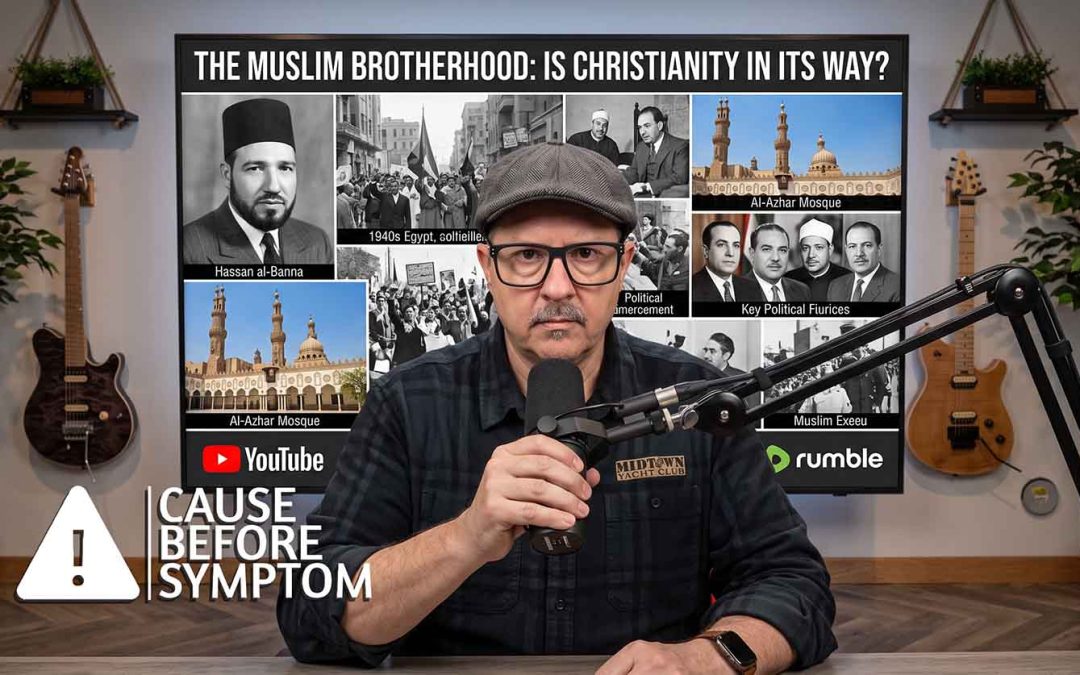
Watch this on Rumble: https://rumble.com/v7govte-the-muslim-brotherhood-is-christianity-in-its-way.html
Opening Monologue — The Movement Most People Have Heard Of but Few Understand
Welcome to Cause Before Symptom, where we don't chase symptoms—we test the cause against Scripture.
Tonight, I want to introduce you to an organization that has existed for nearly a century, influenced political movements across continents, appeared in American intelligence reports, and become the subject of terrorism designations by multiple governments. Yet many Christians have little understanding of what this organization actually is, what it believes, or what it hopes to accomplish.
It is called the Muslim Brotherhood.
Founded in Egypt in 1928 by a schoolteacher named Hassan al-Banna, the Muslim Brotherhood began as a movement dedicated to religious education, social reform, and the restoration of Islamic principles throughout society. It established schools, charities, religious associations, and networks of committed followers. But as the movement expanded, its ambitions increasingly entered the political arena. The question of how Islam should shape government became central to its mission.
Nearly a century later, the Brotherhood's influence can be traced through political parties, religious institutions, historical alliances, and ideological movements across several countries. One prominent Brotherhood figure even claimed the movement had more than 100 million members worldwide. That extraordinary number has never been independently verified, but the claim raises an important question about the difference between actual membership and ideological influence.
And there is another side to this history.
The Brotherhood developed a secret armed apparatus during the 1940s. Its ideological history intersects with the emergence of Hamas. American federal investigators uncovered Hamas fundraising networks connected to Brotherhood-associated individuals and organizations. A 1991 memorandum introduced into federal proceedings described an ambitious vision for developing Islamic institutions in North America. Yet the existence of that document does not prove that every organization it mentioned adopted its proposals.
Russia designated the Brotherhood a terrorist organization in 2003. The United States imposed terrorism-related designations on specific Brotherhood branches in January 2026. Other governments have pursued different relationships with Brotherhood-associated movements, ranging from political cooperation to outright prohibition.
But tonight's investigation is not simply about intelligence agencies, political parties, or international influence.
It is about Christianity.
In Egypt, one of Christianity's oldest communities, Coptic Christians have endured discrimination, intimidation, and terrible sectarian violence. In 2013, churches were burned, Christian businesses were attacked, and families feared for their safety during a period of national upheaval. Some Brotherhood supporters participated in anti-Christian incitement, while other Brotherhood leaders condemned the violence. Muslim neighbors also protected Christians, and Egyptian security forces committed grave abuses against Brotherhood supporters.
These distinctions matter because truth cannot be established by blaming an entire religion for the actions of particular people.
Jesus told His disciples in Matthew 7:16, "Ye shall know them by their fruits." That instruction demands examination, not assumption.
So tonight, I want to investigate what the Muslim Brotherhood actually teaches, how it developed its international influence, what governments have discovered about its activities, and what happens to Christians when religious ideology becomes political authority.
And ultimately, I want to answer one question.
Is Christianity in the Muslim Brotherhood's way?
Not because Christians should fear their Muslim neighbors, but because followers of Jesus should understand the forces shaping religious freedom, government, and the world their children will inherit.
Tonight, we begin with the cause, not the symptom.
Investigation 1 — Who Founded the Muslim Brotherhood, and Why?
To understand the Muslim Brotherhood, we must travel back nearly one hundred years to Egypt in 1928. The First World War had ended, the Ottoman Empire had collapsed, and the Islamic Caliphate had been abolished in 1924. Britain maintained enormous influence over Egypt, particularly around the Suez Canal. Across the Muslim world, religious and political leaders were asking how their societies could recover independence, identity, and authority after generations of foreign intervention.
Into this environment stepped a twenty-one-year-old schoolteacher named Hassan al-Banna. Born in 1906, al-Banna believed that the problems confronting Muslim societies were not simply political or economic. He believed Muslims had drifted away from the principles of Islam and that restoring those principles would restore the strength of their civilization. His solution was not initially to establish a political party or organize a revolution. It was to rebuild society through religious instruction, moral discipline, and organized community activity.
In March 1928, al-Banna established the Society of the Muslim Brothers in Ismailia, near the Suez Canal. According to his later account, six workers approached him because they were frustrated by foreign domination and wanted to do something about the condition of their country. Together, they established what would eventually become one of the most influential Islamist movements of the modern era.
The Brotherhood began with religious meetings, education, charitable work, and efforts to improve everyday life. Its members established schools, organized lectures, and encouraged personal religious commitment. These activities attracted people who felt neglected by Egypt's political establishment. The movement offered more than religious instruction. It provided community, purpose, organizational identity, and a vision of social renewal.
But something important was developing beneath those ordinary activities. Al-Banna believed Islam should guide every dimension of life, including economics, education, law, and government. In his understanding, religion and political authority were not separate spheres. A society transformed by Islamic teaching would eventually require institutions and laws reflecting that transformation.
There is an important historical distinction here. The Brotherhood's original 1930 bylaws expressly prohibited political involvement. Yet by 1938, al-Banna was publicly demanding that political authorities embrace Islamic principles. The movement had progressed from religious and social reform toward direct political engagement.
Al-Banna also envisioned a broader restoration of Muslim political unity. His writings connected individual religious renewal with the eventual establishment of government under Islamic law and, ultimately, a renewed caliphate. That ambition extended beyond Egypt, although its practical meaning and methods developed over time.
For Christians, the significance is not that Muslims established schools, charities, or religious associations. Christians have done the same throughout history. The more consequential question concerns what happens when a religious movement seeks to make its interpretation of divine authority the foundation of government.
Would citizens who rejected that interpretation retain equal rights? Would Christians be free to worship, evangelize, and practice their faith without political disadvantage? Those questions would become increasingly important as the Brotherhood expanded.
And that brings us to the first major discovery of tonight's investigation. The Muslim Brotherhood did not begin as an international terrorist organization. It began as a religious and social reform movement whose founder increasingly connected spiritual renewal with political transformation.
Understanding that development is essential, because the Brotherhood's later history cannot be explained without understanding the vision that inspired its beginning.
Investigation 2 — What Does the Muslim Brotherhood Believe?
Now that we understand why the Muslim Brotherhood was founded, we need to examine what its members were actually taught. Because understanding an organization's objectives requires more than observing its activities. We must examine the principles that guide its decisions, its understanding of authority, and the kind of society it hopes to establish.
Hassan al-Banna believed Islam was not simply a private religion practiced through prayer, fasting, and personal devotion. He taught that Islam provided a comprehensive framework for human existence, encompassing family life, education, economics, law, government, and international relations. His vision challenged the idea that religion and political authority should operate independently.
This philosophy became central to the Brotherhood's identity. The movement promoted the conviction that Islam should shape both the individual believer and the institutions governing society. Its familiar slogan, commonly translated as "Islam is the solution," expressed the belief that Islamic principles could resolve political, moral, and social problems.
But how would such a transformation occur? Al-Banna described a gradual process beginning with the individual, extending through the family and society, and eventually reaching government. Religious education and personal discipline were therefore not separate from the movement's political ambitions. They were part of a larger vision in which society would progressively reflect the Brotherhood's interpretation of Islam.
The movement also developed a demanding understanding of membership. In his *Message of the Teachings*, al-Banna outlined ten principles, including understanding, sincerity, action, sacrifice, obedience, perseverance, and brotherhood. Members were expected to cultivate religious commitment while accepting responsibilities toward the organization. This combination of spiritual instruction and organizational discipline helped distinguish the Brotherhood from a conventional political party.
One of the most consequential questions concerns Islamic law, commonly called Sharia. Sharia encompasses a broad religious and ethical tradition, while specific legal rules arise through different schools and interpretations of Islamic jurisprudence. Brotherhood thinkers generally argued that Islamic principles should inform government and legislation. However, Brotherhood-associated parties and intellectuals have disagreed over constitutional democracy, legislative authority, and how Islamic law should be implemented.
Those disagreements become particularly important when examining religious minorities. Historically, Islamic political traditions have included systems in which Christians and Jews received protection while occupying a different legal position from Muslims. Modern Brotherhood-associated political movements have sometimes endorsed citizenship and political participation for Christians, while critics have questioned whether their proposed constitutional arrangements would guarantee complete religious equality.
This is where our investigation must become precise. Supporting Islamic government does not automatically establish an intention to persecute Christians. But any political program that restricts conversion, evangelism, religious expression, or equal citizenship deserves serious examination, regardless of the religion advancing it.
Another important development came through Sayyid Qutb, whose writings challenged political systems he believed had rejected divine sovereignty. His ideas influenced later revolutionary Islamist movements, but Brotherhood leaders themselves disputed some radical interpretations of his teachings. Consequently, we cannot accurately describe every Brotherhood branch as following one identical political doctrine.
For Christians, the underlying theological difference is profound. Christianity proclaims Jesus Christ as Lord and Savior, while the Brotherhood's religious framework is grounded in Islamic teachings that reject central Christian claims about Christ's divinity and crucifixion. Yet theological disagreement must not be confused with evidence of political persecution.
Jesus declared in John 18:36, "My kingdom is not of this world." His words challenge us to consider the relationship between spiritual authority and earthly government.
The question we must carry forward is whether the Brotherhood's vision of Islamic governance can consistently protect the freedom of people who reject its religious convictions.
Because what a movement believes matters. But what it does when it acquires political authority may reveal even more.
Investigation 3 — How Does the Brotherhood Organize and Expand?
Now that we understand the Muslim Brotherhood's origins and beliefs, we need to examine how a movement founded by a young Egyptian schoolteacher developed relationships and influence across multiple continents. Because the Brotherhood's history is not simply the story of an idea spreading through religious teaching. It is also the story of an organization that developed membership systems, leadership structures, financial resources, and institutions capable of surviving enormous political pressure.
From its early years, the Brotherhood emphasized organization and discipline. Local branches brought members together for religious instruction, community activities, and recruitment. Members participated in educational circles, often called *usra*, meaning family, where small groups studied religious teachings and developed personal relationships. These gatherings encouraged commitment while connecting individuals to a larger organizational identity.
The Brotherhood developed a hierarchical structure headed by a General Guide, supported by leadership bodies and administrative councils. Within Egypt, local organizations operated through regional networks. Membership involved varying levels of participation and commitment, rather than simply identifying oneself as sympathetic to the movement. This distinction becomes important when evaluating claims about its size.
The Brotherhood also developed institutions outside conventional party politics. Schools, charities, professional associations, businesses, and religious organizations provided opportunities to serve communities while expanding its public presence. These activities were not necessarily secret or unlawful. But they could also help the movement build relationships, recruit supporters, and establish influence beyond electoral politics.
As Egyptian governments periodically suppressed the Brotherhood, members and sympathizers relocated to other countries. Some contributed to the development of Islamist organizations in the Middle East and Europe. Others participated in educational, religious, or political institutions abroad. Over time, movements influenced by Brotherhood ideas emerged in countries including Jordan, Syria, Tunisia, and elsewhere.
But we must make an important distinction. Shared ideology does not necessarily mean shared leadership. A political organization inspired by Hassan al-Banna may operate independently of Egypt's Brotherhood. Some national branches have maintained organizational relationships, while others have developed their own priorities, disagreements, and leadership structures. American intelligence assessments from the 1980s recognized these differences and cautioned against assuming that every Brotherhood organization answered to one worldwide command.
This brings us to an extraordinary claim about the Brotherhood's membership. In 2008, prominent Brotherhood figure Youssef Nada reportedly claimed that the movement had more than one hundred million members worldwide. Imagine what that would mean. An organization of that size would represent a population larger than many countries.
But there is a problem. The figure has never been independently verified through publicly available membership records. Researchers have produced substantially smaller estimates for formal membership in Egypt, while acknowledging the difficulty of counting supporters and loosely associated international movements. We cannot responsibly present one hundred million as an established fact.
What we can establish is that the Brotherhood's influence cannot be measured solely by formal membership. Political parties can attract voters who never join the organization. Religious institutions can circulate ideas without accepting organizational direction. Charities can develop independent constituencies. Personal relationships can also connect institutions without proving centralized control.
That distinction will become especially important when we examine the United States and Europe, where allegations about Brotherhood influence have sometimes extended far beyond what documentary evidence establishes.
From a Christian standpoint, we should also recognize that religious education, charitable service, and community organization are not inherently suspicious. Churches engage in those same activities. The relevant questions concern whether institutions operate transparently, whether their leadership and financial relationships can be documented, and whether their political objectives protect the rights of people who disagree with them.
The Brotherhood's organizational history demonstrates how religious conviction, community institutions, political participation, and disciplined membership can sustain a movement across generations.
But its international reach also raises a much more difficult question. When organizations share an ideology, how do we determine whether they are merely inspired by the same teachings or are actually working together under coordinated leadership?
That is where our investigation must follow documents, relationships, and demonstrated actions rather than assumptions.
Investigation 4 — The Secret Apparatus, Political Violence, and the Rise of Hamas
The Muslim Brotherhood's early history contains a contradiction that deserves careful examination. An organization publicly associated with religious education, charitable activity, and social reform also developed a secret armed organization. Understanding why that happened, and what followed, is essential to understanding the movement's relationship with political violence.
During the 1940s, the Brotherhood established a clandestine network known as the Special Apparatus, or Secret Organization. Its members received military training and participated in covert activities, including operations against British interests and involvement in the conflict surrounding the establishment of Israel. The organization operated under conditions of secrecy, creating questions about how much authority its leadership exercised over individual operations.
In December 1948, Egyptian Prime Minister Mahmoud al-Nuqrashi was assassinated by a Brotherhood member after the government ordered the organization's dissolution. Hassan al-Banna publicly condemned the killing, but the assassination intensified the confrontation between the Brotherhood and Egyptian authorities. In February 1949, al-Banna himself was assassinated in Cairo. The movement had entered a cycle of political violence and repression that would shape its future.
The next major confrontation came after Egypt's 1952 revolution. The Brotherhood initially cooperated with the military officers who overthrew the monarchy, but relations deteriorated under Gamal Abdel Nasser. Following an assassination attempt against Nasser in 1954, the government launched a sweeping crackdown. Thousands of Brotherhood members were imprisoned, and allegations of torture became central to accounts of this period.
Among those imprisoned was Sayyid Qutb, whose writings would influence generations of Islamist activists. Qutb argued that societies rejecting divine sovereignty had entered a condition he described as *jahiliyya*, or ignorance of God's guidance. His book *Milestones* challenged the legitimacy of political systems he believed placed human authority above divine law. Revolutionary Islamist movements later drew upon these arguments, although scholars continue to debate their interpretation and influence.
Importantly, Brotherhood leaders did not unanimously embrace Qutb's more revolutionary implications. Hassan al-Hudaybi and other figures opposed interpretations that encouraged declaring fellow Muslims unbelievers. Later militant organizations sometimes rejected the Brotherhood's gradual political approach altogether. Therefore, ideological influence cannot automatically be treated as evidence of organizational control.
But another historical development demands our attention.
In December 1987, during the First Intifada, Hamas emerged from the Palestinian Muslim Brotherhood milieu. Its founding leader, Sheikh Ahmed Yassin, had long been associated with Palestinian Brotherhood networks. Hamas's 1988 charter explicitly identified the organization with the Muslim Brotherhood and called for Israel's destruction.
Unlike Brotherhood branches pursuing electoral or gradual political strategies, Hamas developed an armed wing and carried out attacks against Israeli civilians and military targets. The United States designated Hamas a Foreign Terrorist Organization in 1997. Hamas later participated in Palestinian elections, winning a legislative majority in 2006, and established control over Gaza in 2007. Its 2017 political document revised aspects of its public political language without ending its armed struggle.
These developments establish a genuine historical and ideological connection between the Palestinian Brotherhood and Hamas. They do not establish that every Brotherhood branch directs Hamas operations or endorses every action Hamas has undertaken.
For Christians, the essential question concerns the justification of violence through religious or political authority. Jesus instructed Peter in Matthew 26:52, "Put up again thy sword into his place: for all they that take the sword shall perish with the sword." His teaching requires serious reflection whenever religious conviction becomes entangled with coercion and bloodshed.
The Brotherhood's history demonstrates that movements can contain competing approaches to political change, including education, elections, resistance, and armed conflict. Those differences must be examined rather than erased.
And as we move into the next investigation, another question emerges. What did American intelligence agencies discover about these organizations, their international relationships, and the networks that developed beyond the Middle East?
Investigation 5 — What Did the CIA and FBI Discover About the Brotherhood?
For decades, American intelligence agencies have studied the Muslim Brotherhood, examining its leadership, political ambitions, international relationships, and connections to militant organizations. But what makes these records particularly interesting is that they do not describe a single, unchanging organization. They reveal a movement whose objectives, methods, and relationships have developed across generations.
During the Cold War, American intelligence monitored the Brotherhood's relationship with Egyptian governments and its opposition to communist influence. Declassified CIA assessments from the 1980s described an organization seeking to establish an Islamic political order through gradual social and institutional transformation. Analysts identified recruitment among students, educators, professionals, and businesspeople, alongside the development of financial and organizational resources.
The CIA also recognized an important distinction. Brotherhood organizations in different countries were not necessarily controlled by one international headquarters. National branches developed their own leadership, political priorities, and relationships with governments. This matters because international ideological influence does not automatically establish centralized operational command.
But American federal investigations eventually uncovered something more specific.
In the Holy Land Foundation case, federal prosecutors presented evidence concerning a network established to support Hamas in the United States. The investigation examined fundraising organizations, financial transfers, meetings, and relationships involving individuals associated with the Brotherhood's Palestine Committee.
In 2008, five Holy Land Foundation leaders were convicted of providing material support to Hamas. Prosecutors established that approximately $12.4 million had been directed through organizations associated with Hamas. The convictions demonstrated that charitable structures could be used to channel resources to a designated terrorist organization.
One of the most controversial documents introduced during those proceedings was a memorandum dated May 22, 1991, attributed to Mohamed Akram. Known as *An Explanatory Memorandum*, it described a proposed strategy for developing the Muslim Brotherhood's activities in North America.
The memorandum contained striking language about transforming Western civilization from within. It also discussed establishing institutions, coordinating organizations, developing leadership, and expanding Islamic activities across American society.
But an essential distinction must be preserved. The document establishes what its author proposed. It does not independently establish that every organization mentioned in its pages accepted the proposal, followed its instructions, or operated under Brotherhood control. Courts also distinguished criminal convictions from allegations concerning organizations that were publicly named but never charged.
This is why original evidence matters. A government exhibit is not automatically a judicial finding, and an intelligence assessment is not the same thing as a criminal conviction.
Now consider what happened decades later.
In November 2025, the United States initiated a formal review of specified Muslim Brotherhood branches. On January 13, 2026, the Treasury Department designated the Egyptian and Jordanian branches as Specially Designated Global Terrorists, citing alleged support for Hamas. The Lebanese branch received both that designation and a Foreign Terrorist Organization designation.
These actions marked an important development in American policy, but their legal scope must be understood. The designations concerned specified branches, not every Muslim Brotherhood-associated organization worldwide.
For Christians, these findings raise serious questions about political influence, transparency, financial accountability, and the misuse of charitable institutions. Yet the same standard must apply to every organization, regardless of its religious identity.
Jesus warned in Matthew 7:20, "Wherefore by their fruits ye shall know them." That instruction directs attention toward demonstrated conduct rather than reputation alone.
The intelligence and criminal records establish that particular Brotherhood-associated networks pursued political influence and that individuals within a documented Hamas-support network committed serious federal crimes. They do not establish that every Muslim religious institution participates in those activities.
And that distinction brings us to the next investigation. If the Brotherhood's influence extends beyond Egypt and the Middle East, how do we trace its international relationships without mistaking shared religious beliefs for organizational control?
Investigation 6 — How Far Does the Brotherhood's International Influence Reach?
When Hassan al-Banna founded the Muslim Brotherhood in Egypt in 1928, he could not have known how extensively his ideas would travel. Nearly a century later, movements influenced by his teachings have appeared across the Middle East, Europe, Africa, and North America. But understanding this international expansion requires us to distinguish something very important: the difference between an organization controlling institutions and an ideology influencing people.
The Brotherhood's international development accelerated during the twentieth century as Egyptian governments repeatedly suppressed its activities. Members and sympathizers relocated to other countries, particularly following the confrontation with Gamal Abdel Nasser during the 1950s and 1960s. Some became teachers, religious scholars, professionals, and political organizers. Their experiences and ideas contributed to emerging Islamist movements in their adopted countries.
In Jordan, the Brotherhood developed a longstanding political and social presence, including relationships with the Islamic Action Front. In Syria, the movement became involved in a violent confrontation with the government of Hafez al-Assad, culminating in the devastating suppression of an uprising in Hama in 1982. In Tunisia, the Ennahda movement developed within a broader intellectual environment influenced by Brotherhood thinkers, although its leadership and political evolution followed a distinct national path.
These examples demonstrate that Brotherhood influence did not produce identical organizations everywhere. Some movements participated in elections. Others experienced violent confrontations with governments. Still others concentrated on religious education, social services, or community institutions.
Europe presents another important chapter. Beginning in the mid-twentieth century, Islamist activists and exiles helped establish religious associations, educational organizations, and community institutions. Researchers, including Lorenzo Vidino and Martyn Frampton, have documented personal and ideological relationships connecting certain European institutions to Brotherhood-associated figures.
But those relationships require careful examination. A shared conference, a common religious scholar, or a similar political philosophy does not necessarily prove that one institution controls another. Establishing organizational direction requires stronger evidence, such as leadership appointments, financial records, governing documents, or demonstrated coordination.
The same distinction applies to North America.
The 1991 memorandum attributed to Mohamed Akram described an ambitious vision for coordinating Islamic institutions in the United States. It identified organizations and proposed expanding religious, educational, and community activities. Yet the memorandum's existence does not prove that every organization it mentioned adopted its program. Nor does participation in ordinary Muslim civic life establish membership in the Brotherhood.
Nevertheless, documented relationships deserve examination. The Holy Land Foundation prosecution demonstrated that a particular American fundraising network provided material support to Hamas. That case established criminal responsibility among its defendants, while leaving broader allegations about other organizations subject to separate evidentiary standards.
International influence also operates through ideas. A religious scholar can shape political thinking across borders without commanding a formal organization. Books, lectures, universities, conferences, and personal relationships can transmit ideological concepts across generations. That kind of influence may be significant, but it must not be confused with secret operational control.
This is especially important when considering claims that the Brotherhood possesses one hundred million members. That number remains unverified. Its worldwide ideological reach may be broader than its formal membership, but the two cannot responsibly be counted as the same population.
For Christians, this investigation raises a question about discernment. Jesus warned in Matthew 7:15 about false prophets appearing in sheep's clothing, but that passage does not authorize accusations against people without evidence. Christian discernment requires examining teachings and conduct while refusing to bear false witness.
The Brotherhood's international history reveals a movement whose ideas crossed national boundaries through political organizations, personal relationships, religious institutions, and migration. Some connections are formally documented. Others are ideological or disputed.
And that leads to a revealing question. If the Brotherhood's international relationships are so complex, why have governments reached such different conclusions about the movement?
To answer that, we must examine what Russia, China, the United States, and other nations actually believe they are confronting.
Investigation 7 — Why Do Russia, China, America, and Other Governments Disagree?
One of the most revealing discoveries in our investigation is that governments around the world do not agree on how the Muslim Brotherhood should be treated. Some have designated particular Brotherhood organizations as terrorist groups. Others have permitted Brotherhood-associated political parties to participate in elections. Still others have maintained diplomatic relationships with governments led by Brotherhood figures. Why would nations examining the same movement reach such different conclusions?
Russia provides one of the earliest examples. On February 14, 2003, the Russian Supreme Court included the Muslim Brotherhood among organizations designated as terrorist organizations and prohibited their activities within Russia. The decision emerged during a period when Moscow was confronting armed Islamist movements in the North Caucasus and treating religiously motivated militancy as a major national-security concern.
But Russia's designation requires careful interpretation. The legal classification establishes the Russian government's position. It does not independently prove that every Brotherhood branch participated in terrorism or that every allegation supporting the decision was correct. Russia's security priorities and political interests must be considered alongside its evidence.
China presents a different picture. When Mohamed Morsi, associated with Egypt's Muslim Brotherhood, won Egypt's presidential election in 2012, Beijing congratulated him and maintained diplomatic relations with his government. Following his removal by the Egyptian military in 2013, China emphasized stability, reconciliation, and respect for Egypt's political process.
China's approach reflects its broader emphasis on state sovereignty, political stability, and strategic relationships. Beijing also maintains extensive domestic security policies toward religious movements, particularly in Xinjiang. However, those policies do not establish that China has formally designated the Muslim Brotherhood itself as a terrorist organization. Public diplomatic statements cannot tell us everything Chinese intelligence agencies privately believe.
The United States has followed another path. During the Cold War, American intelligence studied the Brotherhood's opposition to communism, its political ambitions, and its relationships with Middle Eastern governments. Declassified CIA assessments recognized differences between national branches and distinguished gradual political activity from revolutionary militancy.
Decades later, federal investigators uncovered the Holy Land Foundation's financial support for Hamas. In January 2026, the United States imposed terrorism-related designations on specified Egyptian, Jordanian, and Lebanese Brotherhood branches. These developments demonstrate changes in American policy, but they do not amount to a designation of every Brotherhood-associated movement worldwide.
Britain conducted an official review in 2015 that raised concerns about aspects of Brotherhood ideology and relationships with extremism. Yet the British government did not impose a comprehensive ban on the entire movement. Parliamentary scrutiny also questioned elements of the review and its transparency.
Within the Middle East, disagreements are even more pronounced. Egypt designated the Brotherhood a terrorist organization following Mohamed Morsi's removal in 2013. Saudi Arabia and the United Arab Emirates have also treated the Brotherhood as a security threat, particularly regarding its model of organized political Islam.
Qatar and Turkey, by contrast, maintained relationships with Brotherhood-associated political figures and movements, especially during the upheavals following the Arab Spring. Those relationships reflected overlapping ideological, diplomatic, and regional interests, rather than proving that either government controlled the entire movement.
These competing positions reveal something important. Governments do not evaluate religious-political organizations in isolation. They consider national security, domestic opposition, regional alliances, ideological competition, and their own political survival.
A movement considered a legitimate political participant by one government may be prohibited by another. Neither acceptance nor prohibition, standing alone, establishes the complete truth about that movement's conduct.
For Christians, this presents a serious challenge. We cannot simply accept Washington's position because it is American, Moscow's because it is Russian, or Beijing's because it offers a different geopolitical perspective.
First Thessalonians 5:21 instructs believers, "Prove all things; hold fast that which is good." That requires examining evidence rather than adopting the conclusions of powerful governments without question.
The international record demonstrates that the Brotherhood's political activities, national branches, and relationships with violence have produced different responses under different circumstances.
But the question most important to tonight's audience remains unanswered. Beyond the diplomatic disagreements and intelligence assessments, what happened to Christians when Brotherhood-associated political leaders gained authority?
To answer that, we must return to Egypt and examine the experiences of one of the oldest Christian communities in the world.
Investigation 8 — What Happened to Christians Under Brotherhood-Associated Political Rule?
Now we arrive at one of the most important questions of tonight's investigation. What happens when a movement committed to Islamic political governance gains authority over a country with an ancient Christian population? To examine that question, we must return to Egypt, where Coptic Christians have lived for nearly two thousand years.
The Coptic Orthodox Church traces its origins to the earliest centuries of Christianity. Long before the Muslim Brotherhood existed, Egyptian Christians experienced periods of discrimination, violence, and political exclusion. Those problems continued under successive Egyptian governments, including those that opposed the Brotherhood. We must understand this history because it would be inaccurate to attribute every attack against Egyptian Christians to one political movement.
In June 2012, Mohamed Morsi, the Muslim Brotherhood's presidential candidate, won Egypt's first competitive presidential election following the overthrow of Hosni Mubarak. His victory raised difficult questions about the relationship between Islamic political authority and equal citizenship.
Morsi publicly promised to represent all Egyptians, including Christians. His administration included Christian officials, and he spoke about national unity. Nevertheless, many Copts feared that the Brotherhood's growing political influence would weaken protections for religious minorities, particularly as disputes intensified over Egypt's constitution.
The constitution approved in December 2012 retained Islam as the state religion and established principles of Islamic Sharia as the principal source of legislation. It also recognized certain religious freedoms and protections for Christians and Jews. Critics argued that its language and drafting process left important questions unresolved concerning equality, freedom of belief, and the influence of religious authorities.
Then came the violence.
In April 2013, clashes in the town of al-Khusus left Muslims and Christians dead. During funerals at Saint Mark's Coptic Orthodox Cathedral in Cairo, mourners were attacked, and security forces were accused of failing to provide adequate protection. These events deepened Christian fears about whether the government could protect religious minorities.
But the worst destruction followed Morsi's removal by the military in July 2013.
On August 14, Egyptian security forces violently dispersed pro-Morsi protest camps in Cairo, killing hundreds of demonstrators. Human Rights Watch subsequently documented the killings as serious state abuses, describing the Rabaa dispersal as a probable crime against humanity.
During the unrest that followed, mobs attacked churches, Christian schools, homes, and businesses across Egypt. Human rights organizations documented dozens of attacks against Christian religious institutions and property. In some locations, attackers blamed Christians for supporting Morsi's removal.
Anti-Christian incitement by some Brotherhood supporters contributed to an atmosphere of hostility. Yet responsibility for individual attacks must be established through evidence. Not every attacker was a Brotherhood member, and condemnation of the violence also came from Brotherhood-associated voices.
There were Muslims who protected their Christian neighbors. There were Christians who opposed the military crackdown against Brotherhood supporters. Their actions remind us that Egypt's religious communities cannot be reduced to two opposing political camps.
The evidence reveals serious failures to protect Christians during Morsi's presidency and devastating sectarian attacks following his overthrow. It does not establish that Morsi personally ordered those attacks or that every Brotherhood supporter endorsed them.
For Christians, however, the question remains deeply consequential. A government's promises of religious tolerance must be measured against its laws, its actions, and its willingness to protect vulnerable citizens.
Jesus taught in Matthew 7:12 that we should treat others as we would want to be treated. Religious freedom cannot mean protection only for those who agree with the people holding power.
And that leads directly to our next investigation. If Christianity teaches that salvation comes through Jesus Christ, while the Brotherhood advocates a society shaped by Islamic principles, does Christianity become an obstacle to the Brotherhood's political vision?
The answer requires us to distinguish theological disagreement from the political suppression of religious freedom.
Investigation 9 — Is Christianity an Obstacle to the Brotherhood's Political Vision?
We have examined the Muslim Brotherhood's history, organizational structure, international relationships, and the experiences of Christians in Egypt. Now we must confront the question at the center of tonight's investigation. Is Christianity an obstacle to what the Brotherhood hopes to accomplish?
The answer depends upon what we mean by an obstacle. Christianity and Islam disagree on fundamental theological questions. Christianity proclaims Jesus Christ as the Son of God, crucified and risen from the dead. Islam honors Jesus as a prophet but rejects the Christian understanding of His divinity. These differences are profound, but religious disagreement alone does not establish political hostility.
The more consequential issue arises when religious convictions become the foundation of government. Hassan al-Banna envisioned a society in which Islamic principles shaped education, law, public morality, and political authority. His movement sought more than the freedom to practice Islam. It sought a transformation of society according to its understanding of Islam.
That vision creates an unavoidable question. What happens to citizens who do not accept the religious principles governing their country?
Historically, Islamic legal traditions developed frameworks for protecting Christian and Jewish communities while distinguishing their legal position from that of Muslims. These arrangements varied across time and place. They sometimes permitted substantial religious autonomy, but they did not consistently provide the equal citizenship and freedom of religious expression expected under modern international human rights standards.
Brotherhood-associated thinkers have differed over how these traditions should apply today. Some have endorsed constitutional citizenship and protections for Christians. Others have supported restrictions on particular political offices or defended interpretations of Islamic law that raise concerns about religious equality.
Consequently, we cannot honestly claim that every Brotherhood leader advocates the persecution of Christians. But neither can we ignore the tension between religiously defined political authority and the principle that every citizen should possess equal rights regardless of faith.
Consider what genuine religious freedom requires. Christians must be able to worship openly, maintain churches, educate their children, express their beliefs, and participate in public life without discrimination. They must also be free to explain their faith to others, just as Muslims should be free to explain theirs.
The freedom to change one's religion is especially important. In societies where conversion away from Islam carries legal penalties, social intimidation, or threats of violence, the problem extends beyond theological disagreement. Religious authority has become a mechanism restricting personal conscience.
This is where Christianity can become an obstacle to an exclusivist political project. A Christian who believes allegiance to Jesus Christ takes precedence over religious demands imposed by the state may refuse to accept restrictions on worship, evangelism, or conscience.
But that conflict is not unique to Islamic politics. Christians have also suffered under secular dictatorships, communist governments, nationalist movements, and authorities claiming to defend Christianity itself. The danger arises whenever political power demands an allegiance that overrides freedom of conscience.
We should also remember that many Muslims reject religious coercion and support equal citizenship. They should not be treated as enemies because of the political ambitions of particular organizations.
The New Testament provides a striking example. In Acts 5:29, Peter and the apostles declared, "We ought to obey God rather than men." Their response concerned an authority attempting to silence their testimony about Jesus.
That principle helps explain why Christianity can challenge governments seeking control over religious belief. The church's ultimate allegiance cannot be transferred to a political movement, a ruler, or a state.
So is Christianity in the Muslim Brotherhood's way? Where a Brotherhood-associated political program demands restrictions on Christian conscience, equal citizenship, or religious expression, Christianity's independent convictions can indeed become an obstacle. Where Brotherhood-associated leaders genuinely protect those freedoms, theological disagreement need not produce political persecution.
The decisive evidence is not simply what a movement says about religion. It is what its institutions permit people of other faiths to believe, practice, and proclaim.
And that brings us to our final investigation. What does Scripture actually teach Christians about political power, religious coercion, and how followers of Jesus should respond when governments challenge their faith?
Investigation 10 — What Does Scripture Tell Christians About Religious and Political Power?
We have spent tonight examining the Muslim Brotherhood through history, intelligence records, political movements, and the experiences of Christians living under contested religious authority. But this is Cause Before Symptom, and our final standard cannot simply be the judgment of governments or intelligence agencies. We must return to Scripture and ask what Jesus actually taught about faith, political power, and the freedom to follow God.
When Jesus stood before Pontius Pilate, He made a declaration that fundamentally distinguishes His kingdom from earthly political movements. In John 18:36, Jesus said, "My kingdom is not of this world: if my kingdom were of this world, then would my servants fight." Christ was not denying His authority. He was explaining that His kingdom did not originate from the political systems and coercive methods of this world.
This distinction matters because religious movements throughout history have attempted to use governments to enforce their understanding of divine truth. Christianity itself has a history of rulers using state power to punish religious dissent. Those episodes deserve examination under the same moral standard we apply to Islamic political movements.
Jesus did not command His disciples to establish His kingdom through political conquest. In Matthew 28:19, He instructed them to teach all nations. The Christian mission advances through proclamation, discipleship, and witness. A government may regulate public conduct, but it cannot manufacture genuine faith through legislation or force.
Consider the example of the early church. The apostles preached under Roman authority, often facing imprisonment and persecution. Yet they did not possess armies, command governments, or require political office to proclaim the Gospel. Their authority came from the message they carried, not from control over the institutions surrounding them.
Romans 13 teaches that governing authorities have responsibilities concerning public order and justice. But Acts 5:29 establishes an equally important boundary: "We ought to obey God rather than men." Christians are called to respect legitimate civil authority without surrendering their ultimate allegiance to it.
These passages must be understood together. Scripture does not teach that every disagreement with government justifies rebellion. Neither does it require believers to obey commands that would compel them to abandon their faith or violate God's instructions.
The New Testament also addresses how Christians should treat people who disagree with them. In Matthew 5:44, Jesus commands His followers to love their enemies and pray for those who persecute them. That instruction is especially important when discussing Islam, because political disagreement must never become an excuse to hate Muslim neighbors.
The apostle Paul writes in Romans 12:18, "If it be possible, as much as lieth in you, live peaceably with all men." Christians can oppose religious persecution, challenge discriminatory laws, and investigate political organizations without treating entire populations as enemies.
And there is another principle we must not overlook. In Matthew 7:16, Jesus says, "Ye shall know them by their fruits." This means we must examine conduct rather than rely exclusively upon declarations of good intentions or accusations made by political opponents.
If a government promises religious freedom, does it protect churches when they are attacked? If an organization claims to support equal citizenship, does it defend the rights of those who reject its beliefs? If a religious movement speaks about justice, does that justice extend to people outside its own community?
Those questions apply to the Brotherhood, to governments opposing it, and to Christians themselves.
The biblical response to religious-political power is therefore neither fear nor indifference. It is discernment, courage, truthful testimony, and love for our neighbors.
Christianity's strength does not depend upon controlling the state. Its foundation is Jesus Christ.
And if a political movement demands that Christians surrender their conscience, silence the Gospel, or accept unequal treatment because of their faith, then Scripture provides a clear answer. The church must remain faithful to Christ, even when earthly authorities demand otherwise.
Conclusion — Is Christianity in Its Way?
Tonight, we began with a question that deserves more than a simple yes or no. Is Christianity in the Muslim Brotherhood's way? After examining nearly a century of history, political movements, intelligence investigations, international relationships, and the experiences of persecuted Christians, I believe we can answer that question with greater precision.
The Muslim Brotherhood began in Egypt in 1928 as a movement for Islamic religious and social renewal. Its founder, Hassan al-Banna, believed that Islam should shape not only personal faith but the institutions of society and government. Over time, the movement developed political organizations, international relationships, and competing approaches to achieving its objectives.
We discovered that this history includes both charitable activity and political violence. The Brotherhood established schools and community institutions, but it also developed a secret armed apparatus. Its Palestinian organizational lineage contributed to the emergence of Hamas. American federal investigations later established that individuals operating within a Hamas-support network in the United States had provided material support to a designated terrorist organization.
We also discovered the danger of exaggeration. Claims that the Brotherhood possesses one hundred million members remain unverified. A document describing an ambitious political strategy does not prove that every organization it mentions adopted that strategy. And sharing religious ideas does not necessarily establish that institutions operate under one international command.
These distinctions are not excuses for wrongdoing. They are requirements for discovering the truth.
Then we examined the experiences of Christians in Egypt. We found genuine fears about religious equality, serious failures to protect Christian communities, and devastating attacks against churches and Christian property during the political upheaval of 2013. We also found Muslim citizens who defended Christians and state authorities who committed grave abuses against Brotherhood supporters.
The truth requires us to acknowledge all of these facts, even when they complicate the story.
But the deepest issue tonight is not the size of an organization, the number of its international relationships, or the policies of competing governments. It is what happens when political authority attempts to determine which religious convictions deserve freedom and which must remain subordinate.
Christianity becomes an obstacle to any political system that demands ultimate allegiance to something other than Jesus Christ. That is true whether the system is Islamist, communist, nationalist, secular authoritarian, or even a government claiming to act in Christianity's name.
Jesus said in John 18:36, "My kingdom is not of this world." He did not establish His church through military conquest or compel people to believe through the power of government. He called people to repentance, faith, love, and obedience to God.
And that is where the distinction becomes clear.
Christians do not need to oppose Muslims in order to oppose religious coercion. They do not need to fear their neighbors in order to recognize threats to religious freedom. And they do not need to abandon careful evidence in order to defend the Gospel.
If a Brotherhood-associated political movement protects the freedom of Christians to worship, evangelize, and participate equally in society, theological disagreement does not require political hostility. But if that movement seeks to restrict Christian conscience or establish unequal citizenship, then Christianity's refusal to surrender its allegiance becomes an obstacle to that political ambition.
So the answer is conditional, but it is not evasive. Christianity stands in the way of any political project that requires Christians to surrender their faith or their freedom of conscience.
And I want to leave you with one final thought.
The church has survived empires, persecutions, revolutions, and governments that believed they could control or extinguish it. Its endurance has never depended upon possessing the strongest military or the greatest political influence.
It has depended upon the One who established it.
In Matthew 16:18, Jesus declared, "Upon this rock I will build my church; and the gates of hell shall not prevail against it."
That is not a command to fear our neighbors. It is a reason to remain faithful, seek the truth, defend the vulnerable, and love even those with whom we profoundly disagree.
Because here on Cause Before Symptom, we do not chase symptoms. We test the cause against Scripture.
And tonight, the cause we must confront is what happens when earthly power demands authority over the human conscience.
Bibliography
- Al-Banna, Hasan. Five Tracts of Hasan al-Banna (1906–1949): A Selection from the Majmuʿat Rasaʾil al-Imam al-Shahid Hasan al-Banna. Translated by Charles Wendell. Berkeley: University of California Press, 1978.
- Amnesty International. Egypt: 'How Long Are We Going to Live in This Injustice?' Egypt's Christians Caught between Sectarian Attacks and State Inaction. London: Amnesty International, 2013.
- Brown, Nathan J. When Victory Is Not an Option: Islamist Movements in Arab Politics. Ithaca, NY: Cornell University Press, 2012.
- Carnegie Endowment for International Peace. Egypt's Muslim Brotherhood. Washington, DC: Carnegie Endowment for International Peace. https://carnegieendowment.org/.
- Frampton, Martyn. The Muslim Brotherhood and the West: A History of Enmity and Engagement. Cambridge, MA: Belknap Press of Harvard University Press, 2018.
- Hamid, Shadi. Temptations of Power: Islamists and Illiberal Democracy in a New Middle East. New York: Oxford University Press, 2014.
- Human Rights Watch. All According to Plan: The Rab'a Massacre and Mass Killings of Protesters in Egypt. New York: Human Rights Watch, 2014.
- Human Rights Watch. “Egypt: Mass Attacks on Churches.” August 21, 2013. https://www.hrw.org/news/2013/08/21/egypt-mass-attacks-churches.
- International Crisis Group. Egypt's Muslim Brothers: Confrontation or Integration? Middle East/North Africa Report No. 76. Brussels: International Crisis Group, 2008.
- Mitchell, Richard P. The Society of the Muslim Brothers. London: Oxford University Press, 1969.
- Muslim Brotherhood. “An Explanatory Memorandum: On the General Strategic Goal for the Group in North America.” Attributed to Mohamed Akram, May 22, 1991. Government exhibit introduced in United States v. Holy Land Foundation for Relief and Development, U.S. District Court for the Northern District of Texas.
- Pargeter, Alison. The Muslim Brotherhood: The Burden of Tradition. London: Saqi Books, 2010.
- Qutb, Sayyid. Milestones. Indianapolis: American Trust Publications, 1990.
- Rubin, Barry, ed. The Muslim Brotherhood: The Organization and Policies of a Global Islamist Movement. New York: Palgrave Macmillan, 2010.
- Trager, Eric. Arab Fall: How the Muslim Brotherhood Won and Lost Egypt in 891 Days. Washington, DC: Georgetown University Press, 2016.
- United Kingdom. House of Commons. Foreign Affairs Committee. Political Islam, and the Muslim Brotherhood Review. Sixth Report of Session 2016–17. London: House of Commons, 2016.
- United Kingdom. Prime Minister's Office. “Muslim Brotherhood Review: Main Findings.” December 17, 2015. https://www.gov.uk/government/publications/muslim-brotherhood-review-main-findings.
- United States. Central Intelligence Agency. Declassified intelligence assessments concerning the Muslim Brotherhood and political Islam in Egypt and the Middle East. CIA Records Search Tool (CREST), CIA Electronic Reading Room. https://www.cia.gov/readingroom/.
- United States. Department of Justice. “Federal Jury Convicts Holy Land Foundation and Five of Its Leaders on Terrorism Financing Charges.” November 24, 2008. https://www.justice.gov/.
- United States. Department of State. Country Reports on Terrorism. Washington, DC: U.S. Department of State. https://www.state.gov/.
- United States. Department of the Treasury. Office of Foreign Assets Control. Sanctions announcements and designations concerning specified Muslim Brotherhood branches, January 13, 2026. https://home.treasury.gov/.
- Vidino, Lorenzo. The New Muslim Brotherhood in the West. New York: Columbia University Press, 2010.
- Wickham, Carrie Rosefsky. The Muslim Brotherhood: Evolution of an Islamist Movement. Princeton, NJ: Princeton University Press, 2013.
- Willi, Victor J. The Fourth Ordeal: A History of the Muslim Brotherhood in Egypt, 1968–2018. Cambridge: Cambridge University Press, 2021.
- Zollner, Barbara H. E. The Muslim Brotherhood: Hasan al-Hudaybi and Ideology. London: Routledge, 2009.
- The Holy Bible. King James Version. 1611.
Endnotes
- Richard P. Mitchell, The Society of the Muslim Brothers (London: Oxford University Press, 1969). Mitchell provides a foundational historical examination of the Brotherhood's establishment in Egypt, Hassan al-Banna's leadership, its early religious and social activities, and its development into a political movement.
- Martyn Frampton, The Muslim Brotherhood and the West: A History of Enmity and Engagement (Cambridge, MA: Belknap Press of Harvard University Press, 2018). Frampton examines the Brotherhood's founding, its response to British influence in Egypt, its changing political objectives, and its complicated relationship with Western governments.
- Hasan al-Banna, Five Tracts of Hasan al-Banna (1906–1949): A Selection from the Majmuʿat Rasaʾil al-Imam al-Shahid Hasan al-Banna, translated by Charles Wendell (Berkeley: University of California Press, 1978). These translated primary writings provide evidence of al-Banna's religious, social, and political objectives.
- Carrie Rosefsky Wickham, The Muslim Brotherhood: Evolution of an Islamist Movement (Princeton, NJ: Princeton University Press, 2013). Wickham analyzes the movement's ideology, organizational development, political participation, internal disagreements, and evolving approaches to democratic institutions.
- Barbara H. E. Zollner, The Muslim Brotherhood: Hasan al-Hudaybi and Ideology (London: Routledge, 2009). Zollner examines the Brotherhood's ideological development and the disputes surrounding revolutionary interpretations of Islam, including responses to the ideas associated with Sayyid Qutb.
- Sayyid Qutb, Milestones (Indianapolis: American Trust Publications, 1990). This primary text presents Qutb's arguments concerning divine sovereignty, political authority, and the condition of societies he believed had departed from Islamic principles. Its influence should not be confused with universal acceptance of its conclusions by Brotherhood organizations.
- Victor J. Willi, The Fourth Ordeal: A History of the Muslim Brotherhood in Egypt, 1968–2018 (Cambridge: Cambridge University Press, 2021). Willi examines the Brotherhood's internal structures, political survival, membership networks, and institutional evolution across five decades.
- Alison Pargeter, The Muslim Brotherhood: The Burden of Tradition (London: Saqi Books, 2010). Pargeter investigates the movement's international development, organizational culture, and differences between national Brotherhood-associated movements.
- Lorenzo Vidino, The New Muslim Brotherhood in the West (New York: Columbia University Press, 2010). Vidino explores Brotherhood-associated individuals, institutions, and ideological networks in Western countries. The relationships discussed require individual examination rather than an assumption of universal centralized control.
- Mitchell, The Society of the Muslim Brothers. Mitchell documents the Brotherhood's Special Apparatus, its confrontation with the Egyptian government, and the political violence surrounding the assassination of Prime Minister Mahmoud al-Nuqrashi in 1948.
- Frampton, The Muslim Brotherhood and the West. Frampton examines the Brotherhood's relationship with violence, its confrontations with Egyptian governments, and the historical development of its political and international activities.
- Zollner, The Muslim Brotherhood. Zollner provides context for the Brotherhood's internal ideological disputes following the repression of the 1950s and 1960s.
- United States Department of State, Country Reports on Terrorism. These reports provide official American assessments of Hamas and its terrorist activities. Hamas's founding relationship with the Palestinian Muslim Brotherhood must be distinguished from claims that every Brotherhood organization controls or supports Hamas.
- United States Central Intelligence Agency, declassified assessments concerning the Muslim Brotherhood, available through the CIA Electronic Reading Room, https://www.cia.gov/readingroom/. These records are relevant to the Brotherhood's political objectives, organizational relationships, and American assessments during the Cold War. Individual documents require their specific titles, dates, and archival identifiers before they can substantiate particular claims.
- United States Department of Justice, “Federal Jury Convicts Holy Land Foundation and Five of Its Leaders on Terrorism Financing Charges,” November 24, 2008. This announcement documents the convictions of Holy Land Foundation officials for terrorism-financing offenses involving Hamas. The convictions concern the defendants and conduct established in the criminal proceedings.
- Mohamed Akram, attributed author, “An Explanatory Memorandum: On the General Strategic Goal for the Group in North America,” May 22, 1991, government exhibit in United States v. Holy Land Foundation for Relief and Development. The memorandum provides evidence of a proposed organizational strategy. Its inclusion in federal proceedings does not independently establish that every institution mentioned in it accepted or implemented that strategy.
- United States Department of the Treasury, Office of Foreign Assets Control, announcements concerning specified Muslim Brotherhood branches, January 13, 2026. These designations should be understood according to the precise branches, legal authorities, and conduct identified in the official records, rather than generalized to all Brotherhood-associated movements.
- Vidino, The New Muslim Brotherhood in the West. This study provides background on the development of Islamist institutions and networks in Europe and North America, including disputes over the meaning of organizational affiliation.
- United Kingdom, Prime Minister's Office, “Muslim Brotherhood Review: Main Findings,” December 17, 2015. The British government's review addressed concerns about Brotherhood ideology, extremism, and political activity while stopping short of a comprehensive prohibition of the movement.
- United Kingdom, House of Commons Foreign Affairs Committee, Political Islam, and the Muslim Brotherhood Review, Sixth Report of Session 2016–17 (London: House of Commons, 2016). The committee examined British policy toward political Islam and questioned aspects of the government's handling of the Brotherhood review.
- Shadi Hamid, Temptations of Power: Islamists and Illiberal Democracy in a New Middle East (New York: Oxford University Press, 2014). Hamid examines the political strategies of Islamist movements and the tensions between electoral participation, religious commitments, and democratic governance.
- Human Rights Watch, “Egypt: Mass Attacks on Churches,” August 21, 2013. This report documents attacks against Christian churches and institutions following the Egyptian security forces' dispersal of pro-Morsi protest camps.
- Human Rights Watch, All According to Plan: The Rab'a Massacre and Mass Killings of Protesters in Egypt (New York: Human Rights Watch, 2014). This investigation documents the mass killing of protesters by Egyptian security forces in 2013 and provides essential context for the violence and political repression surrounding Morsi's removal.
- Amnesty International, Egypt: 'How Long Are We Going to Live in This Injustice?' Egypt's Christians Caught between Sectarian Attacks and State Inaction (London: Amnesty International, 2013). This report examines sectarian attacks, discrimination, and failures by Egyptian authorities to protect Christian communities.
- Eric Trager, Arab Fall: How the Muslim Brotherhood Won and Lost Egypt in 891 Days (Washington, DC: Georgetown University Press, 2016). Trager examines the Brotherhood's rise to political power, Mohamed Morsi's presidency, and the political confrontations that culminated in his removal.
- The Holy Bible, King James Version, John 18:36. Jesus distinguishes the origin and character of His kingdom from the political kingdoms of this world.
- The Holy Bible, King James Version, Acts 5:29. The apostles affirm obedience to God when human authorities command them to abandon their religious testimony.
- The Holy Bible, King James Version, Romans 13:1–7. Paul discusses the responsibilities of civil authority and the believer's relationship to government.
- The Holy Bible, King James Version, Matthew 5:44. Jesus commands His followers to love their enemies and pray for those who persecute them.
- The Holy Bible, King James Version, Matthew 7:16–20. Jesus teaches that conduct and its consequences provide a basis for discerning the character of those claiming religious authority.
- The Holy Bible, King James Version, Matthew 16:18. Jesus declares that He will build His church and that the gates of hell shall not prevail against it.
- These endnotes identify the principal sources and the subjects they support. They are organized by investigation rather than numbered sequentially. Some government and archival references remain collection-level citations and should not be represented as independently verified support for particular dates, quotations, or legal findings until their exact records have been checked. Likewise, allegations about organizational affiliations, international membership totals, and responsibility for specific acts of violence must remain distinct from documented findings.
#MuslimBrotherhood, #Christianity, #Islam, #PoliticalIslam, #HassanAlBanna, #SayyidQutb, #Hamas, #ReligiousFreedom, #ChristianPersecution, #CopticChristians, #Egypt, #MiddleEast, #IslamicLaw, #ShariaLaw, #CIA, #FBI, #Terrorism, #Geopolitics, #ReligiousLiberty, #ChurchHistory, #BiblicalTruth, #BibleProphecy, #Scripture, #JesusChrist, #ChristianFaith, #FaithAndPolitics, #FreedomOfConscience, #CauseBeforeSymptom, #JamesCarner
MuslimBrotherhood, Christianity, Islam, PoliticalIslam, HassanAlBanna, SayyidQutb, Hamas, ReligiousFreedom, ChristianPersecution, CopticChristians, Egypt, MiddleEast, IslamicLaw, ShariaLaw, CIA, FBI, Terrorism, Geopolitics, ReligiousLiberty, ChurchHistory, BiblicalTruth, BibleProphecy, Scripture, JesusChrist, ChristianFaith, FaithAndPolitics, FreedomOfConscience, CauseBeforeSymptom, JamesCarner