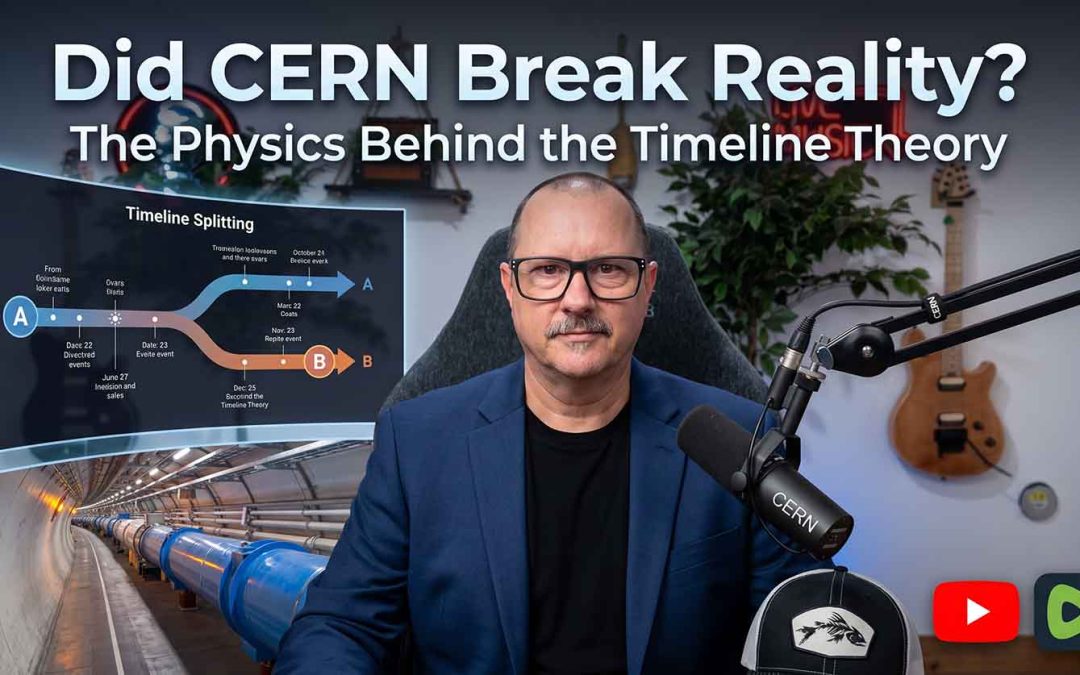
Watch this on Rumble: https://rumble.com/v7c6b28-did-cern-break-reality-the-physics-behind-the-timeline-theory.html
Synopsis
Did CERN accidentally change reality, or has one of the internet's most persistent theories misunderstood what modern physics actually says? Since the discovery of the Higgs boson in 2012, millions of people have connected the Large Hadron Collider to reports of the Mandela Effect, claiming that a proton was somehow pushed out of its proper place in spacetime and that humanity unknowingly crossed into another timeline. Others dismiss the idea entirely, insisting that the science makes such an event impossible. But what happens if we set aside both assumptions and investigate the question from the ground up?
In this episode of Cause Before Symptom, we examine the physics behind the theory rather than the rumors surrounding it. Beginning with the fundamentals of particle collisions, we explore what actually occurs inside the Large Hadron Collider before moving into quantum mechanics, relativity, decoherence, the Many-Worlds Interpretation, extra dimensions, and the unresolved questions that continue to divide some of the world's leading physicists. Along the way, we discover that words like timeline, universe, branch, and spacetime are often used interchangeably in popular culture even though they describe very different concepts within modern physics.
Rather than asking whether CERN changed history, we ask a more fundamental question: does modern physics even contain a mechanism capable of describing such an event? We compare internet claims against published research, investigate the origins of the timeline theory itself, examine the strongest arguments both supporting and opposing its possibility, and separate established science from theoretical speculation without ridiculing either side. This is not a debate between believers and skeptics. It is an investigation into the limits of our current understanding of reality.
Whether the CERN timeline theory ultimately survives scrutiny or not, the journey leads into one of the deepest mysteries in science. Quantum mechanics has transformed our understanding of the universe, yet even after a century of research, physicists still disagree about what its mathematics truly represents. Could reality be stranger than we imagine, or have we misunderstood extraordinary observations through the lens of extraordinary stories? Tonight, we follow the evidence wherever it leads and discover that the greatest mystery may not be CERN itself, but the true nature of reality.
Monologue
Good evening, everyone, and welcome back to Cause Before Symptom, where we don't chase headlines—we chase causes. Tonight, we're stepping into one of the most controversial conversations on the internet. Some people believe CERN, home to the world's largest particle accelerator, accidentally changed reality itself. Others insist the idea is complete nonsense, no different than science fiction. Between those two extremes lies a question that deserves something far better than ridicule or blind acceptance. It deserves an honest investigation.
The story usually begins in 2012. CERN announced the discovery of the Higgs boson, a particle that physicists had spent decades searching for. It was a historic achievement and one that confirmed an important part of the Standard Model of particle physics. But around the same time, another story began spreading online. People claimed they remembered events differently than history recorded them. Logos appeared to have changed. Famous quotations seemed different. Geography looked unfamiliar. These collective memories eventually became known as the Mandela Effect, and before long, many people connected those memories to CERN's experiments.
One explanation spread farther than all the others. According to this theory, when CERN smashed protons together at unprecedented energies, something unexpected happened. A proton was supposedly pushed out of its proper place in spacetime, reality shifted, and humanity unknowingly entered another timeline. Some versions say history itself changed. Others suggest that two realities merged together. Still others argue that CERN weakened the boundary between parallel worlds. It is a fascinating story, but there is one problem. Almost no one begins by asking whether modern physics even contains a mechanism capable of describing such an event.
That is where tonight's investigation begins.
Instead of asking whether the theory is true or false, we are going to ask whether the language being used even matches the language of physics. What exactly is a timeline? Is it the same thing as spacetime? Is it the same thing as what physicists call a branch? Does quantum mechanics actually describe multiple realities, or is that simply one interpretation among several? These questions matter because words have precise meanings in science. Two people can use the same word while describing completely different ideas, and without realizing it, they end up arguing past one another.
Over the past several days, I have gathered books from across the scientific spectrum. Not books that begin with the conclusion that CERN broke reality, and not books that dismiss the discussion before it even begins. Instead, I wanted the strongest voices from modern physics itself. We looked at particle physics, quantum mechanics, cosmology, quantum gravity, and one of the most respected modern defenses of the Everett Interpretation, often called the Many-Worlds Interpretation. My goal was simple: if there is a path from accepted physics to the CERN timeline theory, we should be able to find it. If there isn't, we should understand exactly where that path breaks down.
What surprised me most was not what I found, but what I didn't find.
I found serious physicists discussing branching histories, decoherence, quantum states, extra dimensions, and the structure of spacetime. I found vigorous debates over the meaning of quantum mechanics that have continued for nearly a century. I found genuine disagreements among brilliant scientists about what reality ultimately looks like beneath the mathematics. What I did not find was a published physical mechanism describing how a proton could simply be knocked out of "our timeline" in the way the internet often describes it. That doesn't automatically make the idea impossible. It means we first have to define what such a statement would physically mean before we can test it against evidence.
That distinction may sound small, but it changes everything.
Throughout history, scientific progress has often come from asking better questions rather than demanding immediate answers. Einstein didn't begin by asking whether time could slow down. He asked what would happen if the speed of light were always constant. Quantum mechanics didn't begin by proposing multiple worlds. It began by trying to explain experiments that classical physics could not. Every major breakthrough started by carefully defining the problem before proposing a solution. That is exactly what we intend to do tonight.
As we move through this investigation, you may discover that the internet has blended together several completely different ideas. The concept of alternate timelines, the Many-Worlds Interpretation, parallel universes, extra dimensions, decoherence, and the Mandela Effect are often spoken about as though they are interchangeable. They are not. Some belong to established mathematical physics. Some belong to unresolved scientific debate. Others remain entirely speculative. Our task is to separate these ideas without stripping away the wonder that inspired the questions in the first place.
This is not an episode about proving CERN innocent. It is not an episode about proving the timeline theory correct. It is an episode about learning how to think carefully when extraordinary claims collide with extraordinary science. If modern physics points toward possibilities stranger than we have imagined, we should not fear them. If it rules out certain ideas, we should be willing to accept that as well. Truth has nothing to fear from investigation.
So tonight, we begin where every good investigation begins—not with certainty, but with curiosity. We are going to open the doors of CERN, step inside the world's most powerful particle accelerator, and ask a question that millions of people have wondered for more than a decade.
Did CERN really change reality... or have we misunderstood both physics and the mystery itself?
Part 1 – The Story Everyone Thinks They Know
On July 4, 2012, scientists gathered at CERN with an excitement that had been building for decades. The announcement they were about to make would become one of the defining scientific moments of the twenty-first century. Researchers working at the Large Hadron Collider revealed that they had discovered a new particle whose properties closely matched those predicted for the Higgs boson. Newspapers around the world celebrated the achievement. Television networks declared that physicists had found the so-called "God Particle," a nickname many scientists disliked because it oversimplified the discovery. For the scientific community, it was a tremendous victory. It confirmed a missing piece of the Standard Model, the mathematical framework that describes the known fundamental particles and forces of nature.
To understand why this mattered, imagine trying to complete a thousand-piece puzzle with one piece missing. Every other piece fits perfectly, but without that final piece, you can never be completely certain the picture is correct. For nearly fifty years, physicists believed the Higgs boson was that missing piece. They had built theories around its existence, but no one had ever observed it directly. The Large Hadron Collider was designed, in part, to search for evidence that this elusive particle truly existed. When the evidence finally appeared, it was not simply another scientific paper. It represented the confirmation of decades of predictions, calculations, engineering, and international cooperation.
For most of the world, the story ended there. Scientists celebrated. Universities published articles explaining the importance of the discovery. The public moved on to the next headline. Yet outside the world of physics, another narrative quietly began to grow. It did not begin inside laboratories or academic journals. It began on internet forums, social media, podcasts, and YouTube channels where people started asking a very different question. What if CERN had done more than discover a particle? What if something unexpected had happened during those incredibly energetic collisions? What if reality itself had changed?
At first, these conversations were scattered and disconnected. Some people noticed that famous movie quotes did not match the way they remembered them. Others believed company logos had changed over time. Still others insisted they remembered historical events differently than the official record. Many of these observations eventually became grouped together under a single label: the Mandela Effect. The name came from people who believed they remembered Nelson Mandela dying in prison years before he actually passed away in 2013. Whether these memories resulted from normal human memory, social influence, or something more mysterious became the center of an ongoing debate.
As the Mandela Effect gained popularity, people naturally began searching for explanations. Some suggested that human memory is far less reliable than most of us believe. Cognitive psychologists have spent decades demonstrating that memories are reconstructed rather than replayed like a video recording. Under the right conditions, groups of people can confidently remember details that never actually occurred. This explanation has considerable scientific support and accounts for many well-documented cases of false memory. Yet for many people, it did not fully explain the personal certainty they felt about particular memories.
Others searched in an entirely different direction. Instead of looking inward at psychology, they looked outward toward physics. They asked whether reality itself might have changed. Since CERN was conducting the most energetic particle collisions ever produced by human beings, it became the focus of speculation. The timing seemed suspicious to some observers. The Higgs boson had been discovered in 2012. Around the same period, discussions about the Mandela Effect exploded across the internet. Correlation quickly became, for many people, a suggestion of causation. The idea that CERN had somehow fractured reality or shifted humanity into another timeline spread rapidly because it offered a dramatic explanation for an already mysterious phenomenon.
One version of this theory became especially influential. It claimed that when protons collided inside the Large Hadron Collider, one proton was somehow displaced from its proper position in spacetime. According to the story, this tiny disturbance cascaded through reality itself, shifting humanity into a neighboring timeline that differed only slightly from the original. In this new reality, history remained almost identical, but small details had changed. Most people supposedly never noticed, while others retained memories from the previous timeline. The Mandela Effect, according to this explanation, became evidence that reality had been altered rather than human memory.
As the story spread, new details were added. Some versions claimed CERN had accidentally opened a portal between universes. Others suggested the collider had weakened the barrier between parallel realities. Still others argued that quantum mechanics predicted branching universes and that CERN had somehow pushed humanity from one branch to another. Different storytellers borrowed ideas from particle physics, cosmology, science fiction, and quantum mechanics until they formed a single narrative that sounded scientific, even if many of its individual concepts came from very different areas of research.
One name often associated with these discussions is Max Loughan, sometimes described online as a child genius or physics prodigy. Short video clips circulated widely in which he discussed the possibility that CERN's experiments had altered reality. Over time, countless videos, articles, and social media posts repeated or expanded upon these ideas. As frequently happens on the internet, later versions often became more dramatic than the earliest ones. Claims that may have started as speculative questions gradually evolved into confident declarations that humanity had already crossed into another timeline. Unfortunately, as the story spread, references to published physics became increasingly rare while repeated internet quotations became increasingly common.
This presents us with an important challenge. It is very easy to dismiss extraordinary claims simply because they sound unusual. It is equally easy to accept them because they are intriguing. Neither approach helps us discover the truth. Science has advanced many times by investigating ideas that initially sounded impossible. At the same time, science also requires that every extraordinary claim be supported by evidence and by mechanisms that can be described mathematically or experimentally. The proper response is neither ridicule nor blind belief. It is investigation.
That is exactly what we are going to do.
Before we ask whether CERN changed reality, we must first understand what CERN actually does. Before we ask whether timelines can shift, we must determine whether modern physics even contains a concept equivalent to what most people call a timeline. Before we evaluate claims about alternate realities, we must understand how physicists define spacetime, quantum states, branching histories, and decoherence. Only then can we fairly compare the internet's most popular theories against the best science currently available.
By the end of tonight's investigation, we may conclude that the CERN timeline theory has no support in established physics. We may discover that parts of it resemble legitimate scientific ideas while other parts do not. Or we may uncover questions that physics itself has not yet answered. Whatever the outcome, our responsibility is the same. We follow the evidence wherever it leads. We separate observation from explanation. And we refuse to accept conclusions simply because they are popular—or reject them simply because they are controversial.
Our journey begins, not with alternate realities, but with a much simpler question.
What actually happens when two protons collide?
Part 2 – What Actually Happens When Protons Collide?
Before we can decide whether CERN could have altered reality, we need to understand something much more basic. What actually happens inside the Large Hadron Collider? Surprisingly, many discussions about CERN begin with extraordinary conclusions without ever explaining the experiment itself. If we are going to test claims honestly, we must first understand what the machine is designed to do and why physicists built it in the first place.
The Large Hadron Collider, or LHC, is the largest and most powerful particle accelerator ever constructed. It sits beneath the border between Switzerland and France in a circular tunnel approximately seventeen miles, or twenty-seven kilometers, in circumference. Thousands of superconducting magnets cooled to temperatures colder than outer space guide beams of particles around this enormous ring. These magnets do not create the particles. They simply steer and accelerate them with incredible precision. Every part of the machine exists for one purpose: to study matter at the smallest scales currently accessible to science.
The particles used most often in these experiments are protons. At first glance, that may not sound very exciting. Every atom of hydrogen contains a single proton, and every atom in your body contains protons inside its nucleus. Yet a proton is not a simple object. It is made of smaller particles called quarks, which are held together by particles known as gluons through the strong nuclear force. Inside every proton is a constant storm of energy and interactions. When physicists accelerate protons to nearly the speed of light, they are not trying to destroy matter. They are trying to expose what lies beneath its ordinary appearance.
One common misunderstanding is that the collider simply smashes solid balls together like two marbles colliding. That is not what happens. At the quantum level, particles behave very differently from objects in everyday life. They possess both particle-like and wave-like properties, and the outcome of a collision is described by probabilities rather than simple mechanical impacts. When two proton beams cross inside one of CERN's detectors, countless interactions become possible. Most collisions are relatively ordinary by particle physics standards. Some produce familiar particles. Others briefly create particles that exist for only tiny fractions of a second before decaying into other forms of matter and energy.
Imagine watching two watches collide in midair. If they struck one another at ordinary speed, you might recover two damaged watches. Now imagine they collide at such enormous energies that instead of broken watches, you briefly produce gears, springs, screws, tiny fragments, flashes of light, and entirely new pieces that never existed before the collision. By examining those fragments, you could learn how the watches were built. That is essentially what particle physicists do. They are not interested in destroying protons. They are interested in studying the products that emerge when the proton's internal structure is revealed.
This is why CERN's detectors are so enormous. The detectors are not the collider itself. They are giant scientific cameras surrounding the collision points. Every collision produces showers of particles flying outward in every direction. Sophisticated electronics record the paths, energies, charges, and lifetimes of these particles. Powerful computers then reconstruct what most likely happened during the collision. Physicists are not watching particles with their eyes. They are reconstructing events from enormous amounts of data using well-tested mathematical models and experimental measurements.
The discovery of the Higgs boson illustrates this process perfectly. Scientists never observed a tiny glowing particle floating through space. Instead, they detected the particles produced when the Higgs boson rapidly decayed into other particles. Those decay products matched predictions made decades earlier. Like detectives reconstructing a crime scene from fingerprints and footprints, physicists reconstructed the presence of the Higgs boson from the evidence it left behind. The achievement was remarkable because the evidence agreed with theoretical predictions to an extraordinary degree.
This brings us to the first important question in our investigation. How much energy do these collisions actually involve? News headlines often describe the Large Hadron Collider as producing unimaginable energies, and compared to previous laboratory experiments, that description is accurate. Individual proton beams travel at more than 99.999999 percent of the speed of light. When they collide, they reach energies measured in trillions of electron volts. To particle physicists, these are incredibly energetic events. To everyday experience, the numbers sound almost impossible to comprehend.
Yet there is another way to look at those same collisions.
Although the energy is enormous when concentrated into an object as small as a proton, the total amount of energy involved is surprisingly modest by everyday standards. A flying mosquito carries more total kinetic energy than a single proton collision. The extraordinary achievement of the LHC is not that it produces vast amounts of energy overall. It is that it concentrates energy into an unimaginably tiny volume for an unimaginably brief moment. That concentration allows particles that normally cannot exist to appear briefly before disappearing again.
This distinction is critical because many internet discussions unintentionally confuse energy concentration with total energy. A lightning bolt releases vastly more total energy than a proton collision. A baseball pitch carries far more kinetic energy than an individual proton. What makes CERN unique is not the quantity of energy but the density of energy at microscopic scales. Physicists are recreating conditions similar to those that existed shortly after the Big Bang, not by generating astronomical amounts of power, but by compressing relatively small amounts of energy into extremely small regions of space.
Now we arrive at the first serious challenge to the timeline theory.
Nature has been performing particle collisions for billions of years.
Throughout the universe, cosmic rays travel at extraordinary speeds. Some possess energies that equal or even exceed those produced by the Large Hadron Collider. Every day, these cosmic rays strike Earth's atmosphere, colliding with atoms and producing cascades of secondary particles remarkably similar to those studied at CERN. These natural experiments have occurred not merely thousands or millions of times, but countless trillions upon trillions of times throughout Earth's history. They have also occurred across every star, galaxy, and region of interstellar space in the observable universe.
This observation does not automatically disprove the CERN hypothesis, but it forces us to ask a better question. If high-energy proton collisions alone are capable of shifting reality into another timeline, why has the universe not already experienced such shifts continuously for billions of years? Any theory proposing that CERN uniquely changed reality must explain why naturally occurring collisions of comparable or even greater energy have not obviously produced the same result. That is a serious scientific challenge, and it deserves an equally serious answer.
Supporters of the timeline theory sometimes respond that CERN's collisions differ from cosmic rays because the beams are precisely controlled. Unlike random cosmic-ray impacts, CERN accelerates two beams directly toward one another, producing head-on collisions under carefully engineered conditions. This is an interesting observation, and it deserves consideration rather than dismissal. The geometry of a collision can affect the amount of energy available in the collision itself. Whether that difference is enough to support claims about changing reality is another question entirely, but it is at least a meaningful scientific distinction that should be investigated rather than ignored.
At this point, however, we have learned something important. Nothing we have described so far requires alternate timelines, parallel universes, or shifts in reality. Every collision observed at CERN is currently explained using the mathematical framework of quantum field theory and the Standard Model of particle physics. The machine performs exactly the kind of experiments it was designed to perform. If something extraordinary occurred beyond those predictions, we would need evidence that points beyond the known physics, not merely the fact that energetic collisions took place.
That realization leads us to the next and perhaps most important question of the entire investigation.
Everyone keeps talking about timelines.
But what, exactly, is a timeline?
It may sound like a simple question, yet as we will soon discover, modern physics rarely uses that word at all. Instead, physicists speak of spacetime, worldlines, quantum states, histories, decoherence, and branching. These concepts are related, but they are not identical. Before we can determine whether reality shifted, we must first determine whether science defines reality in the same way that popular culture does. Only then can we fairly test the extraordinary claim that CERN changed the world we live in.
Part 3 – What Is a Timeline According to Physics?
We have now reached the point where most discussions about CERN begin to fall apart—not because the questions are foolish, but because the language becomes imprecise. Ask ten people what a timeline is, and you will probably receive ten different answers. Some imagine a straight line of history stretching from the past into the future. Others picture parallel universes existing side by side. Some think of alternate realities that branch every time a decision is made. Still others imagine entirely separate dimensions. The problem is that modern physics does not use these ideas interchangeably. In fact, physicists rarely use the word timeline at all. If we want to investigate this honestly, we must first learn the vocabulary that physics actually uses.
Let's begin with something familiar: spacetime. Before Albert Einstein developed his theories of relativity, most scientists thought of space and time as separate things. Space was the stage on which events happened, and time was the clock that measured them. Einstein showed that this picture was incomplete. Space and time are woven together into a single four-dimensional structure called spacetime. Every event that has ever happened, every event happening now, and every event that will happen occupies a particular location within that structure. When physicists calculate the motion of planets, stars, or even particles, they describe those events as taking place within spacetime.
Inside spacetime, every object traces what physicists call a worldline. Imagine watching an airplane fly across the sky. If you could leave a glowing trail behind it, that trail would show where the airplane had been. Now imagine adding the passage of time as another dimension. Instead of a simple path through space, the airplane would leave behind a path through spacetime. That path is called its worldline. Every person has one. Every planet has one. Every photon has one. Every proton traveling through the Large Hadron Collider has one. Notice something important already. A worldline is not the same thing as what people usually mean by a timeline. A worldline belongs to an individual object moving through spacetime. It is not an alternate history.
Now we move into quantum mechanics, where the language becomes even more unfamiliar. Instead of describing particles as tiny balls with exact positions and velocities, quantum mechanics describes them using something called the quantum state. The quantum state is not simply a list of where particles are located. It is a mathematical description containing all the information needed to calculate the probabilities of future observations. Different interpretations of quantum mechanics disagree about what the quantum state actually represents, but they all use the same mathematics. This distinction is crucial because many internet discussions unknowingly mix mathematical descriptions with philosophical interpretations.
One of the greatest mysteries in quantum mechanics is known as the measurement problem. At the microscopic level, quantum systems evolve smoothly according to mathematical equations. Yet when measurements are made, we observe definite outcomes. How does one become the other? Physicists have debated this question for nearly one hundred years. Some interpretations propose that the wavefunction somehow collapses during measurement. Others argue that collapse never occurs at all. This disagreement is not a fringe discussion. It lies at the heart of one of the deepest unresolved questions in modern physics.
This is where Hugh Everett enters the story. In 1957, Everett proposed a radical solution that eventually became known as the Many-Worlds Interpretation. Instead of assuming the wavefunction collapses into a single outcome, Everett suggested taking the mathematics literally. According to this view, the quantum state continues evolving without interruption. What appears to us as a single outcome is actually part of a much larger quantum reality. Over time, different components of that quantum state become effectively independent through a process called decoherence. David Wallace, one of the leading modern defenders of Everett's interpretation, argues that what we call separate "worlds" emerge naturally from this process rather than being created by mysterious universe-splitting events.
Notice what has happened.
The internet often says timeline.
Everett says branch.
Those are not automatically the same thing.
A branch, in Everett's framework, is not another universe floating beside ours like another planet in space. It is a description of how different components of the quantum state evolve so that they no longer interfere with one another. These branches emerge continuously through interactions with the surrounding environment. They are not opened like doors. They are not created by machines. They are consequences of how the mathematics evolves if one accepts Everett's interpretation. That is a very different picture from the one commonly presented online.
The key word here is decoherence, because it may be the single most misunderstood concept in the entire discussion. Imagine dropping two stones into a perfectly calm pond. At first, the ripples overlap and interfere with one another. You can clearly see their combined pattern. Now imagine the pond becoming increasingly rough as wind, rain, and countless disturbances appear. Very quickly, those original ripples become impossible to distinguish from everything else happening on the surface. They have not disappeared. They have become effectively impossible to observe separately. Decoherence works in a somewhat similar way. Quantum systems constantly interact with their environment. Those interactions rapidly destroy the interference needed to observe certain quantum behaviors at everyday scales. The result is that the world appears classical even though its underlying description remains quantum.
This has profound implications for the CERN hypothesis. If Everett and Wallace are correct, branching is not a rare event waiting for a giant particle accelerator to trigger it. Branching would occur continuously throughout the universe as quantum systems interact with their environments. Every photon striking your eye, every atom vibrating inside a crystal, every molecule colliding in the atmosphere would participate in this ongoing process of decoherence. CERN would not create branching. At most, it would provide another example of quantum systems evolving according to the same fundamental principles already operating everywhere else in nature.
Another word frequently used in discussions of CERN is parallel universe. Here again, precision matters. Cosmologists use the term in several completely different ways. Some refer to regions beyond our observable universe created during cosmic inflation. Others discuss higher-dimensional braneworld models arising from string theory. Still others refer to Everettian branches within quantum mechanics. These ideas all involve more than one "world," but they are based on entirely different mathematical frameworks. Saying "parallel universe" without specifying which theory is being discussed is like saying "vehicle" without telling someone whether you mean a bicycle, an airplane, or a submarine. The word alone is simply too broad to answer serious scientific questions.
This realization may be the most important discovery we have made so far.
When someone says CERN moved us into another timeline, what do they actually mean?
Do they mean another worldline?
Another Everett branch?
Another spacetime?
Another universe created during inflation?
Another higher-dimensional brane?
Another quantum history?
Each possibility belongs to a different area of physics. Each has different mathematical foundations. Each makes different predictions. Until those distinctions are made, the conversation cannot move beyond speculation because the central claim has never been clearly defined.
There is another subtle point that often goes unnoticed. Throughout all of our research, we found extensive discussions about branching, decoherence, quantum histories, and spacetime. What we did not find was an accepted physical quantity that could be described as a particle's "timeline position." Physicists calculate position, momentum, spin, charge, mass, energy, and quantum states. They do not calculate a particle's location within a timeline because no such quantity exists in the Standard Model of particle physics. That does not prove such a concept could never exist in a future theory, but it does mean that claims involving a proton being "knocked out of our timeline" require definitions that current physics simply does not provide.
This changes our investigation dramatically.
We are no longer asking whether CERN changed timelines.
We are asking whether the concepts people associate with timelines correspond to anything that modern physics actually predicts. That is a far more precise question, and one that deserves careful examination rather than quick conclusions.
Now that we understand the language of spacetime, worldlines, quantum states, branching, and decoherence, we can finally investigate the interpretation most often cited in support of alternate realities. It is time to meet the man whose ideas transformed one of physics' greatest mysteries into one of its most controversial possibilities.
Who was Hugh Everett, and did he really discover many worlds?
Part 4 – Everett, Many Worlds, and the Birth of Branching Reality
In 1957, a young graduate student named Hugh Everett III submitted a doctoral thesis that challenged one of the deepest assumptions in all of physics. At the time, most physicists accepted what is commonly called the Copenhagen Interpretation of quantum mechanics. According to that view, the mathematical description of a quantum system evolves smoothly until a measurement is made. At that moment, the wavefunction is said to collapse into a single outcome. The mathematics predicts several possible results, but observation reveals only one. For decades, this idea dominated physics classrooms around the world. Yet there was one problem that never completely disappeared. No one could explain exactly what qualified as a measurement or why nature should suddenly change its behavior simply because an observation occurred.
Everett believed there was a simpler solution. Instead of changing the mathematics, he proposed changing our interpretation of it. What if the wavefunction never collapses at all? What if the equations of quantum mechanics describe reality exactly as they are written? Rather than assuming that one possibility becomes real while every other possibility vanishes, Everett suggested that every outcome described by the mathematics continues to exist within the evolving quantum state. His proposal was radical because it removed collapse entirely. The equations no longer required a mysterious exception during measurements. They simply continued evolving according to the same rules at every scale.
At first, Everett's work received little enthusiasm. Even his advisor, the famous physicist John Wheeler, encouraged him to soften some of the more controversial implications before publishing his dissertation. Many physicists viewed the idea as philosophically extravagant. If every possible outcome continued to exist, did that mean reality constantly multiplied into countless worlds? The proposal sounded more like science fiction than science. Everett eventually left academic physics, and for many years his interpretation remained on the fringes of scientific discussion. Yet the mathematics itself never disappeared, and over time, a growing number of physicists began revisiting his ideas.
One of the most important figures in that revival is David Wallace. His book, The Emergent Multiverse, is not a popular science book written to entertain general audiences. It is a detailed, technical defense of Everett's interpretation aimed at physicists and philosophers of science. Wallace argues that Everett's approach should not be viewed as adding imaginary worlds to physics. Instead, he argues that if quantum mechanics is taken literally, branching worlds naturally emerge from the mathematics through the process of decoherence. In other words, the branches are not extra assumptions added to quantum mechanics. They are what Wallace believes the mathematics already describes if we stop forcing it to collapse. This is an important distinction because it changes the entire conversation.
Notice what Wallace is not saying.
He is not saying that universes are constantly popping into existence like bubbles.
He is not saying that portals open between realities.
He is not saying that giant machines create alternate worlds.
Instead, he argues that what we perceive as a single classical world is only one stable pattern emerging from a much larger quantum description of reality. According to this view, branching is not an event that occasionally happens. It is a continuous consequence of quantum evolution itself. That is a far more subtle claim than the internet often presents.
To understand this idea, imagine standing at the trunk of a massive oak tree. As you look upward, the trunk divides into large branches. Those branches divide into smaller ones. Those smaller branches continue dividing until thousands of twigs reach toward the sky. Now imagine that the trunk represents the quantum state of the universe. The branches do not suddenly appear because someone built a machine. They emerge naturally as the tree grows. Everett's interpretation suggests something similar. The quantum state evolves continuously, and what we experience as classical reality corresponds to one of many branches that become effectively independent through decoherence.
This is where many online discussions unintentionally oversimplify the science. They often describe the Many-Worlds Interpretation as though every decision instantly creates a brand-new universe. While that image is useful for introducing the idea, it is not how modern defenders like Wallace usually describe the mathematics. They emphasize emergencerather than duplication. A branch is not necessarily a separate universe floating beside ours. It is an effectively independent history arising from the quantum state because interference between different components has become negligible. Whether one wishes to call those branches separate worlds becomes partly a matter of interpretation, but the underlying mathematics remains the same.
Another misconception deserves attention. Many people imagine that if branches exist, then traveling between them should be possible. Yet Everett's interpretation does not provide such a mechanism. In fact, the opposite is generally true. Once decoherence has occurred, branches become effectively isolated from one another. They no longer exchange information in any meaningful way. They no longer interfere as they did before decoherence. From the perspective of observers within one branch, the others become inaccessible. This is one of the reasons many physicists argue that Everett's interpretation, while mathematically elegant, is difficult to test experimentally. If the branches cannot interact, how could observers ever compare them?
This point has enormous consequences for the CERN timeline theory.
If Everett is correct, branching would not require the Large Hadron Collider.
It would not begin in 2012.
It would not depend upon the Higgs boson.
It would not require a single proton to be displaced from anything.
Branching would already be occurring continuously throughout the universe wherever quantum systems interact with their environments. Every atom, every molecule, every photon, and every particle collision would already participate in this ongoing process. CERN would simply be another place where quantum mechanics is being studied under carefully controlled conditions.
Some supporters of the timeline theory might respond that while branching occurs everywhere, CERN somehow produced an unusually significant branch because of the enormous energies involved. That is a reasonable question to ask, but notice how different it is from the original claim. We have already moved away from saying that CERN "created alternate timelines." Now we are asking whether exceptionally energetic quantum interactions could influence branching in unusual ways. That is a much more precise scientific question, and one we can actually investigate. It may ultimately prove false, but at least it belongs to the language of physics rather than the language of internet folklore.
Another interesting aspect of Wallace's work is his emphasis on decoherence rather than observation. Older popular descriptions of quantum mechanics often suggested that consciousness somehow caused the wavefunction to collapse. This led to countless claims that human thought creates reality or that observation magically changes the universe. Wallace rejects that approach. In his framework, decoherence results from ordinary physical interactions with the environment, not from conscious observers. The universe does not wait for someone to look before deciding what is real. Physical systems interact continuously whether anyone is watching or not. That shift removes much of the mystical language that has accumulated around quantum mechanics over the past century.
This also means that many internet explanations combining consciousness, CERN, and timeline changes may be blending together ideas that originate from entirely different interpretations of quantum mechanics. Some discussions unknowingly mix Copenhagen, Everett, consciousness-based interpretations, simulation theory, and science fiction into a single narrative. Once these ideas are separated, it becomes clear that they are often answering different questions using different assumptions. Simply invoking "quantum mechanics" does not automatically connect them into one coherent theory.
By now, one thing should be becoming clear. Everett's interpretation is far stranger than most people realize, but it is also far more disciplined than popular presentations suggest. It does not casually propose magical universe hopping. It does not claim that particle accelerators open doors into neighboring realities. Instead, it offers a mathematically consistent way of understanding quantum mechanics without invoking wavefunction collapse. Whether that interpretation is ultimately correct remains one of the great debates in modern physics, but it deserves to be understood on its own terms rather than through internet summaries.
At this stage in our investigation, we have learned something unexpected. The strongest scientific argument connected to alternate realities actually weakens one of the central claims of the CERN timeline theory. If branching is already built into the quantum description of nature, then CERN no longer appears unique. Instead, we must ask a much more difficult question.
Could anything about the Large Hadron Collider make its branching fundamentally different from the branching that would already be occurring everywhere else in the universe?
That is the question we will examine next, because it finally allows us to test the central hypothesis against the actual mathematics of quantum physics rather than against speculation alone.
Part 5 – Could CERN Create a New Branch?
Now we arrive at the central question of this investigation. Everything we have learned so far has been preparation for this moment. We understand what the Large Hadron Collider does. We understand the basic ideas behind quantum mechanics. We have introduced the Everett Interpretation and seen that it proposes branching realities through the ordinary evolution of the quantum state. The obvious question now becomes this: could CERN create a branch that is somehow different from every other branch constantly emerging throughout the universe?
At first glance, the answer appears obvious. CERN performs the most energetic controlled particle collisions ever created by human beings. The energies involved are so extraordinary that physicists can briefly recreate conditions that existed fractions of a second after the Big Bang. It is understandable why many people would wonder whether such an experiment might uncover something entirely new. Throughout history, whenever humanity has reached a new frontier—whether sailing across oceans, splitting the atom, or exploring space—we have discovered things no one expected. It is not unreasonable to ask whether particle physics might eventually reveal surprises as well.
But asking whether surprises are possible is very different from claiming that a specific event has already occurred.
To answer our question honestly, we need to distinguish between two completely different ideas. The first asks whether CERN could discover new physics. Almost every physicist would answer yes. In fact, that is one of the primary reasons the collider exists. Scientists hope to find evidence of particles or interactions that extend beyond the Standard Model. The second question asks whether CERN could fundamentally change the structure of reality itself. That is a much stronger claim, and it requires a mechanism that current physics can describe. The difference between discovering something new and altering reality is enormous.
One reason the timeline theory became so persuasive online is that people often assume high energy automatically means high danger. That assumption feels intuitive because it matches our everyday experience. Explosions become more destructive as their energy increases. Powerful storms produce greater damage than gentle breezes. Yet particle physics operates on scales that are difficult to compare with ordinary life. A proton collision concentrates tremendous energy into an unimaginably tiny region for an unimaginably brief moment. The total energy involved remains remarkably small. What matters is not how much energy exists overall but how densely it is concentrated.
Suppose someone claims that this extraordinary concentration allows CERN to reach parts of reality that nature cannot. That sounds plausible until we remember something from the previous chapter. Nature has been accelerating particles to extraordinary energies long before human civilization existed. Cosmic rays constantly strike Earth's atmosphere. Some originate from exploding stars, active galaxies, and other violent astrophysical events whose energies exceed those produced inside the Large Hadron Collider. These natural particle accelerators have been operating continuously for billions of years. If concentrated energy alone changes reality, then nature has been running similar experiments throughout the observable universe since long before the first human looked at the stars.
Supporters of the CERN hypothesis sometimes answer this objection by pointing out an important difference. Cosmic rays usually strike stationary atoms, while CERN accelerates two beams directly toward one another. That distinction is scientifically meaningful because head-on collisions make more energy available in the center of mass where new particles can be produced. In other words, CERN uses energy more efficiently than many naturally occurring collisions. This is one reason the collider was built in the first place. Rather than simply creating higher energies, it creates cleaner and more controllable experimental conditions.
This raises an interesting possibility.
Could controlled collisions produce effects that random cosmic rays do not?
That is exactly the kind of question scientists ask every day. Yet even if the answer were yes, it would not automatically support the timeline theory. It would simply mean CERN can study certain particle interactions more effectively than nature usually does in Earth's atmosphere. We would still need evidence showing that these interactions possess entirely new properties capable of influencing spacetime, branching, or the quantum state on a macroscopic scale. At present, no such mechanism has been demonstrated experimentally.
Now let us return to Everett's interpretation.
If Wallace is correct, branching is not triggered by unusual events. Branching is simply the natural consequence of quantum evolution together with decoherence. Every interaction between quantum systems and their environment contributes to this ongoing process. The Large Hadron Collider does not operate outside quantum mechanics. It operates entirely within quantum mechanics. Every magnet guiding the beams, every detector recording particle tracks, every computer analyzing collision data—all of these are themselves quantum systems. Nothing inside CERN escapes the laws governing the rest of the universe.
This observation creates a significant challenge for the timeline hypothesis.
Imagine a river flowing steadily toward the ocean. Along its course, you build a water wheel. The wheel may measure the flow, redirect small amounts of water, or perform useful work, but it does not create the river. According to Everett's interpretation, quantum branching resembles that river. It flows continuously throughout reality. CERN may study the process with extraordinary precision, but nothing in the mathematics suggests that the collider suddenly begins a process that was not already taking place everywhere else.
Some advocates respond by suggesting that CERN does not create branching but instead produces an unusually largebranch. This is an intriguing refinement because it shifts the discussion away from magical universe creation toward quantitative differences. Could a sufficiently energetic quantum event produce consequences that propagate upward into the macroscopic world more dramatically than ordinary quantum interactions? Surprisingly, this question touches upon legitimate areas of scientific research. Physicists routinely study how microscopic quantum events become amplified into observable macroscopic outcomes. The measurement problem itself asks how tiny quantum probabilities become the definite classical world we experience.
However, amplification is not the same as timeline transfer.
Imagine a single spark landing in a dry forest. Under the right conditions, that tiny spark may eventually become a wildfire covering thousands of acres. The spark did not move the forest into another reality. It simply produced consequences that grew larger over time. Chaos theory teaches that small differences can eventually produce enormous changes. Weather systems, ecosystems, and even planetary orbits can become highly sensitive to tiny variations in initial conditions. A microscopic quantum event might therefore influence future events without requiring any movement between alternate realities.
This distinction is one of the most important discoveries of our investigation.
A single quantum event could, in principle, influence future history without requiring timeline shifts at all.
That idea belongs to established mathematics.
Timeline transfer does not.
The internet often combines these two very different concepts into one story, but physics treats them separately.
There is another issue almost no one discusses.
Suppose, purely for the sake of argument, that CERN somehow produced an unusual quantum branch. How would we know? According to Everett, branches become effectively isolated through decoherence. Observers inside one branch experience only the history of that branch. They do not remember living in another branch because there is no accepted mechanism carrying memories from one branch into another. Yet the timeline theory depends almost entirely upon exactly that possibility. People believe they remember details from a previous reality while physical records reflect a different one. That is a fascinating claim, but it requires an additional physical process beyond branching itself. The branch is only half of the theory. Memory transfer is the other half, and current quantum mechanics does not provide an established explanation for how such transfer could occur.
This realization forces us to expand our investigation once again.
Perhaps we have been asking the wrong question.
Instead of asking whether CERN could create another branch, perhaps we should ask whether branches can ever interact after they have separated. If they cannot, then the timeline theory loses one of its central assumptions. If they can, then we must ask under what circumstances interaction becomes possible and whether any experimental evidence supports such an extraordinary claim.
That question takes us beyond particle physics and into some of the most speculative areas of modern science. It leads us toward quantum gravity, extra dimensions, wormholes, and proposals that attempt to unite general relativity with quantum mechanics. These ideas remain highly theoretical, but if any physical pathway exists between branches—or between different regions of reality—it is far more likely to emerge from those fields than from the collisions themselves.
In other words, the deeper we investigate CERN, the less the story appears to be about particle accelerators.
Instead, it becomes a story about something far more fundamental.
Can branches of reality ever communicate with one another, or does the mathematics itself forbid such contact once decoherence has taken place?
That is where our investigation turns next, because if there is no bridge between branches, then changing realities and remembering another history become two entirely different questions requiring entirely different explanations.
Part 6 – Could We Ever Cross Between Branches?
Up to this point, we have asked whether the Large Hadron Collider could create or influence a branch of reality. But now we arrive at an even more important question. Even if branching exists, could anyone ever move from one branch to another? This question lies at the heart of nearly every timeline theory on the internet. It is one thing to propose that reality branches. It is something entirely different to claim that human beings—or even a single proton—can cross from one branch into another. Surprisingly, these are not the same problem, and modern physics treats them very differently.
Imagine driving down a highway that suddenly divides into two separate roads. Once the roads split, each continues in its own direction. Cars on one road no longer interact with cars on the other unless someone builds a bridge connecting them again. Everett's interpretation describes branching in a remarkably similar way. Before decoherence, different quantum possibilities can interfere with one another. After decoherence, they become effectively independent. They continue evolving according to the same laws of physics, but they no longer exchange information. In that sense, the branches resemble highways that have permanently diverged.
This is why the word decoherence matters so much. Earlier, we described it as the process by which interactions with the environment suppress quantum interference. Now we can see why that suppression is so important. Decoherence is not merely a mathematical convenience. It explains why the everyday world appears stable and classical even though its underlying description remains quantum. Once decoherence has taken place, the different branches cease behaving as though they are part of a single observable system. From the perspective of observers living within one branch, the others become effectively inaccessible.
Notice what this means.
If Everett's interpretation is correct, then branching alone does not predict travel between branches.
In fact, it predicts the opposite.
The branches separate because interference disappears. That separation is one of the very reasons classical reality emerges in the first place. If branches constantly reconnected, the stable world we experience would become extraordinarily difficult to explain. Instead of seeing well-defined objects, we would expect bizarre interference effects to appear everywhere around us. Fortunately for everyday life, they do not.
This creates a major obstacle for the CERN timeline theory.
The theory usually assumes two things happened simultaneously. First, reality branched or shifted. Second, millions of people somehow carried memories from one branch into another while physical evidence reflected only the new history. These are actually two completely different claims. Everett addresses the first. He does not provide a mechanism for the second. The theory would therefore require an additional process beyond ordinary branching—one capable of transferring information, memory, or observers across branches after decoherence had already separated them.
Could such a mechanism exist?
The honest answer is that no accepted theory currently provides one.
That does not mean physicists have never explored unusual possibilities. In fact, modern theoretical physics contains several ideas that sound almost unbelievable. The important point is to distinguish between ideas that are mathematically explored and ideas that are experimentally established. Those are not the same thing.
One of the most famous speculative ideas involves wormholes. According to Einstein's theory of general relativity, spacetime can curve dramatically in the presence of mass and energy. Under certain mathematical solutions to Einstein's equations, spacetime can even form shortcuts connecting distant regions. These hypothetical structures became known as wormholes. Science fiction often portrays them as tunnels through space or even time. The mathematics allows such solutions under certain assumptions, but no traversable wormhole has ever been observed. Even if wormholes exist somewhere in the universe, they are not part of the Standard Model of particle physics, and nothing suggests that the Large Hadron Collider produces them.
Another proposal comes from theories involving extra dimensions. Some versions of string theory suggest that our familiar three dimensions of space may be accompanied by additional dimensions too small to observe directly. Braneworld models imagine our universe as existing on a higher-dimensional surface, sometimes called a brane, embedded within a larger structure known as the bulk. These are fascinating mathematical ideas because they attempt to unify gravity with quantum mechanics. They also inspire many internet theories suggesting that CERN could punch through into another dimension. Yet once again, the mathematics and the popular claims are not identical.
Even within these higher-dimensional models, ordinary matter is generally confined to our own brane. Gravity may behave differently because it is allowed to extend into additional dimensions in some versions of the theory, but protons, electrons, and the particles making up ordinary matter remain confined to the familiar universe. In other words, extra dimensions do not automatically provide a doorway through which humanity could accidentally wander. They solve very different theoretical problems than those usually discussed in online timeline theories.
Some researchers have also explored whether quantum mechanics and gravity might eventually be unified into a single theory. Today, these remain among the greatest unsolved problems in physics. General relativity describes gravity extraordinarily well on large scales. Quantum mechanics describes the microscopic world with astonishing accuracy. Yet combining the two into one complete theory has proven extraordinarily difficult. Because we do not yet possess a finished theory of quantum gravity, it is fair to acknowledge that our understanding of reality remains incomplete. However, incomplete knowledge is not the same thing as evidence supporting a particular conclusion. An unanswered question leaves room for investigation, not permission to assume any desired answer.
This distinction is essential because internet discussions often jump directly from "physics is incomplete" to "therefore my preferred explanation is probably true." That reasoning does not follow. Throughout history, many scientific mysteries remained unsolved for decades before eventually receiving explanations no one had anticipated. Admitting uncertainty is one of science's greatest strengths because it keeps inquiry open while resisting the temptation to replace ignorance with speculation presented as fact.
There is another fascinating question that deserves attention. Suppose two branches somehow could interact again. What would we actually expect to observe? Would buildings suddenly change? Would maps redraw themselves overnight? Would books rewrite their own text? Or would the effects be much subtler? Interestingly, quantum mechanics offers no established predictions because it does not currently contain a standard mechanism for post-decoherence branch interaction. Without such a mechanism, there is no mathematical framework describing what branch crossing would even look like from the perspective of observers.
This brings us back to the idea of memory.
The timeline theory depends heavily upon the belief that some people remember an earlier version of reality while the physical world reflects another one. Yet memory itself is stored physically within the brain. If every physical system truly shifted into another branch, why would memory alone remain unchanged? Conversely, if memories survived while the external world changed, what protected those memories from changing as well? These are not rhetorical questions. They expose one of the deepest challenges facing any branch-transfer hypothesis. The theory requires a selective process affecting some physical systems but not others, and no accepted physical mechanism currently explains how such selectivity would occur.
Ironically, the strongest support for alternate branches may also become the strongest objection to timeline travel.
Everett gives us a mathematically coherent picture of branching.
Decoherence explains why those branches separate.
The same process that makes branching possible also makes communication between branches extraordinarily difficult.
That does not prove communication impossible in every conceivable future theory, but it does mean that any proposal involving branch crossing carries a much heavier burden than simply establishing that branching exists.
By this point, our investigation has revealed an important pattern. Each time we examine the physics more carefully, the questions become more precise. We began by asking whether CERN changed reality. Now we are asking whether the mathematics describing branching allows information to move between decohered histories. That is a much narrower and much more scientific question.
It also prepares us for the next stage of our investigation.
So far, we have explored ideas that could, at least in principle, support the possibility of branching realities. Now we must examine the strongest arguments against the timeline theory—arguments that come not from internet skeptics, but from the very physicists who built the Large Hadron Collider and from the mathematics of particle physics itself.
If the timeline theory is going to survive, it must first overcome those objections. If it cannot, we should understand exactly why. If it can, then we will have uncovered something worthy of even deeper investigation.
Part 7 – The Strongest Arguments Against the Timeline Theory
Every good investigation eventually reaches the point where its own hypothesis must face its toughest critics. Up to now, we have given the CERN timeline theory every reasonable opportunity to explain itself. We have explored quantum mechanics, Everett's interpretation, branching realities, decoherence, spacetime, and the unresolved questions that still exist within modern physics. Now we must examine the arguments that physicists themselves raise against the idea. These objections are not based on ridicule or closed-mindedness. They arise from decades of experimental evidence and mathematical reasoning. If the timeline theory is correct, it must overcome these challenges.
The first objection is perhaps the most powerful of all. Nature has been running particle accelerators for billions of years. Long before human beings built the Large Hadron Collider, the universe was already producing particles with astonishing energies. Cosmic rays travel across space at nearly the speed of light before colliding with planets, stars, gas clouds, and one another. Some originate from exploding stars known as supernovae. Others may come from active galaxies whose central black holes accelerate matter to extraordinary speeds. Every second of every day, Earth is bombarded by these particles. Many carry energies that equal or even exceed those produced inside CERN.
This observation forces us to ask an unavoidable question. If energetic proton collisions are capable of shifting reality into another timeline, why has nature not already done so countless times? The atmosphere has experienced these collisions throughout the entire history of our planet. Similar collisions occur across every galaxy in the observable universe. Any explanation claiming that CERN uniquely altered reality must explain why billions of years of naturally occurring high-energy collisions apparently failed to produce the same effect. This is not a minor objection. It is one of the central reasons particle physicists have never considered ordinary proton collisions a threat to spacetime itself.
Supporters of the timeline theory sometimes answer that CERN's collisions differ because they are controlled. This point deserves a fair hearing. The Large Hadron Collider accelerates two beams directly toward one another, creating highly symmetrical head-on collisions. Cosmic rays often strike stationary particles instead. From the perspective of particle physics, this distinction matters because more of the available energy can be concentrated into producing new particles. That is precisely why physicists designed colliders instead of relying upon naturally occurring cosmic rays. However, even acknowledging this difference does not automatically bridge the enormous gap between producing unusual particles and altering the structure of reality itself. A mechanism is still required, and none has yet been demonstrated.
The second objection comes from the laws of conservation. Modern physics is built upon principles that have survived countless experimental tests. Energy is conserved. Momentum is conserved. Electric charge is conserved. These conservation laws are not arbitrary rules. They emerge from deep mathematical symmetries within nature. Whenever physicists analyze particle collisions, they carefully account for every measurable quantity entering and leaving the interaction. Occasionally particles seem to disappear, but only because they transform into other particles or forms of energy that detectors eventually identify. Nothing in the Standard Model allows an ordinary proton simply to leave our universe or slip outside spacetime while preserving the mathematical consistency of these conservation laws.
This leads directly to another important point. Throughout our investigation, we repeatedly encountered the phrase "a proton was knocked out of our timeline." It is an interesting sentence, but from the standpoint of established particle physics, it has no accepted mathematical definition. Physicists can calculate a proton's momentum, spin, charge, energy, and quantum state with extraordinary precision. They can describe its trajectory through spacetime and predict the probabilities of different interactions. What they cannot calculate is a proton's "timeline coordinate," because no such quantity currently exists within the Standard Model. Before such a claim can even be tested, it must first be defined mathematically. Otherwise, the statement remains descriptive language rather than a physical theory.
A third objection involves something we discussed earlier: decoherence. Remember that Everett's interpretation depends upon branches becoming effectively independent. Decoherence explains why those branches cease interfering with one another. Ironically, this process creates one of the greatest challenges for the timeline hypothesis. If branches become isolated through decoherence, then information should not pass freely between them. Yet the timeline theory depends precisely upon such communication. It requires memories, awareness, or observers to survive a transition while physical reality changes around them. In other words, the very interpretation of quantum mechanics most often cited in support of alternate realities also supplies one of the strongest reasons to doubt effortless movement between those realities.
Another scientific objection concerns what physicists call vacuum stability. Before the Large Hadron Collider began operating, some people worried that extremely energetic collisions might trigger catastrophic events. Could microscopic black holes form? Could strange forms of matter consume ordinary matter? Could the universe fall into a lower-energy vacuum state? These concerns were taken seriously enough that CERN commissioned detailed safety analyses before full operation began. Scientists concluded that if such catastrophic processes could be triggered by the collider, nature would almost certainly have triggered them already through cosmic-ray collisions over billions of years. The continued existence of Earth, the Moon, the Sun, and every other astronomical body exposed to cosmic rays became powerful evidence that these scenarios were extraordinarily unlikely.
Notice something important here.
Physicists did not dismiss these concerns by saying, "Trust us."
They examined them mathematically.
They compared collider energies with natural phenomena.
They published their reasoning.
Whether one agrees with every conclusion is a separate matter, but the concerns themselves were investigated rather than ignored. That is how science is supposed to work.
There is also the historical objection. As we traced the origins of the timeline theory, we discovered something interesting. Early public concerns about CERN focused almost entirely on black holes, strangelets, vacuum decay, and similar ideas. The connection between CERN and widespread timeline shifts appears to have become popular only after the Higgs boson announcement and the growing popularity of the Mandela Effect. This does not automatically invalidate the theory. New ideas often emerge after new discoveries. However, it does suggest that the timeline narrative developed gradually through internet discussions rather than originating from published theoretical physics. That historical distinction matters because it helps us separate scientific proposals from later cultural interpretations.
The next objection comes from experimental evidence—or more precisely, the absence of it. The Large Hadron Collider has produced an extraordinary amount of data. Physicists have identified the Higgs boson, studied countless particle interactions, and tested the Standard Model with remarkable precision. They continue searching for signs of supersymmetry, dark matter candidates, extra dimensions, and other new physics. So far, however, no published experimental result indicates that collisions have altered spacetime, transferred matter between quantum branches, or produced observable effects resembling timeline changes. This does not prove that future discoveries are impossible. It simply means that the evidence currently available does not point in that direction.
Another objection is philosophical rather than mathematical. Extraordinary claims require extraordinary evidence—not because they are unpopular, but because they propose extraordinary departures from established knowledge. If someone claims that an experiment changed reality for every human being on Earth, that claim affects every observation, every measurement, every historical record, and every scientific discipline simultaneously. Such a proposal naturally demands correspondingly strong evidence. A handful of unusual memories or internet anecdotes, however sincerely reported, are not by themselves sufficient to overturn the enormous body of experimental physics supporting our current understanding of particle interactions.
At this point, some viewers may feel disappointed. It may seem as though every road we explore eventually leads back to conventional physics. But that is not quite what we have found. We have discovered something more subtle. The strongest objections do not prove the timeline theory impossible. Instead, they show that the specific version of the theory most commonly shared online lacks a clearly defined physical mechanism. That is an important difference. Science rarely proves absolute impossibility. More often, it shows that available evidence supports some explanations more strongly than others.
This brings us to an unexpected realization.
The more carefully we investigate the CERN timeline theory, the less it resembles a question about CERN.
Instead, it becomes a question about the limits of modern physics itself.
Could our current theories be incomplete?
Almost certainly.
Could future discoveries change our understanding of reality?
History suggests they will.
But incompleteness alone does not validate every proposed explanation.
It simply reminds us that science remains an unfinished journey.
As investigators, our responsibility is to distinguish between what is established, what is speculative, and what remains entirely unknown.
That responsibility now leads us to the opposite side of the discussion.
We have presented the strongest arguments against the timeline theory as fairly as we can.
Now we must do the same for the other side.
If someone wanted to build the strongest possible scientific case that reality might be stranger than our current models describe, where would they begin?
Part 8 – The Strongest Arguments Supporting the Possibility
After spending considerable time examining the strongest scientific objections, it would be easy to conclude that the investigation is finished. But that would not be an honest investigation. Throughout the history of science, many accepted theories eventually proved incomplete. Newton's laws explained gravity with extraordinary accuracy until Einstein revealed that gravity was not a force acting across empty space but a consequence of curved spacetime.
Classical physics explained the motion of everyday objects until quantum mechanics exposed a microscopic world that behaved in ways no one had imagined. Every generation of scientists has eventually discovered that the previous generation's understanding, while remarkably successful, was only part of a larger picture. That historical lesson should encourage humility rather than certainty.
One of the strongest arguments supporting continued investigation is simply this: physics itself is unfinished.
No physicist today believes we possess a complete description of reality. The Standard Model explains an enormous range of experimental observations with astonishing precision, yet it leaves major questions unanswered. It does not explain gravity within the same mathematical framework as quantum mechanics. It does not identify the nature of dark matter, which appears to make up most of the matter in the universe. It does not explain dark energy, which seems to drive the accelerated expansion of the cosmos. It leaves unanswered why the constants of nature possess the values they do and why matter dominates over antimatter. If our current theories leave so much unexplained, it would be unreasonable to assume they have already revealed everything there is to know about reality.
The second argument comes from the remarkable success of quantum mechanics itself. Few scientific theories have ever been tested as thoroughly or confirmed as accurately. Yet despite its predictive power, physicists continue debating what the mathematics actually means. This is an extraordinary situation. Normally, successful theories eventually produce broad agreement about their interpretation. Quantum mechanics has done the opposite. More than one hundred years after its development, respected physicists still disagree about whether the wavefunction collapses, whether branching realities exist, whether hidden variables remain possible, or whether entirely different approaches may eventually replace today's interpretations. The mathematics is extraordinarily successful. The meaning of the mathematics remains deeply contested.
This disagreement should not be misunderstood. Physicists are not arguing over whether quantum mechanics works. They are arguing over what the equations describe. That distinction is essential. Two scientists can calculate the same experimental result while holding very different views about the underlying nature of reality. The Copenhagen Interpretation, Everett's Many-Worlds Interpretation, pilot-wave theory, objective collapse models, relational quantum mechanics, and several other approaches all reproduce the overwhelming majority of known experiments. Their disagreement concerns ontology—what actually exists—not the numerical predictions used in laboratories every day.
That alone leaves room for intellectual humility.
If experts cannot yet agree about what quantum mechanics fundamentally describes, then none of us should pretend the philosophical questions have already been settled forever.
Another reason for caution comes from quantum gravity. Earlier we discussed the difficulty of combining Einstein's theory of general relativity with quantum mechanics. This is not a minor technical problem. It is widely regarded as one of the greatest unsolved challenges in theoretical physics. Gravity describes the structure of spacetime itself, while quantum mechanics describes the behavior of matter and energy within that spacetime. Somewhere beneath both theories lies a deeper framework that physicists have not yet discovered. Whatever that future theory ultimately becomes, history suggests it will almost certainly reshape our understanding of reality in ways that are difficult to imagine today.
Some researchers therefore argue that concepts we currently regard as impossible may eventually receive entirely new explanations. This has happened before. Before Einstein, time was considered absolute. Before quantum mechanics, particles were expected to possess definite positions and velocities at all times. Before plate tectonics, continents were believed to remain permanently fixed. Scientific revolutions often replace assumptions that once seemed unquestionable. Recognizing this pattern does not validate every speculative idea, but it reminds us that today's impossibilities sometimes become tomorrow's textbooks.
There is also the question of extra dimensions. Although no experimental evidence has yet confirmed their existence, several theoretical frameworks—including versions of string theory—propose that reality contains more dimensions than the three of space and one of time that we experience directly. These additional dimensions would not resemble hidden rooms waiting behind ordinary walls. Instead, they would exist at scales or in forms that are currently inaccessible to direct observation. If future experiments someday demonstrate that extra dimensions are real, our understanding of locality, gravity, and spacetime itself could change dramatically. It is therefore reasonable to acknowledge that our current picture of the universe may still be incomplete.
Another intriguing area involves quantum information. Over the past few decades, physicists have increasingly described quantum mechanics in terms of information rather than particles alone. Concepts such as entanglement, quantum computing, and quantum error correction have transformed the field. Some researchers now speculate that information itself may play a more fundamental role in reality than previously imagined. These ideas remain active areas of research rather than settled conclusions, but they illustrate how rapidly our understanding continues to evolve. A century ago, quantum information theory did not exist. Today it drives some of the world's most advanced technological research.
There is also a philosophical argument worth considering.
Throughout history, many scientific discoveries began because someone refused to dismiss an uncomfortable question. Asking difficult questions is not anti-science. Refusing to ask them would be. The important distinction is how those questions are investigated. Science encourages curiosity disciplined by evidence. It does not ask us to suppress imagination. It asks us to test imagination against reality. That is precisely what we have attempted throughout this investigation. We are not defending the timeline theory because it is exciting. We are asking whether its central ideas correspond to anything found within modern physics.
So far, the answer appears mixed.
The idea that reality may possess structures beyond ordinary human experience is entirely consistent with many areas of modern theoretical physics.
The idea that quantum mechanics forces us to rethink our intuitive understanding of reality is unquestionably true.
The idea that spacetime itself may eventually require deeper explanation is shared by many leading physicists.
But these broad possibilities should not be confused with specific claims.
Saying that physics is incomplete does not automatically mean CERN shifted humanity into another timeline.
Those are two very different statements.
One follows directly from current scientific knowledge.
The other still requires a mechanism and evidence that have not yet been demonstrated.
There is another point that deserves careful reflection. Many people become interested in theories like the CERN timeline hypothesis because they sense that something about modern physics is profoundly strange. In that feeling, they are not entirely mistaken. Quantum mechanics genuinely challenges everyday intuition. Entanglement, superposition, wave-particle duality, and the uncertainty principle all describe aspects of nature that seem deeply counterintuitive. The mistake often occurs when genuine scientific mysteries become attached to explanations that go beyond what the evidence presently supports. Wonder is justified. Certainty is not.
Perhaps the strongest argument supporting continued investigation is that history repeatedly warns against intellectual arrogance.
Scientists who claimed everything important had already been discovered have almost always been proven wrong.
People who insisted strange observations should be ignored because they did not fit existing theories have often delayed genuine breakthroughs.
Conversely, those who accepted extraordinary claims without demanding evidence have also filled history with mistakes.
Wisdom lies somewhere between those extremes.
Remain curious.
Remain skeptical.
Follow the evidence.
Be willing to change your conclusions when better evidence appears.
That approach has served science remarkably well for centuries.
As we reach the end of this investigation, one important question still remains unanswered.
Throughout this episode, we have deliberately separated the Mandela Effect from the CERN timeline theory because they are not the same phenomenon. One concerns reports of shared memory discrepancies. The other proposes a physical explanation involving particle collisions and alternate realities.
Now it is time to bring those two subjects back together.
Does the Mandela Effect actually provide evidence that reality changed, or is it a fascinating mystery that deserves to be investigated on its own terms?
Part 9 – The Mandela Effect: Evidence or Independent Mystery?
Throughout this investigation, one subject has remained quietly in the background. We have discussed particle collisions, quantum mechanics, branching realities, and the possibility of alternate histories, but we have intentionally avoided drawing conclusions from the Mandela Effect itself. There is a reason for that. The Mandela Effect is an observation. The CERN timeline theory is an explanation. Those are not the same thing. Before we decide whether one explains the other, we must examine the Mandela Effect on its own terms.
The name comes from an unusual memory shared by many people. Thousands claimed they remembered Nelson Mandela dying in prison during the 1980s, even though historical records show he was released in 1990, became President of South Africa in 1994, and died in 2013. As the internet connected more people together, similar examples began appearing. Some remembered famous movie quotes differently. Others insisted that well-known logos had changed. Some believed certain children's books had been spelled differently. Still others remembered historical events, maps, or even anatomical details in ways that no longer matched the available records. Whether these memories represented simple mistakes or something more became the center of an ongoing debate.
One of the most frequently cited examples is the line from Star Wars. Millions confidently remember Darth Vader saying, "Luke, I am your father." Yet if you watch the film today, the line is actually, "No, I am your father." Another example involves the mirror from Disney's Snow White. Many people remember hearing, "Mirror, mirror on the wall," while the film itself says, "Magic mirror on the wall." Similar discussions surround brand logos, product names, song lyrics, and dozens of other cultural memories. For many people, these examples feel deeply personal because they are not merely recalling obscure facts. They are remembering scenes they believe they have heard hundreds of times.
Psychologists have studied memory for decades, and one of their most important discoveries is that memory does not function like a video recorder. Every time we remember an event, the brain reconstructs it from many pieces rather than replaying an exact recording. During that reconstruction, details can be influenced by expectation, repetition, suggestion, and even conversations with other people. Experiments have repeatedly shown that sincere, intelligent individuals can confidently remember events that never occurred. More remarkably, entire groups can develop nearly identical false memories when exposed to the same cultural influences. This is not evidence that people are lying. It demonstrates that human memory is both extraordinarily powerful and surprisingly flexible.
There are good reasons why this happens. The brain is designed for efficiency rather than perfect historical accuracy. Instead of storing every detail, it often remembers the meaning or general pattern of an experience. Later, when recalling the event, the mind naturally fills in missing pieces with information that seems to fit. Consider the famous phrase "Luke, I am your father." Outside the movie, the altered version makes immediate sense because it identifies who is speaking. If someone simply said, "No, I am your father," without context, listeners would have no idea who was talking. Over years of imitation, parody, and everyday conversation, the modified version became far more recognizable than the original line itself.
That explanation accounts for many Mandela Effect examples remarkably well. Yet it does not satisfy everyone. Some people insist that their memories are too detailed, too vivid, or too consistent with those of others to be dismissed as simple reconstruction. They point to examples involving personal experiences rather than movie quotations. They ask why so many unrelated individuals report the same alternative memory if no shared event occurred. These questions deserve respectful consideration because they concern genuine human experiences, not merely internet entertainment. The existence of those experiences is not in dispute. The disagreement concerns what explains them.
This is where many discussions take a sudden leap.
Instead of saying, "People remember things differently," they immediately conclude, "Reality must have changed."
Notice the missing step.
Between the observation and the conclusion lies an explanation that must itself be demonstrated.
That explanation could involve psychology.
It could involve social influence.
It could involve errors in perception.
It could involve something entirely unknown.
But it cannot simply be assumed.
Science requires that explanations be tested, not merely proposed.
Now let us bring CERN back into the discussion.
Suppose, for the sake of argument, that humanity somehow crossed into another branch of reality. What would we expect to observe? Would only popular culture change? Would physical laws remain identical? Would geography shift? Would scientific constants change? Would every written record instantly rewrite itself while selected human memories remained untouched? These are not trivial questions. They expose the enormous complexity of the timeline hypothesis. Once we move beyond a few famous movie quotes and logos, we quickly realize that an authentic shift between realities would require an astonishingly selective process affecting some information while leaving everything else virtually unchanged.
This selective nature creates one of the strongest challenges for the CERN explanation.
If physical reality changed completely, then human brains—which are themselves physical systems—should presumably change as well.
If memories remained unchanged while external reality changed, what protected those memories?
Why would some people remember the previous reality while billions of others would not?
Why would certain commercial logos change but not the mathematics of chemistry?
Why would movie quotations differ while the laws governing planetary motion remained identical?
These questions do not disprove the theory, but they demonstrate how much more complicated it becomes once examined carefully.
There is another possibility that receives far less attention.
What if the Mandela Effect is a genuine phenomenon deserving scientific study without assuming any connection to CERN at all?
This possibility is often overlooked because people naturally seek a single explanation for multiple mysteries. Yet history teaches us that unrelated phenomena can easily become linked in the public imagination simply because they appear around the same time. The rise of the internet, social media, and global communication dramatically increased our ability to compare memories with millions of other people. It is entirely possible that widespread discussion made the Mandela Effect more visible without necessarily causing it. Correlation alone does not establish causation.
Ironically, separating these questions may strengthen both investigations.
If we study the Mandela Effect independently, we can examine memory, cognition, culture, and perception without forcing every observation into a predetermined conclusion.
If we study CERN independently, we can evaluate particle physics, quantum mechanics, and spacetime without expecting those fields to explain every unusual memory people report.
Only after each mystery has been investigated on its own merits should we ask whether any genuine connection exists between them.
This approach reflects one of the oldest principles of careful reasoning.
Do not combine mysteries simply because they are mysterious.
Investigate each one separately.
Only connect them when the evidence requires it.
By now, our investigation has taken an unexpected turn. We began with a simple internet claim that CERN knocked humanity into another timeline. Along the way, we discovered that modern physics rarely uses the word timeline at all. We learned that branching, if it exists, is not the same as travel between branches. We found that memory reconstruction provides a well-supported explanation for many shared recollections while leaving some questions open for continued study. Most importantly, we discovered that every major claim becomes more complicated—not less—the closer we examine it.
There is only one step remaining.
If someone wanted to defend the CERN timeline theory using the strongest possible version of the argument, what conditions would actually have to be true?
Instead of arguing over isolated pieces of evidence, we are going to build the entire chain from beginning to end and test every single link. If even one essential link fails, the theory must be reconsidered. If every link remains possible, then we will know exactly where future scientific research would need to focus.
That is how our investigation will conclude.
Part 10 – What Would Have to Be True?
As we reach the final stage of this investigation, it is time to stop asking isolated questions and instead examine the entire theory from beginning to end. Throughout history, the strongest scientific ideas have not succeeded because they answered one question. They succeeded because every part of the explanation fit together into a single coherent picture. If one piece failed, the entire theory had to be reconsidered. We should apply exactly the same standard here. Rather than asking whether one claim sounds reasonable, let us ask what would have to be true for the CERN timeline theory to work as a complete physical explanation.
The first requirement is obvious but often overlooked.
Multiple histories or branches would have to exist.
Interestingly, this is one part of the theory that modern physics does not dismiss outright. Everett's Many-Worlds Interpretation proposes that branching realities emerge naturally through the evolution of the quantum state. Other interpretations disagree, but the idea itself is part of legitimate scientific discussion. This means the first step cannot simply be rejected as impossible. It remains one of several competing interpretations of quantum mechanics. The mathematics alone does not settle the debate, and physicists continue arguing about its meaning nearly seventy years after Everett first proposed it.
The second requirement is much more difficult.
Branches would have to interact after decoherence.
Here the situation changes dramatically. The very mathematics used to support branching also explains why those branches become effectively independent. Decoherence is not a minor detail. It is the mechanism that allows stable classical reality to emerge from quantum behavior. Once branches separate, they no longer interfere in ways that observers can easily detect. This creates a serious obstacle because the timeline theory depends upon communication between branches after they have already diverged. At present, no accepted interpretation of quantum mechanics provides a well-established mechanism allowing ordinary matter or observers to cross freely between decohered branches.
The third requirement follows naturally.
Information would have to move from one branch to another.
This point is often forgotten, yet it may be the most important of all. Imagine that two branches exist but never exchange information. In that case, each branch evolves independently, and observers inside one branch never become aware of the other. The timeline theory, however, depends upon information surviving a transition. Memories from one history must somehow remain available after entering another. Without information transfer, there is no Mandela Effect connected to branching because no observer would possess knowledge of an alternative history. Information is therefore the true bridge the theory requires, not merely the existence of multiple branches.
This immediately leads to the fourth requirement.
Human memory would have to survive while physical reality changed.
Think carefully about what this implies. Memory is not something floating outside the physical universe. Every memory you possess is stored through physical processes within your brain. Neurons form connections. Electrical signals travel through networks. Proteins strengthen or weaken synapses over time. Memory is physical. If the physical universe changed completely, why would those neural structures remain unchanged? Conversely, if the neural structures remained the same, why would every book, computer, photograph, geological record, and historical document reflect a different reality? The theory requires an extraordinarily selective process, one affecting some physical systems while leaving others untouched. No accepted physical mechanism currently explains such selectivity.
The fifth requirement concerns scale.
A microscopic event would need to produce a macroscopic consequence affecting the entire observable world.
This is actually the strongest scientific part of the theory. Chaos theory demonstrates that tiny causes can eventually produce enormous effects. Weather systems are famous examples. Small changes in initial conditions can grow into dramatically different outcomes over time. Quantum events can also become amplified through measurement processes. Physicists study this amplification constantly. The important distinction is that amplification changes the future through ordinary causal processes. It does not automatically imply that entire histories merge or exchange observers. The mathematics supports sensitive dependence on initial conditions. It does not, by itself, support timeline migration.
The sixth requirement is perhaps the one most people never consider.
The change would have to leave almost everything untouched.
Imagine if humanity truly entered another branch of reality. What should we expect to find? Different laws of physics? Different chemistry? Different constellations? Different biological evolution? Different languages? Yet nearly every timeline theory instead focuses upon remarkably small details—logos, movie quotations, product names, and isolated historical facts. Why would a transition between entire realities preserve almost every measurable feature of the universe while altering a handful of cultural memories? The more selective the proposed changes become, the more specific the required mechanism must be. At present, no accepted theory predicts such selective alterations.
Now let us step back and look at the chain as a whole.
Multiple branches.
Interaction after decoherence.
Information transfer.
Memory preservation.
Macroscopic amplification.
Selective historical alteration.
Every one of these links must remain intact.
If even one fails, the explanation becomes incomplete.
This does not mean the observations themselves disappear. It means we must continue searching for a different explanation.
One of the most valuable lessons from this investigation is that extraordinary questions often become more interesting as they become more precise. We began with a broad claim that CERN changed reality. Along the way, we discovered that this single sentence actually contains several independent scientific questions. Does branching exist? What is decoherence? Can information move between branches? How does memory function? What is spacetime? What does quantum mechanics actually describe? Instead of finding one mystery, we uncovered many smaller mysteries, each deserving careful investigation on its own.
There is another lesson worth remembering.
History repeatedly shows that science advances by replacing vague questions with precise ones. Early astronomers did not simply ask why the planets wandered across the sky. They measured their motions with increasing precision until better theories became possible. Chemists did not ask what everything was made of in general terms. They isolated elements, measured reactions, and built models that could be tested. Physicists did not begin quantum mechanics by claiming reality was mysterious. They followed mathematical predictions wherever they led, even when those predictions challenged common sense. Precision has always been the doorway to discovery.
That is why I believe this investigation has been worthwhile regardless of the conclusion.
We did not prove that CERN changed reality.
We also did not prove that reality could never be stranger than we currently understand.
Instead, we accomplished something more valuable.
We separated established physics from theoretical physics.
We separated theoretical physics from internet speculation.
We separated speculation from evidence.
Once those categories are no longer mixed together, the conversation becomes clearer, more honest, and far more interesting.
Perhaps someday physics will discover a deeper theory uniting quantum mechanics and gravity. Perhaps new experiments will reveal structures of reality we cannot yet imagine. Perhaps some of today's impossible questions will eventually receive answers that surprise us all. Science has humbled itself many times before, and it will almost certainly do so again. But until that day arrives, our responsibility remains unchanged. We should neither reject extraordinary ideas simply because they are unusual nor accept them simply because they are exciting. We should ask difficult questions, demand careful evidence, and remain willing to change our minds whenever better evidence appears.
That may not be as dramatic as claiming that CERN destroyed our timeline.
But it is far more powerful.
Because truth does not need exaggeration.
It only needs people willing to follow it wherever it leads.
Conclusion
Tonight, we set out to answer what seemed like a simple question. Did CERN accidentally change reality? By the end of our investigation, we discovered that the question itself was far more complicated than it first appeared. Before we could evaluate the claim, we had to understand what physicists actually mean by words like spacetime, branch, worldline, decoherence, and quantum state. We discovered that many of the terms commonly used on the internet do not have direct equivalents within modern physics, and that some ideas which are often spoken of as though they were the same actually come from completely different theories.
Along the way, we found something unexpected. The strongest scientific argument for multiple realities does not come from internet speculation. It comes from one of the most respected interpretations of quantum mechanics ever proposed. Hugh Everett's Many-Worlds Interpretation and its modern development by physicists like David Wallace argue that branching realities may emerge naturally from quantum mechanics itself. Whether that interpretation is ultimately correct remains one of the great debates in physics, but it demonstrates that the idea of reality being larger than our everyday experience is not automatically outside the boundaries of serious scientific discussion.
At the same time, we also found that the most popular version of the CERN timeline theory faces significant challenges. The mathematics describing decoherence suggests that branches become effectively independent rather than continually interacting. Current particle physics provides no accepted mechanism by which an ordinary proton could simply leave "our timeline," because no such quantity exists within the Standard Model. The theory also requires information, memories, or observers to move between branches after decoherence has already separated them, yet modern quantum mechanics offers no established process by which that could occur. These are not small obstacles. They are central pieces of the theory that remain unanswered.
Perhaps the strongest objection came not from mathematics but from nature itself. Long before human beings built the Large Hadron Collider, the universe had already become the greatest particle accelerator imaginable. Cosmic rays have struck planets, stars, and galaxies for billions of years. Many possess energies equal to or greater than those produced at CERN. Any explanation claiming that proton collisions alone shift reality must also explain why the universe itself has not apparently been doing the same thing throughout its history. That is a serious question, and one that every version of the timeline theory must answer before it can become a complete physical explanation.
Yet there is another lesson that may be even more important.
Science has always advanced by refusing to confuse mystery with certainty.
The history of physics is filled with discoveries that once seemed impossible. Time slowing down. Space bending. Particles behaving like waves. Quantum entanglement connecting systems across enormous distances. Each of these ideas challenged common sense before evidence gradually forced scientists to rethink reality itself. Because of that history, we should be cautious about declaring that every mystery has already been solved. Humility belongs not only to those proposing extraordinary ideas but also to those convinced that today's theories are the final word.
At the same time, curiosity without discipline easily becomes speculation. Every unanswered question is not evidence for our favorite explanation. Every coincidence is not proof of hidden causes. Throughout this investigation we have tried to hold two ideas together at the same time. First, reality may be stranger than we currently understand. Second, extraordinary claims require mechanisms that can be described, tested, and compared against evidence. Holding those two principles together protects us from both gullibility and intellectual arrogance.
One discovery changed my own perspective as we worked through this material. I no longer think the most important question is whether CERN changed reality. I think the more important question is whether we have even learned how to describe reality correctly. Quantum mechanics has been astonishingly successful at predicting experiments, yet even the world's leading physicists continue debating what its mathematics actually means. That should remind us how much remains unknown. We are not standing at the end of scientific discovery. We are standing somewhere in the middle of it.
Perhaps that is why theories like this continue to capture the imagination. People recognize that modern physics has revealed a universe far stranger than previous generations ever imagined. They hear about quantum superposition, extra dimensions, dark matter, and branching interpretations of reality, and they naturally wonder whether other extraordinary possibilities might also exist. Those questions are not foolish. Curiosity has always been the engine of discovery. The challenge is making sure our conclusions never outrun our evidence.
So where does our investigation leave us?
The idea that reality may be larger and more complex than everyday experience is supported by several serious areas of theoretical physics.
The idea that quantum mechanics raises profound questions about the nature of reality is unquestionably true.
The idea that physicists continue debating those questions is also true.
But the specific claim that CERN knocked humanity into another timeline remains, at least for now, unsupported by an accepted physical mechanism or experimental evidence. That does not make future discoveries impossible. It simply means that today's evidence does not yet carry us that far.
If there is one message I hope you take away from tonight's episode, it is this.
Never be afraid to ask difficult questions.
Never let anyone shame you for being curious.
But also never become so attached to an answer that you stop following the evidence.
Real investigation demands both courage and humility. Courage to question what everyone else assumes, and humility to admit when the evidence leads somewhere unexpected.
Here at Cause Before Symptom, that has always been our mission. We don't chase the most exciting explanation. We chase the one that best fits the evidence. Sometimes the evidence confirms what we expected. Sometimes it surprises us. Either way, truth is never harmed by honest investigation.
Because in the end, reality does not change to match our theories.
Our theories must change to match reality.
Bibliography
- Albert, David Z. Quantum Mechanics and Experience. Cambridge, MA: Harvard University Press, 1992.
- Bell, John S. Speakable and Unspeakable in Quantum Mechanics. 2nd ed. Cambridge: Cambridge University Press, 2004.
- Carroll, Sean. Something Deeply Hidden: Quantum Worlds and the Emergence of Spacetime. New York: Dutton, 2019.
- Close, Frank. Particle Physics: A Very Short Introduction. Oxford: Oxford University Press, 2004.
- Close, Frank. The Infinity Puzzle: Quantum Field Theory and the Hunt for an Orderly Universe. New York: Basic Books, 2011.
- Deutsch, David. The Fabric of Reality: The Science of Parallel Universes—and Its Implications. New York: Penguin Books, 1997.
- Everett III, Hugh. The Many-Worlds Interpretation of Quantum Mechanics. Edited by Bryce S. DeWitt and Neill Graham. Princeton, NJ: Princeton University Press, 1973.
- Greene, Brian. The Elegant Universe: Superstrings, Hidden Dimensions, and the Quest for the Ultimate Theory. New York: W. W. Norton & Company, 1999.
- Greene, Brian. The Hidden Reality: Parallel Universes and the Deep Laws of the Cosmos. New York: Alfred A. Knopf, 2011.
- Gribbin, John. In Search of Schrödinger's Cat: Quantum Physics and Reality. New York: Bantam Books, 1984.
- Ghirardi, Giancarlo. Sneaking a Look at God's Cards: Unraveling the Mysteries of Quantum Mechanics. Princeton, NJ: Princeton University Press, 2005.
- Herbert, Nick. Quantum Reality: Beyond the New Physics. New York: Anchor Books, 1987.
- Kaku, Michio. Hyperspace: A Scientific Odyssey Through Parallel Universes, Time Warps, and the Tenth Dimension. New York: Oxford University Press, 1994.
- Lederman, Leon, with Dick Teresi. The God Particle: If the Universe Is the Answer, What Is the Question? Boston: Houghton Mifflin, 1993.
- Lincoln, Don. The Quantum Frontier: The Large Hadron Collider. Baltimore: Johns Hopkins University Press, 2009.
- Maudlin, Tim. Quantum Non-Locality and Relativity: Metaphysical Intimations of Modern Physics. 3rd ed. Malden, MA: Wiley-Blackwell, 2011.
- Penrose, Roger. The Emperor's New Mind: Concerning Computers, Minds, and the Laws of Physics. Oxford: Oxford University Press, 1989.
- Penrose, Roger. Shadows of the Mind: A Search for the Missing Science of Consciousness. Oxford: Oxford University Press, 1994.
- Randall, Lisa. Warped Passages: Unraveling the Mysteries of the Universe's Hidden Dimensions. New York: Ecco, 2005.
- Rovelli, Carlo. Helgoland. New York: Riverhead Books, 2021.
- Rovelli, Carlo. Reality Is Not What It Seems: The Journey to Quantum Gravity. New York: Riverhead Books, 2017.
- Smolin, Lee. The Trouble with Physics: The Rise of String Theory, the Fall of a Science, and What Comes Next. Boston: Houghton Mifflin, 2006.
- Smolin, Lee. Three Roads to Quantum Gravity. New York: Basic Books, 2001.
- Thomson, Mark. Modern Particle Physics. Cambridge: Cambridge University Press, 2013.
- Wallace, David. The Emergent Multiverse: Quantum Theory According to the Everett Interpretation. Oxford: Oxford University Press, 2012.
- Wheeler, John Archibald, and Wojciech H. Zurek, eds. Quantum Theory and Measurement. Princeton, NJ: Princeton University Press, 1983.
Endnotes
- The Large Hadron Collider (LHC) is the world's largest and most powerful particle accelerator. It accelerates beams of protons to velocities approaching the speed of light before bringing them into controlled collisions inside four major detectors. The primary goal is to investigate the fundamental particles and forces described by the Standard Model of particle physics.
- The Higgs boson was announced by CERN on July 4, 2012, following independent observations by the ATLAS and CMS collaborations. The particle closely matched predictions made nearly fifty years earlier concerning the Higgs field and the mechanism by which elementary particles acquire mass.
- Throughout this episode, the term timeline refers to its common usage in popular culture rather than an accepted technical term in modern physics. Physicists more commonly discuss spacetime, worldlines, histories, quantum states, or branching depending upon the theoretical framework involved.
- Einstein's theory of general relativity unifies space and time into a four-dimensional geometry known as spacetime. Objects moving through spacetime follow paths called worldlines, which describe their histories within the geometry of the universe.
- Quantum mechanics accurately predicts experimental outcomes at microscopic scales but remains subject to multiple competing interpretations concerning the meaning of its mathematical formalism. These interpretations generally agree on observable predictions while differing in ontology.
- The Copenhagen Interpretation traditionally proposes that quantum systems evolve according to the Schrödinger equation until measurement, after which the wavefunction collapses into a definite outcome. The precise nature of this collapse remains one of the longstanding conceptual questions in quantum foundations.
- Hugh Everett III proposed the Relative State Formulation of quantum mechanics in 1957, later becoming known as the Many-Worlds Interpretation. Everett argued that the universal wavefunction evolves continuously without collapse, allowing multiple outcomes to remain within the quantum description.
- David Wallace's The Emergent Multiverse presents one of the most comprehensive modern defenses of the Everett Interpretation. Wallace argues that branching worlds emerge naturally through decoherence rather than being added as independent assumptions.
- Decoherence describes the process by which interactions between quantum systems and their environments suppress observable interference, producing the appearance of classical behavior without necessarily invoking wavefunction collapse.
- Branching in the Everett Interpretation should not automatically be equated with popular concepts of alternate timelines. Within the formalism, branches emerge as effectively independent components of the evolving quantum state through decoherence.
- Current formulations of the Everett Interpretation do not provide an accepted mechanism for observers, information, or ordinary matter to move freely between decohered branches after they have become effectively independent.
- The Large Hadron Collider operates entirely within the framework of quantum mechanics. It does not suspend or replace the known laws governing particle interactions but instead tests those laws under extreme experimental conditions.
- Cosmic rays continually bombard Earth's atmosphere with particles accelerated by natural astrophysical processes. Some observed cosmic rays possess energies exceeding those achieved in laboratory accelerators, although the geometry of naturally occurring collisions differs from the controlled head-on collisions produced by the LHC.
- Before the LHC began operation, CERN commissioned extensive safety studies examining concerns involving microscopic black holes, strangelets, magnetic monopoles, and vacuum decay. These analyses concluded that naturally occurring cosmic-ray collisions provide strong empirical evidence against catastrophic scenarios arising uniquely from collider operations.
- Vacuum decay is a theoretical possibility in certain quantum field theories in which a metastable vacuum transitions into a lower-energy state. Current evidence provides no indication that the Large Hadron Collider can initiate such a transition.
- Microscopic black holes have been proposed within some speculative models involving extra spatial dimensions. If produced under those theories, they are generally expected to evaporate extremely rapidly through Hawking radiation. No experimental evidence has confirmed their production at CERN.
- Extra-dimensional models, including certain versions of string theory and braneworld cosmology, remain theoretical proposals. They have not been experimentally confirmed and do not presently provide an accepted mechanism by which ordinary matter crosses into alternate universes.
- The Standard Model of particle physics successfully describes known elementary particles and three of the four fundamental forces but does not incorporate gravity within its quantum framework. This limitation motivates ongoing research into quantum gravity.
- General relativity and quantum mechanics remain individually successful yet mathematically difficult to unify into a single comprehensive theory. Numerous research programs—including string theory and loop quantum gravity—seek such a unification.
- The measurement problem concerns how definite classical outcomes emerge from quantum systems whose mathematical descriptions allow multiple possible outcomes. Competing interpretations propose different resolutions without altering the predictive success of quantum mechanics.
- Chaos theory demonstrates that extremely small changes in initial conditions can produce dramatically different future outcomes within deterministic systems. This principle should not be confused with movement between alternate realities or timelines.
- Memory research consistently demonstrates that human recollection is reconstructive rather than perfectly reproductive. Shared false memories can arise through normal cognitive processes, social reinforcement, expectation, and repeated exposure without implying deliberate deception.
- The Mandela Effect refers to reports of widespread shared memory discrepancies concerning historical events, popular culture, brand names, geography, and other subjects. The term describes the observation itself rather than any specific explanation for its cause.
- Throughout this investigation, a distinction has been maintained between observation and explanation. Reports associated with the Mandela Effect are observations requiring explanation. The hypothesis that CERN shifted humanity into another timeline represents one proposed explanation rather than an established conclusion.
- At the time of writing, no published experimental evidence demonstrates that proton collisions at the Large Hadron Collider have altered spacetime, transferred observers between quantum branches, or changed the historical record. Likewise, no accepted theory of quantum mechanics currently provides a verified mechanism for such events. This conclusion reflects the present state of published scientific evidence and remains open to revision should future discoveries warrant it.
#CauseBeforeSymptom #CERN #LargeHadronCollider #QuantumPhysics #Physics #ParticlePhysics #HiggsBoson #QuantumMechanics #ManyWorlds #EverettInterpretation #Decoherence #Spacetime #TimelineTheory #MandelaEffect #Reality #Science #Cosmology #QuantumTheory #HighEnergyPhysics #TheoreticalPhysics #Multiverse #QuantumGravity #ScientificInvestigation #CriticalThinking #TruthMatters #Evidence #FollowTheEvidence #ScienceExplained #Mystery #Documentary
CauseBeforeSymptom, CERN, LargeHadronCollider, QuantumPhysics, Physics, ParticlePhysics, HiggsBoson, QuantumMechanics, ManyWorlds, EverettInterpretation, Decoherence, Spacetime, TimelineTheory, MandelaEffect, Reality, Science, Cosmology, QuantumTheory, HighEnergyPhysics, TheoreticalPhysics, Multiverse, QuantumGravity, ScientificInvestigation, CriticalThinking, TruthMatters, Evidence, FollowTheEvidence, ScienceExplained, Mystery, Documentary