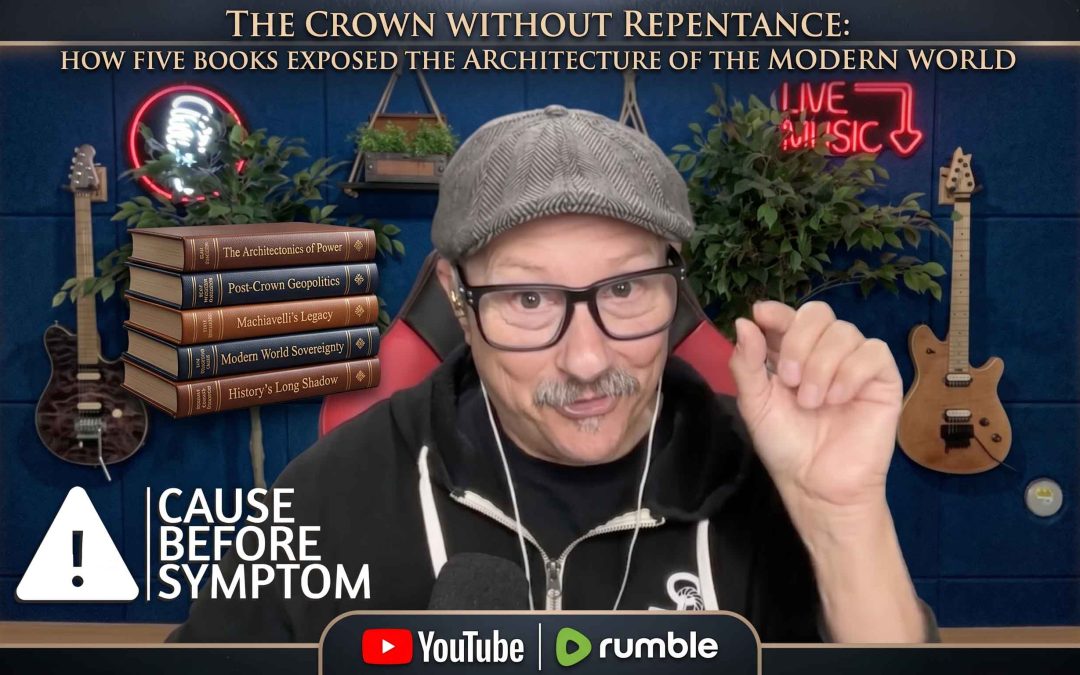
Watch this on Rumble: https://rumble.com/v7a5qxw-cause-before-symptom.html
Synopsis
Something entered the world through Cain that never truly left. It was not merely violence, anger, or jealousy. Those were only the visible surface of a deeper fracture. The real rupture came when authority learned how to continue without repentance. Power separated itself from alignment, survival replaced obedience, and civilization slowly learned how to build stability on unresolved separation from God. Across these five books, that pattern kept appearing again and again—in bloodlines, empires, priesthoods, technologies, financial systems, rituals, institutions, and finally in the digital architecture now surrounding modern life.
Breath War began with the foundation itself: breath as divine authorship, identity, covenant, and dominion. The struggle was never merely political or technological, but spiritual at its root. The Crown of Blood expanded that conflict into history, showing how systems of inheritance, ritual, power, and infrastructure attempted to preserve authority apart from surrender to God. The Ritual Machine exposed how modern civilization itself can become ritualized through repetition, symbols, consent, finance, law, and digital participation. Then The Stone That Speaks turned away from fear and toward witness, memory, covenant, Ethiopia, breath, bones, stones, and the testimony God preserved even while the world buried it beneath systems of forgetting.
What emerged at the end was not merely a theory about hidden elites or ancient conspiracies. It became something much more uncomfortable and much more universal. Civilization repeatedly mistakes continuity for righteousness. If a system survives long enough, people assume it must be legitimate. If authority functions efficiently, people stop asking whether it is aligned with truth. The world learns to trust what continues rather than what repents. That is the crown Cain carried forward into history: power that survives without returning.
These five books do not ultimately point toward fear, secret knowledge, or obsession with hidden systems. They point back toward discernment. The answer is not found in mastering the machine, but in refusing to surrender conscience to it. The answer is memory instead of forgetting, repentance instead of endurance, witness instead of performance, and alignment with God instead of dependence on structures that continue simply because no one has forced them to return. Underneath every empire, institution, ideology, and technological system sits the same question that began in Eden and echoed through Cain: does this authority still walk with God, or has it only learned how to survive without Him?
Monologue
For years I thought the battle was mainly about hidden people, secret systems, elite bloodlines, and occult structures operating behind the surface of civilization. I thought if I could just gather enough evidence, connect enough dots, trace enough institutions, expose enough corruption, then the full picture would finally appear. And to some degree, those systems are real. Governments centralize power. Financial systems manipulate nations. Technology increasingly tracks identity, behavior, speech, and movement. Large institutions protect themselves before they protect truth. None of that is difficult to see anymore. The deeper question became why humanity keeps building these systems over and over again in every age.
That question changed everything for me because eventually I realized the same pattern existed long before computers, central banks, artificial intelligence, or digital surveillance. Babylon had it. Rome had it. Egypt had it. Religious systems had it. Political systems had it. Even families and movements can carry it. The structure changes, but the spirit underneath remains the same. Power survives by continuing. Authority survives by endurance. Systems survive because people slowly mistake continuity for righteousness. If something lasts long enough, humanity begins assuming it must be legitimate simply because it still exists.
That is where these five books slowly led me. Breath War began with the idea that mankind carries something sacred directly from God Himself. Breath was not merely life, but authorship, identity, covenant, and witness. The Crown of Blood explored how civilizations attempt to preserve power through inheritance, ritual, institutions, and eventually technology itself. The Ritual Machine pushed further, examining how modern systems condition participation through finance, law, infrastructure, screens, symbols, and behavioral repetition until daily life itself begins functioning like ritual without most people realizing it. Then The Stone That Speaks changed direction entirely by asking what survives corruption. What testimony remains after empires bury memory beneath systems of forgetting. What cannot be digitized, altered, rewritten, or erased because God Himself preserved it as witness.
But The Crown of Cain finally exposed the center of the entire Codex. Cain was never merely about anger. He was never merely a warning about jealousy or emotional instability. Scripture spends very little time on Cain’s feelings and far more time on what happened afterward. Cain survives. Cain builds. Cain governs. Cain continues without returning to God. That is the fracture that entered history. Authority learned how to survive without repentance. Power learned how to function without reconciliation. Civilization learned how to continue without healing.
That realization changed how I look at nearly everything now. The world trains people to trust systems because they are old. Trust institutions because they are stable. Trust authority because it functions. Trust structures because they survived. But survival is not righteousness. Continuity is not alignment. A thing can continue for generations while still being separated from truth. A government can function while remaining corrupt. A church can grow while remaining spiritually empty. A financial system can stabilize economies while still enslaving nations through debt and dependency. Technology can increase convenience while simultaneously reducing humanity itself into data points inside systems too large for ordinary people to emotionally comprehend.
And that is why I no longer see the central battle as merely political or technological. It is spiritual discernment. The real danger is not simply hidden elites somewhere behind closed doors. The deeper danger is that humanity slowly adapts to systems that continue without repentance until those systems begin feeling normal. People eventually defend the very structures draining them because stability feels safer than truth. The machine survives because continuity comforts people more than correction.
These books were never meant to create fear. They were meant to document a journey through confusion toward discernment. Some ideas became stronger over time. Some needed correction. Some remain unresolved. But the direction became clearer with every book. The answer is not hidden knowledge. The answer is not obsession with darkness. The answer is not mastering systems through superior intelligence. The answer remains what scripture has always pointed toward from the beginning: repentance, alignment, truth, memory, witness, humility, and returning to God instead of surrendering conscience to structures that only know how to survive.
The strange thing is that after years of studying power structures, occult systems, hidden networks, technological control, bloodlines, institutions, and historical patterns, the final conclusion became simpler rather than more complicated. Christ never built Babylon. Christ never built Rome. Christ never built surveillance systems, digital registries, or towers reaching toward heaven through human effort. Christ restored relationship. Christ restored breath. Christ restored witness. And maybe that is why the modern world feels so unstable now. Civilization keeps trying to preserve continuity while separating itself further from the very source of life that made humanity whole in the first place.
Part 1
Something entered the world through Cain that was far larger than one act of violence. Scripture does not spend much time examining Cain’s emotions because the deeper issue was never simply anger. The text follows Cain after the murder because the real fracture begins when authority survives separation from God and continues functioning anyway. Cain lives. Cain moves. Cain builds. Cain fathers a lineage. Civilization itself begins growing outward from unresolved rupture.
That pattern became the foundation underneath all five books. At first the work focused heavily on hidden systems, spiritual corruption, elite structures, technological control, and the architecture of power. But the deeper I went into the research, the more I realized that none of those systems could exist unless humanity first accepted a much more dangerous idea: that authority can continue without repentance and still appear legitimate simply because it survives long enough.
Breath War began with a very simple but unsettling premise. Humanity was not merely created biologically. Adam was authored through breath. The breath of God represented identity, covenant, stewardship, and direct relationship between mankind and the Creator. In that framework, breath was not symbolic poetry. It represented the original alignment between heaven and earth. The serpent’s deception in Eden was not merely temptation toward bad behavior. It was an attempt to redirect authorship itself by convincing mankind to seek life, wisdom, and authority apart from God.
That is why Cain and Abel mattered so deeply in the first book. Abel represents surrendered life. Cain represents self-authorized life. Abel offers sacrifice through obedience while Cain offers the works of his own hands without alignment. The murder itself matters, but what matters even more is what happens afterward. Cain does not return. Cain does not repent. Cain does not restore relationship. Yet Cain continues existing within the world under restraint rather than reconciliation. That distinction changes everything.
Most people think civilization grows upward from progress, intelligence, innovation, and advancement. These books increasingly argue that civilization often grows outward from unresolved spiritual fracture instead. Systems become substitutes for relationship. Structure replaces communion. Stability replaces truth. Humanity slowly learns how to preserve itself externally while remaining internally disconnected from God. Once that separation occurs, every generation begins rebuilding the same tower under different names.
That is why the Codex repeatedly returns to Babel, Rome, Egypt, Babylon, and modern technocracy. The names change, but the operating principle remains remarkably similar. Human beings repeatedly attempt to stabilize existence apart from surrender to God. Sometimes the tower is religious. Sometimes financial. Sometimes military. Sometimes technological. Today the tower increasingly appears digital. Identity becomes data. Memory becomes searchable. Human behavior becomes trackable. Financial life becomes programmable. Speech becomes monitored. Civilization moves toward centralization because centralized systems promise continuity and predictability even while slowly separating people from direct human relationship, conscience, and dependence on God.
But something changed as these books progressed. The earlier work focused heavily on exposing hidden systems. Bloodlines. Ritual structures. Financial architecture. Technological manipulation. Psychological engineering. And while many of those observations remain part of the larger framework, the center of gravity slowly shifted away from fear and toward discernment. The deeper issue was never merely that evil people exist. The deeper issue is that humanity adapts to systems that continue without repentance until those systems begin feeling natural.
That is exactly what The Crown of Cain eventually exposed. The danger is not simply corruption itself. The danger is normalization. Once authority survives long enough, people begin assuming survival proves legitimacy. If a government continues, people trust it. If an institution survives centuries, people assume it must be righteous. If a system functions efficiently, people stop asking whether it is aligned with truth. Civilization begins confusing endurance with holiness.
That realization completely changed how I understood modern life. The machine does not survive primarily through violence anymore. It survives through familiarity. Most people wake up every morning inside systems they never chose, using technologies they barely understand, obeying structures they cannot meaningfully influence, while assuming all of it must somehow be legitimate because it continues functioning. The longer systems survive, the harder they become to question because continuity itself starts feeling sacred.
And that brings everything back to Cain. Cain becomes the prototype for authority that survives without returning. Not authority fully destroyed. Not authority fully reconciled. Authority restrained, permitted, stabilized, normalized, and allowed to continue. That is the crown these books kept tracing through history. It appears in empires, institutions, ideologies, priesthoods, economies, technologies, and even churches whenever power values survival over repentance.
What matters most is where this journey finally arrived. These books no longer point toward obsession with hidden elites or secret systems as the ultimate answer. They point toward something much simpler and much harder. Discernment. The ability to recognize when systems continue without alignment. The ability to refuse surrendering conscience to structures simply because those structures appear stable. The ability to distinguish survival from righteousness.
And maybe that is why Christ becomes more important at the end of the Codex than at the beginning of it. Because Christ does not preserve authority through fear, continuity, manipulation, or control. Christ restores relationship. Christ restores alignment. Christ restores breath. The kingdoms of men survive by endurance. The kingdom of God survives by truth. That difference may be the single most important thing these five books were trying to uncover all along.
Part 2
The deeper I moved into this research, the more I realized the modern world is obsessed with continuation. Everything revolves around keeping systems alive. Governments borrow endlessly to maintain continuity. Financial institutions print currency to preserve continuity. Corporations harvest attention to preserve continuity. Political parties manufacture outrage to preserve continuity. Even people themselves are trained to preserve continuity in their own lives at all costs, often without ever asking whether what continues is actually aligned with truth.
That realization slowly changed the meaning of the Beast system for me. I no longer see it primarily as one future government suddenly appearing out of nowhere. I see it as the final maturation of a pattern that has existed since Cain first walked east of Eden and continued building after separation from God. The danger is not merely evil appearing openly. The danger is humanity adapting to authority that survives without repentance until survival itself becomes the highest moral value.
The Crown of Blood explored this through institutions, dynasties, bloodlines, and technological systems because history repeatedly shows the same tendency. Every empire eventually begins protecting itself above truth. Rome preserved itself through law, military order, taxation, and centralized authority. Babylon preserved itself through ritual, commerce, and priesthood. Modern civilization preserves itself through finance, media, surveillance, digital infrastructure, and psychological management. The methods evolve, but the principle underneath remains remarkably stable. Systems become self-preserving organisms.
That is why the books repeatedly returned to the idea of ritual. Most people hear the word ritual and immediately imagine occult ceremonies in hidden chambers somewhere. But the deeper meaning became much more uncomfortable because ritual eventually revealed itself as repetition that shapes consciousness and reinforces participation. Modern life is filled with ritual. Wake up. Check the phone. Consume the feed. Obey the algorithm. Accept the debt. Work inside systems you do not control. Repeat until exhaustion becomes normal. The Ritual Machine argued that civilization itself can become ritualized until people no longer distinguish between participation and worship.
The frightening part is that modern systems do not usually force participation openly. They condition it gradually. Convenience becomes dependence. Dependence becomes identity. Identity becomes data. Data becomes governance. Eventually human beings begin existing more inside systems of measurement than inside direct relationship with one another or with God. The machine survives because it slowly absorbs human attention, memory, emotion, and identity into itself.
That is where technology becomes spiritually significant in the Codex. The concern was never merely that computers exist or that artificial intelligence exists. Technology itself is not inherently evil. The deeper concern is what happens when systems begin replacing human discernment with artificial mediation. People increasingly trust algorithms more than conscience, screens more than community, institutions more than direct relationship, and digital identity more than spiritual identity. Civilization starts outsourcing memory itself to machines.
That is exactly why The Stone That Speaks marked such an important turning point in the entire body of work. The earlier books focused heavily on exposure. The Stone That Speaks focused on preservation. What survives when systems attempt to erase memory itself? What remains when civilization rewrites history, digitizes identity, edits language, and buries testimony beneath endless streams of information? The answer the book kept returning to was witness. Breath. Bone. Stone. Covenant. Creation itself remembering what mankind keeps trying to forget.
And honestly, that may be the most important emotional shift across all five books. The early work carried urgency, confrontation, and warning. But eventually I realized that exposing darkness alone cannot heal anything. A person can spend their entire life decoding corruption and still never actually return to God. Fear alone does not restore alignment. In many ways fear itself becomes another mechanism of captivity because frightened people become easier to control, easier to manipulate, and easier to destabilize.
That realization forced me to rethink what discernment actually means. Discernment is not paranoia. Discernment is not obsession. Discernment is not assuming every institution is secretly evil or every leader is part of some hidden conspiracy. Discernment means testing authority by alignment rather than by endurance. That is the central lesson of The Crown of Cain. A thing can survive for centuries and still remain spiritually fractured. A system can appear stable while still being deeply misaligned with truth. Continuity itself proves nothing.
That changes how scripture itself reads. Cain becomes more than a story about anger. Babel becomes more than a story about pride. Rome becomes more than a historical empire. These become recurring patterns showing how humanity repeatedly builds systems capable of functioning apart from relationship with God. The systems often appear successful precisely because they endure. That endurance becomes the deception.
And this is where the modern digital age becomes so spiritually dangerous. The world is moving toward systems that increasingly eliminate friction between authority and participation. Digital identity. Programmable currency. Artificial intelligence. Predictive algorithms. Behavioral conditioning. Biometric verification. Centralized communication. Most people accept these things gradually because they appear efficient and convenient. But efficiency without alignment can become one of the most dangerous forms of authority ever created because people stop questioning systems once those systems become comfortable enough to depend upon.
The strange thing is that all of this ultimately drove me back toward simplicity rather than complexity. After years of studying systems of power, hidden structures, technological control, bloodlines, institutions, and ritual architecture, the final conclusion became almost painfully simple. Human beings were not created to live through systems alone. They were created for relationship with God and with one another. The machine survives by separating people from both. It replaces communion with management. It replaces repentance with continuity. It replaces truth with function.
And maybe that is why Christ stands so completely outside the logic of Cain’s crown. Christ does not justify Himself through endurance, domination, or institutional continuity. Christ restores through surrender, sacrifice, humility, repentance, and truth. The kingdoms of the world survive by protecting themselves. The kingdom of God survives by remaining aligned with the Father regardless of cost.
That distinction may be the single dividing line between the systems of men and the kingdom of heaven. One survives by continuation. The other survives by truth.
Part 3
One of the hardest things to accept during the writing of these books was realizing that the modern world does not primarily control people through force anymore. Force still exists, but it is no longer the main engine. The deeper mechanism is normalization. Human beings adapt to systems gradually until those systems begin feeling inseparable from reality itself. Once that happens, questioning the structure feels more dangerous than remaining inside it.
That is exactly how Cain’s crown survives across history. It rarely appears openly wicked at first. It appears practical. Stable. Necessary. Efficient. Civilization repeatedly accepts authority not because authority is righteous, but because authority continues functioning long enough that people begin assuming continuation itself proves legitimacy.
The more I studied institutions, the more I realized nearly every system eventually faces the same temptation: preserve truth or preserve continuity. And most systems choose continuity. Governments choose continuity through surveillance, debt, militarization, and centralized control. Financial systems choose continuity through inflation, dependency, and endless expansion. Religious systems choose continuity through hierarchy, institutional protection, and tradition. Media systems choose continuity through fear, outrage, and emotional management. Even technological systems increasingly revolve around preserving engagement and behavioral predictability above human well-being itself.
That is why The Ritual Machine became such an important part of the Codex. The machine is not merely hardware. It is not merely AI or digital systems. The machine is any structure that conditions participation while slowly separating people from direct relationship, discernment, repentance, and truth. Ritual became the perfect word for it because ritual trains repetition until repetition begins shaping consciousness itself.
Modern civilization is saturated with ritualized behavior. Endless scrolling. Endless outrage cycles. Endless consumption. Endless identity signaling. Endless financial dependency. Endless political theater. People wake up already connected to systems before they have even spoken to another human being or spent a single moment in prayer. Attention itself has become colonized. The machine survives by capturing breath through repetition.
What frightened me most was realizing how invisible this process becomes once people adapt to it. Human beings can normalize almost anything if it arrives gradually enough. Surveillance becomes convenience. Algorithms become authority. Digital profiles become identity. Artificial intelligence becomes companionship. Systems designed to manage behavior slowly become the emotional environment people live inside every day.
And this is where the books began moving away from merely exposing corruption and toward exposing artificiality itself. Modern life increasingly feels detached from creation. Detached from silence. Detached from direct human relationship. Detached from memory. Detached from stillness. Detached from God. Civilization becomes louder, faster, more connected technologically, yet strangely more fragmented spiritually.
That fragmentation is not accidental inside the Codex framework. Breath War argued that the original fracture began when mankind accepted life apart from God as a viable alternative. Everything afterward becomes an attempt to stabilize existence after separation. Empires rise to impose order. Religions rise to manage meaning. Financial systems rise to coordinate survival. Technology rises to eliminate uncertainty. But underneath all of it remains the same unresolved fracture introduced through Cain: authority continuing without reconciliation.
That is why The Stone That Speaks eventually became emotionally necessary within the progression of the five books. Without restoration, the Codex could have easily become trapped inside endless exposure and fear. But the stone changes the direction completely. The stone remembers. The witness survives. Creation itself still carries testimony beneath civilization’s systems of forgetting. Breath, covenant, bones, altars, scripture, memory, and witness remain alive even while empires attempt to overwrite them.
The Ethiopian themes became important there not merely because of canon debates, but because they symbolized preservation outside centralized Western authority. The larger point was that truth can survive outside dominant systems. Testimony does not always remain where empire says it should remain. God repeatedly preserves witness in unexpected places while civilizations centralize power around themselves.
And honestly, that realization forced me to confront something uncomfortable personally. It is possible to become so obsessed with exposing darkness that a person slowly loses sight of restoration itself. Fear can become its own prison. Endless decoding can become another form of captivity. The machine actually benefits when people become emotionally overwhelmed because overwhelmed people lose clarity. They either surrender entirely or descend into paranoia. Both outcomes destroy discernment.
That is why The Crown of Cain ultimately became the most mature book of the five. It shifted the focus away from chasing villains and toward understanding patterns of authority themselves. Cain is dangerous because he survives without repentance and eventually normalizes that condition through continuation. The systems that follow him do not always appear monstrous outwardly. Many appear orderly, productive, stable, even beneficial. That is precisely why discernment becomes necessary.
The world constantly trains people to trust stability over truth. Trust what works. Trust what survives. Trust what continues. But scripture repeatedly warns that endurance alone proves nothing. Babylon endured. Rome endured. Egypt endured. Systems can survive for centuries while remaining spiritually fractured at their core.
That realization completely changed how I view the future. I no longer believe the greatest danger is one sudden apocalypse appearing overnight. The deeper danger is gradual surrender of conscience to systems that feel increasingly necessary. The Beast system succeeds not merely because it becomes powerful, but because humanity adapts to it slowly enough that resistance begins feeling unreasonable.
And maybe that is why repentance matters so much throughout scripture. Repentance interrupts continuity. Repentance forces systems, institutions, and individuals to stop moving forward long enough to confront truth. Cain’s crown cannot tolerate repentance because repentance threatens the entire logic of survival without return. Once authority truly repents, the machine loses its power to normalize fracture.
That may be the deepest divide between the kingdoms of men and the kingdom of God. The systems of men survive through self-preservation. The kingdom of God survives through alignment with truth regardless of cost. One fears interruption. The other welcomes correction. One survives by protecting itself. The other survives by surrendering itself completely to the Father.
And in many ways, that became the final lesson of the entire Codex. The issue was never merely hidden elites, secret bloodlines, or technological systems. The deeper issue is whether humanity will continue mistaking survival for righteousness while slowly surrendering conscience to structures that never truly returned to God in the first place.
Part 4
What began emerging through these five books was not merely a critique of power, but a critique of civilization’s entire definition of legitimacy. The modern world assumes that if something functions, it must deserve to continue. That assumption quietly shapes almost everything around us. Stable governments are treated as righteous governments. Growing economies are treated as healthy economies. Expanding technologies are treated as progress. Even churches often measure success through scale, influence, and institutional endurance rather than repentance, humility, or alignment with God.
The deeper I followed that thread, the more I realized the modern world has almost completely merged morality with functionality. If a thing works, people defend it. If a system survives, people assume it must somehow be justified. That is the exact inversion The Crown of Cain keeps exposing. Cain’s authority survives not because it is reconciled, but because it continues. Over time, continuation itself becomes the argument for legitimacy.
That is why the digital age matters so much spiritually. Technology amplifies continuity beyond anything previous civilizations could have imagined. Systems no longer merely survive through armies or priesthoods. They survive through data, automation, algorithms, predictive behavior, and psychological conditioning. The machine becomes self-reinforcing because it learns from the people participating inside it. Human beings slowly train the system while the system simultaneously trains human beings.
The Ritual Machine explored this as a form of invisible liturgy. Not liturgy in the traditional religious sense alone, but ritualized participation shaping consciousness through repetition. Every civilization eventually creates rituals reinforcing obedience to its own continuity. Ancient empires used temples, sacrifice, priesthoods, and public ceremonies. Modern civilization uses screens, feeds, digital identities, financial systems, entertainment cycles, political outrage, and algorithmic reinforcement. The forms changed. The conditioning did not.
And this is where the Codex stopped being primarily about hidden conspiracies and started becoming a meditation on human nature itself. People want stability. People fear interruption. People fear uncertainty. That fear becomes the doorway through which systems justify almost anything. Once survival becomes the highest value, repentance becomes dangerous because repentance interrupts continuity. Truth becomes threatening because truth destabilizes structures built on unresolved fracture.
That realization helped me finally understand why Christ appears so disruptive to worldly systems throughout scripture. Christ constantly interrupts continuity. He overturns tables. He exposes religious authority. He confronts institutional hypocrisy. He refuses to allow stability itself to become sacred. The systems surrounding Him wanted preservation. Christ demanded alignment.
And honestly, that may be why modern civilization increasingly struggles with Christ even while still using Christian language culturally. The teachings of Christ are profoundly dangerous to systems that survive through self-preservation. Forgiveness interrupts cycles of control. Repentance interrupts institutional arrogance. Humility interrupts hierarchy. Truth interrupts propaganda. Real communion interrupts isolation. Christ constantly brings people back into direct relationship with God rather than dependence upon structures claiming exclusive authority over access to Him.
That is why The Stone That Speaks became emotionally important within the five-book journey. After examining systems of corruption, ritual architecture, bloodline preservation, technological control, and institutional endurance, the stone reintroduced witness. Memory survives. Testimony survives. Covenant survives. God preserves truth even while civilizations bury it beneath systems of forgetting.
The more I thought about it, the more I realized the modern world is suffering from engineered forgetfulness. People forget history within days now because information overload replaces memory. People forget scripture because entertainment dominates attention. People forget silence because noise surrounds them constantly. People forget neighborliness because digital interaction replaces direct relationship. Civilization becomes spiritually fragmented because fragmented people are easier to stabilize inside systems of management.
That may be the true purpose of discernment in the end. Not paranoia. Not obsession. Not constant fear. Discernment means recognizing when systems ask for trust without repentance. Discernment means refusing to confuse endurance with righteousness. Discernment means understanding that civilization itself can normalize misalignment until entire generations no longer remember what truth felt like before the machine trained them to accept artificiality as reality.
And maybe that is why Cain’s crown still matters so much now. Cain becomes the prototype for every system that survives without returning. Governments. Institutions. Financial structures. Religious hierarchies. Technological architectures. Even individuals can carry Cain’s logic whenever survival becomes more important than truth.
But the final direction of the Codex is not despair. It is actually restoration. The machine survives by convincing humanity that systems are stronger than relationship, that continuity is safer than repentance, and that artificial order is preferable to surrender before God. The books ultimately reject that entire premise.
Because the kingdom of God does not survive through self-preservation. It survives through truth. That is the dividing line underneath all five books. The systems of men preserve themselves at all costs. Christ restores what systems cannot heal. And the more unstable the world becomes, the more visible that distinction will likely become in the years ahead.
Part 5
The modern world no longer needs chains the way ancient empires did because people now volunteer their attention, identity, memory, and participation willingly. That may be the most important realization underneath The Ritual Machine and The Crown of Blood. Civilization learned how to preserve control through normalization rather than open force. Systems survive because human beings adapt to them slowly enough that participation begins feeling natural.
That is why the digital age matters so much spiritually inside the Codex framework. Technology is not merely changing tools. It is changing mediation itself. Human beings increasingly experience reality through systems standing between themselves and direct relationship. Algorithms mediate visibility. Platforms mediate speech. Financial systems mediate survival. Artificial intelligence mediates information. Digital identity mediates legitimacy. Civilization slowly moves human existence into managed systems of verification and participation.
But the deeper issue is not technology alone. The deeper issue is humanity’s willingness to trust systems primarily because those systems continue functioning. That is the exact warning The Crown of Cain eventually crystallizes. Civilization repeatedly mistakes continuity for righteousness. If something survives long enough, people begin assuming it must be legitimate.
That pattern explains why governments, institutions, corporations, religious hierarchies, and technological systems all drift toward self-preservation over time. Once continuity becomes the highest value, repentance becomes dangerous because repentance interrupts momentum. Truth becomes threatening because truth destabilizes structures built on unresolved fracture. Systems eventually defend themselves first because survival itself becomes sacred.
And maybe that is why the modern world feels increasingly artificial now. Human beings were not designed to live entirely through mediated systems. People were created for relationship, memory, covenant, truth, silence, witness, and direct dependence upon God. But modern civilization increasingly replaces those things with management. People become profiles. Relationships become metrics. Attention becomes currency. Identity becomes data.
That is where The Stone That Speaks became so important emotionally within the progression of the five books. The stone represented witness surviving corruption. Memory surviving erasure. Breath surviving artificiality. Covenant surviving empire. The message shifted from merely exposing hidden systems toward asking what God preserved beneath them all.
And that ultimately became the dividing line underneath the entire Codex. Cain’s crown survives through continuation. Christ restores through repentance and alignment. The kingdoms of men preserve themselves through control, fear, stability, and endurance. The kingdom of God restores what systems cannot heal. That may be the clearest way to understand everything these books were trying to say from the very beginning.
Part 6
The deeper I moved into these books, the more I realized the real battle was never simply between good people and bad people. It was between alignment and continuation. That distinction changes everything because most systems do not openly present themselves as evil. Most systems present themselves as necessary. Necessary for stability. Necessary for security. Necessary for progress. Necessary for survival.
That is exactly how Cain’s crown survives across history. Power learns how to justify itself through endurance rather than repentance. Once authority survives long enough, people stop asking whether it is aligned with truth and begin defending it simply because it continues existing.
And honestly, that realization changed how I understood modern civilization entirely. The digital age is not merely creating new technology. It is creating new forms of dependency. Human beings increasingly live inside systems that mediate identity, communication, memory, finance, and even emotional life itself. The machine does not need open tyranny if people willingly surrender participation through convenience and normalization.
That is why the Ritual Machine mattered so much in the progression of the Codex. The machine survives through repetition. Attention becomes ritualized. Outrage becomes ritualized. Consumption becomes ritualized. Political identity becomes ritualized. Even fear itself becomes ritualized through endless cycles of crisis and emotional management. Civilization slowly trains people into patterns that reinforce the continuity of the system.
But The Stone That Speaks introduced something the earlier books desperately needed: restoration. Witness survives. Breath survives. Memory survives. God preserves testimony even while civilizations attempt to overwrite it through systems of forgetting. The stone remembers because creation itself bears witness to the Creator whether empires acknowledge Him or not.
And maybe that became the final lesson underneath all five books. The answer is not endless obsession with hidden systems. The answer is discernment strong enough to recognize when authority survives without repentance. The answer is refusing to surrender conscience to structures that normalize separation from God while calling that separation progress.
Because in the end, Cain’s crown survives through continuation. Christ restores through truth. One preserves systems. The other restores relationship. One fears interruption. The other welcomes repentance. And the future of civilization may ultimately depend on which form of authority humanity chooses to trust moving forward.
Part 7
What frightened me most while writing these books was realizing how easily human beings adapt to artificial environments as long as those environments provide stability. Civilization increasingly rewards people for surrendering discernment in exchange for comfort, convenience, predictability, and emotional reassurance. The machine survives because it slowly convinces humanity that management is safer than freedom and continuity is safer than truth.
That is why The Crown of Cain became the final key to understanding the entire Codex. Cain is not merely a man who committed violence. Cain becomes the prototype for authority that survives without reconciliation. His power continues, his lineage continues, his structures continue, and eventually continuity itself becomes the justification for legitimacy.
The modern world operates through the same logic constantly. Institutions justify themselves because they endure. Governments justify themselves because they stabilize society. Financial systems justify themselves because economies continue functioning. Technological systems justify themselves because they increase efficiency. But none of those things automatically prove alignment with truth. Survival alone proves nothing spiritually.
And maybe that is why the world feels increasingly exhausted despite all its advancements. Human beings are trying to preserve continuity while remaining spiritually fractured underneath. Technology accelerates communication while weakening communion. Information expands while wisdom declines. Connectivity grows while loneliness deepens. Civilization becomes more coordinated externally while people become more fragmented internally.
That fragmentation matters because fragmented people are easier to govern through systems of mediation. People disconnected from memory become dependent on institutions for identity. People disconnected from scripture become dependent on media for meaning. People disconnected from prayer become dependent on distraction for emotional regulation. The machine survives by replacing direct relationship with managed participation.
But the deeper lesson of these books is that God continually preserves witness even inside corrupted civilizations. Breath survives. Truth survives. Memory survives. Repentance survives. The stone still speaks because creation itself remembers what humanity keeps trying to bury beneath systems of control and forgetting.
That realization ultimately brought the Codex back toward hope rather than fear. The answer is not paranoia. The answer is not obsession with darkness. The answer is discernment rooted in alignment with God rather than dependence upon systems that survive primarily through self-preservation.
Because in the end, the kingdoms of men all share the same fear: interruption. They fear repentance because repentance destabilizes unresolved authority. They fear truth because truth exposes fracture. They fear surrender because surrender threatens continuity itself.
But Christ operates completely differently. Christ interrupts systems precisely to restore what systems cannot heal. That may be the final distinction underneath all five books. Cain’s crown survives through endurance. Christ restores through reconciliation. One asks humanity to trust what continues. The other asks humanity to return to truth even if the systems of the world cannot survive that return unchanged.
Part 8
At the center of all five books sits one uncomfortable conclusion: civilization repeatedly learns how to continue without returning to God. That is the real architecture underneath the modern world. Not merely corruption. Not merely conspiracy. Not merely hidden elites or technological systems. The deeper structure is authority surviving long enough that humanity mistakes endurance itself for righteousness.
That realization changed the entire direction of the Codex. At first the research focused heavily on hidden systems, ritual structures, technocracy, bloodlines, institutions, and digital control. But eventually those things began looking more like symptoms of a deeper fracture rather than the fracture itself. The real issue began in Eden when mankind accepted the possibility of life apart from direct dependence on God. Cain carried that fracture forward by continuing without repentance. Civilization inherited it by building systems capable of functioning while spiritually unresolved.
That is why modern life increasingly feels detached from humanity itself. People are managed more than shepherded. Measured more than known. Connected more than united. The systems surrounding civilization grow more advanced while individuals grow more spiritually exhausted. Human beings become increasingly dependent on structures that promise stability while slowly draining direct relationship, memory, silence, discernment, and communion with God.
And maybe that is why these books eventually stopped pointing toward fear and started pointing toward restoration instead. The machine survives through normalization. God restores through interruption. The machine says continue at all costs. Christ says return. The machine values efficiency. Christ values truth. The machine preserves systems. Christ restores relationship.
That may be the simplest way to summarize the entire journey across all five books. Breath War explored what was stolen. The Crown of Blood explored how power inherited and organized the fracture. The Ritual Machine exposed how civilization ritualizes participation through systems of repetition and mediation. The Stone That Speaks revealed that witness still survives beneath systems of forgetting. And The Crown of Cain finally exposed the central deception beneath them all: continuity is not righteousness.
And honestly, that realization may become more important in the years ahead than at any previous moment in history. The world is moving toward systems that increasingly centralize identity, memory, communication, finance, and authority into technological structures capable of surviving almost indefinitely. Humanity may soon face the temptation to trust systems more than conscience, algorithms more than wisdom, and continuity more than truth itself.
But scripture keeps returning to the same warning. God does not measure authority by endurance alone. He measures it by alignment. The kingdoms of men preserve themselves through fear of collapse. The kingdom of God survives through truth even when worldly systems fall apart around it.
That is why repentance remains so powerful spiritually. Repentance interrupts the logic of Cain’s crown. Repentance refuses to allow continuity itself to become sacred. Repentance places truth above survival and alignment above stability. And maybe that is the final message these books were always trying to uncover beneath all the systems, structures, rituals, and technologies: humanity cannot remain whole while trusting authority that survives without ever truly returning to God.
Part 9
Maybe the most dangerous thing about Cain’s crown is that it rarely appears openly evil once it matures into civilization. It appears stable. Necessary. Responsible. Productive. That is why discernment becomes so difficult in every age. Human beings naturally trust what appears functional, especially when systems provide order during fear and uncertainty.
But scripture repeatedly warns that functioning systems are not automatically aligned systems. A nation can prosper while remaining spiritually corrupted. A church can grow while losing truth. A financial system can stabilize society while simultaneously enslaving people through dependency and fear. A technological system can increase efficiency while slowly reducing human beings into measurable units inside architectures of control.
That realization forced me to rethink nearly everything about authority itself. Most people assume authority becomes trustworthy through endurance. But the Codex increasingly argues the opposite. Endurance without repentance can actually deepen corruption because systems slowly normalize unresolved fracture over time. What survives long enough eventually becomes invisible. People stop questioning it because it becomes woven into ordinary life itself.
That is exactly what happened with Cain. Scripture does not merely show Cain committing violence. Scripture shows Cain continuing. Building. Governing. Organizing. Stabilizing life after separation from God. That continuation becomes the prototype for every later structure that survives without reconciliation.
And honestly, that pattern now appears everywhere in modern civilization. Systems no longer simply manage society. They increasingly shape identity itself. Technology determines visibility. Media determines emotional focus. Financial systems determine survival. Algorithms determine attention. Artificial intelligence increasingly mediates information itself. Human beings gradually adapt to lives lived almost entirely through systems standing between themselves and direct relationship with reality.
That may be why modern people feel simultaneously connected and isolated at the same time. Civilization keeps expanding externally while human beings become fragmented internally. The machine grows stronger while conscience grows weaker. People become overloaded with information while starving for wisdom. Endless communication exists alongside collapsing communion.
And maybe that is why repentance matters so deeply in scripture. Repentance interrupts normalization. Repentance forces authority to confront truth instead of merely continuing forward. Cain’s crown fears repentance because repentance destabilizes unresolved power. Once authority truly returns to God, continuity alone can no longer justify itself.
That became the final warning underneath all five books. The greatest danger may not be one future dictator, one global government, or one hidden conspiracy alone. The greater danger is humanity gradually surrendering discernment to systems that survive primarily because people fear interruption more than misalignment.
But the kingdom of God operates completely differently. Christ does not preserve systems through fear or endless self-protection. Christ restores through truth. Christ interrupts false stability in order to restore alignment. The kingdoms of men survive by convincing humanity that continuation is sacred. Christ reminds humanity that truth matters more than survival itself.
And maybe that is the final dividing line beneath the entire Codex. Cain’s crown asks whether authority can continue. God asks whether authority has returned.
Part 10
When I first began this journey, I thought the goal was to expose hidden systems. I thought if enough people understood the structures behind finance, media, technology, centralized power, ritual architecture, and institutional corruption, then somehow humanity would wake up and things would change automatically. But after moving through all five books, I no longer believe exposure alone is enough.
Because systems are not sustained merely by secrecy. They are sustained by human beings adapting to them emotionally, spiritually, and psychologically until continuity itself begins feeling sacred. That is the true power of Cain’s crown. Authority survives long enough that people stop asking whether it is aligned with truth and begin defending it simply because it continues functioning.
That realization changed the entire direction of the Codex. Breath War explored divine authorship and the fracture introduced when mankind sought life apart from God. The Crown of Blood traced how power structures inherited and organized that fracture across civilizations and institutions. The Ritual Machine showed how modern systems ritualize participation through repetition, technology, finance, law, and behavioral conditioning. The Stone That Speaks restored the idea of witness, memory, covenant, and preserved testimony beneath civilization’s systems of forgetting. Then The Crown of Cain revealed the center of the entire architecture: authority continuing without repentance.
And honestly, that final realization may matter more now than ever before because the modern world increasingly rewards systems for surviving rather than for being righteous. Governments preserve continuity. Financial systems preserve continuity. Corporations preserve continuity. Platforms preserve continuity. Even people themselves often preserve identity rather than repent before God because interruption feels more frightening than remaining spiritually unresolved.
But scripture constantly interrupts that logic. God repeatedly confronts systems that continue without alignment. Babel falls. Egypt falls. Babylon falls. Rome falls. The warning throughout scripture is not merely against corruption itself, but against humanity trusting structures that survive long enough to appear eternal.
That may be why Christ stands so radically outside the architecture of Cain. Christ does not preserve Himself through domination, propaganda, technological control, institutional continuity, or fear. Christ restores through truth, repentance, humility, communion, sacrifice, and direct relationship with the Father. The systems of men survive by protecting themselves. The kingdom of God survives by remaining aligned even when worldly structures collapse around it.
And maybe that is the final lesson underneath all five books. The answer is not hidden knowledge alone. The answer is not paranoia. The answer is not endless obsession with darkness. The answer is discernment rooted in truth strong enough to recognize when civilization itself has normalized separation from God while still calling that separation progress.
Because in the end, the greatest danger may not be one final empire rising suddenly in the future. The greater danger may be humanity gradually surrendering conscience to systems that feel stable enough to trust while remaining spiritually unresolved underneath. Cain’s crown survives whenever continuity becomes more important than repentance.
But the stone still speaks. Breath still speaks. Truth still speaks. Witness still survives beneath every system civilization builds to bury it. And no matter how advanced the machine becomes, God still measures authority the same way He always has: not by how long it survives, but by whether it has truly returned.
Conclusion
At the end of these five books, the question is no longer whether hidden systems exist. They do. The question is no longer whether power centralizes itself over time. History proves that it does. The deeper question is whether humanity can still recognize the difference between authority that survives and authority that is aligned with God.
That became the true center of the entire Codex.
Breath War began with the idea that mankind was authored directly by God through breath, covenant, and relationship. The Crown of Blood traced how civilizations attempted to preserve power after separation from that relationship. The Ritual Machine exposed how systems condition participation until people mistake ritualized continuity for ordinary life. The Stone That Speaks reminded us that witness still survives beneath empire, memory still survives beneath manipulation, and truth still survives beneath systems of forgetting. Then The Crown of Cain finally named the fracture itself: authority continuing without repentance.
And maybe that is why modern civilization feels increasingly unstable beneath the surface despite all its advancements. Humanity has built enormous systems capable of preserving continuity while starving repentance, humility, silence, communion, neighborliness, and direct dependence upon God. The machine grows stronger externally while people become weaker internally. Civilization becomes more connected technologically while becoming more fragmented spiritually.
But these books were never meant to leave people in fear. Fear itself can become another prison. Endless obsession with darkness can become another form of captivity. The final direction of the Codex was always meant to move toward discernment instead. Discernment strong enough to recognize when systems normalize separation from God while still appearing stable and successful outwardly.
Because in the end, survival is not righteousness. Continuity is not holiness. Stability is not truth. A thing can endure for centuries while remaining spiritually fractured. Cain proved that from the beginning. The world continually trusts what survives. God continually asks whether it has returned.
That is the final dividing line underneath all five books.
The kingdoms of men preserve themselves through fear of interruption. The kingdom of God restores through repentance and truth. One survives by protecting continuity at all costs. The other restores relationship even if systems collapse in the process. One asks humanity to trust what functions. The other asks humanity to return to what is true.
And maybe that is why Christ stands outside every empire, every machine, every institution, and every tower mankind keeps building. Christ never came to preserve Babylon. Christ never came to preserve Rome. Christ never came to preserve systems that survive through domination, fear, and self-protection. Christ came to restore what civilization keeps trying to replace: direct relationship between God and man.
That is why the stone still speaks. That is why breath still matters. That is why witness survives even when empires fall. And that is why no machine, no institution, no empire, and no system can ever fully replace what God authored in the beginning.
Because in the end, God will not measure authority by how long it survived.
He will measure whether it returned.
Bibliography
- Carner, James. Breath War. Unpublished manuscript, 2026.
- Carner, James. The Crown of Blood. Unpublished manuscript, 2026.
- Carner, James. The Ritual Machine. Unpublished manuscript, 2026.
- Carner, James. The Stone That Speaks. Unpublished manuscript, 2026.
- Carner, James. The Crown of Cain. Unpublished manuscript, 2026.
- The Holy Bible, King James Version. Peabody, MA: Hendrickson Publishers, 2011.
- The Ethiopian Orthodox Tewahedo Canon. Translated from Amharic source texts by James Carner, working translation archive, 2025–2026.
- The Book of Enoch (1 Enoch). Ethiopian manuscript tradition.
- The Book of Jubilees. Ethiopian canon tradition.
- The Cave of Treasures. Syriac and Ethiopian manuscript traditions.
- The Testament of Adam. Ancient Near Eastern and Ethiopian textual traditions.
- The Dead Sea Scrolls. Edited by Florentino García Martínez and Eibert J. C. Tigchelaar. Leiden: Brill, 1997.
- Augustine. The City of God. Translated by Marcus Dods. Peabody, MA: Hendrickson Publishers, 2009.
- Ellul, Jacques. The Technological Society. New York: Vintage Books, 1964.
- Foucault, Michel. Discipline and Punish: The Birth of the Prison. New York: Vintage Books, 1995.
- Mumford, Lewis. The Myth of the Machine. New York: Harcourt Brace Jovanovich, 1967.
- Postman, Neil. Technopoly: The Surrender of Culture to Technology. New York: Vintage Books, 1993.
- Ellul, Jacques. Propaganda: The Formation of Men’s Attitudes. New York: Vintage Books, 1973.
- Debord, Guy. The Society of the Spectacle. New York: Zone Books, 1994.
- McLuhan, Marshall. Understanding Media: The Extensions of Man. Cambridge, MA: MIT Press, 1994.
- Lasch, Christopher. The Culture of Narcissism. New York: W. W. Norton & Company, 1979.
- Toffler, Alvin. Future Shock. New York: Random House, 1970.
- Kissinger, Henry. World Order. New York: Penguin Press, 2014.
- Fitts, Catherine Austin. The Solari Report. Ongoing research publication.
- The Holy Bible: 1611 King James Version with Apocrypha. Nashville: Thomas Nelson, facsimile edition.
Endnotes
- The central thesis of The Crown of Cain argues that Cain represents the emergence of authority continuing without repentance rather than merely emotional failure or isolated violence.
- Breath War establishes breath as divine authorship, covenant, dominion, and spiritual identity originating directly from God’s relationship with mankind.
- The Crown of Blood expands the breath-registry framework into historical institutions, bloodlines, ritual systems, technocracy, and digital identity architecture.
- The Ritual Machine frames civilization itself as ritualized participation reinforced through repetition, symbolism, law, finance, media, and technological systems.
- The Stone That Speaks introduces restoration, covenant memory, Ethiopia, witness, breath, bone, and preserved testimony as the surviving counterweight to civilization’s systems of forgetting.
- The Codex repeatedly argues that modern systems increasingly mediate human identity through technology, finance, institutions, and digital participation rather than direct relationship with God and neighbor.
- The concept of “continuity mistaken for righteousness” serves as the primary interpretive framework unifying all five books.
- The show’s interpretation of Cain focuses primarily on Genesis 4 and the continuation of Cain’s lineage, movement, construction, and governance after separation from God.
- References to Babel, Babylon, Egypt, and Rome are used symbolically and structurally throughout the Codex to represent recurring patterns of centralized authority and civilization organized apart from divine alignment.
- The Ethiopian Orthodox Tewahedo canon is referenced throughout the Codex as a preserved witness tradition containing texts and perspectives omitted or marginalized within Western canon traditions.
- Discussions of ritual within the Codex extend beyond occult ceremony into broader concepts of repetition, behavioral conditioning, mediated participation, and social normalization.
- References to “the machine” throughout the show describe integrated systems of technological, institutional, financial, political, and psychological mediation rather than a single literal organization.
- The Codex treats artificial intelligence symbolically as a form of synthetic mediation capable of replacing memory, discernment, authorship, and relational participation if left spiritually unchecked.
- The phrase “the stone still speaks” refers to preserved testimony, covenant witness, creation memory, and divine authorship surviving institutional corruption and historical erasure.
- The concluding distinction between “systems that survive” and “authority that returns” forms the theological resolution of the five-book arc.
#TheCrownWithoutRepentance, #CauseBeforeSymptom, #TheCodex, #BreathWar, #TheCrownOfBlood, #TheRitualMachine, #TheStoneThatSpeaks, #TheCrownOfCain, #ChristianDiscernment, #BeastSystem, #DigitalIdentity, #Technocracy, #AuthorityAndRepentance, #EthiopianCanon, #SpiritualWarfare, #BabylonSystem, #TruthVsContinuity, #KingdomOfGod, #WitnessAndMemory, #ModernWorld
TheCrownWithoutRepentance, CauseBeforeSymptom, TheCodex, BreathWar, TheCrownOfBlood, TheRitualMachine, TheStoneThatSpeaks, TheCrownOfCain, ChristianDiscernment, BeastSystem, DigitalIdentity, Technocracy, AuthorityAndRepentance, EthiopianCanon, SpiritualWarfare, BabylonSystem, TruthVsContinuity, KingdomOfGod, WitnessAndMemory, ModernWorld