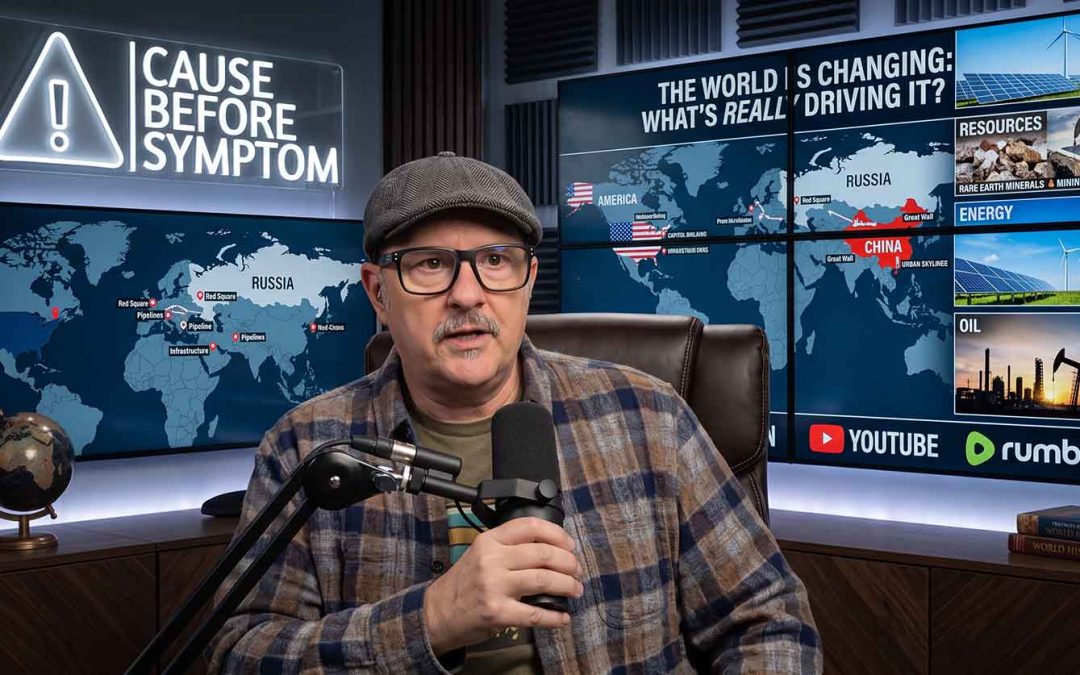
Watch this on Rumble: https://rumble.com/v7gjyw6-the-world-is-changing-whats-really-driving-it.html
Opening — Something Is Moving Beneath Our Feet
Welcome to Cause Before Symptom. We don't chase symptoms. We test the cause against Scripture.
Something is happening in the world, and I don't think most people understand just how much is changing. Europe is preparing for the possibility of war with Russia. Canada is looking for ways to become less dependent on America. China has enormous influence over the materials needed to manufacture modern technology. Governments are spending billions building factories, expanding their militaries, and securing resources. Meanwhile, ordinary families are trying to figure out why everything costs so much and what tomorrow might bring.
Turn on the television, and everybody has somebody to blame. Russia blames the West. The West blames Russia. America argues with China. Canada argues with America. And somewhere in the middle of all this, we're supposed to believe that every decision is simply another political disagreement. But what if we're looking at the symptoms instead of the causes? What if the real story begins long before a politician steps in front of a microphone?
I want you to imagine something simple. You're a farmer with a thousand acres of corn. You own the land, the equipment, and the grain bins. You've got money in the bank. But one morning, you discover nobody can deliver diesel for your tractors. Your equipment is perfectly good, your land is ready, and you've got everything you need except one thing. Without that fuel, you're not going anywhere. Suddenly, the person who can supply diesel has something more important to you than all the money sitting in your account.
Now imagine that same problem happening across the entire world. Countries need oil, natural gas, fertilizer, electricity, copper, computer chips, food, and transportation. Some countries produce these things. Others process them. Others control the routes used to deliver them. And almost nobody has everything they need without depending on somebody else.
For decades, countries built their economies around those relationships. But now those relationships are changing. Governments are worried about what happens if a supplier refuses to deliver, a shipping route closes, a war interrupts production, or a new law makes something harder to obtain. And they're making enormous decisions because of those concerns.
Here's where my investigation begins. Are these countries independently reacting to the same problems? Are governments and corporations working together to protect their interests? Or are certain people and organizations using control over essential supplies to influence decisions before the public even knows there's a problem?
I'm not going to tell you we've discovered somebody secretly running the world. We haven't established that. But I'm also not going to pretend that markets operate without powerful interests influencing them. Governments can restrict exports. Corporations can influence regulations. Central banks can change borrowing conditions. International organizations can recommend policies that affect entire economies. Those are real forms of influence, and their effects can be measured.
Tonight, we're going to follow the evidence backward. Before the price increased, what happened to the supply? Before the government passed a law, who proposed it? Before a country changed its alliances, what dependency was it trying to escape? And when somebody benefited from a crisis, did they simply take advantage of the situation, or is there evidence they helped create it?
Because I believe there's a much better way to understand what's happening than choosing sides and arguing over headlines.
Find what everybody needs. Find where it comes from. Find what happens when that supply is threatened. Then examine who has the ability to influence it.
And perhaps, by the time we're finished, we'll understand why the world seems to be moving beneath our feet—and whether anyone is deliberately moving it.
Investigation 1 — What Does the World Actually Depend On?
Before we can understand who's influencing the world, we need to understand what keeps the world running. And I'm not talking about money. I'm talking about the things that money buys. Because if tomorrow morning every bank account in America had a million dollars in it, but there was no food, fuel, or electricity, all those millions wouldn't do us much good. Money is useful because it allows us to exchange things. But somebody still has to produce those things, and somebody has to deliver them.
Let's start with food. The world has more than eight billion people who need to eat. Farmers need land, water, seeds, fertilizer, fuel, equipment, and transportation. Take away any one of those things long enough, and food production suffers. And here's something most people never think about. A country can have millions of acres of farmland and still depend on another country for the fertilizer needed to grow its crops. That means the people supplying fertilizer can influence food production without owning a single acre of that farmland.
Now let's talk about energy. Oil doesn't just make gasoline. Petroleum is used to manufacture plastics, chemicals, and countless products we use every day. Natural gas heats buildings, generates electricity, and helps produce nitrogen fertilizer. Electricity powers hospitals, factories, communication networks, and the equipment that keeps food refrigerated. When energy becomes harder to obtain, the effects spread into nearly everything else. A factory might have all the materials it needs, but without reliable electricity, it cannot operate.
Then we have minerals. Copper carries electricity through power lines, buildings, and machines. Iron ore becomes steel. Lithium, nickel, and graphite are important for many batteries. Rare earth elements are used in certain magnets, motors, and advanced equipment. But digging these materials out of the ground is only the beginning. They often have to be processed before manufacturers can use them. That's important because a country might have plenty of a mineral underground but lack the factories needed to turn it into something useful.
Now imagine all those products have been manufactured, but nobody can deliver them. Ships carry enormous amounts of international trade. Trucks bring products to stores. Railroads move grain, coal, chemicals, and industrial materials. Ports connect countries to one another. If a major transportation route closes, the products don't necessarily disappear. They simply become harder, slower, or more expensive to obtain. That's how a problem in one location can affect prices thousands of miles away.
And this brings us to something I want you to remember throughout tonight's investigation. Having the most resources doesn't always mean having the most influence. Sometimes the greatest advantage belongs to whoever controls the part of the process that cannot easily be replaced. It might be a refinery, a fertilizer plant, a shipping route, an electrical grid, or a factory producing one essential component. If everything else depends on that one part, a disruption there can affect the entire system.
But there's another side to this. The supplier also needs customers. A refinery without buyers cannot operate profitably forever. A mine without transportation cannot sell its minerals. A farmer without a market cannot earn a living. Dependence often works in both directions, although one side may have more alternatives than the other.
So before we investigate Europe, Russia, Canada, China, or America, we need to establish this foundation. Every modern economy depends on physical resources, the ability to process them, and the transportation needed to deliver them.
And when those systems become difficult to replace, they become sources of economic influence.
Our next question is what happens when the world has plenty of something, but people still cannot get it.
Investigation 2 — What Happens When There's Plenty, but You Can't Get It?
Now that we understand what the world depends on, I want to show you something that sounds impossible. There can be plenty of something available, and people can still experience a shortage. That might sound ridiculous, but it happens all the time. And understanding why it happens is one of the most important parts of tonight's investigation. Because when somebody tells you the world is running out of something, the first question should be whether we're actually running out or whether something is preventing us from getting it.
Let's use oil as an example. Imagine there's an enormous amount of crude oil available, but the refineries that turn it into gasoline and diesel are already operating near their limits. Suddenly, one refinery shuts down because of an equipment failure. The oil hasn't disappeared. It's still underground, sitting in storage tanks, or moving through pipelines. But the ability to turn that oil into fuel has been reduced. Gasoline prices can rise even while crude oil remains plentiful. The shortage isn't necessarily the resource. It's the ability to process it.
Now imagine a farmer in Iowa who produces an enormous corn harvest. His grain bins are full, and the harvest was excellent. But a railroad interruption prevents him from shipping that corn to customers. Meanwhile, a buyer hundreds of miles away needs corn and cannot get enough delivered. One location has too much, another has too little, and both have a problem. The farmer may receive lower prices because he cannot move his crop, while the distant buyer pays more because deliveries are limited. The same interruption creates opposite effects depending on where you stand.
This happens with electricity, too. A region might generate more electricity than it needs, but without enough transmission lines, that power cannot easily reach another region experiencing shortages. Building power plants doesn't automatically solve the problem if the electrical grid cannot carry the additional electricity. The important question becomes whether the entire system can deliver what people need, not simply whether enough energy exists somewhere.
Now let's look at minerals. Copper might be available in the ground, but opening a new mine can take many years. After mining, the material must be processed into forms manufacturers can use. If processing plants cannot obtain enough copper concentrate, they may compete against one another for the available supply. That competition can change prices and profits long before consumers notice anything unusual.
Here's where the numbers become important. To understand a shortage, we need to know how much is produced, how much people use, how much is stored, and how quickly additional supplies can arrive. If a country has ninety days of fuel available, a temporary interruption might be manageable. But if it has only five days available and replacement deliveries take a month, that same interruption becomes much more serious.
And there's something else. Markets don't always wait until supplies actually disappear. Prices can change when buyers believe a shortage is coming. Businesses may order extra inventory, which can make supplies tighter for everyone else. Sometimes that fear proves justified. Sometimes it doesn't.
So when you hear that oil, food, electricity, or minerals are becoming scarce, don't immediately assume the earth is running out. Find the point where production, processing, storage, or delivery can no longer keep up.
Because once we identify that bottleneck, we can ask a much more serious question.
What happens when somebody deliberately restricts it?
Investigation 3 — Can Somebody Create a Shortage Without Destroying Anything?
Now we're getting into something that changes how we look at the world. We've already established that a shortage doesn't always mean we're running out of something. Sometimes the problem is getting that resource to the people who need it. But what happens when somebody deliberately limits that supply? What happens when there's plenty available, the factories are working, the trucks are running, and the customers are waiting, but somebody makes a decision that prevents the product from reaching them?
Imagine you're a farmer growing corn in Iowa. You've had an excellent harvest, and there's more than enough corn to meet demand. But tomorrow morning, the government announces that only a certain amount can be exported. The corn hasn't disappeared. Nobody burned the fields or destroyed the grain bins. But buyers overseas can no longer purchase as much as they wanted. Prices might fall for farmers who suddenly have fewer customers, while prices rise for foreign buyers who can no longer obtain enough corn. One decision has created two different market conditions without destroying a single bushel.
Now consider something that actually happened. In 2025, the Democratic Republic of the Congo, one of the world's largest cobalt producers, suspended cobalt exports before introducing export quotas. Cobalt is used in certain batteries and industrial products. The government wanted greater control over its mineral industry and hoped to support prices after a period of oversupply. The restriction changed how much cobalt could reach international buyers, even though the mineral itself was still there. That's a real example of a government deliberately limiting available exports to influence market conditions.
But governments aren't the only ones capable of restricting supply. Oil-producing countries sometimes agree to reduce production because they believe too much oil is pushing prices down. Businesses can also reduce output when producing more would be unprofitable. These actions aren't automatically illegal or dishonest. However, agreements between competing private companies to restrict output and raise prices can violate competition laws. The important point is that production decisions affect what buyers can obtain and what they're willing to pay.
Now consider legislation. Suppose a government introduces expensive new requirements for operating a processing plant. A large company might afford the upgrades, while smaller competitors cannot. Some smaller facilities may close, reducing competition and leaving fewer suppliers. The regulation might have a legitimate purpose, such as preventing pollution or protecting workers. But its economic effects still deserve examination. Who proposed the requirements? Were cheaper alternatives considered? How many businesses closed? Did prices increase afterward? And did the remaining companies gain market share?
Here's where we have to be especially careful. If a company profits after a new law takes effect, that doesn't prove it secretly wrote the law. We need to examine public comments, lobbying records, government meetings, proposed regulations, and the actual results. We also need to compare prices with what would likely have happened without the restriction. Otherwise, we might mistake ordinary market changes for manipulation.
And there's another possibility. Sometimes restricting one product encourages people to develop alternatives. Higher prices can motivate new mines, factories, technologies, and suppliers. That means the influence created by a shortage may be temporary, especially when competitors can respond.
So here's what we've learned. Scarcity doesn't always begin with nature, war, or broken equipment. Sometimes it begins with a decision. A production limit, export quota, transportation restriction, or regulation can change the amount of a product available to buyers.
And now we're ready to examine a much larger question.
When Europe prepares for conflict with Russia, are we watching a response to danger, a struggle over essential resources, or both?
Investigation 4 — Why Is Europe Preparing for War With Russia?
Now that we've seen how supply can be restricted without destroying anything, let's look at Europe and Russia. Because something much bigger than an argument over borders is happening. European governments are spending enormous amounts of money preparing their militaries, building weapons factories, and securing the materials needed to keep those factories running. But before we assume Europe wants a war, we need to understand what changed and why its leaders believe these preparations are necessary.
Start with February 2022, when Russia launched its full-scale invasion of Ukraine. European countries watched a major war unfold on their doorstep. Millions of people fled their homes, cities were destroyed, and the fighting exposed a problem many European governments had ignored for years. They had allowed their military stockpiles and weapons production to become too small for a prolonged conflict. At the same time, parts of Europe depended heavily on Russian energy. That meant the country European governments were trying to pressure was also supplying resources their economies needed.
Think about that for a moment. Imagine you're arguing with the person who supplies the fuel for your farm. You might have good reasons for the disagreement, but you still need the fuel. If that relationship breaks down, you have to find another supplier, and that could cost considerably more. That's part of what Europe experienced when Russian pipeline gas deliveries collapsed and European countries scrambled to replace them. They bought more liquefied natural gas, changed suppliers, reduced consumption, and invested in alternative energy sources.
But energy was only one dependency. Modern militaries need ammunition, explosives, steel, electronics, fuel, and factories capable of producing replacements quickly. A country might own hundreds of military vehicles, but if it cannot manufacture spare parts or ammunition, those vehicles become less useful over time. European governments began asking whether their industries could support a major conflict lasting years instead of weeks. The answer exposed serious production limitations.
Now follow the numbers. According to the European Commission, Russia supplied about 45 percent of the European Union's imported natural gas in 2021. By 2025, that figure had fallen to approximately 12 percent. Russian gas imports dropped from 152 billion cubic meters to 36 billion. Europe dramatically changed where it obtained an essential resource. But replacing one dependency can create another, especially when the replacement comes from distant suppliers and requires expensive transportation and infrastructure.
Now look at military spending. Europe's Readiness 2030 program is designed to make up to 800 billion euros available for additional defense investment, including a 150-billion-euro loan program. That doesn't mean all the money has already been spent. It means European governments are creating the financial ability to purchase equipment, expand factories, and strengthen their defenses. And here's where influence enters the picture. Defense manufacturers, raw-material suppliers, financial institutions, military planners, and government officials all participate in different parts of that process. Some recommend what is needed. Others decide what gets purchased. Still others receive the contracts.
But does that prove somebody wants a war because war is profitable? No. The evidence establishes a real security threat, substantial industrial weaknesses, and major financial commitments. It also establishes opportunities for businesses to profit from military expansion. What it doesn't establish is that those businesses caused the war or secretly directed Europe's response. To answer that, we'd need to examine who proposed particular spending programs, who influenced their design, and whether the purchases addressed genuine shortages.
And we cannot ignore Russia's position. Russia considers NATO's military presence near its borders a security threat, while European governments point to Russia's invasion of Ukraine as evidence that stronger defenses are necessary. Those competing security claims don't erase the fact that Russia invaded its neighbor. But they help explain why each new military decision can increase suspicion on the other side.
So what are we actually watching? Europe is trying to protect itself militarily while rebuilding industries it believes are essential to its independence. Russia is trying to maintain its security position and influence while continuing its war in Ukraine. Both face economic costs, and both depend on resources, manufacturing, and transportation.
The deeper question isn't simply whether Europe wants war. It's whether fear of future conflict is changing who controls Europe's energy, factories, military production, and financial commitments.
Because while Europe is trying to become less dependent on Russia, another longtime partnership is changing across the Atlantic.
And that's where Canada and America enter our investigation.
Investigation 5 — Why Is Canada Looking for a Way Out of America's Shadow?
For generations, Canada and the United States have been more than neighbors. They've been business partners. Canada sells America oil, natural gas, electricity, lumber, minerals, automobiles, and agricultural products. America sells Canada machinery, technology, manufactured goods, and countless other products. Their factories, pipelines, railroads, and electrical systems are connected. But something has changed. Canada is now looking for ways to become less dependent on the United States, and to understand why, we need to examine the numbers instead of the political arguments.
Imagine you're a farmer who sells three-quarters of everything you grow to one customer. For thirty years, that customer has been dependable. Then one morning, he announces new fees, threatens to stop buying certain crops, and tells you the agreement you've relied on might change again tomorrow. Even if he's still your biggest customer, wouldn't you start looking for somebody else to buy your harvest? That's the problem Canada faces. Its economy has been built around access to the American market, and American trade policy has become less predictable.
In 2024, approximately 76 percent of Canada's merchandise exports went to the United States. By 2025, that share had fallen to about 72.5 percent. That's still an enormous dependency. Nearly three out of every four dollars Canada earned from exporting physical goods came from American customers. But the decline tells us something important. Canada's trading relationships were already beginning to shift, even though replacing the American market would be extraordinarily difficult.
Now look at the other side. America also depends on Canada, particularly for energy. Canadian crude oil supplies a large portion of American petroleum imports, especially to refineries designed to process heavier grades of oil. Canada also supplies natural gas and electricity across the border. These aren't products that can always be replaced overnight. Pipelines, refineries, and power lines were built around decades of cooperation. If that relationship becomes more expensive or unreliable, both countries can experience consequences.
Now here's where the story becomes especially interesting. On October 1, 2026, Canada announced plans to fast-track a new oil pipeline from Alberta to the Pacific coast. The proposed pipeline could carry one million barrels of oil per day, giving Canadian producers another way to reach overseas buyers instead of depending so heavily on American refineries. The project isn't built yet, and it faces enormous costs and environmental concerns. But the decision reveals what Canada is trying to accomplish. It's not simply looking for new friends. It's building another road to market.
And who stands to influence these decisions? Energy producers, pipeline operators, automobile manufacturers, financial institutions, labor organizations, and government officials all have interests in the outcome. Some want access to new markets. Others want protection from tariffs. Still others are concerned about construction costs, environmental damage, or the effects on local communities. Those interests don't necessarily agree, and none of them alone explains Canada's entire strategy.
So let's return to our original question. Is Canada turning its back on America, or is it trying to make sure America isn't its only option? The numbers suggest the second explanation. Canada still depends heavily on American customers, but it is deliberately investing in ways to reduce that dependence. And the United States must also consider what happens when an important supplier develops more choices.
This is what a shift in economic power can look like. No army has to cross a border. No factory has to explode. Sometimes all it takes is a new transportation route, another customer, or a change in trade rules to alter who has the stronger negotiating position.
And that brings us to China, where control over essential materials and processing capacity creates a different kind of influence—one that reaches into factories around the world.
Investigation 6 — Why Does China Have So Much Leverage?
Now let's turn our attention to China, because China demonstrates something important about how power works in today's world. You don't necessarily have to own the most resources to influence the countries that need them. Sometimes it's enough to control the factories that turn those resources into usable products. And over the past several decades, China has built an enormous industrial system that much of the world depends on.
Imagine you're a farmer who grows wheat. You harvest thousands of bushels, but you don't have a mill to turn that wheat into flour. There's only one mill within driving distance, and nearly every farmer in the region uses it. Even though the farmers own the wheat, the mill owner has considerable influence. If the mill closes, raises its prices, or refuses certain customers, the farmers have a problem. That's similar to what happens with many minerals that China processes.
Take rare earth elements. These materials are used in powerful magnets found in electric motors, wind turbines, industrial equipment, and some military systems. The minerals can be mined in different countries, but separating and refining them requires specialized facilities. China has developed much of that processing capacity. According to the International Energy Agency, China accounts for more than 90 percent of the refining of certain critical minerals, including gallium and graphite. That means manufacturers elsewhere may depend on Chinese processing even when their raw materials come from another country.
Now consider what happens when access changes. China has imposed export controls on several strategically important materials. Those restrictions can require foreign buyers to obtain permission before purchasing certain products. The materials haven't disappeared, but buyers may face delays, uncertainty, or reduced availability. Businesses that need those materials must decide whether to wait, pay more for alternatives, or invest in new suppliers. That's a real example of how decisions made at one point in a supply chain can affect industries thousands of miles away.
But China has another advantage. It doesn't simply process materials. It manufactures enormous quantities of finished products, including electronics, machinery, batteries, and vehicles. That manufacturing capacity allows Chinese businesses to produce goods at scales many competitors struggle to match. When production increases faster than demand, prices can fall, putting pressure on factories in other countries. So China can influence markets through both concentrated processing capacity and abundant manufacturing output.
However, there's another side to this relationship. China needs customers, energy, food, raw materials, and access to international markets. If foreign countries stop purchasing Chinese products, Chinese factories can suffer. If important shipping routes are disrupted, China's imports and exports become more expensive. That means China's influence is substantial, but it isn't unlimited.
Now ask who can shape these conditions. Chinese government agencies establish trade rules and export restrictions. State-owned and private companies operate mines, refineries, and factories. International manufacturers decide where to purchase materials. Shipping companies move the products, while governments elsewhere decide whether to build competing industries.
These are different centers of influence, sometimes cooperating and sometimes competing. The numbers demonstrate China's importance to global supply chains, but they don't establish that China controls every market or directs every country's decisions.
And that brings us to the next question. If governments understand these dependencies, why are they suddenly willing to spend enormous amounts of money trying to escape them?
Investigation 7 — Why Are Governments Spending So Much Money Right Now?
Now we've reached a question that should concern every taxpayer. If governments already owe enormous amounts of money, why are they spending billions more building factories, expanding their militaries, securing energy supplies, and developing new transportation routes? And why are so many countries making these investments at roughly the same time? To understand what's happening, we need to look beyond government budgets and ask what they're actually trying to buy.
Imagine your family owns a farm. For years, you've rented equipment because it was cheaper than buying your own. You've purchased fertilizer from one supplier, bought diesel from another, and hired trucks whenever you needed to move grain. Everything worked beautifully until deliveries became unreliable. Suddenly, you realize that saving money today might leave you unable to operate tomorrow. So you borrow money to buy equipment, build storage tanks, and create alternatives. Your expenses increase, but you're hoping to become less vulnerable.
That's similar to what governments are doing. Europe is investing in military production because its leaders believe they need greater defense capacity. America is encouraging domestic manufacturing because it wants more reliable access to important technologies and industrial materials. China continues investing in manufacturing, energy infrastructure, and advanced technology. Canada is considering new transportation routes to reach customers beyond the United States. These projects have different purposes, but they share one important feature. They're expensive attempts to change what each country depends on.
Now consider the scale. The European Union's Readiness 2030 initiative aims to enable up to 800 billion euros in additional defense investment. That isn't 800 billion euros already spent. It's a plan to create financial room for governments to expand military capabilities. Meanwhile, America's CHIPS and Science Act, signed in 2022, authorized roughly 280 billion dollars across semiconductor incentives and broader research and technology programs. The semiconductor manufacturing incentives alone were substantially smaller than that total. These numbers show how much governments are willing to commit to industries they consider important.
But here's where we need to pay attention. Government spending doesn't automatically create more resources. If ten countries decide to build factories at the same time, they may compete for the same copper, steel, electricity equipment, skilled workers, and construction materials. That competition can raise costs and delay projects. Money can purchase available supplies, but it cannot instantly create a new copper mine or train thousands of experienced engineers.
And somebody receives that money. Construction companies build the facilities. Equipment manufacturers supply machinery. Defense contractors produce weapons. Banks finance projects. Mining companies sell materials. Each has a financial interest in what governments decide to build. Some of these businesses also lobby governments, participate in industry consultations, and recommend policies. That creates opportunities for influence, but receiving a contract doesn't prove a company improperly influenced the decision.
There's another problem. Governments usually borrow or collect taxes to finance spending. Borrowing creates future interest payments, while taxes take money from households and businesses. If a project strengthens essential supplies, those costs might be justified. But if it produces something nobody needs, taxpayers can be left paying for an expensive mistake.
So here's the question I want you to remember. Are governments spending money to solve real shortages and vulnerabilities, or are some investments being shaped by the industries that stand to profit from them?
The answer won't come from the size of the spending alone. We have to examine who identified the problem, who proposed the solution, who helped write the rules, and whether the investment actually delivered what was promised.
And that leads directly to our next investigation: who influences these decisions before the public ever sees them?
Investigation 8 — Who Influences the Decisions Before Governments Make Them?
Now we've reached one of the most important questions of tonight's investigation. When a government announces a new law, a trade restriction, or a billion-dollar investment, where did that idea come from? Most people imagine politicians sitting around a table discussing problems and deciding what to do. But many decisions begin long before an elected official casts a vote. And if we want to understand who influences the world, we need to examine what happens before those decisions become public.
Imagine your school announces a new rule requiring every student to purchase a particular kind of computer. The principal says it's necessary because the school needs better technology. But who decided which computer was required? Did teachers recommend it? Did a technology company help design the requirements? Were cheaper alternatives considered? And what happens if only one manufacturer sells a computer that meets the new rule? Suddenly, the question isn't simply whether the school needs computers. It's who helped decide what everybody must buy.
Governments face similar situations. They depend on specialists to explain complicated problems involving energy, banking, transportation, medicine, technology, and national defense. Those specialists may work for universities, businesses, industry associations, government agencies, or international organizations. Their knowledge can be valuable. But some also represent industries that stand to gain or lose money depending on what the government decides.
Consider the European Union. The European Commission proposes legislation, often after consulting businesses, researchers, public-interest organizations, and national governments. Those proposals then move through the European Parliament and Council. That means people outside elected office can contribute ideas and recommendations before a law is approved. Their involvement doesn't prove wrongdoing. But it creates a record we can examine to discover whose recommendations were accepted and whose concerns were rejected.
Now consider banking. International groups such as the Basel Committee develop standards intended to make banks safer. Those standards can influence national banking regulations, even though the committee itself doesn't pass laws for every country. Central banks and financial regulators participate in these discussions. Banks also respond to proposed requirements because those rules affect how much money they can lend and how much capital they must hold. Decisions made in technical meetings can eventually affect mortgages, business loans, and the cost of borrowing.
The same pattern appears in manufacturing and trade. Industry associations recommend safety standards. Corporations submit comments on proposed regulations. Lobbyists meet with lawmakers. International organizations publish recommendations that governments may choose to adopt. Sometimes these activities improve public policy by providing information officials need. Other times, they can give well-funded interests more opportunities to shape the outcome than ordinary citizens possess.
But here's the distinction we cannot ignore. Influence is not the same as control. A company might recommend a regulation and lose the argument. An international organization might publish a proposal that governments reject. And two countries might adopt similar policies because they're facing the same problem, not because somebody ordered them to.
So how do we measure influence? We compare the original proposals with the final rules. We examine meeting records, public comments, financial interests, and the timing of decisions. Then we ask who benefited, who faced additional costs, and whether the promised results actually occurred.
Because if we're going to claim somebody is directing the future, we need more than a list of powerful names.
We need to demonstrate how their influence changed a decision.
And that brings us to the question we've been building toward all night. Are these changes happening naturally, or are powerful interests coordinating them?
Investigation 9 — Is This Happening Naturally, or Is Somebody Coordinating It?
Now we've reached the question that started this entire investigation. Europe is preparing for a possible war with Russia. Canada is looking for new trading partners. China has enormous influence over critical materials. America is trying to rebuild industries it once allowed to move overseas. And governments everywhere are spending extraordinary amounts of money. Is all of this happening naturally, or is somebody coordinating these changes behind the scenes?
Imagine ten farmers in Iowa who all decide to purchase additional fertilizer on the same morning. At first, that might seem suspicious. Did somebody tell them to do it? Were they working together to drive up prices? But then you discover that all ten received the same weather forecast warning of heavy rain. Suddenly, their behavior makes sense. They weren't following secret instructions. They were independently responding to the same information. And that's one possible explanation for what we're watching around the world.
Countries face many of the same problems. Energy disruptions affect transportation and manufacturing. Wars threaten shipping routes and essential supplies. Industrial competition puts pressure on factories. Governments worry about depending on foreign suppliers. When several countries recognize these problems, they may make similar decisions without anyone directing them. Economists can test this explanation by comparing production, consumption, inventories, prices, and the timing of government actions.
But there's another possibility, and this one isn't speculation. Governments, corporations, central banks, and international organizations regularly coordinate decisions. They hold meetings, develop common standards, negotiate agreements, and recommend policies. NATO members coordinate defense planning. Central banks exchange information. International banking regulators develop standards that countries can adopt. Industry associations recommend rules affecting entire markets. These activities are documented, and they demonstrate that not everything happens independently.
The important question is whether that coordination explains the particular changes we're investigating. Suppose five countries introduce similar restrictions on a critical mineral. If all five are experiencing shortages, their decisions might be independent responses to the same problem. But if their supply conditions are completely different, and their laws contain nearly identical language, we'd have a reason to examine who developed the proposals. Even then, similar wording might come from a publicly shared model rather than secret instructions. We'd need the records to know.
Now let's consider the numbers. If a country depends on one supplier for ninety percent of an essential material, that supplier has considerable bargaining power. If several countries depend on the same supplier, one decision can affect all of them simultaneously. That might look like centralized control over several economies, even when the supplier only controls one important part of their supply chains. Influence can spread through dependency without anyone controlling every government.
And there's something else. When a crisis happens, businesses and governments can take advantage of the situation. Some may increase production, others may restrict exports, and some may lobby for policies that protect their interests. But benefiting from a crisis doesn't prove somebody created it. We need evidence showing who made the decision, what information they possessed, and whether their actions actually caused the outcome.
So what does our investigation establish? We have evidence of genuine economic dependencies, real supply restrictions, and documented cooperation among powerful institutions. We also have evidence that countries respond to shared economic and security problems. What we haven't established is that one central authority is directing all these developments toward a single outcome.
That leaves us with a question we can actually investigate rather than guess about.
If we stop watching political speeches and start measuring the physical economy, can we recognize the next major change before it reaches the headlines?
Investigation 10 — What Are the Numbers Telling Us About What Comes Next?
Now we've reached the final investigation, and I want to bring everything together. We've examined Europe, Russia, Canada, America, China, corporations, central banks, and international organizations. We've discovered that some changes happen because countries face the same problems, while others involve deliberate cooperation and government decisions. But here's the question that matters most. Can we recognize what's coming before the rest of the world realizes something has changed?
Imagine you're a farmer watching the weather. You don't wait until your fields are flooded before checking the forecast. You watch rainfall, temperatures, soil conditions, and the rivers around your property. None of those measurements can guarantee what tomorrow will bring. But together, they can warn you that something is developing. That's exactly how we should examine the global economy. Instead of listening to predictions about which country will become powerful, we should measure the things every country depends on.
Start with inventory. How much oil, grain, fertilizer, or copper is actually available? If a country uses one million barrels of fuel every day but has only ten million barrels available, it has roughly ten days of supply at that consumption rate, assuming no additional deliveries. If replacement shipments take thirty days, there's a serious vulnerability. But if another supplier can deliver tomorrow, the situation looks very different. The amount available matters, but so does the time required to replace it.
Next, examine production. Are factories operating near their limits, or could they manufacture considerably more? A refinery operating at ninety-eight percent capacity has less room to increase output than one operating at seventy percent. If demand suddenly rises, the first refinery may struggle to respond. And if several refineries experience the same problem, prices can rise before anyone actually runs out of fuel.
Then examine transportation. Are ports becoming congested? Are ships taking longer routes? Are railroads moving less freight? Are pipelines operating at capacity? These measurements can reveal problems that haven't reached store shelves yet. A shortage might begin at a shipping terminal weeks before consumers notice higher prices.
Now consider something even more important. How many alternative suppliers exist? If a country purchases an essential material from twenty independent suppliers, losing one might be manageable. But if nearly everything comes from one processing system, the risk becomes much greater. That's why concentrated supply chains deserve attention, regardless of which country or corporation operates them.
But we also need to watch government decisions. When officials announce export restrictions, new tariffs, production quotas, or major industrial investments, we should compare those decisions with the physical conditions that existed beforehand. Was there already a shortage? Did the policy increase production or reduce it? Did competitors enter the market or disappear? And did prices behave the way officials predicted?
Here's where our investigation becomes especially valuable. If the same pattern appears repeatedly, we can begin testing whether one event tends to come before another. Perhaps declining inventories regularly precede higher prices. Perhaps new restrictions are followed by reduced competition. Or perhaps government investments consistently appear after shortages have already developed.
But a pattern isn't automatically proof of manipulation. We have to compare it with other possible explanations and examine the actual decisions involved.
So what are the numbers telling us? They show a world where countries are trying to reduce dangerous dependencies while competing for many of the same resources, factories, and transportation systems. They also show that concentrated supply can create enormous influence without requiring control over the entire economy.
And that leaves us with one final thought.
The future may not belong simply to whoever has the most money, the largest army, or the biggest economy. In particular situations, the advantage may belong to whoever can reliably provide what everybody else desperately needs.
And now we have to ask whether the people holding that advantage are protecting the system—or using its weaknesses to shape what happens next.
Ending — Don't Follow the Money Until You Know What the Money Needs
Tonight, we started with a simple question. Why does the world seem to be changing so quickly? Why is Europe preparing for a possible war with Russia? Why is Canada looking for new trading partners? Why does China have so much influence over manufacturing? And why are governments spending enormous amounts of money trying to become less dependent on one another?
When we began looking at these questions, something became clear. The world doesn't run on money alone. It runs on food, fuel, electricity, minerals, factories, and transportation. Money helps people buy those things, but money cannot replace something that isn't available. And when an essential resource becomes difficult to obtain, the people who can supply it suddenly gain bargaining power.
Think about the farmer we discussed earlier. He can own the land, the tractors, the buildings, and everything else needed to grow his crops. But if he cannot get diesel, fertilizer, or replacement parts, his operation can come to a stop. The person supplying that missing item may have more influence over his immediate future than the bank holding his mortgage. That's not because the supplier controls the farmer's entire life. It's because the farmer has a dependency he cannot easily escape.
Now multiply that problem across the entire planet. Countries depend on other countries for energy, food, manufacturing, technology, and security. For decades, those relationships helped economies grow. But they also created vulnerabilities. And now governments are trying to reduce those vulnerabilities, sometimes by building their own industries, sometimes by finding new partners, and sometimes by restricting what other countries can buy or sell.
But we also discovered something important about influence. It doesn't always begin with an elected official making a speech. Sometimes it begins with a technical recommendation, an industry meeting, a proposed regulation, or a decision about which products are allowed into a market. Those decisions can change who competes, who produces, and who profits. That's why examining what happened before a law was passed can be just as important as examining the law itself.
So did we discover that one organization is secretly controlling everything? No. The evidence doesn't establish that. But did we discover that powerful institutions can influence markets and government decisions? Absolutely. Some of that influence is public, some is difficult to measure, and some may produce consequences that ordinary people never realize began with a decision made years earlier.
And I want to make one distinction perfectly clear. When somebody benefits from a crisis, that doesn't prove they created it. But when somebody has the ability to restrict an essential supply, helps shape the rules governing that supply, and benefits from the outcome, we have a legitimate reason to investigate. Not to accuse them automatically, but to find out what actually happened.
Maybe the greatest mistake we can make is assuming every major event must have one hidden explanation. The world is more complicated than that. Sometimes countries independently react to the same danger. Sometimes they cooperate openly. Sometimes powerful interests influence decisions. And sometimes the consequences are entirely different from what the decision-makers intended.
So when you hear another headline about war, inflation, trade disputes, or shortages, I want you to ask a different set of questions. What does everybody involved need? Where does it come from? Who can interrupt it? How quickly can it be replaced? And what decisions were made before the problem appeared?
Because if we can answer those questions, we can begin to understand the world without being controlled by fear, headlines, or somebody else's explanation.
And perhaps that's the most important lesson tonight. Don't assume that whoever has the most money controls the future. First, find out what that money depends on.
Then follow the evidence backward until you reach the cause.
This is Cause Before Symptom. We don't chase symptoms. We test the cause against Scripture.
Bibliography
- Bank for International Settlements. Basel Framework. Basel: Bank for International Settlements, 2026.
- Bank for International Settlements. Basel Committee on Banking Supervision: Overview. Basel: Bank for International Settlements, 2026.
- European Commission. Future of European Defence: ReArm Europe Plan / Readiness 2030. Brussels: European Commission, 2025.
- European Commission. Law-Making Process. Brussels: European Commission, n.d.
- European Commission. Planning and Proposing Law. Brussels: European Commission, n.d.
- European Commission. REPowerEU: Four Years On. Brussels: European Commission, 2026.
- European Commission. Security of Gas Supply. Brussels: European Commission, n.d.
- European Commission. Tracking Law-Making. Brussels: European Commission, n.d.
- Global Affairs Canada. Highlights of Canada's Merchandise Trade Performance: 2025 Update. Ottawa: Government of Canada, 2026.
- International Energy Agency. Global Critical Minerals Outlook 2025. Paris: International Energy Agency, 2025.
- International Energy Agency. Global Critical Minerals Outlook 2026. Paris: International Energy Agency, 2026.
- International Energy Agency. World Energy Outlook 2025. Paris: International Energy Agency, 2025.
- International Energy Agency. “With New Export Controls on Critical Minerals, Supply Concentration Risks Become Reality.” Paris: International Energy Agency, 2025.
- International Monetary Fund. World Economic Outlook, April 2026: Global Economy in the Shadow of War. Washington, DC: International Monetary Fund, 2026.
- North Atlantic Treaty Organization. Increasing Defence Industrial Production. Brussels: NATO, n.d.
- North Atlantic Treaty Organization. Vilnius Summit Communiqué. Brussels: NATO, July 11, 2023.
- Reuters. “Canada to Fast Track Oil Pipeline Designed to Diversify Economy Away from US.” October 1, 2026.
- Reuters. “Congo to Replace Cobalt Export Ban with Quotas from October 16.” September 21, 2025.
- Statistics Canada. “Canadian International Merchandise Trade, December 2025.” The Daily, February 19, 2026.
- United Nations Conference on Trade and Development. Review of Maritime Transport 2025: Staying the Course in Turbulent Waters. Geneva: United Nations, 2025.
- United States Congress. CHIPS and Science Act of 2022. Public Law 117-167. Washington, DC: Government Publishing Office, August 9, 2022.
- U.S. Department of Energy. Report on Evaluating U.S. Grid Reliability and Security. Washington, DC: U.S. Department of Energy, 2025.
- U.S. Energy Information Administration. “The Middle East Gulf Was Source for 8% of 2025 U.S. Crude Oil Imports.” Today in Energy, April 6, 2026.
- U.S. Geological Survey. Mineral Commodity Summaries 2026. Version 1.3. Reston, VA: U.S. Geological Survey, 2026.
- U.S. Geological Survey. Mineral Commodity Summaries 2026 Data Release. Reston, VA: U.S. Geological Survey, 2026.
- World Bank. Commodity Markets Outlook, April 2026. Washington, DC: World Bank, 2026.
- World Bank. Commodity Markets. Washington, DC: World Bank, n.d.
Endnotes (Chicago Style)
1. International Energy Agency, World Energy Outlook 2025 (Paris: International Energy Agency, 2025). Provides the broader context for global energy demand, production, supply security, and the economic consequences of energy dependency.
2. United Nations Conference on Trade and Development, Review of Maritime Transport 2025: Staying the Course in Turbulent Waters (Geneva: United Nations, 2025). Examines international shipping, maritime trade disruptions, transportation costs, and vulnerabilities in global supply chains.
3. U.S. Geological Survey, Mineral Commodity Summaries 2026 (Reston, VA: U.S. Geological Survey, 2026). Provides production, import reliance, and supply information for minerals essential to manufacturing, energy infrastructure, and advanced technology.
4. International Energy Agency, Global Critical Minerals Outlook 2025 (Paris: International Energy Agency, 2025). Examines mineral production, refining concentration, supply-chain vulnerabilities, and the time required to expand production capacity.
5. World Bank, Commodity Markets Outlook, April 2026 (Washington, DC: World Bank, 2026). Provides context for commodity prices, supply-and-demand conditions, and the economic consequences of disruptions to essential resources.
6. U.S. Department of Energy, Report on Evaluating U.S. Grid Reliability and Security (Washington, DC: U.S. Department of Energy, 2025). Addresses the importance of reliable electrical infrastructure and the risks associated with limitations in generation and transmission capacity.
7. Reuters, “Congo to Replace Cobalt Export Ban with Quotas from October 16,” September 21, 2025. Documents the Democratic Republic of the Congo's decision to restrict cobalt exports and subsequently introduce quotas, illustrating how government decisions can alter international mineral availability.
8. International Energy Agency, “With New Export Controls on Critical Minerals, Supply Concentration Risks Become Reality” (Paris: International Energy Agency, 2025). Examines how export restrictions and concentrated processing capacity can affect manufacturers dependent on critical mineral supplies.
9. European Commission, REPowerEU: Four Years On (Brussels: European Commission, 2026). Documents Europe's efforts to reduce dependence on Russian energy following the invasion of Ukraine and the restructuring of European energy supply relationships.
10. European Commission, Security of Gas Supply (Brussels: European Commission, n.d.). Provides the institutional framework for European natural gas security, emergency preparedness, and supply diversification.
11. North Atlantic Treaty Organization, Vilnius Summit Communiqué (Brussels: NATO, July 11, 2023). Documents NATO's assessment of European security challenges, including Russia's war against Ukraine and the alliance's commitments to deterrence and defense.
12. North Atlantic Treaty Organization, Increasing Defence Industrial Production (Brussels: NATO, n.d.). Explains efforts to expand defense manufacturing, strengthen industrial capacity, and address limitations in military equipment and ammunition production.
13. European Commission, Future of European Defence: ReArm Europe Plan / Readiness 2030 (Brussels: European Commission, 2025). Describes European initiatives intended to enable additional defense investment and expand military-industrial capabilities.
14. Global Affairs Canada, Highlights of Canada's Merchandise Trade Performance: 2025 Update (Ottawa: Government of Canada, 2026). Provides data concerning Canada's merchandise exports, dependence on the United States, and changes in international trading relationships.
15. Statistics Canada, “Canadian International Merchandise Trade, December 2025,” The Daily, February 19, 2026. Supplies official Canadian trade statistics that can be used to examine changes in export destinations and import relationships.
16. Reuters, “Canada to Fast Track Oil Pipeline Designed to Diversify Economy Away from US,” October 1, 2026. Reports on Canada's proposed pipeline development and the objective of expanding access to international energy markets.
17. U.S. Energy Information Administration, “The Middle East Gulf Was Source for 8% of 2025 U.S. Crude Oil Imports,” Today in Energy, April 6, 2026. Provides context for the composition of American crude oil imports and the significance of international petroleum supply relationships.
18. International Energy Agency, Global Critical Minerals Outlook 2026 (Paris: International Energy Agency, 2026). Examines evolving mineral supply chains, processing concentration, and international efforts to diversify sources of critical materials.
19. U.S. Geological Survey, Mineral Commodity Summaries 2026 Data Release (Reston, VA: U.S. Geological Survey, 2026). Supplies mineral production and trade data useful for examining international dependence on concentrated mining and processing industries.
20. United States Congress, CHIPS and Science Act of 2022, Public Law 117-167 (Washington, DC: Government Publishing Office, August 9, 2022). Establishes the legislative framework for federal semiconductor manufacturing incentives, research programs, and related technology investments.
21. International Monetary Fund, World Economic Outlook, April 2026: Global Economy in the Shadow of War(Washington, DC: International Monetary Fund, 2026). Provides macroeconomic context for government spending, international financial conditions, economic uncertainty, and global growth.
22. European Commission, Law-Making Process (Brussels: European Commission, n.d.). Explains the institutional process through which European legislation is proposed, considered, amended, and adopted.
23. European Commission, Planning and Proposing Law (Brussels: European Commission, n.d.). Describes how the European Commission develops legislative proposals and incorporates consultation and policy analysis before formal adoption.
24. European Commission, Tracking Law-Making (Brussels: European Commission, n.d.). Identifies procedures and public records through which legislative proposals and their development can be examined.
25. Bank for International Settlements, Basel Committee on Banking Supervision: Overview (Basel: Bank for International Settlements, 2026). Explains the committee's international role in developing banking supervisory standards and coordinating regulatory approaches.
26. Bank for International Settlements, Basel Framework (Basel: Bank for International Settlements, 2026). Documents internationally developed banking standards concerning capital adequacy, risk management, and financial stability.
27. International Monetary Fund, World Economic Outlook, April 2026. Provides context for examining whether similar government economic decisions may arise from shared international pressures rather than centralized direction.
28. International Energy Agency, Global Critical Minerals Outlook 2025. Provides a basis for evaluating how concentrated refining capacity and limited alternative suppliers can create economic leverage without establishing centralized political control.
29. World Bank, Commodity Markets (Washington, DC: World Bank, n.d.). Identifies commodity price data and market information that can be used to compare supply disruptions, government decisions, and subsequent price movements.
30. World Bank, Commodity Markets Outlook, April 2026. Provides a broader analytical framework for examining commodity supply, demand, price movements, and the limitations of forecasting future economic disruptions.
#TheWorldIsChanging #WhatsReallyDrivingIt #GlobalEconomy #WorldEconomy #Geopolitics #GlobalPower #EconomicPower #SupplyChains #ResourceDependency #CriticalMinerals #EnergySecurity #EnergyCrisis #GlobalTrade #TradeWars #China #Russia #Europe #Canada #UnitedStates #BRICS #EconomicWarfare #GovernmentSpending #MilitarySpending #IndustrialPolicy #CentralBanks #FinancialInfluence #GlobalMarkets #Manufacturing #ResourceControl #EconomicIndependence #GlobalRealignment #FollowTheEvidence #CauseBeforeSymptom #JamesCarner
TheWorldIsChanging, GlobalEconomy, WorldEconomy, Geopolitics, GlobalPower, EconomicPower, SupplyChains, ResourceDependency, CriticalMinerals, EnergySecurity, GlobalTrade, TradeWars, China, Russia, Europe, Canada, UnitedStates, BRICS, EconomicWarfare, GovernmentSpending, MilitarySpending, IndustrialPolicy, CentralBanks, FinancialInfluence, GlobalMarkets, Manufacturing, ResourceControl, EconomicIndependence, GlobalRealignment, CauseBeforeSymptom, JamesCarner