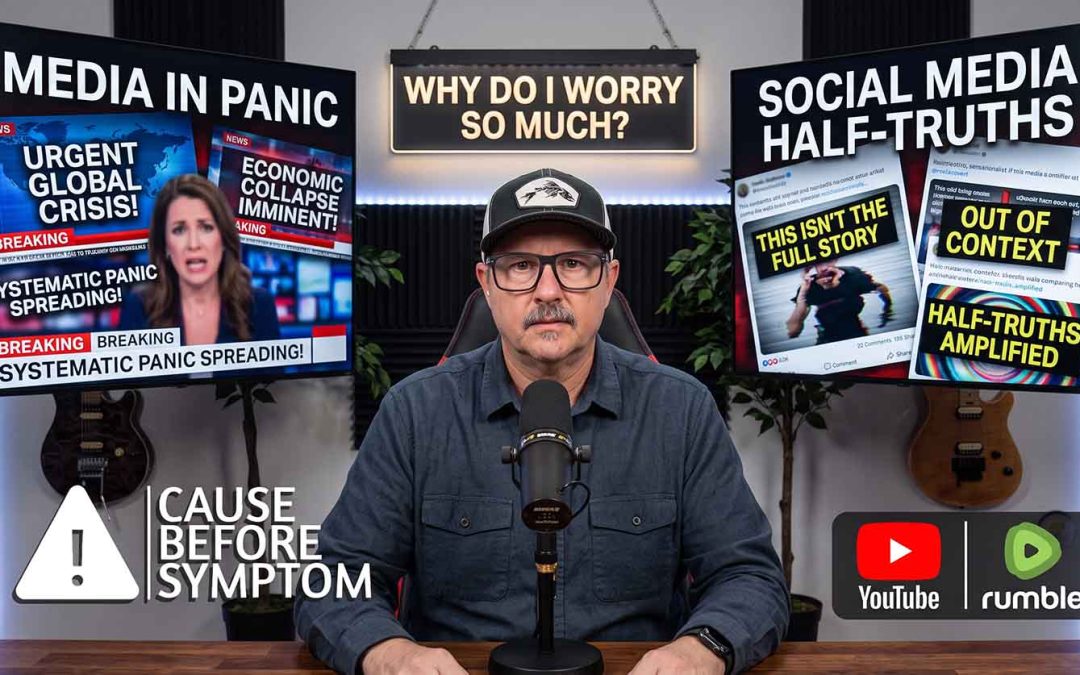
Watch this on Rumble: https://rumble.com/v7csr5k-why-do-i-worry-so-much.html
Synopsis
Why do we worry so much? Is worry simply part of being human, or have we misunderstood what is happening inside both our minds and our bodies? In a world filled with breaking news, endless notifications, financial uncertainty, and constant distractions, many people live as though danger is always just around the corner. But is that how God intended us to live?
In this episode of Cause Before Symptom, I investigate the difference between stress and worry through the lens of Scripture and modern science. We’ll discover that stress is not our enemy but a remarkable survival system designed by God to protect us in moments of genuine danger. Worry, however, is something entirely different. It begins when the mind refuses to leave tomorrow in God’s hands and continually rehearses problems that have not yet happened.
Together, we’ll explore what chronic stress does to the body, why modern life keeps so many people trapped in a constant state of alertness, and what the Bible teaches about finding true peace. We’ll also walk into the Garden of Gethsemane, where Jesus experienced overwhelming distress without sinning, revealing that the presence of stress does not mean the absence of faith.
If you’ve ever wondered why your mind won’t slow down, why you feel exhausted even when nothing is physically wrong, or whether God has something better for you than a life ruled by anxiety, this episode will challenge the way you think about worry. More importantly, it will show that Christ’s invitation is not simply to survive this life—but to experience His peace in the middle of it.
Monologue
Good evening, everyone, and welcome to Cause Before Symptom, where we don’t chase symptoms—we test the cause against Scripture.
Tonight, I want to ask you a question that I think almost every one of us has asked at some point in our lives. Why do I worry so much? Why is it that even when everything seems to be okay, my mind still races? Why do I lie awake thinking about conversations that haven’t happened yet, bills that haven’t arrived yet, illnesses I don’t have, or tragedies that may never come? Why does it seem so difficult to simply be at peace?
Maybe you’ve been told that worrying is just part of life. Maybe you’ve even been told that if you worry enough, you’re simply being responsible. Others have said that if you’re stressed, it’s because your faith isn’t strong enough. But what if neither of those explanations tells the whole story? What if we’ve confused things that God intended to be very different?
Tonight, I want to separate three words that we often use as though they mean the same thing: stress, worry, and peace. They are not the same. In fact, understanding the difference may completely change the way you look at your own life.
God designed the human body with an incredible ability to respond to danger. If a child runs into the street, if a car suddenly swerves toward you, or if someone you love is in immediate danger, your body reacts before your mind has time to think. Your heart races. Your muscles tighten. Your breathing changes. That isn’t weakness. That isn’t sin. That is one of God’s remarkable designs for preserving life.
But something has changed in the modern world. Most of us aren’t running from wild animals or invading armies every day. Instead, we wake up to breaking news, political conflict, economic uncertainty, social media arguments, endless notifications, and a constant stream of reasons to believe that disaster is just around the corner. Even when we’re sitting safely in our own homes, our minds can feel as though they’re under attack. The body was designed for moments of danger, but many people are living as though those moments never end.
That raises another question. If stress is part of God’s design, then why does it seem to be making so many people sick? Why are anxiety, exhaustion, sleeplessness, and burnout becoming so common? More importantly, what does the Bible actually say about all of this?
One of the most surprising discoveries we’ll make tonight is that Jesus Himself experienced overwhelming distress. As He prayed in the Garden of Gethsemane, the weight of what lay before Him was so great that the Gospel of Luke describes His sweat as being like great drops of blood falling to the ground. Yet Scripture is equally clear that Jesus lived without sin. That means stress itself cannot be sin. So if stress isn’t the problem, then where does worry begin? And what does real peace actually look like?
Those are the questions we’re going to investigate together. We’ll look at what happens inside the body when stress takes over. We’ll examine why our minds become trapped in cycles of worry. We’ll compare modern scientific understanding with timeless biblical wisdom. Most importantly, we’ll discover that God’s answer to worry is not pretending that life is easy. His answer is learning to trust Him in the middle of life’s uncertainty.
If you’ve ever found yourself asking, “Why can’t I stop worrying?” then I hope you’ll stay with me until the end. Because tonight isn’t about making anyone feel guilty for being stressed. It’s about discovering that God never intended for His children to live as prisoners of fear. There is a difference between your body’s alarm system and your heart’s trust in God, and understanding that difference may be one of the most freeing lessons you’ll ever learn.
Let’s begin.
Part 1 – Why Do I Worry So Much?
I want to begin tonight with a question that may be more personal than any other I’ve asked on this program. Why do I worry so much? Not why do bad things happen. Not why is the world so broken. But why does my mind keep returning to the same fears over and over again? Why can’t I simply let them go?
Most of us have accepted worry as a normal part of life. We joke about being “professional worriers.” We tell ourselves that worrying means we care. Parents worry about their children. Children worry about their parents. We worry about our health, our finances, our jobs, our future, and sometimes even things that have almost no chance of ever happening. Before long, worry becomes so familiar that we stop questioning whether it belongs there at all.
But I want to ask something different. What if worry is not our natural state? What if we’ve become so accustomed to living with it that we’ve forgotten what genuine peace feels like? Imagine someone who has lived next to a busy highway for twenty years. At first, every passing truck keeps them awake. But eventually, they stop noticing the noise. The sound never went away. They simply became used to it. I wonder if that’s what has happened to many of us. We’ve become so accustomed to worry that we’ve mistaken it for normal living.
When we open the Bible, we find something remarkable. Jesus never taught His followers that life would be free of problems. In fact, He promised they would face trouble. He never suggested that believers would avoid pain, disappointment, sickness, or loss. Yet over and over, He called His followers to live without being ruled by fear. That tells me there must be a difference between experiencing hardship and allowing hardship to take possession of the heart.
One of the verses that has always stood out to me is found in Matthew chapter 6, where Jesus says, “Do not worry about tomorrow, for tomorrow will worry about itself. Each day has enough trouble of its own.” I’ve read that verse many times, but recently I noticed something I had overlooked. Jesus didn’t say tomorrow would be trouble-free. He actually acknowledged that every day has its own difficulties. His point wasn’t that problems don’t exist. His point was that today’s strength was never intended to carry tomorrow’s burdens before they arrive.
That makes me wonder if much of our suffering comes not from today’s reality but from tomorrow’s imagination. We replay conversations that haven’t happened. We prepare for disasters that may never come. We fight battles that don’t yet exist. In many cases, our bodies react as though those imagined events are already taking place. Our hearts race, our stomachs tighten, and sleep becomes difficult—not because of what is happening, but because of what might happen.
As I began researching this subject, I discovered something fascinating. Modern science tells us that the human brain often reacts to perceived danger in much the same way it reacts to actual danger. Whether the threat is standing in front of you or simply being imagined in your mind, many of the same biological systems begin to activate. That doesn’t mean every imagined fear produces the same response as a real emergency, but it does explain why worry can feel so physically exhausting. The body often prepares for a battle that never arrives.
Think about the world we live in today. We wake up to breaking news. Our phones vibrate with alerts. Social media presents a never-ending stream of conflict, tragedy, outrage, and uncertainty. Before we’ve even finished breakfast, we’ve been reminded of wars, economic concerns, political division, disease, natural disasters, and countless other reasons to feel uneasy. It is little wonder that so many people feel as though they’re always waiting for the next crisis.
But here’s the question I want us to carry through this entire episode. Is God asking us to eliminate every fearful thought that enters our minds? Or is He teaching us something much deeper about what we choose to do after those thoughts arrive?
That question changes everything. Because if the first feeling of fear is simply part of being human, then perhaps the real battle is not over whether fear knocks on the door. Perhaps the battle is over whether we invite it inside and let it stay. Before we can understand worry, we first have to understand something even more basic. We have to understand stress itself, why God created it, and why it was never meant to become a permanent way of life. That’s where we’re going next.
Part 2 – What Is Stress?
Before we can understand worry, we first have to understand stress. The two words are often used as though they mean the same thing, but they are not. In fact, confusing them has caused many people to believe something about themselves that simply isn’t true. Some Christians have even wondered whether feeling stressed means they have failed God. I don’t believe Scripture supports that conclusion, and I think both the Bible and science point us in a different direction.
Stress is one of the most remarkable systems God placed inside the human body. It is automatic. You do not decide to make your heart beat faster when a child runs into traffic. You do not consciously tell your muscles to tighten when you slip on a patch of ice. Before your mind has finished processing the danger, your body has already begun preparing to protect your life. That response is not weakness. It is one of God’s gifts to mankind.
Scientists call this the fight-or-flight response. When your brain recognizes danger, it sends signals throughout your body almost instantly. Your heart begins pumping faster to move more blood to your muscles. Your breathing becomes quicker so more oxygen reaches your body. Your pupils widen to improve your vision. Muscles become tense and ready for action. Your liver releases stored energy into your bloodstream. Even your digestion slows because, at that moment, surviving is far more important than digesting lunch.
Think about how incredible that design really is. You don’t have to remember a checklist during an emergency. God already built one into your body. Long before medical science understood adrenaline or cortisol, the Creator designed human beings with the ability to react almost instantly to genuine danger. Without that response, humanity would never have survived.
The problem is not stress itself. The problem is that the system was designed for emergencies, not for permanent operation. Imagine owning a smoke detector that never stopped sounding. At first it would warn you of danger. But after weeks or months of constant alarms, it would no longer be protecting you. It would simply become a source of exhaustion. That’s very similar to what happens when the body’s stress response never gets the opportunity to switch off.
This is where modern life becomes so different from the world most of human history experienced. Thousands of years ago, danger usually had a beginning and an end. A storm passed. A wild animal fled. A battle concluded. The body returned to rest. Today, many people experience something entirely different. The danger isn’t always physical. It’s informational. Every hour seems to bring another reason to stay on alert.
Think about your average day. Before you’ve even left your bed, your phone may have already informed you about a new conflict overseas, rising prices, political arguments, another crime story, another health warning, another economic prediction, and another social media debate. None of those things may be happening in your living room, yet your mind is continually being reminded that the world is full of danger. Your body wasn’t designed to receive hundreds of reminders every day that something somewhere might be wrong.
That doesn’t mean information is bad. Being informed is valuable. The problem comes when information never allows the body to experience rest. It’s the difference between hearing a smoke alarm because dinner burned and living in a house where the alarm never stops ringing. Eventually, the alarm itself becomes part of your daily existence.
This understanding also changes the way we read the Bible. Jesus never told people they should never feel distressed. In fact, in the Garden of Gethsemane, He experienced such profound anguish that Luke describes His sweat as being like great drops of blood. Whatever exactly Luke intended to convey, the passage leaves no doubt that Jesus was under extraordinary emotional and physical strain. Yet the New Testament is equally clear that Jesus was without sin. That means the presence of stress cannot, by itself, be evidence of sin.
That realization should be freeing for many people. Feeling your heart race after receiving bad news does not mean your faith has failed. Feeling your stomach tighten while waiting for medical test results does not mean you’ve stopped trusting God. Those reactions are part of being human. The real question is not whether your body sounds the alarm. The question is what your heart does after the alarm goes off.
And that’s where we begin to move from stress into something entirely different. Stress is the body’s response to danger. Worry is what happens when the mind refuses to let the alarm grow quiet. Understanding that distinction may be one of the most important discoveries we’ll make tonight.
Part 3 – What Is Worry?
Now that we’ve separated stress from worry, let’s look more closely at what worry actually is. This is where I think many of us have unknowingly combined two very different experiences into one. Stress happens to the body. Worry happens in the mind. One is largely automatic. The other is something that grows as our thoughts continue to feed it.
Think about the last time someone startled you. Maybe a loud noise made you jump, or perhaps your phone rang in the middle of the night. Before you had time to think, your heart was already beating faster. That was stress. But after the moment passed, your mind had a choice. Would you allow your body to settle down, or would you begin imagining everything that could possibly go wrong? That is where worry often begins.
Worry is the mind trying to solve a future that has not yet arrived. It continually asks questions that cannot be answered today. What if I lose my job? What if my child gets hurt? What if the doctor finds something serious? What if the economy collapses? What if I make the wrong decision? Notice that nearly every one of those questions begins with the same two words: “What if?”
The problem with worry is that there is no finish line. Every answer simply produces another question. If one fear is resolved, another quickly takes its place. The mind convinces itself that if it can just think long enough, it can somehow prepare for every possible outcome. But life doesn’t work that way. Tomorrow cannot be lived today.
Jesus understood this better than anyone. In Matthew chapter 6, He didn’t tell His followers that tomorrow would be easy. He didn’t promise there would never be hardship. Instead, He said something both simple and profound: “Do not worry about tomorrow, for tomorrow will worry about itself. Each day has enough trouble of its own.”
I’ve read that verse many times, but this time something stood out to me. Jesus acknowledges that each day has trouble. He isn’t asking us to pretend difficulties don’t exist. He’s teaching us that God gives us grace for today’s responsibilities, not for tomorrow’s imaginary ones. When I borrow tomorrow’s problems, I’m also borrowing burdens that God never asked me to carry today.
Think about how often we mentally live in the future. We rehearse conversations before they happen. We imagine arguments before anyone says a word. We predict outcomes before any evidence exists. Sometimes we become emotionally exhausted fighting battles that never take place. We lose today’s peace because of tomorrow’s possibilities.
I also find it interesting that the Bible rarely tells us to control our feelings. Instead, it repeatedly speaks about directing our thoughts. Paul tells believers to take every thought captive. He tells us to think about whatever is true, honorable, just, pure, lovely, and worthy of praise. Isaiah speaks of the person whose mind is stayed upon God. Again and again, Scripture points to the mind because our thoughts become the doorway through which worry either enters or leaves.
That doesn’t mean we choose the first fearful thought that appears. I don’t believe that’s how the mind works. Fear can arrive without invitation. A frightening phone call, unexpected bad news, or a sudden crisis can immediately produce anxious thoughts. The question is not whether those thoughts knock on the door. The question is whether we invite them to move in and rearrange the furniture.
I’ve heard an illustration that captures this well. You may not be able to stop birds from flying over your head, but you can stop them from building a nest in your hair. Whether or not that saying is exactly historical doesn’t really matter. The principle is sound. Thoughts will come and go throughout the day. We don’t control every thought that enters our minds. But with God’s help, we do have a choice about which thoughts we continue to entertain.
This becomes even more important when we remember what we learned about stress. If the body has already sounded the alarm, and the mind keeps replaying fearful scenarios, the alarm never has the chance to stop. The body continues preparing for danger because the mind continues announcing that danger is coming. The result is a cycle where stress feeds worry, and worry feeds stress.
Perhaps this is why Jesus invited people to something so different. He never promised a life without storms. He promised peace in the middle of them. Peace is not believing that nothing bad can happen. Peace is trusting that even if something bad does happen, God will still be faithful. That kind of peace doesn’t come from controlling tomorrow. It comes from trusting the One who already holds tomorrow in His hands.
But if that’s true, then we have to ask another important question. If Jesus taught us not to worry, did He Himself ever experience overwhelming stress? The answer may surprise some people, because it reveals one of the most comforting truths in all of Scripture.
Part 4 – Did Jesus Ever Experience Stress?
If someone were to ask me for the strongest evidence that stress is not a sin, I wouldn’t begin with a medical journal. I would begin in a garden.
The night before His crucifixion, Jesus entered the Garden of Gethsemane knowing exactly what awaited Him. He knew He would be betrayed by one of His own disciples. He knew He would be arrested, falsely accused, beaten, mocked, and nailed to a cross. He knew the physical suffering that was coming, but He also understood something even greater that no one else could fully comprehend. He was about to bear the weight of humanity’s sin.
The Gospel writers do not present Jesus as calm and unaffected. They describe a man under extraordinary emotional pressure. Matthew records Jesus saying, “My soul is exceedingly sorrowful, even unto death.” Think about those words for a moment. This wasn’t mild concern. This wasn’t simple nervousness. Jesus openly admitted that the sorrow He was carrying was overwhelming.
Then Luke records something even more remarkable. He tells us that while Jesus prayed earnestly, “His sweat became like great drops of blood falling down to the ground.” Some physicians believe Luke may have been describing a rare condition called hematidrosis, in which extreme stress can cause tiny blood vessels around the sweat glands to rupture. Others understand Luke’s words as a vivid comparison rather than a medical diagnosis. Either way, the point is unmistakable. Jesus was under unimaginable stress.
Now here’s the question that changed the way I looked at this subject.
Did Jesus sin in that garden?
Of course not.
The New Testament repeatedly tells us that Jesus was without sin. He was tempted in every way as we are, yet remained perfectly obedient. If stress itself were sinful, then Jesus could not have been the spotless Lamb of God. That conclusion simply doesn’t fit the testimony of Scripture.
This is incredibly freeing because it separates something many Christians have unknowingly joined together. Feeling stressed is not the same as failing God. Feeling overwhelmed is not proof that your faith is weak. Your body can respond to genuine difficulty exactly as God designed it to respond without you committing a single sin.
But let’s keep reading the account because this is where Jesus teaches us something even deeper.
Notice what He did with His stress.
He didn’t pretend it wasn’t there.
He didn’t hide it from His Father.
He didn’t shame Himself for feeling it.
He prayed.
Three times He poured out His heart before the Father. Three times He honestly acknowledged the suffering before Him. He even prayed, “If it is possible, let this cup pass from Me.” Those are not the words of someone pretending everything is easy. Those are the words of Someone bringing His deepest anguish before God.
Then comes one of the greatest statements of trust ever spoken.
“Nevertheless, not as I will, but as You will.”
That single sentence changes everything.
The stress did not disappear.
The soldiers were still coming.
The cross was still ahead.
The betrayal was still real.
The pain had not been removed.
What changed was not His circumstances. What remained unshaken was His trust.
I think many of us pray as though peace comes after God changes our circumstances. Jesus demonstrates something different. Peace comes from surrendering our circumstances to the Father, even when they don’t immediately change.
There’s another detail that I don’t want us to miss. Earlier, Jesus had asked His disciples to stay awake and pray with Him. Instead, they fell asleep. Luke tells us they were sleeping because of sorrow. Even they were physically and emotionally exhausted by what was happening. Again, Scripture doesn’t portray them as machines without emotion. It portrays real people carrying real burdens.
Throughout the Bible, faithful men and women experienced deep emotional distress. David cried out in the Psalms. Elijah became so discouraged that he asked God to take his life. Jeremiah is known as the weeping prophet. Paul wrote about being burdened beyond measure at times. Yet God continued to work through each of them. Their emotional struggles did not disqualify them from His love or His purpose.
Perhaps one of the greatest lies many believers have accepted is that feeling anxious for a moment means they have somehow disappointed God. But what I see in Scripture is something very different. God doesn’t condemn His children for bringing Him their fears. He invites them to do exactly that.
The difference between Jesus and so many of us wasn’t that He never experienced overwhelming stress. The difference was that He refused to let stress become distrust. He brought every ounce of His anguish to the Father, and when He rose from prayer, He walked forward in obedience.
That leads us to another question. If stress itself isn’t the enemy, why does living under constant stress cause so much damage to our bodies? To answer that, we need to understand what happens when God’s emergency alarm system never gets the chance to turn off.
Part 5 – What Constant Stress Does to the Body
Now that we’ve seen Jesus experience tremendous stress without sin, let’s return to the question we left unanswered. If stress is something God designed, why does it seem to make so many people sick?
The answer is actually very simple.
Stress was designed to save your life for a moment, not to become the way you live every day.
Imagine buying a brand-new truck. Every once in a while, you may need to floor the accelerator to avoid an accident or merge into fast-moving traffic. The engine was built for moments like that. But if you drove everywhere with the accelerator pressed to the floor, the engine wouldn’t last very long. It wasn’t designed to operate at maximum output all day, every day.
The human body is very similar.
When stress appears, your brain releases powerful chemicals like adrenaline and cortisol. Your heart beats faster. Your blood pressure rises. More oxygen reaches your muscles. Your liver releases stored energy into your bloodstream. Your senses become sharper. Every one of those changes is preparing you to survive.
For a few minutes, that’s a wonderful design.
For a few months, it’s a completely different story.
When stress never seems to end, cortisol remains elevated far longer than it was ever intended to. Over time, researchers have found that prolonged stress is associated with high blood pressure, poor sleep, digestive problems, weakened immune function, difficulty concentrating, memory problems, anxiety, depression, and an increased risk for several chronic illnesses. It doesn’t guarantee those conditions, but it can certainly contribute to them.
Think about sleep for a moment. Have you ever noticed that the more worried you are, the harder it is to fall asleep? That’s because your brain is trying to protect you. It thinks there’s danger nearby, so it keeps you alert. From your body’s perspective, deep sleep would be a terrible idea if a lion were hiding outside your tent. The problem is that today the “lion” may simply be tomorrow’s meeting, next month’s bills, or a headline you read an hour ago.
The digestive system is another example. During an emergency, your body temporarily slows digestion because escaping danger is more important than processing dinner. But if your body believes it’s living in an emergency every day, your stomach and intestines never receive the message that it’s safe to relax. This is one reason stress is so often connected with stomach pain, acid reflux, nausea, and other digestive complaints.
The immune system is affected as well. In the short term, stress helps prepare the body for injury or infection. But under prolonged stress, parts of the immune system can become less effective. The body begins paying a price for staying on high alert month after month or year after year.
Even your thinking begins to change.
Have you ever walked into a room and forgotten why you went there? Have you ever found yourself reading the same paragraph three times because your mind wouldn’t stay focused? Have you ever felt mentally exhausted even though you hadn’t done much physical work? Chronic stress can contribute to all of those experiences because the brain functions differently when it believes survival is the highest priority.
Then there are the muscles. Many people carry stress without even realizing it. Their shoulders stay tight. Their jaw remains clenched. Headaches become common. Neck pain, back pain, and tension throughout the body slowly become accepted as normal. But normal doesn’t always mean healthy. Sometimes it simply means we’ve lived with something for so long that we’ve stopped noticing it.
As I studied all of this, one thought kept coming back to me.
What if many people are not actually living in danger?
What if they’re living in the constant expectation of danger?
There’s a difference.
Your body responds to both.
That realization helped me understand something Jesus said in a completely new way. When He told His followers not to worry about tomorrow, perhaps He wasn’t only protecting their spiritual lives. Perhaps He was also protecting the very bodies God had created. Every day spent carrying tomorrow’s burdens is another day the alarm system keeps ringing when there is no immediate fire.
This doesn’t mean Christians will never experience illness, anxiety, or emotional struggles. We live in a fallen world, and there are many reasons people suffer. Trauma, grief, medical conditions, lack of sleep, and countless other factors can affect both the body and the mind. But understanding how God designed the stress response helps us recognize something important. The body isn’t betraying us. It’s trying to protect us. The problem is that it often receives signals telling it the emergency never ends.
And that brings us to what may be the biggest reason so many people struggle today. If our bodies were designed for occasional emergencies, why does modern life seem determined to convince us that every day is one? That’s the question we’ll investigate next.
Part 6 – Why Does Modern Life Keep Us Stressed?
If you had lived two hundred years ago, you probably would have known very little about what was happening outside your own community. News traveled slowly, and most of what concerned you was right in front of you—your family, your work, your neighbors, your crops, and your town. Life was certainly not easy, but there were long stretches of time when your mind wasn’t constantly being reminded of disasters happening hundreds or thousands of miles away.
Today, everything has changed. Before we’ve even finished our first cup of coffee, we’ve been exposed to wars, economic uncertainty, political conflict, natural disasters, crime, disease, and endless opinions about what might happen next. Most of these events pose no immediate danger to us personally, yet our brains receive a continuous stream of messages telling us that the world is full of threats. The body doesn’t always distinguish between a danger standing in front of us and a danger repeatedly presented to us through a screen.
I’m not suggesting we should become uninformed. Knowing what is happening in the world allows us to pray, help others, and make wise decisions. Information itself isn’t the problem. The problem begins when the flow of information never stops. There was a time when the evening news lasted thirty minutes. When it ended, life continued. Today, news, social media, and notifications follow us every waking hour, giving our minds very little opportunity to experience genuine rest.
I also think something else has quietly happened. Many of us have taken on emotional responsibilities that God never intended us to carry. We know about tragedies we cannot prevent, wars we cannot stop, and decisions we cannot control. Without realizing it, we begin carrying the emotional weight of an entire world while possessing only the ability to influence a very small part of it. That burden is simply too heavy for any human being.
When I read the Gospels, I notice something remarkable about Jesus. He was fully aware of the suffering around Him. He knew the Roman government was corrupt. He knew people were hungry, sick, oppressed, and grieving. Yet He was never consumed by every problem at once. He remained completely present with the person standing in front of Him. He gave His full attention to the work His Father had placed before Him that day. He wasn’t mentally living in tomorrow while neglecting today.
That challenges me because I wonder how often my body is in one place while my mind is somewhere else entirely. How often am I sitting with my family while thinking about tomorrow’s responsibilities? How often do I spend more time reading about the world’s problems than speaking with the God who rules the world? It’s an uncomfortable question, but I think it’s one we all need to ask ourselves.
Perhaps one of the greatest battles of our generation is not over information but over attention. Every company, every platform, every advertiser, and every news outlet is competing for our focus. Many have discovered that fear captures attention more effectively than peace. The more anxious people become, the more likely they are to keep watching, keep scrolling, and keep coming back for the next update. Whether intentional or not, the result is a culture that rarely allows the human mind to rest.
Jesus made a promise that has become more meaningful to me the more I study this subject. He said, “My peace I give to you.” He didn’t promise a peaceful world. He promised His peace in the middle of an unpeaceful world. Those are two completely different things. The world has always known war, uncertainty, and hardship, but God’s peace has never depended upon perfect circumstances.
I’m not saying we should throw away our phones or ignore the news. Technology has brought tremendous blessings. We can learn, communicate, encourage one another, and share the Gospel around the world in ways previous generations could never have imagined. The issue isn’t the existence of technology. The issue is whether technology has begun shaping our minds more than God’s Word.
That leads me to one final question before we continue. Who is discipling your mind every day? Is it Scripture, teaching you to trust God one day at a time? Or is it an endless stream of voices convincing you that disaster is always just around the corner? Because whatever continually occupies our minds will eventually shape our hearts. In the next part, we’ll discover that the Bible has a great deal to say about what we choose to think about and why that choice matters more than we may have ever realized.
Part 7 – Does the Bible Tell Us What to Think About?
If there is one thing I’ve learned while studying this subject, it’s that the greatest battlefield isn’t the world around us. It’s the six inches between our ears. Long before our actions change, our thinking changes. Long before our habits change, our thoughts change. Scripture recognizes this over and over again. The Bible doesn’t simply tell us what to do. It teaches us how to think.
That may surprise some people because many assume Christianity is mostly about behavior. But when I read the New Testament, I see Jesus constantly addressing the heart and the mind before He addresses outward actions. He understood that what fills the mind eventually shapes the person. If the roots are healthy, the fruit eventually becomes healthy as well.
One of Paul’s most famous instructions is found in Philippians, where he writes, “Do not be anxious about anything, but in everything by prayer and supplication with thanksgiving let your requests be made known to God.” For years I wondered how that was even possible. How can someone simply decide not to be anxious? Then I realized Paul wasn’t telling believers to never experience a fearful thought. He immediately follows that instruction with prayer, thanksgiving, and the promise that God’s peace will guard our hearts and our minds. The answer isn’t pretending fear never arrives. The answer is knowing where to take it when it does.
Later in the same chapter, Paul gives one of the most practical instructions in all of Scripture. He tells believers to think about whatever is true, honorable, just, pure, lovely, commendable, excellent, and worthy of praise. I’ve often read that passage as a list of virtues, but now I see it as something more. Paul is giving us a filter for our minds. Before allowing a thought to settle in, we can ask whether it belongs in one of those categories. If it doesn’t, perhaps it doesn’t deserve to occupy our attention.
This doesn’t mean we ignore reality. If someone we love is sick, we don’t pretend they’re healthy. If there is injustice in the world, we don’t pretend it doesn’t exist. Christianity has never been about denying reality. It’s about viewing reality through the faithfulness of God instead of through the hopelessness of fear.
I also find it significant that Paul writes about taking every thought captive. He doesn’t say every thought is automatically true. He doesn’t say every thought deserves to be believed. He says thoughts can be examined, tested, and, when necessary, rejected. That’s a powerful idea because many of us have unknowingly believed that if a thought enters our minds, it must be accurate. But thoughts are not facts. They are invitations. Some deserve to be welcomed. Others should be shown the door.
The more I think about this, the more I believe worry survives because it goes unchallenged. A fearful thought enters the mind, and instead of asking whether it’s true, we immediately begin building a story around it. One possibility becomes a certainty. One concern becomes ten. Before long, we’re emotionally reacting to events that haven’t happened and may never happen at all.
Jesus repeatedly called His followers back to the present. He spoke about today’s bread, today’s cross, today’s obedience, and today’s responsibilities. He never encouraged people to live months or years ahead in their imaginations. That’s because God gives us grace for today. Tomorrow’s grace arrives tomorrow.
Perhaps this is one of the greatest invitations in the Christian life. God isn’t asking us to control every thought that appears in our minds. He’s asking us to decide which thoughts deserve a home there. The first fearful thought may arrive without permission, but we can choose whether it remains. We can feed it until it grows stronger, or we can bring it before God and replace it with His promises.
That doesn’t happen overnight. Just as worry can become a habit, peace can become one too. Every time we choose prayer instead of panic, gratitude instead of complaint, and God’s promises instead of endless “what if” questions, we’re training our minds in a new direction. Over time, those small decisions begin changing not only the way we think but the way we live.
So the real question isn’t whether fearful thoughts will ever visit us. They will. The real question is who will have the final word—our fears or our Father. Because whatever voice we continually listen to will eventually become the voice we trust the most.
Part 8 – Why Do We Hold On to Worry?
At this point, another question naturally comes to mind. If worry is so harmful, why do we keep doing it? Why do we return to it day after day, even when we know it robs us of our peace? I don’t think it’s because people enjoy worrying. I think it’s because, deep down, worry convinces us that it is accomplishing something.
Have you ever noticed that when you stop worrying, a little voice sometimes says, “You’re not taking this seriously enough”? It’s almost as though worry has become a substitute for responsibility. We begin believing that if we worry enough, we’re somehow preparing ourselves for whatever may happen. But if we’re honest, how many of the things we’ve worried about actually happened the way we imagined? And of the ones that did happen, how many were made better because we spent weeks or months worrying beforehand?
I think worry gives us the illusion of control. There are many things in life we simply cannot control. We cannot control tomorrow’s weather, the economy, the decisions of other people, or how long we will live. Those realities can make us uncomfortable because human beings naturally like certainty. Worry steps into that discomfort and whispers, “Keep thinking about it. Maybe you’ll figure it out.” But most of the time, we aren’t finding answers. We’re simply going around in circles.
When I read the Bible, I notice that trust always requires letting go of something. Abraham had to let go of certainty. Moses had to let go of his excuses. Peter had to let go of the safety of the boat. Trust has never meant having all the answers. It has always meant believing that God is faithful even when we don’t.
That may be why worry and trust cannot comfortably live together for very long. Worry says, “Everything depends on me.” Faith says, “I will do what God has asked me to do and trust Him with what only He can do.” That’s a tremendous difference. One carries the weight of the entire future. The other carries today’s obedience and leaves tomorrow in God’s hands.
I also wonder if many of us have confused awareness with responsibility. Just because I know about every tragedy happening around the world doesn’t mean God expects me to carry the emotional weight of every one of them. He calls me to love my neighbor, to pray, to give, to serve, and to act where I can. But He has never asked me to bear the burden of being the world’s savior. That position has already been filled.
There is another subtle danger in worry that I hadn’t considered before researching this episode. Worry has a way of pulling us away from the present moment. While we’re mentally living in tomorrow, we often miss what God is doing today. We miss conversations with our children. We miss opportunities to encourage someone. We miss moments of gratitude. We miss answers to prayers we’ve already received because our attention is fixed on problems that haven’t arrived yet.
Jesus lived differently. Everywhere He went, He was fully present. Whether He was speaking with a Samaritan woman, healing a blind man, feeding thousands, or comforting grieving sisters, His attention was completely focused on the person and the purpose before Him. He wasn’t distracted by imagined futures. He was faithfully accomplishing the Father’s will one moment at a time.
I think that’s one of the greatest lessons we can learn from His example. Peace doesn’t come from knowing the future. Peace comes from knowing the One who holds the future. The more we try to control what belongs to God, the heavier life becomes. The more we trust Him with what only He can carry, the lighter our own burden becomes.
Perhaps that’s why Jesus extended one of the most comforting invitations in all of Scripture: “Come to Me, all who labor and are heavy laden, and I will give you rest.” He didn’t say He would immediately remove every problem. He promised rest. Maybe that’s what so many of us have been searching for all along—not a life without challenges, but a heart that no longer has to carry them alone.
The good news is that this isn’t just a beautiful idea. The Bible gives us practical ways to move from a life dominated by worry to a life increasingly shaped by peace. That’s exactly where we’re headed next.
Part 9 – How Do We Find Peace?
Now we’ve arrived at the question that matters most. If worry has become such a normal part of our lives, how do we actually find peace? Not temporary relief. Not a vacation from stress. But the kind of peace Jesus promised His followers.
The first thing we have to understand is that peace is not the absence of problems. If it were, almost no one would ever experience it. Jesus promised His followers that they would have trouble in this world, yet He also said, “My peace I give to you.” That tells me peace and problems can exist at the same time. Peace is not found in perfect circumstances. It is found in a perfect Savior.
I think one of the greatest mistakes we make is believing that peace comes after everything is finally under control. We tell ourselves, “Once I pay off this debt, then I’ll have peace.” “Once the medical tests come back, then I’ll have peace.” “Once my children are grown, then I’ll have peace.” But life has a way of replacing one challenge with another. If peace depends upon circumstances, it will always be temporary.
Jesus taught something very different. He continually brought people back to today. Give us this day our daily bread. Don’t worry about tomorrow. Take up your cross today. There is a pattern throughout His teaching that reminds us God gives us today’s grace for today’s responsibilities. He has never promised today’s grace for tomorrow’s imaginary burdens.
Prayer is one of the ways we return to that reality. Prayer is not informing God about something He doesn’t already know. It is transferring the burden from our shoulders to His. Every time we pray, we are admitting that God is greater than the problem in front of us. We are acknowledging that while we have limits, He does not.
Gratitude is another powerful weapon against worry. That doesn’t mean pretending everything is wonderful when it isn’t. It means intentionally remembering what God has already done. Worry continually asks, “What if God doesn’t provide?” Gratitude answers, “Look at all the times He already has.” The more we remember God’s faithfulness in the past, the easier it becomes to trust Him with the future.
I also believe we have to become more intentional about what we allow into our minds. If I spend three hours every evening consuming fear, outrage, and endless predictions of disaster, I shouldn’t be surprised when I struggle to sleep. Just as healthy food nourishes the body, healthy thoughts nourish the mind. That doesn’t mean ignoring reality, but it does mean asking whether what I’m consuming is helping me trust God or teaching me to fear everything around me.
Rest is another gift that many people have forgotten. From the very beginning of Scripture, God established rhythms of work and rest. He never intended human beings to run endlessly without stopping. Sleep, quiet, worship, time with family, prayer, and even moments of silence remind our bodies that the emergency has ended. We are not machines. We are created beings who need rest because God designed us that way.
Community matters as well. Worry thrives in isolation. When we carry every burden alone, those burdens become heavier than they really are. Throughout the New Testament, believers are encouraged to pray for one another, encourage one another, and bear one another’s burdens. God never intended the Christian life to be lived in complete isolation.
Most importantly, we have to remember who is actually in control. That doesn’t mean becoming passive or refusing to act. We still work, plan, save, prepare, and make wise decisions. Trust in God has never been an excuse for laziness. But after we have done what God has placed in our hands, there comes a point where we must leave the outcome with Him. There are some responsibilities that belong to us, and there are others that belong only to God.
As I studied this topic, I kept coming back to one simple thought. Every morning, I have a choice. I can begin my day listening to the world’s fears, or I can begin my day listening to God’s promises. Both voices are available. One tells me everything depends on me. The other reminds me that everything ultimately depends on Him.
Perhaps peace isn’t something we discover once and keep forever. Perhaps it is something we choose every single day. Every day we decide whether worry will become our companion or whether trust will become our guide. One leads deeper into fear. The other leads deeper into the presence of God. And I can’t think of a better place to leave my future than in the hands of the One who already knows the end from the beginning.
Part 10 – Living in Peace Without Escaping Reality
As we come to the end of this investigation, I want to leave you with one final thought. I don’t believe God is asking us to pretend the world is safe. The world has never been completely safe. Since the fall in Genesis, humanity has lived with disease, violence, uncertainty, disappointment, and death. Jesus never denied that reality, and neither should we.
What He did offer was something the world could never manufacture. He offered peace in the middle of uncertainty. That may be one of the greatest differences between the world’s definition of peace and God’s definition of peace. The world says peace comes when all the problems disappear. Jesus says peace comes when we trust Him, even while the problems remain.
Think back to everything we’ve learned tonight. Stress is not your enemy. God created it to protect you when real danger appears. Worry is different. Worry begins when the mind refuses to leave tomorrow in God’s hands. The body sounds the alarm, but the mind keeps pulling the fire alarm long after the danger has passed. Eventually, we begin living as though every day is an emergency, and our bodies pay the price.
The good news is that God has not left us without an answer. He hasn’t promised to remove every hardship from our lives, but He has promised His presence through every one of them. Throughout Scripture, God’s people faced impossible situations. They crossed seas that would not part until they stepped forward. They walked around walls that would not fall until they obeyed. They entered battles they could not win on their own. Again and again, they discovered that God’s faithfulness was waiting on the other side of their trust.
I also hope tonight has removed an unnecessary burden from some of you. If you’ve been carrying guilt because you’ve experienced stress, I hope you can let that guilt go. Jesus Himself experienced overwhelming distress in the Garden of Gethsemane. His heart was heavy, His sorrow was real, and yet He remained perfectly obedient to His Father. Feeling the weight of life does not mean you’ve failed God. It means you’re human.
The question is never whether stress will visit your life. It will. The question is whether stress will become worry, or whether stress will become prayer. Every difficult moment gives us that choice. We can carry tomorrow ourselves, or we can place tomorrow into the hands of the One who is already there.
Perhaps that’s why Jesus spoke so often about today. Today’s bread. Today’s obedience. Today’s cross. Today’s grace. We spend so much of our lives trying to solve tomorrow that we forget today is the only day we’ve actually been given. Yesterday cannot be changed. Tomorrow has not yet arrived. But today is where God meets us.
So let me leave you with the same question we began with.
Why do I worry so much?
Maybe the answer isn’t that you’re weak.
Maybe the answer isn’t that your faith is too small.
Maybe you’ve simply been carrying burdens that God never asked you to carry.
If that’s true, then tonight can be the beginning of something different. Not because the world suddenly becomes peaceful, but because your heart no longer depends on the world for its peace. The storms may continue. The headlines may never stop. The uncertainty of life may remain. But the child of God has been invited to stand in the middle of all of it with a peace that cannot be purchased, manufactured, or taken away.
Thank you for joining me tonight on Cause Before Symptom. My prayer is that the next time worry knocks on your door, you’ll remember that God designed your body to respond to danger, but He never intended for your heart to become a permanent home for fear. Peace isn’t found by controlling tomorrow. Peace is found by trusting the One who already holds it.
Until next time, take care of yourselves, take care of one another, and never stop searching for the cause before the symptom.
Conclusion
As I close tonight’s program, I hope you’ve discovered that the answer to the question, “Why do I worry so much?” is far more complex—and far more hopeful—than many of us have been led to believe.
Stress and worry are not the same thing. Stress is one of God’s designs for protecting human life. It prepares the body to respond when real danger appears. Jesus Himself experienced overwhelming stress in the Garden of Gethsemane, yet He remained without sin. That alone should remove the burden of believing that every stressful moment is somehow evidence of weak faith. It isn’t. It’s part of being human.
Worry begins when the mind refuses to let go of tomorrow. It replays conversations that haven’t happened, prepares for disasters that may never come, and carries burdens that belong to another day. Over time, the body never receives the message that the danger has passed. The alarm continues to ring, and what was designed to protect us eventually begins wearing us down.
Our modern world doesn’t make this easy. We are surrounded by information twenty-four hours a day. Every headline competes for our attention. Every notification asks for our concern. Every prediction invites us to imagine another crisis. Without realizing it, many of us have begun carrying the emotional weight of an entire world, even though God never asked us to do that. He asked us to love our neighbor, remain faithful, and trust Him with what lies beyond our control.
Perhaps the greatest lesson I learned while preparing this episode is that peace is not something we find after life becomes easy. Peace is something we receive when we stop trying to control what belongs to God. The circumstances around us may not change immediately, but our hearts can. That is exactly what Jesus demonstrated in Gethsemane. The cross did not disappear, yet He walked toward it with complete trust in His Father.
If you take only one thought away from tonight, let it be this: stress is your body’s alarm system. Worry is your mind trying to live in tomorrow. Peace is your heart trusting God with what you cannot control.
The next time you feel your heart race or your mind begin asking endless “what if” questions, don’t condemn yourself. Instead, ask a different question. Is there a real danger in front of me, or am I carrying tomorrow before it has arrived? Then do what Jesus did. Bring your concerns honestly before your Father, trust Him with the outcome, and return your attention to the work He has placed in front of you today.
God never promised that life would be free of storms. He promised that He would be with us in the middle of them. And when the One who calms the wind and the waves is in the boat, there is no reason for fear to become our permanent home.
Thank you for spending this time with me. Until next time, remember that we don’t chase symptoms—we search for the cause. And sometimes, the cause isn’t found in the world around us, but in what we’ve allowed to take root within us. May God bless you, give you His peace, and remind you that tomorrow has always belonged to Him.
Bibliography
- Allender, Dan B., and Tremper Longman III. The Cry of the Soul: How Our Emotions Reveal Our Deepest Questions About God. Colorado Springs, CO: NavPress, 1994.
- Beck, Aaron T., and David A. Clark. The Anxiety and Worry Workbook: The Cognitive Behavioral Solution. New York: Guilford Press, 2010.
- Bessel van der Kolk. The Body Keeps the Score: Brain, Mind, and Body in the Healing of Trauma. New York: Viking, 2014.
- Brantley, Jeffrey. Calming Your Anxious Mind. 2nd ed. Oakland, CA: New Harbinger Publications, 2014.
- Cloud, Henry, and John Townsend. Boundaries. Grand Rapids, MI: Zondervan, 1992.
- Damasio, Antonio. Descartes’ Error: Emotion, Reason, and the Human Brain. New York: G. P. Putnam’s Sons, 1994.
- Goleman, Daniel. Emotional Intelligence. New York: Bantam Books, 1995.
- Heiser, Michael S. The Unseen Realm: Recovering the Supernatural Worldview of the Bible. Bellingham, WA: Lexham Press, 2015.
- Kabat-Zinn, Jon. Full Catastrophe Living. Revised ed. New York: Bantam Books, 2013.
- McEwen, Bruce S. The End of Stress as We Know It. Washington, DC: Joseph Henry Press, 2002.
- Sapolsky, Robert M. Why Zebras Don’t Get Ulcers. 3rd ed. New York: Henry Holt and Company, 2004.
- Selye, Hans. The Stress of Life. Rev. ed. New York: McGraw-Hill, 1976.
- The Holy Bible, Ethiopian Orthodox Tewahedo Canon.
- The Holy Bible, King James Version.
- Thompson, Curt. Anatomy of the Soul. Carol Stream, IL: Tyndale House Publishers, 2010.
- Willard, Dallas. Renovation of the Heart: Putting on the Character of Christ. Colorado Springs, CO: NavPress, 2002.
Endnotes
- The distinction between stress and worry reflects both modern neuroscience and the biblical pattern observed throughout Scripture. Stress is the body’s automatic physiological response to perceived danger, while worry involves prolonged mental focus on uncertain future events.
- The human stress response, often called the “fight-or-flight” response, is mediated by the sympathetic nervous system and involves hormones such as adrenaline (epinephrine) and cortisol. These responses prepare the body for immediate survival.
- Hans Selye’s pioneering research established many of the foundational concepts of biological stress, while Bruce McEwen later expanded this work through the concept of “allostatic load,” describing the physical cost of chronic stress.
- Robert Sapolsky’s research demonstrates that while acute stress is adaptive, prolonged activation of stress hormones contributes to numerous physical and psychological health problems.
- Modern studies have associated chronic stress with hypertension, cardiovascular disease, digestive disorders, impaired immune function, sleep disturbances, depression, anxiety disorders, and cognitive decline. Stress is considered a contributing factor rather than the sole cause of these conditions.
- The Gospels describe Jesus experiencing profound emotional distress in the Garden of Gethsemane (Matthew 26:36–46; Mark 14:32–42; Luke 22:39–46). Luke’s description that His sweat became “like great drops of blood” has been interpreted either as a simile or as a possible description of hematidrosis, a rare condition associated with extreme physical or emotional stress. The text itself does not require one medical interpretation.
- Hebrews 4:15 affirms that Jesus was “tempted in every way, just as we are—yet without sin.” This passage supports the conclusion that experiencing emotional distress or stress itself is not equivalent to committing sin.
- Matthew 6:25–34 forms the foundation of Jesus’ teaching on worry. Rather than denying the existence of future troubles, Jesus teaches His followers to trust God’s provision one day at a time.
- Philippians 4:6–9 connects freedom from anxiety with prayer, thanksgiving, and disciplined thought. Paul directs believers not merely away from worry but toward specific patterns of thinking centered on truth, purity, excellence, and praise.
- Second Corinthians 10:3–5 introduces the concept of “taking every thought captive,” emphasizing that believers are responsible for evaluating and submitting their thinking to Christ rather than accepting every thought uncritically.
- Isaiah 26:3 declares that God keeps in perfect peace those whose minds remain fixed upon Him, illustrating the biblical relationship between sustained trust and inner peace.
- Proverbs 14:30 and Proverbs 17:22 reflect the biblical observation that emotional and spiritual well-being influence physical health, anticipating principles that modern medicine continues to investigate.
- The New Testament repeatedly portrays prayer as the proper response to anxiety rather than a denial of difficult circumstances (Philippians 4:6–7; 1 Peter 5:7).
- The phrase “today’s grace for today’s burdens” summarizes a biblical principle drawn primarily from Matthew 6:34 and the petition for “daily bread” in Matthew 6:11, emphasizing daily dependence upon God rather than self-reliance regarding the future.
- This episode distinguishes between involuntary emotional responses and deliberate patterns of thought. While people do not generally choose the body’s immediate stress response or the first fearful thought, Scripture consistently teaches that believers can, with God’s help, direct their minds toward trust rather than prolonged worry.
- This presentation is intended for biblical teaching and educational purposes. It does not replace appropriate medical or mental health care. Individuals experiencing severe anxiety, panic attacks, trauma-related symptoms, or other significant psychological concerns should seek qualified professional evaluation while continuing to pursue spiritual growth through prayer, Scripture, and Christian community.
#WhyDoIWorrySoMuch, #BiblicalPeace, #StressAndWorry, #ChristianLiving, #FaithOverFear, #TrustGod, #MentalHealth, #BibleStudy, #JesusChrist, #Prayer, #PeaceOfGod, #Anxiety, #RenewYourMind, #CauseBeforeSymptom, #Scripture
WhyDoIWorrySoMuch, BiblicalPeace, StressAndWorry, ChristianLiving, FaithOverFear, TrustGod, MentalHealth, BibleStudy, JesusChrist, Prayer, PeaceOfGod, Anxiety, RenewYourMind, CauseBeforeSymptom, Scripture