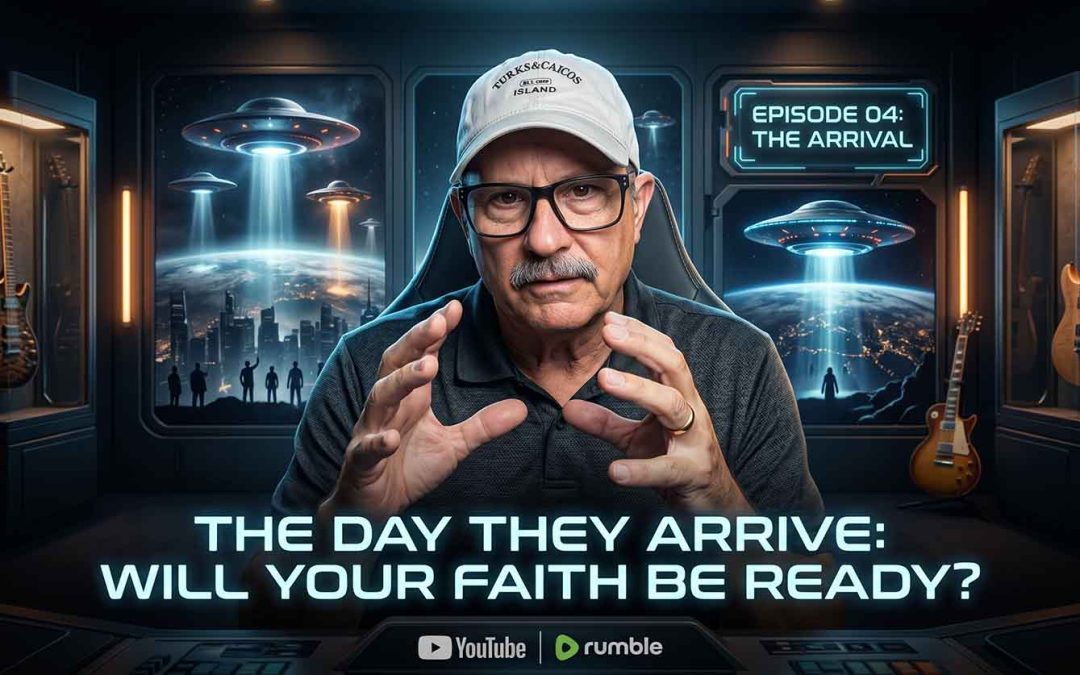
Watch this on Rumble: https://rumble.com/v7c8094-the-day-they-arrive-will-your-faith-be-ready.html
A Biblical Guide to Discernment in the Age of Disclosure
Synopsis
What would happen if tomorrow every government on Earth announced that humanity is no longer alone? Would your faith remain unshaken, or would the headlines redefine everything you believe?
In recent months, reports have circulated that prominent pastors were invited to private meetings to discuss the possibility of future disclosure involving unidentified aerial phenomena and non-human intelligence. Whether every detail of those accounts is ultimately verified or not, one fact is undeniable: conversations that were once dismissed as fringe are now taking place in government hearings, military reports, scientific circles, and even within the Church. The question is no longer whether people are talking about disclosure. The question is whether Christians are prepared to think biblically if such a moment ever arrives.
In this episode of Cause Before Symptom, we move beyond speculation and sensationalism to examine one of the most important questions believers may ever face. Instead of asking whether aliens exist, we ask what Scripture commands God’s people to do whenever they encounter extraordinary claims that challenge their understanding of reality. Throughout the Bible, God’s people repeatedly encountered angels, fallen spirits, false prophets, signs, wonders, and supernatural events. Their safety never depended on understanding every mystery. It depended on knowing God’s voice.
Together, we will investigate the recent claims that pastors have participated in disclosure-related meetings, examine what the Bible actually says about other intelligent beings, explore why deception is one of the central themes of biblical prophecy, and discover why Scripture places greater importance on testing the message than explaining the messenger. We will compare modern claims with ancient warnings and ask whether the coming test of faith will be one of information or one of discernment.
Most importantly, this episode challenges every believer to ask a deeply personal question: If tomorrow the entire world accepted a new explanation for humanity’s place in the universe, would Jesus Christ still be enough? If governments, scientists, media outlets, and even religious leaders all embraced a narrative that appeared to contradict Scripture, would your foundation remain secure?
This is not an episode about fear. It is an episode about preparation. It is not about predicting the future but about building a faith that cannot be shaken regardless of what tomorrow’s headlines may bring. Because the greatest danger has never been the unknown—it has always been failing to recognize truth when it stands before us.
The day may come when the world looks to the skies for answers. Whether that day comes soon, much later, or not in the way many expect, the calling of the Christian remains unchanged: test every claim, measure every message against Scripture, hold fast to Jesus Christ, and remember that no announcement from man can overturn the truth revealed by God.
Monologue
Welcome back to Cause Before Symptom, where we don’t chase symptoms—we search for the cause and test everything against Scripture.
Over the past several months, something unusual has happened. A number of well-known pastors have publicly claimed they were invited to private meetings to discuss the possibility of future disclosure involving unidentified aerial phenomena and non-human intelligence. Some describe conversations with government officials. Others speak of meetings with military personnel, theologians, and researchers. Whether every detail of those accounts is eventually proven true or not, one thing cannot be ignored. Conversations that were once considered fringe have now entered the halls of government, the military, academia, and even the Church.
For decades, the subject of UFOs lived on the edge of society. If you talked about it, people laughed. Today, military pilots testify before Congress. Government agencies release reports. Scientists openly discuss the possibility of intelligent life beyond Earth. News organizations cover unidentified objects without embarrassment. The conversation has changed, and people are beginning to ask questions they never imagined asking just a few years ago.
But tonight, we are not here to debate flying saucers. We are not here to prove aliens exist, nor are we here to convince you that they do not. We are here because there is a much more important question that every Christian should answer before the world ever gives them one.
If tomorrow every television station interrupted its programming with the same announcement… if every government on Earth confirmed that humanity was no longer alone… if scientists stood before cameras declaring contact with non-human intelligence… what would happen to your faith?
Would you panic?
Would you believe everything you were told?
Would you reject everything out of fear?
Or would you quietly open your Bible before opening social media?
That question may sound strange, but Christians have faced moments like this before. Throughout history, cultures have announced discoveries that they believed changed everything. Philosophies have risen that claimed to replace God. Empires have declared themselves eternal. False prophets have promised secret knowledge. New religions have proclaimed a better path. Every generation has been told that the old truths no longer apply.
Yet the Word of God has remained.
The Bible has never promised that believers would be protected from confusion. In fact, it promises the opposite. Jesus warned repeatedly that deception would increase in the last days. The apostles warned that false teachers would arise. Paul warned that many would abandon sound doctrine. John instructed believers to test the spirits because not every spirit comes from God. Over and over again, Scripture assumes that God’s people will encounter claims that appear convincing, persuasive, and even supernatural.
Notice something remarkable. The Bible never tells believers to fear the supernatural. It tells them to discern it.
That is a tremendous difference.
Moses witnessed miracles performed by God, but he also watched Pharaoh’s magicians imitate some of those signs. Elijah called down fire from heaven, but Israel had already been deceived by false prophets who claimed to speak for God. Daniel encountered heavenly messengers whose appearance left him trembling, yet he also warned that deception would increase before the end. The apostles healed the sick and cast out demons, but they also encountered sorcerers, false apostles, and lying wonders.
The lesson is consistent from Genesis to Revelation. Not every extraordinary event carries divine authority. Not every messenger speaks the truth. Not every miracle comes from God. The appearance of power is never enough. The message must always be tested.
That brings us to today.
Imagine for just a moment that the headlines tomorrow read, “We Are Not Alone.”
Imagine scientists celebrating the greatest discovery in human history. Imagine governments urging calm while preparing the public for a new reality. Imagine religious leaders scrambling to explain what this means for their faith traditions. Imagine social media filling with excitement, fear, celebration, and confusion all at the same time.
Now ask yourself something very simple.
What changes about Jesus Christ?
Does His death on the cross become less true?
Does His resurrection suddenly lose its power?
Does the promise of salvation disappear because humanity discovers something unexpected?
Of course not.
If Christ is who He claimed to be yesterday, then He is still who He claims to be tomorrow. Truth does not change simply because new information appears. The foundation of Christianity has never rested on humanity being alone in the universe. It has always rested on the identity of Jesus Christ.
That is why tonight’s episode is not really about aliens. It is about discernment.
We are going to examine recent claims that pastors have attended disclosure-related meetings. We are going to look at what Scripture says about angels, fallen beings, deception, and the unseen realm. We are going to ask difficult questions without rushing to easy answers. We are going to separate documented facts from speculation, testimony from evidence, and biblical teaching from cultural imagination.
Most importantly, we are going to prepare ourselves before emotion has a chance to take over.
Because fear has always been one of deception’s greatest allies.
When people are afraid, they stop asking questions. When people are overwhelmed, they look for someone else to think for them. When people believe the world has suddenly changed overnight, they become willing to surrender convictions they once believed were unshakable.
The people of God are called to be different.
We are called to be steady when others panic.
We are called to be discerning when others become distracted.
We are called to test every spirit, examine every claim, and hold fast to what is true.
Whether disclosure comes in our lifetime or not is ultimately beyond our control. But being spiritually prepared is not.
So tonight, we are not preparing for a prediction.
We are preparing our hearts.
Because if the day ever comes when the world says, “They have arrived,” the first question should never be, “Who are they?”
The first question should always be, “What are they asking me to believe?”
And if your faith is built upon Jesus Christ, no headline, no government announcement, no scientific discovery, and no extraordinary claim should ever be powerful enough to shake the foundation that God Himself has laid.
Let’s begin.
Part 1 – Why Is This Conversation Happening Now?
For most of the last seventy-five years, the subject of UFOs occupied an unusual place in our culture. It was neither fully accepted nor completely rejected. It lived somewhere between science fiction, eyewitness testimony, military secrecy, and public ridicule. Those who claimed to have seen something unusual were often dismissed without investigation, while those who believed every story accepted extraordinary claims without demanding evidence. The result was a conversation filled with more emotion than careful examination.
That landscape has changed dramatically over the past decade. Governments around the world have acknowledged that there are aerial objects they cannot immediately identify. Military pilots have described encounters with objects displaying flight characteristics they could not explain. Congressional hearings have been held. Intelligence officials have testified under oath. Regardless of what these objects ultimately prove to be, the conversation itself has become legitimate. The question is no longer whether unidentified objects exist. The question is what they are, and whether anyone truly understands them.
At the same time, another story has quietly emerged within Christian circles. Several pastors have publicly stated that they participated in private meetings where the subject of disclosure was discussed. According to their accounts, the meetings explored how churches might respond if the public were confronted with evidence of non-human intelligence or a major government announcement. These claims have generated enormous interest because they suggest that spiritual leaders may already be thinking about questions many churches have never considered.
It is important to be careful here. Some of these pastors describe firsthand participation. Others repeat what trusted friends told them. Some details agree with one another, while others differ. Publicly available evidence has not yet confirmed every claim or established exactly who organized every meeting. As Christians, we should neither dismiss testimony simply because it sounds unusual nor accept every story simply because it comes from someone we respect. Wisdom requires patience. Truth welcomes investigation.
This is one of the greatest challenges facing believers today. We live in a world where information travels faster than verification. A single video can reach millions of people before anyone has time to examine whether the claims are accurate. Social media rewards confidence more than caution. The loudest voices often receive the most attention, even when they possess the least evidence. As followers of Christ, we must resist the temptation to react emotionally before we have carefully examined the facts.
Scripture encourages exactly this kind of careful thinking. The Book of Proverbs repeatedly teaches that wisdom listens before answering and investigates before reaching conclusions. Luke begins his Gospel by explaining that he carefully investigated everything before writing his account. Even the Bereans were praised because they searched the Scriptures daily to verify what they were being taught. God never asks His people to abandon reason. He calls them to use it faithfully.
This principle becomes even more important when the subject involves extraordinary claims. Throughout history, people have predicted the end of the world, announced secret knowledge, claimed divine revelations, and promoted sensational stories that later proved false. At the same time, history also shows that genuine events are sometimes ignored because they seem too unbelievable at first. The challenge is learning how to walk between those two dangers. We should neither believe everything nor reject everything. We should examine everything.
There is another reason this conversation deserves our attention. Whether disclosure happens tomorrow, ten years from now, or never in the way people imagine, millions of people are already preparing themselves for the possibility. Television programs, documentaries, podcasts, government hearings, scientific conferences, and countless online discussions have normalized a subject that was once considered untouchable. Ideas shape expectations long before events unfold. By the time an announcement is made, many people have already decided what they will believe.
That is precisely why the Church should not wait until after a major announcement to begin thinking biblically. If believers have never considered these questions before the headlines appear, they may find themselves reacting emotionally instead of responding with wisdom. Preparation has always been one of God’s greatest gifts to His people. Noah built the ark before the rain began. Joseph stored grain before the famine arrived. The wise virgins filled their lamps before the bridegroom appeared. God’s pattern has always been to prepare His people before the moment of testing.
Perhaps the most important question is not whether governments know something we do not. It is not whether unidentified phenomena represent advanced technology, natural events, or something else entirely. Those are fascinating questions, but they are not the foundation of our faith. The foundation is much deeper than that. The real question is whether Christians have prepared themselves spiritually to evaluate whatever claims the future may bring.
If tomorrow someone stood before the world and claimed to possess answers that would rewrite human history, would you know how to examine those answers? Would you compare them with Scripture, or would you simply compare them with popular opinion? Would your confidence rest in the latest announcement, or would it rest in the unchanging character of God?
That is why this episode matters. We are not chasing the latest headline. We are preparing our minds before the next headline arrives. Because history has shown that people who prepare beforehand are far less likely to be carried away by fear, excitement, or deception. And if there is one lesson repeated throughout the Bible, it is this: God does not expect His people to know everything. He expects them to remain faithful when they do not.
Part 2 – Has God Ever Prepared His People Before?
One of the greatest mistakes we can make is believing that God only warns His people after history has already changed. The opposite is true. Throughout the Bible, God repeatedly prepares His people before major events unfold. Sometimes those warnings came years in advance. Sometimes they came through prophets. Sometimes they came through dreams. Sometimes they came directly from the Lord Himself. But the pattern is remarkably consistent. God prepares before He reveals.
The first great example is Noah. Imagine living in a world where rain had never destroyed civilization. Noah spent decades building an ark while the people around him continued living ordinary lives. To everyone else, his actions probably appeared foolish. They laughed, mocked, and ignored the warnings because nothing in their daily experience suggested judgment was coming. By the time the first drops began to fall, preparation was no longer possible. The opportunity had already passed.
Joseph’s story follows the same pattern. Pharaoh dreamed of seven years of abundance followed by seven years of devastating famine. God did not reveal the future merely to satisfy curiosity. He revealed it so Egypt could prepare. Joseph spent years storing grain while the fields were still producing. Those years of quiet preparation became the reason millions survived when the famine eventually arrived. The blessing was not simply knowing what was coming. The blessing was using that knowledge wisely before the crisis began.
Moses received instructions before Israel ever reached the Red Sea. The people did not know how they would escape Pharaoh’s army, but God already had a plan. Likewise, Joshua received encouragement before crossing the Jordan River. David was anointed king years before he ever sat on the throne. Esther was placed in the palace before Haman’s plot threatened the Jewish people. Again and again, God positioned His servants before the moment they would be needed.
The prophets followed the same pattern. Jeremiah warned Jerusalem for decades before Babylon destroyed the city. Isaiah spoke of future events generations before they occurred. Ezekiel warned the exiles while many still hoped disaster could be avoided. These prophets were rarely popular because people naturally resist warnings during times of apparent peace. It is much easier to believe tomorrow will look exactly like today than to imagine history taking an unexpected turn.
Jesus continued this pattern during His earthly ministry. Long before Jerusalem fell in A.D. 70, He warned His disciples that the Temple would be destroyed. He told them there would be wars, rumors of wars, false messiahs, persecution, and widespread deception. He did not give those warnings to create fear. He gave them so His followers would recognize the season when those events began to unfold. Preparation strengthens faith. Surprise often weakens it.
The apostles carried that same message into the early Church. Paul warned believers not to be quickly shaken by alarming reports. Peter warned that false teachers would secretly introduce destructive ideas. John warned that many antichrists had already entered the world. Jude urged Christians to contend earnestly for the faith because deception would come from within as well as from outside the Church. None of these writers assumed believers would escape confusion. They assumed believers would need discernment.
That is one of the most overlooked themes in all of Scripture. God rarely answers every question ahead of time, but He consistently gives His people enough truth to remain faithful. Noah did not know every detail of the coming flood. Joseph did not know exactly how the famine would unfold. Daniel did not understand every vision he received. Even the apostles admitted there were mysteries they did not fully comprehend. Yet each of them trusted what God had already revealed rather than becoming consumed by what remained hidden.
Perhaps that is the lesson we need today. Many people spend countless hours trying to predict future events. They search for secret codes, hidden timelines, and exclusive information that no one else possesses. Yet the Bible repeatedly teaches that faithfulness is more valuable than secret knowledge. God has never required His people to know every detail of the future. He has required them to trust Him as the future unfolds.
If one day the world announces something extraordinary, whether it involves unexplained technology, non-human intelligence, or discoveries that challenge our understanding of reality, Christians should remember this biblical pattern. God has always prepared His people, not by answering every possible question in advance, but by giving them an unchanging foundation. The purpose of prophecy has never been to satisfy curiosity. It has always been to produce steadfastness.
That is why we are having this conversation now instead of waiting for tomorrow’s headlines. Preparation is not panic. Preparation is wisdom. We insure our homes before a fire. We fasten our seatbelts before an accident. We study Scripture before deception arrives. The wise servant prepares before the master returns, not after.
As we continue, keep this thought in mind. If God has consistently prepared His people before every major turning point in biblical history, perhaps the most important preparation today is not learning every theory about disclosure. Perhaps it is becoming so firmly rooted in God’s Word that no future announcement—however astonishing it may be—can uproot the faith that has already been planted.
Part 3 – What Does the Bible Actually Say About Other Beings?
One of the first things Christians should understand is that the Bible has never taught that humanity is the only intelligent life God created. That idea actually comes more from popular culture than from Scripture. From the opening chapters of Genesis to the closing chapters of Revelation, the Bible describes a universe filled with beings that are not human. Some remain faithful to God. Others rebelled against Him. Some serve His purposes. Others oppose them. The existence of non-human intelligence has never been a mystery in the Bible.
The first beings we encounter are the angels. Throughout Scripture they appear as messengers, warriors, protectors, and servants of God. They speak with Abraham, rescue Lot from Sodom, strengthen Elijah, announce the birth of Christ, minister to Jesus after His temptation, and stand beside the empty tomb after the resurrection. Angels are never presented as myths or symbols. They are real members of God’s creation, possessing intelligence, purpose, and authority that exceeds our own in many ways.
Then we encounter beings unlike anything most people imagine. Ezekiel describes living creatures with multiple faces, wings, hands beneath their wings, and wheels filled with eyes. Isaiah speaks of seraphim surrounding God’s throne, each with six wings, proclaiming God’s holiness day and night. The cherubim guarding the entrance to Eden are not portrayed as harmless babies with little wings. They are powerful throne guardians whose appearance inspires reverence rather than comfort. If someone witnessed one of these beings today without any biblical context, they might struggle to describe what they had seen.
The Bible also introduces us to the Watchers in the Book of Daniel. These heavenly watchers observe earthly events and participate in God’s judgments. In the Ethiopian canon, the Book of Enoch expands upon the account found in Genesis 6, describing a group of Watchers who rebelled against God, descended to Earth, and corrupted humanity through forbidden knowledge. Whether one accepts every detail of Enoch or focuses only on the canonical texts, the biblical world clearly includes heavenly beings capable of both obedience and rebellion.
Then there are the fallen angels and the demonic realm. Scripture teaches that rebellion did not begin on Earth but in the unseen realm. Satan is described as the adversary who opposes God’s purposes, while demons seek to deceive, oppress, and draw humanity away from the Creator. Their greatest weapon is rarely physical violence. It is deception. From the serpent in the Garden to the lying spirits described throughout Scripture, the pattern is consistent. They distort truth just enough to make error appear believable.
The apostle Paul takes us even deeper. He reminds believers that our struggle is not merely against flesh and blood but against principalities, powers, rulers of darkness, and spiritual forces in heavenly places. Notice that Paul does not spend much time describing these beings physically. His concern is their influence. They work through ideas, temptation, deception, pride, fear, and rebellion. Their greatest victories often occur long before anyone recognizes a spiritual battle is taking place.
This is important because many modern conversations focus almost entirely on appearance. People ask what these beings look like, where they come from, what technology they possess, or how advanced their civilization might be. The Bible asks a different question. It asks whom they serve and what message they bring. Scripture consistently places character above appearance and truth above spectacle. A being may appear glorious, intelligent, or powerful, yet still lead people away from God.
That principle helps us avoid a common mistake. If one day humanity encounters an intelligence that appears more advanced than ourselves, many people will naturally assume greater knowledge equals greater wisdom. History warns us against making that assumption. Throughout the Bible, intelligence without obedience becomes pride. Power without holiness becomes corruption. Knowledge without truth becomes deception. The first temptation in Eden was not the promise of military power or advanced technology. It was the promise of greater knowledge apart from God.
At the same time, Christians should be careful not to force every unexplained phenomenon into a single category. Scripture teaches the existence of faithful angels, rebellious spirits, and an unseen spiritual kingdom, but it does not answer every question people ask today. It does not specifically describe spacecraft, interstellar civilizations, or every mystery of the universe. Where the Bible speaks clearly, we should speak clearly. Where it remains silent, we should be humble enough to admit the limits of our knowledge.
That humility is one of the greatest protections against deception. We do not honor God by pretending to know what He has not revealed. At the same time, we should not ignore what He has revealed simply because it challenges modern assumptions. The Bible presents a universe far more supernatural than many people realize. It teaches that there are unseen intelligences, spiritual kingdoms, faithful messengers, rebellious powers, and an ongoing conflict between truth and deception. None of those ideas should surprise a student of Scripture.
So if the world one day announces contact with non-human intelligence, Christians should not begin by asking whether the universe contains other intelligent beings. The Bible answered that question thousands of years ago. Instead, they should ask a much more important question. Who are these beings, whom do they serve, and does their message lead people toward the living God or away from Him? That is the question Scripture repeatedly teaches us to ask, and it is the question that will matter far more than appearances if that day ever comes.
Part 4 – The Coming Test Will Be About Truth, Not Technology
One of the greatest assumptions of the modern world is that the most technologically advanced civilization must also possess the greatest wisdom. We have been conditioned to believe that if someone can travel farther, build faster, calculate quicker, or manipulate the laws of physics beyond our understanding, then they must also know more about morality, truth, and the meaning of life. But the Bible has never made that connection. In fact, Scripture repeatedly warns that power and truth are not the same thing.
Think back to the opening chapters of Genesis. The serpent did not tempt Eve with superior technology. He tempted her with superior knowledge. His promise was simple: “You will be like God, knowing good and evil.” The temptation was never about information alone. It was about accepting truth from a source other than God. Humanity’s first deception was not believing something impossible. It was believing someone other than the Creator had a better explanation for reality.
The same pattern appears throughout the Old Testament. When Moses stood before Pharaoh, God empowered him to perform miraculous signs. Yet Pharaoh’s magicians were able to imitate several of those miracles. Imagine witnessing that scene without any understanding of God. You would see two groups performing extraordinary acts. One represented the Lord. The other represented a kingdom opposed to Him. The miracle itself did not reveal who spoke the truth. The message behind the miracle did.
That lesson becomes even clearer during the ministry of Jesus. Crowds often followed Him because of the miracles. They saw the sick healed, the blind receive sight, and the dead raised. Yet many who witnessed those same miracles still rejected Him. Why? Because miracles alone do not produce faith. They may capture attention, but they cannot force someone to embrace the truth. Even after witnessing incredible signs, some people accused Jesus of working by the power of Satan rather than by the Spirit of God. The evidence was before them, but their hearts remained unchanged.
The apostles encountered the same problem. In the Book of Acts, Simon the Sorcerer amazed the people with signs and wonders before Philip arrived preaching Christ. Simon possessed influence because people were impressed by his abilities. Yet Peter made it clear that spiritual power without a transformed heart is dangerous. God was not impressed by Simon’s reputation. He was concerned with the condition of his soul.
This principle runs through the entire Bible. Extraordinary ability is never presented as proof of divine authority. False prophets perform signs. False teachers gather followers. The Book of Revelation even describes miraculous events that deceive many people during the last days. Scripture prepares believers for a future in which impressive demonstrations of power will become part of the deception itself. The warning is not that miracles will disappear. The warning is that they will become more difficult to interpret correctly.
Now consider how this applies to a future disclosure scenario. Imagine an intelligence capable of technology beyond anything humanity has achieved. They might cross enormous distances. They might heal diseases we cannot cure. They might manipulate gravity, energy, or communication in ways that appear impossible to us. They might demonstrate knowledge that leaves the world’s greatest scientists speechless.
Would any of that automatically make their worldview true?
Not according to Scripture.
A being may possess extraordinary knowledge and still reject God. A civilization may achieve remarkable technological advancement while remaining morally bankrupt. History demonstrates this on a smaller scale every day. Humanity has developed computers capable of astonishing calculations, yet we continue to struggle with greed, violence, corruption, hatred, and pride. Technological progress has never guaranteed spiritual maturity.
That is why Christians must resist one of the oldest temptations in history: confusing intelligence with authority. The serpent was intelligent. The fallen angels described in ancient Jewish tradition were portrayed as possessing knowledge beyond mankind. Babylon became powerful through its wisdom. Egypt mastered engineering centuries ahead of its neighbors. Rome dominated through organization and innovation. Yet none of those civilizations became righteous simply because they were advanced.
Our culture often assumes that newer ideas must be better than older ones. Scripture turns that assumption upside down. Truth does not evolve because someone possesses more information. Two plus two still equals four whether it is written on parchment or displayed on a quantum computer. In the same way, God’s truth does not become obsolete because someone arrives with greater scientific understanding. If God is the author of reality, then every genuine discovery should ultimately agree with Him rather than replace Him.
This brings us to what may become the most important question of all. If a being arrived tomorrow claiming to possess knowledge millions of years beyond our own, what would happen if that being said Jesus was only a prophet? Or that the resurrection never occurred? Or that humanity created religion as a stepping stone toward higher consciousness? Would advanced technology make those claims true?
Of course not.
The source of a message does not determine its truth. Truth must be measured against God’s revelation. That has always been the biblical standard.
If the day ever comes when humanity encounters something that appears wiser, stronger, or more advanced than ourselves, Christians should remember that the greatest battle has never been over technology. It has always been over truth. Satan’s first weapon was not superior power. It was a believable lie. That has not changed in six thousand years, and there is no reason to believe it will change in the future.
So if extraordinary visitors ever stand before the world, don’t let the first question be, “How powerful are they?”
Ask instead, “Is what they are saying true?”
Because technology may impress the mind.
But only truth can save the soul.
Part 5 – If They Arrived Tomorrow…
Let’s do something that many Christians have never done. Instead of arguing about whether disclosure will happen, let’s imagine how the world might respond if it did. This is not a prediction. It is a thought exercise designed to prepare our hearts rather than satisfy our curiosity. The details may never unfold this way, but asking the question now helps us discover where our faith truly rests.
Imagine waking up tomorrow morning to hundreds of alerts on your phone. Every major news network has interrupted its regular programming. Governments across the world issue coordinated statements within minutes of one another. Stock markets temporarily halt trading. Airlines reroute flights. Military leaders hold emergency press conferences. Scientists from every major nation stand before cameras to explain that humanity is facing something unlike anything previously acknowledged.
Within hours, social media becomes almost impossible to navigate. Millions celebrate what they call the greatest discovery in human history. Others panic, believing the end of the world has arrived. Every video platform fills with experts, influencers, preachers, skeptics, and conspiracy theories. Some claim they knew this day was coming. Others insist it is all a government deception. Fear spreads faster than facts, and speculation quickly outruns evidence.
Churches would not be immune from that confusion. Some pastors might immediately embrace the announcement, believing it confirms that God’s creation is even larger than previously understood. Others might reject every part of it without examining the evidence. Still others would simply admit they do not know and encourage their congregations to remain calm while seeking wisdom. In moments of uncertainty, people naturally look for confident voices, even when confidence is not supported by knowledge.
Families would have difficult conversations around dinner tables. Parents would struggle to answer questions from their children. Young believers who have built their understanding of Christianity around assumptions rather than Scripture might wonder whether everything they were taught has suddenly become outdated. Some would begin searching for answers in places that have never pointed people toward God. Others would discover for the first time how little they actually know about what the Bible says concerning the unseen realm.
This is exactly why preparation matters. When people are emotionally overwhelmed, they often surrender their ability to think carefully. We witnessed this during national emergencies, financial crises, natural disasters, and global pandemics. Fear has a remarkable ability to narrow our focus until we become willing to accept almost any explanation that promises certainty. The pressure to conform becomes enormous when everyone around us appears convinced that history has changed overnight.
But now stop the story for just a moment and ask yourself a simple question.
What has actually changed?
Has Jesus Christ ceased being the Son of God?
Has the cross lost its power?
Has the resurrection been undone?
Has God’s promises suddenly become unreliable because the evening news announced something unexpected?
The answer to every one of those questions is no.
If Christ is who He claimed to be yesterday, He is still who He claims to be tomorrow. If the Gospel was true before the announcement, it remains true afterward. The foundation of Christianity has never depended upon humanity knowing everything about the universe. It has always depended upon the person of Jesus Christ and His victory over sin and death.
Sometimes we unknowingly build our faith upon assumptions that Scripture never asks us to make. We may assume we understand every detail of creation. We may assume we know everything God has made or everything He has permitted to exist. Yet the Bible repeatedly reminds us that God’s ways are higher than our ways and that His knowledge far exceeds our own. Humility has always been a necessary part of genuine faith.
That humility should produce confidence rather than fear. Christians do not need to panic every time the world announces something new. We do not follow Christ because we have solved every mystery. We follow Him because we have come to know the One who is truth itself. There is a profound difference between trusting our explanations and trusting our Savior. One can be shaken. The other cannot.
If tomorrow’s headlines leave the entire world searching for answers, let them also find something unexpected in the people of God. Let them find believers who refuse to panic. Let them find Christians who are thoughtful rather than reactionary, peaceful rather than fearful, humble rather than arrogant. Let them see a people whose confidence does not rise and fall with every breaking news alert because their hope was anchored somewhere much deeper long before the headlines ever appeared.
So perhaps the question has never really been whether “they” arrive tomorrow. The more important question is whether our faith is mature enough to remain steady if the world believes they have. Because history has shown that the greatest crises often reveal what we have been trusting all along. If our confidence rests in Christ, then no announcement—no matter how astonishing—can remove the foundation that God Himself has established.
Part 6 – The Messages That Should Immediately Concern Christians
Now let’s assume, for the sake of discussion, that contact is announced and communication begins. Most people immediately wonder what these beings might look like, how their technology works, or where they came from. Those are fascinating questions, but from a biblical perspective they are not the most important ones.
The first question should never be, “What are they?”
The first question should be, “What are they saying?”
That has always been God’s standard.
Throughout the Bible, God never instructed His people to judge a messenger by appearance alone. Angels often appeared as ordinary men. At other times they appeared so glorious that those who saw them fell to the ground in fear. Demonic forces sometimes hid behind false prophets, idols, and persuasive teachers. The appearance changed, but the test remained exactly the same. Does the message agree with what God has already revealed?
Imagine that these visitors announced they had been watching humanity for thousands of years. Imagine they claimed they guided our evolution, inspired our religions, and now believed humanity was finally mature enough to know the truth. Millions of people would likely celebrate such an announcement as the missing piece of human history.
But then suppose they said something else.
Suppose they claimed Jesus was simply one enlightened teacher among many.
Suppose they said the resurrection was symbolic rather than historical.
Suppose they explained that sin is merely an outdated psychological concept.
Suppose they declared that salvation comes through expanding consciousness rather than repentance.
Suppose they insisted that every religion contains part of the truth, but none possesses the whole truth.
Would any of those statements sound familiar?
They should.
Long before anyone spoke about extraterrestrials, many of those same ideas had already appeared in ancient philosophies, mystery religions, Gnosticism, the New Age movement, and countless belief systems that placed human enlightenment above God’s revelation. The packaging may change, but the message often remains remarkably consistent. Humanity does not need a Savior. Humanity simply needs greater knowledge.
That idea stands in direct opposition to the Gospel.
Christianity teaches that humanity’s greatest problem is not ignorance. It is separation from God because of sin. If ignorance were the problem, education alone could save us. If technology were the problem, invention could redeem us. If biology were the problem, science could solve it. But Scripture says our deepest need is reconciliation with our Creator, something only Jesus Christ accomplished through His death and resurrection.
Now imagine another possibility.
Suppose these beings possessed astonishing knowledge. They answer scientific questions that have puzzled humanity for centuries. They explain the universe in ways our greatest physicists never imagined. They cure diseases overnight. They solve our energy problems. They transform transportation, communication, and medicine within a single generation.
Would that make them trustworthy in matters of spiritual truth?
Not necessarily.
A brilliant engineer is not automatically a trustworthy theologian.
A gifted physician is not automatically an authority on salvation.
Likewise, an advanced civilization—if one existed—would not automatically possess authority over God’s revelation simply because it understood the physical universe more completely than we do.
This is where many people could be deceived. We naturally assume that someone who knows more in one area must know more in every area. History teaches otherwise. Human beings have built remarkable civilizations while committing terrible atrocities. Intelligence and morality are not the same thing. Knowledge and wisdom are not identical. Advancement does not equal righteousness.
The apostle Paul warned about this very tendency when he wrote that people could be “always learning and never able to come to the knowledge of the truth.” Information alone has never transformed the human heart. The internet proved that. We have more information available today than any generation in history, yet confusion, division, and moral uncertainty continue to grow. Knowledge without truth simply gives error a larger platform.
So how should Christians respond if extraordinary claims are ever presented to the world?
Listen carefully.
Examine the evidence honestly.
Avoid both blind acceptance and automatic rejection.
But above all, compare every spiritual claim to Scripture.
If a message diminishes Christ, denies His resurrection, rejects repentance, replaces grace with self-enlightenment, or encourages humanity to seek salvation anywhere other than the Son of God, Christians already possess everything they need to evaluate that message. We do not need to panic because we have already been given the standard by which every spirit, every prophet, every teacher, and every worldview must be measured.
Perhaps that is why the Bible spends so much time teaching discernment instead of satisfying our curiosity. God knew there would always be persuasive voices competing for our attention. He knew there would be signs, wonders, philosophies, ideologies, and messages that sounded convincing. That is why He anchored our faith, not in changing circumstances, but in His unchanging Word.
If the day ever comes when the world is captivated by voices from beyond our current understanding, remember this.
The greatest deception will probably not begin with a weapon.
It will begin with an idea.
Because history has shown that civilizations rarely fall the moment their walls are broken.
They fall when they begin believing a different story about who they are, where they came from, and why they exist.
As Christians, we already know that story.
The question is whether we will still believe it when every other voice tells us to forget it.
Part 7 – Testing Every Spirit
If there is one command that Christians need to remember more than any other when facing extraordinary claims, it is found in a single sentence written nearly two thousand years ago. The apostle John wrote, “Beloved, do not believe every spirit, but test the spirits to see whether they are from God.” That command may be one of the most practical instructions ever given to the Church, because it assumes something many people forget. Not every spiritual experience comes from God simply because it is spiritual.
Notice what John did not say.
He did not tell believers to reject every supernatural event.
He did not tell them to embrace every supernatural event.
He told them to test.
That single word changes everything.
Testing requires patience. It requires humility. It requires the willingness to examine evidence before reaching conclusions. It also requires a standard by which something can be measured. Gold is tested against purity. A compass is tested against true north. In the same way, every spiritual claim must be tested against God’s revealed truth.
That means Christians should never be intimidated by extraordinary experiences. Throughout history, people have claimed visions, miracles, prophetic revelations, secret knowledge, encounters with heavenly beings, and messages from unseen intelligences. Some were genuine. Many were not. The existence of the experience alone has never determined whether it came from God. Scripture consistently points beyond the experience to the message.
So how do we test a message?
The first question is simple.
Who receives the glory?
Does the message direct people toward worshipping God, or does it direct attention somewhere else? Throughout the Bible, faithful servants of God consistently point away from themselves and toward the Lord. Deception almost always redirects attention toward the messenger, hidden knowledge, or humanity itself.
The second question is just as important.
What does it say about Jesus Christ?
This is the test John himself emphasized. Does the message affirm who Jesus is, what He accomplished through His death and resurrection, and His authority as Lord? Or does it attempt to redefine Him into something more comfortable for the culture? Throughout history, countless movements have admired Jesus as a teacher while denying Him as Savior. Scripture does not allow us to separate those two realities.
The third question is one that many people overlook.
Does it agree with what God has already revealed?
God does not contradict Himself. If a new message requires us to reject the clear teaching of Scripture, then Christians already have everything they need to evaluate it. God may reveal things we do not yet understand, but He will never ask us to abandon the truth He has already given.
The fourth question is perhaps the most revealing.
What fruit does it produce?
Does it produce humility or pride?
Does it encourage repentance or self-exaltation?
Does it strengthen love for God and neighbor, or does it feed fear, arrogance, division, and obsession? Jesus taught that trees are recognized by their fruit. The same principle applies to ideas. Every belief eventually produces a harvest. The question is whether that harvest resembles the character of Christ.
Now imagine applying those same questions to every extraordinary claim you encounter. It doesn’t matter whether the claim comes from a preacher, a politician, a scientist, a bestselling author, a social media influencer, or even an intelligence that appears beyond human understanding. The standard never changes. Christians are not called to be impressed. We are called to be discerning.
This also protects us from another danger: building our faith upon personalities instead of truth. Every generation has charismatic leaders who gather enormous followings. Some are faithful servants of God. Others sincerely believe things that are not true. Still others knowingly deceive. Our responsibility is not to follow personalities blindly. It is to examine every teaching carefully, no matter who delivers it.
One of the greatest strengths of Christianity is that it welcomes examination. The apostles did not fear investigation because they believed truth could withstand scrutiny. Luke carefully investigated eyewitness accounts before writing his Gospel. Paul reasoned from the Scriptures in synagogues. The Bereans searched the Scriptures daily to verify what they were hearing. Biblical faith has never required believers to stop thinking. It requires them to think with wisdom.
So if one day the world announces contact with an intelligence unlike anything humanity has encountered before, remember this simple checklist.
Who receives the glory?
What does the message say about Jesus Christ?
Does it agree with God’s Word?
What kind of fruit does it produce?
Those four questions may prove more valuable than every scientific theory, political statement, or media analysis combined. Because while the world will naturally focus on appearances, technology, and spectacle, God has always looked deeper. He examines the heart, and He teaches His people to examine the message.
Perhaps that is why the command to “test every spirit” has never become outdated. It was written for the early Church, but it speaks just as clearly to ours. The forms of deception may change. The language may evolve. The technology may become astonishing. But truth never changes.
And neither does the God who revealed it.
Part 8 – Why Fear Is the Enemy
If deception has a favorite companion, it is fear.
Fear has the ability to change the way people think almost instantly. Calm, rational people can become impulsive when they believe everything around them is falling apart. History has demonstrated this countless times. Financial markets crash because people panic. Entire populations flee because of rumors. Individuals surrender freedoms they once cherished because someone convinced them there was no other choice. Fear rarely waits for all the facts. It demands an immediate response.
The Bible understands this better than any psychology textbook ever could. Again and again, whenever God or His messengers appeared to His people, one of the first words spoken was, “Do not be afraid.” That command appears throughout Scripture because fear clouds judgment. A frightened heart struggles to hear truth. A peaceful heart can still discern wisely even in the middle of uncertainty.
Think about the Israelites standing at the edge of the Red Sea. Behind them stood Pharaoh’s army. Before them stretched an impossible barrier of water. Fear immediately convinced them that they had been abandoned. They forgot the plagues they had witnessed. They forgot God’s promises. They forgot the miracles that had already brought them out of Egypt. In a matter of hours, fear erased months of evidence.
The same thing happened when the twelve spies entered Canaan. Ten returned terrified by the size of the cities and the strength of the people living there. Only Joshua and Caleb remembered the God who had already delivered Israel from Egypt. The circumstances were identical for all twelve men. The difference was not what they saw. The difference was what they believed. Fear magnified the obstacles until God’s promises seemed small.
Perhaps the greatest example comes only weeks after Israel left Egypt. Moses climbed Mount Sinai to receive God’s law, but when he delayed returning, the people became anxious. They wanted certainty. They wanted something visible. Their fear and impatience produced the golden calf. It wasn’t merely an act of idolatry. It was an attempt to replace trust with something they believed they could control. Fear had persuaded them to create their own answer rather than wait for God’s.
Peter experienced something similar. When Jesus walked on the water, Peter stepped out of the boat and did something no ordinary man could do. As long as his attention remained on Christ, he stood above the waves. But the moment fear became greater than faith, he began to sink. The storm had not changed. Jesus had not moved. The only thing that changed was Peter’s focus.
Those stories should sound familiar because human nature has not changed. Every generation faces moments when fear competes with faith. During wars, economic collapses, pandemics, natural disasters, and national tragedies, people instinctively search for someone who promises immediate answers. In those moments, discernment often becomes the first casualty. People embrace ideas they would normally question because anxiety makes certainty feel more valuable than truth.
Now imagine a worldwide disclosure event. Regardless of what was actually announced, fear alone would likely reshape the conversation. Some people would immediately assume invasion. Others would celebrate without asking difficult questions. Governments might urge calm while releasing only limited information. Social media would overflow with rumors presented as facts. Artificial intelligence would generate convincing images and videos faster than anyone could verify them. Distinguishing truth from fiction would become increasingly difficult.
That is precisely why Christians cannot afford to become people driven by fear. If our emotions control our thinking, then whoever controls our emotions begins influencing our decisions. Scripture repeatedly teaches the opposite. Followers of Christ are called to be sober-minded, watchful, patient, and self-controlled. Those qualities are impossible to maintain when panic becomes our guide.
This does not mean Christians ignore danger or pretend that difficult events cannot happen. Noah believed the flood was coming, but he spent his time building the ark instead of spreading panic. Joseph believed the famine would arrive, but he focused on storing grain instead of living in fear. Daniel understood that kingdoms would rise and fall, yet he remained faithful in Babylon rather than surrendering to despair. Biblical preparation has always been practical, peaceful, and rooted in trust.
There is another reason fear is so dangerous. It often causes people to surrender their convictions one compromise at a time. When people become convinced that survival is the highest priority, they will often trade truth for security. Throughout history, governments, empires, false religions, and corrupt leaders have understood this principle. A frightened population is easier to persuade than a confident one. That is why the people of God must never allow fear to become the foundation of their decisions.
If disclosure ever becomes a reality, the world will undoubtedly experience a wide range of emotions. Some will be fascinated. Some will be skeptical. Some will celebrate. Others will panic. But Christians have an opportunity to respond differently. Our confidence has never rested in governments, scientific institutions, military strength, or human explanations. Our confidence rests in the sovereignty of God.
That means we do not have to fear the unknown.
The God who created the universe has never been surprised by anything that exists within it.
He has never awakened to discover a problem He did not anticipate.
He has never revised His plans because history took an unexpected turn.
If tomorrow brings astonishing news, it will still unfold under His authority.
So if there is one thing to remember before any extraordinary event, let it be this: fear is often the doorway through which deception enters. Close that door. Anchor yourself in Scripture. Pray for wisdom. Think carefully. Refuse to be rushed into conclusions simply because the rest of the world has become afraid.
Because Christians should never be known as the first people to panic.
We should be known as the last people to lose hope.
Part 9 – What If It Isn’t What Everyone Thinks?
As we come toward the end of this discussion, it is important to acknowledge something that often gets lost in conversations like these. There are still many things we simply do not know. In an age where everyone feels pressure to have immediate answers, humility has become increasingly rare. Yet humility is one of the greatest strengths a Christian can possess. It allows us to distinguish between what God has clearly revealed and what we are still trying to understand.
If one day the world announces contact with non-human intelligence, there are several possibilities people will immediately begin discussing. Some will conclude we have encountered another biological civilization somewhere within God’s creation. Others will argue that the phenomenon has always been misunderstood natural events or advanced human technology. Still others will believe the experiences are primarily spiritual in nature. There will also be people who insist the entire event is deception, whether political, psychological, or something else entirely.
At this moment, no one can honestly claim to know every answer.
That may be uncomfortable, but it is also healthy.
Too often we are tempted to replace uncertainty with certainty before the evidence justifies it. History is filled with examples of confident predictions that later proved completely wrong. Some people predicted the end of the world on specific dates. Others declared certain discoveries impossible until they became reality. Entire generations have mistaken assumptions for facts. Christians should resist that temptation by allowing evidence to lead conclusions instead of forcing conclusions onto the evidence.
This is especially important because Scripture itself demonstrates remarkable restraint. The Bible reveals exactly what we need to know for salvation, for faithful living, and for recognizing truth. It does not attempt to answer every scientific question or satisfy every human curiosity. There are mysteries that remain mysteries because God chose not to reveal them. That should remind us that not knowing everything is not a weakness. It is part of being human.
Suppose the announcement eventually turns out to involve advanced technology developed in secret by human governments. That would surprise many people, but it would not change the Gospel.
Suppose it turns out to be a misunderstood natural phenomenon that science finally explains. That would not change the Gospel.
Suppose humanity eventually discovers biological life elsewhere in God’s creation. That would not change the Gospel.
Suppose some experiences involve genuine spiritual deception. That would not change the Gospel.
In every scenario, the center of Christianity remains exactly where it has always been: Jesus Christ.
One of the reasons believers become vulnerable to deception is that they sometimes build their faith around ideas the Bible never requires them to defend. We begin treating our personal theories as though they were Scripture itself. Then, when one of those theories is challenged, our faith feels threatened even though the Gospel has never been touched. There is an important difference between defending God’s Word and defending our own assumptions.
This is why Christians should hold some things with confidence and other things with humility. We can confidently proclaim that Christ died for our sins, rose from the dead, and will return. We can confidently affirm that God created all things, that truth exists, and that salvation comes through Christ alone. Those are not opinions; they are the foundation of our faith.
At the same time, we can humbly admit that we do not know every detail about the unseen realm. We do not know every aspect of God’s creation. We do not know every event that will unfold before Christ returns. Prophecy often becomes clearest after fulfillment rather than before it. The disciples themselves misunderstood several prophecies until after the resurrection. If they needed time to understand God’s plan while walking beside Jesus, we should be cautious about claiming complete certainty regarding every future event.
There is another danger we should avoid. Some people become so fascinated by the unknown that they stop paying attention to what is already known. They spend countless hours studying speculation while neglecting Scripture. They become experts on theories but strangers to God’s Word. Curiosity is not wrong, but it should never replace discipleship. God did not call His people to master every mystery. He called them to remain faithful.
So what if the world is wrong?
What if the explanation offered to humanity is incomplete?
What if it contains some truth mixed with serious error?
History suggests that deception often works exactly that way. The most convincing counterfeit is not one hundred percent false. It contains enough truth to appear credible while quietly leading people away from what matters most.
That is why discernment is so essential.
Our goal is not to predict tomorrow’s headlines with perfect accuracy. Our goal is to become the kind of believers who remain faithful regardless of what tomorrow’s headlines say. Whether the future brings discoveries we cannot yet imagine or events no one currently expects, the calling of the Christian remains unchanged.
Walk humbly.
Love the truth.
Test every claim.
Hold fast to God’s Word.
And remember that the greatest confidence a believer can have is not confidence in a theory about the future. It is confidence in the God who already holds the future in His hands.
Part 10 – Will Your Faith Be Ready?
As we close this investigation, let’s return to the question that brought us here in the first place.
What if tomorrow everything changed?
Not necessarily reality itself, but the world’s understanding of reality.
What if every major news organization carried the same announcement? What if governments spoke with one voice? What if universities rewrote textbooks? What if scientists declared that human history must now be understood differently? What if social media filled with excitement, confusion, celebration, and fear all at once? How would you respond?
For many people, the greatest shock would not be the announcement itself. It would be discovering how much of their faith depended upon assumptions they had never examined. If our confidence rests in what culture believes, then our faith will rise and fall every time culture changes its mind. But if our confidence rests in Jesus Christ, then no announcement can move the foundation beneath our feet.
That has always been the difference between faith and opinion.
Opinions change.
Governments change.
Scientific models change.
Civilizations rise and fall.
Empires come and go.
But Jesus Christ remains the same yesterday, today, and forever.
The early Christians understood this better than perhaps any generation in history. They lived in a world filled with competing religions, political pressure, emperor worship, false prophets, pagan temples, and philosophical schools that all claimed to possess the truth. Every day they heard voices telling them that their understanding of God was outdated. Yet the Church did not survive because it had political power. It survived because it refused to surrender the Gospel.
That same decision belongs to every generation.
The challenge may look different in our lifetime than it did in theirs, but the principle has never changed. Every generation must decide which voice will become its final authority. Will it be the voice of the crowd? The voice of government? The voice of popular culture? The voice of fear? Or will it be the voice of the Shepherd who said, “My sheep hear My voice, and I know them, and they follow Me”?
If one day humanity is presented with a message that promises a new understanding of our origins, our future, or our purpose, Christians should not ask whether the message is exciting. They should ask whether it is true. Excitement fades. Truth endures. Every false religion in history has offered humanity something attractive. Some promised secret knowledge. Others promised power, enlightenment, peace, or freedom from moral responsibility. The promises were different, but the invitation was always the same: trust something other than God.
That is why the first lie in the Garden remains the pattern for every deception that followed. The serpent did not begin by denying God’s existence. He began by encouraging Eve to question God’s Word. Once God’s Word became negotiable, every other deception became possible. That strategy has not changed. The battlefield has always been the question of whose voice we ultimately trust.
As Christians, we should never fear asking difficult questions. Our faith was not built upon avoiding investigation. It was built upon historical events, eyewitness testimony, fulfilled prophecy, and the person of Jesus Christ. Truth does not fear examination because truth has nothing to hide. If tomorrow presents us with new questions, we should investigate them honestly while refusing to abandon the foundation that has sustained believers for two thousand years.
Perhaps the greatest witness the Church can offer in a time of uncertainty is quiet confidence. Not arrogance. Not denial. Not panic. Confidence rooted in the character of God. Imagine the impact if, while the rest of the world rushed to conclusions, Christians became the people who patiently examined evidence, measured every claim against Scripture, and treated others with both humility and love. That testimony might speak louder than any argument we could ever make.
So let me leave you with the question that has been quietly running beneath this entire episode.
If tomorrow every authority on Earth agreed on an explanation that directly contradicted the Gospel…
Whom would you believe?
Would your confidence remain in Christ?
Would you still believe He is the Son of God?
Would you still believe He died for your sins?
Would you still believe He rose from the dead?
Would you still believe that salvation comes through Him alone?
Those are not hypothetical questions.
They are the questions every generation eventually faces in one form or another.
The details change.
The pressure changes.
The language changes.
But the decision remains exactly the same.
Our hope has never rested in governments.
Our hope has never rested in science.
Our hope has never rested in technology.
Our hope has never rested in our ability to explain every mystery in the universe.
Our hope rests in Jesus Christ.
If tomorrow brings discoveries that astonish the world, we can examine them without fear.
If tomorrow brings questions we cannot yet answer, we can admit what we do not know without losing our confidence.
If tomorrow brings voices that challenge everything Scripture teaches, we already possess the standard by which those voices must be tested.
Because long before anyone ever spoke about disclosure, God had already prepared His people for something far more important than extraordinary events.
He prepared us to recognize the truth.
So whether “they” arrive or not…
Whether disclosure comes or never comes…
Whether the future looks exactly as people predict or completely different from anyone’s expectations…
Remain faithful.
Remain humble.
Remain discerning.
And above all, remain anchored to the One who said, “I am the way, the truth, and the life.”
Because when the world is searching for answers, the strongest testimony a Christian can give is not that they predicted every event correctly.
It is that they never let go of the One who never changes.
Conclusion
As we bring this episode to a close, let’s remember what we actually set out to accomplish tonight.
We did not try to prove that extraterrestrials exist.
We did not try to prove they do not exist.
We did not attempt to predict the future or claim knowledge that God has not revealed.
Instead, we asked a much more important question.
If the world presents humanity with something extraordinary, will your faith be ready?
That question matters because history teaches us that every generation faces a moment when it must decide what it truly believes. Sometimes that moment comes through persecution. Sometimes it comes through prosperity. Sometimes it comes through false teaching. Sometimes it comes through fear. The form changes, but the test remains remarkably consistent. Will we trust God’s Word, or will we surrender it when something appears more convincing?
The Bible has never promised believers a life free from difficult questions. In fact, Scripture prepares us for the opposite. It tells us that deception will increase. It tells us that false prophets will arise. It tells us that signs and wonders will persuade many. It tells us that the love of truth must be guarded carefully because there will always be voices offering easier explanations and more attractive alternatives.
That should not frighten us.
It should prepare us.
One of the greatest mistakes Christians can make is believing that our faith depends upon understanding every mystery before it happens. It does not. Noah did not understand every detail of the flood. Abraham did not understand every step of his journey. Daniel admitted that some of the visions he received remained beyond his understanding. Even the disciples misunderstood much of what Jesus taught until after His resurrection. Yet God remained faithful to every one of them.
The same God who guided them still guides His people today.
If tomorrow the world announces something that challenges everything people think they know, remember this: truth does not change because the headlines do. Governments may revise their statements. Scientists may update their theories. Cultures may reinvent themselves. Public opinion may shift overnight. But God’s character remains exactly as it has always been.
That is why our confidence cannot be built upon circumstances.
It cannot be built upon governments.
It cannot be built upon technology.
It cannot be built upon personalities.
It cannot even be built upon our own ability to explain every mystery.
It must be built upon Christ.
Perhaps the greatest lesson we can take away from tonight is that discernment is not a gift reserved for scholars, pastors, or theologians. It is the responsibility of every believer. Every Christian is called to test what they hear. Every Christian is called to compare every message with Scripture. Every Christian is called to love truth more than comfort, certainty, or popular opinion.
If one day extraordinary visitors stand before the world, Christians should not be the easiest people to deceive.
We should be the hardest.
Not because we are stubborn.
Not because we reject evidence.
But because we already know that appearances can deceive, power can corrupt, and knowledge can be used to lead people away from God just as easily as toward Him.
Our foundation was never built upon spectacular events.
It was built upon the death, burial, and resurrection of Jesus Christ.
Long before there were governments…
Long before there were scientific institutions…
Long before there were media networks…
Long before there were theories about life beyond Earth…
There was the promise of redemption.
And long after every human kingdom has passed away…
That promise will still remain.
So whether disclosure comes in our lifetime or never comes at all…
Whether tomorrow brings astonishing discoveries or simply another ordinary sunrise…
Our calling remains exactly the same.
Walk in truth.
Remain humble.
Love your neighbor.
Test every spirit.
Hold fast to what is good.
Keep your eyes on Christ.
Because in the end, the question was never really whether they arrive.
The real question has always been whether you will still be standing when every competing voice demands your allegiance.
My prayer is that when that day comes—whatever it looks like—you won’t be known as someone who followed the loudest voice.
You’ll be known as someone who remained faithful to the true One.
Until next time, remember…
We don’t chase symptoms.
We search for the cause.
And we test everything against Scripture.
Bibliography
- Beale, G. K. The Book of Revelation. Grand Rapids, MI: Eerdmans, 1999.
- Charles, R. H., trans. The Book of Enoch. Mineola, NY: Dover Publications, 2003.
- Charlesworth, James H., ed. The Old Testament Pseudepigrapha. 2 vols. New York: Doubleday, 1983–1985.
- Heiser, Michael S. The Unseen Realm: Recovering the Supernatural Worldview of the Bible. Bellingham, WA: Lexham Press, 2015.
- Kean, Leslie. UFOs: Generals, Pilots, and Government Officials Go on the Record. New York: Crown Publishing Group, 2010.
- Kean, Leslie, and Ralph Blumenthal. “Glowing Auras and ‘Black Money’: The Pentagon’s Mysterious U.F.O. Program.” The New York Times, December 16, 2017.
- Kline, Meredith G. Kingdom Prologue. Eugene, OR: Wipf and Stock, 2006.
- Lewis, C. S. Mere Christianity. New York: HarperOne, 2001.
- Lewis, C. S. The Screwtape Letters. New York: HarperOne, 2001.
- Moreland, J. P. Kingdom Triangle. Grand Rapids, MI: Zondervan, 2007.
- National Aeronautics and Space Administration. NASA Independent Study Report on Unidentified Anomalous Phenomena. Washington, DC: NASA, 2023.
- Nickelsburg, George W. E., and James C. VanderKam. 1 Enoch: The Hermeneia Translation. Minneapolis: Fortress Press, 2012.
- Office of the Director of National Intelligence. Annual Report on Unidentified Anomalous Phenomena. Washington, DC: ODNI, various years.
- Strobel, Lee. The Case for Christ. Grand Rapids, MI: Zondervan, 1998.
- The Holy Bible, English Standard Version. Wheaton, IL: Crossway, 2016.
- The Holy Bible, Ethiopian Orthodox Tewahedo Canon. Modern English translation by James Carner. Unpublished manuscript.
- The Holy Bible, King James Version. Peabody, MA: Hendrickson Publishers, 2011.
- United States Congress. House Committee on Oversight and Accountability. Unidentified Anomalous Phenomena: Exposing the Truth. Hearing transcripts and witness testimony.
- VanderKam, James C. Enoch and the Growth of an Apocalyptic Tradition. Washington, DC: Catholic Biblical Association of America, 1984.
- Walton, John H. The Lost World of Genesis One. Downers Grove, IL: IVP Academic, 2009.
- Wright, N. T. Surprised by Hope. New York: HarperOne, 2008.
Endnotes
- Recent public discussion surrounding alleged disclosure-related meetings involving pastors is based primarily on firsthand and secondhand testimony from participants and speakers. At the time of writing, not all claims have been independently verified through publicly available government documentation.
- The Bible consistently teaches the existence of intelligent, non-human beings, including angels, cherubim, seraphim, heavenly hosts, principalities, powers, and fallen spiritual beings. See Genesis, Job, Daniel, the Gospels, Paul’s Epistles, and Revelation.
- Scripture repeatedly warns believers to test spiritual claims rather than accepting or rejecting them solely because they are extraordinary. See 1 John 4:1, Acts 17:11, 1 Thessalonians 5:21, and Proverbs 18:13.
- Jesus warned His followers that deception would increase before His return and that false prophets and false signs would become significant features of the last days. See Matthew 24, Mark 13, and Luke 21.
- Paul’s discussion of spiritual warfare emphasizes that the Christian struggle extends beyond human institutions into an unseen spiritual realm. See Ephesians 6:10–18.
- The Ethiopian Orthodox Tewahedo canon preserves additional Second Temple literature, including 1 Enoch, which expands upon themes related to the Watchers mentioned in Genesis 6 and Daniel. Interpretations vary among Christian traditions regarding the authority of these texts.
- Modern UAP investigations by governments distinguish between unidentified phenomena and conclusions regarding extraterrestrial origin. An unidentified object is not, by itself, evidence of non-human intelligence.
- Throughout biblical history, God consistently prepared His people before major historical events through prophets, dreams, visions, and direct revelation. Examples include Noah before the Flood, Joseph before the famine, Jeremiah before the Babylonian exile, and Jesus’ warnings concerning Jerusalem.
- The New Testament consistently identifies Jesus Christ—not knowledge, miracles, or supernatural experiences—as the ultimate standard by which every spiritual claim must be measured.
- This episode does not argue that future disclosure will occur, nor does it claim certainty regarding the nature of unidentified phenomena. Its purpose is to encourage biblical discernment so that believers evaluate future claims according to Scripture rather than fear, speculation, or popular opinion.
#CauseBeforeSymptom #Disclosure #AlienDisclosure #UFODisclosure #UAP #Christianity #BibleProphecy #BiblicalDiscernment #TestEverySpirit #LastDays #EndTimes #BibleStudy #JesusChrist #ChristianPodcast #Faith #Truth #SpiritualWarfare #Deception #WatchAndPray #Gospel #Prophecy #Church #ChristianLiving #Scripture #WorldEvents #UFO #Discernment #Apologetics #KingdomOfGod #BeReady
CauseBeforeSymptom, Disclosure, Alien Disclosure, UFO Disclosure, UAP, Christianity, Bible Prophecy, Biblical Discernment, Test Every Spirit, Last Days, End Times, Bible Study, Jesus Christ, Christian Podcast, Faith, Truth, Spiritual Warfare, Deception, Watch and Pray, Gospel, Prophecy, Church, Christian Living, Scripture, World Events, UFO, Discernment, Apologetics, Kingdom of God, Be Ready