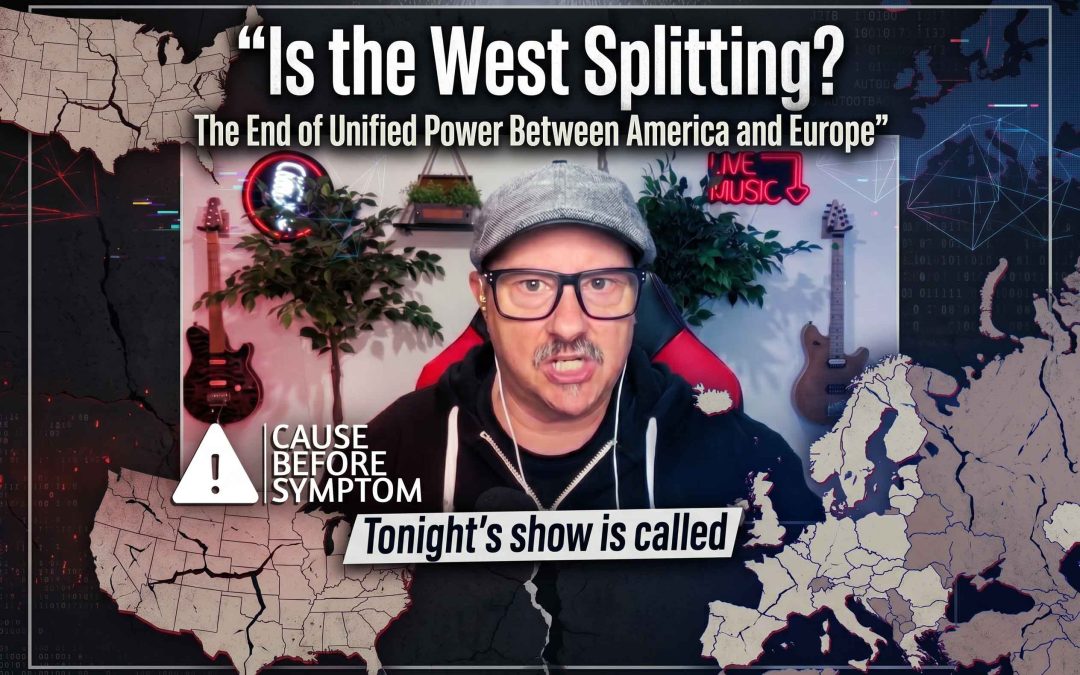
Watch this on Rumble: https://rumble.com/v798i9w-is-the-west-splitting-the-end-of-unified-power-between-america-and-europe.html
Synopsis
This episode examines whether the long-standing unity between the United States and Europe is fracturing or simply evolving under new pressures. Using a cause-before-symptom approach, the analysis traces the foundation of Western alignment built after World War II through institutions like NATO, then tests what has changed in recent years. It evaluates the shift in U.S. policy toward national prioritization under Donald Trump, the differing economic and energy dependencies shaping Europe’s responses, and the growing tension across trade, military strategy, and global conflict zones such as Iran.
Rather than assuming collapse or hidden control, the episode compares documented behavior across finance, intelligence, and diplomacy to determine whether the West is still operating as a unified system or transitioning into competing power centers. It highlights a key tension: institutional cooperation—seen in alliances like Five Eyes—continues even as political and economic interests diverge. The result is not a simple answer, but a tested framework: the West may not be breaking apart, but it is no longer acting as a single, unquestioned force.
Monologue
For most of modern history, one idea has gone largely unquestioned: the West is unified. The United States leads, Europe aligns, and together they move as a single force across finance, war, trade, and global policy. That assumption has shaped how people interpret institutions like NATO and the broader Western order.
But that picture is beginning to fracture.
The signs are not hidden. They show up in trade disputes between allies, in disagreements over military strategy, and in economic pressure being applied not just to rivals, but to partners. What was once automatic alignment is now being renegotiated in real time.
Energy exposes the shift even more clearly. The United States has moved toward independence and export strength, while Europe remains more vulnerable to external supply disruptions. That difference alone creates competing priorities where there used to be shared strategy.
War reveals it further. When conflict emerges, responses are no longer unified. The United States may escalate, while European nations hesitate or push for restraint. That divergence is not theoretical—it is observable behavior.
Under Donald Trump, U.S. policy has leaned into national leverage over global coordination. Alliances are no longer treated as fixed commitments, but as arrangements subject to negotiation. This changes the entire tone of the relationship between America and Europe.
And yet, the deeper structures still operate. Intelligence cooperation continues through Five Eyes. Military coordination still runs through NATO frameworks. Financial systems remain tightly connected between London and New York, moving capital across borders regardless of political tension.
This creates a contradiction. The system appears unified at the institutional level, but divided at the strategic level. That contradiction is where the real story lives.
So the question is not simply whether the West is splitting. The question is whether what we are seeing is the end of unity, or the exposure of how fragile that unity always was.
Because unity depends on shared interest. And when those interests begin to diverge, the structure doesn’t disappear—it reveals itself.
Tonight, the goal is not to assume collapse or control, but to examine the evidence and ask a harder question: are we witnessing a fracture, or a transformation in how power operates between America and Europe?
Because once that is understood, the headlines stop being confusing—and start making sense.
Part 1 – The Foundation of Western Unity
The modern idea of a unified West did not emerge naturally—it was constructed out of necessity after World War II. Europe was economically shattered, militarily weakened, and politically unstable. The United States, largely untouched domestically by the war, stepped into a position of unmatched strength. What followed was not just recovery, but the deliberate building of a system designed to prevent another global collapse.
That system was anchored through institutions. The creation of NATO established a collective defense structure, where an attack on one member would be treated as an attack on all. This was not just about security—it was about binding nations together into a shared military framework that reduced the likelihood of internal conflict. At the same time, economic systems were aligned through dollar-based trade and reconstruction efforts, tying European recovery directly to American financial leadership.
The result was a tightly interwoven network of dependency and cooperation. Europe relied on the United States for military protection and economic stability. The United States relied on Europe for strategic positioning, political alignment, and market integration. This mutual reliance created the appearance of unity, but it was rooted in shared interests rather than permanent agreement.
Over time, this alignment became normalized. Generations grew up assuming that Western unity was fixed, not conditional. Policy coordination, intelligence sharing, and economic integration reinforced that perception. Structures like transatlantic trade agreements and intelligence alliances deepened the connection, making it difficult to distinguish where one system ended and the other began.
But the foundation itself was built on conditions that no longer fully exist. The postwar environment that required absolute unity has changed. Europe has rebuilt. New global powers have emerged. Economic pressures have shifted. What was once a system of necessity has become a system of choice.
Understanding this foundation is critical, because it reframes everything that follows. If Western unity was built on shared need, then any change in that need will inevitably change the structure. What appears today as a fracture may not be a sudden break—it may be the natural result of a system whose original conditions are no longer holding it together.
Part 2 – The Shift in U.S. Doctrine
The foundation of Western unity held as long as the United States chose to maintain it. For decades, American policy operated under an assumption that global leadership was worth the cost. That meant maintaining alliances, supporting international institutions, and stabilizing regions even when the direct benefit to the United States was not immediate. It was a strategy built on long-term influence rather than short-term gain.
That approach has begun to change.
Under Donald Trump, U.S. policy shifted toward a more direct calculation of national interest. The language changed first. Alliances were no longer described as permanent commitments, but as arrangements that needed to be justified. Trade relationships were no longer assumed to be mutually beneficial; they were evaluated in terms of advantage and leverage. This marked a departure from decades of policy where stability and cooperation were treated as ends in themselves.
The shift was not just rhetorical—it showed up in action. Trade agreements were renegotiated or abandoned. Tariffs were applied not only to adversaries, but to long-standing allies. Military commitments were questioned, with increased pressure on European nations to contribute more to their own defense. These moves signaled a broader recalibration: the United States was no longer automatically prioritizing the maintenance of a unified Western system.
At the same time, there was a renewed focus on domestic strength and regional control. Energy independence became a strategic objective, reducing reliance on external suppliers and increasing the ability to influence global markets from within. Manufacturing and supply chains were brought into focus, with efforts to reduce dependence on foreign production. These policies pointed toward a model where the United States sought resilience and leverage, rather than integration.
This shift does not mean isolation. The United States did not withdraw from the world, nor did it dismantle its alliances. Instead, it changed the terms of engagement. Cooperation became conditional. Alignment became negotiable. What had once been a system of assumed unity became a system of calculated participation.
For Europe, this change introduced uncertainty. A structure that had operated predictably for decades was now subject to reevaluation. Decisions that were once coordinated began to diverge. The stability that defined the Western alliance was replaced with a dynamic where each side began reassessing its own position.
Understanding this shift is essential, because it explains why tensions are emerging now. The system itself has not disappeared—but the guiding principle behind it has changed. And when the core doctrine changes, every relationship built on top of it begins to move.
Part 3 – Europe’s Different Incentives
If the United States is shifting its doctrine, Europe is not simply following—it is operating from a different set of constraints. That difference is what creates the tension.
Europe’s position is shaped by geography, economics, and structure. Unlike the United States, it does not have the same level of resource independence. Energy supply, in particular, has historically come from external sources, making stability in surrounding regions more critical. Disruption carries a higher cost, which naturally pushes European policy toward caution rather than escalation.
Economic structure reinforces this. European economies are deeply integrated with one another through regulatory and trade frameworks, especially those tied to the European Union. This creates a system where coordination is necessary, and sudden shifts can ripple across multiple nations at once. Where the United States can act more unilaterally, Europe often has to move through consensus, which slows decision-making and favors predictability.
There is also a different approach to risk. The United States, particularly under a more assertive doctrine, may accept short-term disruption for long-term leverage. Europe, by contrast, tends to prioritize continuity. Trade relationships, diplomatic engagement, and regulatory stability are treated as foundational, not optional. This creates a natural divergence when policies introduce volatility.
These differences become most visible during moments of conflict. When tensions rise globally, the United States may lean toward decisive action, while European nations weigh the economic and political consequences more heavily. The result is not necessarily disagreement in principle, but a divergence in timing, method, and tolerance for risk.
At the same time, Europe is not passive. It is recalibrating in response to these pressures, seeking greater strategic autonomy while still maintaining transatlantic ties. This balancing act—between independence and cooperation—defines its current position.
Understanding Europe’s incentives is critical, because it explains why alignment is no longer automatic. The two sides are not simply choosing different paths—they are responding to different realities. And when those realities no longer match, the system built on shared assumptions begins to strain.
Part 4 – Trade Fractures Between Allies
Trade is where unity becomes measurable, because it moves from language into action. For decades, the United States and Europe operated within a framework that prioritized open markets, coordinated policy, and mutual growth. Disagreements existed, but they were managed inside a system that assumed cooperation as the baseline.
That baseline has shifted.
Under a more assertive U.S. posture, trade has become a tool of leverage rather than a reflection of partnership. Tariffs have been applied not only to competitors, but to European allies, signaling that economic relationships are now subject to renegotiation. This introduces a different dynamic. Instead of reinforcing alignment, trade policy begins to test it.
Europe’s response reflects its own priorities. Rather than fully absorbing these pressures, European nations have pushed back—through negotiation, countermeasures, and regulatory resistance. The result is not a complete breakdown, but a visible strain. Trade is no longer a stabilizing force; it is a point of tension.
This matters because trade ties are one of the strongest connectors between systems. When they begin to fracture, it signals that underlying interests are no longer perfectly aligned. Economic interdependence still exists, but it is no longer treated as an unquestioned good. It is evaluated, challenged, and, at times, contested.
The shift also reveals a deeper change in how power is exercised. The United States is willing to use its economic weight to reshape relationships, even if that creates friction with long-standing partners. Europe, in turn, is navigating how to protect its own economic stability without severing ties completely.
What emerges is a more competitive form of cooperation. The relationship continues, but it is no longer defined by automatic alignment. It is defined by negotiation, pressure, and recalibration.
Trade, in this sense, becomes a clear indicator of the broader question. If allies are willing to apply economic pressure to one another, then unity is no longer assumed—it is conditional. And when unity becomes conditional, the system begins to look very different from what it once was.
Part 5 – Energy as a Power Shift
Energy is where policy becomes physical. It determines what nations can sustain, what risks they can take, and how dependent they are on the outside world. When energy structures change, power shifts with them.
For decades, Europe operated with a level of external dependence that shaped its behavior. Access to oil and gas from surrounding regions made stability in those areas essential. Disruption meant immediate economic impact—higher costs, industrial strain, and political pressure. That reality pushed European policy toward caution, favoring diplomacy and continuity over aggressive disruption.
The United States has moved in a different direction. Through expanded domestic production and infrastructure, it has reduced reliance on foreign energy while increasing its ability to export. This changes the equation entirely. Instead of being vulnerable to supply shocks, the United States gains leverage from them. It can stabilize markets, redirect flows, and influence pricing in ways that were not possible before.
This divergence creates a structural imbalance between the two systems. Where Europe must manage exposure, the United States can operate with greater independence. That independence allows for more flexibility in policy—whether in trade, conflict, or negotiation—because the immediate cost of disruption is lower.
Energy also connects directly to broader strategy. When a nation controls more of its own supply, it is less constrained by external relationships. It can prioritize domestic resilience, reshape alliances, and respond to global events without the same level of risk. That shift is visible in how the United States approaches both allies and adversaries.
At the same time, Europe is not static. It is actively working to diversify supply, invest in alternatives, and reduce dependence. But these transitions take time, and during that period, the difference in position remains significant.
What emerges is not just an energy gap, but a strategic gap. Two systems that once operated under similar constraints are now moving under different conditions. That difference influences every decision that follows, from trade to security to diplomacy.
Energy, in this context, becomes more than a resource. It becomes a foundation for autonomy. And when one side gains autonomy while the other remains exposed, alignment becomes harder to maintain.
Part 6 – Military Alignment Under Pressure
Military unity has long been the clearest symbol of Western alignment, anchored through structures like NATO. For decades, the assumption was simple: the United States would provide the backbone of defense, and Europe would align within that framework. The arrangement created stability, but it also created dependence.
That balance is now under pressure.
The United States has increasingly questioned the terms of that arrangement, particularly the level of contribution from European nations. Calls for increased defense spending are not new, but they have become more direct and more forceful. The message has shifted from cooperative expectation to conditional support—security is no longer treated as guaranteed, but as something that must be sustained by shared effort.
Europe, in response, faces a structural challenge. Many nations have built their defense posture around the assumption of U.S. backing. Adjusting that posture requires time, resources, and political agreement across multiple countries. As a result, movement toward greater military independence is gradual, uneven, and often debated internally.
This creates a gap between expectation and capability. The United States is signaling a desire for recalibration, while Europe is still working within the constraints of an existing system. The alliance continues to function, but the terms are being renegotiated.
At the same time, coordination has not disappeared. Joint operations, training, and planning still occur. Military structures remain intact, and communication channels are active. This is not a breakdown—it is a shift in how responsibility is distributed within the alliance.
The tension becomes most visible during moments of crisis. When rapid decisions are required, differences in risk tolerance, resource availability, and strategic priority can surface quickly. What was once automatic alignment now requires discussion and agreement.
Understanding this pressure is key, because it reflects a broader pattern. The military alliance is not collapsing, but it is no longer operating on assumption alone. It is moving toward a model where participation is more deliberate, contributions are more scrutinized, and alignment is less guaranteed.
That change does not eliminate cooperation, but it alters its nature. And when the foundation of military unity shifts, it signals that the broader structure of Western alignment is being tested in real time.
Part 7 – Intelligence Cooperation vs Political Friction
While trade, energy, and military policy show visible strain, intelligence cooperation tells a different story. Beneath political disagreement, the deeper systems of information sharing continue to function with remarkable consistency. This is most clearly seen through alliances like Five Eyes, where the United States, the United Kingdom, and key partners exchange signals intelligence at a level that is rarely interrupted by changes in leadership.
This creates a unique dynamic. On the surface, political leaders may disagree, apply pressure, or diverge in strategy. But underneath, the flow of intelligence remains steady. Threat assessments, surveillance capabilities, and data sharing continue because they serve a common need—awareness and security in an unpredictable environment.
That separation between politics and intelligence reveals something important about how the system operates. Political alignment can shift quickly, influenced by elections, economic pressures, or public sentiment. Intelligence systems, by contrast, are built for continuity. They are designed to persist across administrations, maintaining long-term capabilities regardless of short-term disagreement.
At the same time, this continuity does not eliminate tension. Differences in policy can influence how intelligence is used, interpreted, or acted upon. One nation may choose escalation based on the same information that leads another to restraint. The data may be shared, but the response is not always unified.
This reinforces a broader pattern seen throughout the system. The deeper the structure, the more stable it remains. The closer it gets to public policy, the more it begins to diverge. Intelligence cooperation continues because it is foundational, but political friction grows because interests are no longer perfectly aligned.
What emerges is a layered system operating at two speeds. At one level, cooperation persists through established frameworks. At another, strategy begins to separate as each side recalculates its position. The result is not a clean break, but a complex relationship where unity and divergence exist at the same time.
Understanding this distinction is critical. It shows that the system is not simply holding together or falling apart. It is adapting unevenly, with some parts remaining tightly connected while others begin to move independently.
Part 8 – The Iran Conflict as a Case Study
Moments of conflict reveal the true state of alignment, because they force decisions that cannot be delayed or softened. The situation with Iran provides a clear example of how the United States and Europe respond when pressure is applied to the system at the same time.
The United States has tended to approach Iran through a lens of deterrence and leverage. Economic sanctions, military positioning, and the willingness to escalate are used as tools to force compliance or limit influence. This approach prioritizes control over outcomes, even if it introduces short-term instability into the region.
Europe, by contrast, has generally favored containment through diplomacy and economic engagement. Maintaining agreements, reducing escalation, and preserving stability are often treated as the preferred path. This is not simply a difference in opinion—it reflects the structural realities discussed earlier. Europe carries greater exposure to disruption, particularly through energy markets and regional proximity.
When these approaches meet, the result is visible divergence. The same situation produces different responses, not because the underlying information is different, but because the incentives are. One side may see escalation as a necessary tool, while the other sees it as a risk to be managed.
This divergence becomes more pronounced when coordination is required. Joint action depends on shared timing and shared thresholds for response. When those thresholds differ, alignment becomes harder to achieve. What was once a unified stance becomes a negotiation, and sometimes a point of disagreement.
At the same time, the broader relationship does not disappear. Communication continues, intelligence is shared, and diplomatic channels remain open. The system does not collapse under pressure—it reveals where alignment holds and where it does not.
The Iran situation, therefore, is not just a regional issue. It is a lens through which the larger question can be examined. When faced with the same challenge, the United States and Europe do not always move together. That alone signals a shift from automatic unity to conditional alignment.
Understanding this case helps clarify the broader pattern. The system is still connected, but it is no longer synchronized. And when synchronization breaks, even temporarily, it shows how much of the unity depended on shared conditions that are now changing.
Part 9 – Financial Systems and Global Influence
If there is one area where unity appears most intact, it is within the financial system. While politics, trade, and military strategy show visible strain, global finance continues to operate through deeply interconnected structures that bind the United States and Europe together.
At the center of this system are two primary hubs: New York and the City of London. These are not competing centers in the traditional sense—they function as complementary nodes in a larger network of capital flow. Investment, banking, currency exchange, and legal structuring move between them continuously, forming a system that operates beyond short-term political tension.
This continuity is reinforced by shared frameworks. Global finance relies on legal systems, regulatory standards, and institutional trust that have been built over decades. Many of these frameworks trace back to British legal traditions and American financial dominance, creating a hybrid system that spans both regions. As a result, even when policy diverges, the underlying mechanisms of finance remain aligned.
The durability of this system reveals something important. Financial structures are designed for stability and continuity. They adapt more slowly than political systems and are less influenced by changes in leadership. Capital seeks predictable environments, and the transatlantic financial network provides exactly that.
At the same time, this does not mean the system is static. Shifts are occurring—emerging markets are gaining influence, alternative financial systems are being explored, and geopolitical tensions are introducing new risks. But within the Western framework, the core connection between the United States and Europe remains strong.
This creates a contrast with other areas of divergence. While trade becomes more competitive and military alignment more conditional, finance continues to integrate. The system holds together at its deepest level, even as surface-level relationships evolve.
Understanding this layer is critical because it highlights the difference between visible change and structural continuity. Political and strategic disagreements may suggest fragmentation, but the persistence of financial integration suggests that the foundation of influence remains interconnected.
The question, then, is not whether the system is breaking, but whether it is capable of sustaining unity in one domain while allowing divergence in others. If finance remains aligned while policy separates, the result is a complex structure where cooperation and competition exist at the same time.
That complexity defines the current moment. The system has not collapsed, but it is no longer moving as a single force. And where the deepest connections remain intact, the surface-level fractures become even more significant to examine.
Part 10 – Split or Realignment?
After examining trade, energy, military posture, intelligence, and finance, the question returns with more clarity: is the West actually splitting, or is it being reshaped?
The evidence does not support a clean break. The core structures that defined Western unity—financial integration, intelligence sharing, and military coordination—are still in place. Alliances like NATO continue to function, and systems such as Five Eyes remain active. These are not superficial connections; they are deeply embedded frameworks that do not dissolve easily.
At the same time, alignment within those structures is no longer automatic. Trade is contested. Energy strategies diverge. Military expectations are being renegotiated. Political leadership is willing to challenge long-standing assumptions. What once operated as a unified direction now operates as a series of negotiated positions.
This creates a system that appears stable at its foundation but variable in its execution. Cooperation still exists, but it is no longer unconditional. Each side is recalculating its interests within the same structure, rather than moving as a single coordinated force.
That distinction matters. A true split would involve the breakdown of core institutions and the severing of cooperation. What is being observed instead is a shift in how those institutions are used. They are no longer expressions of unquestioned unity; they are platforms through which competing priorities are managed.
The result is a more complex form of alignment. Unity has not disappeared, but it has become conditional. Influence is still shared, but it is exercised differently. The system is not collapsing—it is adjusting to new pressures, new incentives, and new realities.
So the conclusion is not that the West has ended as a unified entity. The conclusion is that the nature of that unity has changed. What once depended on shared assumptions now depends on active negotiation.
And that change reframes everything. The question is no longer whether the West stands together by default. The question is how long it can maintain cooperation when the interests that once held it together are no longer perfectly aligned.
Conclusion
What emerges from this examination is not a clean break, and not a unified front—but something in between. The idea of a permanently unified West does not hold under pressure. What does hold are the deeper structures that were built over decades: financial integration, intelligence sharing, and military coordination through frameworks like NATO and Five Eyes. These systems continue to operate, even as the alignment within them begins to shift.
The visible fractures—trade disputes, energy divergence, military tension, and differing responses to conflict—are not random. They are symptoms of changing incentives. The United States is moving toward a model that prioritizes national leverage and independence. Europe is responding from a position shaped by exposure, integration, and the need for stability. These are not opposing systems, but they are no longer moving in perfect synchronization.
What this reveals is that Western unity was never absolute. It was conditional—built on shared needs, shared threats, and shared benefit. As those conditions change, so does the alignment. The system does not disappear, but it no longer behaves as a single force. It becomes something more complex, where cooperation and competition exist side by side.
So the question is not whether the West has split. The question is whether it can continue to function as a connected system while its core interests begin to diverge. Because if those interests continue to pull in different directions, the structure may remain—but the unity that once defined it will not.
Bibliography
- Brendon, Piers. The Decline and Fall of the British Empire, 1781–1997. London: Vintage, 2008.
- Darwin, John. The Empire Project: The Rise and Fall of the British World-System, 1830–1970. Cambridge: Cambridge University Press, 2009.
- Ferguson, Niall. Empire: The Rise and Demise of the British World Order and the Lessons for Global Power. New York: Basic Books, 2003.
- Ferguson, Niall. The House of Rothschild: Money’s Prophets, 1798–1848. New York: Viking, 1998.
- Quigley, Carroll Quigley. Tragedy and Hope: A History of the World in Our Time. New York: Macmillan, 1966.
- Quigley, Carroll Quigley. The Anglo-American Establishment: From Rhodes to Cliveden. New York: Books in Focus, 1981.
- James, Lawrence. The Rise and Fall of the British Empire. London: Abacus, 1994.
- Knight, Stephen. The Brotherhood: The Secret World of the Freemasons. London: Granada, 1984.
- Webster, Nesta Helen. Secret Societies and Subversive Movements. London: Boswell, 1924.
- Hagger, Nicholas. The Syndicate: The Story of the Coming World Government. Winchester: O Books, 2004.
- Estulin, Daniel. The True Story of the Bilderberg Group. Walterville, OR: TrineDay, 2007.
- Feinstein, Andrew. The Shadow World: Inside the Global Arms Trade. New York: Farrar, Straus and Giroux, 2011.
- Hennessy, Peter. The Secret State: Preparing for the Worst 1945–2010. London: Penguin, 2010.
- Dorril, Stephen. MI6: Inside the Covert World of Her Majesty’s Secret Intelligence Service. New York: Free Press, 2000.
- Jones, Owen. The Establishment: And How They Get Away With It. London: Penguin, 2014.
- Pilger, John. The New Rulers of the World. London: Verso, 2002.
Endnotes
- Piers Brendon, The Decline and Fall of the British Empire, 1781–1997 (London: Vintage, 2008), 45–72.
- John Darwin, The Empire Project: The Rise and Fall of the British World-System, 1830–1970 (Cambridge: Cambridge University Press, 2009), 210–255.
- Niall Ferguson, Empire: The Rise and Demise of the British World Order and the Lessons for Global Power (New York: Basic Books, 2003), 302–340.
- Niall Ferguson, The House of Rothschild: Money’s Prophets, 1798–1848 (New York: Viking, 1998), 118–146.
- Carroll Quigley, Tragedy and Hope: A History of the World in Our Time (New York: Macmillan, 1966), 950–980.
- Carroll Quigley, The Anglo-American Establishment: From Rhodes to Cliveden (New York: Books in Focus, 1981), 33–68.
- Lawrence James, The Rise and Fall of the British Empire (London: Abacus, 1994), 500–530.
- Stephen Knight, The Brotherhood: The Secret World of the Freemasons (London: Granada, 1984), 75–102.
- Nesta Helen Webster, Secret Societies and Subversive Movements (London: Boswell, 1924), 210–240.
- Nicholas Hagger, The Syndicate: The Story of the Coming World Government (Winchester: O Books, 2004), 145–178.
- Daniel Estulin, The True Story of the Bilderberg Group (Walterville, OR: TrineDay, 2007), 55–89.
- Andrew Feinstein, The Shadow World: Inside the Global Arms Trade (New York: Farrar, Straus and Giroux, 2011), 260–295.
- Peter Hennessy, The Secret State: Preparing for the Worst 1945–2010 (London: Penguin, 2010), 120–158.
- Stephen Dorril, MI6: Inside the Covert World of Her Majesty’s Secret Intelligence Service (New York: Free Press, 2000), 340–372.
- Owen Jones, The Establishment: And How They Get Away With It (London: Penguin, 2014), 95–130.
- John Pilger, The New Rulers of the World (London: Verso, 2002), 180–210.
#Geopolitics, #USvsEurope, #WesternAlliance, #GlobalPowerShift, #NATO, #FiveEyes, #EnergyPolitics, #TradeWars, #MilitaryStrategy, #EconomicShift, #GlobalInfluence, #CauseBeforeSymptom
Geopolitics, USvsEurope, WesternAlliance, GlobalPowerShift, NATO, FiveEyes, EnergyPolitics, TradeWars, MilitaryStrategy, EconomicShift, GlobalInfluence, CauseBeforeSymptom